



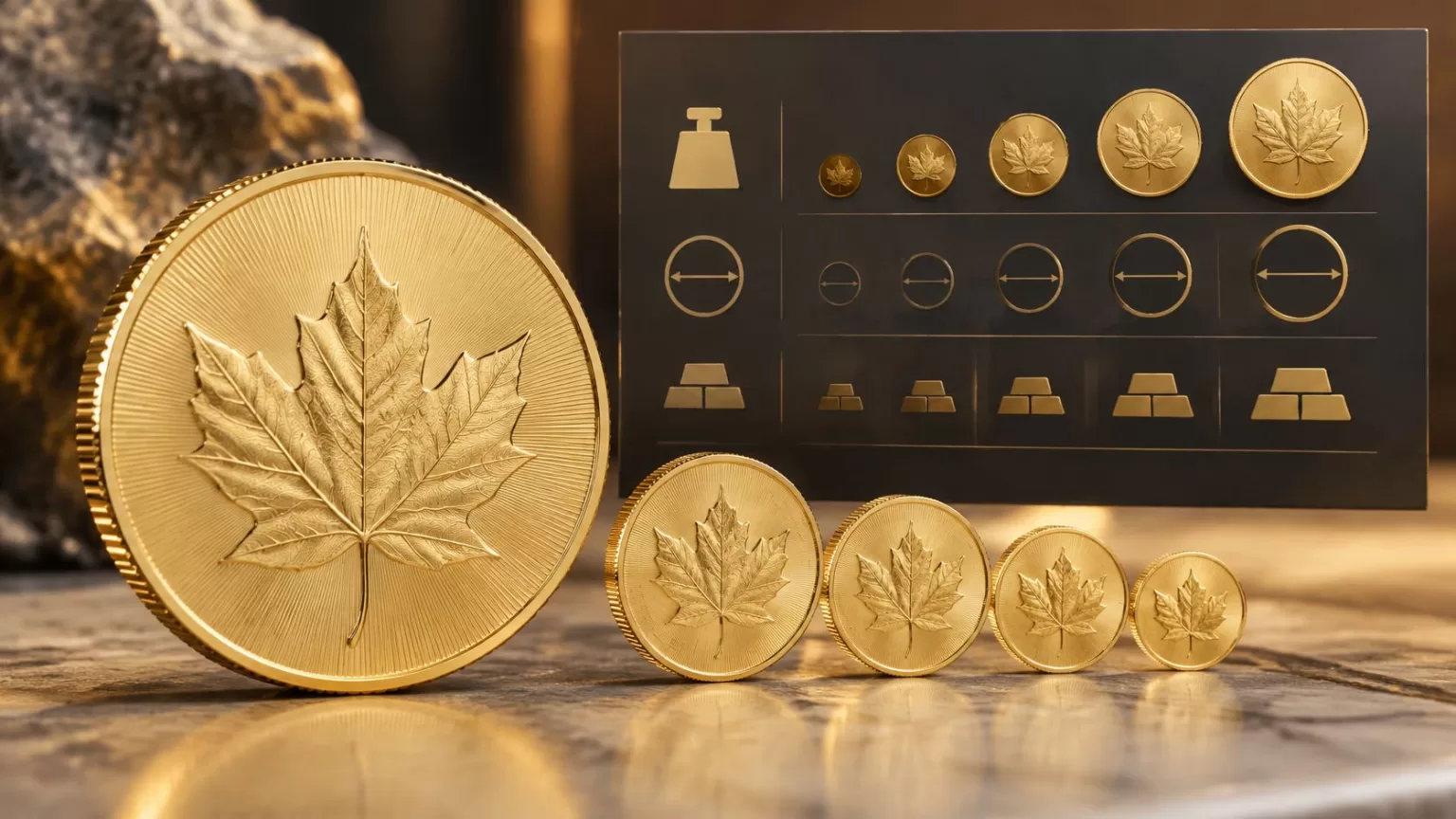
The Royal Canadian Mint lists the standard 1-ounce Gold Maple Leaf bullion coin at 31.11 grams, 30 millimetres in diameter, 99.99 percent purity and a C$50 face value (Royal Canadian Mint specifications). These figures describe the standard bullion issue, not every gold coin sold under the Maple Leaf name.
A dealer's Maple Leaf listing may describe a different product from the one named in a custodian's paperwork. The Mint also publishes premium and collector issues with different weights, denominations and presentation, so the exact product matters when comparing prices or requesting IRA acceptance.
Why Maple Leaf Specifications Matter for Retirement Savers
A saver requests a Gold Maple Leaf for a retirement account. The dealer offers a coin in presentation packaging, while the custodian's purchase paperwork describes ordinary bullion. Both documents may use the Maple Leaf name, but that doesn't establish that they describe the same product.
Product identification connects the purchase to the account records. The dealer invoice, custodian authorization and eventual resale quote should describe the same issue. Otherwise, a buyer could pay for collector features that the intended resale buyer doesn't value.
Match the product, not just the name
Maple Leaf gold coin specifications work best as a set of identifiers. Weight establishes the published size, diameter helps distinguish the physical format, purity describes the metal, and denomination provides another check against the product description.
A sensible document review includes:
- Product wording: Determine whether the listing says bullion, premium bullion, ultra-high-relief or Maplegram.
- Physical specifications: Match the weight and diameter rather than relying on a photograph.
- Account description: Check that the custodian's authorization names the product the dealer will deliver.
- Purchase economics: Separate the gold-content value from charges for finish, packaging or collectibility.
Specifications don't predict returns
The denomination stamped on a coin isn't its dealer price. A bullion holding's market value responds to gold prices, while the amount received on resale also depends on the buyer's quote and transaction costs.
A precise product description can prevent a purchasing mismatch, but it can't guarantee an investment outcome. Even a correctly identified coin can fall in market value.
Before a purchase, the buyer should recheck the year-specific Royal Canadian Mint listing. Product descriptions change between issues, and a familiar name isn't a substitute for matching weight, diameter, purity and face value together.
Standard Maple Leaf Gold Coin Specifications by Size
Standard Gold Maple Leaf bullion specifications
The Royal Canadian Mint's standard bullion specification table publishes the following weights, diameters, face values and purity for the ordinary bullion family.
| Size | Gross weight | Diameter | Face value | Purity |
|---|---|---|---|---|
| 1 ounce | 31.11 g | 30 mm | C$50 | 99.99% |
| 1/2 ounce | 15.55 g | 25 mm | C$20 | 99.99% |
| 1/4 ounce | 7.77 g | 20 mm | C$10 | 99.99% |
| 1/10 ounce | 3.11 g | 16 mm | C$5 | 99.99% |
| 1/20 ounce | 1.55 g | 14.1 mm | C$1 | 99.99% |
The Mint describes this purity as 24-karat gold and specifies a serrated edge for the standard full-ounce coin.
How to read a bullion row
Start with the size, then move across the row. The size expresses the intended gold denomination, while the gram figure provides the Mint's published weight for matching a product listing or invoice.
The fractional coins contain smaller quantities of gold. They aren't discounted versions of the full-ounce coin, and their total purchase prices shouldn't be compared without allowing for the different gold quantities.
For example, a buyer considering a smaller denomination should request both the total price and the premium relative to its gold content. A lower invoice total doesn't necessarily mean a more economical purchase per unit of gold.
Diameter is a separate identification field. It isn't a measure of value, and the physical width of a fractional coin doesn't tell the buyer its proportion of the full-ounce coin's gold content.
Practical rule: Read across a complete row. A matching weight with a different denomination or product description calls for clarification before payment.
Understand the units and rounding
Precious-metals listings use the troy ounce, not the everyday ounce used for many household measurements. The distinction is explained in the guide to troy ounces versus regular ounces.
For invoice matching, use the Mint's published gram weight rather than replacing it with a conversion copied from another website. Published specifications have a stated precision, so adding decimal places doesn't automatically make a dealer's description more authoritative.
Gross weight means the weight of the whole coin. Fine-gold content means the gold portion after accounting for fineness. Those labels shouldn't be exchanged, particularly when comparing ordinary bullion with unusual collector products.
Face value isn't melt value
The C$ marking identifies Canadian-dollar legal-tender denomination. It isn't a U.S.-dollar sales price, a dealer bid or the coin's melt value.
For valuation purposes, a buyer should distinguish:
- Gold-content value: The value attributed to the gold at the relevant market quotation.
- Purchase premium: The amount charged above that gold-content value.
- Resale proceeds: The amount a buyer offers, after applicable charges.
- Face value: The legal-tender amount shown on the coin.
This chart applies to ordinary bullion. A special finish, presentation case or similar-looking maple leaf design doesn't establish that a coin belongs in it. The exact issue and year remain essential checks before buying.
Five Product Classes That Are Not Interchangeable
A Maple Leaf design can identify several different products. For retirement savers, the useful distinction is the product class: standard bullion, five-nines premium bullion, ultra-high-relief coins, small premium fractionals and Maplegrams. Their purity, presentation, format and likely resale audience can differ.
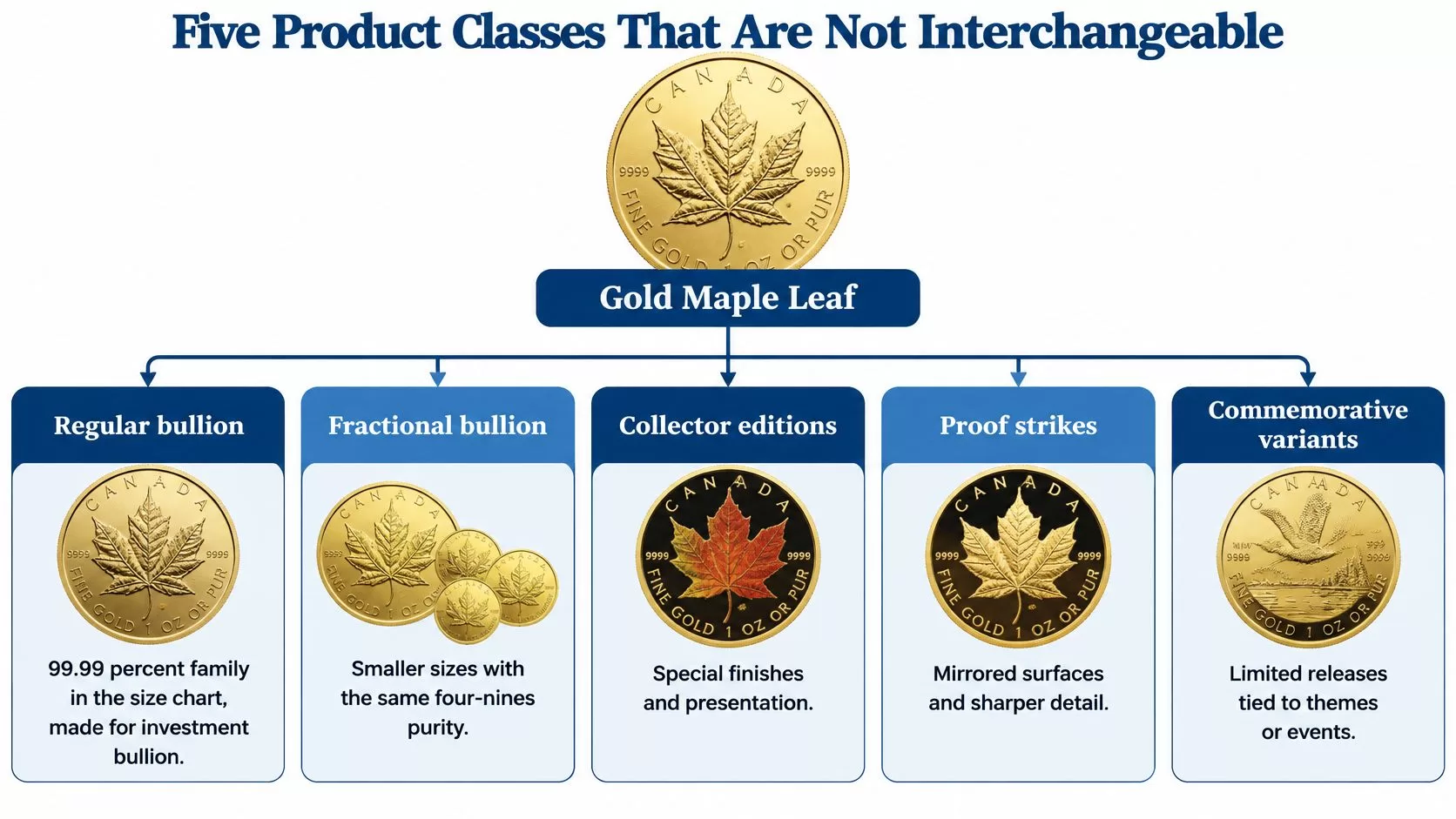

Five classes, five identifying features
- Standard bullion: The conventional investment product, compared with ordinary bullion of the same size.
- Five-nines premium bullion: A premium-bullion format with a different purity specification and presentation. The Mint's Our Purest Maple Leaf description identifies it as 99.999% gold, compared with 99.99% for regular bullion.
- Ultra-high-relief coins: Collector-oriented pieces that emphasize sculptural detail and presentation. Compare the specific product's weight, edge treatment and finish.
- Small premium fractionals: Issues such as Treasured can match an ordinary fractional coin's gold denomination while adding a privy mark and limited production.
- Maplegrams: Small, individually packaged coins presented in a sheet, offering a divisible format rather than the format of a conventional ounce coin.
These features are useful sorting labels, not price conclusions. Higher fineness does not by itself determine the purchase premium, resale terms or institutional handling. A matching gold denomination also does not make a premium fractional equivalent to ordinary fractional bullion.
Before comparing quotes, identify the gold weight, the premium over melt, the likely resale category and any packaging requirements. If opening or separating a product could affect handling, ask how the packaging must be kept. For an account purchase, obtain custodian acceptance for the exact issue.
A standard bullion quote cannot establish a fair price for a limited ultra-high-relief coin because both listings state the same gold denomination. Likewise, a collector asking price does not establish what an account buyer should pay for ordinary bullion. The Mint's exact product description and item number help distinguish the product being priced.
Which Maple Leaf Coins Fit a Gold IRA
Gold purity is only one part of a Gold IRA decision. Standard bullion, five-nines issues, proof coins, ultra-high-relief pieces and Maplegrams can differ in product identity, packaging and account handling. Ask the custodian to approve the exact product description in writing.
The Royal Canadian Mint's standard bullion product description identifies a standard bullion issue with a radial-line finish. That description helps distinguish it from proof, ultra-high-relief, commemorative or specially packaged alternatives.
Separate tax eligibility from institutional acceptance
A dealer's statement that a coin is IRA-eligible does not by itself establish approval for a specific account. Tax treatment, custodian acceptance and depository handling are related, but each concerns a different part of the transaction.
Mint specifications identify the coin. They do not establish the tax treatment of a proposed U.S. transaction or replace the custodian's account agreement.
Readers comparing gold coins for IRA accounts should check current IRS rules and the account's custody requirements separately. This distinction helps clarify which questions concern the coin and which concern the account.
Evaluate the practical account fit
A conventional bullion Maple Leaf and a specially packaged collector issue can present different account and resale considerations. The saver should assess whether a premium feature serves the account's investment purpose.
- Standard bullion: Compare the product description with the custodian's accepted-product list.
- Premium or five-nines issues: Check whether presentation packaging affects receiving or storage.
- Proof and ultra-high-relief products: Ask how the institution handles the product and how the dealer expects to treat it at repurchase.
- Privy-marked fractionals: Consider whether the account's added cost reflects a feature a future bullion buyer may not value.
- Maplegrams: Confirm whether the depository handles intact sheets, individual blisters or another specified format.
A custodian's decision may reflect product policy, handling conventions or the institution's investment menu. Its answer applies to the product and arrangement it has reviewed.
Get the answer before moving retirement funds
Send the custodian the dealer's product description, including the product name, year, weight, finish and any privy or special-relief designation. Ask for written confirmation of the exact issue and packaging requirements before authorizing a purchase or initiating a rollover.
Also clarify how a repurchase would be quoted, how specialty premiums would be assessed and which account charges would apply. A high purchase premium warrants particular attention when a future buyer may value the coin mainly for its metal.
Mint specifications alone do not establish tax benefits or acceptance by a particular custodian. Individual circumstances and current rules may require professional review.
Published Figures for Limited and Premium Issues
Published figures for nonstandard Gold Maple Leaf issues
The Royal Canadian Mint's 2026 Ultra High Relief listing publishes 99.99% purity, 33.17 g weight, 30 mm diameter, C$200 face value and a 550-coin mintage. It also specifies interrupted serrations, a reverse-proof finish and 1.8 mm peak relief.
For the other rows, the Mint's 2025 Ultra-High Relief listing reports 33.17 g, 30 mm, C$200 and 550 coins; its 2025 Our Purest listing reports 99.999% purity, 31.11 g, 30 mm, C$200 and 800 coins.
The Mint's 2025 Treasured Gold Maple Leaf listing identifies the 99.99%-pure tenth-ounce polar-bear privy issue at 3.11 g, 16 mm, C$5 and a 5,000-coin mintage. Its Maplegram25 listing identifies the 25-coin format with 1 g per coin and an 8 mm diameter.
| Issue | Purity | Weight | Diameter | Face value | Mintage |
|---|---|---|---|---|---|
| 2026 Ultra High Relief 1 oz | 99.99% | 33.17 g | 30 mm | C$200 | 550 |
| 2025 Ultra High Relief 1 oz | 99.99% | 33.17 g | 30 mm | C$200 | 550 |
| 2025 Our Purest 1 oz | 99.999% | 31.11 g | 30 mm | C$200 | 800 |
| 2025 Treasured 1/10 oz | 99.99% | 3.11 g | 16 mm | C$5 | 5,000 |
| 2025 Maplegram25 | 99.99% | 1 g each, 25 coins | 8 mm | Confirm individual denomination with Mint | Confirm release limit with Mint |
Read the special features as product identifiers
The ultra-high-relief weight is a published gross-weight specification, not an instruction to price the product as additional bullion gold. Its fine-gold denomination and gross weight must be read as separate fields.
Likewise, the higher face denomination on certain premium products doesn't establish a greater gold-content value. Denomination is useful for identifying the issue, not for calculating its spot-linked value.
The table deliberately leaves the Maplegram's denomination and release limit as confirmation tasks rather than filling them with unsupported figures. An absent field should prompt a question, not an assumption based on another product.
Limited production doesn't establish resale value
A stated mintage describes the issue's production limit. It doesn't establish buyer demand, the future resale premium or the speed at which an owner could sell.
Collector and premium products require attention to:
- Finish and surface condition: A buyer interested in presentation may evaluate the coin differently from a bullion dealer.
- Original packaging: Cases, certificates or individual blisters may matter to the intended resale audience.
- Dealer repurchase terms: The selling price and the dealer's current buyback quote can differ substantially in structure.
- Year-specific details: Similar names across releases don't make separate issues identical.
Before treating a specialty listing as a price comparison, match the year, finish, product format and mintage. A nearby photograph or a shared maple leaf design isn't enough.
Related Measures Buyers Cross Check
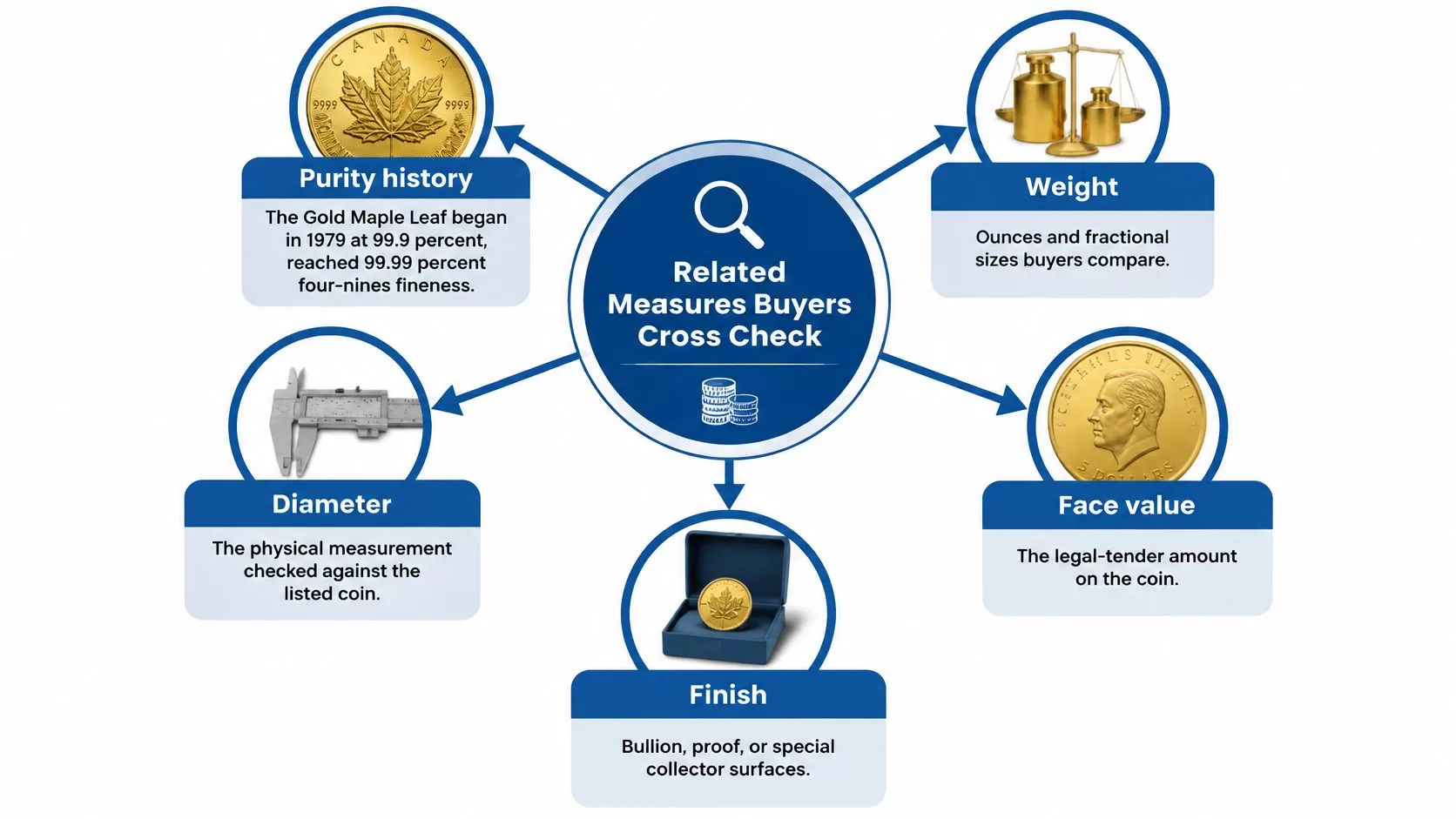
The Royal Canadian Mint records three purity milestones for the Gold Maple Leaf: 99.9% in 1979, 99.99% in 1982, when it became the first bullion coin at that level, and a separate 99.999% issue in 2007. These dates help explain why an older coin's specification may differ from a modern standard bullion issue, even when both carry the Maple Leaf name. The Mint's Gold Maple Leaf history and specifications lists these milestones.
The Mint publishes a standard ounce coin weight of 31.11 g. Applying its stated fineness to that rounded weight gives approximately 31.1069 g of fine gold; the difference reflects the rounded published weight, not a separate coin format. The Mint's standard Gold Maple Leaf specifications provide the figures used in this calculation.
Connect weight to purity carefully
A gram listing and a troy-ounce listing can describe the same intended bullion size. Check whether each figure refers to gross weight, fine-gold content or a rounded published specification. These are related measures, but they answer different questions: gross weight covers the whole coin, while fine-gold content describes its gold portion.
The Maplegram is the gram-based relative of the ounce-denominated family. Its format belongs in a gram-based comparison rather than an ordinary fractional-ounce row.
Cross-check the physical specification
Diameter and edge treatment can help distinguish one product format from another. A shared gold denomination does not mean two national bullion coins have the same dimensions, gross weight or composition; compare each listing with the Mint description for that coin.
- Purity and year: Match the listed purity to the issue year.
- Weight and units: Record whether the figure is total mass or fine-gold content.
- Diameter and edge: Compare the physical format with the exact Mint description.
- Finish and packaging: Identify whether the coin is conventional bullion or a specialty presentation.
A specification identifies the coin's published attributes. For market-price context, the guide to Gold Maple Leaf pricing covers a separate measure. Keeping the specification and price figures distinct makes purchasing records easier to compare.
Three Listing Examples and How to Read Them
A one-ounce bullion listing and a Maplegram can both carry the Gold Maple Leaf name, yet describe different products. Read each listing by its specific format before comparing it with another coin or deciding what questions to ask.
Example A: Check the standard bullion fields
The Royal Mint's 2024 Canadian Maple bullion listing specifies 1 troy ounce of gold, 999.9 fineness, a 30-millimetre diameter and a C$50 denomination. Together, these details identify a standard bullion coin.
Before comparing offers, confirm the inventory year, edge and finish against the written description. Then ask for a quote that separates the metal-linked amount from the dealer premium. A standard bullion format alone does not show whether a particular premium is reasonable.
Example B: Decide whether a specialty issue fits the purchase
A buyer seeking conventional bullion sees a listing described as ultra-high-relief, with an interrupted edge, reverse-proof presentation and limited mintage. Those features place it in a specialty comparison group, so the buyer should ask how its presentation affects the quote and how a repurchase would be priced. The earlier table gives the coin's published weight and denomination.
The practical question is whether the buyer wants that collector presentation or intended to acquire ordinary investment bullion.
Example C: Check what the Maplegram packaging contains
A Maplegram offer describes small coins in individual serial-numbered blisters. The packaging and divisible format are part of the product, so the buyer should compare it with another listing for the same format rather than a full-ounce coin. A gram denomination also should not be treated as the same unit as the smallest fractional-ounce entry.
Before purchase, the buyer should confirm that the custodian's acceptance covers the exact packaged product the dealer plans to deliver.
In each case, the listing's product class guides the comparison. The buyer can identify the intended format and ask the dealer and custodian to acknowledge it before paying a premium.
Confirm the Exact Coin Before You Roll Over
A disciplined purchase starts with a clear record of what the dealer is offering and what the retirement account will hold. The full product name, specifications, special features and price should all refer to the same coin.
Complete the purchase checks in order
- Read the full product title. Identify wording such as bullion, premium bullion, ultra-high-relief, proof, privy or Maplegram. Ask the dealer to clarify any shortened invoice description.
- Match the specification fields. Compare gross weight, diameter, purity and face value with the entry for that product. Pause if a figure does not match and the difference is unexplained.
- Record the special features. Note the finish, edge treatment and mintage. These details help distinguish a limited collector issue from ordinary bullion.
- Evaluate the premium. Compare the amount above the coin's gold-content value with the intended holding and likely resale route.
- Check the transaction details. Confirm that the dealer's quote describes the same product identified in the specifications, including its year and product class.
- Keep the documentation. Store the Mint description, dealer quote, acceptance correspondence and final invoice together.
Common questions before authorization
Does higher purity automatically make the coin more suitable?
No. Suitability also depends on purchase costs, product acceptance, storage requirements and the investor's circumstances.
Should original packaging be removed before shipment?
Follow the receiving instructions for the specific shipment. Removing a coin from its presentation or blister can raise handling questions.
Does a specification match prove authenticity?
No. Measurements help identify a coin, but they do not replace professional authentication or a reliable transaction process.
Physical bullion may be one option for diversification, but product accuracy alone does not determine whether a rollover fits a household's circumstances.
This is not financial advice. Consult a licensed financial advisor, CPA, or tax professional before making investment decisions. This material is not personalized financial, tax or legal advice. Review a rollover in light of current rules and individual circumstances.
Gold IRA Association is an educational resource with rollover guides, precious-metals eligibility explanations and company comparisons for retirement savers. Its materials can help readers prepare questions about product specifications, fees and storage before choosing a custodian.


