




A saver nearing retirement may be watching everyday costs rise while an old 401(k) or IRA remains concentrated in familiar market investments. That can lead to a practical question: could a self-directed IRA account provide more room for diversification, perhaps through real estate, private investments, or qualifying precious metals? The answer depends less on the promise of “more control” than on whether the saver is prepared to handle custody rules, fees, valuation, liquidity, and tax compliance.
This guide explains how the account works, how it differs from a standard IRA, which gold and silver products may qualify, and why a custodian's involvement doesn't mean an investment has been reviewed. It also translates prohibited-transaction rules into everyday decisions involving property, family members, lending, and personal use. The practical outcome is clarity, not a guaranteed result: a reader should finish knowing which questions to ask before moving retirement money.
Introduction for Savers Considering More Control
A near-retiree named Daniel might have a familiar concern. His retirement savings are in an employer plan and an IRA, and market swings make him uneasy. He has also heard that physical gold, rental property, or private investments could sit inside a self-directed IRA. What he hasn't yet determined is whether the additional choice would make his retirement plan stronger or give him more ways to make an expensive mistake.
That distinction matters. A self-directed IRA can expand the available investment menu, but it doesn't remove the rules that apply to retirement accounts. The account still has to use an appropriate custodian, hold permitted assets, maintain clean records, and avoid transactions that personally benefit the owner or other disqualified people. The owner also remains responsible for researching an investment, even when a custodian processes the paperwork.
Practical perspective: More control means more responsibility. It doesn't mean professional investment validation.
For a saver considering gold or silver, the first questions should be practical:
- What qualifies: Does the metal meet the applicable legal description and fineness requirement?
- Where it stays: Will an approved trustee or depository hold it, rather than the account owner?
- Who checks the investment: Has anyone independently verified ownership, valuation, liquidity, and fees?
- How money moves: Will a trustee-to-trustee transfer avoid the risks associated with receiving funds personally?
- What could go wrong: Could a personal-use decision, family arrangement, or borrowing structure create a prohibited transaction?
The answers are more important than the label “self-directed.” A metals-focused account can be one diversification option, but physical metals aren't guaranteed to rise in value, eliminate losses, or solve every retirement concern. Other alternative assets may offer a wider menu, but they can also be difficult to sell or value.
This article is written for U.S. savers who are evaluating that tradeoff. It doesn't recommend a specific investment or provider. It offers a plain-English framework for deciding whether further research is worthwhile and for knowing when a licensed financial advisor, CPA, or tax professional should review the proposed transaction.
What a Self Directed IRA Account Really Is
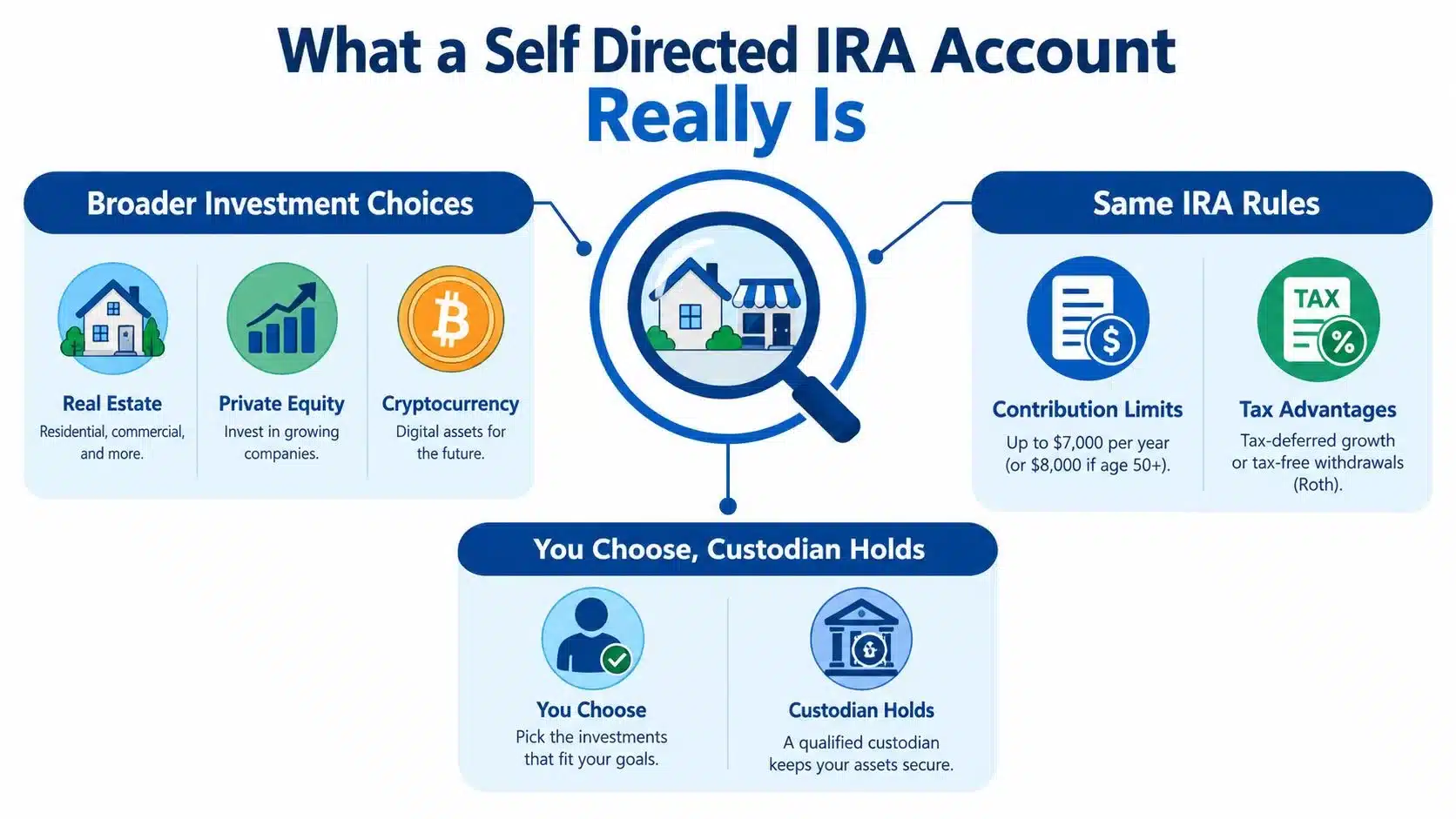
A self-directed IRA account is an IRA structure that permits a broader investment menu than many conventional accounts. Depending on the custodian and account arrangement, that menu can include certain real estate, private placements, and qualifying precious metals. The account isn't a separate tax universe. It remains an IRA subject to tax-law restrictions.
A useful way to understand it is to separate the account into three parts:
- The IRA structure holds retirement assets and provides the applicable tax treatment.
- The investor chooses an investment and directs the transaction.
- The custodian or trustee administers the account and holds or arranges custody of the assets.
The investor doesn't personally take ownership of IRA assets while they remain inside the account. That separation becomes especially important when the account holds physical metals or property.

Broader choice does not mean unlimited choice
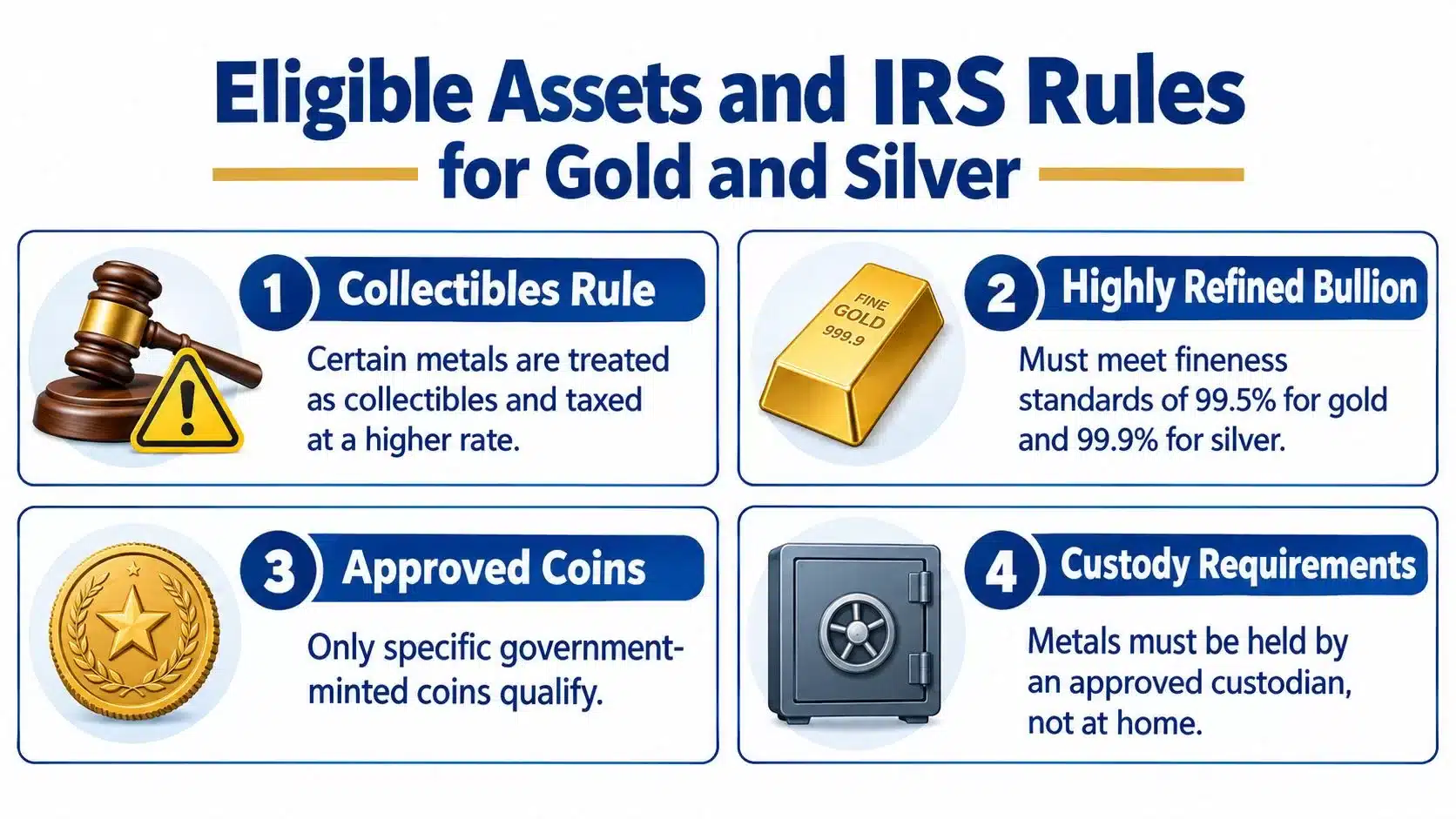
Internal Revenue Code Section 408(m) generally treats collectibles as prohibited IRA investments, while creating exceptions for specified gold, silver, platinum, and palladium coins and bullion. For commonly cited precious-metal standards, gold generally needs 99.5% fineness, silver 99.9%, and platinum and palladium 99.95%, as described in this overview of self-directed IRA rules and qualifying metals.
The American Gold Eagle is a notable statutory exception. It may qualify despite having 91.67% gold content, rather than the usual 99.5% standard. That example shows why a product's name or market value isn't enough. Eligibility depends on the product's legal characteristics.
The custodian remains part of the structure
A qualified custodian or trustee administers the account. The custodian may handle account records, transactions, reporting, and custody arrangements, but the broader investment choice doesn't turn the custodian into an investment validator. The investor still has to determine whether an asset is legitimate, suitable, fairly valued, and realistically sellable.
The mental model is simple: the investor directs, the IRA owns, and the custodian administers. Keeping those roles separate helps prevent the common mistake of assuming that an accepted transaction has also been judged a good investment or a safe tax strategy.
How Self Directed Accounts Compare With Standard IRAs
The difference between a standard IRA and a self-directed IRA is usually the investment menu and the amount of responsibility placed on the account owner. A conventional platform commonly offers investments with familiar pricing, regular reporting, and established liquidity. A self-directed structure may permit real estate, private-placement securities, precious metals, commodities, cryptocurrency, promissory notes, and tax-lien certificates, as outlined by FINRA's self-directed IRA risk guidance.
That flexibility can appeal to someone who understands a particular asset, such as rental property or private lending. It can be less suitable for someone who wants simple reporting, easy trading, and a custodian that helps evaluate investments. Alternative assets may be harder to value or sell, and investors may receive less standardized information and regulatory protection.
| Feature | Standard IRA | Self Directed IRA Account |
|---|---|---|
| Investment menu | Often centered on publicly traded securities and other platform offerings | May include selected alternatives such as property, private placements, notes, and qualifying metals |
| Pricing | Often supported by observable market prices | May depend on appraisals, sponsor statements, dealer pricing, or other valuation methods |
| Liquidity | Many holdings can be sold through an established market | Some assets may take time to sell or may have no readily available buyer |
| Investor research | Still necessary, but information is often more standardized | More responsibility falls on the owner to verify ownership, value, terms, and exit options |
| Custodian role | Account administration and transaction processing | Administration and custody, without necessarily assessing quality, legitimacy, or projected return |
| Fees | Usually easier to see within a conventional fee schedule | May include account-opening, annual, administrative, transaction, storage, and asset-specific charges |
Control changes the owner's workload
A standard account can feel easier because the investor usually works with assets that have frequent pricing and broad disclosure. A self-directed arrangement replaces some of that convenience with choice. The investor may need to examine a property deed, private-placement documents, promissory-note terms, metal specifications, storage arrangements, or an issuer's financial information.
This doesn't mean conventional investments are risk-free. It means the risks are presented differently. Public pricing can make a loss visible quickly, while an illiquid private asset may look stable because it isn't repriced often.
Fees deserve a side-by-side review
FINRA warns that self-directed IRA fees may be significantly higher than those of ordinary investment accounts because investors can face account-opening, annual, administrative, transaction, and asset-specific charges. The right comparison isn't just an account-opening charge. It includes every cost that may apply while the investment is held, changed, valued, stored, insured, or eventually sold.
A saver who values simplicity may prefer a narrower menu. A saver with relevant knowledge, patience, and a documented research process may consider broader control worth the added work. Neither choice is automatically superior.
Eligible Assets and IRS Rules for Gold and Silver
Gold and silver inside a self-directed IRA must satisfy two separate tests. First, the product must be legally eligible. Second, the metal must remain in an acceptable custody arrangement. Passing only one test isn't enough.
The tax code generally treats gold and other bullion as collectibles, but it provides an exception for certain highly refined bullion held in the physical possession of a bank or an IRS-approved nonbank trustee. An IRA-owned LLC doesn't erase that requirement. In other words, placing an LLC between the IRA and the metal doesn't allow the owner to keep the bullion at home.
Check the product before sending money
Before purchase, the investor should confirm:
- Metal type: Gold, silver, platinum, or palladium must fall within the applicable statutory exception.
- Fineness: Commonly cited minimums are 99.5% for gold, 99.9% for silver, and 99.95% for platinum and palladium, with specific statutory exceptions such as the American Gold Eagle. These standards are summarized in the IRS FAQ on IRA investments and transfers.
- Coin or bullion status: A precious-metal label alone doesn't establish eligibility.
- Custody: The approved trustee or depository must hold the metal physically.
- Documentation: The custodian's records should identify what was purchased and where it is held.
A dealer's description can help identify a product, but it shouldn't be the only verification. The custodian and the investor should confirm the legal characteristics and approved storage arrangement before the transaction closes.
If an IRA invests in disallowed collectibles, the invested amount is treated as distributed in the investment year and may be subject to the 10% additional tax on early distributions, depending on the circumstances. That consequence makes a pre-purchase check far safer than trying to correct an ineligible purchase later.
Understand transfer and rollover mechanics
A direct trustee-to-trustee transfer moves funds from one retirement account trustee to another without paying the money to the investor. It avoids the 60-day redeposit deadline and isn't subject to the once-per-year IRA rollover limit. If the distribution is paid to the investor, it generally must be redeposited within 60 days to qualify for rollover treatment.
Readers researching broader tax planning around retirement assets can also review Allied Tax Advisors IRA strategies for additional context. For a focused review of precious-metal eligibility and custody, the precious metal IRA rules provide a useful companion resource.
Custodians Fees Storage and Your Due Diligence
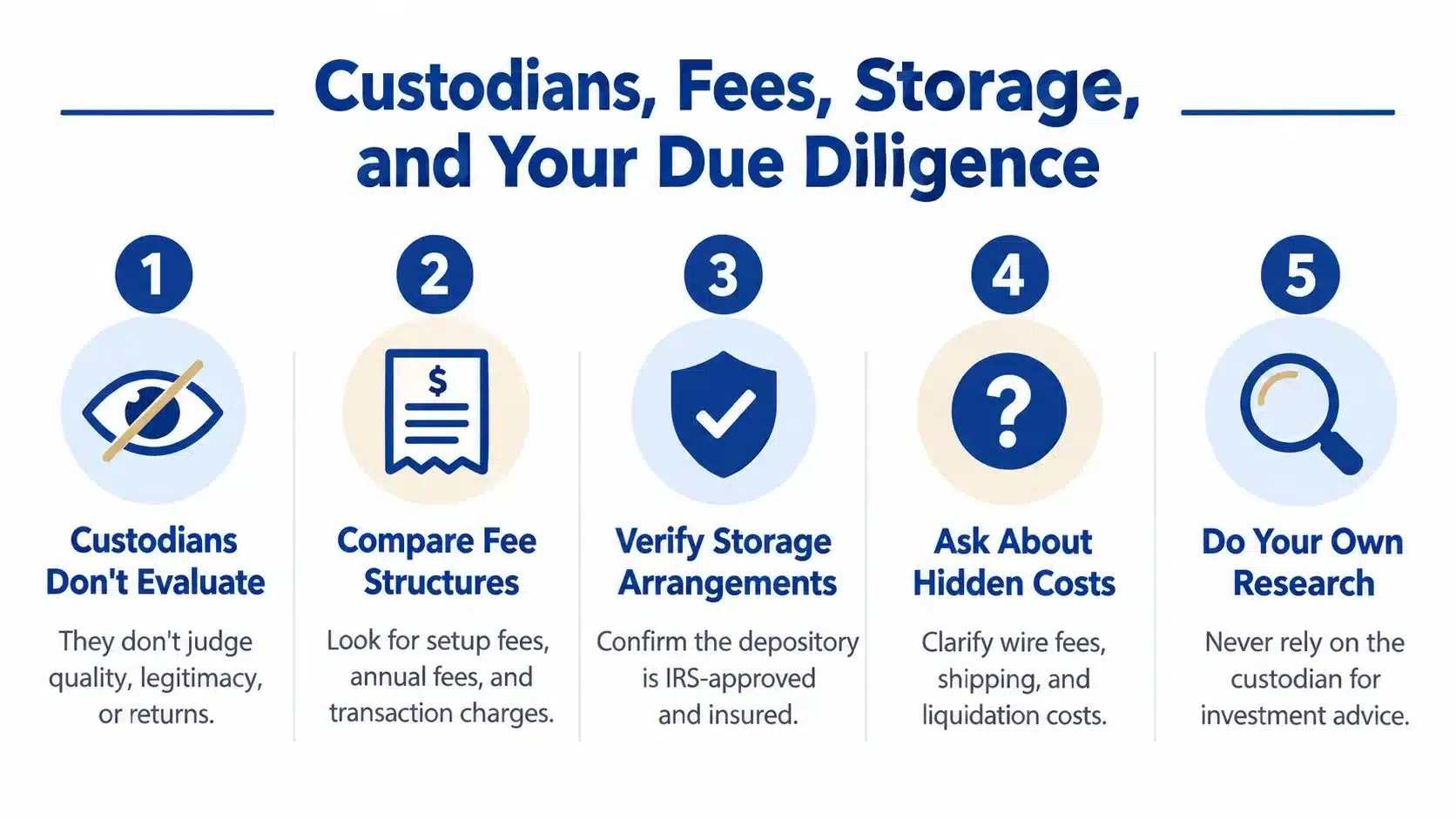
A custodian's acceptance of an asset doesn't prove that the asset is legitimate, fairly valued, or likely to produce the return described by a promoter. The SEC warns that SDIRA custodians generally don't evaluate an investment's quality, legitimacy, or projected return. Some custodians may not hold the underlying investment asset at all, particularly when the IRA owns an interest in a private arrangement.
That creates a responsibility gap. The custodian may process paperwork correctly while the investment itself has weak disclosure, uncertain ownership, limited liquidity, or unrealistic cash-flow assumptions. Fraudulent promoters can also use the tax-advantaged account structure to make an opportunity appear more credible than it is.
Build a written verification file
The term due diligence for investors refers to the process of investigating an opportunity before committing money. For a self-directed IRA, a repeatable file might include:
- Ownership evidence: Confirm who owns the property, company interest, note, or metal and whether the IRA will receive the correct legal interest.
- Valuation method: Identify whether the value comes from an appraisal, market data, sponsor estimate, dealer quote, or another method.
- Financial support: Request financial statements, cash-flow assumptions, offering documents, and registration information where applicable.
- Exit terms: Determine how and when the asset could be sold, transferred, redeemed, or distributed.
- Promoter relationships: Ask whether the promoter, custodian, dealer, appraiser, or storage provider has a financial relationship that affects incentives.
- Failure costs: Find out whether custodial, administrative, recordkeeping, storage, or closing fees continue if the investment becomes worthless.
For physical metals, FINRA advises reviewing the IRA statement for the metal's “melt” value, meaning bullion weight multiplied by the spot price, and checking that the recorded quantity matches what was purchased. The investor should also confirm the storage and insurance arrangements rather than assuming that a statement alone proves the metal is safely held.
Compare the full fee schedule
Ask for fees in writing before funding the account. The review should cover account setup, annual administration, transactions, storage, insurance, wire or delivery charges, valuation support, and liquidation or closing costs. A low initial charge can obscure ongoing costs that matter more over a long holding period.
The self-directed IRA fees guide can help organize that comparison. The important question isn't whether a fee exists. It's whether the investor understands what triggers it, who receives it, and whether it continues after an asset fails or becomes difficult to sell.
Benefits Risks and Prohibited Transactions to Avoid
A self-directed account can help an investor access assets that aren't normally available through a conventional IRA. That may support diversification for someone who understands the asset. It can also introduce illiquidity, valuation uncertainty, higher administration costs, and greater exposure to fraud.
The most dangerous misunderstanding is that “self-directed” means “anything goes.” IRS rules generally prohibit an IRA from borrowing money, selling property to itself, using IRA assets as loan security, or buying property for the owner's present or future personal use, as explained in IRS Publication 590-B.
Use a separation test for common scenarios
For a real-estate investment, the property belongs to the IRA. The owner, close family members, and other disqualified people shouldn't use it as a vacation property, live in it, provide personal labor, or receive side benefits. The IRA should pay its expenses and receive its income through the proper account channels.
For a private business or promissory note, ask whether the owner is providing services, guaranteeing debt, lending personally, receiving preferential terms, or mixing personal funds with IRA funds. A transaction that looks small or helpful can still create a prohibited-transaction concern.
For physical metals, the account owner shouldn't take personal possession, pledge the metal as collateral, or arrange storage outside the approved custody structure. The safer question isn't just “Can the IRA buy this?” It is “Who may use, manage, lease, improve, finance, or benefit from it?”
A prohibited transaction can cause the account to stop qualifying as an IRA from the first day of that tax year. IRS guidance also describes a 15% tax on the transaction amount and a possible additional 100% tax if the transaction isn't corrected. Those consequences justify pausing a questionable transaction and seeking qualified tax advice before acting.
A simple decision path helps:
- Does the owner or a disqualified person receive personal use or a side benefit? If yes, stop and obtain professional guidance.
- Does the owner borrow, guarantee, pledge, sell, or provide services to the IRA arrangement? If yes, don't proceed without review.
- Can every payment and benefit be documented as belonging to the IRA? If no, the structure needs further analysis.

The self-directed IRA disqualified person guide can help readers identify relationship and personal-benefit questions before a transaction. It shouldn't replace advice from a qualified tax professional familiar with the investor's facts.
Deciding If a Self Directed Account Fits Your Retirement
A self-directed IRA may fit a saver who understands a particular alternative asset, can tolerate limited liquidity, and is willing to maintain careful records. It may be a poor fit for someone who wants simple pricing, minimal administration, or a custodian that evaluates investments.
For a metals-oriented account, the decision can be tested with a short checklist:
- Knowledge: Can the investor explain why the asset belongs in the retirement plan without relying on a sales pitch?
- Eligibility: Has the investor verified the product's legal status and, where relevant, fineness?
- Custody: Will the trustee or approved custodian hold physical metals rather than the account owner?
- Verification: Has the investor checked ownership, valuation, storage, insurance, liquidity, and promoter incentives?
- Costs: Are setup, annual, administrative, storage, insurance, transaction, and potential tax or penalty costs understood?
- Separation: Can the investor avoid personal use, family benefits, borrowing, collateral arrangements, and mixed payments?
- Cash needs: Is there enough liquidity outside the investment to handle retirement expenses and account obligations?
Physical metals must remain in the possession of the IRA trustee or custodian. FINRA advises checking the account statement for melt value and confirming that the recorded bullion quantity matches the purchase. Investors may also face storage, insurance, administrative, transaction, and potentially tax or penalty costs, and self-directed IRA fees are generally higher than fees for directed IRAs, according to FINRA's guidance on buying physical gold and other metals.
A broader retirement decision may also involve housing equity, income needs, and cash-flow planning. Readers considering those questions can review when a reverse mortgage makes sense as a separate educational resource, not as a substitute for individualized advice.
The central choice is not control versus no control. It is simplicity versus responsibility. A self-directed IRA can provide access to qualifying alternatives, including precious metals, but it can't guarantee diversification, preserve purchasing power, or prevent losses. Rules and individual tax circumstances can change, so professional review is appropriate before a rollover, transfer, purchase, or distribution.
This is not financial advice. Consult a licensed financial advisor, CPA, or tax professional before making investment decisions.
Gold IRA Association provides educational guides on Gold and Silver IRAs, eligible metals, rollover procedures, custodians, storage, fees, and provider comparisons. Readers who want to organize their research can visit Gold IRA Association to review the relevant checklists and retirement-account resources before speaking with a qualified professional.


