




Retirement can feel different when market swings start to matter more than headlines. A saver who spent decades building a 401(k) or IRA may suddenly want part of that nest egg in something tangible, recognizable, and easier to understand than another paper asset. For many near-retirees, 1 oz Gold Eagle coins become that first serious look at physical gold.
The American Gold Eagle is widely known, but it's also widely misunderstood. The biggest confusion usually centers on its 22-karat purity, its place inside a Gold IRA, and how to buy it without making an expensive mistake. Those are the points that matter most when the goal is protecting retirement assets with care, not chasing excitement.
Why Investors Turn to Gold in Retirement
A pre-retiree often reaches the same question from different directions. Inflation raises everyday costs. Markets can turn sharply. Confidence in the dollar or in the broader financial system may feel less certain than it did a decade ago. That doesn't mean every retirement portfolio needs gold, but it does explain why physical bullion keeps coming up in serious retirement planning conversations.
Gold appeals to this audience for simple reasons. It's tangible. It doesn't depend on a company's earnings report. It isn't a promise from a bank. For someone trying to reduce concentration in traditional assets, a physical coin can feel easier to evaluate than a complex fund or structured product.
Why the 1 oz Gold Eagle gets attention
The 1 oz American Gold Eagle is often where the research starts because it combines familiarity with practicality. It's a U.S. Mint coin, it carries legal tender status, and it fits both personal ownership and certain retirement account strategies. That combination matters to investors who want gold they can understand and eventually liquidate without a lot of explanation.
A reader in this stage usually wants answers to a few basic but important questions:
- What exactly is in the coin
- Why a 22-karat coin can still work in an IRA
- How to buy authentic coins from a trustworthy seller
- Where the coins must be stored if they're held inside a retirement account
- How the Gold Eagle compares with other bullion choices
Practical rule: A retirement investor usually isn't looking for the most exotic gold product. The better starting point is often the one that's easiest to verify, store, and resell.
That practical mindset is where the Gold Eagle tends to stand out. It isn't just a gold coin. It's a specific tool that can fit a broader retirement strategy when the buyer understands its structure and rules.
What Makes the 1 oz Gold Eagle Unique
A lot of retirement investors first assume the best gold coin must be the purest one. The 1 oz American Gold Eagle is a good example of why that shortcut can mislead you.
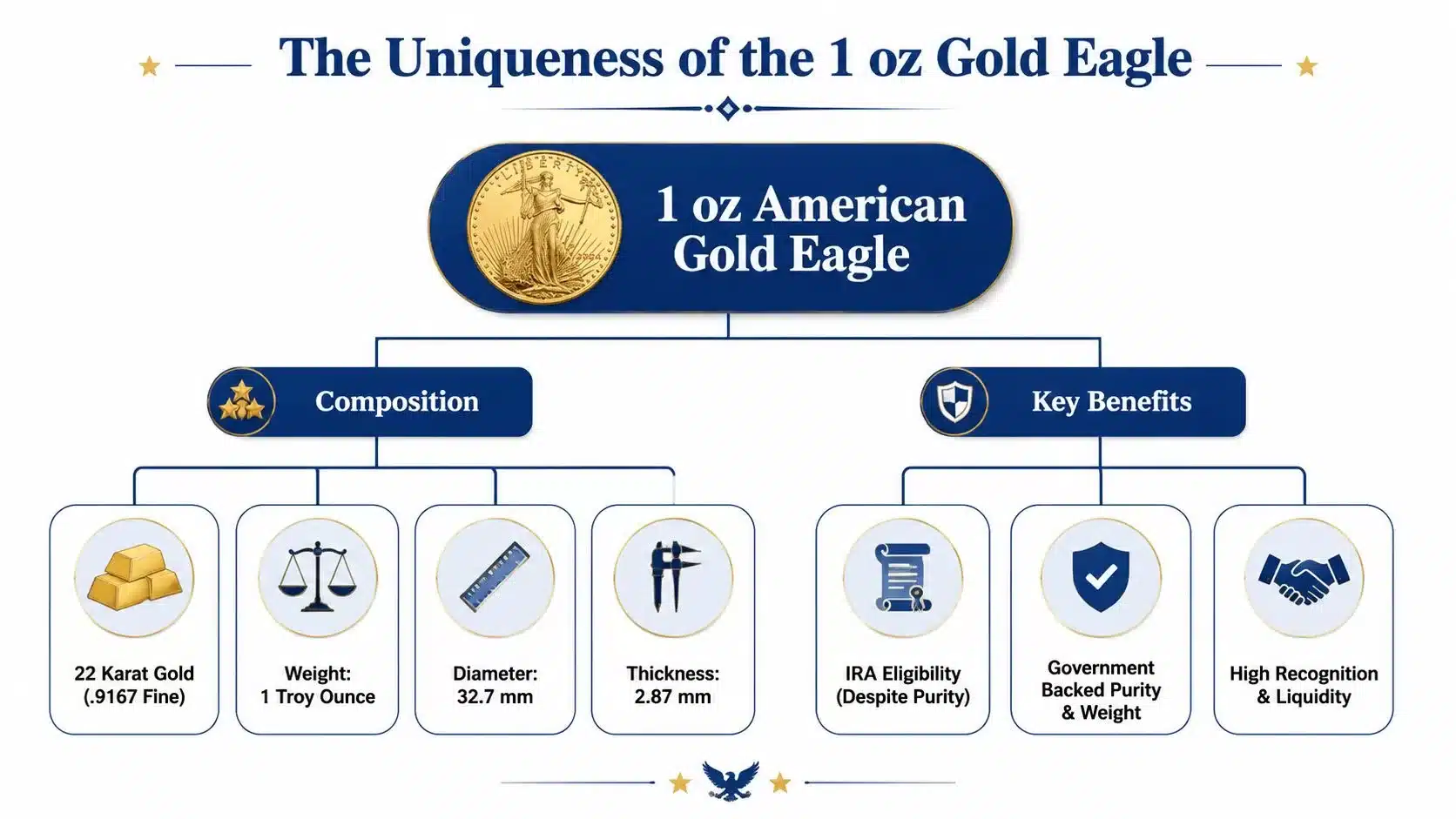
Its appeal starts with structure, not marketing. The coin contains one full troy ounce of actual gold, but it is struck as a 22-karat coin rather than a .9999 fine coin. That means the gold is blended with small amounts of other metals to make the coin harder and more resistant to everyday contact. For someone buying bullion with long holding periods in mind, that difference is practical.
The easiest way to understand it is to separate gold content from total coin weight. A 1 oz Gold Eagle gives you one full ounce of gold. The coin weighs more overall because the added alloy metals sit alongside that ounce of gold, not in place of it.

Why the 22-karat build matters
Pure gold is soft. A high-purity bullion coin can still be an excellent investment product, but softness matters once a coin is handled, inspected, shipped, or passed on to heirs. The Gold Eagle's 22-karat construction works like a durable frame around the gold you own.
That shows up in a few real-world ways:
- Routine handling: A sturdier coin is generally less prone to minor marks during inspection or transfer.
- Long holding periods: Coins that hold up well physically tend to stay easier to present and evaluate later.
- Estate planning: Family members often find a widely recognized U.S. Mint coin easier to identify and discuss than a less familiar bullion piece.
The look is different too. Because of the alloy, Gold Eagles often have a warmer tone than very high-purity bullion coins. Some buyers care about that. Others care more about what the color signals, which is the coin's traditional 22-karat format and long-standing market recognition.
One ounce means gold content, not total mass
This point trips up careful buyers because the label sounds simpler than the coin's construction. "1 oz" refers to the amount of gold in the coin. It does not mean the coin's entire physical weight is limited to one troy ounce.
| Feature | What it means |
|---|---|
| Gold content | One full troy ounce of gold |
| Total coin weight | Higher than one troy ounce because alloy metals are included |
| Purity | 22 karat, or .9167 fine |
| Practical result | Greater durability than a softer pure-gold coin |
A useful comparison is a reinforced door. The value is in what the door protects, but the added materials make the whole piece stronger in daily use. The Gold Eagle works in a similar way.
For retirement-focused buyers, one more trait stands out. The coin is widely recognized, produced by the U.S. Mint, and commonly included in discussions of IRA-approved gold coin options. That familiarity can support resale, verification, and long-term planning.
It also sets up the question that confuses many investors: how a 22-karat coin can still qualify for an IRA. That answer turns on a narrow statutory exception, and it is one of the main reasons the Gold Eagle holds a distinct place among bullion coins.
The Special Case of Gold Eagles and Your IRA
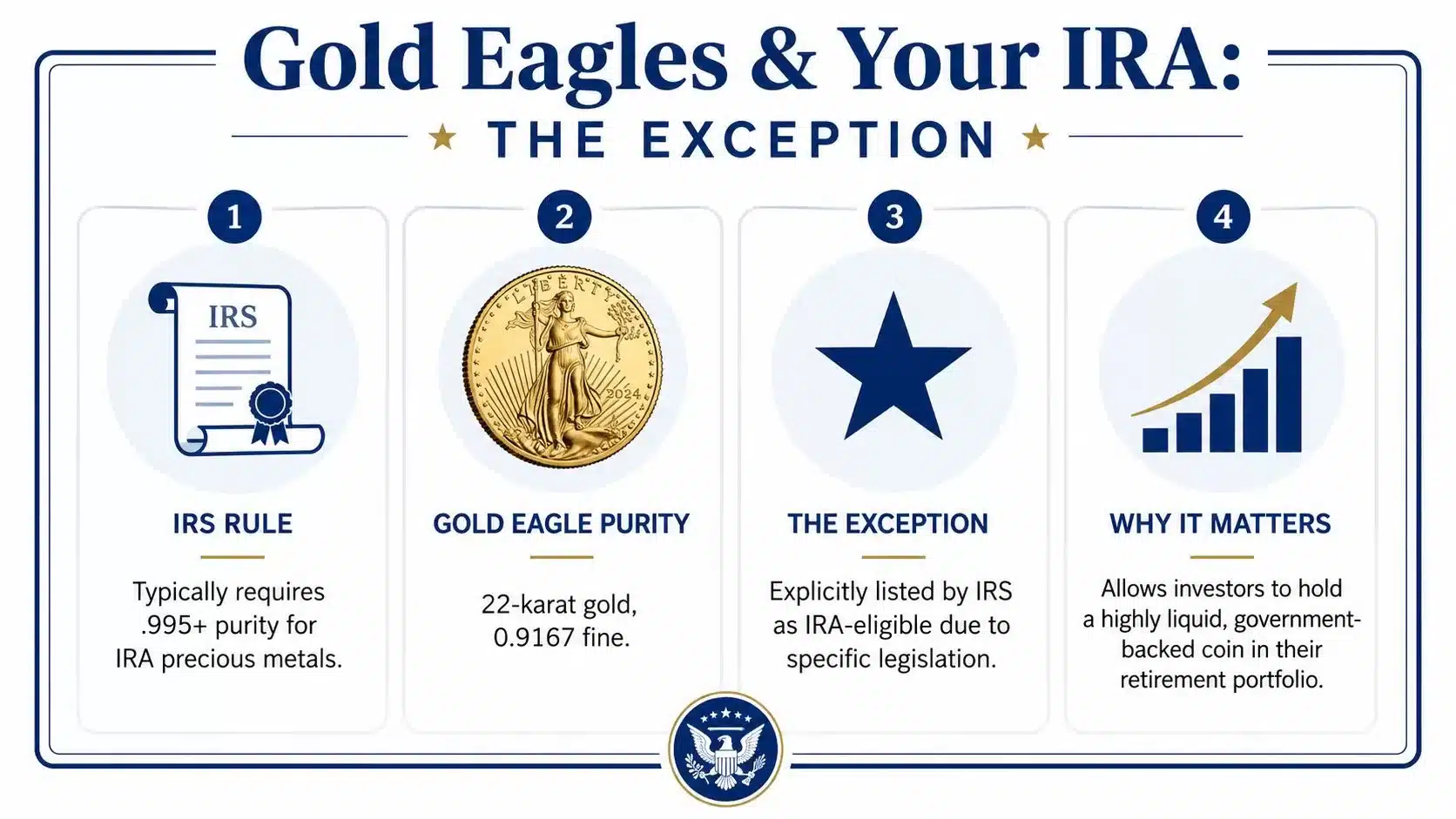
A pre-retiree often reaches the same moment of doubt. You understand that physical gold can belong in an IRA, then you notice that the American Gold Eagle is 22 karat instead of .995 fine gold, and the question follows immediately: does that make it ineligible?
For the Gold Eagle, the answer is no.
The reason matters. The 1 oz American Gold Eagle is allowed in an IRA because the law treats it as a special case under IRC Section 408(m)(3)(A). In plain English, Congress specifically permitted this coin, even though it does not meet the purity threshold that applies to many other gold products. That is why the Gold Eagle holds a distinct place in retirement planning. Its IRA eligibility rests on statute, not on a loose interpretation of the fineness rule.
The rule investors usually hear first
Many retirement savers learn the simplified version of the metals rule first. Gold for an IRA generally needs high purity. That guideline is useful, but it is only the starting point.
The better way to evaluate a coin is to separate the general standard from the exceptions written into law. A classroom analogy helps here. A school may require closed-toe shoes for everyone, yet still allow steel-toe work boots during a shop class because the rulebook says so. The Gold Eagle works in a similar way. The general purity standard exists, but this coin has its own written exception.
Why the exemption changes the decision
This affects strategy, not just compliance.
If you assume every IRA-eligible gold coin must clear the same purity bar, you may rule out one of the most established bullion coins in the U.S. market without realizing the law already made room for it. For a retirement account, that opens an additional path for investors who value a coin with longstanding recognition, straightforward resale appeal, and clear legal treatment inside a self-directed IRA.
It also reduces a common form of confusion. You do not need to argue that the Gold Eagle is "close enough" to .995 fine. The legal question is simpler than that. The coin is specifically allowed.
A practical way to apply this rule
For IRA planning, ask two questions in order.
- Is the coin one of the products the tax code permits for IRA ownership?
- Will it be purchased and stored through the IRA's required custodian and approved depository structure?
That first question is where the Gold Eagle stands apart. That second question still matters just as much, because IRA approval is about both the asset and how the account holds it.
Investors comparing eligible products can review this list of IRA-approved gold coins.
The Gold Eagle qualifies for an IRA because the law specifically allows it, even though its purity is lower than the standard many other gold products must meet.
For a saver nearing retirement, that distinction offers something useful: clarity. The Gold Eagle's place in an IRA is not a gray area. It is a defined exception, and that can make portfolio decisions more confident and more precise.
How to Buy and Sell 1 oz Gold Eagle Coins
A pre-retiree often reaches the same point in the buying process. The price looks fair, the coin is familiar, and the seller says it is IRA-eligible. Then the practical questions start. How much should you pay over spot? How do you know the coin is real? If you need to sell later, who buys it back?
Buying well starts by treating the Gold Eagle as both a bullion asset and a retirement asset. The coin's broad market recognition helps on the resale side, but recognition alone does not protect you from overpaying, buying the wrong version, or creating problems for an IRA transaction.

Start with the full cost, not just the gold price
A 1 oz Gold Eagle almost always sells above the metal's spot price. That extra amount is the premium. It reflects mint production, distribution, dealer margin, and the market's appetite for a widely recognized U.S. bullion coin.
For retirement planning, the premium matters because it affects your break-even point. If gold rises, your coin can gain value. If you paid far more than the market normally pays for a standard bullion Eagle, the coin has to work harder before you come out ahead. That is why a disciplined buyer compares live offers for the same product type on the same day.
Check four things before you send funds:
- The exact version of the coin: standard bullion, proof, or a collectible issue with a much higher markup
- The total delivered cost: not just the quoted price, but shipping, insurance, and payment-related fees
- The seller's repurchase process: whether the company clearly explains how it buys coins back
- The account structure: if the purchase is for an IRA, the transaction should be set up through the IRA custodian rather than shipped to you personally
That last point matters more than many investors expect. Gold Eagles are specifically allowed in IRAs under the tax code, but the buying process still has to follow IRA custody rules. If you want to understand why personal possession can create tax trouble, review the rules on storing Gold IRA metals at home.
Vet the seller before you vet the story
A seller should be able to answer plain questions plainly. Where did the coin come from? Is it bullion or a higher-markup collectible product? How is it inspected before shipment? What happens if you want to sell it back?
Those answers tell you a lot.
A careful buyer looks for clear invoices, written delivery terms, and a buyback policy that is easy to understand. If the language gets fuzzy when you ask about authentication or resale, that is useful information. In physical gold, confusion usually costs money.
Counterfeits deserve serious attention
Counterfeit Gold Eagles are not a theoretical risk. The harder fakes are difficult because tungsten is close to gold in density, which means a fake can pass simple eyeball tests and still be wrong inside.
Start with basic screening:
- Weight: compare the coin to published mint specifications
- Diameter and thickness: measure both, not just one
- Appearance: inspect design details, edge quality, and finish consistency
- Magnet test: useful as a quick screen, but not enough on its own
For larger purchases, better testing is sensible. Professional dealers and depositories may use tools that check the metal below the surface, not just the outside. That matters for retirement assets, where you are trying to reduce avoidable risk, not merely make a quick trade.
A short visual walkthrough can help reinforce what to inspect during a purchase:

Selling usually gets easier when the coin is easy to recognize
The 1 oz Gold Eagle has one practical advantage that shows up at resale. Buyers already know what it is. That does not guarantee the highest bid in every market, but it often makes pricing and liquidity more straightforward than with obscure rounds or heavily marked-up specialty products.
Your resale outcome is shaped at the time of purchase. A standard bullion Eagle in verifiable condition is easier to quote than a coin bought through a vague listing with poor documentation.
| Buying choice | Later effect on resale |
|---|---|
| Choosing standard bullion coins | Dealers can usually price them faster |
| Keeping invoices and any original packaging | Supports confidence and speeds verification |
| Buying through reputable channels | Reduces authenticity questions later |
| Avoiding large collectible premiums unless intentional | Keeps value tied more closely to the gold market |
For a pre-retiree, that is the main lesson. Buy the coin in a way that keeps your future options open. The Gold Eagle's legal IRA status is a major advantage, but a sound transaction still depends on price discipline, seller quality, and a resale plan.
Storing Your Gold Eagles for an IRA
Storage rules change completely depending on whether the coins are personally owned or held inside a retirement account. That's where many new buyers get caught off guard.
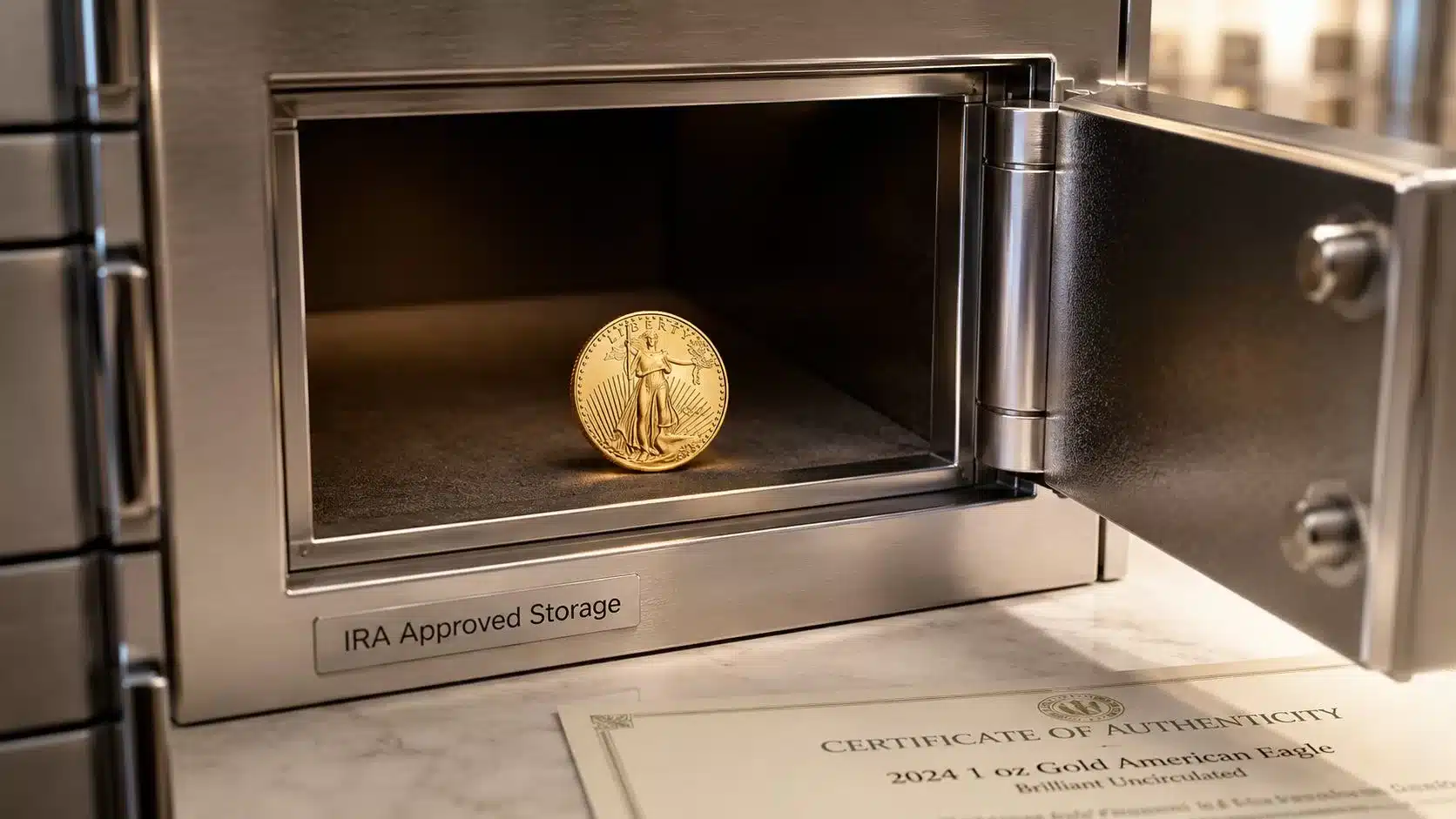
If 1 oz Gold Eagle coins are bought inside a Gold IRA, the investor doesn't keep them at home. The coins must be held through an approved structure that includes a custodian and a qualified depository. The custodian administers the account. The depository handles the physical storage, security procedures, and recordkeeping that support IRA compliance.
IRA storage and personal storage are not the same
This distinction is simple but important.
| Storage type | What applies |
|---|---|
| Gold IRA storage | Third-party custody and approved depository arrangements |
| Personal ownership outside an IRA | The owner chooses where and how to store the coins |
For IRA holdings, the main benefit of third-party storage is compliance. It also brings operational advantages such as documented custody, security controls, and a cleaner audit trail. Those features matter because retirement accounts have tax rules, and physical possession can affect how the IRS views the account.
What personally held owners can choose
Outside an IRA, the owner has more flexibility. Some investors use a home safe. Others prefer private vault storage or bank-based options where available. Each choice involves tradeoffs around access, privacy, insurance, and convenience.
A balanced way to think about the options:
- Home storage: Immediate access, but the owner bears the security burden
- Private vaulting: Stronger professional protection, but less direct access
- IRA-approved depository: Required for IRA compliance, with formal oversight and custody structure
A reader weighing the home-storage question in more depth can review whether gold IRA metals can be stored at home.
Retirement-account storage rules aren't arbitrary. They're part of what preserves the account's tax-advantaged structure.
For many pre-retirees, that makes the decision easier. If the goal is IRA ownership, proper depository storage isn't a nuisance to work around. It's part of the investment itself.
Tax Implications and Rollover Rules
A pre-retiree rolls part of a former employer plan into a self-directed IRA, buys 1 oz Gold Eagles, and assumes the tax side works the same as any other bullion purchase. That assumption can lead to confusion.
Gold Eagle taxes involve two separate rule sets. One governs how retirement money moves into the account. The other governs what happens when coins are sold. Keeping those issues separate makes the whole picture easier to follow.
Why the Gold Eagle deserves special attention
The American Gold Eagle has a rare place in retirement planning because Congress carved out a statutory exception for it. That point matters because the coin is 22k, not the high-purity format many investors associate with IRA eligibility. In other words, the Gold Eagle is not IRA-approved because it clears the usual purity hurdle in the same way as many other bullion products. It is IRA-approved because the law specifically allows it.
That distinction can shape strategy. An investor who prefers the Gold Eagle's durability, recognition, and U.S. minting status does not have to avoid it despite its 91.67% purity. The IRA rules treat this coin as a special case.
Tax treatment depends on account type
Inside a traditional IRA, taxes are generally deferred. The purchase of Gold Eagles inside the account is not usually the taxable event. Taxes are generally triggered later, when distributions are taken from the IRA, and those distributions are usually taxed according to the rules of the account.
Inside a Roth IRA, the framework is different. Qualified distributions are generally tax-free, assuming the account meets IRS requirements.
Outside an IRA, physical Gold Eagles are typically treated as personal investment property. Any gain on sale may create a tax obligation. The reporting and rate details depend on the investor's holding period, cost basis, and tax situation.
Dealer reporting and personal tax liability are not the same thing.
A sale may or may not trigger a dealer filing requirement, but the investor is still responsible for proper tax reporting. That is the practical point many gold buyers miss.
How rollovers and transfers fit in
For retirement investors, Gold Eagles often enter the account through either a transfer or a rollover. Those terms are related, but they are not identical.
A transfer usually moves IRA funds directly from one custodian to another. The account holder never takes possession of the money. That is often the cleaner path.
A rollover can involve funds leaving one retirement account and being deposited into another retirement account under IRS timing rules. If the process is handled incorrectly, the IRS can treat the movement as a distribution, which may create taxes and, in some cases, penalties.
A simple way to view it:
- Transfer: Custodian to custodian movement of IRA funds
- Rollover: Retirement funds are moved under rollover rules and timing requirements
- Distribution: Money leaves the retirement system and may become taxable
That is why paperwork matters as much as coin selection.
A practical sequence for pre-retirees
Many investors do best with a plain, disciplined process:
- Confirm the source account type. A former employer plan, traditional IRA, and Roth IRA do not all follow the same path.
- Work with the custodian on the correct funding method. Use a transfer when available, or complete the rollover exactly as required.
- Buy metals the IRA can hold. Gold Eagles fit here because of their statutory exception, not because they match the usual high-purity standard.
- Keep the transaction inside the IRA structure. Personal possession at the wrong time can create avoidable tax problems.
- Track records carefully. Cost basis, account statements, and distribution records all matter later.
Investors comparing coin and bar formats before funding the account can review this guide to gold bars vs gold coins for IRA buyers.
Why small mistakes get expensive
Tax trouble with Gold Eagles usually does not come from the coin itself. It comes from mishandling the account.
For example, if retirement funds are distributed to the investor instead of moved through the proper channel, the IRS may view that as a taxable event. If IRA metals are sent to the account owner rather than held through the required custody structure, the tax-advantaged status of the arrangement can come into question. The coin remains legal. The account handling is what creates the problem.
This is not financial advice. Consult a licensed financial advisor, CPA, or tax professional before making investment decisions.
For a retirement investor, the lesson is straightforward. Gold Eagles are unusually useful because the tax code gives them special IRA treatment even though they are 22k coins. That benefit only works as intended when the rollover, custody, and distribution rules are handled carefully.
Gold Eagles vs Other Gold Bullion Options
Most retirement investors don't choose between "gold" and "no gold." They choose between forms of gold ownership. That means the right comparison isn't emotional. It's practical.
The Gold Eagle tends to be evaluated against high-purity bullion coins and gold bars. Each has a different tradeoff profile.
Where the Gold Eagle stands out
The Gold Eagle's strongest case is usually a combination of durability, broad recognition, and special IRA treatment. It isn't the purest bullion option, but purity alone doesn't decide usefulness.
According to the earlier cited Gold Eagle pricing discussion, the coin is 91.67% pure, remains IRA-eligible by statute, and often carries a 3–5% lower premium over spot than some other IRA-approved coins with 99.99% purity such as the Buffalo or Maple Leaf.
A side-by-side decision view
| Decision factor | Gold Eagle | Higher-purity gold coin | Gold bar |
|---|---|---|---|
| Purity | Lower than .9999 alternatives | Higher purity | Varies by product |
| Durability | Strong due to alloy structure | Softer if very pure | Depends on format and handling |
| IRA eligibility | Special statutory exception | Usually based on purity standard | Must meet account rules |
| Recognition | Strong in the U.S. market | Also recognized, depending on product | Often straightforward, but less familiar to some retail sellers |
| Premium profile | Often lower than some IRA-approved coin alternatives | Can be higher | Sometimes attractive, depending on size and source |
Which investor usually prefers which format
A few broad patterns can help:
- Choose Gold Eagles when durability, U.S. familiarity, and IRA flexibility matter most.
- Choose very pure bullion coins when maximum purity is the buyer's top preference.
- Choose bars when the investor is focused on format efficiency and is comfortable comparing coin and bar tradeoffs.
Readers who are deciding between formats may find this comparison of gold bars versus gold coins useful.
The key point is that the Gold Eagle doesn't win because it's purest. It wins for many buyers because it balances several real-world concerns at once.
Frequently Asked Questions About 1 Oz Gold Eagles
What is the face value of a Gold Eagle, and does it matter?
The 1 oz American Gold Eagle has a legal tender face value of $50, but that isn't what drives its investment value. Buyers care about the coin's gold content, market demand, and resale liquidity. The face value mainly reflects its status as official U.S. coinage.
How is the premium on a Gold Eagle calculated?
The premium is the amount above the current gold spot price. It generally reflects minting costs, distribution, dealer overhead, market demand, and the coin's recognition in the marketplace. A buyer shouldn't evaluate premium in isolation. The better test is whether the full offer makes sense for that product in current conditions.
Are older Gold Eagles worth more than newer ones?
Usually, standard bullion Gold Eagles trade based mainly on gold value and normal bullion demand, not age alone. Some specific versions may interest collectors, but a typical retirement investor should assume that bullion pricing and condition matter more than year unless the coin is clearly being sold as a collectible.
Can someone take physical possession of Gold Eagles held in an IRA?
Not while they remain inside the IRA under the normal custody structure. IRA-held metals are generally stored through the approved custodian and depository arrangement discussed earlier. Physical possession usually comes into play only when the account holder takes a distribution, and the tax treatment depends on the person's circumstances.
Why do people get confused about Gold Eagle IRA eligibility?
Because the coin is 22 karat, many investors assume it fails the normal purity test. The confusion comes from applying the general rule without knowing the statutory exception. The Gold Eagle is unusual because Congress specifically allowed it.
Is a Gold Eagle better than a purer coin?
Not automatically. It depends on what the investor values. Someone who wants the highest purity may prefer another option. Someone who values durability, broad recognition, and the special IRA exception may prefer the Gold Eagle.
For readers who want help turning this research into a practical next step, Gold IRA Association offers educational guides and comparison resources focused on retirement investors. A sensible next move is to compare top Gold IRA companies or speak with a Gold IRA specialist at 888-910-8386 before making any rollover or metals purchase decision.


