




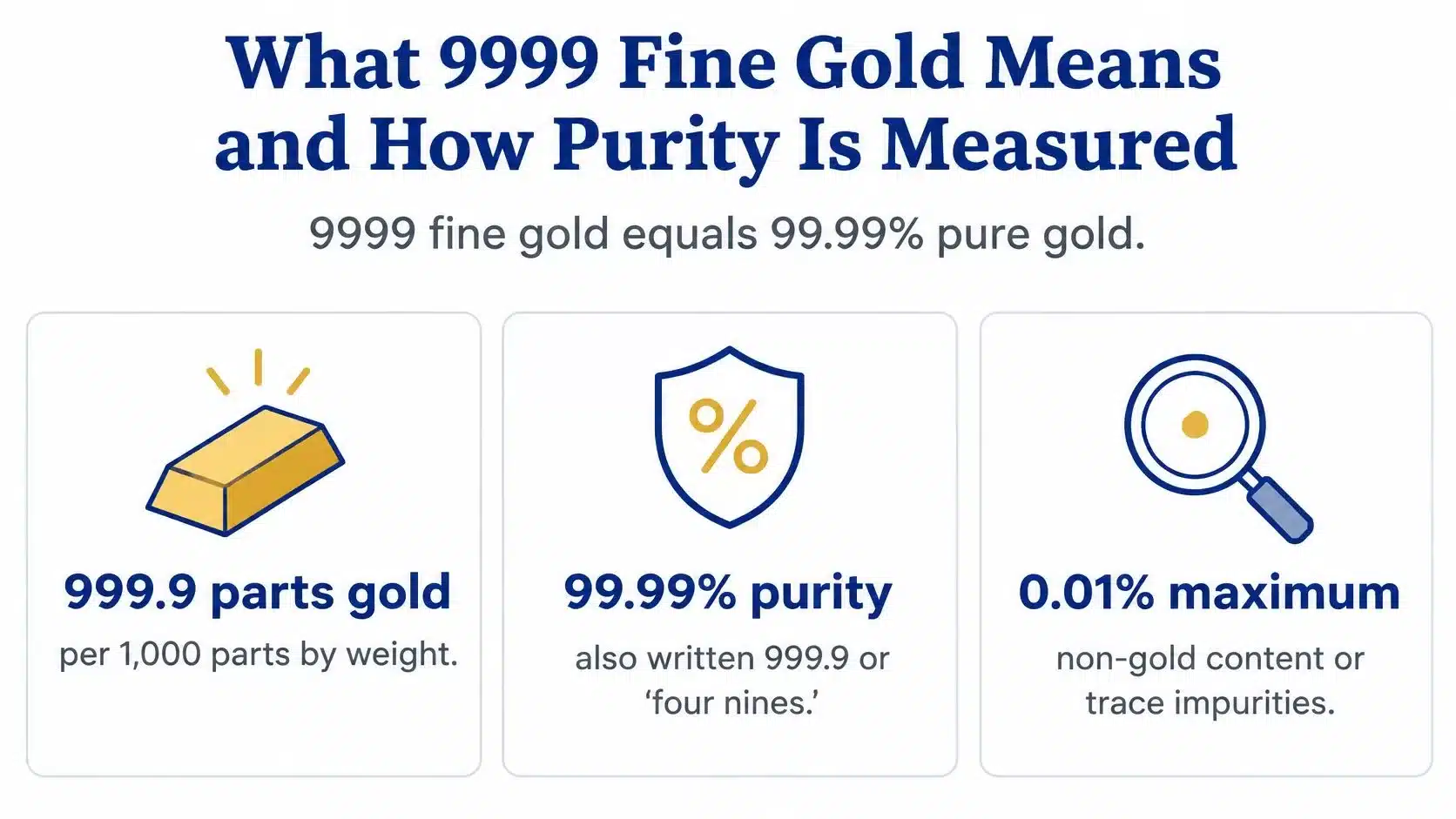
9999 fine gold contains 999.9 parts gold per 1,000 parts by weight, which equals 99.99% purity and a maximum theoretical impurity content of 0.01%. That purity designation describes the metal's composition, but it doesn't establish whether a retirement account may hold it.
For retirement savers, three questions need separate answers: how pure the gold is, how that purity was measured, and whether the particular product and custody arrangement satisfy IRA rules.
What 9999 Fine Gold Means and How Purity Is Measured
Fineness expresses the proportion of gold in a material by weight. The London Bullion Market Association's explanation of gold purity describes 9999 fine gold, also written 999.9 or four nines, as 999.9 parts gold per 1,000, equivalent to 99.99% gold and no more than 0.01%, or 100 parts per million, of impurities.
That designation isn't a claim of chemical perfection. Even highly refined gold can retain tiny amounts of other elements. The fineness number quantifies those traces rather than pretending they don't exist.
The infographic shows how the different expressions describe the same composition.

How an Assay Establishes Purity
An assay is a test used to determine a metal's composition. Traditional fire assay uses controlled heating and separation to assess precious-metal content.
Modern assay practice can also determine fineness by measuring impurities and subtracting their combined concentration from the total. This approach requires precise laboratory measurements because the non-gold content is so small.
The distinction matters when examining a certificate. A fineness stamp states a specification; an assay provides evidence supporting the composition. Neither a seller's description nor an attractive package substitutes for documentation identifying the actual product.
24-karat, often shortened to 24K, describes gold as pure, but it doesn't provide the same parts-per-thousand precision. For a purchase comparison, the stated fineness and certified fine weight are more useful than the karat description alone.
Fine Weight and Gross Weight Aren't Identical
Fine weight means the weight of the gold itself. Gross weight includes both gold and any non-gold material.
For a bullion bar specified to contain one troy ounce of fine gold, the fine-gold content is approximately 31.1035 grams, while the trace non-gold fraction adds about 0.0031 grams to gross weight, using the weight and pricing context described in LBMA's guide to the gold price. The difference is tiny for an individual purchase, but it matters for assay records, accounting and fabrication tolerances.
A buyer shouldn't assume that every ounce marking describes precisely the same thing. Product specifications should say whether the advertised weight represents fine gold content or total weight.
Practical rule: Match the weight description, fineness stamp and assay documentation before comparing prices.
For readers unfamiliar with investment-metal terminology, the explanation of what bullion is distinguishes metal bought primarily for its precious-metal content from items bought chiefly for collectible appeal.
A useful buyer checklist follows:
- Read the stated weight. Identify whether it describes gross weight or fine gold content.
- Confirm the fineness stamp. Compare the marking with the invoice and product specification.
- Confirm the refiner name. The identity on the product should match its supporting documents.
- Request the assay certificate. Check that it corresponds to the bar rather than merely describing a product range.
- Inspect packaging and identification. Check seals and serial numbers where applicable, and investigate inconsistencies before payment.
These checks address metal composition and documentation. They don't establish IRA eligibility.
How 9999 Compares With Other Gold Fineness Grades
Gold grades describe different concentrations of the same metal. A higher fineness means less non-gold content by weight, not an automatic promise of a better investment.
The LBMA guide to London Good Delivery gold and silver identifies 995.0 parts per thousand as the minimum for large London Good Delivery gold bars and describes the development of higher-purity refining and kilobar standards. The percentage and impurity columns below express the corresponding arithmetic for each fineness grade.
Gold Fineness Grades Compared
| Grade | Parts per 1,000 | Gold percentage | Maximum impurities | Typical use |
|---|---|---|---|---|
| 9999 (four nines, 999.9) | 999.9 | 99.99% | 0.01% (100 ppm) | Investment bars and coins; Asian kilobar trade |
| 9995 | 999.5 | 99.95% | 0.05% (500 ppm) | Intermediate high-purity grade |
| 999 | 999.0 | 99.9% | 0.1% (1,000 ppm) | Common bullion and fabricated-product standard |
| 995 | 995.0 | 99.5% | 0.5% (5,000 ppm) | LBMA Good Delivery minimum for wholesale bars; IRS reference threshold |
| 24K | No parts-per-thousand rating | Essentially pure | Not specified by the label alone | Jewelry and general gold description |
The top row represents a highly refined product suitable for direct ownership, while the intermediate grades contain progressively larger permitted non-gold fractions. The wholesale minimum serves a different trading function; it doesn't imply that qualifying wholesale bars are defective or unsuitable for their intended market.
The same LBMA account records that the four-nines kilobar specification was issued in Shanghai on July 1, 2015, following a joint LBMA–Shanghai Gold Exchange meeting. Formal standardization helped establish a consistent specification for a purity already used in Asian kilobar trading and smaller investment bars.
Purity Doesn't Set the Entire Price
A buyer pays for fine gold content plus a premium. That premium can reflect manufacturing, product form, issuer, distribution and dealer markup.
A more elaborate coin can therefore cost more than a simpler bar without containing more fine gold. Likewise, a higher purchase premium isn't a guarantee that a future buyer will pay the same premium on resale.
Compare the amount of fine gold and the total purchase price, not just the number of nines.
Reading a label is straightforward: identify the grade, match it to the relevant row, then determine whether that grade satisfies the intended use. A retirement-account purchase also requires a separate legal and custody review.
Why Purity Alone Does Not Make Gold IRA-Eligible
The common mistake is treating a high fineness stamp as an IRA approval mark. Purity answers a metallurgical question, not the entire retirement-account question.
The documentation surrounding a purchase should establish both the metal specification and the account arrangement.

The Purity Test and the Custody Test
The IRS generally treats precious metals as collectibles, but Section 408(m) provides an exception for certain bullion. An IRS written determination discussing the bullion exception explains that qualifying bullion must meet the applicable regulated-futures-contract minimum, stated for gold as 995 parts per 1,000, and remain in the physical possession of an eligible IRA trustee.
The arithmetic is favorable for four-nines gold: 999.9 minus 995 equals 4.9 parts per 1,000, or 0.49 percentage points, calculated from the fineness figures discussed in another IRS determination addressing precious-metal bullion.
That margin establishes that the material clears the numerical purity threshold. It doesn't establish that a particular purchase, account or storage arrangement meets every requirement.
The following video provides additional context for the retirement-account discussion.

Why a Pure Bar Can Still Be Ineligible
Consider a saver who buys a properly assayed bar personally and places it in a home safe. The metal can satisfy the purity test while the arrangement fails the separate trustee-possession requirement.
An IRA owner can't designate privately stored gold as an IRA asset. Account ownership, purchase instructions and trustee custody must be established through the appropriate retirement-account process.
The misunderstandings usually fall into distinct categories:
- Stamp equals approval. A fineness marking doesn't certify the retirement-account arrangement.
- Personal ownership equals IRA ownership. A personal invoice doesn't establish that an IRA acquired the metal.
- Secure home storage equals compliant custody. Physical security and trustee possession are different requirements.
- Dealer acceptance equals legal eligibility. A seller's willingness to complete a transaction isn't a substitute for an eligibility review.
Current IRS guidance should be checked before acting, and rules can apply differently according to individual circumstances. IRS written determinations also shouldn't be treated as personalized approval of another taxpayer's transaction.
Gold IRA Association's website materials are provided for informational purposes only and aren't intended as financial, legal or investment advice. This is not financial advice. Consult a licensed financial advisor, CPA, or tax professional before making investment decisions.
Which 9999 Gold Products Qualify for an IRA
The IRS coin exception and the bullion exception are separate routes. IRS Publication 590-B identifies U.S. Treasury-minted gold coins in one-ounce, one-half-ounce, one-quarter-ounce and one-tenth-ounce denominations as permitted exceptions to the collectible restriction, while separately addressing qualifying bullion.
That distinction prevents an important error: a table of IRA gold categories isn't necessarily a list of products sharing the same purity. A coin may qualify under the specified coin rule, while a bar must be evaluated under the bullion rule.
9999 Gold Products and Their IRA Status
| Product | Form | General IRA status | Check before buying |
|---|---|---|---|
| U.S. Treasury gold coins in the denominations identified above | Coin | Permitted under the IRS coin denomination rule | Confirm the denomination and U.S. Treasury issuer |
| 9999 gold bullion bars from recognized refiners | Bar | Generally eligible if the applicable fineness and trustee-custody requirements are met | Refiner name, stated weight and assay certificate |
| Royal Canadian Mint Gold Maple Leaf | Coin | Verify against current IRS guidance and custodian requirements | Approved-product list; face value isn't market price |
| U.S. Mint proof and commemorative 9999 issues | Collector coin | Often outside the permitted list; issue-specific review required | Denomination and issue type against the IRS rule |
| Private-mint rounds and unlisted bars | Round or bar | Must qualify under the bullion exception and custody rules | Issuer, fineness, weight and custodian acceptance |
Recognized refiner is useful purchasing information, but it isn't a substitute for applying the legal rule. Likewise, custodian acceptance is an operational check, not a promise of a particular tax outcome.
Bars, Bullion Coins and Collector Issues
A concrete bar example is the Royal Canadian Mint's 2025 one-ounce gold bar, specified as .9999 fine gold. Its product specification establishes composition; the account administrator must still evaluate the intended IRA transaction.
For coins, the Royal Canadian Mint's 2025 Gold Maple Leaf specification identifies a one-ounce coin containing 99.99% pure gold with a $50 face value. Face value isn't the market purchase price, and the exact product should be checked against current guidance and the custodian's accepted-product list.
Collector pieces need a different level of caution. The 2025-W half-ounce .9999 fine-gold Sacagawea anniversary proof is an example of a collector-oriented issue described in Coin World's reporting on the U.S. Mint release. Its purity doesn't settle its IRA status, and neither a proof finish nor a government issuer creates blanket eligibility.
Purchase safeguard: Obtain an explicit eligibility determination for the exact issue, not merely for a similar coin or a broad product category.
Private rounds and unlisted bars also need a clear yes-or-no review before an IRA purchase proceeds. A missing listing isn't proof of prohibition, but it is a reason to resolve the question before funds move.
The comparison of gold bars versus gold coins helps separate product-form choices from compliance requirements. Common purchasing mistakes include assuming every four-nines item qualifies, ignoring premiums over the metal's spot value and skipping the custodian's product review.
Frequently Asked Questions About 9999 Fine Gold
Is 9999 Gold the Same as 24-Karat Gold?
Not exactly. The karat label describes pure gold, while four-nines fineness provides a more precise composition specification.
The distinction is explained under What 9999 Fine Gold Means and How Purity Is Measured. For a purchase, the assay and product specification provide more detail than a general karat description.
Does 9999 Gold Automatically Qualify for an IRA?
No. A pure product can still fail the applicable product or custody requirements.
The discussion under Why Purity Alone Does Not Make Gold IRA-Eligible separates those tests. The exact coin issue or bar specification should be evaluated, rather than relying on a seller's broad IRA-friendly description.
Can an IRA Keep a 9999 Bar at Home?
No, an IRA owner can't substitute private home storage for the eligible-trustee possession required for qualifying bullion. A secure safe doesn't resolve the account-ownership and custody questions.
The custody discussion explains why personal possession and IRA ownership aren't interchangeable. Storage instructions should be established before a transaction proceeds.
Does Higher Fineness Mean a Higher Price?
Not automatically. Buyers also pay premiums associated with product form, issuer and dealer markup, and those premiums aren't guaranteed to be recovered on resale.
How 9999 Compares With Other Gold Fineness Grades distinguishes composition from price. Comparing fine gold content, the purchase quote and the seller's proposed repurchase terms gives a more useful picture than comparing purity labels alone.
Confirm Eligibility With Your Custodian Before You Buy
The safest purchasing sequence resolves eligibility before committing retirement funds. A qualified gold IRA custodian has a different role from a metals seller or an educational publisher.
A pre-purchase review should cover the following:
- Identify the exact product. Confirm its form and, where relevant, denomination against current IRS rules.
- Document account acceptance and custody. Establish that the custodian accepts the specific item and that an eligible trustee will hold it.
- Compare the complete cost. Include setup, custody, storage and transaction charges, not just the metal quote.
- Review retirement fit. Consider the holding period, access to cash, future distributions and overall diversification.
Keep Risk Separate From Purity
Investing in precious metals and IRAs involves risk, including potential loss of principal. A high purity grade doesn't guarantee returns, resale premiums or a favorable retirement outcome.
Gold IRA Association's team offers personalized educational guidance suited to an individual's retirement goals and financial situation. That support doesn't replace professional financial, legal or tax advice, and individual circumstances affect how rules apply.
This is not financial advice. Consult a licensed financial advisor, CPA, or tax professional before making investment decisions.
Gold IRA Association offers educational guides and checklists for distinguishing gold purity from IRA product and custody requirements. Visit Gold IRA Association or call 888-910-8386 to discuss questions about a proposed gold purchase and identify information to review with a custodian, with no obligation to act.


