



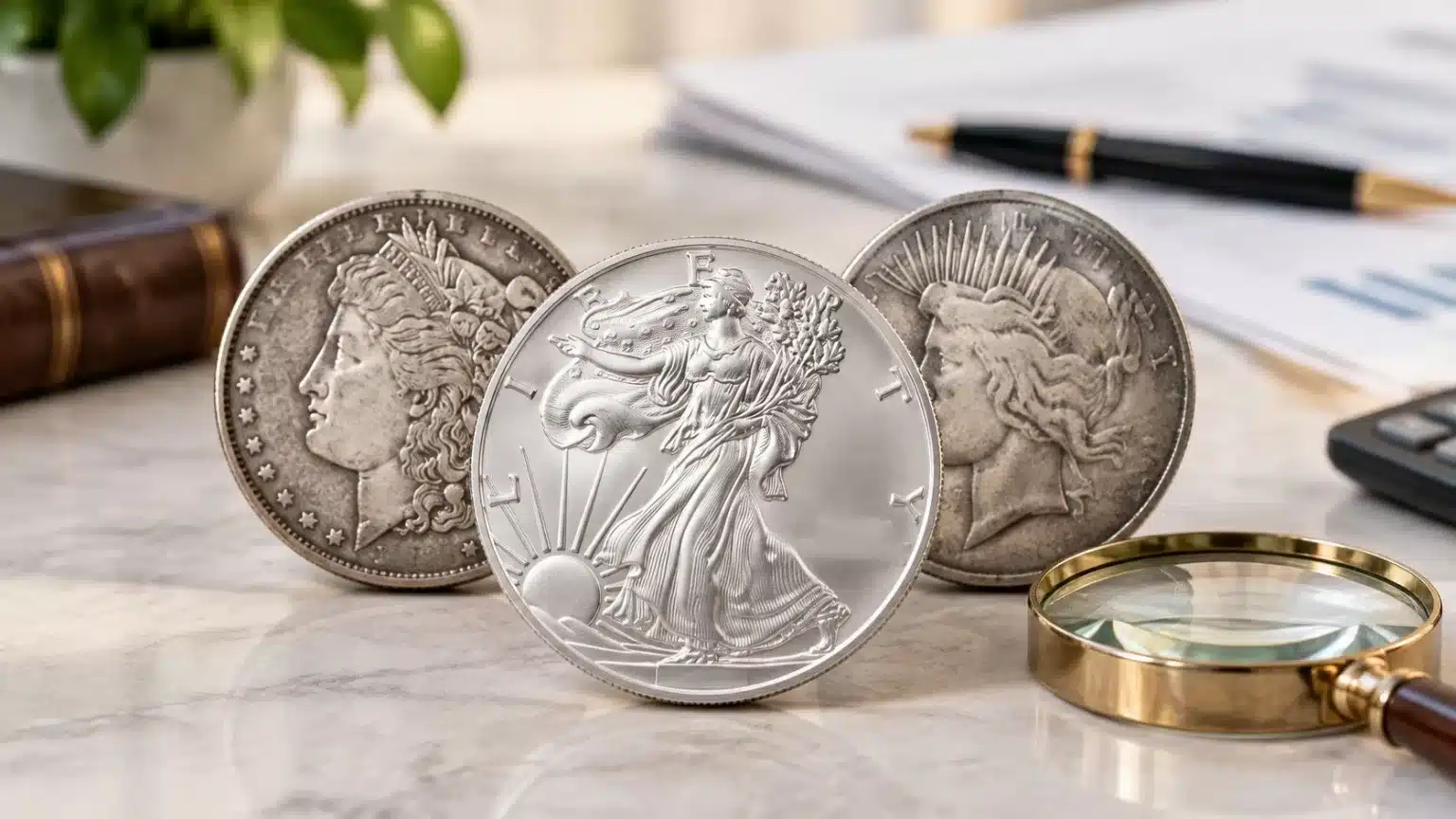
Only .999 fine silver products such as the American Silver Eagle generally qualify for a Silver IRA, while 90% silver Walking Liberty half dollars and Morgan dollars generally do not; the custodian and current IRS rules determine the final answer. These are general screening conclusions, not assurances that every product with those specifications is acceptable.
If Liberty appears on both an old silver dollar and a modern bullion coin, why would their retirement-account treatment differ? The answer requires separating design, silver purity, collectability, and custodian acceptance, rather than treating the Liberty name as an eligibility label.
Which Liberty Silver Coins Qualify for a Silver IRA
Two Liberty silver products can share a design and a .999 stamp and still receive different answers from an IRA custodian. The table below sorts the main Liberty silver products; each one gets its verdict from a different combination of the four tests described above.
Liberty silver products and likely IRA status
| Product | Silver fineness | Likely IRA status | Deciding factor |
|---|---|---|---|
| American Silver Eagle, one-ounce bullion | 99.9% | Generally eligible | U.S. Mint bullion coin under the recognized statutory exception |
| Walking Liberty half dollar, 1916-1947 | 90% | Generally not eligible | Below .999 fineness; collector value reflects date and mintmark |
| Morgan dollar, circulating, 1878-1904 and 1921 | 90% | Generally not eligible | Below .999 fineness; collectible |
| Peace dollar, circulating, 1921-1928 and 1934-1935 | 90% | Generally not eligible | Below .999 fineness; collectible |
| Modern Morgan or Peace silver dollar, 2021 onward | 99.9% | Unlikely | Commemorative-style release; ask the custodian whether it accepts the exact issue |
| American Liberty Silver Medal, 2022 and 2025 | 99.9% | Unlikely | Issued as a medal, not a coin; confirm the custodian lists the 2022 or 2025 issue by name |
Standard bullion versus historical coins
The American Silver Eagle bullion coin is the clearest starting point for an IRA buyer interested in a Liberty design. Every coin in the series carries the same one-ounce weight and standardized bullion format, so a dealer's listing describes the product a custodian expects to see.
Walking Liberty half dollars are 90% silver, so they fail the purity screen whatever their artwork or condition. They can be attractive ordinary-ownership collectibles, but their circulating-coin alloy is the obstacle.
Original Morgan dollars face the same problem. A genuine coin, an appealing grade, and a desirable mintmark don't change its underlying composition.
Original Peace dollars belong in the same category.
Modern silver still requires classification
Modern Morgan and Peace dollars solve the purity problem that blocks their older counterparts, reaching .999 fineness. That upgrade leaves their legal category unchanged: the Mint sells them as commemorative-style collectibles rather than standard bullion. Treat eligibility as unlikely unless the custodian approves the exact issue in writing and explains its basis for acceptance.
The American Liberty Silver Medal requires a separate inquiry because the Mint issues it as a medal rather than a coin. The U.S. Mint's collectible-coins guidance distinguishes bullion from collectibles and identifies the 2025 American Liberty issue as a silver medal containing one troy ounce of .999 silver. A .999 stamp alone doesn't place a product inside the bullion exception.
Practical rule: Liberty describes artwork or a product name. It doesn't describe an IRA eligibility category.
A seller's statement that a product is retirement suitable isn't enough. Ask the custodian for a written determination naming the precise product, then confirm that answer is consistent with current IRS requirements before any money moves.
IRS Purity Rules That Decide IRA Eligibility
IRA silver screening starts with a bright-line test: in general, silver bullion must reach 99.9% fineness, while qualifying U.S. Mint American Silver Eagles follow a statutory coin route. Passing either path only opens the file. The exact product still has to match an exception, and the metal must remain under IRA trustee or custodian control in approved storage.


Eligibility works better as four separate checks than as a single label. The name or artwork identifies the design. Assay or Mint specifications establish fineness. The legal category separates a bullion issue from a collectible strike. Custody and product acceptance confirm whether the account can hold it. A Liberty coin can clear one check and fail another.
Purity opens the file; the other checks decide
Federal tax rules generally restrict IRA investments in collectibles while providing exceptions for certain coins and qualifying precious-metal bullion. That is why a genuine silver coin with strong collector demand can still fall outside the IRA exceptions, while a qualifying bullion product still needs the right issue, paperwork path, and custody arrangement.
Use fineness to narrow candidates, then move to product identity. Gold IRA Association's IRA-eligible silver guide is useful for seeing how eligible-silver categories are commonly organized before the exact issue goes to the custodian for a decision.
Custodian acceptance is an operational requirement, and it still depends on the precise coin or medal being approved.
Proof finishes and collectible premiums
A proof finish does not settle eligibility by itself. The U.S. Mint's American Eagle proof description identifies proofs as collector versions of its official silver bullion coins, so the finish and market purpose deserve attention.
Some custodians accept qualifying proof or uncirculated Eagles under product policies; others restrict available selections. A graded holder, rare-date label, or presentation box should not be read as turning an excluded collectible into an IRA asset. A collector-oriented finish also leaves open the possibility that a qualifying coin exception still applies, so classify the exact issue before treating the word collectible as decisive.

Custody is a separate requirement. An IRA arrangement generally requires appropriate trustee or custodian control and approved storage, not personal possession presented as IRA storage. When a product sits between bullion and collectible categories, have the custodian, CPA, or licensed financial advisor review the exact issue before funds move.
Why Older Liberty Dollars Usually Fail the Purity Test
A dollar-sized coin can look like a serious silver holding while containing an alloy that fails the retirement-account screen. Design, silver purity, collectability, and custodian approval are four separate checks, and an older Liberty coin can pass the other three while failing on fineness alone.
Specifications of Liberty silver products
| Product | Total weight | Pure silver | Diameter |
|---|---|---|---|
| American Silver Eagle, one-ounce | 31.103 g | 1.000 troy oz | 40.60 mm |
| Walking Liberty half dollar, 1916-1947 | 12.50 g | Approximately 0.3617 troy oz | 30.6 mm |
| Morgan dollar, circulating | 26.73 g | Approximately 0.7734 troy oz | 38.1 mm |
| Peace dollar, circulating | 26.73 g | Approximately 0.7734 troy oz | 38.1 mm |
| American Liberty Silver Medal, 2022 | 1.000 troy oz | Approximately 0.999 troy oz | 40.60 mm |
Two columns in the table describe different things. Total weight covers the whole coin including its copper alloy, while pure-silver weight counts only the silver inside it. Confusing the two makes a 90%-silver coin look like a full silver ounce when it is not.
Walking Liberty half dollars
The PCGS Walking Liberty guide identifies the 1916-1947 half dollar as a 90% silver and 10% copper coin weighing 12.50 grams, containing approximately 0.3617 troy ounce of fine silver, and measuring 30.6 millimeters across. Its reeded edge, alloy, and measurements provide useful authentication benchmarks.
At those specifications, its theoretical silver value is approximately 36.17% of the spot price of a troy ounce, before any collector premium. An actual buyer may offer a different amount because condition, date, mintmark, strike quality, and rarity affect the transaction.
The same PCGS guide notes that early 1917 examples can carry either obverse or reverse mintmarks. That variety check belongs before pricing, especially when a seller claims an unusual issue.
Morgan and Peace circulating dollars
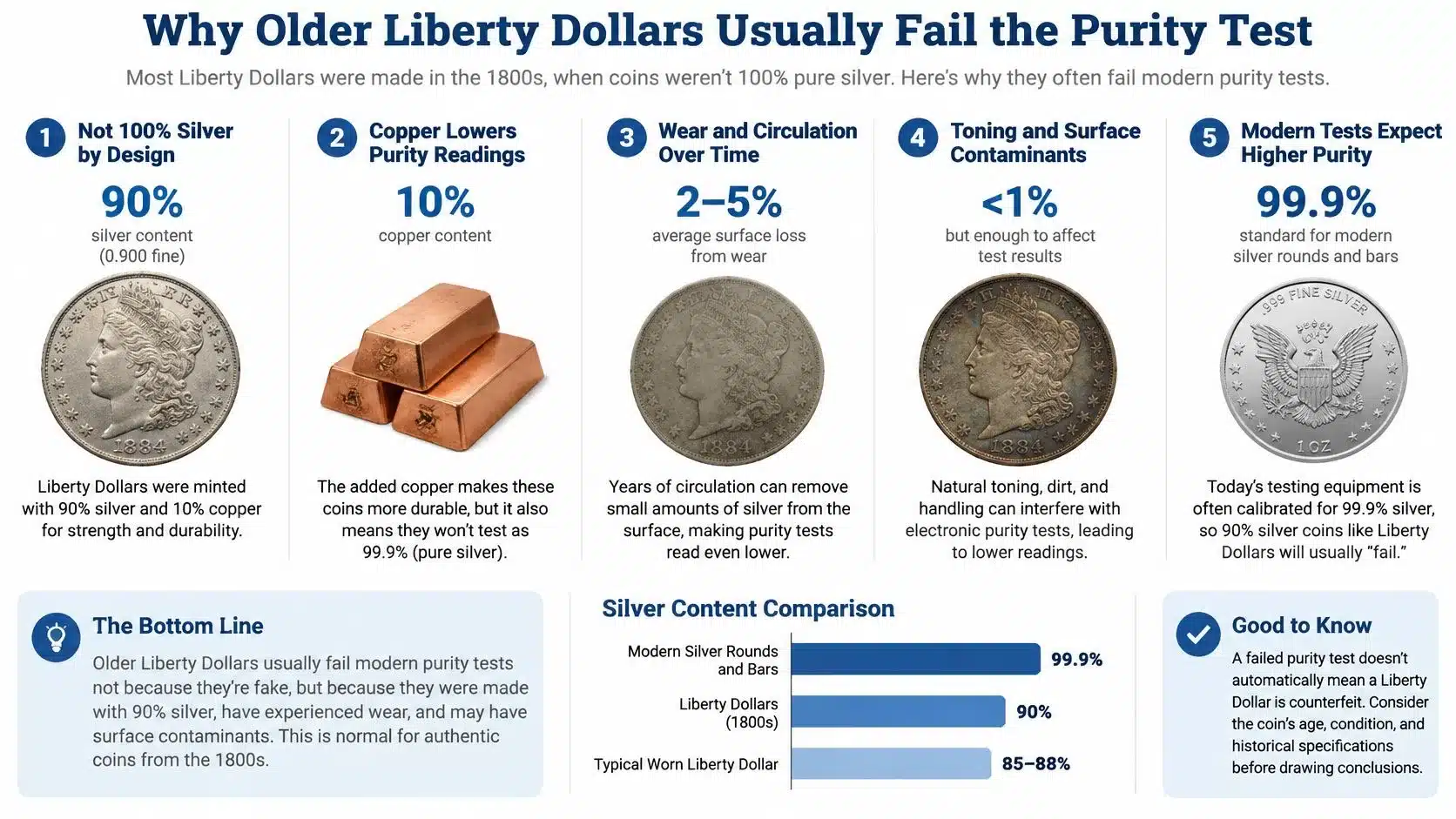
The U.S. Mint's Morgan and Peace dollar history records Morgan production from 1878 through 1904, followed by 1921, and describes the original alloy as 90% silver and 10% copper, with approximately 0.7734 troy ounce of pure silver per coin. Its size and dollar denomination shouldn't be mistaken for a full-ounce silver holding.
The Mint identifies original Peace dollar production as 1921 through 1928, then 1934 and 1935, and distinguishes these original 90%-silver issues from modern versions. The original Peace dollar shares the Morgan's alloy standard, giving both coins the same fineness profile.
Both series show why an impressive silver coin fails a retirement-account purity screen: a 90% alloy falls well short of the 99.9% fineness the qualifying comparison coin meets. The alloy is fixed at minting, so a coin's history, condition, and authentication details sit on top of it rather than changing it.
The Silver Eagle comparison
For contrast, the U.S. Mint's American Eagle specifications list 1.000 troy ounce, or 31.103 grams, of 99.9% fine silver, a 40.60-millimeter diameter, and a reeded edge. Its $1 face value is a denomination, not a statement of purchase price.
A retirement saver comparing coins should therefore record:
- Gross weight, using the issuer's stated convention.
- Fine-silver content, separate from total alloy weight.
- Diameter and edge, matched to the exact issue.
- Fineness, supported by product documentation.
Older circulating alloys generally fail the relevant purity screen regardless of design. Keeping those specifications on the invoice or accompanying documentation makes the purchase easier to review later.
Modern Liberty Silver Medals and Commemorative Releases
Modern releases can look like original dollars while differing in composition, so each product needs its own specification check. A modern Morgan dollar and a nineteenth-century original share a name and portrait style but contain different alloys, and a buyer who assumes otherwise is checking the wrong document.
The U.S. Mint's modern Morgan and Peace program announcement separates the .999 fine silver issues introduced in 2021 from the circulating originals, with initial product limits of 175,000 Morgan coins and 200,000 Peace coins offered at $85 each; for 2023 it recorded uncirculated limits of 275,000 per design, authorized proof production of 400,000 per design, and San Francisco proofs priced at $80.
Those figures record what the Mint authorized and charged at launch. They say nothing about what a dealer asks, or a buyer pays, on the secondary market today.
Medals and special releases need their own review
The U.S. Mint's 2022 American Liberty Silver Medal specifications describe a proof-format, 99.9% fine-silver medal weighing 1.000 troy ounce and measuring 40.60 millimeters. A medal can match a bullion coin's weight and fineness profile while remaining a different product class, so the product category line on a listing matters as much as the metal line.
The Mint's 2026 enhanced uncirculated American Eagle listing specifies a 125,000 mintage limit, a Liberty Bell privy mark for the 250th anniversary, and a reeded-edge variation described as an enhanced security feature. Those details are useful identifiers, and the buyer should see them on the product itself or its sealed packaging rather than taking them on faith from a listing title.
Keep the classifications separate
A careful buyer applies four distinct questions:
- Design, identifying the exact Liberty-themed product rather than assuming shared artwork means shared specifications.
- Purity, establishing the metal's fineness without inferring legal status.
- Collectability, separating bullion exposure from premiums attached to finish, packaging, or scarcity.
- IRA acceptance, reviewing coin versus medal, government versus private issuer, and the custodian's documented position.
Gold IRA Association's explanation of the Buffalo silver round offers a useful comparison for distinguishing a privately minted round from a government-issued coin.
Scarcity limits supply; demand sets price. A premium paid for a privy mark or presentation finish can disappear entirely when the owner sells.
How to Verify a Liberty Silver Coin Before Buying
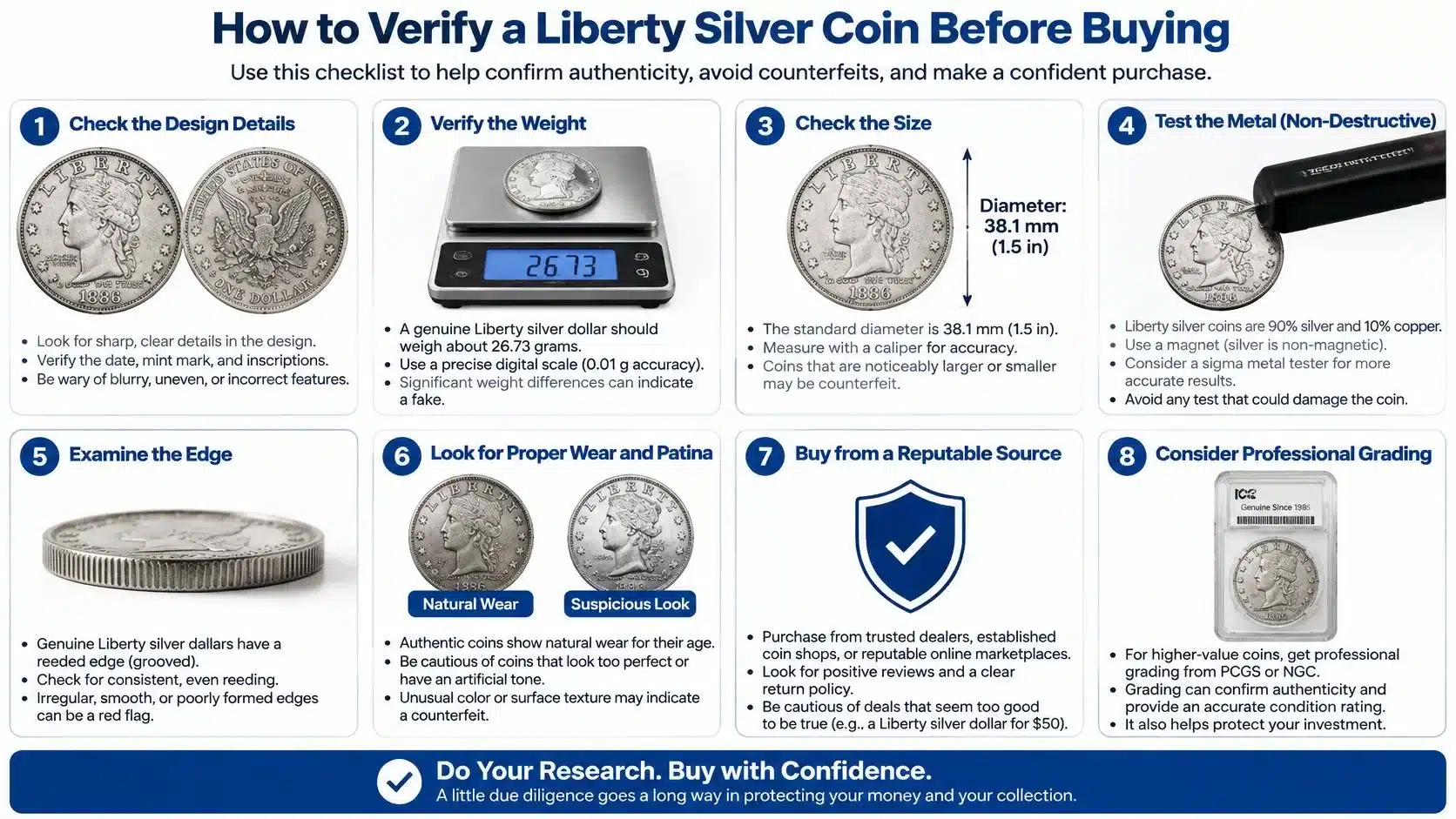
Identify the issuer and exact product. The record should contain the complete product name and official product identifier where available, not a generic Liberty silver coin.
Check denomination, date, and mintmark together. The U.S. Mint's 2025 uncirculated Eagle listing identifies West Point and a W mintmark, while the corresponding San Francisco proof issue carries an S mintmark; these are distinct products, not interchangeable descriptions of every Eagle that year.
Match weight and fineness to the precise issue. A calibrated scale and digital calipers can reveal discrepancies, but measurements alone aren't conclusive authentication. Sealed collector packaging shouldn't be opened casually just to complete a home check.
Identify the finish. Bullion, uncirculated, and proof describe different versions. The seller's invoice should match the product offered for custodian review.
Inspect the edge and special marks. Compare reeding, plain edges, mintmarks, and privy marks with the issuer's description. An unusual feature needs an official explanation, not a scarcity claim.
Obtain written custodian confirmation. The response should identify the exact issue and any conditions relating to packaging, certification, dealer delivery, or storage.
Retain the purchase record. Keep the receipt, listing, photographs, packaging information, certification details, and written acceptance together.
Compare the all-in cost. Request the total acquisition price and a contemporaneous buyback indication before treating a quoted premium as reasonable.
The following checklist can help organize the purchase file.
Compare metal exposure with the premium
Identical metal specifications don't guarantee identical purchase prices. A buyer may pay extra for finish, mint facility, packaging, certification, or collector demand without acquiring more silver.
Say a retirement saver receives quotations for an ordinary bullion Eagle and a presentation-box collector version. The useful comparison separates the silver exposure, purchase premium, likely selling spread, and account costs rather than treating the more expensive version as superior.
A complete verification record explains what was purchased, why it was accepted, and which costs were paid beyond the metal value.
Gold IRA Association's guide to investing in American Silver Eagles provides additional context for evaluating the product category. Eligibility and investment suitability remain separate decisions, and neither follows from an attractive package or a low production limit.
Liberty Silver Coins FAQ
Can a 1921 Morgan dollar go in a Silver IRA?
No. Original circulating Morgans fall below the fineness bar that governs IRA metals, and a prized date or mint mark adds nothing the purity test can count. A saver who wants the Morgan design can satisfy that interest through a qualifying modern bullion product instead.
Can a Liberty Silver Medal sit in the same IRA as Silver Eagles?
Possibly, but the medal can't borrow the Eagles' status. A coin may carry a statutory basis for acceptance while a medal, classified separately by the Mint, stands or falls on its own documentation. The practical step is to submit the exact medal issue to the custodian for written confirmation before buying, even if the account already holds approved Eagles.
Are proof American Eagles eligible?
That depends on the specific release rather than the Eagle name. Ask the custodian to confirm the exact year, finish, and packaging in writing before ordering, since a graded or presentation version may be judged differently from ordinary bullion.
Do the rules change?
Custodian product policies and official interpretations can shift, so verify eligibility on the day of purchase rather than relying on an older dealer description.
Confirm Eligibility Before You Buy
Before funding a purchase, confirm three things in order: the product itself, its documented acceptance, and the transfer path that will move money into the account.
A buyer can admire a Morgan dollar, own a Liberty medal outside an IRA, and hold standardized bullion inside a retirement account without contradiction. Design, silver purity, collectability, and custodian approval are separate tests, and a coin can pass some while failing others.
Put the product decision before the transfer
The verification steps above already describe what a sound purchase file contains: product identity, documented acceptance for the exact issue, full cost visibility, and clearly assigned transfer responsibilities. What matters here is sequence. Settling the product choice first keeps a committed transfer from pressuring a buyer into whatever a dealer happens to have in stock.
Transfers deserve attention independently of the metal selection. For readers working with an intermediary, Kons Law's discussion of IRA transfer issues for brokerage professionals offers additional context for questions about transaction handling; it doesn't replace advice about an individual transfer.
The Gold IRA Association team can help readers find educational information relevant to their retirement goals and financial situation. Locating that information is a different step from obtaining a custodian's product approval.
Keep the decision proportionate to the retirement plan
Eligibility works like a boarding pass: it gets a product into the account, but it doesn't decide how much of the portfolio that product should occupy. Retirement savers still need to weigh liquidity needs, ongoing account expenses, and the consequences of selling during unfavorable conditions. A qualifying coin bought with money the saver may need soon can be the wrong holding even when every rule is satisfied.
Readers seeking help locating educational material about Liberty silver products and account questions can contact Gold IRA Association at 888-910-8386.
Gold IRA Association offers plain-language guides, product explanations, and provider comparisons for retirement savers evaluating precious metals accounts. Readers can visit Gold IRA Association to prepare informed questions about a specific Liberty silver product before discussing a purchase with their custodian.


