



If a silver coin is pure enough for an IRA, why can the same coin still trigger a taxable distribution? The answer comes down to custody as much as purity. Readers who understand IRA eligible silver check both the product and where it's held before any money moves, because passing one test while failing the other isn't enough.
Eligible Silver Coins and Bars at a Glance
The short answer is narrow. An IRA can hold one-ounce silver coins minted by the U.S. Treasury and certain silver bullion that meets the 0.999 fineness standard, provided an approved trustee or custodian holds the metal. Everything else needs closer scrutiny, and many familiar products don't qualify at all.
U.S. tax law treats most precious metals as "collectibles" for IRA purposes, which generally makes an IRA investment in those assets taxable as a distribution in the year of purchase. According to IRS Publication 590-A, an IRA may hold one-ounce silver coins minted by the U.S. Treasury, as well as certain silver bullion that satisfies the applicable requirements. That exception is a specific carve-out, not permission to hold any silver product.
IRA Eligibility of Common Silver Products
| Product | Weight | Fineness | IRA status |
|---|---|---|---|
| American Silver Eagle (U.S. Treasury) | 1 oz | 0.999 | Eligible when held by an approved custodian |
| Canadian Silver Maple Leaf | 1 oz | 0.9999 | Commonly accepted as bullion; confirm with custodian |
| Silver bars from recognized refiners | 100 oz or 1,000 oz | 0.999 or higher | Eligible if fineness and custody rules are met |
| Privately minted rounds | 1 oz | 0.999 or higher | Eligible only with documented fineness and custodian approval |
| Pre-1965 U.S. dimes and quarters | Multiple denominations | 0.900 | Not eligible; below 0.999 fineness |
| Proof and numismatic silver coins | Set by individual issue | Set by individual issue | Not eligible as collectibles |
The one-ounce detail matters for U.S. Treasury coins. It distinguishes an expressly permitted coin from an otherwise similar coin in a different weight. A heavier or lighter government coin doesn't automatically inherit the same treatment just because it's made of silver.
Bars and rounds work differently. A large bar from a recognized refiner can qualify as bullion at 0.999 or higher, while a privately minted one-ounce round needs documented fineness and the custodian's approval before purchase. Stamps on the metal help, but documentation and custodian acceptance close the loop.
Practical rule: Match the exact product name, weight, and fineness against the table, then get the custodian's confirmation before shopping.
Older circulating coins confuse many savers. Pre-1965 dimes and quarters contain silver, yet their fineness falls well short of the bullion standard. Proof and numismatic coins fail for a different reason. Their value leans on rarity, finish, or collector demand, which puts them on the collectibles side of the line.
The table reflects the general rule, not a guarantee for any single purchase. Custodians apply the rules to specific products and storage arrangements, so the custodian makes the final call. Checking that call first costs a phone call. Checking afterward can cost taxes.
The Two Tests Every Silver Product Must Pass
Eligibility isn't one decision. It's two separate gates, and a product must clear both. A coin can be pure enough and still fail because of where it's stored. A bar can sit in the right vault and still fail because it isn't pure enough.
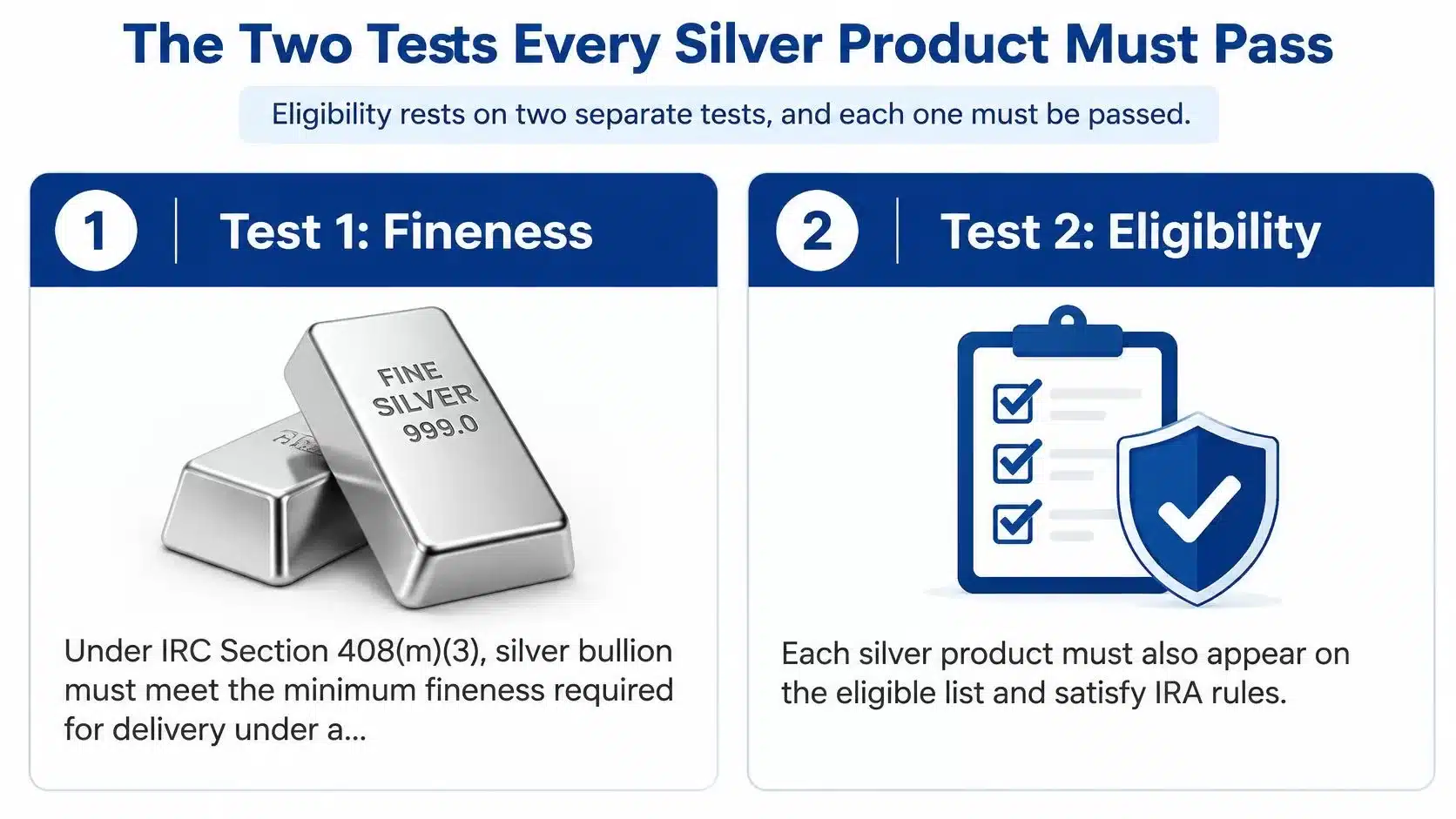

Test 1 Fineness
Under IRC Section 408(m)(3), silver bullion must meet the minimum fineness required for delivery under a regulated futures contract, and the IRS written determination on the collectible exception explains that in practice this generally means silver with at least 99.9% fineness. That's the 0.999 threshold. Products at 0.900 or other lower purities don't round up, and close enough doesn't count.
Test 2 Custody
The same framework requires the metal to remain in the physical possession of an IRA trustee or custodian. Personal storage isn't sufficient, even in a high quality home safe. If the investor or an unauthorized party holds otherwise qualifying bullion, the purchase can be treated as a collectible and therefore as an IRA distribution.
Readers comparing account structures can review the broader precious metal IRA rules before selecting a custodian. That step helps separate a normal brokerage IRA, which typically can't hold physical metal, from a self-directed account built for custodial possession.
Before funding any purchase, confirm these points in writing:
- Exact product: Full name, weight, and issuer match what the custodian approved.
- Fineness documentation: The dealer supplies records showing 0.999 or higher, where bullion treatment applies.
- Approved storage: The custodian names the depository and the chain of custody.
- Delivery route: Metal ships to the custodian's arrangement, not to the account owner's home.
Passing the fineness test never repairs a custody failure.
That distinction explains most surprises. Say a saver buys a qualifying one-ounce round, then asks the dealer to ship it home for inspection before forwarding it to a depository. The product may have passed test one, but personal possession puts test two at risk. Both gates must stay closed in the right order.
Silver Products That Fail the IRA Rules
A buyer paid a dealer premium for a one-ounce silver round marked "IRA approved." The custodian later refused that round. The premium stayed with the dealer, and the metal never entered the account.
The sticker only advertises what the dealer is selling. Custodian approval is a separate written decision by the trustee for that account. Sellers may state fineness and what they have in stock. They cannot approve IRA treatment on the custodian's behalf. The phrase works like a price tag on a locked case: it names the item, and someone else still holds the key.
Compare three lines before any payment goes out: the product name on the invoice, the mint mark, and the custodian's written approval. If those three do not match, the purchase fails even when the dealer calls it eligible.
Shipping instructions create a different failure. A dealer may list the buyer's home as the destination while the order is labeled for an IRA. That address sends the metal to the investor instead of the trustee's arrangement. Ask the custodian to name the depository and the ship-to in writing. If the dealer will not retarget the shipment there, cancel the order. Home delivery is not a workaround that keeps the purchase inside the IRA.
IRS Publication 590-B recognizes one-ounce U.S. silver coins minted by the Treasury Department as permissible IRA investments when a trustee or custodian holds them. A privately minted round sits outside that description, so it stands or falls on bullion fineness plus the same custody requirement. When the custodian rejects the round, replace it with a product the custodian has already approved, or leave that purchase out of the IRA.
Those rules decide only whether a given piece of silver may sit in the account. They do not decide whether silver suits a particular retirement portfolio. An eligible coin can still be a weak fit if storage fees or the allocation crowd out other goals. Clearing the IRS tests is permission to hold the metal, not a forecast of how the account will perform.
Silver IRA Funding Limits and Final Checks
New contributions to a silver IRA use the regular IRA limits for that calendar year. Holding silver does not create a separate allowance, so the tax year and the saver's age come before any purchase is sized.
The annual cap works like one measuring cup shared by a traditional IRA and a Roth IRA. Funding a silver account does not refill that cup.
The IRS IRA contribution limits page sets the figures in the table below: for 2025 the combined limit was $7,000, or $8,000 for individuals age 50 and older, and for 2026 it is $7,500, or $8,600 for someone age 50 or older; that page also states that rollover contributions do not count against the annual IRA contribution limit, and contributions can't exceed taxable compensation.
| Tax year | Under age 50 | Age 50 and older |
|---|---|---|
| 2025 | $7,000 | $8,000 |
| 2026 | $7,500 | $8,600 |
A 40-year-old can split the 2026 cap, for example $4,000 into a traditional silver IRA and $3,500 into a Roth IRA. Those two deposits use the full $7,500. They do not open a second $7,500 allowance in the other account.
Eligible funds moved from a workplace plan or another retirement account follow the rollover rule above, so they are not sized like a new annual contribution. Readers comparing account structures can review self-directed IRA limits before choosing a funding route.
Confirm the current year's figure with the IRS before acting, because limits change and last year's number may no longer apply.
A dollar amount that fits the cap can still be a poor portfolio choice. Silver that clears the tax rules may not suit a saver whose taxable compensation is already stretched, or whose retirement money needs to stay available for other goals.
Three final checks prevent most funding errors:
- Product check: The metal meets the 0.999 fineness standard or is a qualifying U.S. Treasury coin.
- Custody check: An approved trustee or custodian will hold the metal.
- Funding check: The contribution or rollover route fits the account and the saver's taxable compensation, and a product that passes still has to fit the portfolio.
Gold IRA Association's listed phone number is 888-910-8386. Readers can call that number or send a name, email, and message through the website's contact form.
These materials are for informational purposes only and are not financial, legal, or investment advice.
How to Buy, Store and Hold Eligible Silver
A dealer invoice with the wrong ship-to line can undo an otherwise careful silver purchase. The buy has to follow a set order, the way a relay baton stays with the assigned runner. Miss one handoff and a clean order can turn into corrective paperwork.
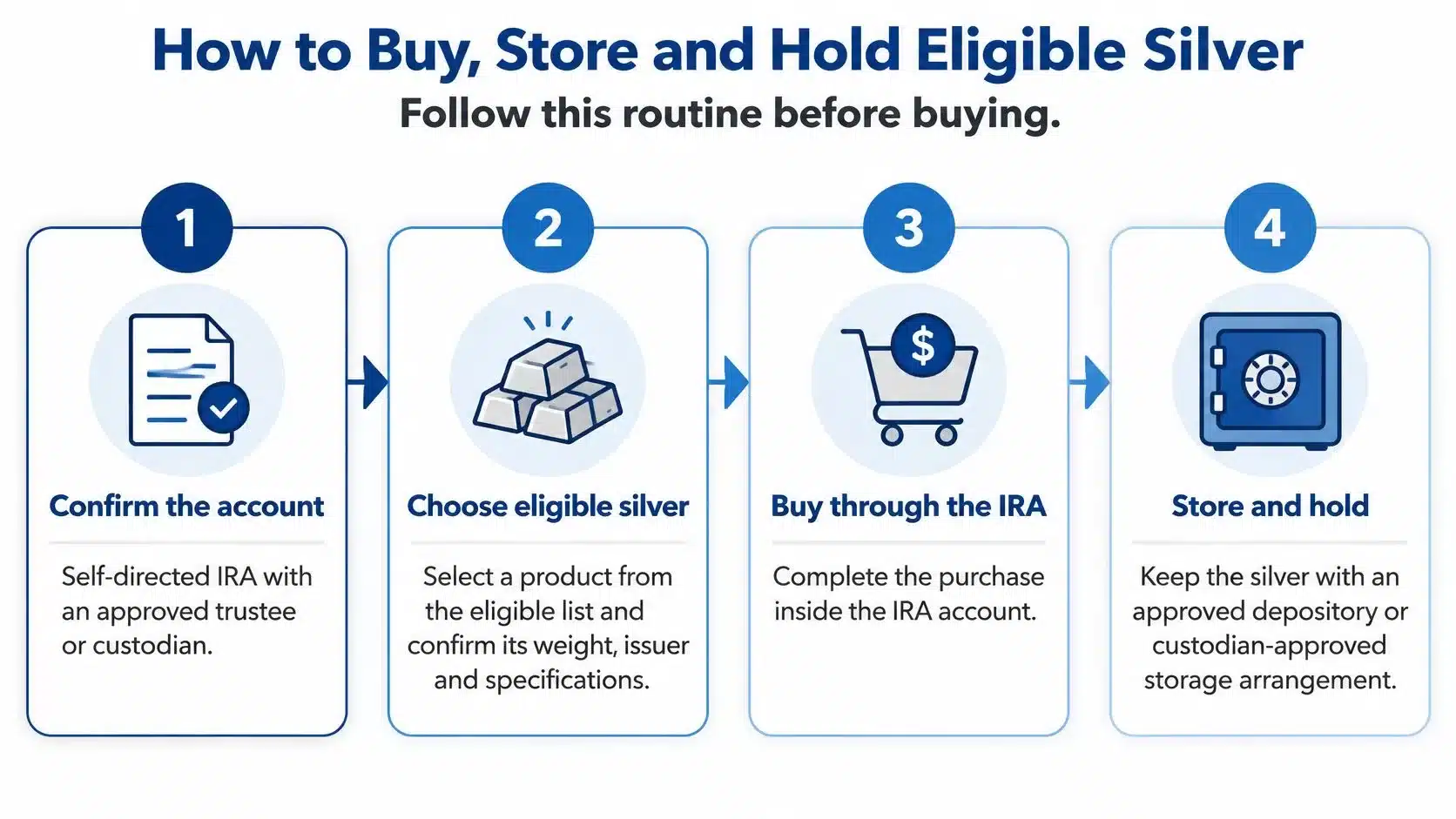
A Six Step Buying Routine
- Confirm the account: Open a self-directed IRA with an approved trustee or custodian. Funding a standard IRA that cannot administer physical metal is the usual slip.
- Choose from the eligible list: Match weight, issuer, and the fineness rule that applies to that product. A similar design swapped in at the last minute can fail the product check you already completed.
- Get documentation: Ask the dealer for the invoice, fineness paperwork, and depository name that line up with the earlier product-and-custody checklist.
- Direct delivery correctly: Instruct the dealer to deliver only into the custodian's depository. The custody check already rules out a personal address, so read the ship-to line before you pay.
- Compare total cost: Add the dealer premium, custodial and storage fees, and transaction charges. Guidance on precious metals storage helps readers separate storage charges from purchase spreads.
- Keep records: Retain purchase and custody records for tax reporting and for later sale or distribution questions.
Readers can send a direct message to Gold IRA Association to get help finding educational information about account rules and provider comparisons. That help is most useful before a dealer invoice exists, while changing a product is still simple.
What Holding Silver Involves
Physical silver is a metal position. It produces no operating-company cash flow, pays no dividend, and does not generate earnings. Price can move with industrial slowdowns, investor inflows, premiums, and dealer spreads.
Storage and insurance sit on top of that price. The IRA holder's result includes those costs along with the spot move.
Recent forecasts show why a single demand story is too simple. The Silver Institute February 2026 newsletter reports physical investment is forecast to rise 20% to 227 million ounces in 2026, while industrial fabrication is expected to decline to roughly 650 million ounces, a four-year low. Photovoltaic manufacturers reducing silver use and substituting other materials contribute to that softer industrial side.
Stronger investment buying and softer industrial demand can occur at the same time, and each describes a different part of the market.
Selling takes its own plan. Liquidation may take time, spreads can reduce proceeds, and storage plus insurance continue while the metal sits in the depository. Eligible silver can sit inside a broader retirement mix, and it can still lose principal. Passing the tax rules does not decide whether the holding fits a particular portfolio.
Frequently Asked Questions About IRA Eligible Silver
Are silver ETFs or mining stocks IRA-eligible silver?
No. An ETF share works like a claim on a fund, not a bar in the IRA's approved depository. A mining stock is a stake in a company. Neither is physical silver the custodian holds, so neither counts as IRA-eligible silver. Ask the custodian before using either as a substitute.
What happens if a purchased product does not qualify?
Contact the custodian and the seller right away. Keep the invoice, note the fineness, and note where the metal was delivered. A bar below the required purity fails the fineness test. Metal shipped home fails the custody test, because the IRA never held it in an approved depository. Moving that metal yourself can make the correction harder. A tax professional should explain how to fix the account.
Can personally owned silver be moved into a silver IRA?
Coins in a home safe generally cannot transfer in as an in-kind contribution. The IRA has to buy eligible silver, and the custodian has to place it in approved storage. Selling the personal metal and funding the account within the contribution rules is the usual route. Tax eligibility is separate from whether silver fits that retirement portfolio. Review the plan with the custodian and a tax professional before any sale.
Gold IRA Association publishes plain-English guides and reviews of Gold IRA companies, covering credibility, customer service, fees, and investment options. Readers comparing Gold IRA companies can use the contact form or call 888-910-8386. Advice is suited to retirement goals, and the team aims to respond within 24 hours. Visit Gold IRA Association.


