




A reader nearing retirement may sit with a 401(k) statement, a headline about inflation, and a simple question: Can part of that account hold physical gold or silver without creating a tax problem? Learning how to start a precious metals IRA means answering that question in the right order. The opening paperwork is only the start, because ongoing custody, valuation, total cost, and access to cash determine whether the account fits at all.
Five Steps to Open a Precious Metals IRA
Order matters because each step protects the next one. A common and expensive mistake is buying coins first, then discovering the chosen custodian cannot hold them, the product doesn't qualify, or personal delivery breaks the custody rules.
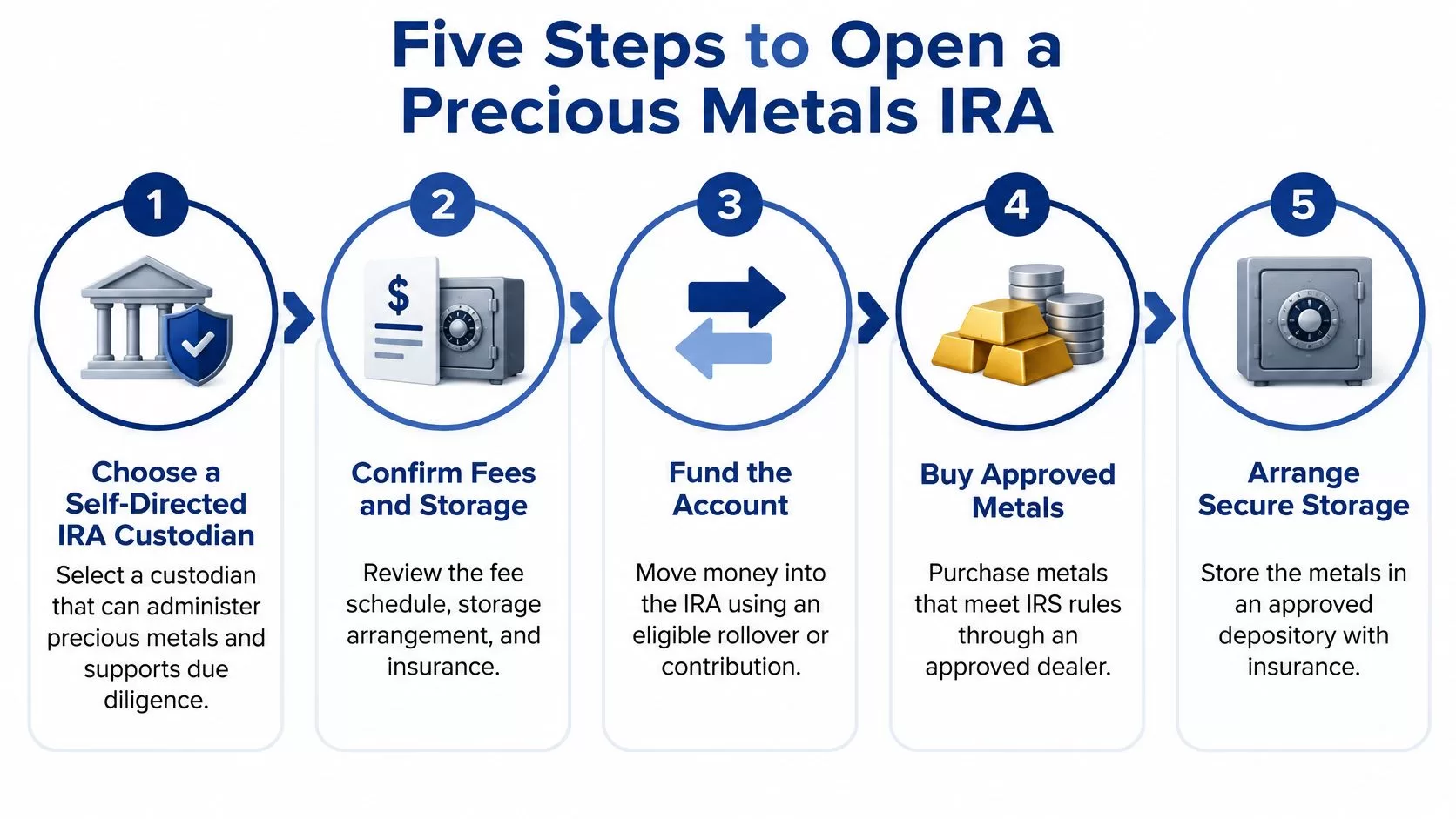

The Five Steps in Sequence
- Choose a self-directed IRA custodian: Select one that administers precious metals, using the due diligence checks that follow. A regular brokerage IRA usually isn't set up for physical metal.
- Confirm terms in writing: Review the fee schedule, storage arrangement, insurance, reporting, and dealer relationships before signing. Written answers prevent surprises after funding.
- Open and fund the IRA: Use a direct trustee-to-trustee transfer where possible, so money moves between institutions and no personal distribution occurs.
- Buy only qualifying products through the IRA: The IRA, not the individual, is the buyer. Metals purchased personally can't be placed into the account afterward.
- Send metals to approved custody: Delivery goes to an IRS-approved trustee or depository, not to a home address.
The IRS guide to IRA distributions supports this separation of administration, funding, purchasing, and custody, and notes that mandatory withholding generally doesn't apply when a plan sends a distribution directly to another eligible retirement plan or IRA. Personal possession can cause an asset to be treated as distributed.
Practical rule: A custodian's willingness to hold an asset doesn't by itself make that asset tax-qualified.
A Checklist to Bring to the First Call
Readers can print the five steps and tick off each item only after receiving written confirmation. Custodian name, eligible products, storage location, transfer method, and delivery destination should all be settled before any order is placed.
Choose a Custodian That Administers Metals
A custodian and a dealer do different jobs, and confusing them causes many misunderstandings. The custodian administers the IRA, handles account records and reporting, and must be able to hold physical metals through an approved arrangement. The dealer sells the metal. A separate depository often stores it.
That separation is a safeguard. When one firm both sells the metal and controls custody, the reader should ask how pricing, records, and storage are independently verified. Clear roles make errors easier to spot and correct.
Custodian Due Diligence Checklist
| Check | What a Good Answer Looks Like | Red Flag |
|---|---|---|
| IRS-approved trustee or custodian status | Written confirmation it administers precious metals IRAs | Vague answer or a request to skip documentation |
| Eligible product confirmation | Written list of approved coins and bars | Says any bullion or coin qualifies |
| Metal segregation and storage | Clear statement of the depository and how metal is recorded to your account | Storage handled at a location the custodian will not name |
| Reporting and valuation | Regular statements and a process for annual fair-market values | No defined valuation process |
| Transfer acceptance | Accepts direct trustee-to-trustee transfers from your current plan | Insists you take the funds personally first |
| Dealer relationship | Discloses any affiliated dealer and whether you may use another | Pressure to buy from a single in-house dealer |
Fees deserve a full review, and the cost discussion below covers how to model them. At the selection stage, the point is simpler. Every fee should appear in a written schedule, not only in a sales conversation.
Readers comparing administrators can review the guide to choosing an IRA custodian for gold before interviewing candidates. Responsiveness matters too, because valuation deadlines and transfer problems rarely wait for a slow reply.
Three Questions for Every Candidate
- Who physically holds the metal: Ask for the depository name and how holdings are recorded to the account.
- Who values the metal: Ask how annual fair-market values are produced and when they're due.
- What happens if the custodian closes: Ask how accounts and metals would transfer to a successor.
A candidate that answers plainly, in writing, has passed the first real test.
Rollover, Transfer or New Contribution Compared
A $300,000 401(k) can move to a new custodian without using any of the year's annual contribution capacity, provided rollover rules are met. That distinction surprises many savers. Funding method determines tax treatment, timing pressure, and whether the move counts against yearly limits.
The direct trustee-to-trustee transfer is the default choice for most readers because the current plan or IRA sends funds straight to the new custodian. The account holder never receives the money. To start one, ask the current plan administrator for a direct rollover form, name the new custodian as payee, and track the transfer until funds arrive. Readers still working may ask about an in-service rollover, but availability depends on the employer's plan rules.
Funding Methods Compared
| Method | How Money Moves | Withholding | Counts Toward Annual Limit |
|---|---|---|---|
| Direct trustee-to-trustee transfer | Plan or IRA sends funds straight to the new custodian | Generally none | No |
| Indirect rollover | Funds paid to you, then deposited within a short IRS deadline | A portion may be withheld from employer-plan distributions | No |
| New annual IRA contribution | You deposit cash from current earnings | Not applicable | Yes, subject to the yearly limit |
Table notes: annual IRA limits are set by the IRS each year. See the IRS draft instructions for Form 5329 for how the combined traditional and Roth limit works and why the limit does not apply to rollover contributions.
An indirect rollover is riskier. Funds are paid to the individual, withholding generally applies to employer-plan distributions paid that way, and the full amount must reach the new IRA quickly. Missing the deadline or failing to replace withheld money can turn part of the movement into a taxable distribution. That replacement requirement is where ongoing cost matters. You must make up withheld dollars from other savings to complete a full rollover, or the shortfall may be taxed and penalized.
New contributions follow different rules. They are limited each year, they require eligible compensation, and they share one combined ceiling across traditional and Roth IRAs. Rollovers and direct transfers do not use that ceiling. A side by side explanation of a direct transfer versus a rollover can help readers confirm which route a form describes.
Rules vary by plan and personal circumstances. A tax professional should confirm the route before any distribution is requested.
Which Metals and Coins the IRS Allows
Start with a simple filter. An IRA can hold only the metal products the tax code singles out. According to IRS Publication 590-A, an IRA may hold certain U.S. gold coins in one-, one-half-, one-quarter-, and one-tenth-ounce denominations, one-ounce U.S. silver coins minted by the Treasury, qualifying platinum coins, and certain gold, silver, palladium, and platinum bullion. For bullion bars, the publication sets a fineness floor of .995 for gold, .999 for silver, and .9995 for platinum and palladium. Highly refined bullion fits the exception only when a bank or an IRS-approved nonbank trustee holds it.
Eligible Metals by Type and Minimum Fineness
| Metal | Commonly Eligible Products | Minimum Fineness for Bars |
|---|---|---|
| Gold | American Gold Eagle in 1, 1/2, 1/4 and 1/10 oz; Canadian Gold Maple Leaf; gold bars | .995 |
| Silver | American Silver Eagle 1 oz; Canadian Silver Maple Leaf; silver bars | .999 |
| Platinum | American Platinum Eagle; Canadian Platinum Maple Leaf; platinum bars | .9995 |
| Palladium | Canadian Palladium Maple Leaf; palladium bars | .9995 |
Use the table as a starting checklist, not a purchase list. A product can clear the fineness floor and still fail the account's paperwork test if the invoice or assay does not match. The custodian should confirm each exact product in writing.
How to Check a Product Before Paying
Purity is checked through the stamp on the coin or bar and, for bars, an assay or certificate from the refiner. The dealer invoice should name the product, weight, and fineness clearly enough that the custodian can record it without guessing.
A 1-ounce American Gold Eagle is the classic eligible example. A rare coin bought mainly for collector value points the other way.
Numismatic and collectible coins, including most rare-date or graded pieces, generally don't qualify, even when the metal content is high. Collector appeal doesn't cure an eligibility problem, and marketing language doesn't either.
Readers who want background on coin selection outside an IRA can consult gold coin advice for Boise investors from Carat 24 – Trusted Gold Experts, then still confirm IRA eligibility separately with the custodian. That second step matters because a sound retail coin purchase and a qualifying IRA purchase are different decisions.
Verify form, purity, and storage before funding a purchase. A product that fails the statutory exception may lose the intended tax treatment. A product that passes still has to justify its spread, storage cost, and your need for cash.
What a Precious Metals IRA Really Costs
The central question isn't one fee. It's the break-even hurdle, meaning how much the metal must rise before the holder gains anything after spreads and recurring charges. The image below shows the paperwork side of that calculation, where custodial invoices sit beside the metal itself.
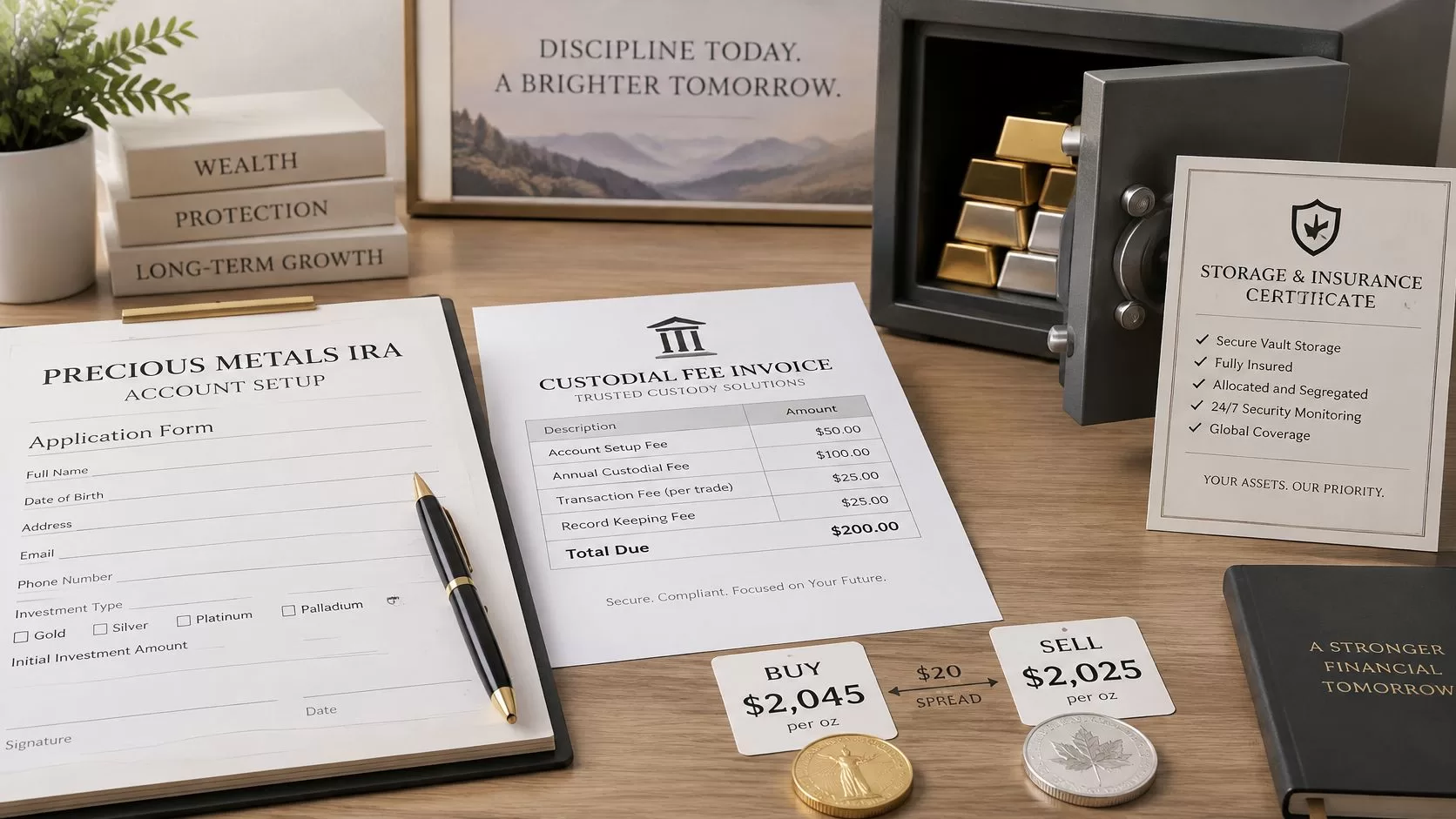
Cost Categories to Model Before You Buy
| Cost | How It Is Usually Charged | Question to Ask |
|---|---|---|
| Account setup | One-time fee | Is it refunded if the transfer does not complete? |
| Annual custodial | Flat fee or percentage of assets | Does the fee rise with account value? |
| Storage and insurance | Yearly, often by weight or value | Who insures the metal, and up to what value? |
| Dealer spread | Built into purchase and sale prices | What is the buy and sell spread on each product? |
| Shipping and assay | Per transaction | Are these charged on purchase, sale or both? |
| Distribution or sale | Per transaction or per sale | What happens if I need cash in a single year? |
The CFTC guide to precious metals fraud and costs cautions that precious-metals prices fluctuate, while dealer markups, commissions, storage, insurance, and administrative costs can materially reduce retirement savings, and notes that large bullion purchases may not make sense for someone retired or approaching retirement if high fees accompany the rollover. It also warns about collectible coins with high markups and low liquidity.
Investing in precious metals and IRAs involves risk, including the potential loss of principal. The break-even formula is simple enough to run at a kitchen table. The metal price must rise by the purchase spread plus the sale spread plus annual charges over the holding period, divided by the purchase price, before the holder gains anything.
The short video below offers another walk through account mechanics for readers who prefer to watch before running their own numbers.

Fixed annual charges weigh more heavily on a small balance than on a larger one, because the same dollar fee consumes a bigger share of the account. A fuller breakdown of precious metals IRA fees can help readers build that comparison before requesting quotes.
Liquidity deserves equal attention. Selling involves a bid-ask spread, paperwork through the custodian, and time. Partial distributions and required minimum distributions need cash, which can conflict with holding a less liquid physical asset.
Request a written fee schedule and model at least a five-year holding period. For some readers, a conventional low-cost portfolio will fit better, and reaching that conclusion early is a good outcome.
Keeping the Account Compliant After Opening
Opening the account is not the main compliance event. The recurring work after funding is, because the owner must help supply annual fair-market values to the custodian for IRS reporting and keep a clean separation between personal assets and IRA assets.
The U.S. Government Accountability Office report on unconventional IRA assets warns that owners can have difficulty supplying updated valuations for annual IRS reporting, and that an inaccurate or late valuation may lead to premature distribution at the wrong value and potentially threaten the account's tax-favored status. A prohibited transaction generally causes an IRA to lose its status for the year, with assets treated as distributed at fair market value.
Compliance Scenarios and the Correct Action
| Situation | Risk | Correct Action |
|---|---|---|
| Keeping metals at home | Treated as a distribution, with possible taxes and penalties | Have the custodian arrange approved depository storage |
| Using IRA metals as loan collateral | Possible prohibited transaction and loss of account status | Do not pledge IRA assets; ask the custodian first |
| Selling personal coins to the IRA | Prohibited self-dealing | Get tax professional advice before any transfer of personal holdings |
| Late or inaccurate annual valuation | Distribution at the wrong value and reporting errors | Provide the valuation through the custodian by its deadline |
| Beneficiary change or estate transfer | Delays and unclear title to the metal | Update beneficiary forms and involve an estate attorney |
Each situation has the same root cause. The investor, custodian, depository, and dealer must remain separate roles, with the IRA treated as its own owner rather than an extension of a personal safe.
A Simple Annual Calendar
- Confirm valuations early: Ask the custodian for its deadline and required format each year.
- Retain core records: Keep statements, purchase receipts, delivery notices, and depository records together.
- Review product status: Recheck the eligible product list when IRS guidance changes.
- Update beneficiaries: Confirm forms after marriage, divorce, deaths, or estate plan changes.
Advisors who serve retirement clients face similar documentation demands, and a guide to RIA client growth from Advisor Momentum offers context on how advisory practices build systematic client processes. Readers can borrow that systems mindset without turning recordkeeping into a burden.
Precious Metals IRA Questions Investors Ask
A few practical situations come up again and again once the account is open. Each one has a clear next step that protects the tax status of the metals.
Suppose a bank offers a lower rate if retirement assets are listed as collateral. Signing that pledge can be treated as a distribution of the amount involved, with tax and possible penalties. Pause the loan paperwork and ask the custodian in writing whether the proposed language creates a prohibited transaction before anything is signed.
Suppose a 401(k) check arrives made payable to you instead of the new custodian. Cashing it starts the 60-day clock and possible withholding. Forward the uncashed check details to both plan administrators at once and request a corrected trustee-to-trustee transfer, with the payee naming the new custodian for your benefit.
Suppose an inherited graded or rare coin is offered for deposit. Value as a collectible does not make it eligible. Send the exact mint, weight, purity, and product number to the custodian and buy only after receiving written confirmation that the item meets IRS requirements.
Two funding questions also cause confusion. A rollover from an existing plan is separate from a new yearly contribution, so one does not use up the limit for the other. Price expectations deserve the same caution, and why expected returns are not guarantees from Artul.ai explains that distinction in plain terms.
Ongoing fees, storage charges, and limited liquidity form a break-even hurdle. Readers who may need steady withdrawals should compare that all-in cost against a conventional mix before funding.
Next Steps Before You Fund the Account
Before metal is ordered, get the account's ongoing cost and compliance duties in writing. Compare the all-in expense against how long you expect to hold the account and any need for regular income. A metals IRA can be a poor fit when liquidity matters or when fees take too long to recover. Metals and IRAs carry risk, including possible loss of principal.
A licensed financial advisor or tax professional can weigh the account against a conventional diversified portfolio, your time horizon, and any need for regular income. Get advice specific to your situation, and remember that a more conservative route may suit some households better.
Before funding, assemble the document checklist, ask the custodian for written answers to any remaining fee and account-handling questions, and book an advisor conversation. For account-rule questions, call a Gold IRA specialist at 888-910-8386. You can also send a direct message to Gold IRA Association for help finding educational information about account rules and provider comparisons.
The materials on Gold IRA Association's website are provided for informational purposes only and are not intended as financial, legal, or investment advice. The decision belongs to you and your advisor, made calmly and without pressure.
For plain-English guides on rollovers, eligible metals, custodian selection, and total account costs, visit Gold IRA Association and use its educational comparisons to prepare sharper questions before funding a precious metals IRA.


