




The common advice to roll a TSP into a Roth IRA leaves out the most important detail: a direct rollover isn't necessarily tax-free. A separated federal employee moving pre-tax TSP savings into a Roth IRA is making a taxable conversion, not merely changing account providers. The decision requires identifying which balance will move, planning how to pay the tax, and understanding when the converted money can be spent.
What a TSP to Roth IRA Rollover Is Taxed As
A federal employee leaves service, opens a Roth IRA, and requests a transfer of traditional TSP savings. The employee expects no tax because the money never enters a checking account. That expectation confuses the payment method with the tax treatment.
According to the TSP's withdrawal guidance, traditional money rolled into a Roth IRA is taxable in the current year, and no income tax is withheld from that rollover. Estimated tax payments may therefore be necessary. Moving the same traditional money directly to a traditional IRA generally preserves tax deferral instead.
The source balance and destination determine the federal tax result. The word “rollover” alone doesn't establish whether a transaction creates income.
Tax result by TSP source and destination
| Source balance | Destination | Taxed this year | Withholding on a direct rollover |
|---|---|---|---|
| Traditional pre-tax TSP | Traditional IRA | No, deferral generally continues | Generally none |
| Traditional pre-tax TSP | Roth IRA | Yes, the pre-tax amount is ordinary income | None, so estimated tax may be needed |
| Roth TSP | Roth IRA | Generally no | None |
| Mixed traditional and Roth TSP | Split or partial Roth destination | Only the traditional slice sent to the Roth IRA | None on the direct Roth slice |
An existing Roth TSP balance generally doesn't create another income-tax charge merely because it moves to a Roth IRA. Those contributions were made with after-tax dollars. However, that doesn't mean every subsequent withdrawal, including earnings, automatically qualifies for tax-free treatment.
A mixed TSP account therefore needs more than a single account-balance figure. The participant needs a breakdown showing traditional money, Roth money, and the intended destination for each.
Deferral and conversion serve different purposes
A traditional IRA rollover postpones the tax decision. A Roth conversion brings previously untaxed income onto the current return in exchange for Roth treatment going forward, subject to applicable distribution rules.
For readers comparing those objectives, Fintrack's explanation of tax deferral strategies for 2026 provides context for understanding postponed taxation. Deferral isn't forgiveness, and conversion isn't an automatic tax reduction.
Practical rule: A transfer can avoid withholding while still creating an income-tax bill.
Federal treatment also doesn't settle the state-tax question. A tax projection should address the participant's state of residence, other income, and available cash, rather than assume the federal result applies everywhere. Current-year brackets and administrative rules should be verified before paperwork is submitted.
Gold IRA Association's website materials are provided for informational purposes only and aren't intended as financial, legal, or investment advice. Before selecting a withdrawal amount, the participant should print the traditional-versus-Roth breakdown and circle only the traditional portion intended for conversion.
How to Complete a Direct TSP to Roth IRA Rollover
The cleaner payment route is usually a direct rollover, with the TSP paying the receiving Roth IRA custodian rather than the participant. That arrangement reduces handling mistakes without changing the taxable character of pre-tax money.
The process begins with eligibility and account instructions, not with a distribution request.
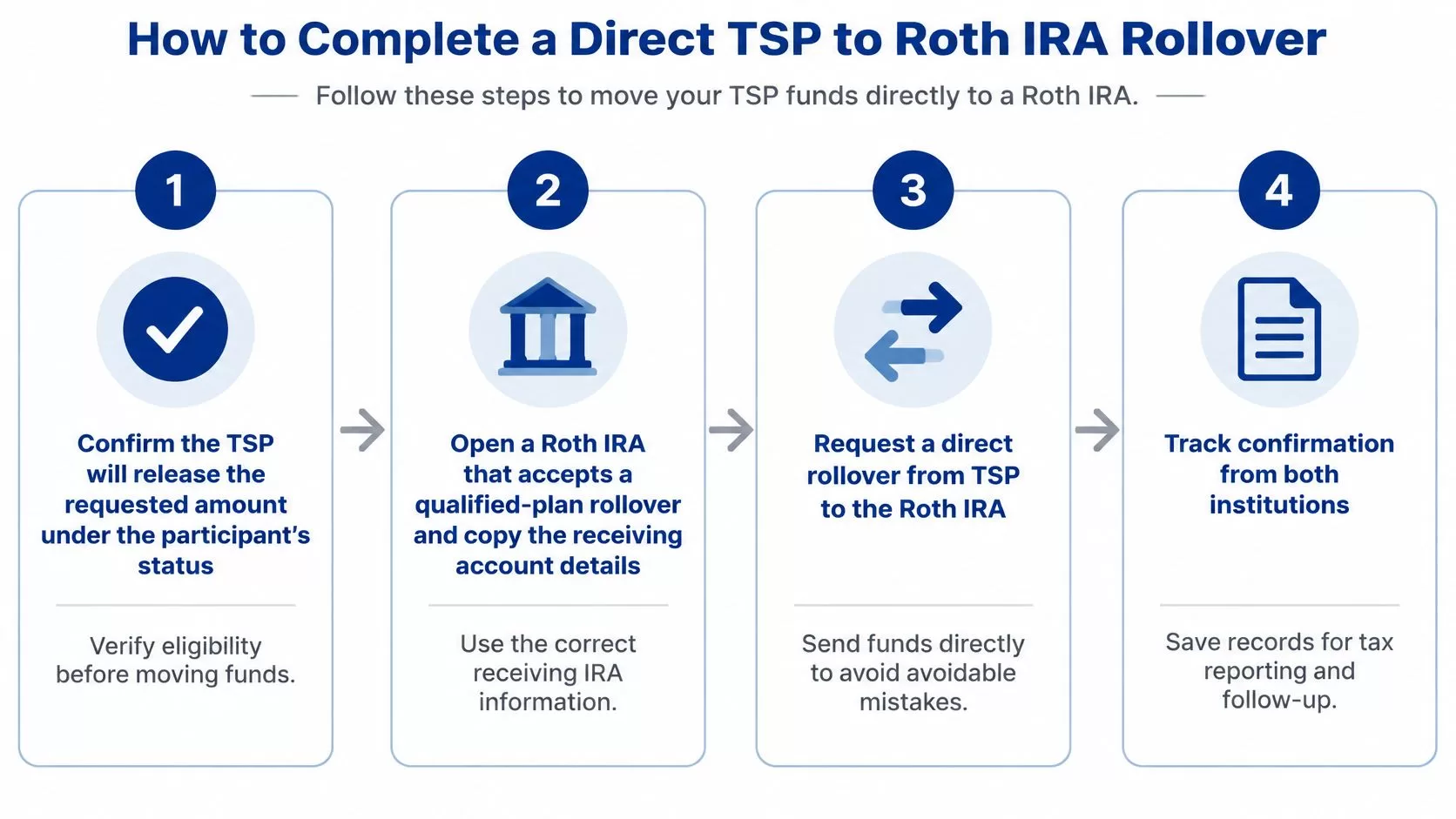

The direct rollover sequence
Confirm withdrawal eligibility. The participant should establish that the TSP permits the requested distribution under the participant's employment or beneficiary status. Opening an IRA doesn't create a right to withdraw TSP money.
Prepare the receiving Roth IRA. The receiving institution must accept a qualified-plan rollover. Its instructions should identify the account number, exact payee wording, delivery address, and any required rollover documentation.
Request payment to the custodian. The TSP withdrawal request should specify a direct rollover to the Roth IRA. The payee instructions matter more than whether a check passes through the participant's hands.
Identify the correct source balance. For a mixed account, the participant should distinguish the traditional amount being converted from any existing Roth TSP money. Roth money should retain a Roth destination.
Reserve outside cash for taxes. The conversion amount should be supported by a written tax estimate and a payment plan. A tax professional can determine whether an estimated payment is appropriate.
Save the transaction records. Keep the TSP confirmation, receiving custodian's receipt, and subsequent tax documents together. Reconcile the requested amount with the amount credited.
Why an indirect rollover creates a funding problem
The TSP's rollover information distinguishes direct movement from a distribution paid to the participant, which generally carries 20% withholding and a 60-day rollover deadline. In the illustrative case of a $100,000 taxable traditional distribution, the participant typically receives $80,000 and must replace the withheld $20,000 from other funds to complete a full rollover.
| Indirect-rollover event | What happens in the example |
|---|---|
| TSP distributes the traditional balance | The gross distribution exceeds the cash received |
| Federal tax is withheld | The participant has a cash shortfall |
| Participant completes the full rollover | Outside money must replace the withheld amount |
| Participant deposits only the net check | The withheld portion remains outside the retirement account |
Depositing only the net amount doesn't make the missing portion disappear. That portion is generally treated as distributed, with income tax and potentially an additional early-distribution tax based on the participant's circumstances. The withholding is a tax payment credited on the return, not a reduction in the gross distribution.
For a Roth conversion, the converted pre-tax amount remains taxable even when the rollover is completed properly. Completing the full rollover addresses where the money ends up, not whether the conversion creates income.
A participant-payable check shouldn't be accepted casually. The replacement funds and deposit arrangements should already be in place before choosing an indirect rollover.
Eligibility Timing and the Forms You Need
A participant separated from federal or uniformed service generally has a straightforward starting point: an eligible rollover distribution can be directed to a Roth IRA. When traditional TSP money makes that trip, the move is a Roth conversion, and each conversion starts its own five-year clock at the receiving IRA. Someone still employed must first establish whether an available withdrawal category permits the transaction at all.
The IRS rollover guidance explains the distinction between eligible distributions, direct rollovers, and distributions that cannot be rolled over. It also explains the 60-day rule and the 20% withholding generally applicable when a taxable eligible employer-plan distribution is paid to the participant.
Who can send TSP money toward a Roth IRA
| Situation | Roth IRA path | Main catch |
|---|---|---|
| Separated from federal or uniformed service | Eligible rollover can go directly to a Roth IRA | The Roth IRA must be open and able to accept rollover funds |
| Still employed and under 59½ | Generally no ordinary in-service rollover | Hardship withdrawals are usually not rollover-eligible |
| Age 59½ and still employed | In-service withdrawal may be available | Confirm the current TSP rule before requesting |
| Required minimum distribution due | Cannot be rolled | Take the RMD first; only the excess may be eligible |
| Roth TSP balance | Direct rollover to a Roth IRA | Access rules at the receiving Roth IRA still apply |
| Non-spouse beneficiary | Often a direct rollover to an inherited IRA | Not the same as a spouse's own Roth IRA |
Each category has its own rules, so choose the one that matches your status before filling out any forms. An age-based in-service withdrawal must satisfy current TSP requirements, and a financial-hardship withdrawal generally doesn't become rollover-eligible because the participant intends to redeposit it.
The beneficiary rows work the same way. A non-spouse beneficiary should confirm the inherited-account requirements before entering any receiving-account instructions, since spouse beneficiaries may have options that aren't available to other beneficiaries.
Confirm your category in My Account before you request the withdrawal.
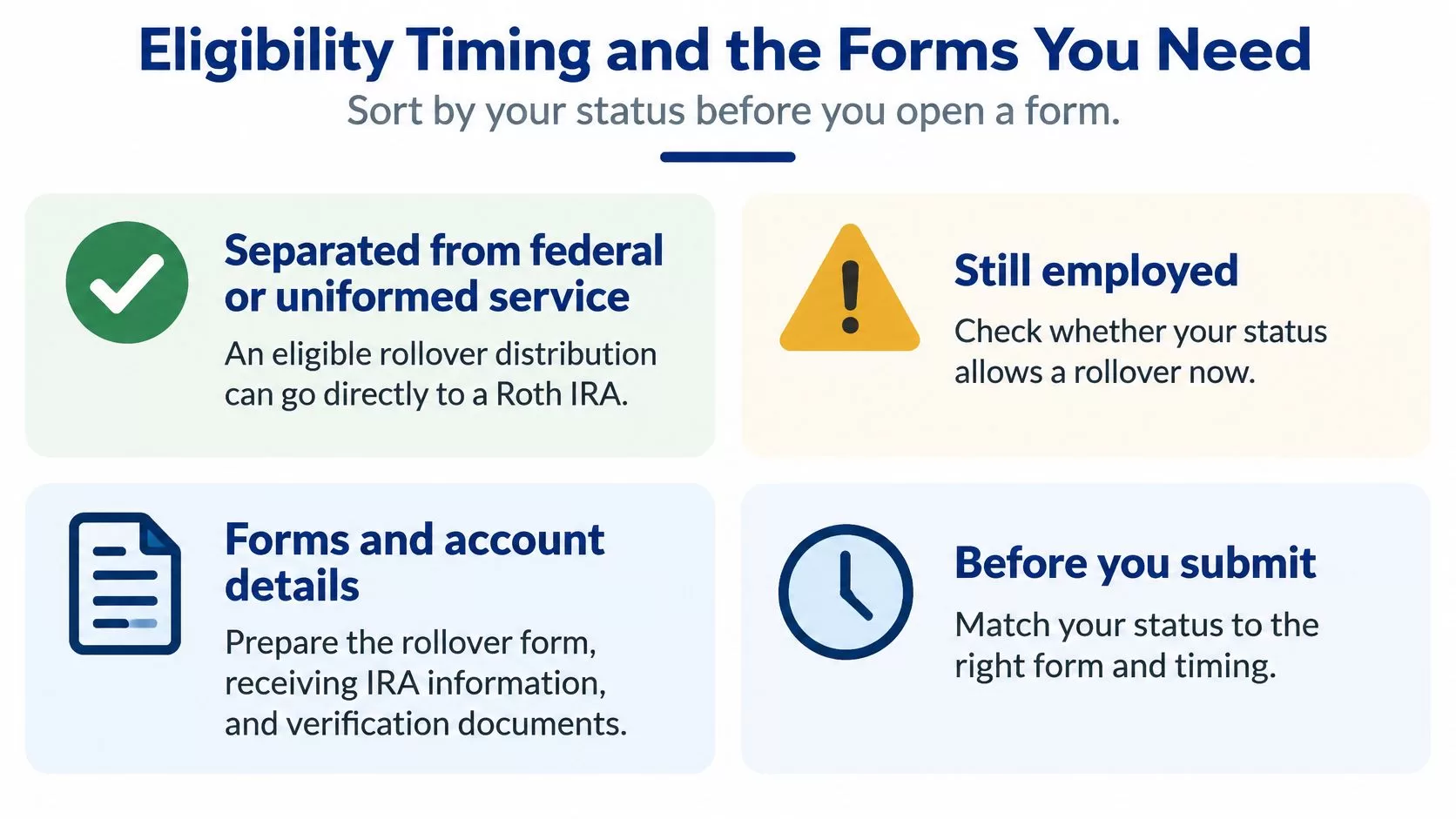
Assemble the request and reporting file
The participant should use the current TSP withdrawal process in My Account, or obtain the applicable paper package when online processing isn't available. Old downloaded forms shouldn't substitute for current instructions.
The transaction file should contain:
- Receiving account instructions. Include the Roth IRA registration, account number, exact payee line, and delivery instructions.
- Withdrawal confirmation. Retain the amount, source balance, payment destination, and distribution date.
- Tax reporting documents. Keep Form 1099-R from the distributing account and Form 5498 from the receiving IRA custodian.
- Reconciliation notes. Record any difference between the requested amount, distributed amount, and credited amount.
The payment method controls how the money moves. A withholding election only applies when a distribution is paid to the participant, so the participant should verify the payment destination before authorizing release.
Year-end timing deserves particular attention. The relevant tax year follows the TSP distribution, not merely the date the participant submits a request or sees a receiving-account posting. A December distribution can belong to that year even when the custodian posts the deposit in January, so the actual distribution date should be confirmed.
Five-Year Clocks After the Rollover
Consider a hypothetical FERS retiree who leaves service at 57 and converts traditional TSP money into an established Roth IRA. The retiree assumes the older account makes the newly converted money immediately available without an additional tax. That assumption can be wrong.
IRS Publication 590-B explains that each conversion or rollover contribution has a separate five-year period, beginning on January 1 of the conversion tax year, and that withdrawing taxable converted amounts early can trigger a 10% additional tax unless an exception applies. This is particularly important before age 59½, even when the Roth IRA itself is older.
The timeline separates account qualification from conversion access.
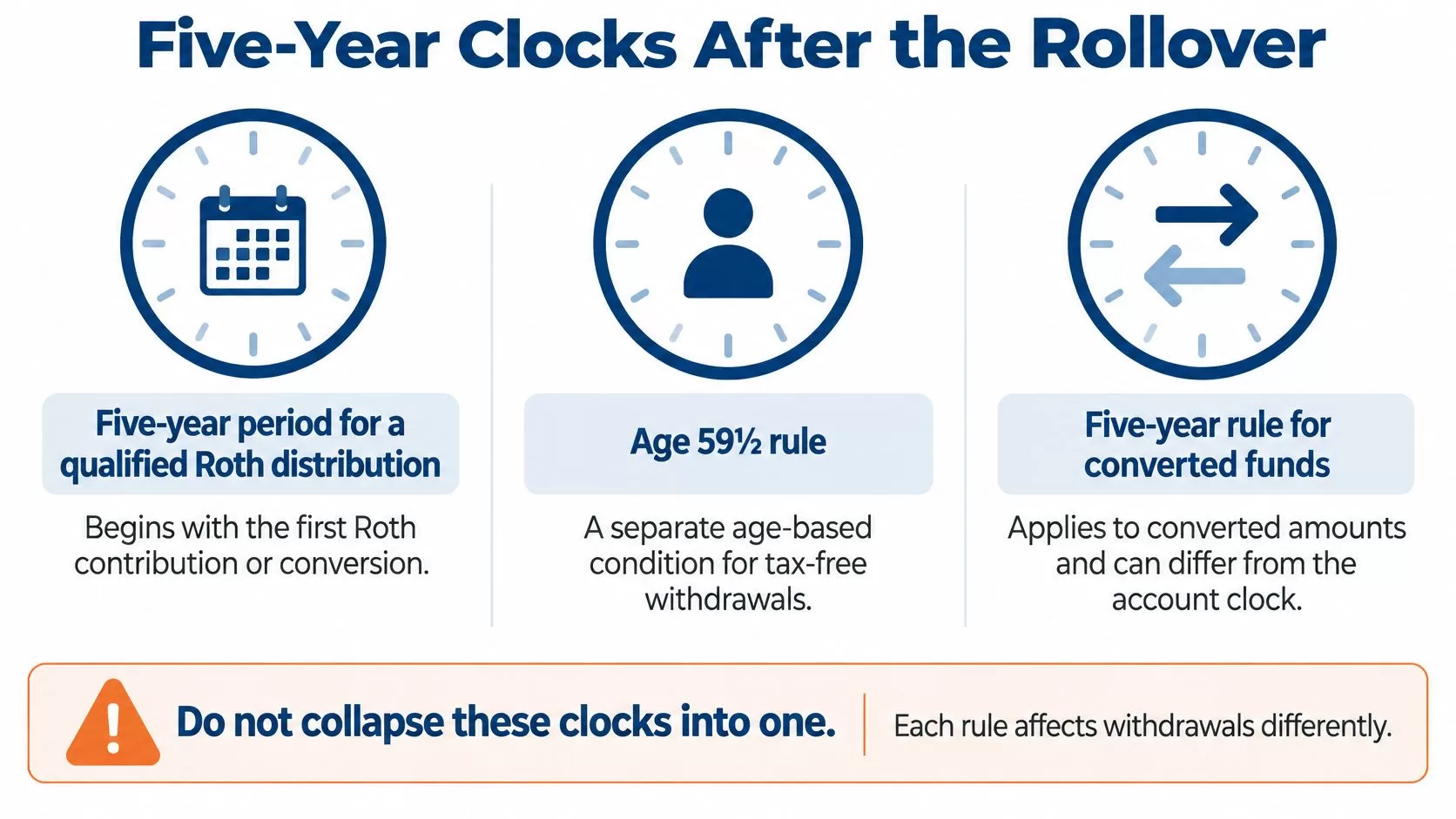
The account period and conversion periods aren't interchangeable
The Roth IRA qualified-distribution period concerns whether a distribution, particularly its earnings component, meets the requirements for qualified treatment. It generally begins with the first tax year for which a Roth IRA contribution was made, including a conversion contribution.
The conversion period addresses a different issue: whether an early withdrawal of a taxable converted amount triggers the additional tax. An established Roth IRA doesn't automatically satisfy the separate period for a newly completed conversion.
The age-based exception is another condition, not another account-opening date. Reaching the applicable age generally provides an exception to the early-distribution additional tax, but it doesn't by itself satisfy the requirements for a qualified distribution of earnings.
An older Roth IRA can satisfy an account-history requirement without making every newly converted dollar unrestricted spending money.
Repeated annual conversions require separate records because each has its own tax-year starting point. The household should maintain a conversion ledger showing the year, gross conversion, taxable portion, and any later withdrawals.
Identify which money leaves the account
Roth IRA withdrawal ordering generally treats distributions as coming from regular contributions first, conversions next, and earnings last. Those layers shouldn't be collapsed into one balance just because the custodian displays one account total.
Important precautions include:
- Protect the tax-payment reserve. An early retiree shouldn't assume converted principal can safely fund the conversion tax.
- Check the payment record. A direct rollover confirmation doesn't establish that tax was withheld.
- Exclude required distributions. An RMD isn't eligible conversion money.
- Preserve source records. Existing Roth TSP amounts and newly converted traditional amounts aren't interchangeable tax layers.
Gold IRA Association's explanation of the five-year rule provides additional background. Readers can consult a professional advisor for advice specific to their own situation before spending converted funds.
The following video offers another format for reviewing the rollover topic.

Partial Conversions and a Worked Example
A conversion decision doesn't have to cover the entire traditional balance. The TSP's withdrawal information distinguishes eligible destinations and source balances, so a participant holding both traditional and Roth TSP money should evaluate the traditional portion on its own. Only the pre-tax side creates a conversion tax bill when it moves to a Roth IRA.
Consider a hypothetical retired couple with $200,000 in traditional TSP savings, pension income, and no Roth TSP balance. The amounts below illustrate timing choices, not projected tax savings or investment returns.
Three ways to handle the same hypothetical balance
| Approach | Taxable in 2026 | Withholding on direct rollover | Main risk |
|---|---|---|---|
| Convert all $200,000 in 2026 | $200,000 | None | One large income spike that can push the return into a higher bracket and a different Medicare premium tier |
| Convert $40,000 annually for five years | $40,000 | None on each direct rollover | An installment sized for a low bracket can land in a higher one if income rises in a later year |
| Roll to a traditional IRA, convert later | None | None on the direct rollover | The balance stays pre-tax, and every later conversion is taxed under the rules in force that year |
These are hypothetical planning paths. The staged amounts total the starting balance only if investment changes, fees, and other withdrawals are ignored.
Each annual conversion also starts a separate five-year period of its own, the ordering covered in the previous section.
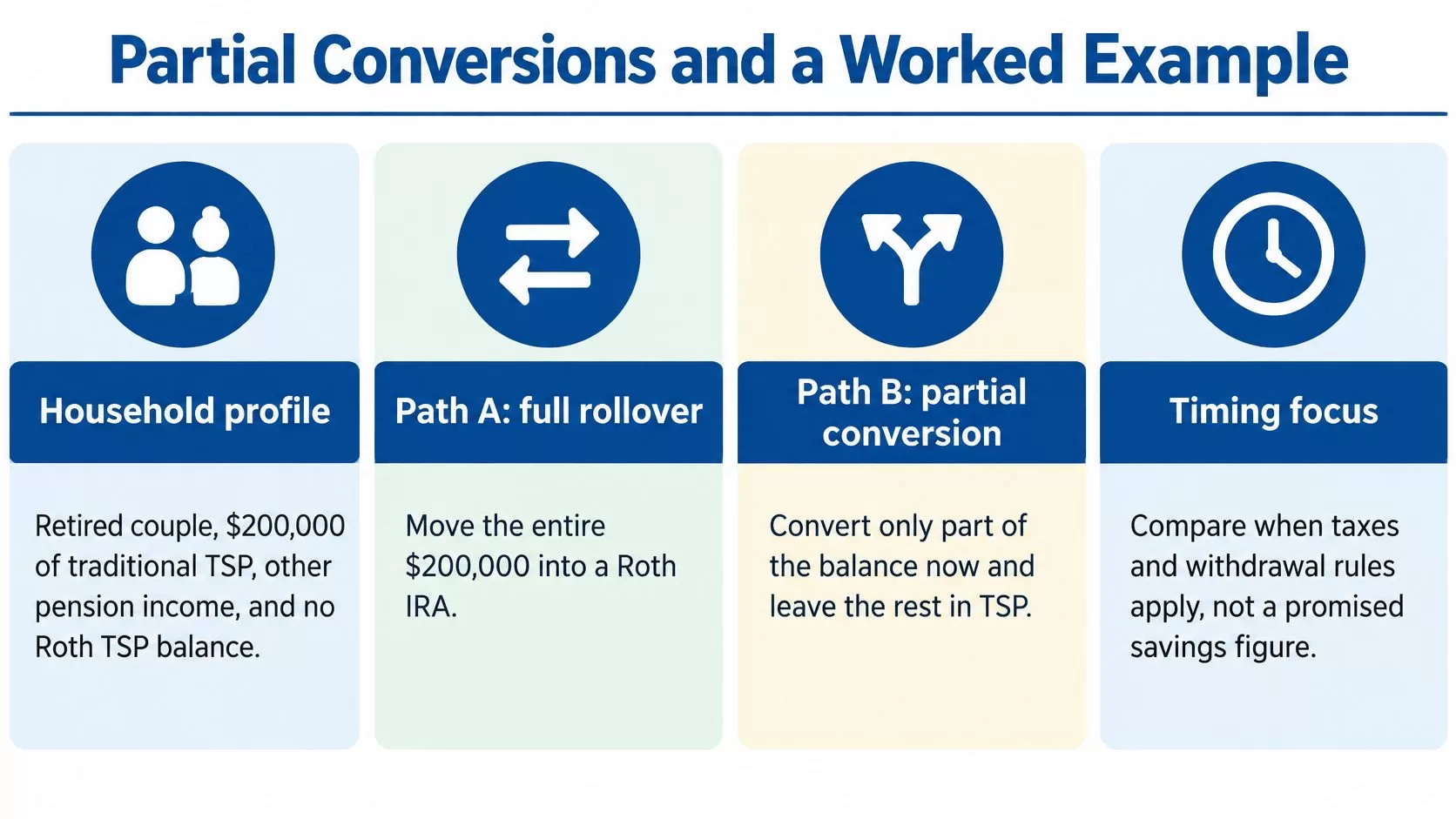
Compare the complete return, not just the conversion
The full-conversion path places a large amount of additional income on one return. Whether that is acceptable depends on the household's pension, deductions, other taxable income, state treatment, and ability to pay the resulting bill.
The staged path gives the couple an opportunity to reassess before each transaction. Staging may keep you in a lower bracket in 2026, but it leaves a second conversion decision for each future year. Every year has a bracket ceiling, and this path fills the room beneath it five times rather than overflowing it once.
The traditional IRA path postpones the conversion decision while changing the account location. Before choosing it, the couple should compare investment costs, account features, and any tax complications associated with existing IRAs.
Additional conversion income may move a household into a higher marginal bracket or affect Medicare premiums in a later assessment period. A projection should use current thresholds rather than assumed future limits.
How the tax gets paid shapes which path fits this couple. Covering a $200,000 conversion's liability calls for far more available cash in one year than covering five installments of $40,000, and pulling the tax out of retirement money shrinks the balance that was just converted. A staged plan spreads that liability across five returns rather than reducing it.
Roth Conversion Questions People Ask
Can a TSP-to-Roth conversion be undone?
Under current law, a completed Roth conversion generally can't be reversed through recharacterization. The participant should verify the current IRS treatment before authorizing the transfer and treat the request as final. Once processed, the converted amount is fixed as taxable income for that year, and its five-year tracking period starts on its own schedule.
A tentative tax estimate is a poor reason to rush a transaction that can't be unwound.
Does the TSP withhold tax on a direct Roth rollover?
The TSP reports the direct rollover to the IRS on Form 1099-R for the year of the transfer. Because nothing is withheld at the source, the participant typically covers the resulting income tax through estimated payments during the year or a larger payment due with the return.
Payment timing deserves attention. A conversion processed late in the year leaves less room to spread estimated payments across the remaining quarters.
Can an employee who is still working roll TSP money into a Roth IRA?
Possibly, but only when current TSP withdrawal rules permit an eligible distribution. An age-based in-service withdrawal may provide a route; continued employment alone doesn't establish eligibility.
The participant should confirm which withdrawal category applies before opening a request, since the wrong category can stop the transfer before it starts.
Can a conversion raise Medicare premiums?
Higher conversion-year income feeds the measure Medicare uses to set premium tiers, so a large conversion can push a household into a higher bracket for premiums. The assessment draws on an earlier tax return rather than current-year income, which means the effect arrives on a delay. A tax professional can confirm which assessment year applies and how the added income compares with current thresholds.
A comparison of Roth IRAs and workplace retirement accounts helps separate the account-features question from the conversion decision itself, which turns on the household's full tax picture.
For timing, take a participant who converts in the year before a premium assessment draws on that return. The higher income can surface in a later Medicare premium notice, arriving months after the transfer itself felt finished.
Confirm the Tax Bill Before You Move the Money
Pick a conversion amount your tax projection supports, then request the transfer. A mixed TSP holds two kinds of money, and only the traditional dollars create a tax bill when they land in a Roth IRA. The participant should know which traditional dollars will move, how the tax will be paid, and whether the remaining cash reserve can still support retirement spending.
The order matters. A tax professional should test the proposed conversion against the household's full current-year return before any request is filed. That review sets the amount, and the amount drives the paperwork.
The final authorization checklist
- Amount selected. The request identifies a deliberate traditional conversion amount rather than an undifferentiated mixed balance.
- Projection reviewed. A written estimate places the conversion alongside pension income, other withdrawals, deductions, and state taxes on the current-year return.
- Payee instructions confirmed. The receiving Roth custodian's exact payee details are in hand before the TSP direct-rollover request is submitted.
- Roth destination verified. Existing Roth TSP money is directed to a Roth IRA so it keeps its Roth status.
- Access reviewed. Planned withdrawals account for each conversion's five-year clock and the participant's distribution rules.
Gold IRA Association's overview of IRA rollover taxes offers broader context, and no rollover guarantees a particular tax outcome or IRS result. If outside cash can't cover the projected tax, reduce the conversion amount or wait until the reserve can support it.
Any later gold or silver allocation would be a separate self-directed IRA investment decision involving an appropriate custodian, storage costs, and IRS eligibility and purity rules. It isn't part of the TSP distribution itself. Investing in precious metals and IRAs involves risk, including the potential loss of principal.
Gold IRA Association's materials are provided for informational purposes only, and a professional advisor can address a reader's specific situation.
Gold IRA Association offers educational rollover guides, account-rule explanations, and provider comparisons to help readers distinguish the tax decision from any later precious metals investment. Visit Gold IRA Association to explore those resources, or call 888-910-8386 to talk with a Gold IRA specialist about educational questions related to retirement-account options.


