




A 55-year-old investor may have spent decades building a 401(k) or traditional IRA, only to feel less comfortable with paper assets as inflation, market volatility, and economic uncertainty dominate the headlines. If physical gold or silver enters the retirement plan, precious metals storage becomes an immediate practical question, not an afterthought. The central issue is simple: personally owned bullion can be stored in several ways, but IRA-owned bullion must follow a separate custody structure.
Why Storage Is the First Decision a Precious Metals IRA Investor Faces
A retirement investor considering gold or silver usually has two decisions to make before placing an order. First, the investor must identify a qualified trustee or custodian and an approved depository. Second, the investor must select metals that meet the account's eligibility requirements. The storage arrangement affects both decisions.
The account, not the individual, owns the bullion. The custodian administers the retirement account and maintains its records, while the depository holds the physical metal. This division of responsibility is why storage can affect compliance, fees, insurance, distribution procedures, and the investor's ability to verify ownership.
A rollover also needs careful sequencing. Funds should move through the appropriate retirement-account process before eligible metals are purchased through the account. A provider that discusses coins and bars before explaining custody, depository arrangements, and total costs may be focusing on the product before addressing the structure.
Practical rule: Choose the custody and storage framework before choosing the specific bullion.
Why the vault decision affects the whole account
A custodian may work with one or more professional depositories. Those facilities may offer segregated storage, where identified assets are assigned to a client, or pooled storage, where the client owns a quantity or claim rather than a particular bar. Insurance, audit practices, delivery procedures, and transfer policies can differ between arrangements.
The fee structure matters, too. A value-based charge may be reasonable for one account size but costly for another. Flat minimums, separate insurance, transaction charges, and distribution fees can change the effective cost.
Investors who want the broader mechanics can review this guide to how a Gold IRA works. The important point is that the storage choice isn't merely about where a safe sits. It determines whether the account has a defensible custody chain from rollover to eventual distribution.
The Three Main Precious Metals Storage Options Explained
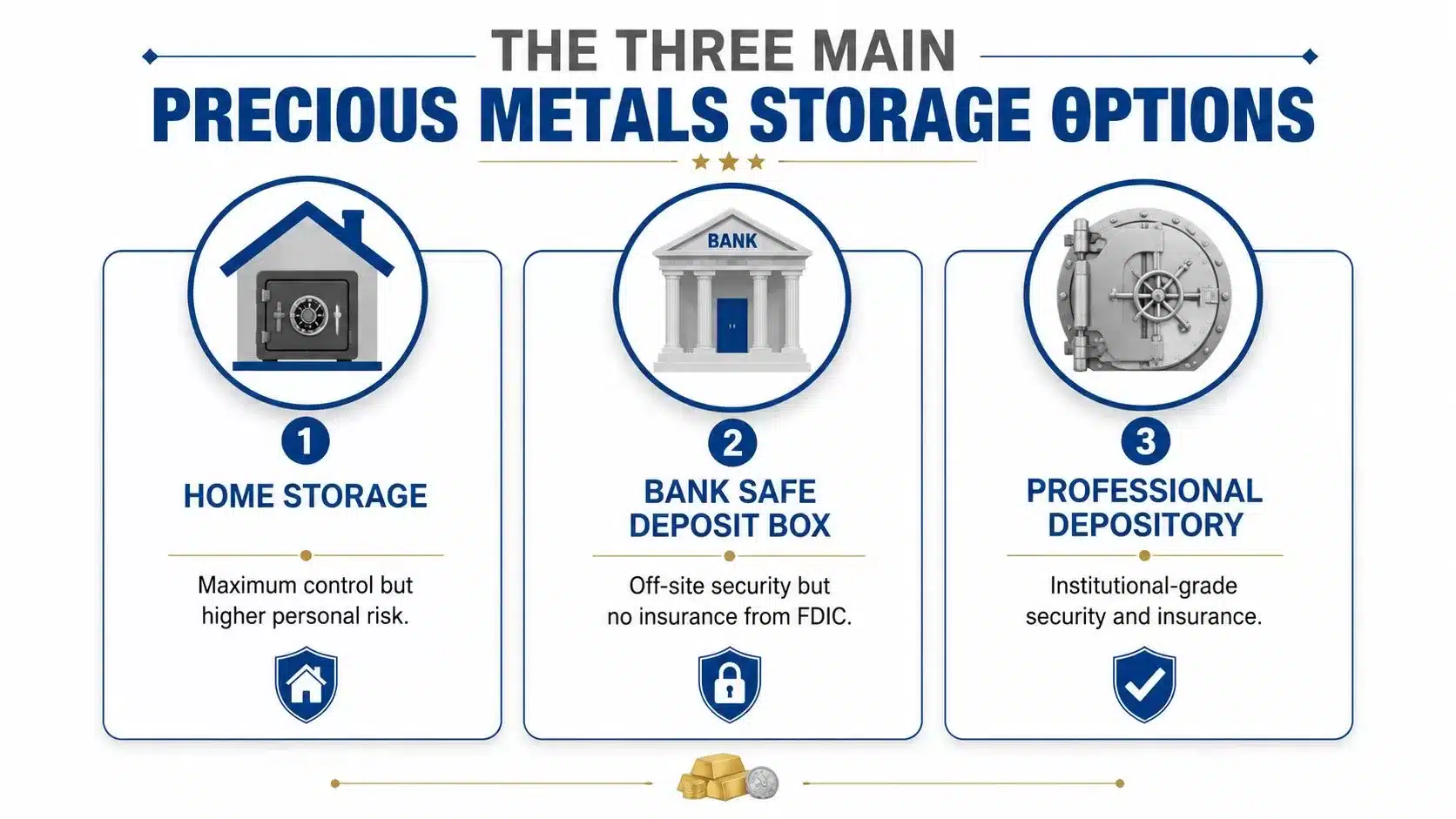
Physical bullion generally sits in one of three places: a private residence, a bank safe deposit box, or a professional depository. Each option serves a different purpose for personally owned metals. Only the third fits the normal structure for bullion owned by an IRA.

Home storage
A home safe offers direct access. The owner controls the location, can inspect the coins or bars without arranging an appointment, and doesn't pay a recurring vault charge. That convenience comes with responsibility for burglary protection, fire and water risks, inventory records, insurance, and estate access.
Home storage can make sense for personally owned bullion when the owner has an appropriate safe and understands the limits of household insurance. It isn't the same as institutional custody, and it doesn't create an acceptable IRA arrangement merely because the safe is strong or concealed.
Bank safe deposit boxes
A bank box is rented space inside someone else's secure building. It places the metal away from the residence and may be useful for documents, records, or personally owned bullion where limited access is acceptable.
A safe deposit box isn't the same as a bank deposit account. Contents generally aren't protected by ordinary deposit insurance, so the owner must understand what coverage exists and what exclusions apply. Access also depends on bank hours and the institution's policies.
Professional depositories
A professional depository resembles a specialized warehouse designed for high-value bullion. It may provide controlled access, inventory procedures, insurance, audits, and either segregated or pooled storage.
For an IRA, the depository operates within the custodian's approved custody framework. The account owns the metal, the custodian administers the account, and the depository holds the bullion. That structure is fundamentally different from placing retirement-owned coins in a home safe or personal bank box.
How IRS Rules Shape Where IRA Metals Must Be Stored
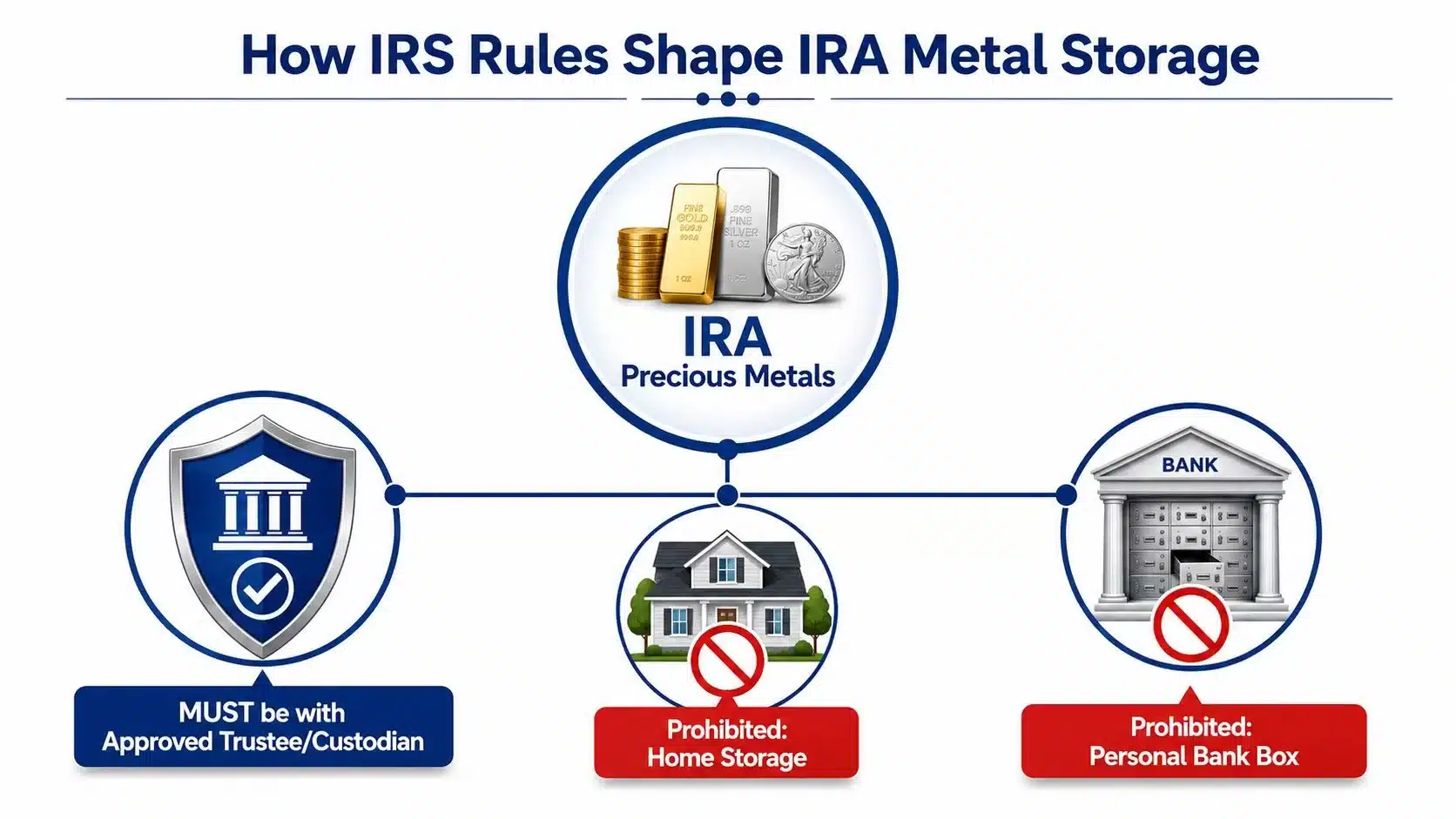
The key rule is that eligible bullion in an IRA generally must remain in the physical possession of a trustee or custodian. IRS guidance explains that qualifying bullion must be held by a bank or an approved non-bank trustee or custodian, rather than by the individual account holder, as described in the IRS guidance on collectibles in individual retirement accounts.
This rule creates a clear mental model:
- The IRA owns the metal.
- The custodian administers the account and records.
- The depository holds the physical bullion.
A self-directed IRA custodian handles administration, reporting, transactions, and documentation. A depository provides the physical storage environment. The two roles can work together, but they aren't interchangeable. An investor shouldn't assume that a dealer, a home safe, or a personal bank box can replace the approved trustee or custodian.
Why home storage creates a compliance problem
Some marketing materials describe a “home storage IRA” as though an individual can establish an entity, purchase bullion through it, and keep the metal personally. That arrangement should receive careful scrutiny. The IRS custody requirement means personal possession isn't the normal compliant structure for IRA-owned bullion.
If an account holder takes possession of retirement-owned metals outside the approved custody chain, the transaction may be treated as a distribution or otherwise affect the account's tax-advantaged status. The exact consequences depend on the facts, the account, and the transaction, so a tax professional should review any questionable arrangement before funds or metals move.
The same concern applies to a personal safe deposit box. A box rented by the individual doesn't automatically become an approved IRA depository. Investors should ask for the custodian's written explanation of where the metals will be held and which entity has physical possession.
The following video provides another visual explanation of the custody relationship:

For a broader overview, review the rules for precious metal IRAs. The IRS rule is the spine of the entire arrangement. A low storage quote doesn't help if the custody structure places the account at risk.
Segregated vs Pooled Storage and What You Actually Own
A vault can hold bullion securely while leaving an important ownership question unanswered: what exactly belongs to the IRA? The answer depends on the storage agreement.
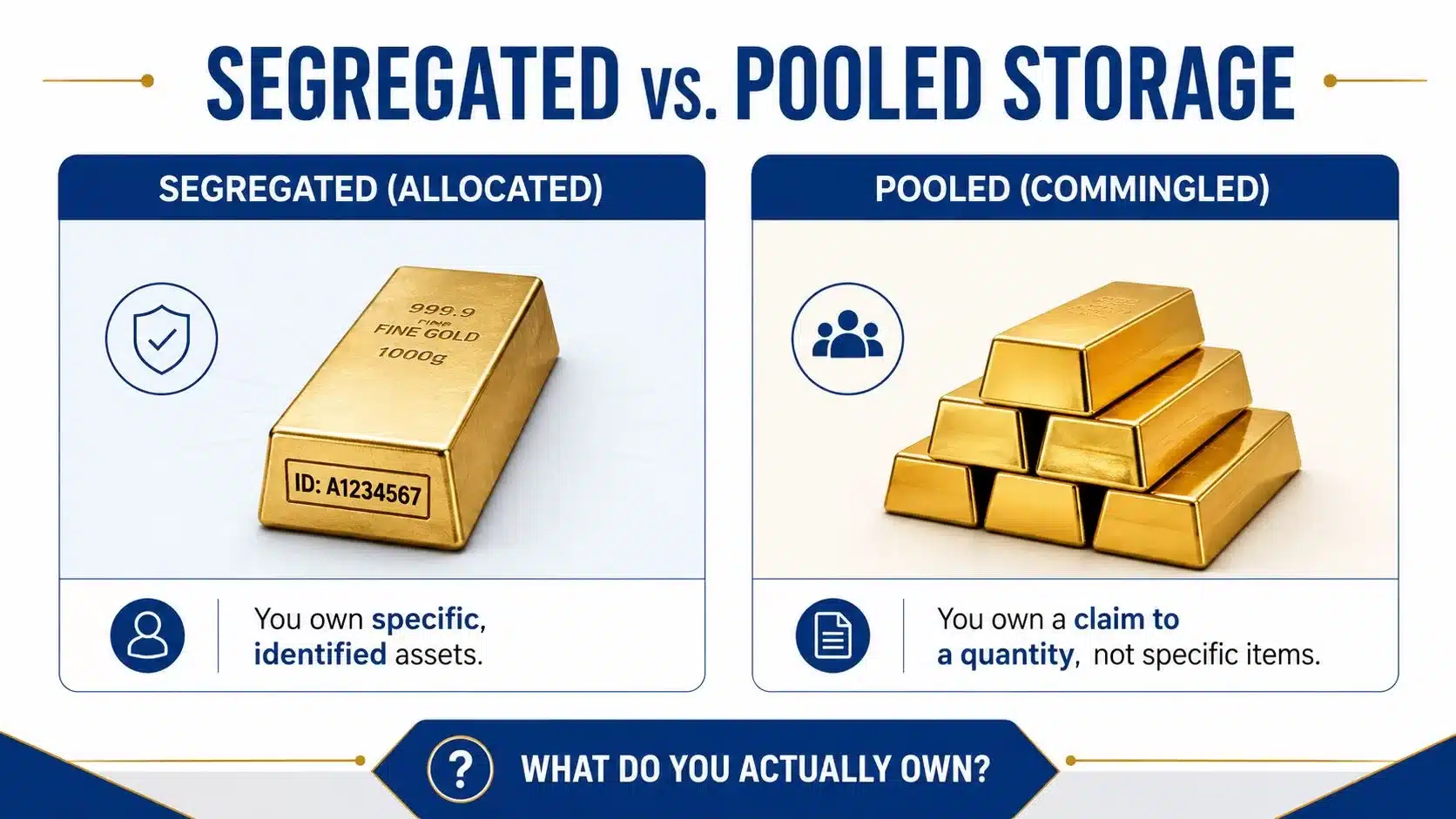
In allocated or segregated storage, specific bars, coins, or parcels are identified for a particular account. Records may include bar numbers, descriptions, weights, and other identifying details. The investor owns the identified assets, subject to the account's legal structure and the custodian's records.
In pooled or unallocated storage, the investor owns a stated quantity or a contractual claim rather than a particular serial-numbered bar. The arrangement may simplify transactions and reduce handling, but it offers less direct identification of the exact items associated with the account.
Questions that clarify ownership
The storage agreement should answer practical questions in plain English:
- Can the account identify specific bars or parcels?
- Does the custodian provide inventory statements?
- How often does an independent party audit the holdings?
- What insurance applies, and who underwrites it?
- Does coverage include theft, damage, and transportation?
- Can the account request an in-kind distribution?
- What happens if the investor changes custodians or depositories?
Insurance and audit language deserves close reading. “Insured storage” doesn't describe the policy limit, covered events, exclusions, claims process, or whether insurance is included in the quoted fee. A depository should explain those points in writing.
Security principles also apply beyond bullion. Readers assessing physical storage environments can consult this resource on storage facility security for Boston movers for a useful perspective on access controls, monitoring, and facility safeguards.
The cheapest arrangement isn't necessarily the least expensive if it leaves ownership records, insurance, or distribution procedures unclear.
The Real Cost of Precious Metals Storage
Storage fees are only one part of the bill. A provider may charge a flat amount, a percentage of asset value, or a combination of charges. Insurance may be included, or it may appear as a separate line item.
Published fee schedules show that insured vault storage can range from about 0.12% to 1.0% of asset value, depending on the provider, jurisdiction, and account size, as summarized in this precious metals storage cost guide. Some providers add insurance separately, which can make the effective rate higher than the advertised storage percentage.
A small account can be affected by a minimum annual charge. A larger account may find that a value-based fee becomes the dominant expense. That's why an investor should model the actual dollar cost for the specific account rather than compare percentages in isolation.
Storage Cost Components at a Glance
| Cost Component | How It's Usually Charged | What to Watch For |
|---|---|---|
| Storage | Flat fee or percentage of asset value | Minimums, tier changes, and whether the fee applies to all metals |
| Insurance | Included or billed separately | Policy limits, exclusions, and the identity of the underwriter |
| Custody | Account or administrative charge | Setup costs, annual administration, and transaction processing |
| Buying and selling | Spread or transaction charge | Difference between purchase and resale prices |
| Distribution | Shipping, handling, or processing charge | In-kind delivery procedures and insurance during transit |
| Transfer | Administrative or transportation charge | Costs when changing custodians or depositories |
Environmental controls are part of the value
A professional facility should manage the environment as well as physical access. The Canadian Conservation Institute says most stable metal objects can remain free of corrosion at or below 55% relative humidity, while 30% RH or lower is ideal; for silver, reducing relative humidity from 75% to 15% can reduce tarnish rate by a factor of three, according to this environmental controls guide for precious metals.
That doesn't mean tarnish automatically destroys bullion value. It does mean moisture control can reduce surface deterioration, particularly for silver. Investors should ask whether the storage facility monitors humidity, air quality, packaging, and handling procedures.
Over a long retirement, transaction and distribution charges can matter as much as the annual storage line. A useful comparison requests an all-in schedule for purchase, custody, storage, insurance, sale, transfer, and in-kind distribution.
Choosing a Custodian and Depository With a Practical Checklist
A good consultation should produce documents, not just reassurance. The investor can compare two or three candidates using three categories: custodian fitness, depository quality, and fee transparency.
Start with the custodian
Ask whether the proposed custodian is an approved bank or non-bank trustee, how it administers self-directed accounts, and which transactions it handles directly. The custodian should explain the rollover path, account documents, reporting responsibilities, and distribution process without suggesting that personal possession is acceptable.
The guide to choosing an IRA custodian for gold can help investors organize these questions before a call. A provider's explanation should remain consistent across written materials and verbal conversations.
Then examine the depository
The custodian or provider should identify the available depository and explain its storage model. Investors can ask:
- Physical possession: Which legal entity holds the metal?
- Storage type: Is the bullion segregated, allocated, pooled, or unallocated?
- Verification: How often are independent audits performed?
- Insurance: What does the policy cover, and is it included?
- Access and delivery: How are distributions, transfers, and shipments handled?
- Records: Will the account receive an inventory statement identifying its holdings?
A depository that refuses to explain these basics deserves caution. Security claims should be supported by written procedures, not only by phrases such as “high security” or “fully protected.”
Request the complete fee schedule
The comparison should include annual custody, storage, insurance, purchase, sale, transfer, and distribution charges. Ask whether the provider earns a spread on coins or bars and whether the quoted storage rate changes as the account value changes.
Gold IRA Association publishes educational material, rollover guidance, company comparisons, and fee explanations that can help readers prepare for these conversations. It functions as an information resource, not as the custodian or depository that ultimately holds an account's bullion.
A clear provider can explain the custody chain and total cost without pressuring an investor to decide during the first conversation.
Key Takeaways and Your Next Step Toward Compliant Storage
For retirement accounts, storage isn't a lifestyle preference. It's a legal and operational requirement. IRA-owned bullion generally must remain in the physical possession of an approved trustee or custodian, with the depository serving as the professional facility that holds the metal.
Three points deserve attention before any rollover:
- Home storage isn't the normal compliant path for IRA bullion.
- Allocated and pooled storage describe different ownership records.
- The cost includes storage, insurance, custody, transactions, transfers, and distributions.
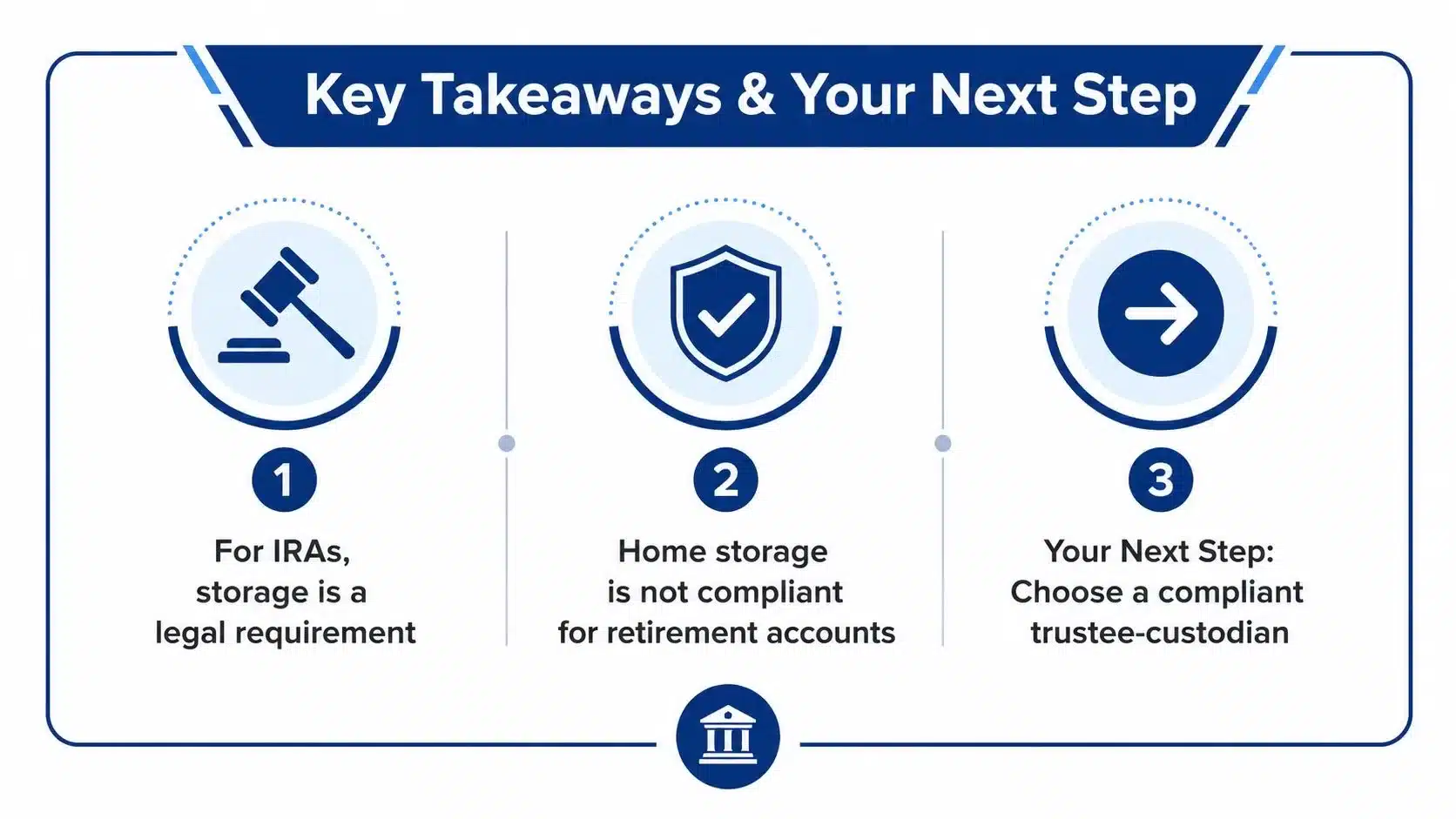
The next step is to request written information from a qualified custodian and compare its depository arrangements, ownership records, insurance, audit practices, and complete fee schedule. This is not financial advice. Consult a licensed financial advisor, CPA, or tax professional before making investment decisions.
Frequently Asked Questions About Precious Metals Storage
How long does a rollover and storage setup take?
Timing varies with the existing plan administrator, custodian, paperwork, funding method, and metal selection. Investors should ask for a written sequence of steps and confirm when the account can purchase and place metals into custody.
Can IRA metals be stored at home?
Home storage is generally incompatible with the IRS requirement that eligible IRA bullion remain in the physical possession of an approved trustee or custodian. Taking personal possession can jeopardize the account's intended tax-advantaged treatment, so a tax professional should review any proposed home-storage structure.
How does depository insurance work?
Insurance may be bundled into storage or charged separately. The investor should request the policy details, covered risks, exclusions, limits, claims process, and whether coverage applies during transport and distribution.
Are there minimum account sizes?
Minimums vary by custodian, depository, provider, and account arrangement. Investors should compare the minimum annual charges and total fees for the intended balance, because a flat minimum can affect a smaller account more heavily.
Gold IRA Association offers educational guides, rollover resources, provider comparisons, and fee explanations for readers evaluating compliant precious metals storage. Visit Gold IRA Association to compare custodial questions and prepare for a discussion with a qualified precious metals IRA specialist.


