


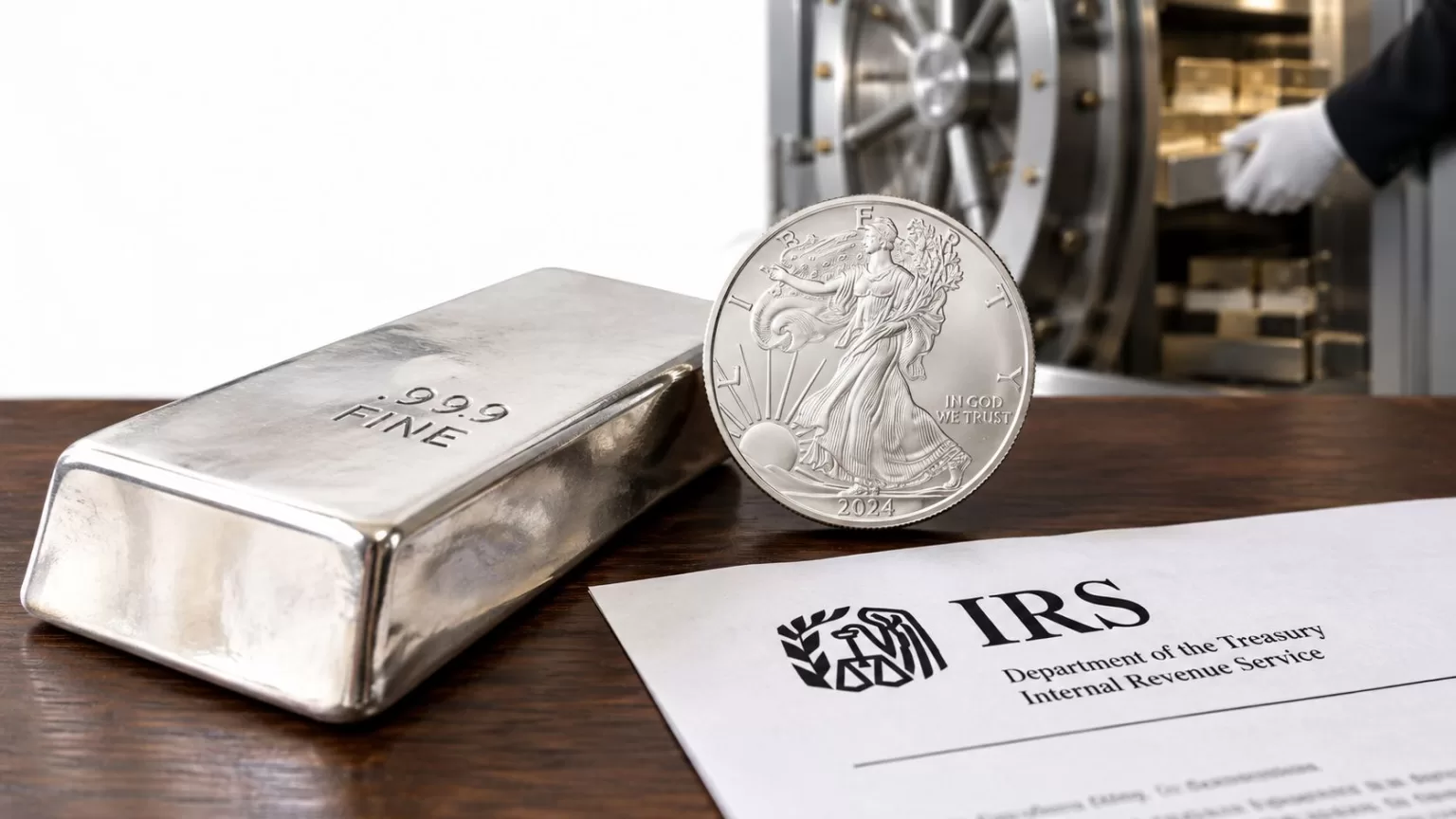
IRA-approved silver means physical silver with at least .999 fineness, or a specifically named eligible coin, held by an IRS-approved custodian inside a self-directed IRA. The silver cannot be kept at the investor's home, in a personal safe, or in another arrangement the investor controls.
A near-retiree standing at a coin shop counter may see familiar silver coins, bars, and collectible pieces that all look like reasonable retirement assets. The difficulty is that silver content alone doesn't determine IRA eligibility. The product, its purity, its manufacturer, and its custody arrangement must all satisfy the applicable rules.
What IRA Approved Silver Actually Means
Suppose you buy a silver bar at a coin shop and place it in your home safe. The bar may contain enough silver to meet the purity rule, yet that purchase still does not create IRA-approved silver. IRA-approved silver describes a complete arrangement, not a sticker attached to the metal.
Use three checkpoints:
- Purity: Most qualifying silver bullion must be at least .999 fine, or 99.9% pure silver.
- Product type: The item must be an eligible coin, bar, or other permitted bullion product. Some coins qualify through a specific statutory designation rather than through a general assumption that government-issued coins are acceptable.
- Custody: The IRA must own the metal, and an approved trustee or custodian must hold it in an approved depository. The account holder cannot take personal delivery or store it under personal control.
These checkpoints work like three locks on one door. A product that passes only one or two remains outside the required arrangement.
Internal Revenue Code Section 408(m)(3)(B) provides the foundation for silver bullion held in a tax-advantaged IRA. The IRS publication on individual retirement arrangements also notes that a self-directed IRA can hold certain one-ounce U.S. silver coins minted by the Treasury Department.
That distinction prevents a common mistake. A .999-fine bar can be technically eligible as a product, but holding it at home can make the arrangement noncompliant. A specifically named qualifying coin still needs the same approved IRA custody structure.
Practical rule: “IRA-approved” describes the silver, its permitted form, and its custody together.
The meaning comes down to three questions: Does it meet the required purity or named-coin rule? Is the product permitted? Is an approved custodian holding it for the IRA?
The IRS Purity Standard of .999 Fine
The .999 fineness standard is easier to understand than it sounds. Imagine dividing a piece of metal into 1,000 equal parts. At least 999 of those parts must be pure silver, with only a very small remainder made up of other materials.
This threshold is tied to Internal Revenue Code Section 408(m), which governs collectibles and the precious metals that may be held in certain individual retirement accounts. The IRS framework separates standardized bullion from items whose value depends mainly on rarity, artistry, or collector interest. The IRS guidance on investments in collectibles is important because it shows why a silver item can contain real precious metal and still fail the retirement-account test.
Modern investment silver commonly reaches the .999 benchmark, which makes the standard practical for government mints and recognized refiners. A bar marked .999 fine silver gives the buyer a clear starting point, but the fineness mark isn't the only question. The account structure and manufacturer still need review.
A named-coin pathway
Some silver coins qualify through a specific statutory designation rather than through a buyer's general assumption that all government coins are acceptable. The American Silver Eagle is the clearest example. The IRS specifically recognizes qualifying one-ounce U.S. silver coins minted by the Treasury Department, making the coin's legal status part of the eligibility analysis.
That doesn't mean every proof, commemorative, historic, or collectible silver coin qualifies. The exact product and the way it's purchased still matter.
Why the history matters
The purity framework developed alongside the broader opening of retirement accounts to certain precious metals. This guide to precious metal IRA rules provides additional educational context on the account structure and compliance framework.

Meeting .999 fineness is necessary but not sufficient. A buyer must also confirm the product pathway and arrange for proper custody before treating the silver as an IRA holding.

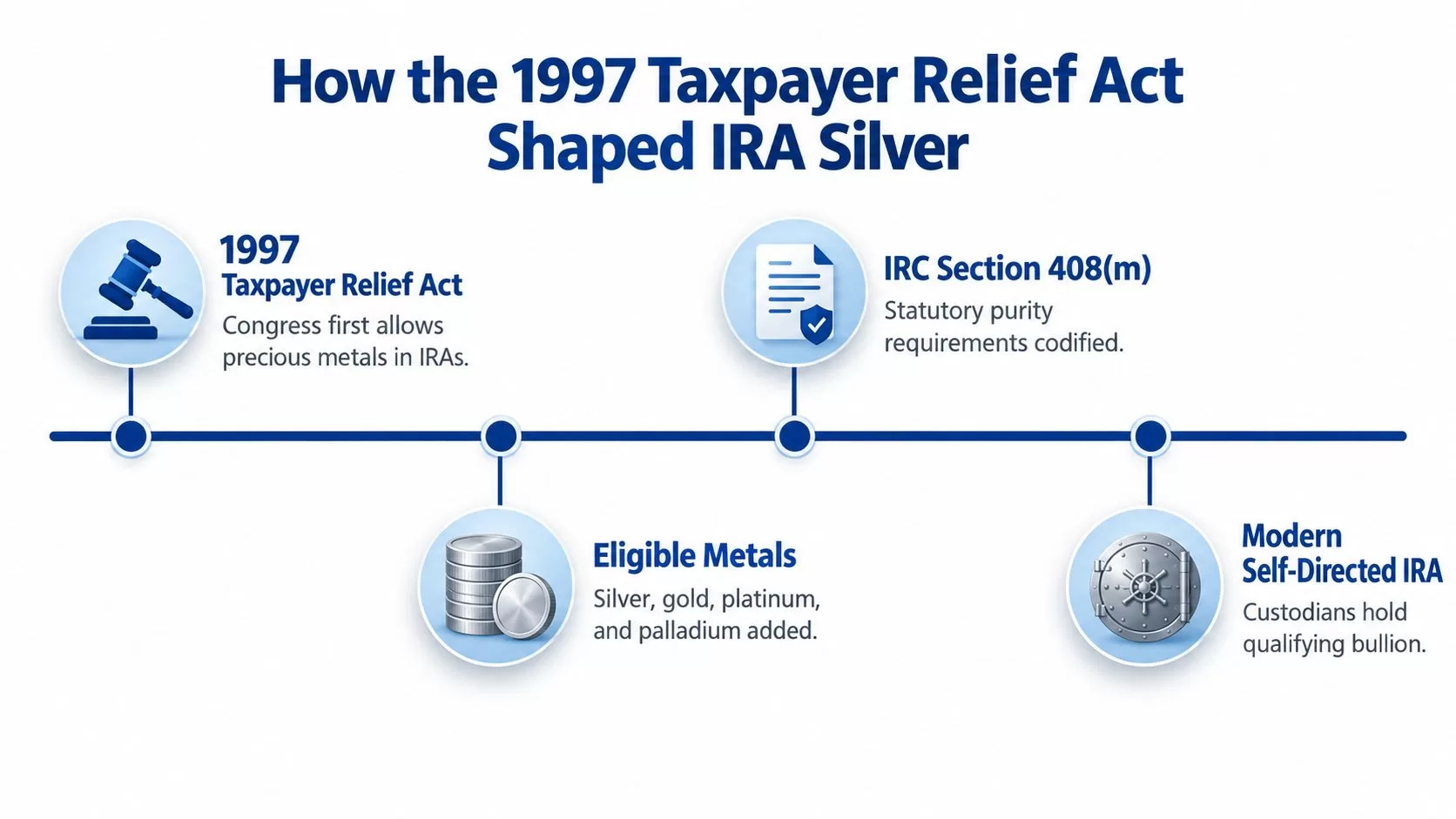
How the 1997 Taxpayer Relief Act Shaped IRA Silver
Suppose a near-retiree buys a silver coin that looks investment-grade and asks a custodian to place it in an IRA. The answer depends on the legal route that makes the product eligible, not just on its silver content. The Taxpayer Relief Act of 1997 created the foundation for holding certain precious metals in retirement accounts.
The Act added exceptions under IRC Section 408(m)(3) for specifically recognized coins, including qualifying American Eagle coins, and for bullion meeting the required fineness standard. That history explains why custodians maintain separate product lists today. One list covers named coins. The other covers fineness-based bullion.
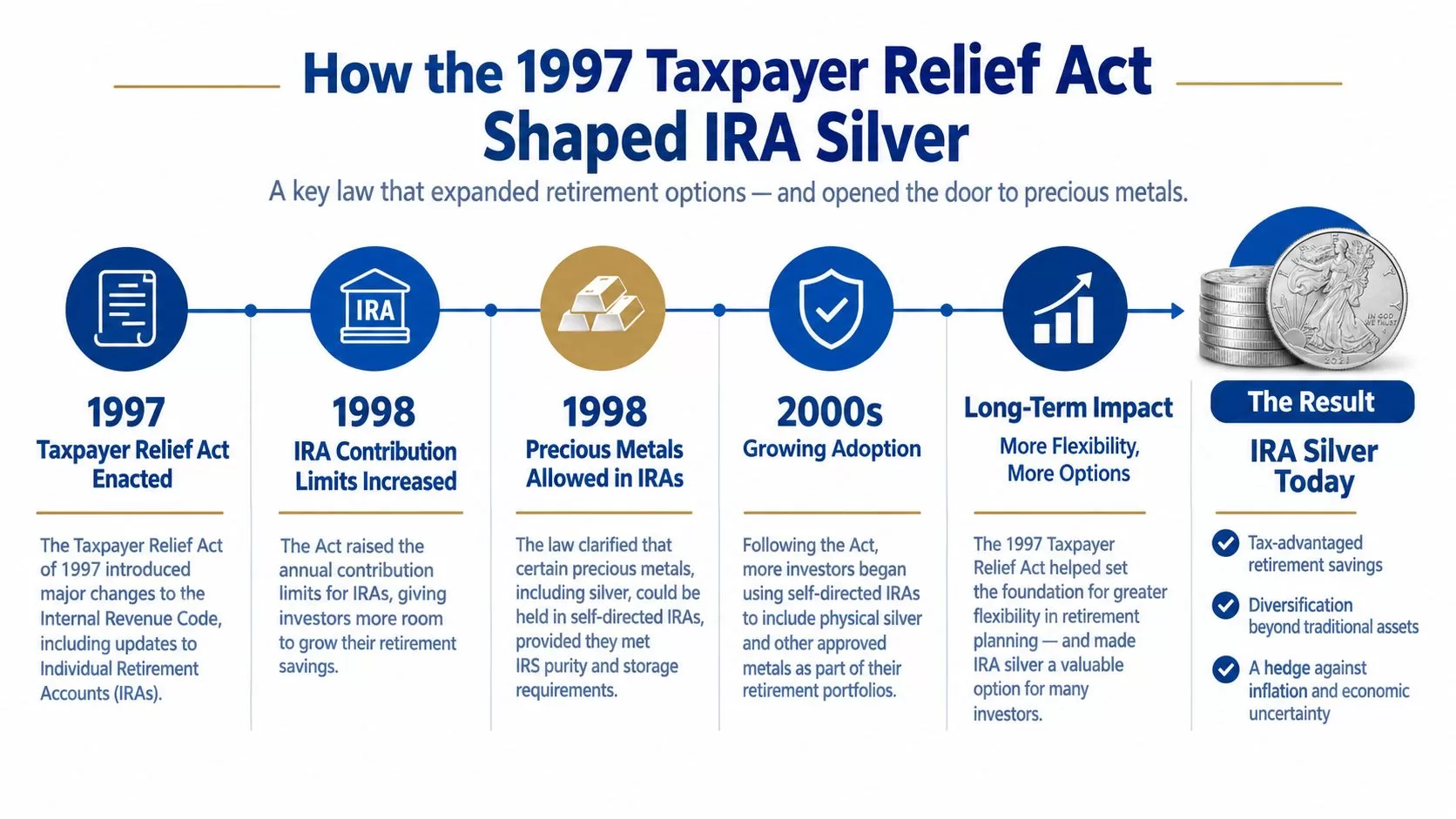
Before the change, retirement investors generally associated IRAs with paper assets such as securities and mutual funds. The law created a limited route for physical metal, while preserving restrictions intended to separate standardized investment products from collectibles and items that may be difficult to value or sell.
A collector's silver proof shows why that boundary matters. It may contain substantial silver, yet its price can depend mainly on rarity, condition, or presentation. That makes it different from a standardized bullion product. The legal test focuses on the recognized product category and measurable requirements.
The historical rule also separates technical eligibility from actual compliance. A coin or bar may fit an approved category, but the IRA still needs an approved custodian and proper account custody. Keeping eligible silver personally does not turn it into a compliant IRA holding.
The practical lesson is simple: the 1997 law opened the door, while the continuing rules determine which products and arrangements can pass through it. A popular silver item outside the approved pathways may still fail for retirement-account purposes.
Qualifying Silver Coins and Bullion Bars
Silver generally reaches IRA eligibility through one of two pathways. The first pathway applies to a specifically named qualifying coin. The second applies to bullion that meets the required fineness and production standards.
| Pathway | How It Qualifies | Common Examples |
|---|---|---|
| Named coin | The coin is specifically recognized under the applicable statutory rules | American Silver Eagle and certain qualifying U.S. Treasury-minted silver coins |
| Fineness-based bullion | The bar or bullion product meets the .999 standard and comes from an acceptable mint, refiner, or manufacturer | .999 silver bars and other qualifying bullion products |
The named-coin route is useful because it gives the investor a clearly identifiable product category. The American Silver Eagle is the best-known example. The IRS also explicitly notes that a self-directed IRA can hold qualifying one-ounce U.S. silver coins minted by the Treasury Department.
The second route requires more checking. A silver bar marked .999 fine may satisfy the purity requirement, but the buyer should also verify the producer, documentation, and custodian's approved product list. A dealer's product description isn't a substitute for confirmation from the custodian that the specific bar can enter the account.
What to confirm before ordering
A careful buyer should ask for the following information:
- Exact product name: Confirm whether the item is a named qualifying coin or a fineness-based bullion product.
- Fineness mark: Look for a clear indication of .999 or higher purity where the fineness pathway applies.
- Manufacturer details: Confirm that the mint, refiner, or manufacturer meets the applicable acceptance standards.
- Custodian acceptance: Ask the IRA custodian to approve the precise product before funds are committed.
- Delivery instructions: Make sure the seller ships directly through the custodian's process to the approved depository.
The guide to IRA-approved silver bars can help readers understand why bars require attention to both metal quality and producer status.
A one-ounce Silver Eagle and a .999 silver bar can therefore qualify through different reasoning. The coin relies on its recognized status, while the bar relies more heavily on fineness and acceptable production. Neither should be purchased for an IRA solely because it looks authentic or appears on a general dealer webpage.
Silver Products That Do Not Qualify
The most common mistake is assuming that substantial silver content equals IRA eligibility. It doesn't. Silver must meet the applicable purity and product rules, and some familiar forms fall short before custody is even considered.
| Product | Why It Raises a Problem |
|---|---|
| Pre-1965 U.S. junk or constitutional silver | Commonly about 90% pure, below the .999 standard |
| Sterling silver | Generally about 92.5% silver, below the required fineness |
| Silver-plated items | The silver layer isn't comparable to qualifying bullion |
| Silver-clad pieces | The precious-metal content and product type may not meet the bullion test |
| Collectible or numismatic pieces | Value may depend on rarity, grade, or artistry rather than standardized bullion content |
| Unrecognized bars or rounds | The manufacturer or refiner may not satisfy acceptance requirements |
The distinction between a popular product and an eligible product is especially important with pre-1965 junk silver. Those coins can be widely traded outside retirement accounts, but their approximately 90% purity is below the IRA threshold. The explanation of IRA-eligible silver identifies the American Silver Eagle as an explicitly eligible investment product and contrasts it with lower-purity constitutional silver.
Custody creates a second failure point. Even an eligible coin or bar can become a personal distribution problem if the investor takes possession or stores the metal in a location personally controlled by the investor. A home safe or personally controlled safe-deposit box doesn't replace approved IRA custody.
Storage is part of eligibility. The right silver in the wrong location isn't a compliant IRA holding.
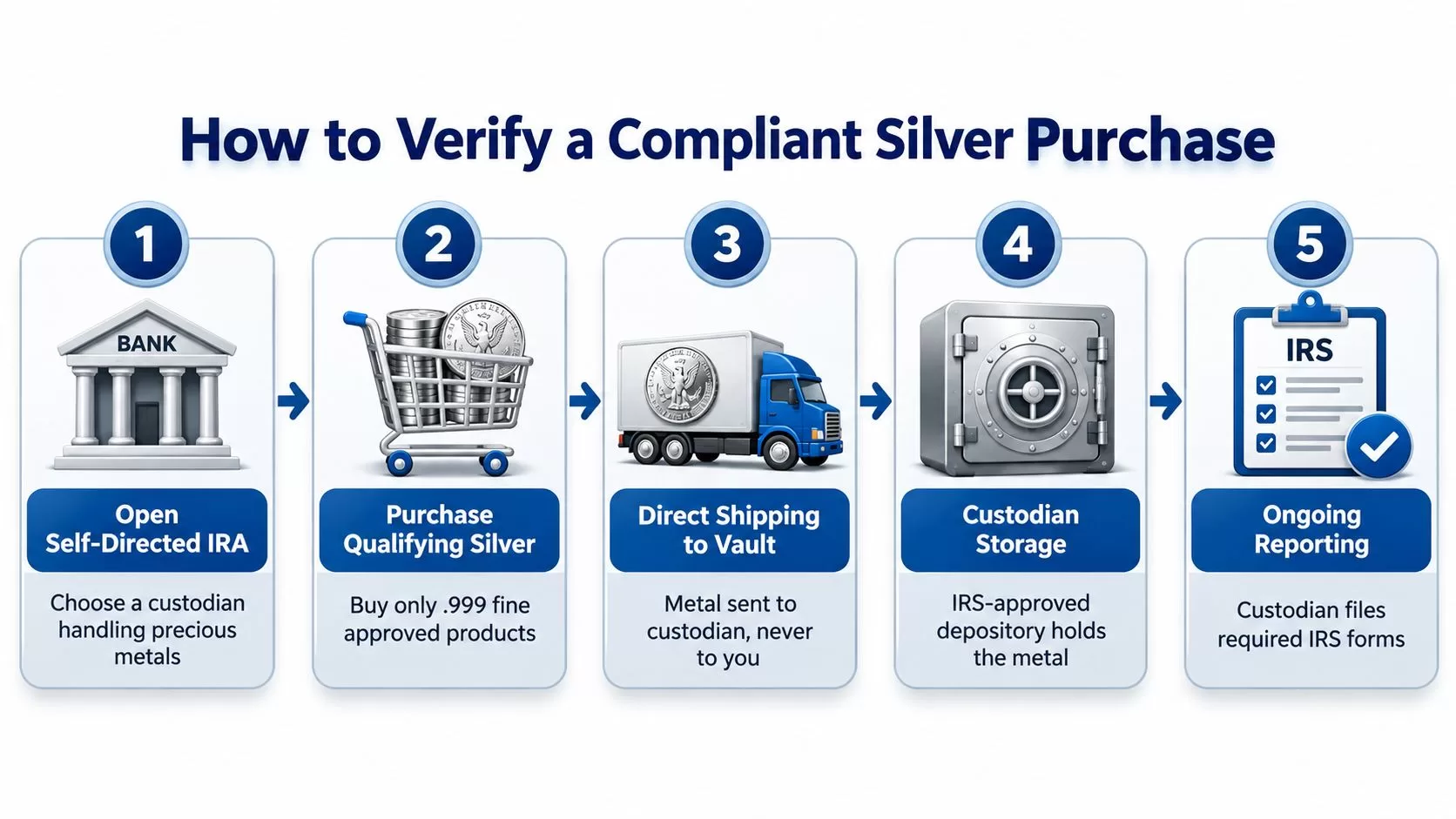
How to Verify a Compliant Silver Purchase
A compliant purchase starts before the investor chooses a coin or bar. The account must be structured correctly, and the custodian must be involved in the transaction from the beginning.
Start with the account
A self-directed IRA is designed to accommodate alternative assets that ordinary brokerage accounts may not handle. The investor should first select a custodian that administers precious-metals IRAs and ask how its process works for product approval, payment, reporting, and storage.
Once the account is active, the purchase should move through the custodian or through a dealer working within the custodian's established process. A private person-to-person transaction creates unnecessary uncertainty because the custodian may reject the product, its documentation, or its chain of custody.
Check the item
Before placing an order, the buyer should verify:
- Fineness: Confirm the .999 mark when the product relies on the fineness pathway.
- Product identity: Match the exact coin or bar name, size, and manufacturer to the custodian's accepted list.
- Documentation: Request an assay card, certificate, or other authenticity records when the product requires supporting paperwork.
- Dealer process: Confirm that the seller knows the metal must ship directly to the custodian's approved depository.
The guide to buying silver for an IRA offers additional educational guidance for reviewing the purchase process.
Control the delivery
The silver should go directly to the custodian's approved depository. The investor shouldn't ask the seller to send it home “temporarily,” inspect it personally, or move it into a private storage arrangement after delivery.
The reason is practical as well as regulatory. The custodian needs a documented chain showing that the IRA purchased the silver and that an approved facility received and held it for the account. If personal possession occurs, the transaction may be treated as a distribution, with tax consequences determined by the investor's circumstances.
Quick Verification Checklist and Next Steps
Before approving a silver purchase, a near-retiree can use this short yes-or-no review:
- Product identity: Is the item a specifically qualifying coin or a bullion product that fits the fineness pathway?
- Purity: Does the silver meet the .999 minimum fineness where that standard applies?
- Producer: Has the custodian confirmed that the mint, refiner, or manufacturer is acceptable?
- Documentation: Are the product description, fineness marking, and authenticity records available?
- Custodian: Is the purchase being administered by an approved custodian for a self-directed IRA?
- Delivery: Will the seller ship the metal directly to the custodian's approved depository?
- Personal possession: Will the investor avoid taking the silver home or placing it in personally controlled storage?
- Account records: Will the custodian record the purchase and maintain the required account documentation?
A “no” answer doesn't necessarily mean the investment is impossible. It means the buyer should pause and ask the custodian to resolve the issue before sending money or accepting delivery.
The next sensible step is to speak with a self-directed IRA specialist, request current product-acceptance lists from more than one custodian, and compare the associated custodial and storage charges. Readers should also review how a potential silver allocation fits with their retirement income needs, liquidity requirements, time horizon, and tolerance for price changes.
This is not financial advice. Consult a licensed financial advisor, CPA, or tax professional before making investment decisions.
Gold IRA Association provides educational guides, compliance checklists, and comparisons designed to help readers evaluate precious-metals IRA questions. Visit Gold IRA Association to review the silver IRA resources before speaking with a custodian or placing an order.


