



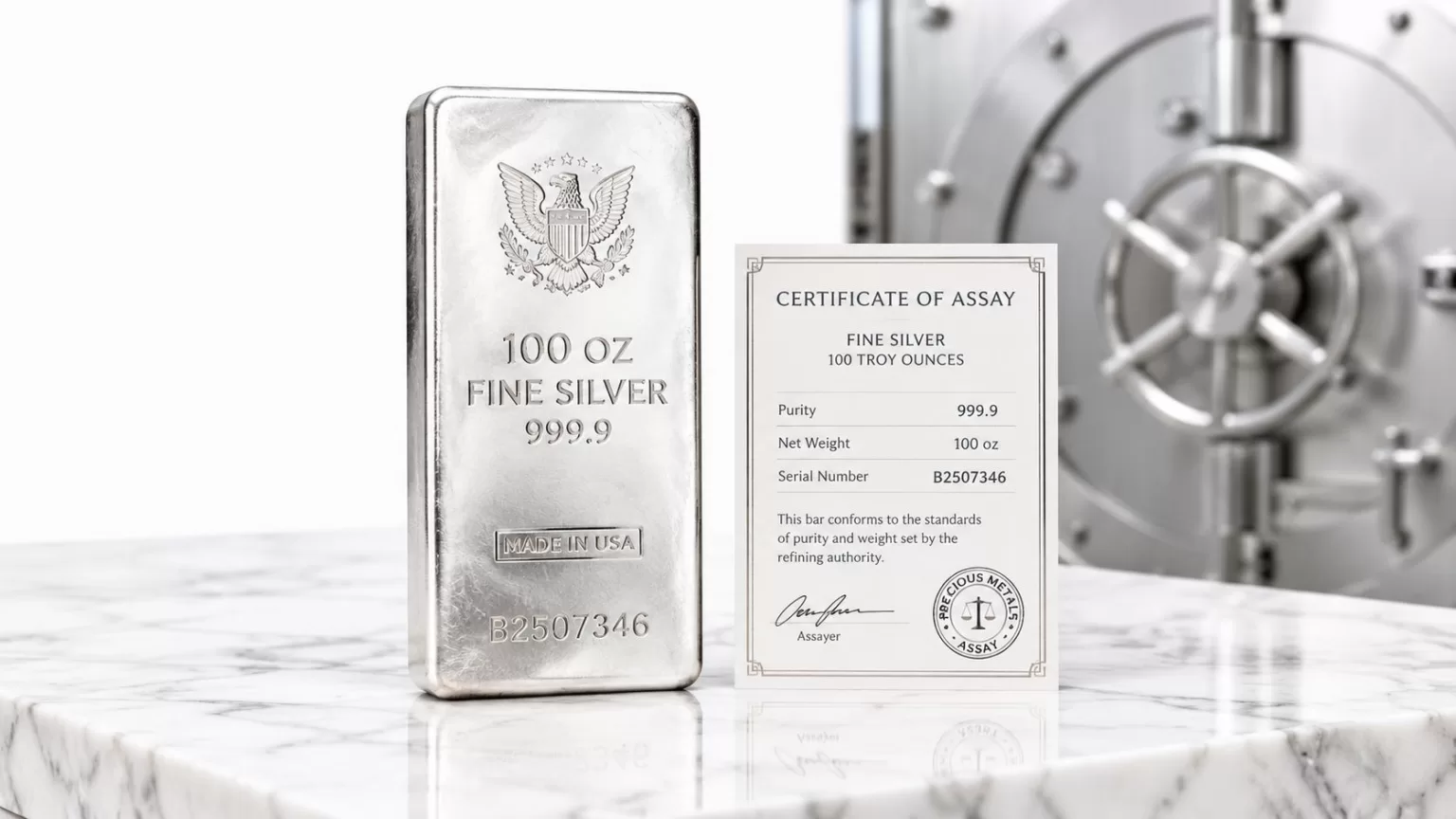
A near-retiree moving part of a rollover IRA into physical silver may quickly encounter the silver 100 oz bar. It looks efficient: one large, recognizable unit instead of many smaller pieces. But the right question is whether it offers a low purchase premium. The decision also depends on IRS eligibility, custody, all-in holding costs, and how easily the position can be sold when retirement income is needed.
Why a Silver 100 oz Bar Comes Up in Retirement Planning
A retiree around age 62 might want physical silver inside a self-directed IRA, while keeping the rest of the account invested in more liquid assets. A 100 oz bar can seem attractive because it concentrates a substantial silver holding into one auditable product. The bar weighs exactly 100 troy ounces, approximately 3,110 grams, or about 6.86 pounds, according to standard 100 oz silver bar specifications.
That convenience comes with a decision that smaller coins and bars don't create in the same way. A 100 oz bar is one unit. If the account owner later needs only part of the silver exposure converted to cash, the bar generally can't be divided for a dealer transaction.
Before choosing one, an IRA investor should answer four practical questions:
- Does it qualify? The silver must meet the required fineness and come from an eligible producer.
- What does it cost? The purchase premium is only one part of the expense. Custody, storage, insurance, and selling terms also matter.
- Where will it stay? IRA-owned metal must remain with an approved custodian and qualified depository rather than in a home safe.
- How will it be sold? A large bar may be easy to recognize but less flexible when withdrawals need to happen in stages.
Retirement investors considering a broader self-managed structure may also benefit from reviewing whether an SMSF is right for you before comparing physical-asset arrangements. U.S. IRA rules are different, but the underlying question is similar: who controls the assets, who documents them, and who handles compliance?
Practical rule: A 100 oz bar can be a defensible choice for a portfolio that values cost-efficient accumulation, but it shouldn't be treated as the default format for every retiree.
What a Silver 100 oz Bar Actually Is
A 100 oz silver bar contains 100 troy ounces of silver. A troy ounce isn't the same as an ordinary household ounce, which is sometimes called an avoirdupois ounce. Precious-metals markets use troy weight, so the 100 oz designation remains consistent across major bullion markets and storage records.
The standard mass is about 3,110.35 grams, or roughly 6.86 pounds, as described in 100 oz silver bar market specifications. Most bars are marked at .999 fine silver, meaning 99.9% purity. Some products use.9999 fineness. One listed example measures 132.00 mm by 78.00 mm by 29.00 mm and carries.9999 fineness, according to published specifications for a 100 oz silver bar.
Cast and minted formats
A cast bar is poured into a mold and usually has a simple, industrial appearance. A minted bar is cut or formed from refined silver and may have cleaner edges, more detailed surfaces, and retail-oriented packaging. Neither description alone determines whether a bar is appropriate for an IRA. Weight, fineness, refiner credentials, and authentication records matter more.
Investors may encounter names including Engelhard, Johnson Matthey, PAMP Suisse, Royal Canadian Mint, Asahi, SilverTowne, and recognized Good Delivery producers. The important point is not the visual design. A recognized producer generally makes verification and resale more straightforward.
What the markings do
A large bar may carry:
- Weight and fineness, showing the amount and purity of silver.
- Refiner or mint identity, identifying the producer.
- Serial number, when the product is individually serialized.
- Assay documentation, linking the bar to its stated specifications or refinery lot.
| Spec | Typical Value |
|---|---|
| Weight | 100 troy ounces |
| Metric weight | Approximately 3,110 grams |
| Ordinary weight equivalent | About 6.86 pounds |
| Common fineness | .999, or 99.9% pure silver |
| Higher fineness seen in some products | .9999 |
| Format | Cast or minted |
| Identification | Refiner markings, and sometimes a serial number and assay record |
The value of the format comes from concentration and standardization. One large, identifiable unit can simplify inventory and reduce fabrication per ounce. That same concentration creates the liquidity issue examined later.
How 100 oz Bars Compare to Smaller Silver Formats
Large bars are usually designed for cost-per-ounce efficiency. Fabrication, packaging, and distribution costs are spread across more silver, so the premium per ounce is often lower than for smaller products. Market guidance identifies the same trade-off: larger bars can be efficient to accumulate, while smaller denominations are easier to divide and resell through silver liquidity comparisons.
That doesn't make the larger bar automatically cheaper in an all-in retirement strategy. A lower entry premium helps only if the investor can hold the entire unit and later find a suitable buyer without paying away the savings through a wide resale spread.
| Format | Typical Premium per oz | Notes |
|---|---|---|
| 100 oz bar | Usually lower than smaller formats | Efficient for concentrated accumulation |
| 10 oz bar | Usually higher than a 100 oz bar | More manageable for partial sales |
| 1 oz round | Usually higher than larger bars | Easier to sell in individual units |
| Bullion coin | Often includes additional product and distribution costs | Familiar to many retail buyers |
The precise premium changes with dealer inventory, market conditions, product brand, and demand. A recognized bar can sometimes command better treatment than an unfamiliar generic product, even when both meet the same purity standard.
Investors comparing formats should review silver coins versus silver bars with a specific retirement goal in mind. Someone building a long-term holding that may be sold as one position has different needs from someone expecting periodic withdrawals.
The central comparison is therefore not “large bar versus small coin” in the abstract. It is lower acquisition friction versus greater distribution flexibility. Smaller units may cost more to acquire, but they give the owner more control over how much gets sold at one time.
IRS Rules for Silver Bars in an IRA
For a self-directed IRA, the purity floor is clear. Eligible silver must meet at least.999 fineness, and the product must be produced by a government mint or an accredited refiner, assayer, or manufacturer, as summarized in IRA-eligible silver requirements.
That requirement doesn't mean every 100 oz bar will be accepted automatically. The custodian still needs to confirm the product, producer, documentation, and delivery process. The safest approach is to obtain written acceptance before the purchase is funded.
The eligibility checks
| Requirement | Standard | Notes |
|---|---|---|
| Purity | At least.999 fine silver | Bars below this threshold may not qualify |
| Producer | Government mint or eligible accredited producer | Confirm the exact refiner with the custodian |
| Documentation | Assay and identifying records | Serial numbers should match where applicable |
| Ownership | IRA-owned asset | The investor shouldn't take personal possession |
| Delivery | Custodian-directed shipment | The bar goes to the approved depository |
Recognized producers can reduce verification friction, but the custodian's approved list controls the transaction. A bar from a well-known refiner may still require review if its packaging, serial number, or chain-of-custody records are incomplete.
One product page explicitly identifies a 100 oz secondary-market bar as IRA/RSP approved and states that it contains 100 troy ounces of.999 fine silver, as shown in the listed IRA-approved 100 oz bar. That kind of product-specific statement is useful, but it doesn't replace confirmation from the chosen custodian.
A buyer should also review IRA-approved silver bars before placing an order. The goal is to avoid purchasing a bar first and discovering later that the custodian won't accept it, leaving the investor to arrange a repurchase or separate ownership outside the IRA.
Custody and Storage for IRA Silver Bars
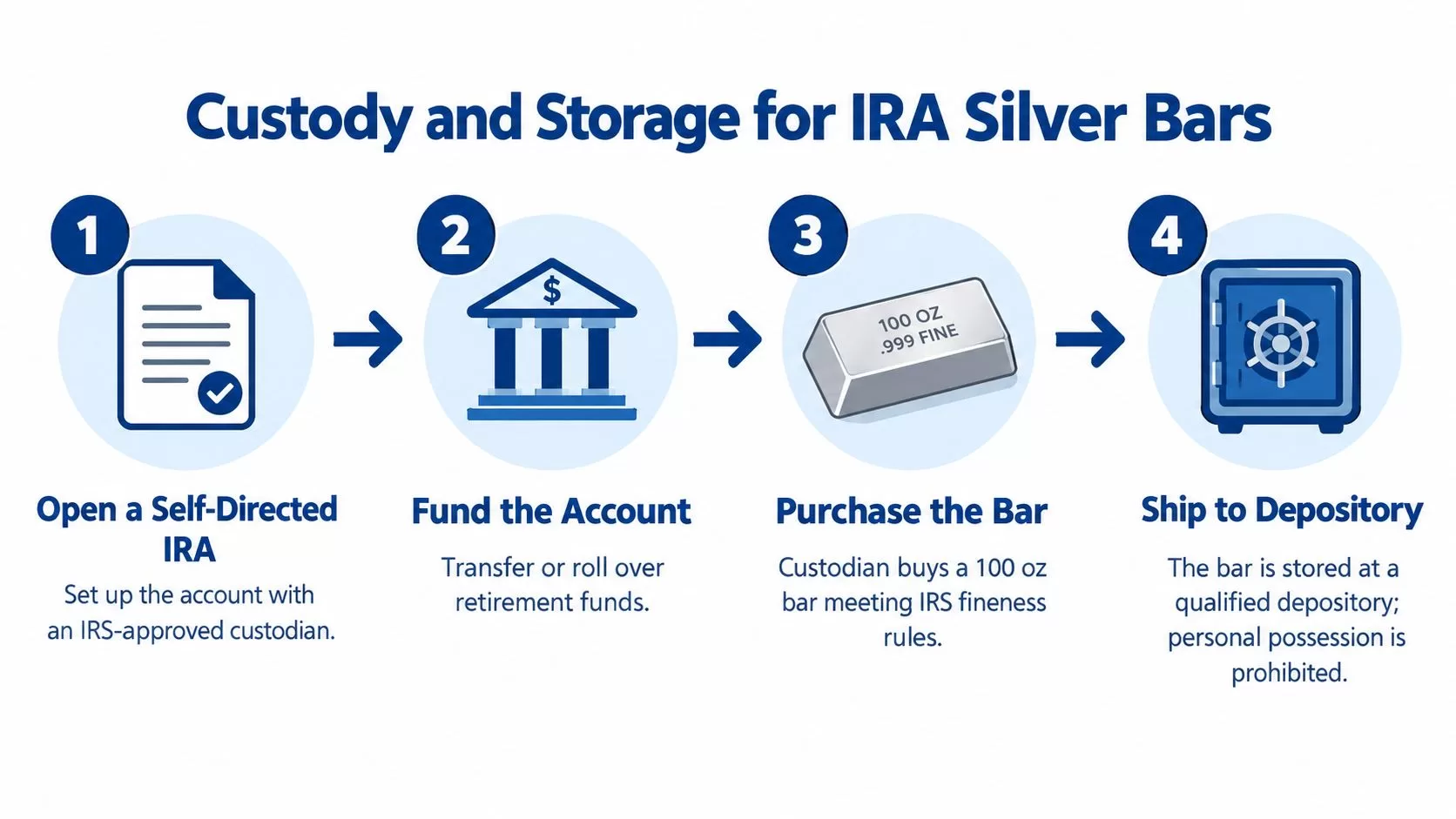
An IRA investor can't have the account purchase a 100 oz bar and keep it at home. The metal remains an IRA asset and must be held through an approved custodian at a qualified depository. The custodian records ownership, while the depository handles physical storage and inventory controls.
A typical process looks like this:
- The investor opens a self-directed IRA with a custodian.
- Retirement funds move into the account through an appropriate transfer or rollover.
- The custodian purchases the eligible bar.
- The bar ships directly to the qualified depository.

Segregated versus commingled storage
Segregated storage keeps the investor's identified bars separately allocated, normally with serial numbers and detailed records. It can make the chain of custody easier to follow, though the service may cost more.
Commingled storage places qualifying metal into a pooled inventory while the account retains a documented ownership interest. This approach may be less expensive, but the account statement should still clearly identify the weight, purity, and ownership records maintained by the custodian.
Insurance terms deserve careful review. Coverage may be available through the storage arrangement, but limits, deductibles, exclusions, and valuation methods should be confirmed in writing. Investors should request periodic records showing the bar's refiner, weight, serial number where applicable, and storage status.
The precious-metals storage guide provides useful context for comparing depository arrangements. The practical test is documentation. If a provider can't explain where the bar is held, how it is insured, or how the record will support a later distribution, the arrangement needs more scrutiny.
Fees and Premiums to Expect on a 100 oz Bar
The purchase price is only the first line in an IRA cost model. A 100 oz bar may have a lower retail premium than smaller formats, but the account can also incur setup, custody, storage, insurance, delivery, and liquidation expenses.
Because the verified market data doesn't establish a universal fee schedule, investors should treat provider quotes as account-specific rather than assume a standard charge. The cost model should show each expense separately and identify whether it is charged once, annually, or per transaction.
Build the cost stack before funding
| Cost Component | Typical Range | Frequency |
|---|---|---|
| Silver premium | Varies by dealer, product, and market conditions | At purchase |
| Account setup | Provider-specific | Usually one time |
| Custody | Provider-specific | Often recurring |
| Depository storage | Depends on storage arrangement | Recurring |
| Insurance | May be bundled or itemized | Recurring or included |
| Shipping and handling | Depends on transaction terms | Purchase or distribution |
| Liquidation costs | Depends on bid, spread, and testing needs | At sale |
A lower acquisition premium can be meaningful, but it should be compared against the account's total operating expense. For a modest silver allocation, recurring charges can matter more than a small difference between two products. For a larger allocation held for a long period, the bar's lower fabrication cost may carry more weight.
Questions for the fee schedule
Ask the custodian and dealer to identify:
- Every recurring charge, including account administration and storage.
- Insurance treatment, including whether coverage is bundled.
- Distribution expenses, such as shipping, handling, and any required verification.
- Buyback pricing, including how the bid is calculated relative to the silver market.
- Storage type, because segregated and commingled arrangements may be priced differently.
Cost discipline: Compare the full dollar cost of ownership, not just the premium displayed beside the bar. A cheap entry point can lose its advantage if the account's ongoing and exit charges are poorly understood.
No provider's fee schedule should be accepted as permanent. Charges and terms can change, and the investor should retain the written schedule that applied when the account was opened.
The Liquidity Trade-Off Most Buyers Miss
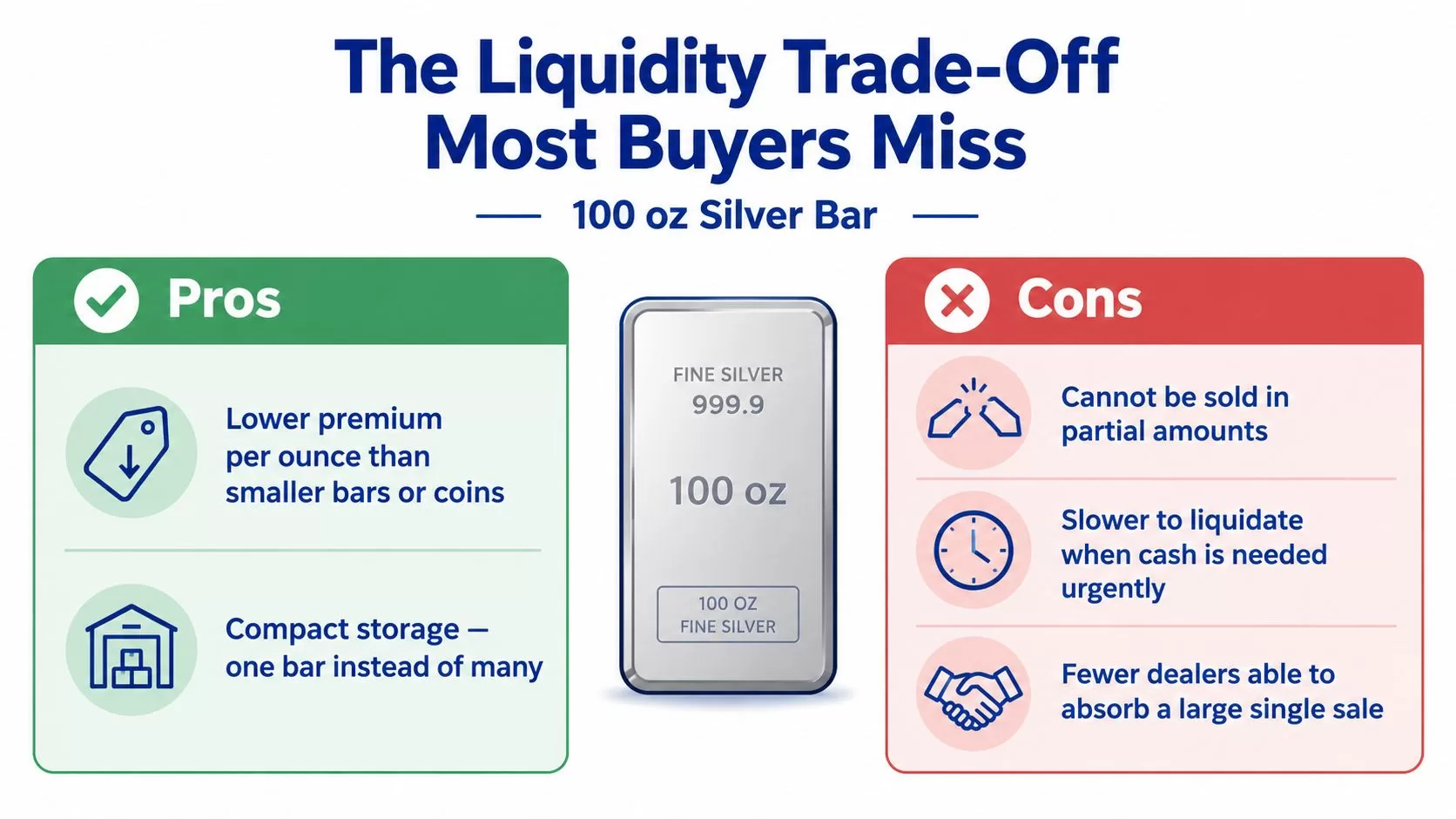
The defining weakness of a 100 oz bar is its all-or-nothing sale size. A retiree who needs a small cash withdrawal can't normally ask a dealer to remove a fraction of the silver from the bar. The entire bar must be sold, or the investor must use another asset for the immediate need.
That matters for staged retirement income. A person might want to raise cash for a bill, supplement a monthly withdrawal, or satisfy a distribution need without changing the rest of the account. A large bar doesn't provide the same control as a collection of smaller, separately tradable units.
Why the exit can be less flexible
A dealer's bid reflects the product's recognizability, condition, testing requirements, current inventory needs, and the size of the transaction. Large bars remain tradable, but some buyers may prefer larger transactions or have less capacity to absorb one bar quickly. Smaller 1 oz and 10 oz formats generally give an owner more choices about how much to sell.
A market guide states that a 100 oz bar can save about $200 to $400 compared with buying the same weight in Silver Eagles, while also identifying the central drawback: selling part of the position usually requires selling the whole bar, as explained in the comparison of silver coins, bars, and rounds. Those savings are real, but they should be viewed as compensation for reduced flexibility rather than as a free advantage.

An in-kind distribution creates another complication. The custodian may be able to distribute the physical bar rather than sell it, but shipping, documentation, valuation, and tax reporting still require coordination. Taking the whole bar doesn't solve a need for a smaller amount of cash, and dividing it outside the account can create additional compliance and valuation questions.
For required minimum distributions or ordinary mid-retirement spending, the practical choice is often a blended format. Smaller units can handle staged sales, while a 100 oz bar can serve the portion of the holding that the investor expects to leave untouched.

The right question isn't whether the bar can be sold. It can be. The question is whether the investor can sell the entire unit at the right time and on acceptable terms.
A Practical Checklist Before You Buy
A 100 oz bar fits best when the investor values compact accumulation and doesn't expect to liquidate the silver in small stages. Smaller units may be more suitable when retirement income, emergency access, or periodic rebalancing requires precise control over the amount sold.
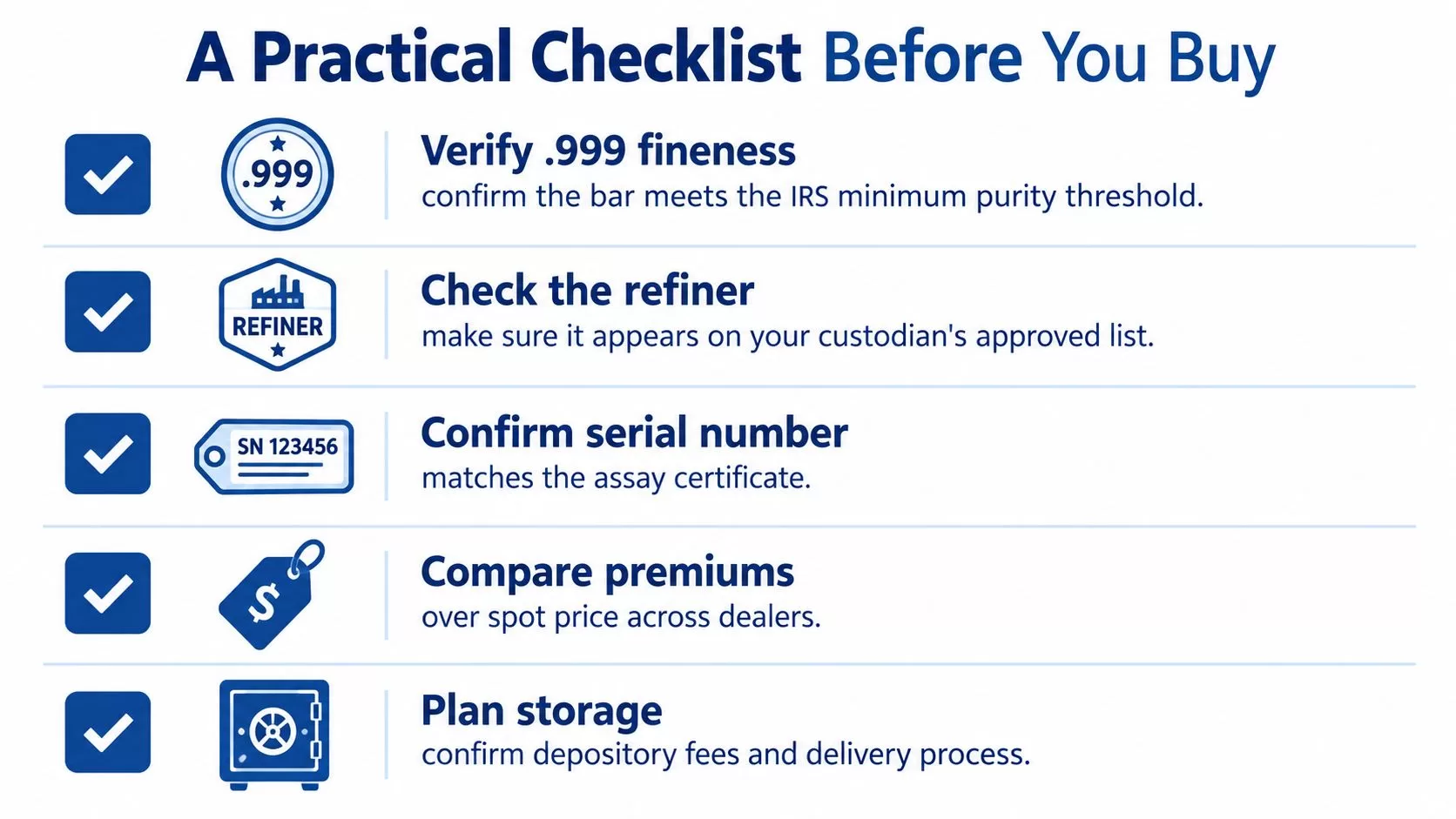
Use the following checks before committing retirement funds:
- Verify purity: Confirm the bar carries at least.999 fineness and that the product documentation supports the stated purity.
- Check the producer: Ask the custodian to confirm that the exact refiner or mint appears on its approved list.
- Match the records: Ensure the serial number, where present, matches the assay certificate and the custodian's inventory record.
- Compare the full purchase price: Review the premium over spot across multiple approved products, not just one quoted bar.
- Plan the vault arrangement: Confirm the depository, storage type, insurance terms, statement format, and distribution process.
The final decision should also include at least two potential buyers or liquidation channels. Ask how each would price the complete bar, whether testing or assay review could apply, and how long settlement normally takes. A provider's purchase policy is as important as its sales presentation.
Avoid generic or unbranded bars when the documentation is weak. Confirm whether storage is segregated or commingled, understand the process for an in-kind distribution, and consider how the bar's size fits the account's future distribution needs.
Decision rule: Choose a 100 oz bar when staged liquidity is unlikely and the lower per-ounce acquisition cost matters more than flexibility. Favor smaller units when partial liquidation, simpler withdrawals, or easier resale is central to the retirement plan.
This is not financial advice. Consult a licensed financial advisor, CPA, or tax professional before making investment decisions.
Gold IRA Association offers educational guides on silver IRA eligibility, custody, storage, rollovers, and provider evaluation. Visit Gold IRA Association to review the research and use its checklists before deciding whether a 100 oz bar belongs in a retirement account.


