



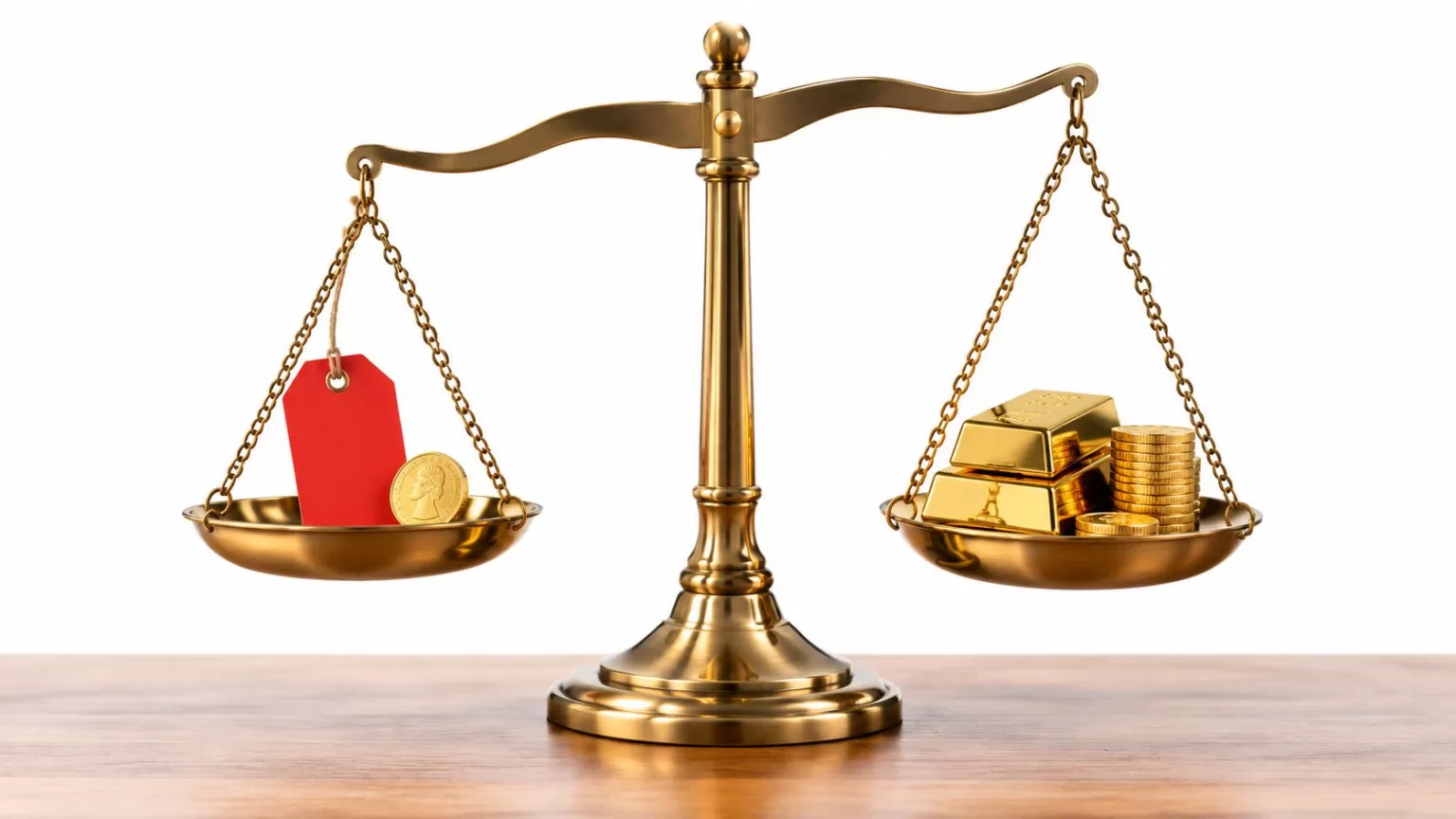
A near-retiree comparing two gold offers may see one coin priced below the other and assume it's the better deal. Yet the lower-priced option might not qualify for an IRA, might carry unclear storage or custodial costs, or might add little to the retirement portfolio's overall purpose. The higher-priced option could provide more useful eligibility, liquidity, documentation, or diversification.
That's why price vs. value matters. Price is the amount paid today. Value is what the purchase contributes over time, after rules, costs, risks, and purpose are considered. This distinction becomes especially important when physical metals are held inside a retirement account.
The discussion begins with the basic difference between market price and intrinsic value, then examines why prices can move away from value for extended periods. It applies the same framework to gold and silver, where spot prices, dealer premiums, IRA eligibility, storage, and rollover mechanics all affect the result. The aim is simple: help retirement savers evaluate an offer without confusing a low sticker price with a sound decision.
What Price and Value Really Mean for Investors
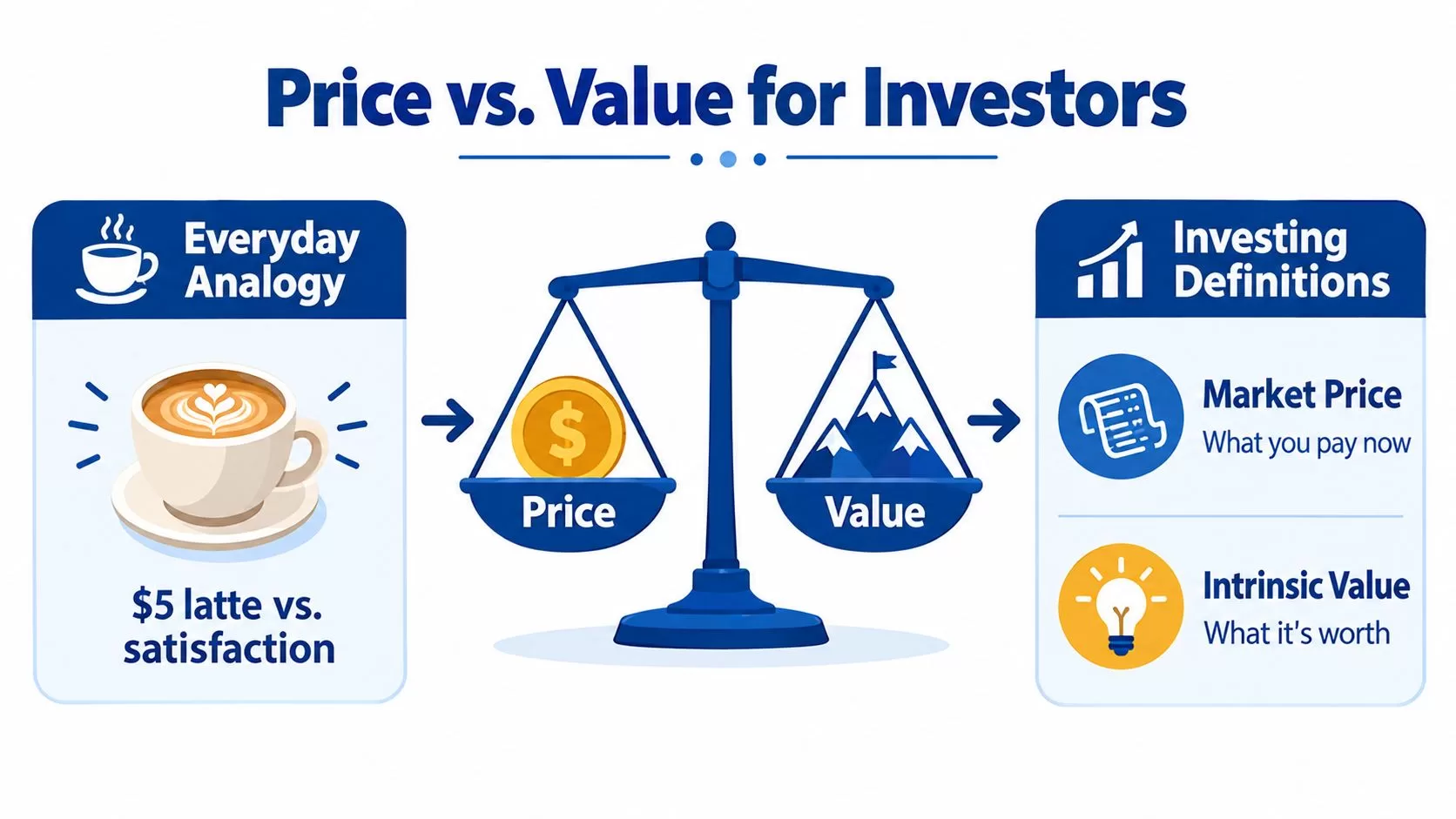
A simple purchase illustrates the difference. A lower-priced cup of coffee may save money, but it might not provide the taste, convenience, or satisfaction a buyer wants. A more expensive cup may offer better value for that particular person, even though its price is higher.
Investing uses the same distinction, but with more uncertainty. Market price is what an investor pays or receives now. Intrinsic value is an estimate of what an asset is worth based on its fundamentals, usefulness, financial strength, and expected future payoffs.

The investor's basic question
The central question isn't, “What does this cost?” It's, “What does this purchase provide in return for the price paid?”
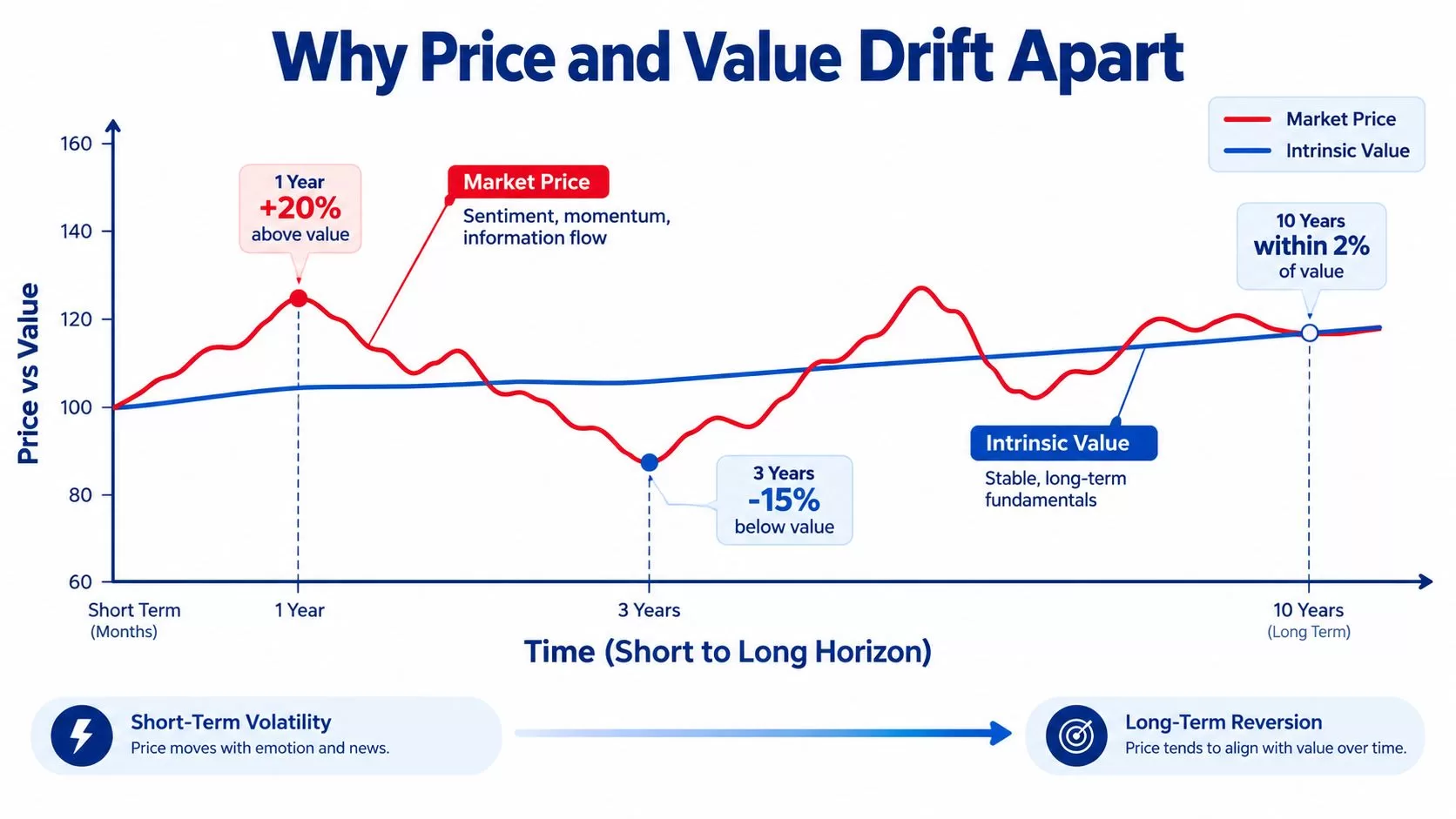
Benjamin Graham and David Dodd formalized the modern distinction between price and value during the 1920s at Columbia Business School. Their value-investing framework estimated an asset's intrinsic value and looked for situations where the market price fell below that estimate. Columbia's history of value investing explains that market price and intrinsic value can diverge, but tend to move toward one another over time.
That gap creates what Graham and Dodd called a margin of safety. In plain English, an investor leaves room for mistakes in the valuation, unexpected events, or a less favorable outcome than expected.
Practical rule: A low price can be attractive, but only after the buyer understands what the asset is worth and what risks the discount may be signaling.
Why the distinction matters for retirement savers
Retirement investors usually have a longer time horizon and less flexibility to recover from avoidable mistakes. A low-priced asset that fails an account rule, costs more to hold than expected, or doesn't fit the portfolio may have little practical value.
The same reasoning applies to purchasing-power risk. Readers seeking a broader explanation of how investors may shield capital in inflationary markets should focus on the difference between preserving nominal dollars and preserving what those dollars can buy. Gold is often considered as one possible diversification tool, but its role should be judged by the portfolio's needs rather than by its price on a particular day.
For additional background, the price of gold adjusted for inflation can help readers think about historical purchasing power without treating any past relationship as a promise about future performance.
Why Market Price and Intrinsic Value Drift Apart and Come Back Together
Market prices move quickly because buyers and sellers respond to news, expectations, fear, confidence, and momentum. Intrinsic value usually changes more slowly because it depends on underlying cash flows, assets, demand, and risk. That difference in speed allows price and value to separate.
An efficient-market perspective holds that prices rapidly incorporate available information. Under that view, a persistent gap may indicate either mispricing or an error in the analyst's assumptions. A value investor accepts that prices often reflect information efficiently, while still asking whether the market has overreacted or misunderstood long-term fundamentals.
What history can and cannot prove
Long-run evidence supports the idea that price and value can remain apart for meaningful periods. A major academic review reports that the value premium has appeared in 87 years of U.S. equity data, more than 30 years of out-of-sample evidence, 40 other countries, and more than a dozen other asset classes in the research summarized by AQR's review of value investing.
Another institutional summary reports that value stocks outperformed growth stocks by 4.0% annually in the U.S. since 1927, while the average premium in years when value won was nearly 15%. The figures describe historical equity patterns, not gold returns and not a forecast for any individual investor.
History also shows why patience can be difficult. Value underperformed for 13 years from mid-2007 to late 2020 across geographies, sectors, valuation measures, and asset classes, according to Dimensional's history of value and growth. A cheap-looking asset can stay out of favor for years.
Why price alone is a weak signal
A low price may reflect temporary pessimism. It may also reflect weaker growth, damaged cash flows, excessive debt, or a higher required return. Without examining the reason for the discount, an investor can't know whether the purchase represents value or a problem priced more cheaply.
For retirement savers, the lesson is practical. A price signal is immediate and visible, while value requires an assessment of purpose, risk, and time horizon. Paying less may improve the starting point, but it doesn't remove the need for disciplined review.
How Price Signals Differ From Value Signals in Precious Metals
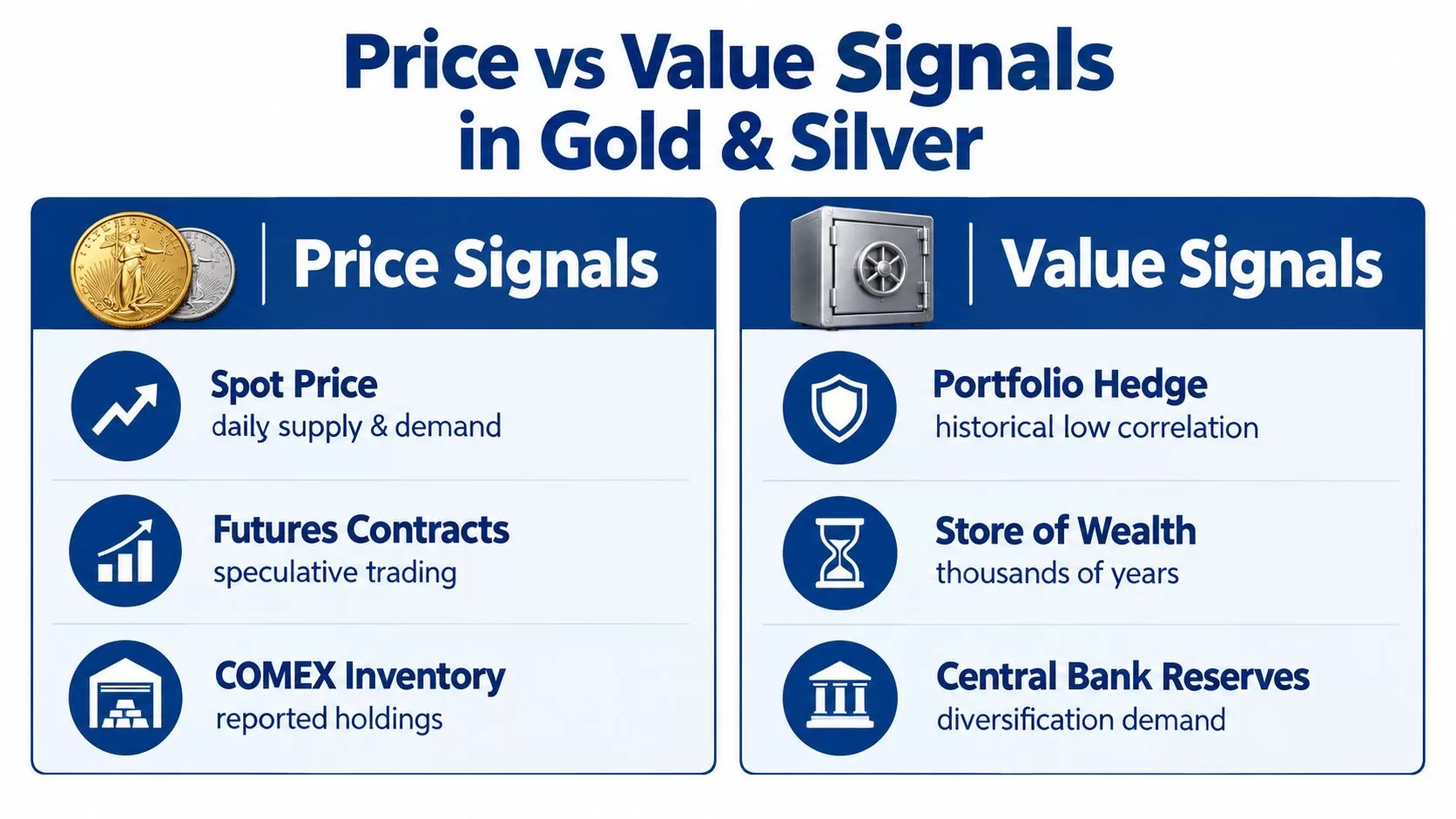
Gold and silver require a slightly different application of the price-versus-value framework. Precious metals don't produce corporate earnings in the same way as a business, so investors often judge them through market price, scarcity, liquidity, purchasing-power concerns, and their possible role in a broader portfolio.
The spot price reflects the current market quotation for the metal. A retail coin or bar may cost more than spot because of fabrication, distribution, dealer margin, and other transaction considerations. That difference doesn't automatically mean the item is poor value. The buyer must ask what the additional cost provides and whether the product fits the intended account.
Comparing the signals
| Signal Type | What It Tells You | Limitation to Watch |
|---|---|---|
| Spot price | The current quoted market price for the metal | It doesn't include every purchase, storage, or account cost |
| Dealer premium | The amount added above the metal's quoted price | A low premium doesn't prove strong liquidity or IRA suitability |
| Portfolio role | How the holding may contribute to diversification | A useful role depends on the investor's existing assets and risk tolerance |
| Eligibility | Whether the product may fit the account's rules | A product can have market value outside an IRA but not qualify inside one |
| Liquidity | How easily the holding may be sold or exchanged | Buyback terms and market conditions can affect the outcome |
A reader focused only on price might choose the product with the smallest premium. A reader focused on value also checks whether the product is eligible, recognizable, easy to document, and appropriate for the portfolio's role. Convenience, trust, quality, and clear service can influence perceived value beyond the sticker price.
Short-term market movement can also confuse the decision. A discussion of the relationship between a diesel price record and bitcoin struggle illustrates why several markets can behave unpredictably at the same time. One asset's movement doesn't establish what another asset is worth.
The gold price for a Maple Leaf can provide useful product-specific context, but a quoted coin price still needs to be evaluated alongside eligibility, premium, storage, and the investor's intended use.
Value is a portfolio question
Gold may serve as a potential hedge or diversification element, but the benefit depends on what the investor already owns. A purchase that duplicates existing exposure may add less value than one that addresses a genuine portfolio need.
The right comparison is therefore not always “Which product is cheapest?” It's “Which eligible holding provides a reasonable combination of cost, quality, liquidity, and portfolio purpose?”
What Price vs. Value Means Inside a Gold IRA
Inside a Gold IRA, eligibility comes before bargain hunting. A coin or bar may have a market price, but it can't provide IRA value if the account can't legally hold it under the applicable rules.
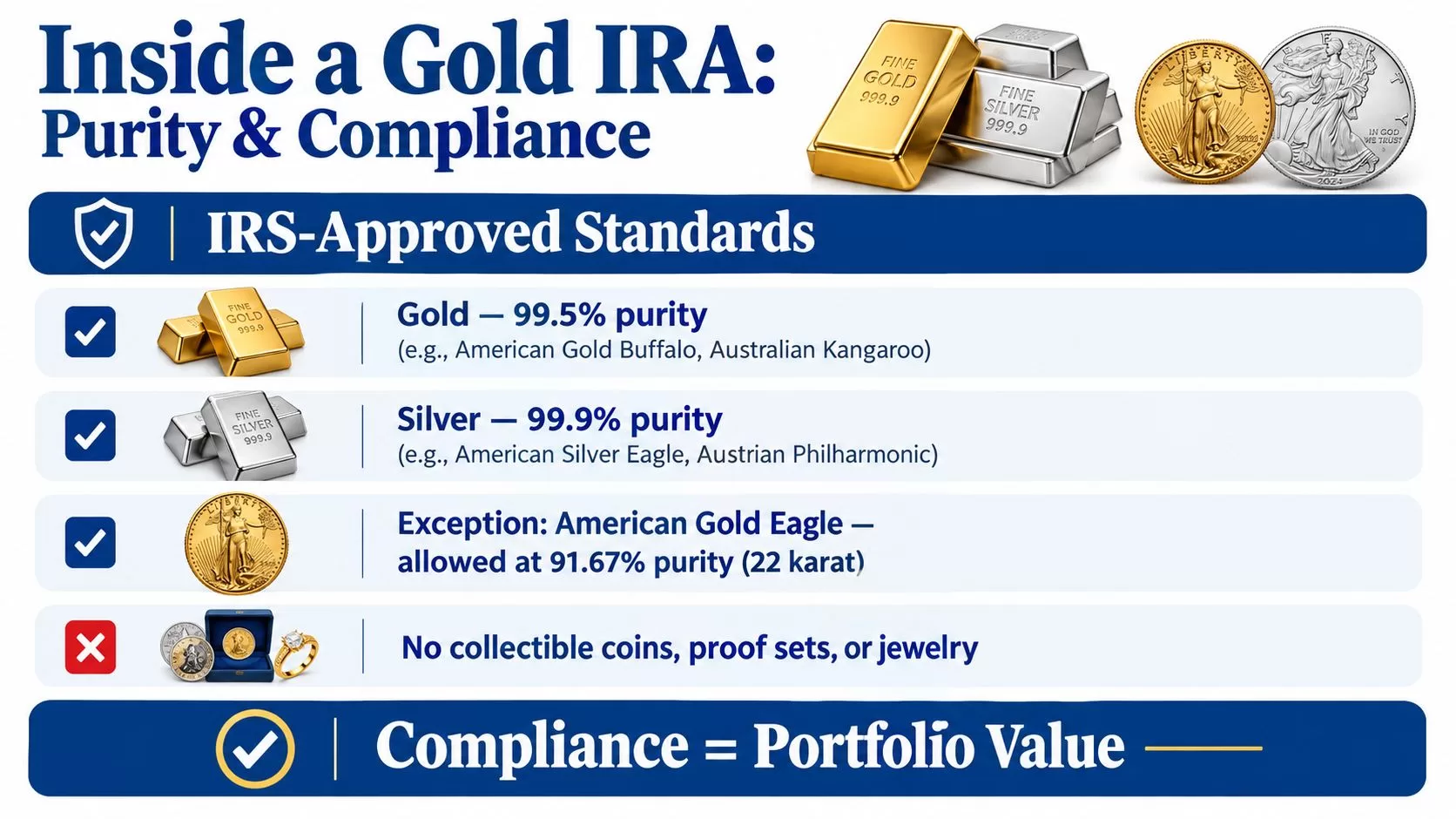
For IRA-approved gold, the purity threshold is 0.995 fineness, meaning the metal must be at least 99.5% pure. Silver must meet 0.999 fineness, while platinum and palladium must meet 0.995 fineness, as explained in this guide to IRA-eligible gold and silver.

Eligibility changes the meaning of a low price
The IRS allows an exception for American Gold Eagle coins, which are 91.67% pure, rather than meeting the general gold purity threshold. That named exception demonstrates why investors shouldn't judge eligibility from fineness alone. Legal classification matters too, as described in this Gold IRA guide.
A lower-priced collectible, jewelry item, or non-qualifying product may still have value outside a retirement account. It may have little or no value for the specific purpose of funding a compliant Gold IRA. Readers can review broader account considerations in this Traditional IRA compliance guide, while remembering that individual circumstances can change the tax and legal analysis.
Rollover mechanics can outweigh a small price difference
The transfer method also affects value. A direct rollover from a 401(k) to another qualified retirement account is treated as tax-free because the money moves directly between institutions without the account holder taking possession.
An indirect rollover typically involves 20% federal withholding and gives the taxpayer exactly 60 days to redeposit the full amount, according to this explanation of direct and indirect 401(k) rollovers. The account holder must replace the withheld amount when completing the rollover, or the transaction may create tax consequences.
That difference shows why process quality can matter more than a modest product-price gap. A transparent custodian, approved storage arrangement, accurate paperwork, and clearly explained charges are part of the purchase's practical value.
Total cost belongs in the comparison
A Gold IRA may involve setup, custodian, storage, transaction, and other account-related charges. The lowest advertised metal price doesn't necessarily produce the lowest overall cost. Investors should request a complete explanation in writing and ask which charges are recurring, which are one-time, and which apply when buying or selling.
How to Judge Any Gold Offer on Price and Value Before You Buy
A disciplined review doesn't require advanced valuation software. It requires asking the same basic questions of every offer and separating the metal's quoted price from the account's total economic cost.
Start with eligibility and documentation
Confirm the product. Identify the exact coin or bar, metal, weight, fineness, manufacturer, and condition. A vague description makes a meaningful comparison difficult.
Check IRA eligibility. Confirm that the product meets the applicable purity and classification rules before discussing whether its price is attractive. Ask who will verify eligibility and how that verification will be documented.
Separate metal from account services. Request separate figures for the metal, premium, shipping if applicable, account setup, custody, storage, and transactions. A single bundled figure can hide the factors that determine value.
Examine the full ownership experience
Review the custodian and storage arrangement. Understand which institution holds the account, where the metals are stored, how records are maintained, and whether the arrangement matches the requirements of a self-directed retirement account.
Ask about liquidity. Find out how sales are handled, whether a buyback process exists, how pricing is determined, and what documentation the account holder receives. A low purchase price offers limited value if the exit process is unclear.
Consider the portfolio role. Decide whether the proposed allocation is intended for diversification, a possible inflation hedge, wealth preservation, or another clearly defined purpose. Gold and silver can be options for diversification, but they don't eliminate market, liquidity, or account risks.
Readers who want a focused breakdown of recurring and transaction costs can consult the Gold IRA fees guide. The purpose isn't to find a fee-free account. It's to understand what each charge pays for and whether the services support the retirement plan.
Before signing: Compare at least the product specification, eligibility, total costs, storage structure, liquidity process, and portfolio purpose. A low sticker price should be the beginning of the review, not the conclusion.
The final decision should account for the investor's age, retirement income, tax position, existing assets, and tolerance for price changes. This is not financial advice. A licensed financial advisor, CPA, or tax professional can help evaluate whether a rollover or precious-metals allocation fits the individual situation.
Bringing Price and Value Together for Your Retirement Plan
Price is what the investor pays today. Value is what the purchase contributes to the retirement plan after costs, rules, risks, and purpose are considered. That distinction applies to an everyday purchase, a publicly traded asset, and a physical metal held in a retirement account.
Historical value-investing evidence shows that price and estimated value can diverge for long periods. Precious-metals investors face a more specific version of the same problem: the cheapest product may fail eligibility rules, carry unclear costs, or add little diversification. A product with a higher apparent price may offer better practical value if it is eligible, properly stored, clearly documented, and suited to the portfolio.
A careful investor doesn't chase the lowest quote or assume that a premium guarantees quality. The better process is to verify the product, calculate the full cost, understand the rollover method, review liquidity, and decide what role the holding is meant to play.
Before taking action, readers can request educational materials and compare providers using the resources available through Gold IRA Association. This is not financial advice. Consult a licensed financial advisor, CPA, or tax professional before making investment decisions.
Gold IRA Association provides educational guides on IRA-eligible metals, rollover procedures, account structures, fees, and provider comparisons. Visit Gold IRA Association to review the information needed to compare price with long-term value before speaking with a provider.


