




A lot of people asking how much gold should I own are in the same place. Retirement is getting closer, the stock market still matters for growth, but big swings, inflation worries, and questions about the dollar make a plain stock-and-bond mix feel less comfortable than it once did. The hard part isn't deciding whether gold has a role. It's deciding how much is helpful without going so far that it starts changing the whole character of the portfolio.
A near-retiree with most savings in a 401(k) often wants two things at once. First, less vulnerability to rough market periods. Second, enough growth potential to support a retirement that could last decades. Gold can fit into that conversation, but the answer usually isn't a single magic number.
Introduction Why This Question Matters Now
For someone in their late fifties or sixties, this decision tends to feel more personal than theoretical. A large drawdown a few years before retirement can hurt. At the same time, moving too much money into a non-income-producing asset can also create problems if stocks keep doing the heavy lifting for long-term growth.
That tension is why the better question isn't, "Is gold good or bad?" The better question is, what job should gold do inside this particular retirement plan? One saver may want a small diversifier. Another may want more downside defense. A third may already have enough conservative assets and only needs a modest hedge.
A gold allocation is best treated as a portfolio design choice, not a prediction contest about next year's gold price.
This is also where many articles oversimplify the topic. They jump straight to a single percentage and present it like a universal rule. The evidence points in a more nuanced direction. The right amount depends on goals, risk tolerance, home currency, and how close someone is to drawing income from the portfolio.
Readers also need the practical side, especially if the gold position will sit inside a retirement account. Not every product qualifies for an IRA. Not every rollover method carries the same tax risk. Those details matter just as much as the allocation target itself.
This article takes a step-by-step approach. It starts with what gold does in a retirement portfolio, then looks at what research says about allocation bands, then turns those ideas into usable ranges for different retirement profiles. It closes with IRA rules and the common mistakes that lead people to overdo or underdo a gold allocation.
This is not financial advice. Readers should consult a licensed financial advisor, CPA, or tax professional before making investment decisions.
What Gold Actually Does Inside a Retirement Portfolio
Gold often gets discussed as if it must either save a portfolio or drag it down. Neither view is very helpful. In practice, gold usually works best as a supporting asset, not the star of the show.
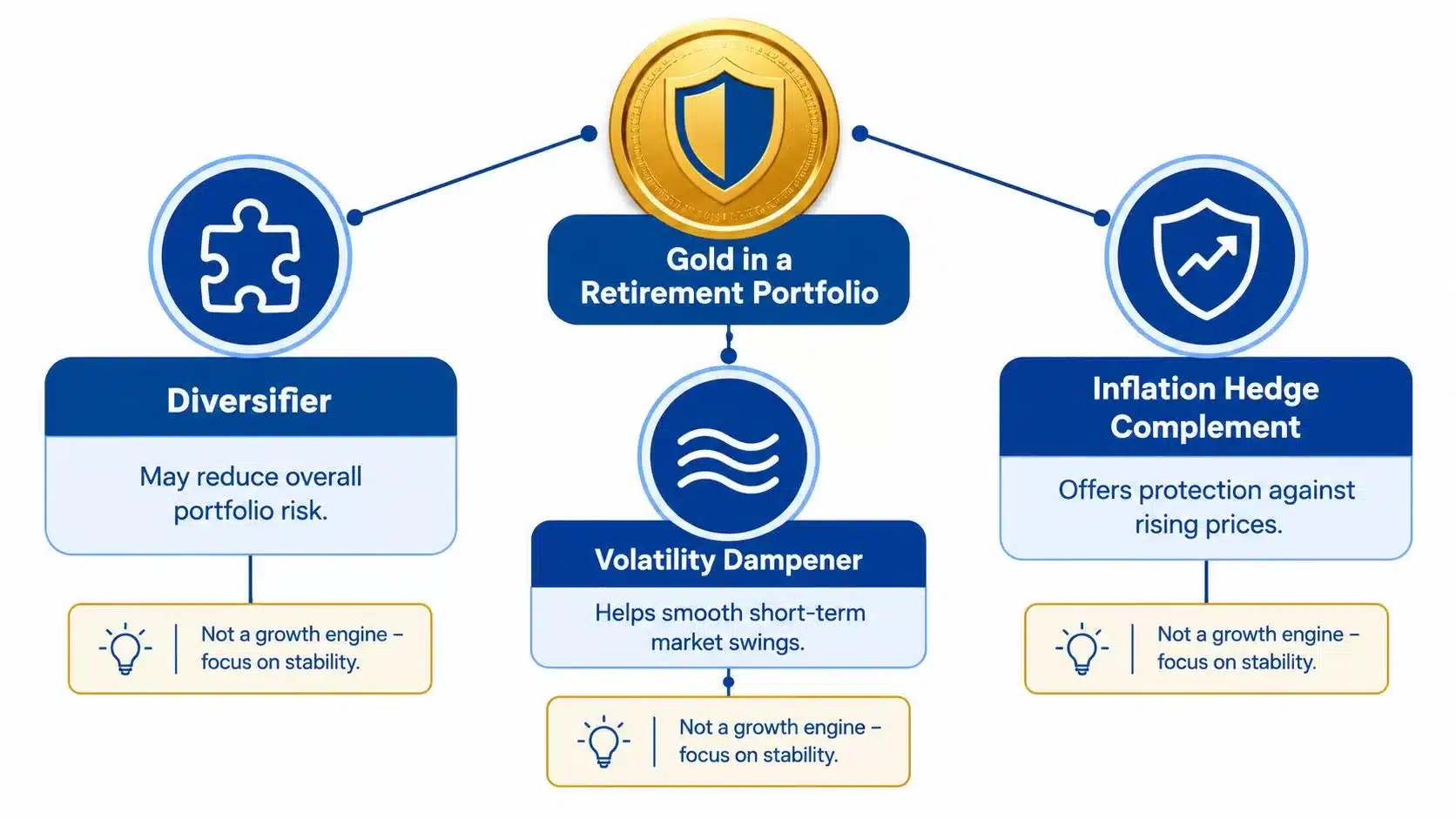

Gold can act like a shock absorber
Stocks are the main growth engine in many retirement portfolios. Bonds often help with income and stability. Gold plays a different role. It may help diversify the portfolio when the usual stock-bond balance isn't working as smoothly as expected.
A simple way to think about it is this. Gold can act like a shock absorber. It doesn't remove every bump, and it doesn't guarantee protection, but it may soften the ride when financial assets are under stress.
That's one reason some retirees look at gold as an inflation hedge. The point isn't that gold always rises when prices rise. The point is that some investors use it as a complement to paper assets when they want another source of stability.
Gold is not a growth engine
Confusion starts. Gold may help with diversification, but it isn't the same as owning productive businesses or interest-paying bonds. Someone who puts too much of a retirement portfolio into gold can reduce exposure to long-run growth assets.
That doesn't make gold a bad asset. It just means the role has to match the expectation.
A practical way to separate gold's strengths from the hype:
- Diversifier: Gold may behave differently from stocks and bonds at important moments.
- Volatility dampener: A modest allocation can help reduce overall portfolio turbulence.
- Inflation hedge complement: It may support purchasing-power concerns, but it shouldn't be treated as a perfect inflation solution.
Practical rule: If the goal is retirement stability, gold usually belongs in the "risk management" bucket, not the "maximize growth" bucket.
Why role matters more than opinion
Two people can have the same view of the economy and still need different gold allocations. One may have a pension and plenty of bond exposure. Another may be heavily dependent on market-based retirement assets. Their portfolios need different things.
That is why the question how much gold should I own can't be answered well without first asking what gold is supposed to accomplish. If the answer is "a little more resilience," the range will likely be modest. If the answer is "a deliberate defensive tilt," the range may be higher, but the trade-offs become much more important.
What History and Research Say About Allocation Percentages
The most useful research doesn't ask whether gold is "good." It asks what happens to a full portfolio when a measured amount of gold is added. That's the right lens for retirees, because retirement planning is about portfolio behavior, not isolated asset opinions.
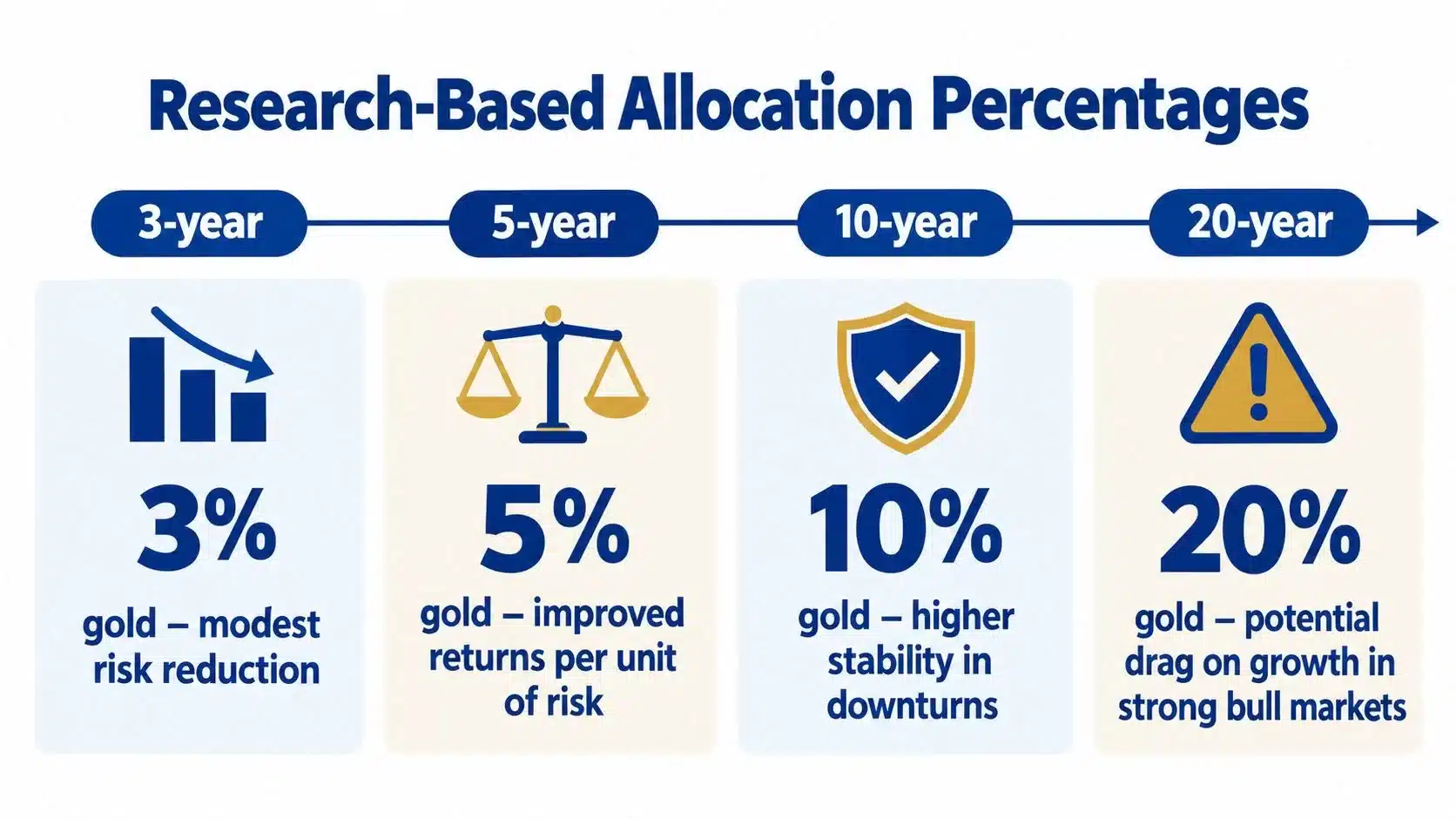

What a major long-run analysis found
A 2025 World Gold Council analysis found that adding 2.5%, 5%, 7.5%, or 10% gold to a hypothetical average U.S.-dollar portfolio improved risk-adjusted returns and reduced drawdowns over 3-, 5-, 10-, and 20-year periods. In that same analysis, a 5% gold allocation increased annualized return from 6.7% to 7.0% over 20 years, while reducing annualized volatility from 9.9% to 9.6% and improving maximum drawdown from -34.9% to -32.7%.
That matters because it shows something many retirees intuitively hope for. A relatively small slice of gold can change portfolio behavior without taking over the portfolio.
A separate independent strategic-allocation study reached a similar broad conclusion. It found that adding a modest 2.5% to 10% gold allocation to a hypothetical average U.S.-dollar portfolio improved risk-adjusted returns and reduced drawdowns, supporting gold as a small strategic sleeve rather than a core holding.
Why different studies give different "best" answers
Readers often get tripped up. Research can point to different optimal percentages because it depends on what the researcher is optimizing for.
A 2024 academic paper on portfolio construction found that gold allocations between 1% and 34% improved risk-adjusted returns, with an optimal mark of 17% in the authors' model. The same paper also cited earlier long-term work showing the minimum downside volatility of 3.3% occurred when a 10% gold allocation was added to a 30/70 equity-bond portfolio.
That doesn't mean every retiree should jump to those figures. It means the "best" answer changes based on the target:
- Maximizing risk-adjusted return may point to one allocation.
- Minimizing downside volatility may point to another.
- Keeping a diversified, easy-to-live-with retirement mix may point to a more moderate range.
A short video can help readers think through this trade-off visually.

Why 5% to 10% keeps showing up
The practical takeaway is narrower than the full academic range. Modest allocations appear repeatedly because they can offer diversification benefits without turning the portfolio into a macro bet on gold itself.
Some research supports much higher allocations for specific goals, but the closer an investor moves toward a large gold position, the more that choice starts to dominate the portfolio.
For many retirement savers, 5% to 10% stands out as a workable middle ground. It's large enough to potentially matter in rough periods, but still small enough to leave stocks and bonds in their usual lead roles.
How Much Gold to Own by Goal and Risk Profile
Once the research is translated into real life, the answer becomes less about a single ideal percentage and more about choosing an allocation band that fits the portfolio's job. A saver trying to preserve capital will usually think differently than a saver who still needs stronger growth.
A simple way to frame the decision
Three questions matter most:
- How close is retirement? The shorter the timeline, the harder it is to recover from a deep drawdown.
- How much volatility can this person tolerate? Some investors can stay calm through declines. Others can't.
- What already sits in the portfolio? A stock-heavy mix may benefit from a different gold weight than a bond-heavy one.
Here is a practical decision matrix.
| Investor Profile | Example Gold Range | Primary Goal | Key Trade-off |
|---|---|---|---|
| Growth-oriented near-retiree | 2.5% to 5% | Add diversification without giving up much growth exposure | May not provide as much downside cushioning in severe stress |
| Balanced retirement saver | 5% to 10% | Improve portfolio balance and smooth rough periods | Some opportunity cost if stocks strongly outperform for long stretches |
| More defensive or preservation-focused saver | 10% to 12% | Increase resilience and reduce dependence on stocks and bonds alone | Higher chance of slower portfolio growth over time |
| Highly defensive macro-driven investor | Above moderate allocation bands | Make a stronger defensive or currency-related bet | Gold can become a dominant portfolio call rather than a diversifier |
For many retirees, modest usually means enough
A balanced saver often lands in the middle band for a reason. It lines up with the research pattern that modest gold allocations can improve diversification and reduce drawdown pressure without fully reshaping the portfolio.
Someone retiring soon with a traditional stock-and-bond account may find that 5% to 10% feels meaningful but still manageable. It is enough to count, yet not so large that the investor's future depends heavily on gold outperforming.
A workable retirement allocation should be small enough to hold through good times and large enough to matter in bad times.
When a lower allocation may make sense
A lower range can fit people who still need growth and already have some portfolio ballast elsewhere. Examples include a saver with substantial bond exposure, a pension, or other stable income sources. In that case, gold may only need to serve as a light diversifier.
That investor isn't saying gold is unimportant. The investor is saying the portfolio already has some defensive features, so the gold sleeve doesn't need to do all the work.
When a somewhat higher allocation may fit
A saver who feels vulnerable to inflation, market shocks, or currency concerns may prefer a somewhat larger gold allocation. This is especially true when the portfolio is heavily exposed to paper assets and retirement is near enough that large losses feel harder to absorb.
There is support for this kind of customization. A report summarized by Investing.com on BCA Research findings noted optimal gold allocations ranging from 0% to 26% for conservative portfolios and 0% to 29% for balanced portfolios depending on home currency, with U.S.-dollar investors often near 7% for conservative portfolios and 10% to 12% for balanced portfolios.
That point is easy to miss in consumer content. Home currency changes the picture. So does the risk target. A U.S.-based retiree and an investor in another major currency may not land on the same answer.
A practical way to choose a starting point
For many readers, the cleanest approach is to choose a starting band, not a permanent number carved in stone.
- If growth still leads: Start near the lower end.
- If balance is the priority: Start in the middle.
- If defense matters most: Consider the upper end of the moderate range and test how it changes the overall portfolio.
That approach turns the question from "What is the one right percentage?" into "What percentage fits this retirement plan?"
Putting Your Target Into Practice Inside a Gold IRA
Choosing a target is only half the job. The next step is making sure the account structure, the metals, and the funding method all line up with IRS rules.
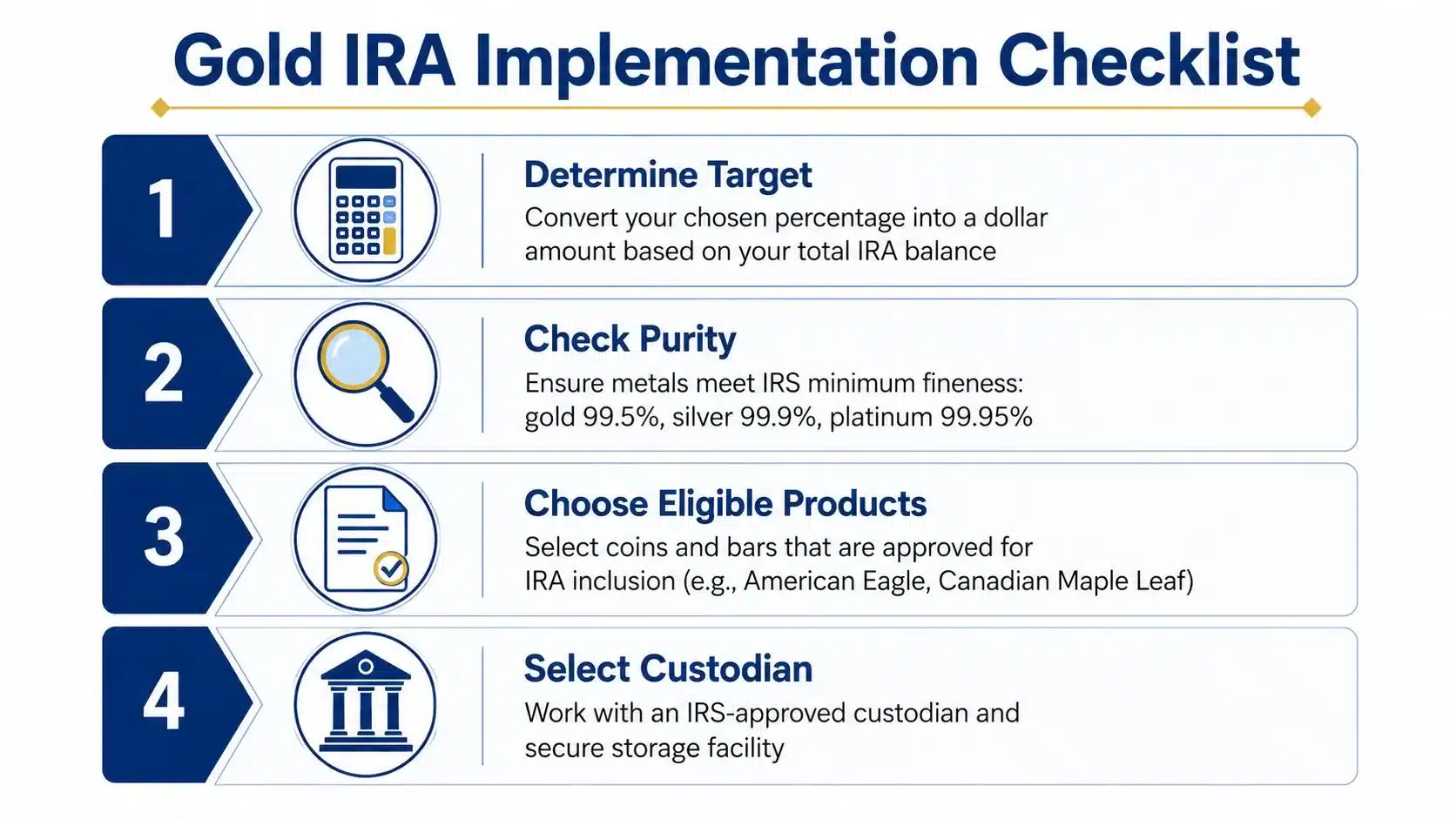
Start with the portfolio target, not the product
A retiree who decides on a gold allocation should first convert that percentage into a dollar target inside the retirement portfolio. That keeps the decision disciplined. The account shouldn't be built by choosing coins or bars first and backing into an allocation later.
Readers who need the account basics can review how a Gold IRA works before moving money.
A few implementation rules matter right away:
- Purity standard for bullion: Gold held in an IRA generally must meet a minimum fineness of 99.5%, expressed as .9950, for bullion bars and rounds to qualify under the IRS collectible exception, according to this Gold IRA purity rules overview.
- Special coin exception: Certain U.S.-minted coins are statutory exceptions, including American Gold Eagle coins, even though they don't meet the 99.5% purity standard, as explained in this collectibles and IRA exception summary.
Rollover mechanics can affect the whole process
The funding method matters more than many people realize. Mistakes here can create taxes or unnecessary friction.
Key points to watch:
- Indirect IRA-to-IRA rollovers: A person can make only one indirect IRA-to-IRA rollover in any rolling 12-month period across all traditional IRAs combined. Direct trustee-to-trustee transfers and employer-plan-to-IRA direct rollovers aren't subject to that same limit, based on this indirect rollover rule explanation.
- Employer-plan indirect rollovers: For a 401(k) or similar employer plan moving into an IRA, funds must be redeposited within 60 days to avoid taxation, and the plan may withhold 20% for federal taxes on eligible distributions if the rollover is handled indirectly, according to this 401(k) rollover rules guide.
A direct transfer is often simpler because it avoids some of the timing and withholding issues that can trip people up.
Don't confuse IRA gold with every form of gold exposure
Some investors also want to understand how physical gold ownership compares with newer digital forms of exposure and recordkeeping. For readers exploring that broader field, this overview of gold tokenization and blockchain wealth adds useful context, even though a retirement account still has its own compliance rules and custody requirements.
Inside a Gold IRA, the practical sequence is straightforward:
- Set the target allocation first
- Use IRA-eligible metals only
- Choose a compliant funding path
- Keep records clean and organized
That order helps prevent a common mistake. People often become focused on a specific product before confirming whether it fits the retirement plan and the account rules.
Common Pitfalls When Deciding Your Gold Percentage
The biggest mistake isn't owning too little gold. It's assuming that more gold automatically means more safety.
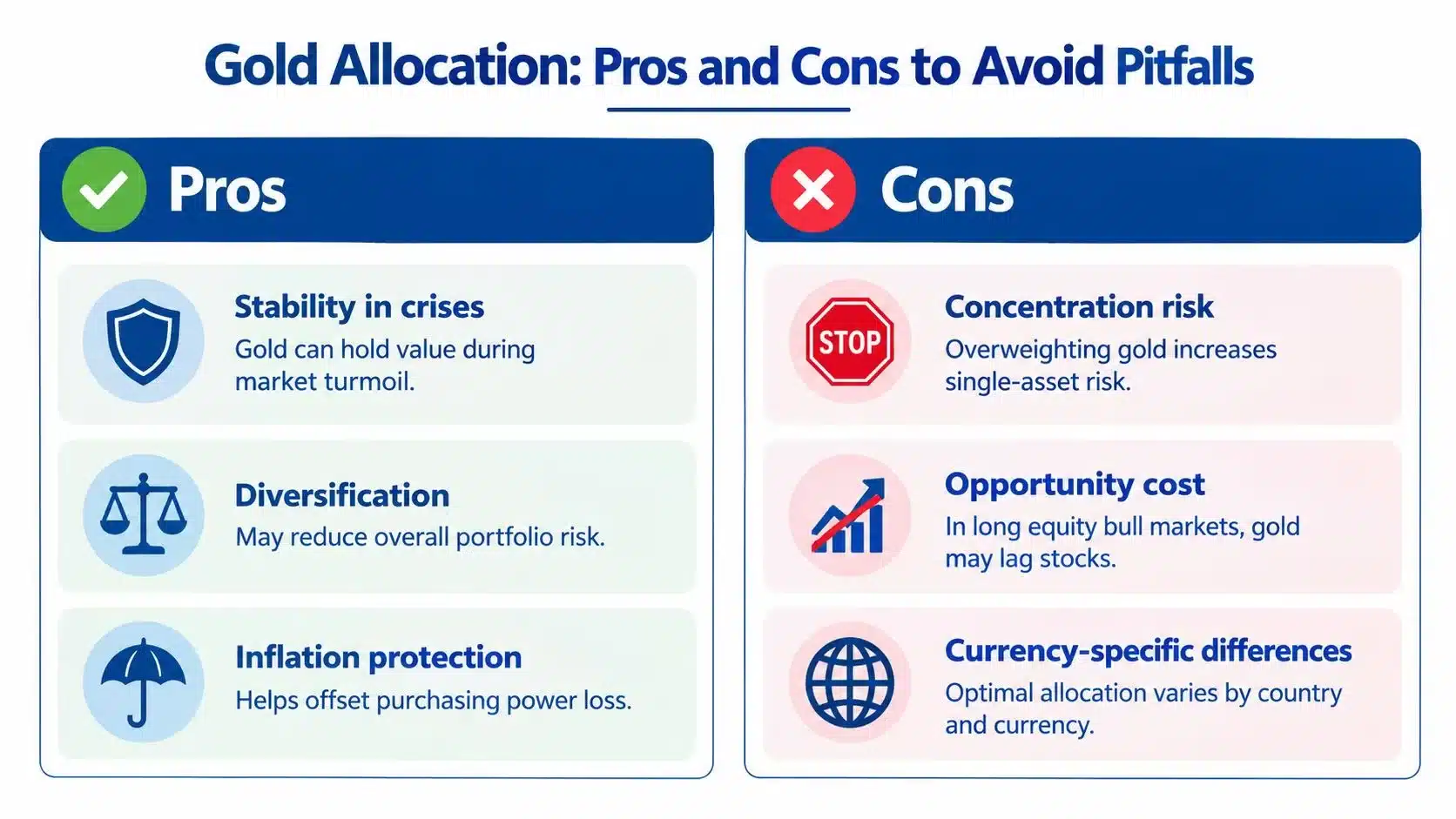
More protection can become concentration
Gold can help diversify a portfolio. But once the allocation becomes too large, the investor may be replacing one concentration risk with another. Instead of being too dependent on stocks, the portfolio becomes too dependent on a single alternative asset.
That is why some larger allocation arguments should be treated carefully. A World Gold Council publication discussing portfolio ranges notes that long-horizon work supports modest allocations, with 1% to 7% able to reduce volatility and downside risk without materially reducing returns, and earlier research suggesting 2% to 10% is optimal for most investors. The same discussion also notes that some newer practitioner commentary argues for 18% to 30% allocations under current monetary and fiscal conditions.
At that point, the investor is usually making more than a diversification decision. The investor is making a stronger macro call.
Currency can change the answer
Another common error is assuming that a universal gold range fits everyone everywhere. It doesn't. As covered earlier, home currency can shift the optimal range, especially for investors outside the U.S. or for those measuring risk in a different currency base.
That matters because many articles present one neat percentage band and stop there. Real portfolios aren't built in a vacuum. Currency exposure, bond mix, and withdrawal timeline all influence how much gold may make sense.
Chasing fear or recent performance
Investors also get into trouble when they decide their gold percentage emotionally. After a sharp market selloff, gold can suddenly feel like the answer to everything. After a strong stock run, it can feel unnecessary.
Neither reaction is reliable.
A better test is whether the chosen allocation still feels sensible in both environments:
- During strong stock markets: Does the gold position still seem worth holding for diversification?
- During market stress: Is the allocation large enough to matter without taking over the portfolio?
- During retirement planning reviews: Does the mix still match the income timeline and risk tolerance?
Readers who are evaluating providers or trying to avoid high-pressure tactics should also stay alert to common warning signs covered in this guide to Gold IRA scam red flags.
Gold can be useful. Turning it into the center of the retirement plan is a separate choice, and it deserves a higher burden of proof.
This is not financial advice. Before changing a retirement allocation, readers should consult a licensed financial advisor, CPA, or tax professional.
Choosing Your Number and Next Steps With Confidence
The most useful answer to how much gold should I own isn't a single fixed percentage. It's a range that fits the job. For many diversified retirement savers, 5% to 10% is a practical middle ground. It is often enough to add diversification and help with downside control, but not so much that the portfolio becomes a bet on gold itself.
Some investors may reasonably choose less. Some may choose more, especially if their risk target, currency exposure, or portfolio structure points that way. The key is to make that choice deliberately. Start with the retirement goal, test the trade-off between stability and growth, and then implement the allocation in a way that fits IRA rules if retirement money is involved.
A calm process usually works best:
- Pick the role gold should play
- Choose an allocation band
- Check that it fits the full portfolio
- Use compliant IRA mechanics if funding through a rollover
This is not financial advice, and no outcome is guaranteed. A licensed financial advisor, CPA, or tax professional can help confirm whether the chosen range fits an individual's full financial picture.
Gold IRA Association publishes plain-English education for retirees and pre-retirees who want to understand allocation choices, Gold IRA rules, and rollover mechanics before acting. Readers who want a helpful next step can visit Gold IRA Association to compare educational resources, review Gold IRA guidance, or request a free Gold IRA kit.


