




A call arrives just as retirement planning becomes urgent. The salesperson says a 401(k) rollover into gold can protect savings, avoid market risk, and secure the future. The pitch sounds professional, but the details about pricing, custody, eligible metals, and taxes remain unclear.
That combination deserves caution. A legitimate precious-metals IRA can involve complicated rules, while a gold IRA scam often uses that complexity to pressure retirement savers into moving money before they understand the transaction. This guide shows how the fraud typically works, which questions expose weak offers, and how to verify pricing, IRS eligibility, and custodian mechanics before any funds move. Readers can also review the basics in this guide to how a gold IRA works.
Gold IRA Association publishes educational material designed to help savers compare providers and understand retirement-account procedures without sales pressure. The practical standard is simple: slow down, get the important terms in writing, and ask a licensed financial advisor, CPA, or attorney for advice suited to the individual situation.
Introduction Why Gold IRA Scams Target Retirement Savers
A near-retiree may be especially receptive to a call that mentions inflation, market volatility, or uncertainty around traditional investments. The caller presents as an “IRA expert,” asks about existing retirement accounts, and recommends a self-directed IRA holding physical gold or silver. The offer may sound like a protective step, but the caller's real objective could be a rollover into overpriced metals or an account structure the saver doesn't fully understand.
The U.S. Commodity Futures Trading Commission's warning about metals fraud says gold and silver IRA scams often begin with dealers posing as “IRA experts” and persuading retirement savers to move funds into self-directed IRAs. That approach works because the salesperson reaches the saver at a financially sensitive moment, when preserving accumulated retirement savings matters more than chasing speculative gains.
The documented harm isn't merely theoretical. In 2022, the SEC and 27 state securities regulators charged Safeguard Metals and its owner over an alleged scheme that took approximately $68 million from at least 450 investors, with most of the money coming from retirement savings. The case shows how a sales operation can affect many investors across multiple states and heavily involve older Americans.
The right response isn't panic. Physical precious metals may be one diversification option, but no provider should receive retirement funds until the saver understands the dealer's price, the expected selling price, recurring fees, custodian, depository, and tax mechanics.
Practical rule: A convincing voice, polished website, or retirement-themed advertisement isn't proof of a fair offer. Written terms and independent verification matter more.
This is not financial advice. Before making an investment or rollover decision, consult a licensed financial advisor, CPA, or tax professional who can review the individual's retirement plan, tax position, and risk tolerance.
How Gold IRA Scams Work and Common Red Flags
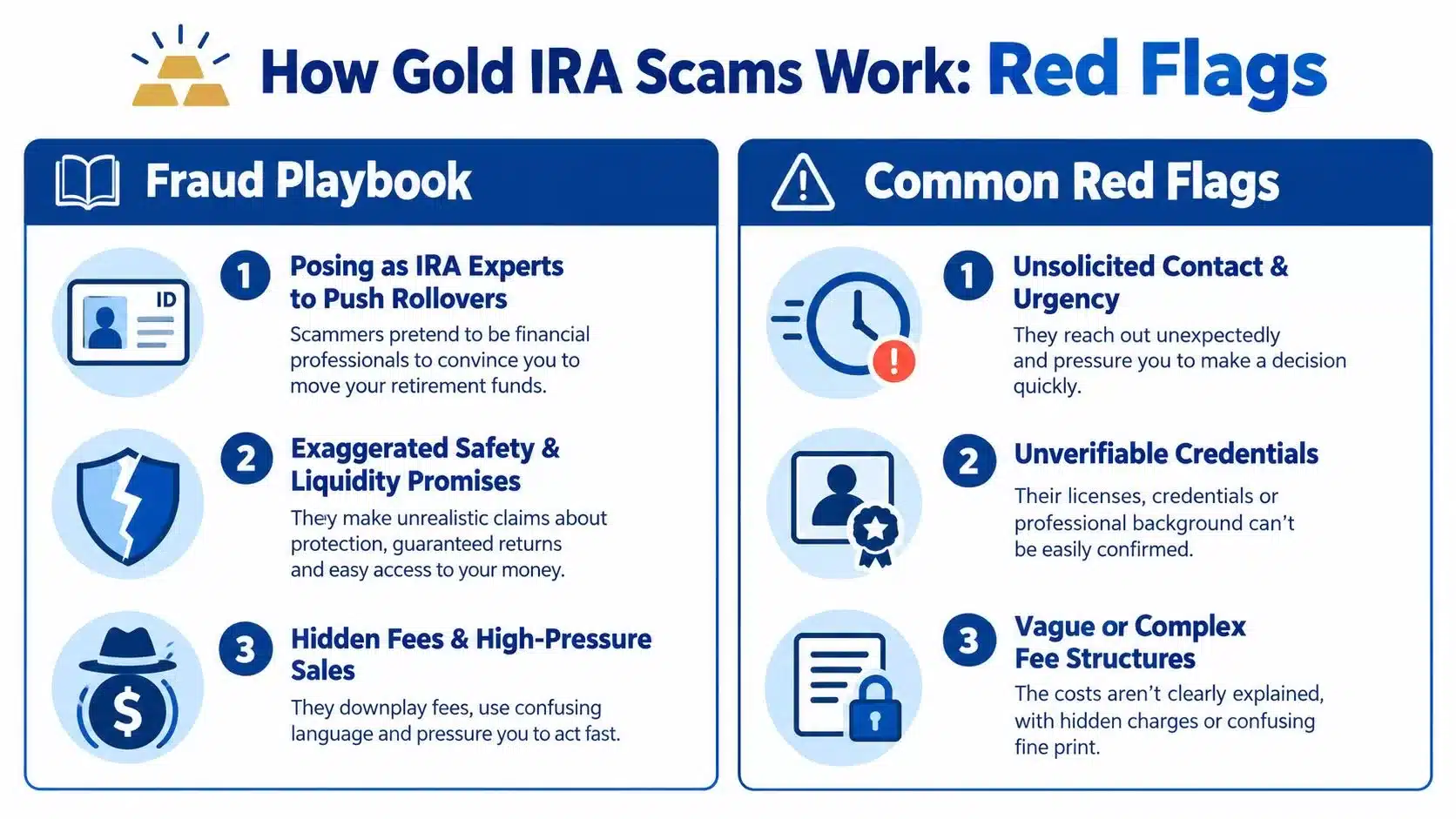
A gold IRA scam usually follows a recognizable sequence. The first contact creates concern, the salesperson claims special expertise, and the proposed solution involves moving retirement assets into a self-directed IRA. The seller then controls the conversation about which metals to buy, where they will be stored, and what the transaction will cost.
The sales pitch creates trust before it explains cost
Fraudsters may call themselves IRA experts even when they aren't the independent professionals the title suggests. The CFTC describes a pattern in which dealers use that identity to persuade savers to roll retirement funds into self-directed IRAs. Once the rollover becomes the focus, the seller can shift attention away from the basic question, “What will this metal cost me, and what can I sell it for?”
A related federal enforcement pattern involved SEC and CFTC actions against a firm accused of persuading investors to roll over 401(k) and IRA assets into precious-metals self-directed IRAs for fraudulent purposes. The important warning is the structure itself: high-pressure solicitation combined with nontransparent pricing and difficult liquidation can expose the saver to risk before the account is even funded. Readers researching related state-level issues can also review this resource on a New York gold company.

Promises about safety and liquidity can hide the real risk
Gold isn't a guaranteed safe asset, and a physical-metal IRA isn't automatically liquid. A seller who promises complete protection, effortless access, or certain retirement security is simplifying a decision that involves market prices, spreads, storage, insurance, administration, and potential tax consequences.
The CFTC's joint metals IRA warning describes misleading sales pitches involving self-directed IRAs and notes a recurring pattern of exaggerated claims about retirement protection. The same warning context is important for evaluating claims that make gold sound risk-free while saying little about fees or the process for selling.
The pricing problem can be severe. The CFTC explains that precious-metals IRA schemes can create a 30% to 300% or greater spread between buy and sell prices, according to its metals IRA fraud bulletin. A saver facing that spread may need a major rise in the spot price just to break even, before storage, insurance, and administrative fees are considered.
Overpriced products and urgency complete the playbook
Some sellers steer customers toward collectibles or other products that don't qualify for an IRA. Others use limited-time language, repeated calls, or claims that retirement savers must act immediately because of an economic event. Those tactics discourage comparison and make it harder for the customer to ask a custodian to verify the details.
A 2021 lawsuit by New York Attorney General Letitia James against Lear Capital and its founder alleged that nearly 1,000 New Yorkers were cheated out of about $10 million, illustrating how costly precious-metals retirement schemes can become for retail investors in one state. The allegation isn't proof that every metals provider operates improperly, but it reinforces the need to separate a persuasive sales pitch from independently verified account terms.

Your Due Diligence Checklist to Spot and Avoid Fraud
The safest way to evaluate a provider is to treat the proposed rollover like a document audit. A seller should be able to explain the transaction in plain English and provide the important figures before the saver authorizes a transfer.
Start with the complete price
Ask for a written quote that shows the buy price, the expected sell price, the spread between them, and every recurring charge. The request should cover storage, insurance, administration, account maintenance, shipping, and any transaction-related cost that applies.
Don't accept “competitive pricing” as an answer. The CFTC specifically recommends requesting written buy and sell prices plus recurring fees before funding a rollover. If the provider won't give those terms in writing, the offer fails the first review.
The spread tells the saver how far the metal price must move before the position reaches its starting value. A large spread creates a break-even hurdle even if the spot price rises, and recurring fees add another expense while the account remains open.
Verify the metal before accepting the sales description
A product name isn't enough. Ask for the exact coin or bar name, its fineness, its weight, and written confirmation from the custodian that it can be held in the IRA. A seller who calls a collectible “IRA-approved” without documentation is asking the customer to rely on marketing rather than rules.
The IRS eligibility rule is discussed in the next section, but the practical check belongs here: never fund a purchase until the custodian, not only the dealer, confirms that the proposed product qualifies.
Separate the three roles
The dealer sells the metal. The custodian administers the retirement account. The depository stores the assets and handles related records. A salesperson who blurs those responsibilities makes it harder to identify who is accountable for pricing, custody, reporting, and liquidation.
Read the custodian's agreements independently. This guide to an IRA custodian for gold can help readers understand why the account administrator deserves separate scrutiny from the company selling the metals.
Use a written comparison before making a decision
| Verification Item | Transparent Provider | Red Flag Provider |
|---|---|---|
| Buy and sell prices | Provides both figures in writing | Discusses only the purchase price |
| Spread | Explains the difference and break-even effect | Says pricing is standard without detail |
| Recurring fees | Lists storage, insurance, administration, and account charges | Uses vague or verbal fee explanations |
| IRA eligibility | Identifies the exact product and confirms eligibility | Markets collectibles or unclear products |
| Account roles | Separates dealer, custodian, and depository duties | Presents one salesperson as responsible for everything |
| Rollover process | Encourages custodian-to-custodian coordination | Pushes the saver to receive or move funds quickly |
Document every conversation
Save the quote, account agreement, product list, fee schedule, emails, text messages, and call notes. Write down the name and role of every person involved. If the seller changes the terms verbally, ask for a revised document before proceeding.
A pause is not a missed opportunity. It is a basic control against an irreversible retirement mistake.
The rollover should stop until the saver can answer four questions: What is being purchased? What will it cost? Who holds the account and metal? How can the position be sold, and at what price?
Rollover Mechanics and IRS Rules Scammers Misrepresent
Rollover language can make a risky transaction sound routine. The important distinction is whether the money moves directly between financial institutions or is paid to the account holder first.
Direct transfers and indirect rollovers are different
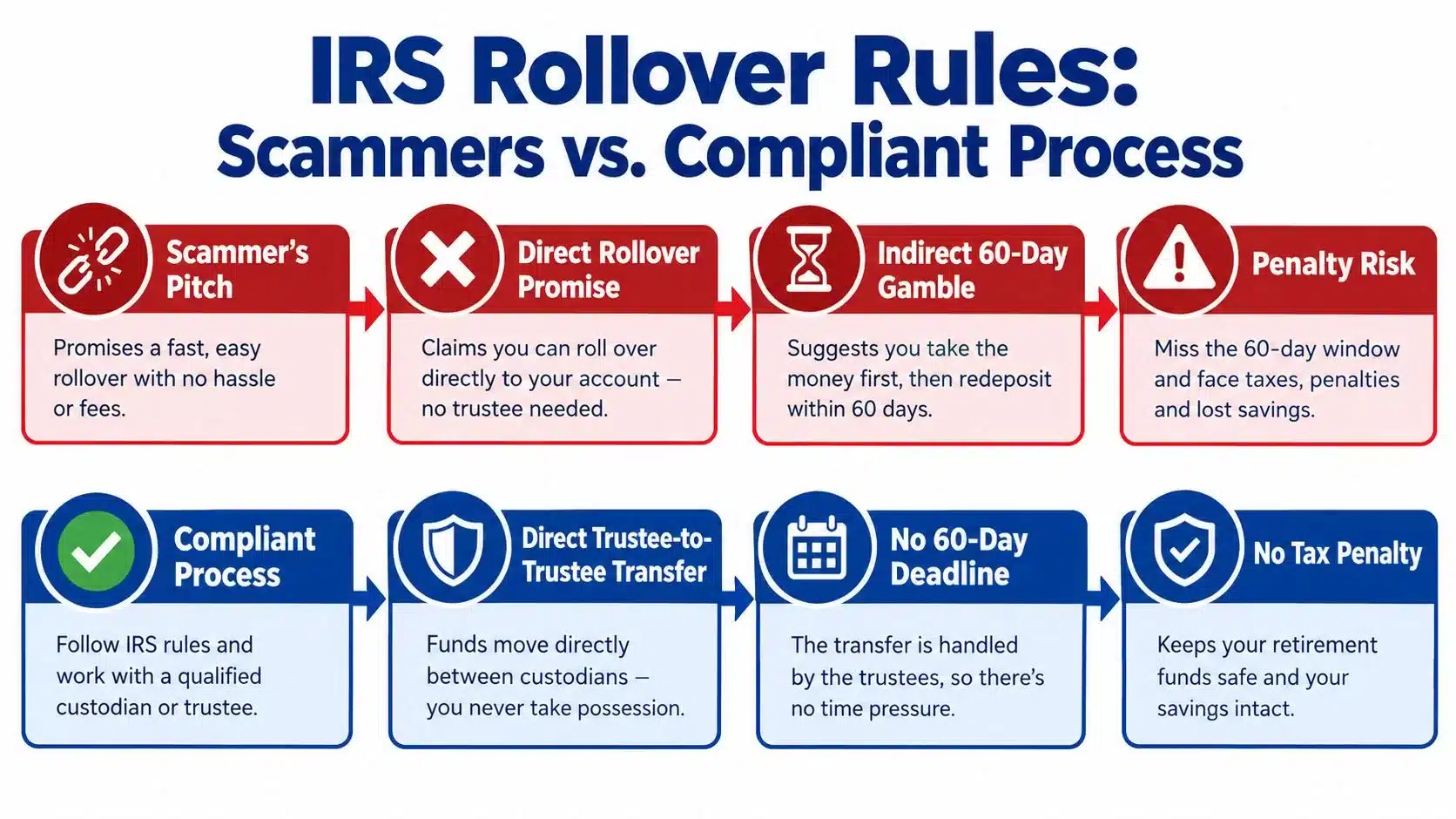
A direct trustee-to-trustee transfer moves retirement funds from one custodian to another without the account holder taking possession. It doesn't use the indirect rollover clock, which generally makes the mechanics easier to control.
With an indirect rollover, the retirement funds are paid to the account holder. The money must be redeposited into the new IRA within 60 calendar days or it is generally treated as taxable income, as explained in this guide to the 60-day rollover rule. If the investor is under 59½, the distribution may also face a 10% early-withdrawal penalty.
A salesperson who says the account holder can receive the money and “sort it out later” is ignoring the central tax risk. The safer question is whether the custodian can coordinate a direct transfer instead.

Employer-plan withholding creates a cash shortfall
Indirect distributions from an employer plan such as a 401(k) may involve 20% federal tax withholding, according to this explanation of gold IRA rollover withholding. The investor receives only the remaining amount but generally must deposit the full original distribution to complete the rollover correctly.
That means the saver may need to replace the withheld amount from other cash. A pitch that describes the transaction as a simple rollover while ignoring this gap isn't giving enough information to support a sound decision.
Contributions aren't the same as rollovers
For 2026, new IRA contributions are capped at $7,500, or $8,600 for savers age 50 and older, according to this overview of gold IRA rules. Exceeding the applicable limit can trigger a 6% excise tax on the excess until corrected.
A rollover and a new contribution follow different rules. A seller who suggests that unlimited retirement cash can be added as annual contributions is misrepresenting the account mechanics.
Confirm metal purity and product eligibility
IRS rules require most gold bullion or bars held in a gold IRA to meet a minimum fineness of 99.5%, or 0.995. The American Gold Eagle is a specific exception and is permitted despite having 91.67% purity, as explained in this summary of IRS rules for gold IRA products.
That exception doesn't make every coin eligible. Ask the custodian to confirm the exact product before purchase, especially if the dealer uses terms such as collectible, rare, proof, or limited edition.
How to Vet Gold IRA Companies Like an Independent Reviewer
A provider shortlist should come from evidence, not from the loudest advertisement. Gold IRA Association's review approach focuses on credibility, service responsiveness, disclosure quality, investment choices, storage arrangements, and reputation checks. Readers can also consult broader financial education, including Lighthouse Consultants on finance, before evaluating a retirement product.
Test the provider's answers
Send each shortlisted company the same written questions. Ask for the complete fee schedule, the exact products available, the custodian and depository relationships, the selling process, and the documents required for a rollover. Consistent questions make it easier to distinguish a transparent company from a skilled salesperson.
A strong response should be specific without being evasive. The representative should explain what the company does and what it doesn't do, identify the parties responsible for custody and storage, and give the saver time to review documents independently.
Check reputation and paperwork together
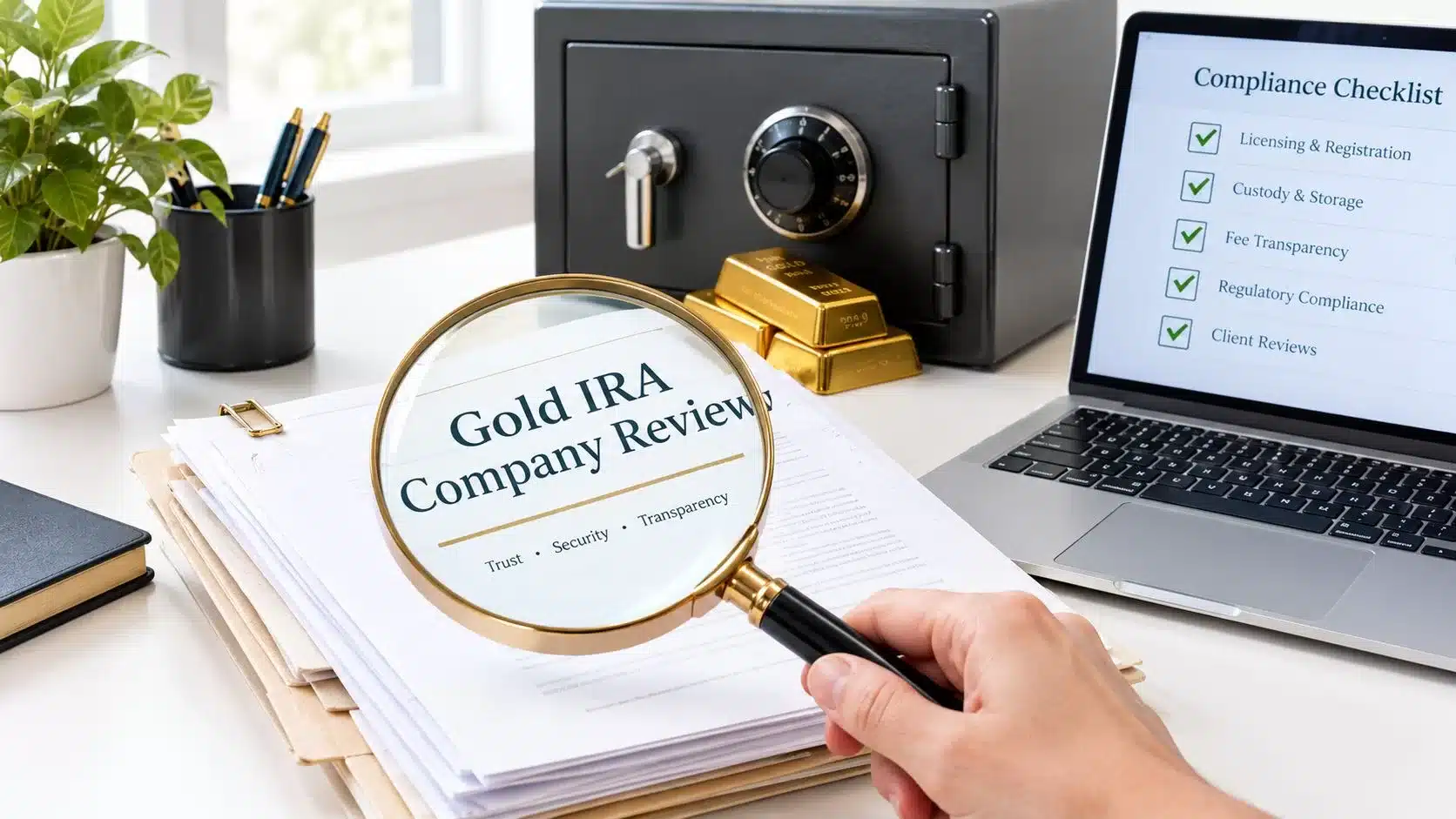
Online reviews can reveal recurring complaints, but they shouldn't replace regulatory and contractual checks. Look for unresolved concerns involving misleading sales practices, unexplained fees, delayed distributions, or difficulty selling assets. Then compare those reports with the provider's current written disclosures.
Customer service matters because retirement accounts require coordination. A company that answers questions clearly before receiving money is more useful than one that becomes vague when asked for pricing or liquidation details.
Keep the evaluation independent
A provider can offer educational help without becoming the decision-maker. The saver should still review the account agreement, confirm the custodian independently, and seek professional tax advice before moving funds. Gold IRA Association offers educational guides and comparison material, but its content shouldn't replace individualized professional advice.
A practical shortlist contains providers that answer the same questions with documents, not promises. Remove any company that uses urgency to bypass review, refuses to show the full price, or tells the saver that tax and eligibility questions can be handled later.
What to Do If You Suspect a Gold IRA Scam and How to Report It
Stop the transaction first. Don't send additional funds, sign revised documents, or authorize a rollover while the pricing, product eligibility, or account ownership remains unclear. Contact the custodian through independently verified contact information and ask whether money has moved, which assets were purchased, and what restrictions apply to reversing or selling the transaction.
Preserve everything. Keep contracts, invoices, account statements, emails, text messages, caller details, advertisements, and notes describing what the representative promised. A clear timeline can help a professional or regulator understand how the solicitation unfolded.
Seek guidance from a licensed financial advisor, CPA, or attorney. A professional can help assess possible tax reporting, account procedures, and legal options without promising a particular recovery. The CFTC warning materials identify precious-metals IRA fraud as an investor-protection concern, and suspected conduct may also warrant reports to the FTC, FINRA, state securities regulators, and the relevant state attorney general.
Each report should explain who contacted the saver, what was promised, how funds moved, which metals were purchased, what fees appeared, and whether the provider refused to supply documents. Regulators may not resolve every loss, but prompt, well-documented reporting can help preserve information about a suspected scheme.
This is not financial advice. Consult a licensed financial advisor, CPA, or tax professional before making investment decisions, and consult an attorney for potential legal claims.
Gold IRA Association provides plain-language guides, rollover education, fee explanations, and company comparison resources to help retirement savers investigate an offer before committing funds. Visit Gold IRA Association to review the available checklists and compare providers at a measured pace.


