



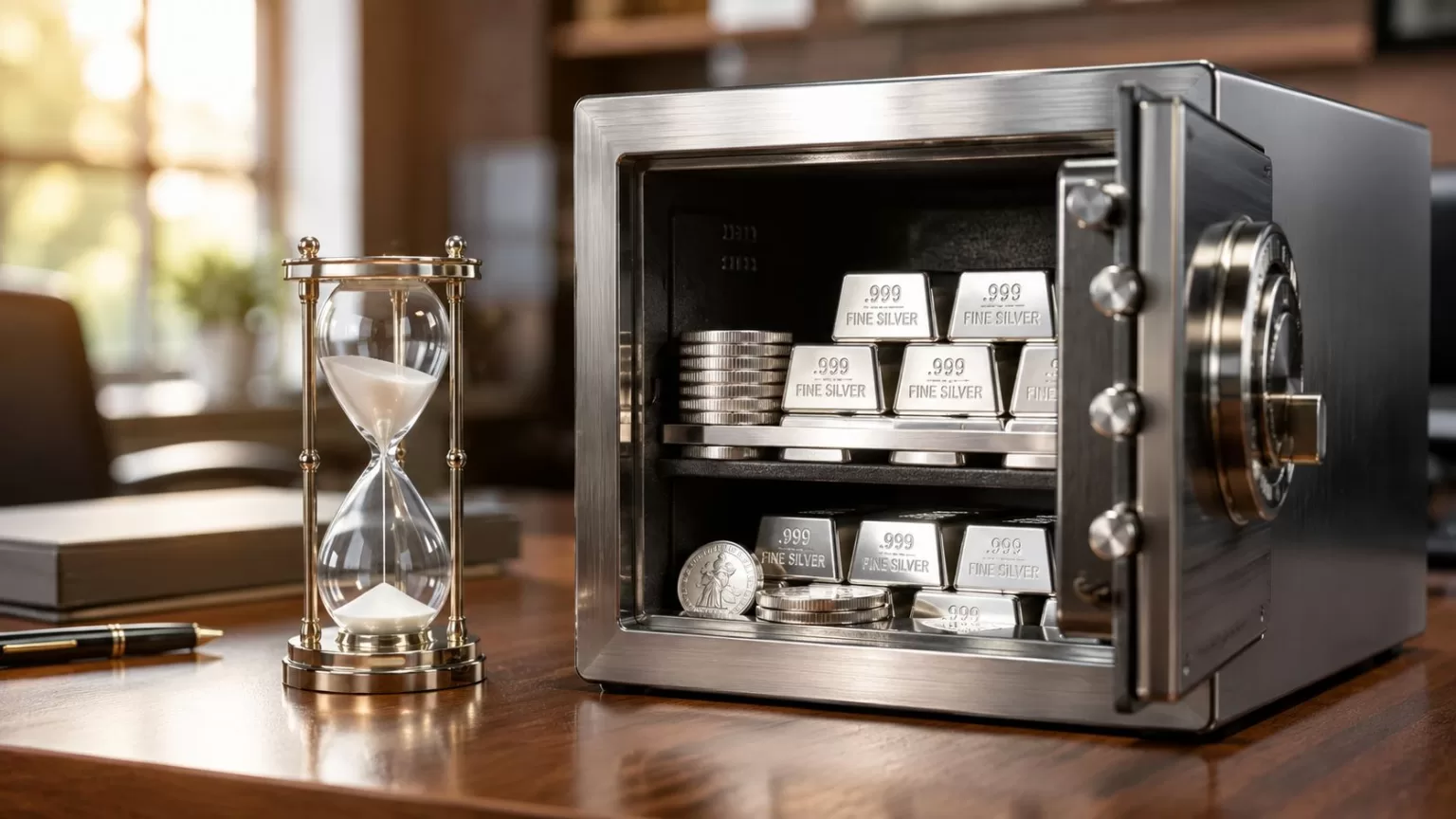
A Silver IRA is a self-directed IRA that holds physical silver meeting the IRS standard of at least.999 fineness, or 99.9% purity, through an approved custodian and depository, not at home. It's a regulated retirement structure, not a personal storage account for coins and bars.
A saver nearing retirement may be watching grocery bills rise, stock prices swing, and traditional retirement accounts feel less predictable than they once did. That naturally raises a practical question: could physical silver have a place inside a retirement plan without creating tax or storage problems?
The answer depends on more than the price of silver. A Silver IRA involves eligibility rules, an account custodian, an approved depository, purchase and transaction costs, and decisions about how funds move from an existing retirement account. The metal price is only one part of the ownership equation.
Introduction to What a Silver IRA Means for Retirement Savers
A Silver IRA is a self-directed individual retirement account designed to hold qualifying physical silver. Unlike a standard brokerage IRA, which generally focuses on securities such as stocks, bonds, and funds, a self-directed account can be structured to hold approved tangible assets. The IRS still sets the boundaries, and the silver must satisfy specific purity and custody requirements.
The account doesn't give the owner permission to buy any silver product and place it in a home safe. Eligible metal must be held by an IRS-approved trustee or custodian and stored in an approved depository. Personal possession can cause the holding to be treated as a taxable distribution under IRA rules. (IRS guidance on collectibles in individually directed accounts)
That distinction matters for readers who already own older coins, decorative silver, or privately minted rounds. Silver content alone doesn't make an item IRA-eligible. The product's fineness, form, and approval status must be checked before retirement funds are used.
This guide explains how the structure works, what silver qualifies, how rollovers and transfers differ, and why all-in costs deserve as much attention as the metal's purchase price. It also addresses when recurring charges may make a Silver IRA relatively expensive for a small account.
The information is educational, not individualized financial, tax, or legal advice. Retirement rules can depend on the account type and the individual's circumstances. This is not financial advice. Consult a licensed financial advisor, CPA, or tax professional before making investment decisions.
How a Silver IRA Works Inside a Self Directed Retirement Account
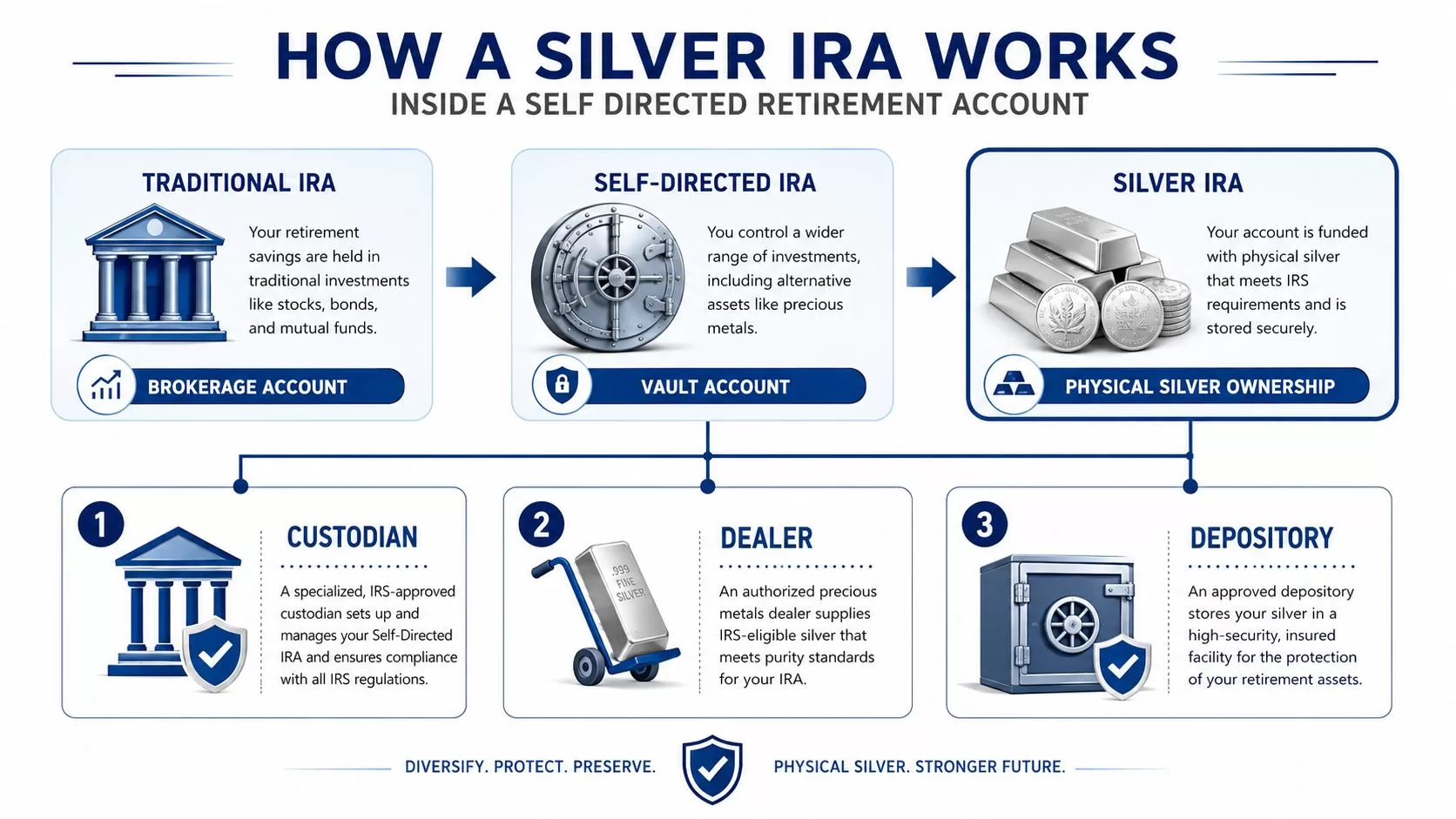
A regular IRA holds securities through a brokerage. A self-directed IRA uses the same retirement-account structure but permits a wider range of approved assets, including physical silver, through a specialized custodian. The metal adds extra steps because someone must arrange the purchase, maintain records, confirm compliance, and store the asset securely.
Three parties have separate responsibilities:
- Account owner: The individual decides whether qualifying silver fits the retirement plan and gives investment directions.
- Custodian or trustee: The IRS-approved financial institution establishes and administers the IRA, records transactions, and handles compliance procedures.
- Dealer and depository: A dealer supplies eligible silver, while an approved depository receives and stores it under the retirement account's arrangements.
The owner does not take the silver home. The custodian coordinates the transaction, and the depository holds the metal for the account. This creates a documented chain from purchase through storage and keeps the physical asset within the retirement account's formal custody process.

Traditional and Roth treatment
A Silver IRA can generally use a Traditional IRA or Roth IRA framework. A Traditional Silver IRA defers tax until withdrawals, while a Roth Silver IRA is funded with after-tax dollars and qualified withdrawals are tax-free. The account type, contribution history, conversions, distributions, and individual tax position all affect the result.
The self-directed label does not remove prohibited-transaction rules. The custodian handles administration, but the owner must provide accurate directions and avoid transactions or purchases that violate IRA requirements. That responsibility is part of the cost of holding a physical asset rather than a security that stays within a brokerage system.
Practical rule: The owner chooses the investment direction, while the custodian and depository manage the account's formal custody process.
Readers exploring self-directed accounts more broadly may find unlocking LP capital with SDIRAs useful for understanding how specialized custodians support alternative-asset accounts. The broader choice of assets also means more administration, storage arrangements, and recurring charges to evaluate. For a smaller balance, those costs can take a larger share of returns even when the silver price itself performs well.
IRS Rules for Silver Purity and Eligible Products
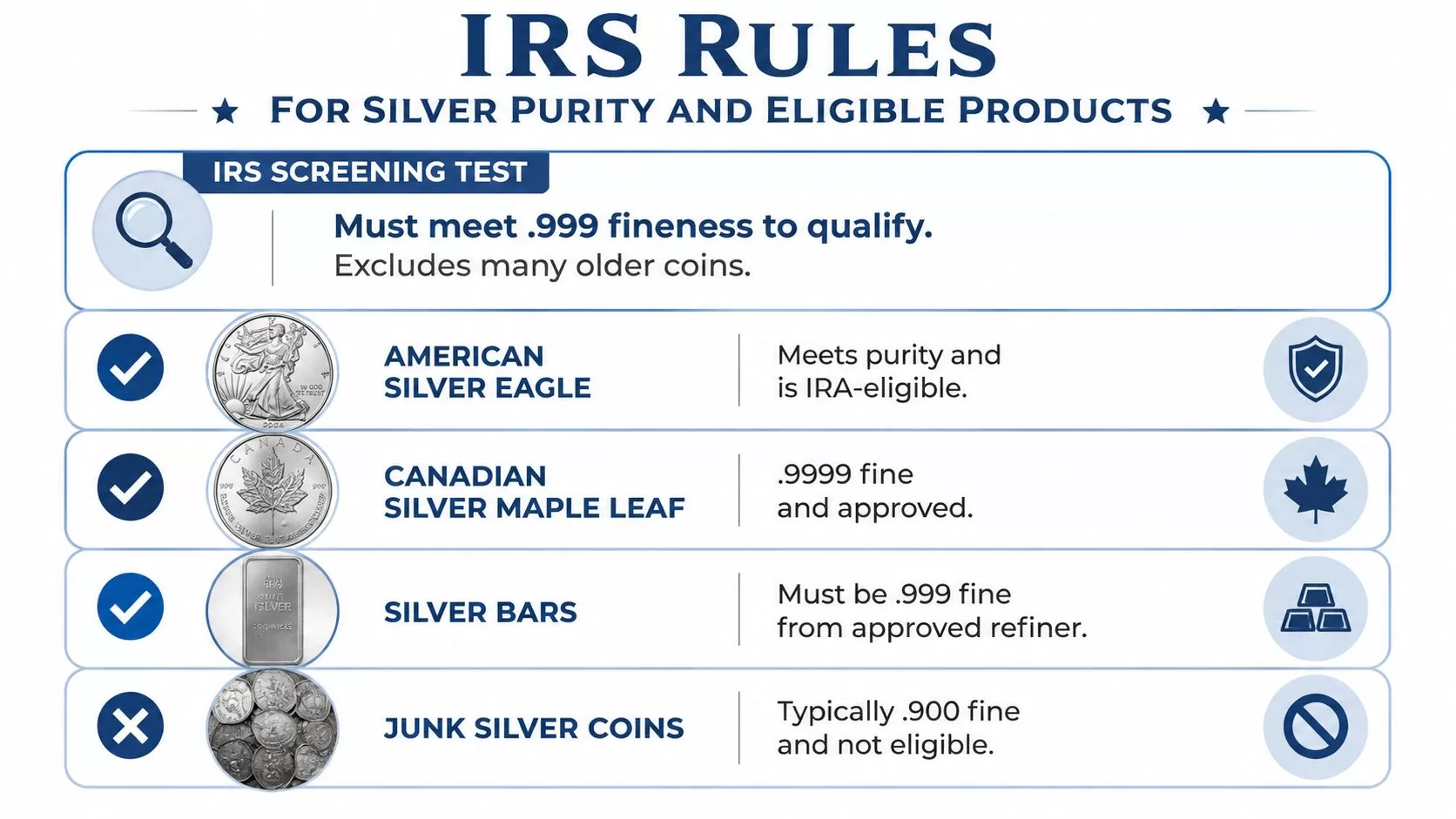
Before buying, confirm two separate things: the silver's purity and the way it will be held. Silver in a Silver IRA generally must be at least .999 fine, meaning 99.9% pure, under Internal Revenue Code Section 408(m)(3)(B).
A coin can contain genuine silver and still fail this test. Older U.S. “junk silver” coins commonly contain 90% silver, rather than.999 fine silver. Their age, design, or collector interest does not replace the IRS purity requirement.
What commonly qualifies
The list is narrower than many new investors expect:
- Government-minted bullion coins: Certain government-issued coins, including American Silver Eagles, may qualify under a statutory exception.
- Approved bullion bars: Bars generally must meet the required fineness and come from an accepted or accredited refiner.
- Clearly documented products: The custodian should verify eligibility before the purchase is completed. A dealer's description alone is not enough.
Bar specifications can vary, so readers can review this guide to IRA-approved silver bars before directing retirement funds toward a particular product.
What commonly fails
Pre-1965 U.S. 90% silver coinage, numismatic or collectible pieces, and most private-mint rounds generally fail the standard eligibility test. A product may be popular with collectors and still be unsuitable for a Silver IRA.
Purity is only half of the decision. The silver must also remain with the required custodian and an approved depository. Personal storage can create a tax problem, even when the metal itself meets the purity standard. Have the custodian approve the product and arrange delivery to the depository before committing purchase funds. These steps also affect total ownership cost, so storage and account charges matter alongside the quoted silver price, particularly for a smaller balance.
Benefits and Drawbacks to Weigh Before You Decide
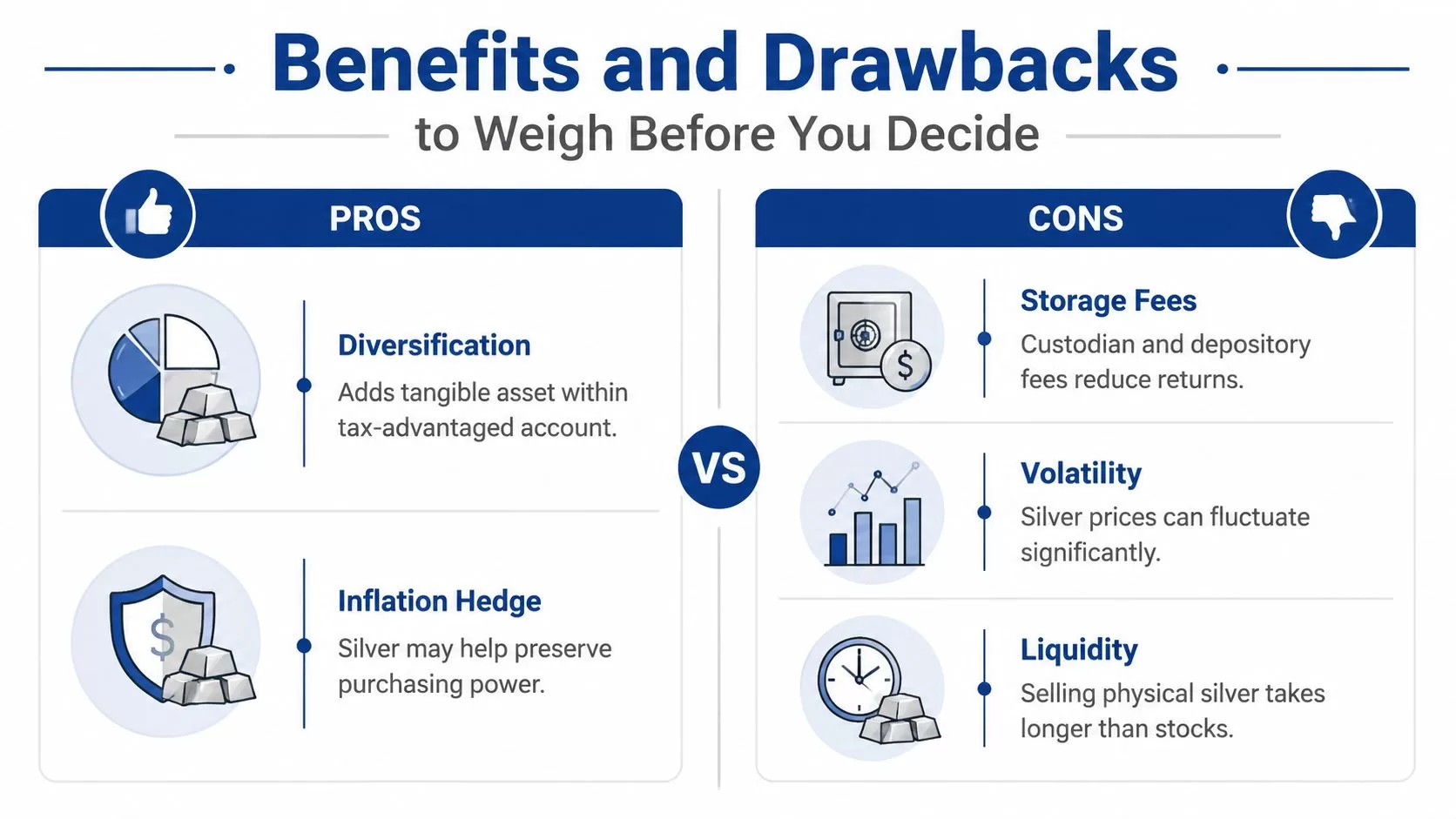
A Silver IRA may appeal to a retirement saver who wants physical-asset exposure inside a tax-advantaged account. Silver can provide a form of diversification that behaves differently from ordinary financial assets, and some investors view precious metals as a possible hedge during periods of inflation or market stress. Those are potential portfolio roles, not guarantees.
The tangible nature of silver is another attraction. The retirement account owns physical bullion rather than a share in a silver-related company. That distinction may matter to someone who wants an asset with direct metal exposure rather than exposure to corporate management, mining operations, or financial markets.
Potential advantages
- Diversification: Silver adds a tangible asset category to a retirement portfolio that may otherwise consist mainly of securities.
- Retirement-account structure: Qualifying silver can remain inside a Traditional or Roth IRA framework, subject to the rules of that account.
- Physical ownership: The account holds approved bullion rather than merely tracking a silver price through a paper investment.
- Possible inflation hedge: Silver may help some investors diversify purchasing-power risk, although its price can also decline.
- Choice of products: Eligible coins and bars provide different approaches to storage and eventual distributions.
Costs and trade-offs
The same physical structure that attracts investors also creates friction. Custodian and depository charges reduce the amount of return that remains after expenses. Transaction pricing can also differ from a quoted spot price because investors may pay premiums when buying and accept a different price when selling.
Silver prices can be volatile. A retirement saver who needs predictable liquidity may prefer assets that can be sold electronically during market hours. Selling physical silver requires an authorized transaction, valuation, and movement of funds through the account.
A Silver IRA is better evaluated as one diversification tool, not as a complete replacement for a diversified retirement plan.
The decision should account for time horizon, withdrawal needs, tolerance for price swings, and willingness to pay for regulated storage. The right question isn't whether silver is attractive in isolation. It's whether the account's benefits justify its added structure and cost.
Understanding the True All In Costs and Storage Choices
The metal invoice is only the beginning. A Silver IRA can involve setup charges, annual custodian fees, storage costs, transaction charges, and wire fees. Industry fee guidance places a typical precious-metals IRA using segregated storage at roughly $300 to $700 per year, although actual charges vary by provider, account structure, storage method, and services included.
Typical Silver IRA Annual Cost Breakdown
| Fee Category | Typical Range | Notes |
|---|---|---|
| Custodian fees | Varies by provider | Covers account administration, records, and required reporting |
| Storage fees | Varies by storage choice | Segregated storage can cost more than commingled storage |
| Transaction charges | Varies by transaction | May apply when buying or selling eligible silver |
| Wire fees | Varies by transfer | May apply when funds move through the account |
| Setup charges | Varies by provider | May be charged when the account is opened |
“Typical range” does not mean every account will fall within the same price. A provider may bundle several services into one annual charge, while another may list each item separately. Comparing only the annual custodian fee can therefore produce a misleading result.
Why storage selection changes the calculation
Segregated storage keeps a client's approved metals separately identified from other holdings. That may provide clearer allocation records, but it can also carry higher charges. Commingled storage places qualifying metals in a shared vaulting arrangement, with account records identifying the owner's interest without assigning a separate shelf or compartment to every item.
The choice affects long-term efficiency because the fee is paid regardless of whether silver rises in price. A small balance can feel the expense more sharply than a larger balance. For example, the same annual dollar charge represents a greater drag on a modest account than on a substantially larger one, even though the custodian performs similar administrative work.
Questions to ask before opening
- Bundling: Which fees are included in the annual charge, and which appear separately?
- Storage: Is the quoted storage price for segregated or commingled custody?
- Transactions: Are buying, selling, shipping, or wire instructions charged individually?
- Small balances: Does the provider use a minimum annual charge?
- Exit costs: What costs may apply when the account sells metal or distributes it?
Readers who want a deeper explanation of custody arrangements can review this guide to precious-metals storage. The practical test is straightforward: estimate the total recurring cost, then compare that drag with the convenience and asset exposure a standard brokerage IRA may provide.
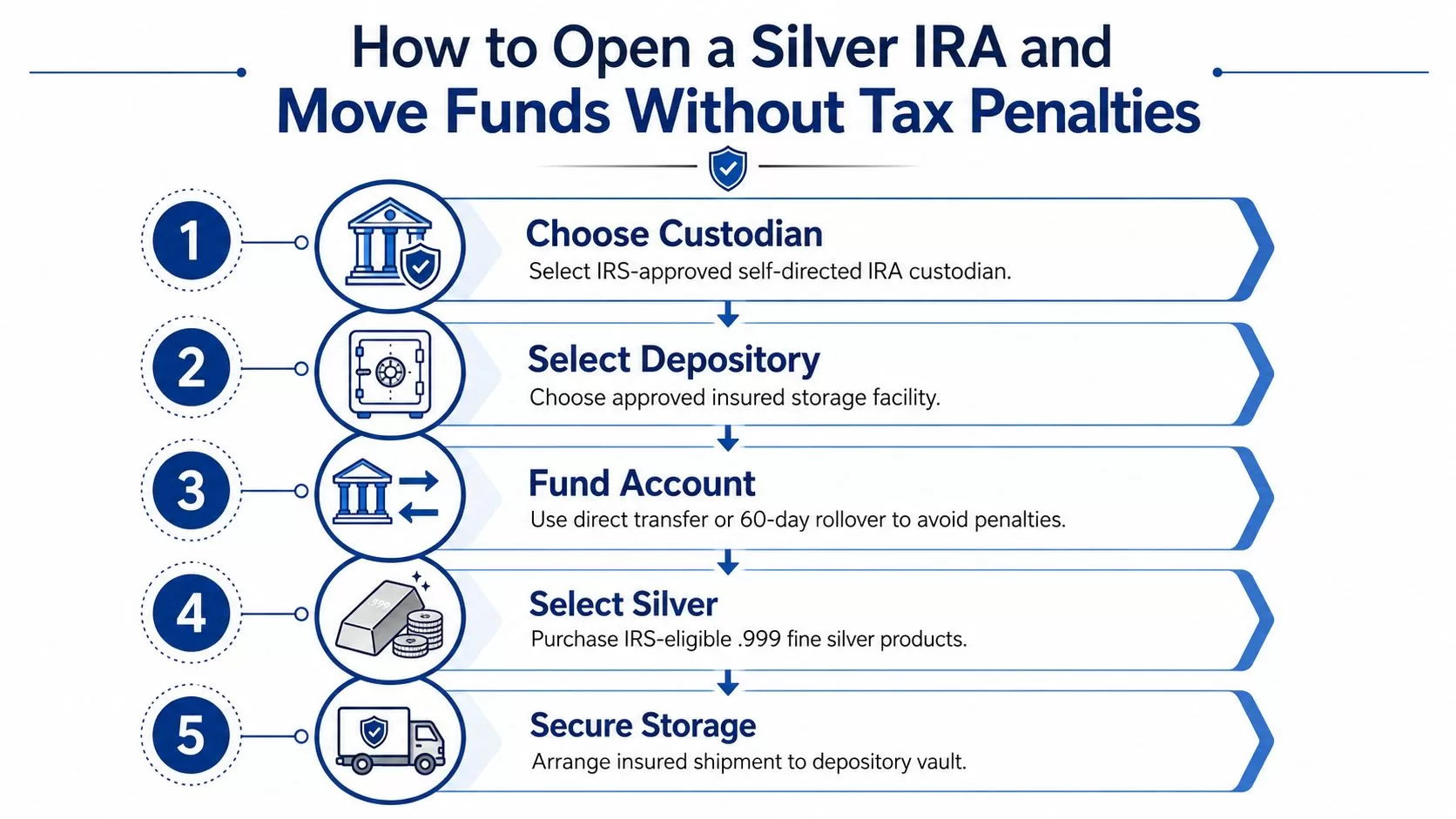
How to Open a Silver IRA and Move Funds Without Tax Penalties
Opening the account is a sequence of decisions, not a metal purchase. The owner first selects an approved custodian, confirms the depository arrangement, and determines how retirement funds will enter the new account. Only after those pieces are in place should the owner select qualifying silver.
A practical opening checklist
- Choose the custodian. Confirm that the institution administers self-directed precious-metals IRAs and explain its fee schedule in writing.
- Select the depository. Verify that the facility is approved for retirement-account storage and understand whether storage is segregated or commingled.
- Fund the account. Use a direct transfer where appropriate, or complete an indirect rollover within the required deadline.
- Approve the silver. Ask the custodian to confirm that each coin or bar meets the applicable fineness and product standards.
- Arrange delivery to storage. The dealer or custodian should send the metal directly to the approved depository, not to the owner's home.
The IRS says an indirect IRA rollover must be completed within 60 days of receiving the distribution. Since 2015, a taxpayer can complete only one rollover from an IRA to another IRA during any 12-month period, regardless of how many IRAs the taxpayer owns. (IRS rollover timing and one-rollover rule)
The 12-month rule isn't based on the calendar year. The clock starts on the date the account owner receives the distribution, so another indirect IRA-to-IRA rollover cannot be completed until that rolling period has passed. (Explanation of the rolling 12-month rule)
A direct transfer, in which funds move between custodians without the owner receiving the money, can avoid the practical risks associated with personally handling a distribution. The exact procedure depends on the source account and the receiving custodian, so paperwork should be reviewed before any funds leave the existing plan.
Before choosing products, readers can review guidance on buying silver for an IRA and then request written confirmation of eligibility from the custodian.
The following video provides a visual overview of the account-opening process.

Common mistakes include missing the 60-day deadline, exceeding the one-rollover limit, buying non-eligible coins, and assuming a home safe satisfies the depository requirement. A careful process protects both the account's tax status and the owner's ability to document what happened.
Next Steps to Decide if a Silver IRA Fits Your Plan
A Silver IRA is a regulated retirement account for qualifying physical silver. Its foundation is the .999 purity standard, approved custody, and depository storage. The structure may provide diversification, but it also brings recurring expenses, administrative steps, and less immediate liquidity than many brokerage investments.
Before proceeding, assess the retirement goal, expected holding period, need for accessible cash, tolerance for silver-price volatility, and willingness to pay for storage and administration. Compare the complete fee schedule, not just the quoted price of the metal.
This is not financial advice. Consult a licensed financial advisor, CPA, or tax professional before making investment decisions. A custodian can explain account mechanics, but personalized tax and retirement decisions require advice suited to the individual's circumstances.
Gold IRA Association provides educational guides on Silver IRA rules, rollover procedures, eligible products, storage, fees, and provider comparisons. Visit Gold IRA Association to compare educational resources and prepare questions before speaking with a custodian or financial professional.


