




The popular advice is simple: buy the cheaper precious metal and gain more upside. That logic fails when comparing palladium cost vs gold for retirement. Gold and palladium don't perform the same economic job, and palladium's dependence on automotive manufacturing creates risks that a lower per-ounce price doesn't solve.
For a pre-retiree, the central question isn't which metal costs less today. It's whether the metal can support the portfolio's purpose, especially wealth preservation, inflation resilience, liquidity, and disciplined withdrawals. The evidence points to a clear distinction: gold is generally the stronger defensive foundation, while palladium is a narrower, more speculative industrial position.
Why Palladium and Gold Are Not Interchangeable Hedges
A lower palladium price does not make it a cheaper version of gold. The two metals serve different portfolio roles. Gold functions primarily as a monetary and investment asset, while palladium depends heavily on industrial demand. Around 80% of global palladium demand comes from autocatalysts, according to an industry palladium factsheet.
That difference matters in retirement planning. Gold has broad recognition and established demand across investment and jewelry markets. Investors commonly hold it to diversify portfolios and help address inflation, currency weakness, or financial stress. Palladium is tied more closely to vehicle production, emissions rules, catalyst technology, and the industrial economy.
Palladium can rise sharply when manufacturers need more catalyst material or mine supply is disrupted. It can also decline when automakers reduce internal-combustion-engine production, replace palladium with other materials, or carry less inventory. Those forces differ from the monetary and safe-haven demand that supports gold.
The electric-vehicle transition changes the argument
Electric vehicles do not use traditional exhaust catalysts in the same way as internal-combustion vehicles. As electric-vehicle adoption expands, the market supporting palladium's dominant use can shrink. Palladium demand will not necessarily disappear, but the transition creates a long-term demand problem that gold does not face in the same form.
A recent 2026 market report forecasts a 9% decline in palladium demand in 2026, with automotive demand falling alongside lower internal-combustion-engine output and investment demand turning negative. It also reports that palladium remained in deficit from 2012 through 2024, but may move into balance, weakening the scarcity-premium argument for future prices. The projections are summarized in the Johnson Matthey PGM Market Report.
Retirement principle: A cheaper asset is not automatically a better hedge. Match the asset's underlying demand to its job in the portfolio.
For a direct comparison of the metals' industrial characteristics, review this guide to platinum versus palladium. The retirement conclusion is straightforward. Gold is the more natural defensive holding. Palladium is an industrial-cycle position exposed to the gradual erosion of gasoline and diesel vehicle demand. Treating both as interchangeable hedges ignores that structural risk.
Current Market Prices and Historical Cost Trends
Palladium's lower quoted price can conceal the larger retirement risk. Gold and palladium have never maintained a fixed price relationship, and the long-term record shows that relative pricing can change sharply when supply, industrial demand, or market expectations shift. A 49-year comparison found that the gold-to-palladium ratio was often near an average and median of 2.4, so gold commonly traded at roughly 2.4 times palladium's price. The same analysis recorded unusually high ratios in 1981 and 1982, when palladium fell below $100 per ounce. The figures appear in The Assay's long-run gold-to-palladium ratio analysis.
Recent pricing shows a wider premium for gold. On September 7, 2026, the gold-to-palladium ratio was about 3.134, meaning one troy ounce of gold bought roughly 3.134 troy ounces of palladium. Over the trailing year, the ratio averaged about 3.039, with a low of 2.196 and a high of 3.712, according to the gold-to-palladium ratio data.
| Measure | Gold | Palladium |
|---|---|---|
| Long-run typical relationship | Gold often traded at about 2.4 times palladium | Palladium often traded below gold |
| Recent ratio on September 7, 2026 | One ounce bought roughly 3.134 ounces of palladium | Gold carried a substantial premium |
| Documented historical peak | Not specified in the verified data | $3,440.76 per troy ounce in March 2022 |
| Average closing price in 2024 | Not specified in the verified data | $919.39 |
| Average closing price in 2025 | Not specified in the verified data | $1,053.66 |
Palladium's retreat after its peak matters more than its apparent discount. The metal reached a documented all-time high of $3,440.76 per troy ounce in March 2022, then fell to an average closing price of $919.39 in 2024 and $1,053.66 in 2025, according to historical palladium price data. That pattern shows why a lower entry price does not create a dependable floor. For a retirement account, the question is whether the asset's role justifies that price risk.

Gold's higher price per ounce is not evidence of poor value. Retirement investors buy an asset for its role, liquidity, and risk characteristics, not for the number of ounces acquired. Investors assessing gold's purchasing-power history can review this analysis of the price of gold adjusted for inflation. For long-term retirement protection, that distinction matters more than the spot-price gap.

Volatility and Risk Profile Comparison
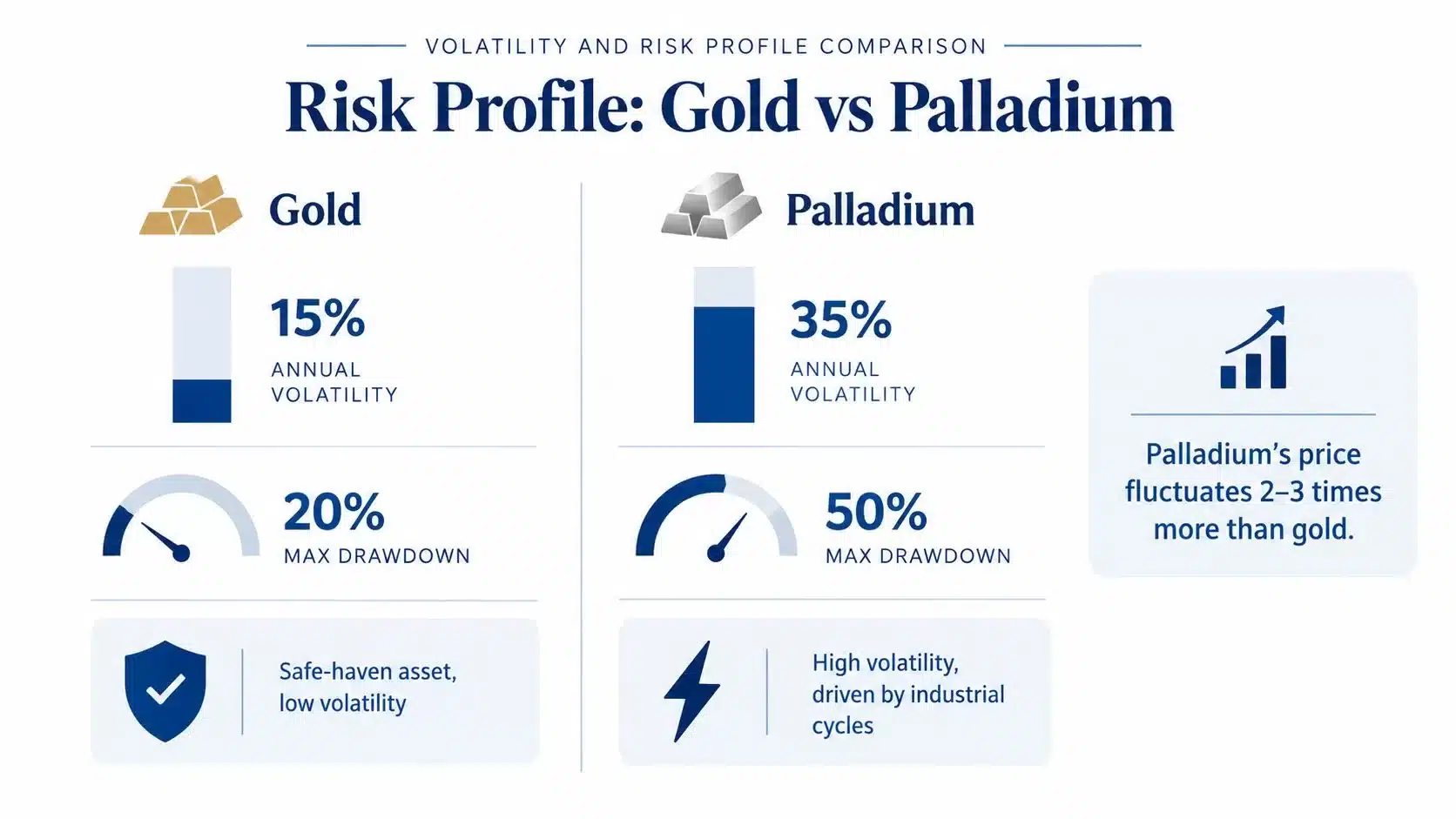
Palladium's lower spot price does not make it a conservative retirement holding. Its value reacts quickly to industrial demand, mine supply, geopolitical developments, and substitution decisions. That combination can erase the apparent cost advantage and create portfolio behavior that is difficult to manage during withdrawals.
Gold fluctuates too, but independent precious-metals research from the World Gold Council places its annualized volatility generally within a 10% to 18% range across most days. The same analysis gives gold a volatility half-life of about 1.6 months, indicating how quickly volatility tends to revert after a stress period. Those measures make gold easier to evaluate as a strategic diversifier.
Why the range matters more than the entry price
Palladium's volatility matters more than its quoted discount. Its historical price behavior shows that a lower entry point does not establish a reliable floor, as noted earlier. The practical issue for retirees is exposure to a sharp decline while the account still needs to fund planned withdrawals.
Use four controls:
- Position sizing: Give palladium less portfolio space than a steadier diversifier.
- Withdrawal planning: Avoid relying on palladium sales to fund near-term spending. Selling after a steep decline can turn temporary weakness into a permanent loss.
- Rebalancing: Set written rules for trimming rallies and reducing exposure if the metal's structural demand weakens.
- Liquidity review: The spot quote is not the amount received after dealer spreads, product premiums, and selling costs.
Gold's comparatively steadier volatility profile supports a strategic allocation. Palladium belongs only in a smaller, clearly defined position for investors who can tolerate substantial drawdowns and accept that industrial demand, rather than defensive demand, largely drives its outcome.
Practical rule: If a retirement account may need the money during a downturn, palladium should not be its primary precious-metal holding.
Behavior creates another risk. Investors often react poorly when an asset loses value after they bought it because it appeared inexpensive. Gold can decline as well, but palladium's sharper swings make panic selling more likely. A retirement plan should therefore define the allocation, rebalancing triggers, and liquidity needs before purchasing palladium. Price alone is a poor reason to hold it.
Industrial Demand Drivers and the EV Transition Threat
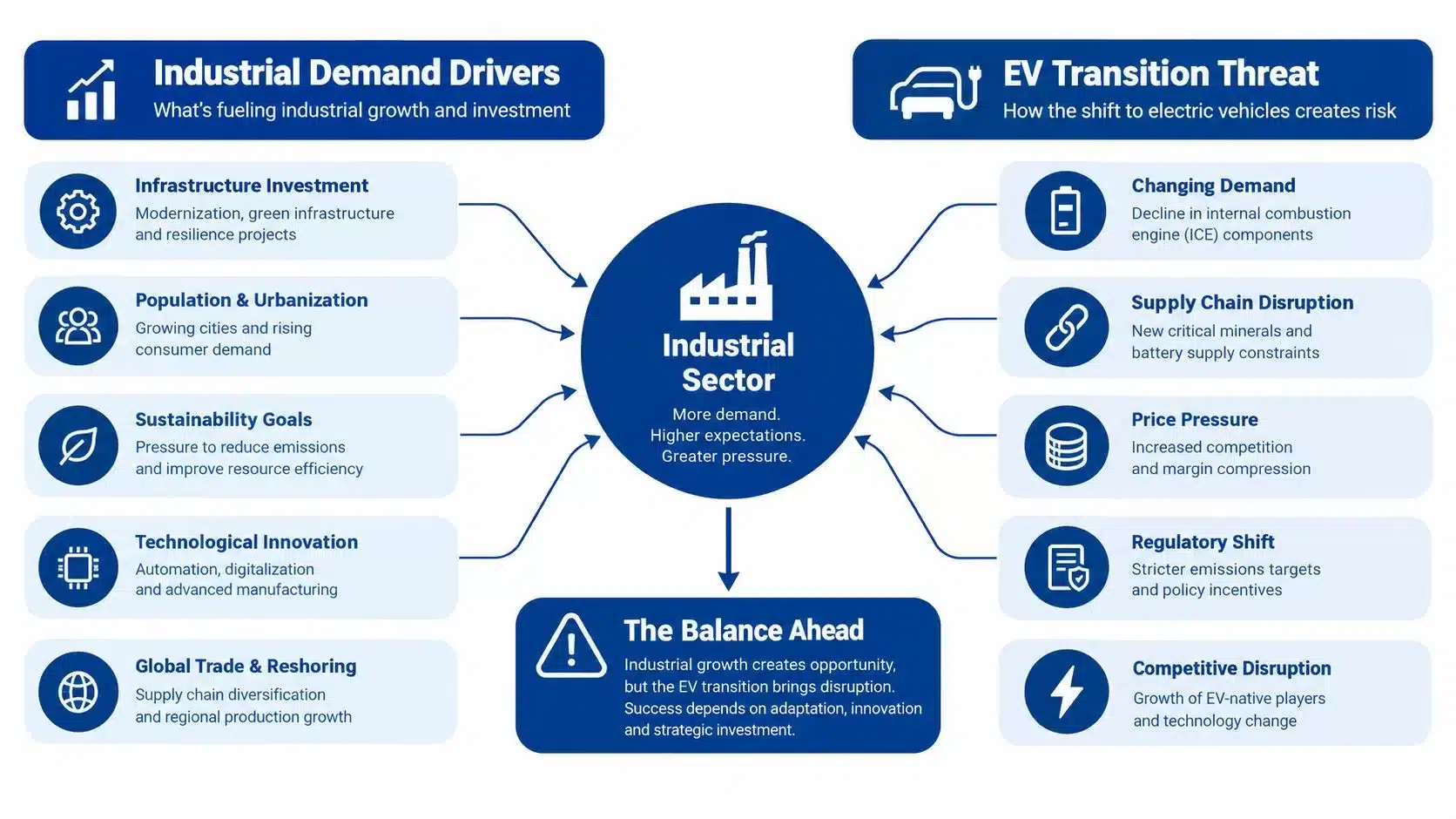
Palladium and gold respond to different economic forces. Palladium is tied closely to industrial manufacturing, especially emissions-control systems for internal-combustion vehicles. Gold draws demand from investors, jewelry buyers, and central banks, so its price can respond to monetary policy, currency concerns, financial stress, and safe-haven demand even when industrial activity weakens.

EV transition changes the demand test
Electric vehicles do not use the same emissions-control systems as gasoline and diesel vehicles. As EV adoption reduces internal-combustion production, palladium faces a structural demand challenge. Hybrid vehicles may extend some automotive demand, but that does not remove the need to assess whether substitution, changing vehicle designs, and tighter emissions requirements will reduce palladium use over time.
Recycling creates another pressure point. Recovered palladium from used automotive systems can return to the market when prices make collection profitable. That secondary supply can limit the effect of mine disruptions and weaken the case for treating a temporary shortage as a lasting bull market.
Investors should track four items before treating a lower palladium cost as a bargain:
- Vehicle mix: Review the direction of internal-combustion, hybrid, and EV production rather than relying on current automotive demand.
- Substitution: Watch whether manufacturers replace palladium with other materials in emissions-control systems.
- Recycling: Account for additional supply from recovered automotive components.
- Supply concentration: Check exposure to mine outages, geopolitical disruption, trade restrictions, and policy shocks. Russia and South Africa together account for the majority of primary palladium production, according to SFA Oxford's analysis of palladium market drivers.
Supply concentration can still create sharp rallies. It does not solve the longer-term demand question. A disruption may lift prices temporarily, while declining internal-combustion production pressures demand over a longer period. Separate a short-term supply squeeze from a durable retirement investment thesis.
Palladium can suit an investor who deliberately wants cyclical industrial exposure. It is not a substitute for gold's broader monetary role. For a retirement portfolio, palladium requires a specific view on vehicle technology, substitution, recycling, and mine economics. Gold needs a broader directional thesis. That difference makes palladium a satellite holding at most, not the foundation of a precious-metals allocation.
IRA Eligibility, Storage Costs, and Dealer Premiums
Physical gold and palladium can be held in a self-directed individual retirement account when the products meet applicable IRS requirements and the account uses an approved structure. The investor doesn't place personal coins in an IRA. A custodian administers the account, and an approved depository holds the metals.
The IRS rules governing purity, eligible products, custody, distributions, and transactions can change or depend on individual circumstances. Investors should verify current requirements with a qualified tax professional and the chosen custodian before purchasing.
Compare the total cost, not just the spot quote
The purchase price is only one part of the calculation. Investors should request a written breakdown of setup charges, annual custodial fees, storage charges, dealer premiums, shipping, and the expected buyback spread.
| Metal | IRS Purity Requirement | Common IRA-Eligible Products | Typical Dealer Premium | Liquidity and Buyback Spread |
|---|---|---|---|---|
| Gold | Must meet applicable IRS standards | Approved bullion coins and bars | Varies by product, size, and minting | Generally broad market recognition, but spreads vary |
| Palladium | Must meet applicable IRS standards | Approved palladium bullion coins and bars | Can vary significantly, especially for smaller products | More specialized market, so buyback terms require careful review |
Palladium's lower spot price can be offset by product economics. Smaller denominations may carry higher premiums relative to their metal value, and a specialized market can produce less favorable selling terms. Gold products may also carry premiums, so the correct comparison is the all-in acquisition cost versus realistic liquidation proceeds.
Storage and account structure
A precious-metals IRA generally involves several parties:
- The account custodian handles administration and reporting.
- The dealer quotes products, premiums, and transaction terms.
- The depository stores the metal and maintains records.
- The investor decides on allocation, funding, and eventual distributions.
Storage choices and fee structures differ, so investors should ask whether charges are flat, asset-based, segregated, or commingled. A useful overview of precious-metals storage can help readers understand why custody and storage are separate from the metal's spot price.
Retirement-account rules also differ from ordinary brokerage decisions. Someone researching whether a retirement account can fund a major personal purchase should separately review resources such as buying a house with a Roth IRA, because real-estate withdrawals and precious-metals custody involve different rules and risks.
Before funding: Obtain the product list, purity documentation, complete fee schedule, storage arrangement, and buyback policy in writing.
This is not financial advice. Consult a licensed financial advisor, CPA, or tax professional before making investment decisions.
Strategic Allocation Recommendations for Retirees
Gold should dominate a retirement precious-metals allocation unless the investor has a specific reason to accept palladium's industrial and demand risks. The evidence supports using palladium, if at all, as a controlled satellite holding rather than a replacement for gold.
A practical framework looks like this:
- Conservative wealth preservation: Keep 80% to 100% of the precious-metals allocation in gold, with little or no palladium. This approach prioritizes monetary exposure, liquidity, and behavioral stability.
- Moderate diversification: Use 70% to 80% gold and 20% to 30% palladium only when the investor can tolerate industrial-cycle volatility and accepts that palladium's demand outlook is changing.
- Growth-oriented speculation: A higher palladium share may suit an investor with a long horizon, substantial nonmetal assets, and the ability to hold through severe declines. It still shouldn't become the foundation of retirement income planning.
These percentages describe the composition of the precious-metals sleeve, not the entire retirement portfolio. The appropriate overall allocation depends on income needs, pensions, cash reserves, tax status, debt, and the investor's ability to withstand losses.
Rebalancing needs a written rule
Palladium's volatility makes informal portfolio management dangerous. Investors should decide in advance when to trim an oversized position, how much exposure is acceptable, and what evidence would justify reducing the holding. A rebalancing rule can prevent a rally from turning a small tactical position into an unintended concentration.
Gold also benefits from discipline, but its role is usually strategic rather than opportunistic. Investors should review whether the allocation still matches the retirement plan, not chase whichever metal has recently risen.
The strongest recommendation is simple: use gold for the defensive job and palladium only for a deliberate industrial thesis. A lower palladium price doesn't justify giving it equal weight.
Real-World Decision Scenarios for Pre-Retirees
A 62-year-old focused on wealth preservation should generally favor gold and keep palladium minimal or absent. With retirement withdrawals approaching, the investor has less time to recover from a sharp industrial-cycle decline. A rollover into a properly structured self-directed IRA may be considered, but the investor should first confirm plan rules, compare custodial and storage charges, and establish how required distributions will be handled.
A 55-year-old seeking inflation protection with some growth has more flexibility. Gold can form the larger share of the precious-metals allocation, while a limited palladium position may provide industrial exposure. The investor should fund the account through a compliant rollover or contribution process, avoid treating palladium as a cash substitute, and review the allocation on a scheduled basis rather than reacting to daily price movements.
A 50-year-old with a longer horizon and high risk tolerance may accept a larger palladium sleeve, but only within a diversified retirement plan. The investor should have adequate liquid reserves outside the metals account, understand that automotive demand may weaken as electric vehicles expand, and use position limits to prevent a speculative holding from dominating retirement assets.
Implementation questions for every profile
Before selecting either metal, each investor should answer:
- What is the purpose? Inflation diversification, crisis resilience, long-term growth, or industrial speculation?
- When might the money be needed? Near-term withdrawals make palladium's volatility more consequential.
- What are the all-in costs? Spot price, premium, storage, custody, shipping, and selling spread all matter.
- Who will provide advice? Tax and legal questions belong with qualified professionals, not sales materials.
- How will the position be monitored? Set review dates and rebalancing rules before purchasing.
Gold IRA Association offers educational guides on precious-metals IRAs, rollover mechanics, IRS-eligible products, storage, fees, and provider comparisons. Visit Gold IRA Association to review the resources and build a more informed gold-versus-palladium decision before speaking with a custodian or financial professional.


