




A gold bullion standard is a monetary system in which currency can be redeemed for large, high-purity gold bars rather than circulating coins. Today, the same 995 fineness, or 99.5% pure gold, threshold helps determine which gold a self-directed IRA may hold.
What is gold bullion standard in practical terms, and why should someone approaching retirement care about a monetary system that no longer operates? The answer connects monetary history with a modern question about gold IRA eligibility. The bullion standard focused on standardized bars, reliable purity, and official custody, while retirement-account rules apply similar ideas to the gold permitted inside a tax-advantaged account.
What the Gold Bullion Standard Means
Could a person bring ordinary paper money to a bank and leave with a gold coin? Under a gold bullion standard, generally no. Currency could be exchanged for substantial gold bars held by central banks or monetary authorities, rather than for small coins meant for household purchases.
The term bullion describes gold valued mainly for its metal content. A bar's acceptance depends on several measurable features:
- Weight, which establishes how much metal changes hands.
- Fineness, which shows the share of pure gold.
- Assay and provenance, which help confirm that the bar is genuine and acceptable for settlement.
Professional markets use the LBMA Good Delivery bar, broadly defined at about 350 to 430 troy ounces with minimum fineness of 995 parts per thousand. The LBMA Good Delivery rules explain the requirements that make large bars suitable for professional trading.
Why standardization mattered
A government or central bank needed more than a vault containing objects that appeared to be gold. It needed metal that another official institution would accept without checking or renegotiating every bar's quality from scratch. Consistent weight, purity, refinery identification, and assayer certification reduced uncertainty during settlement.
This framework also clarifies the difference between a bullion standard and the older gold coin standard. Coins supported circulation and smaller transactions. Bullion bars served mainly as reserve assets and settlement instruments. For households, redemption was impractical because it involved large bars and official transactions rather than ordinary purchases.
The connection to modern retirement planning is direct. The same 995 fineness threshold used to describe qualifying large bullion helps explain why purity remains central when determining whether gold may be held in an IRA. History describes the monetary system, while current account rules apply a related quality test to retirement assets.
For readers exploring automated precious-metals strategies, strategia EA metallo prezioso offers a separate educational resource. The central lesson is simple: the bullion standard treated gold as a wholesale settlement asset, not everyday pocket money.
A Short History from the Classical Standard to Bretton Woods
Why does this history matter to someone considering gold for retirement? It explains how gold moved from a public currency anchor to a standardized wholesale asset, a change that helps clarify why modern IRA-eligible gold is judged by defined purity rules.
The classical gold standard took shape in continental Europe in 1876. By 1913, all major industrial powers, including the United States, followed its rules, with London serving as the financial center. Countries tied their currencies to specified quantities of gold, creating fixed exchange relationships and a shared method for international settlement. These milestones appear in the International Monetary Fund's account of the gold standard.
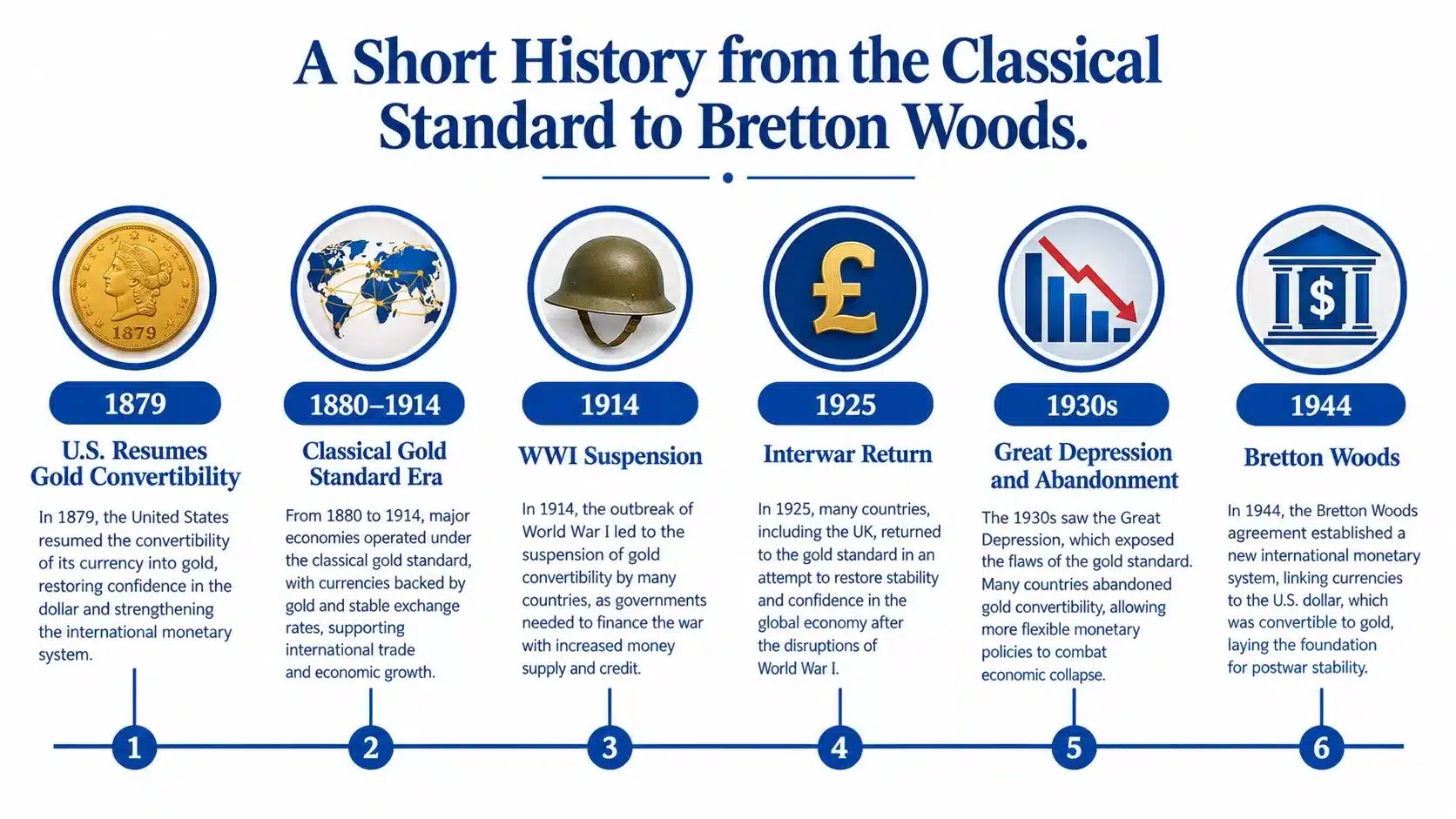

World War I broke the system in 1914. Governments suspended or abolished the ability to exchange notes for gold within their borders, giving them more room to finance wartime spending. The prewar arrangement did not pause and return unchanged. Later efforts to restore gold-linked systems faced a less stable interwar economy.
At the 1944 Bretton Woods conference, 44 nations created another international monetary order. The United States agreed to exchange dollars held by foreign central banks for gold at $35 per ounce. Other currencies were tied to the dollar, rather than directly to gold. This made Bretton Woods a gold-exchange standard, a distinction described in this historical overview of the gold standard.
The dollar's official gold connection lasted about 27 years, from the 1944 agreement until August 15, 1971, when President Nixon ended convertibility. Bretton Woods then effectively ended. The pattern is useful for retirement planning: governments valued gold's credibility, yet also sought flexibility during war, recession, and economic expansion. That history helps explain why modern rules focus on identifiable bullion quality, including the 995 fineness threshold associated with IRA-eligible gold.
How Modern Bullion Bars Are Defined by Weight and Purity
What makes a gold bar acceptable for investment? Its appearance is only a starting point. Fineness measures the amount of pure gold in 1,000 parts of metal. A bar marked 995 contains at least 99.5% pure gold. A higher marking means a larger share of the metal is pure gold.
The modern wholesale reference is the Good Delivery bar. It generally weighs 350 to 430 troy ounces and must meet at least 995 fineness, under the LBMA's Good Delivery standards. Professional bars also show marks identifying the refiner, weight, fineness, and serial information. These details work like an identity record, helping buyers trace the bar and assess whether it belongs in an accepted settlement chain.
Common bar formats
Institutional buyers use large bars for wholesale settlement. Individual investors more often see smaller cast or minted products. Exact specifications vary by manufacturer, so the product description and supporting documents deserve careful review.
| Bar Type | Weight | Typical Fineness | Common Use |
|---|---|---|---|
| Good Delivery bar | About 350 to 430 troy ounces | At least 995 | Central-bank and wholesale settlement |
| Kilogram bar | 1 kilogram | Typically .9999 fine | Professional and private bullion ownership |
| Smaller cast bar | 100 grams | Typically .9999 fine | Individual investment and storage |
| Retail bar | 1 troy ounce | Typically .9999 fine | Personal precious-metals ownership |
The practical lesson is straightforward. Retirement investors do not need an institutional-size bar to own bullion. A smaller bar can represent the same basic idea when its weight, purity, and refinery provenance are verifiable. In other words, the bar's paperwork matters almost as much as its shape. These checks connect the historical bullion standard with the modern purity requirements investors encounter today, including the 995 fineness threshold used for IRA-eligible gold.
Readers who want a plain-language definition can review what a bullion bar is. Before transferring retirement funds, confirm the exact product, refinery, packaging, and custody arrangements. A familiar weight or attractive finish does not establish eligibility by itself.
Bullion Standard vs Gold Coin Standard
Could two systems both tie money to gold while serving different users? Yes. A gold coin standard puts gold coins into circulation and gives each coin a defined monetary value. A bullion standard keeps larger bars in official reserves, with redemption or settlement based on measured metal content.
The difference is practical. Coins can be counted, divided, and passed between households, merchants, and banks. Bars work better for large transfers because institutions can move substantial gold without minting and handling many separate coins.
| Attribute | Bullion Standard | Gold Coin Standard |
|---|---|---|
| Main form of gold | Standardized bars | Circulating gold coins |
| Primary users | Central banks, treasuries, and large financial institutions | Households, merchants, banks, and governments |
| Value reference | Weight, fineness, and certification | Coin denomination and defined gold content |
| Typical purpose | Reserve backing and international settlement | Everyday payment and redemption |
| Main advantage | Efficient wholesale transfer | Easier division and public use |
| Main limitation | Poor fit for retail transactions | Higher minting and handling burden |
The bullion model did not mean that a country had more gold. It changed how the gold connection operated. Monetary authorities could maintain formal convertibility for official purposes without putting precious-metal coins throughout the domestic economy. That arrangement suited reserve management and international settlement, while ordinary households generally had no direct path to redeem currency for bars.
A retirement investor now faces a smaller, private version of the same practical question: bars or coins? An IRA is not a national monetary system, yet the choice still involves trade-offs. Bars may suit efficient storage and larger holdings, while coins can be easier to divide and recognize. Purity remains only one part of the decision. Divisibility, premiums, resale procedures, and custody records also matter. The comparison of gold bars versus gold coins explains these differences in practical terms.
The historical link also clarifies why modern IRA rules emphasize documented specifications. Gold can serve as a reserve asset, a circulating coin, or a privately held retirement investment, but each role depends on clearly defined weight, purity, and verification.
Why the Same Purity Rules Apply to Gold IRAs
The modern connection becomes clearer when an investor compares the bullion standard with the requirements for a self-directed Gold IRA. The IMF definition of monetary gold identifies qualifying bullion held by monetary authorities as reserve assets when it reaches at least 995 parts per 1,000 purity. IRA rules use a closely related purity floor for many gold products.
Four practical eligibility questions
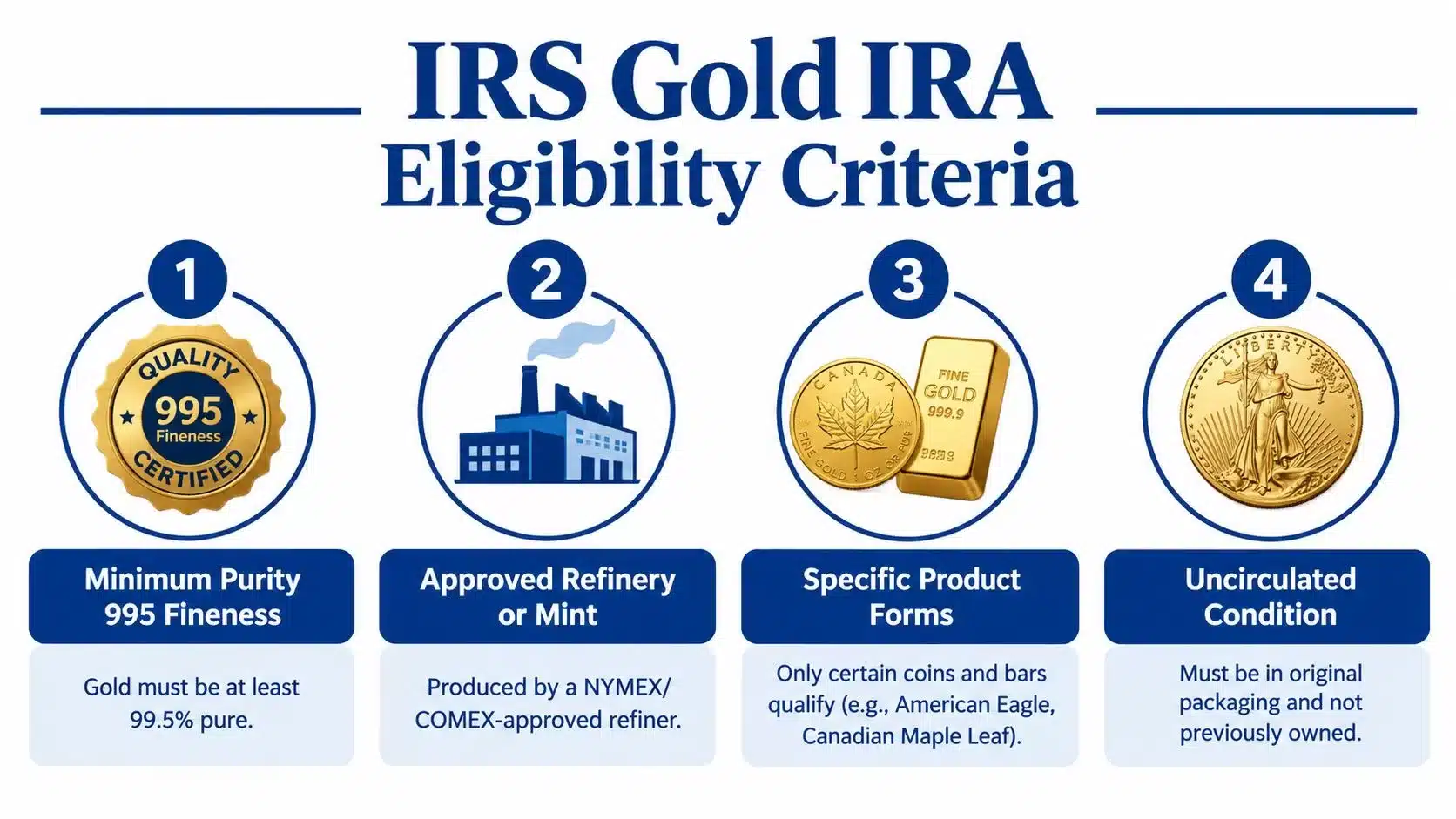
A gold product generally needs to satisfy several conditions before an IRA custodian can accept it:
- Does it meet the minimum fineness? Most eligible gold must reach 0.995 fineness, or 99.5% pure gold.
- Who produced it? The product must come from an approved refiner or mint recognized through an accepted market or industry standard.
- Can its quality be documented? Tamper-evident packaging, an assay certificate, identifying marks, or equivalent records help establish authenticity and specifications.
- Where will it be stored? The metal must remain with an approved depository under the control of a qualified custodian, rather than being kept personally at home.
The exact treatment can depend on the product and the account structure. A custodian should verify eligibility before purchase, because fineness alone isn't enough. A bar can have suitable purity yet fail an account's documentation, packaging, provenance, or custody requirements.
Coins, bars, and the important exception
Common examples discussed in IRA eligibility include the American Gold Eagle, Canadian Gold Maple Leaf, and Austrian Vienna Philharmonic, along with one-ounce bars produced by recognized refiners. The American Gold Eagle is a notable exception because it is 22-karat gold at 91.67% purity, yet U.S. bullion and IRA rules treat it differently from the normal .995 bar threshold. The American Gold Eagle and bullion purity discussion outlines this distinction.
By contrast, the American Gold Buffalo is made from .9999 fine gold, contains one troy ounce, and carries a $50 legal-tender face value, according to this description of the American Gold Buffalo. Legal-tender wording doesn't automatically make a coin eligible. The product still needs to fit the applicable IRA rules.
Collectible and numismatic coins are a separate concern. A coin's rarity, historical appeal, or collectible premium doesn't make it appropriate for a Gold IRA, even if its metal content appears attractive. Anyone considering alternatives such as rental property investing with retirement funds should compare the separate custody, valuation, tax, and liquidity rules rather than assuming every self-directed asset follows the bullion framework.
Why the Gold Bullion Standard Faded and What Replaced It
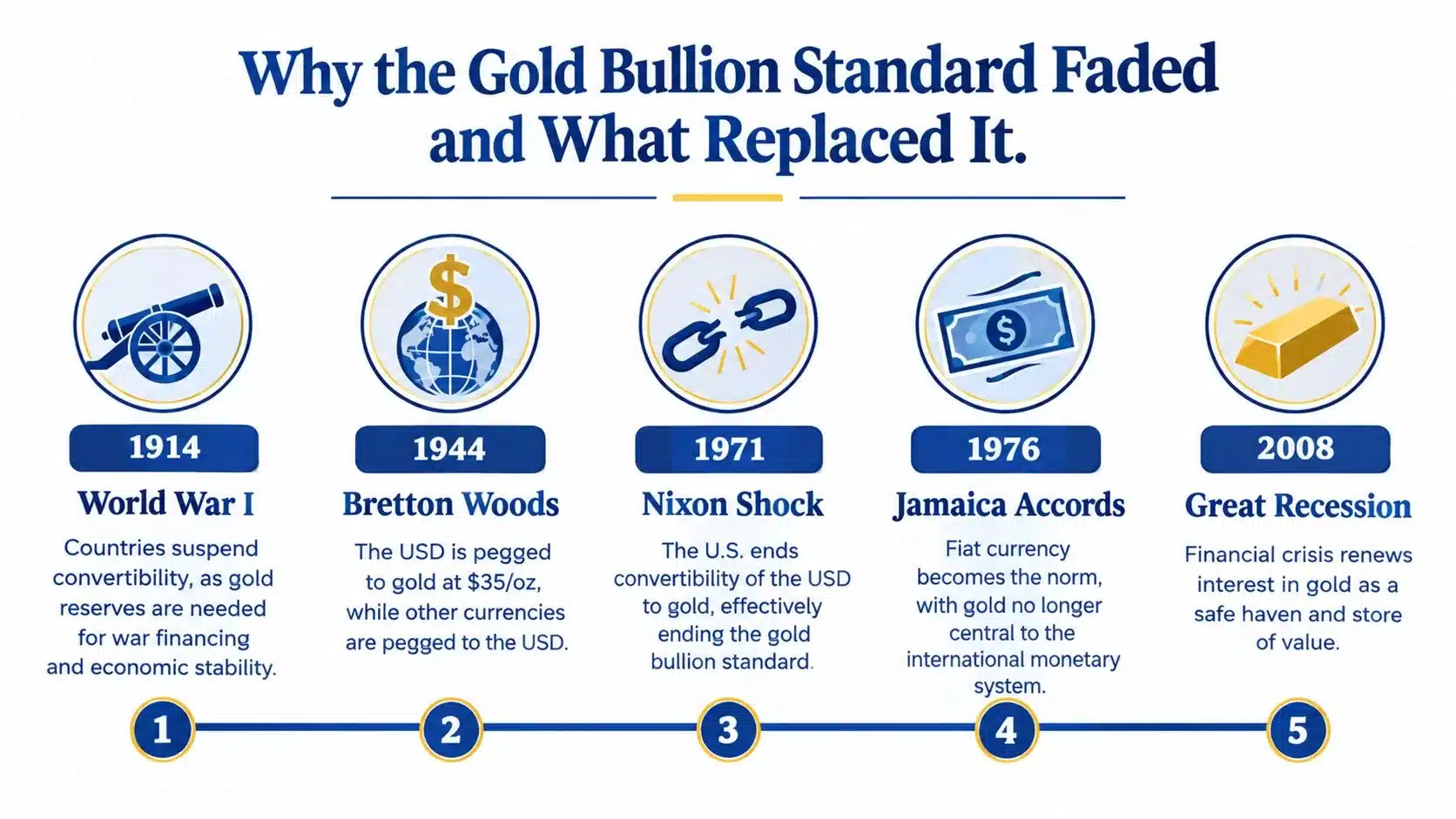
Why did governments move away from a system that tied currency to gold? The answer is that fixed convertibility often conflicted with urgent policy needs. During 1914, authorities suspended the internal conversion of notes into gold. That decision broke the mechanism requiring paper currency to remain exchangeable for metal and showed how quickly wartime demands could pressure a bullion-based system.
Bretton Woods restored an international gold connection in a narrower form. At the 1944 conference, foreign central banks could exchange dollars for gold at $35 per ounce, while other currencies were linked to the dollar. The arrangement lasted about 27 years, until Nixon ended dollar convertibility on August 15, 1971. The broader sequence is summarized in the historical discussion of international monetary systems cited earlier.
The scale problem
A fixed gold base places a firm limit on monetary expansion. If population, productivity, banking credit, and trade grow faster than the available monetary metal, the system can create pressure for deflation or tighter credit. Governments that issue more claims than their reserves can support may also face redemption demands, which can drain those reserves.
The practical challenge is easier to see in modern markets. Gold reached repeated record highs during 2025 and 2026, surpassing roughly US$3,000 per ounce amid strong demand and financial volatility. At those price levels, backing a modern money system with physically deliverable gold would require enormous reserves and strict control over redemption. The general historical overview of the gold standard provides context for why this connection became difficult to maintain, but it is not a source for current gold prices.
Governments instead adopted fiat currencies, floating exchange rates, and central-bank reserve management. Gold remained relevant, mainly as an official reserve asset and a privately held store of value rather than a medium for ordinary transactions.
That shift also clarifies a modern retirement-planning question. Today's 995 fineness threshold for many IRA-eligible gold products reflects the same preference for measurable purity and standardized metal that shaped the bullion standard, even though a Gold IRA does not make gold part of the national currency system.
Practical perspective: Gold can serve a different purpose inside a retirement portfolio than it served inside a national monetary system. A private holder does not need gold to price groceries, settle trade balances, or support an entire currency.
Key Takeaways and Smart Next Steps for Retirees
What does what is gold bullion standard mean for a retirement investor today? Historically, it described currency that could be exchanged for large, standardized, high-purity gold bars held by monetary authorities. Its practical legacy is narrower but still useful: uniform purity, trusted provenance, and controlled custody give investors a clear way to examine physical gold.
The connection to modern IRA rules begins with 995 fineness, or 99.5% pure gold. This threshold reflects the bullion standard's preference for measurable purity and consistent metal. It does not make every product below the threshold worthless, and it does not place every product above the threshold inside an IRA. Rather, it provides one screening point. The exact coin or bar must also satisfy the account's rules.
What retirees should verify
- Product eligibility: Confirm that the exact coin or bar is permitted before funds move. Collectible, numismatic, and unsuitable below-fineness products can be excluded under IRC Section 408(m).
- Refinery provenance: Look for recognized production and assay records that can be checked. A privately minted bar may contain genuine gold, yet buyers may have more difficulty confirming its origin or resale value.
- Custody and storage: A Gold IRA requires an approved depository and qualified custodian. Taking personal possession can create tax and compliance problems.
- Total costs: Review account setup, custody, storage, insurance, transaction, and possible liquidation charges before selecting a provider.
- Portfolio role: Gold may diversify a retirement portfolio, but it can be less liquid than cash and does not remove market risk.
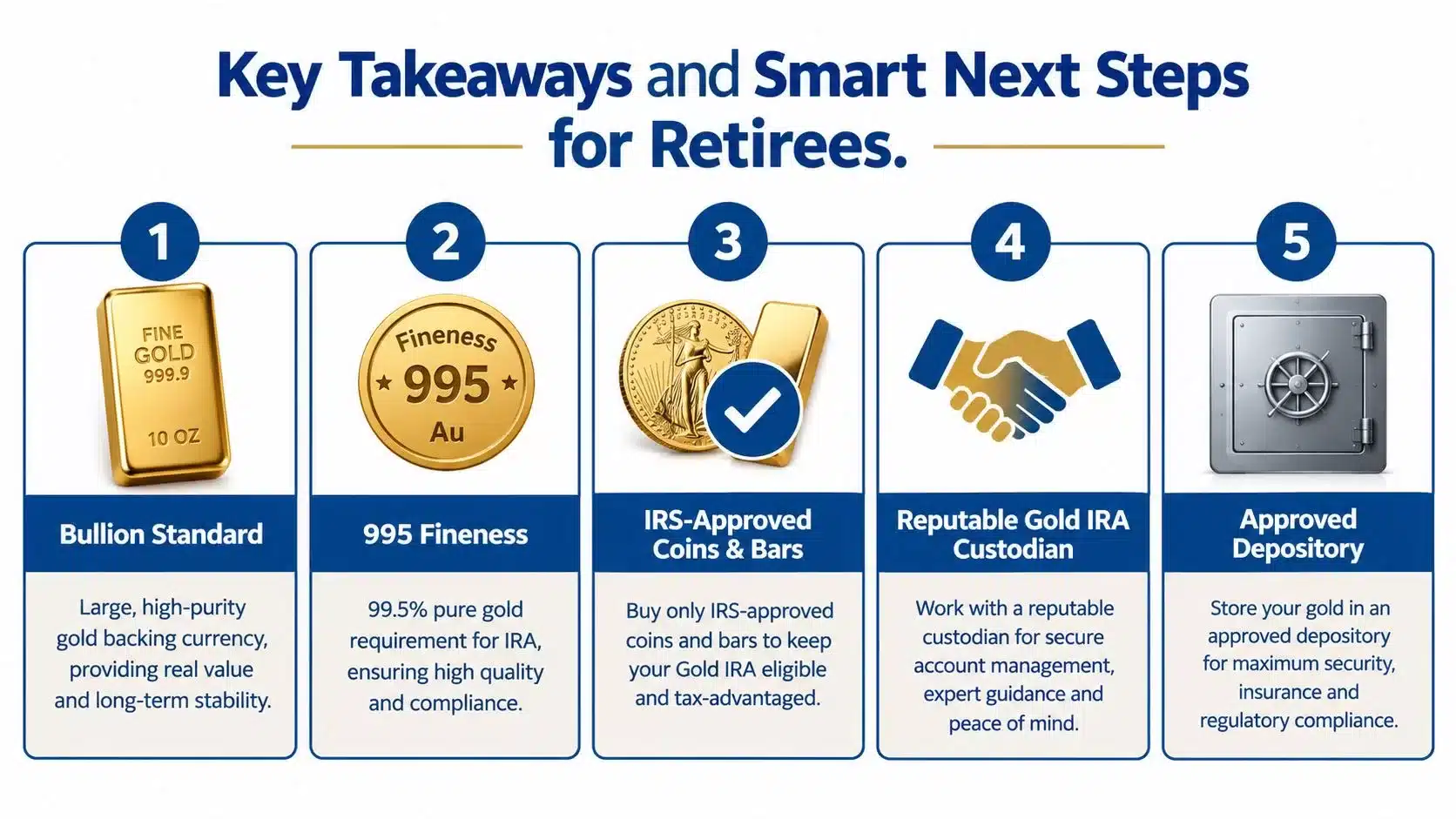
Documentation connects the historical model with a modern account. Monetary authorities needed bars that other institutions could accept without lengthy rechecking. A retirement investor needs a similar chain of evidence: product identity, fineness, refinery information, purchase records, and depository custody. The Gold IRA reporting requirements provide another point to review before discussing a transaction with a custodian.
The following video offers another visual explanation of the subject:

Before moving retirement funds: Request a current list of IRA-eligible products, compare the full fee schedule, and ask a fee-only financial advisor or tax professional to review how the decision fits the broader retirement plan.
This is not financial advice. Consult a licensed financial advisor, CPA, or tax professional before making investment decisions.
Gold IRA Association provides educational guides on eligible metals, rollovers, custodians, storage, fees, and company comparisons. Readers can visit Gold IRA Association for checklists and comparison resources before speaking with a provider.


