



A gold IRA rollover moves retirement funds from a 401(k) or IRA into a self-directed IRA that can hold IRS-approved physical gold. With an indirect rollover, the money generally must reach the new account within 60 days, while a direct trustee-to-trustee transfer avoids that clock.
A near-retiree may be considering this move after watching a market decline reduce an account balance, or looking for a different asset mix before leaving work. The important question isn't only whether gold can be placed inside an IRA. It's whether the funds, metal, paperwork, custody, and fees will all be handled correctly.
What a Gold IRA Rollover Actually Means
A gold IRA rollover is the movement of money from an eligible retirement account, such as a 401(k), 403(b), or traditional IRA, into a self-directed IRA that holds IRS-approved physical gold. The retirement money generally remains tax-deferred when the transaction follows the applicable rollover rules. The investor isn't cashing out the retirement account and then buying gold personally.
Several things change during the process:
- The receiving account changes. Funds move into a self-directed IRA designed to accommodate permitted alternative assets.
- The custodian changes. A new custodian administers the account, handles records, and coordinates reporting.
- The asset mix changes. Instead of holding only conventional investments, the IRA can hold approved physical precious metals.
- The tax status can remain intact. That depends on using a qualifying rollover or direct transfer and following the applicable requirements.
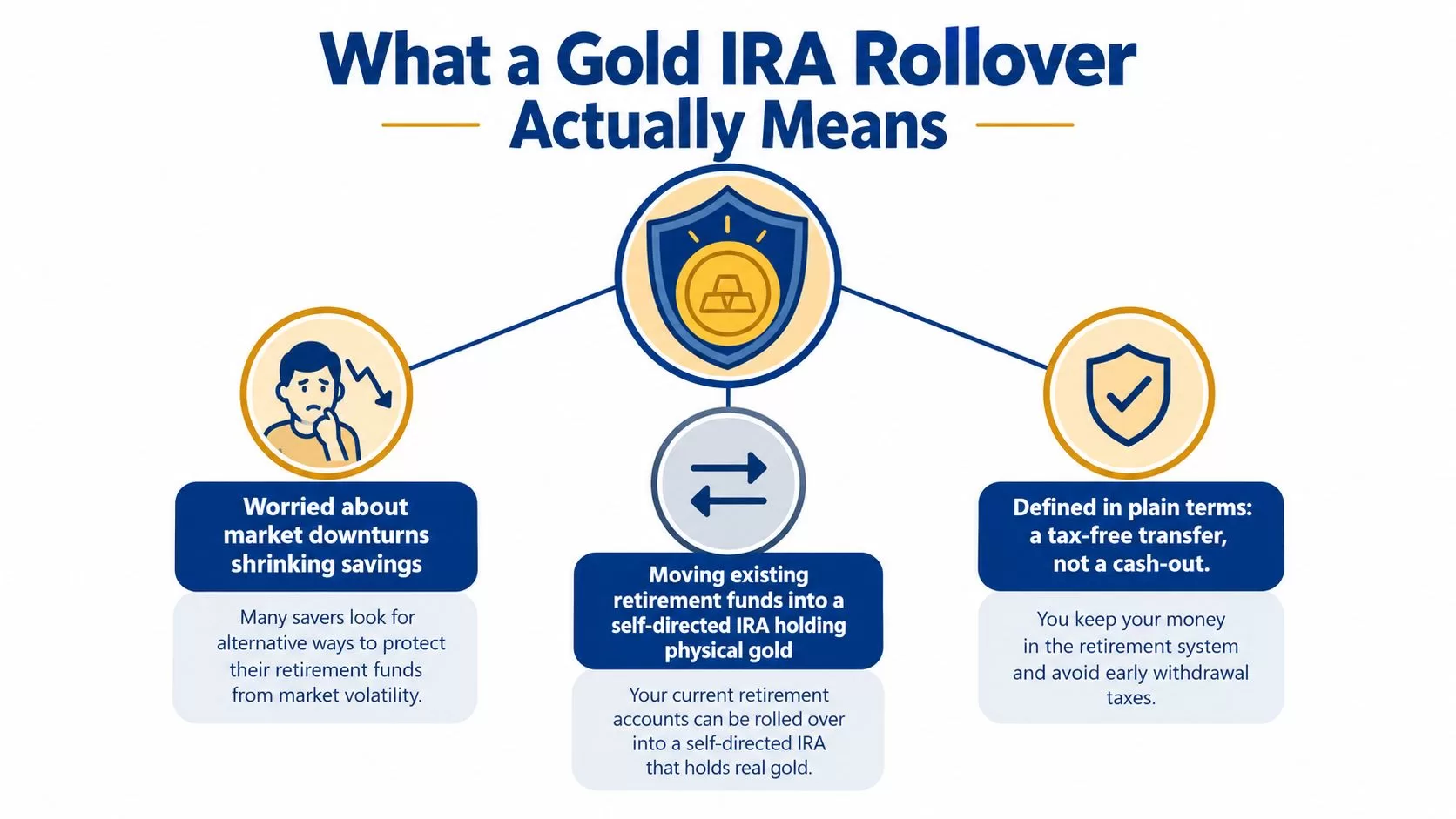

Gold appeals to some retirees because it's a tangible asset with a risk profile different from shares, bonds, or cash. That doesn't make it risk-free, and it doesn't guarantee protection from losses. It means only that some investors view precious metals as one possible diversification component.
Practical rule: The rollover is the movement of retirement money. It isn't the same thing as taking personal ownership of the gold.
The basic mechanic is straightforward. The difficult decisions involve timing, withholding, eligible products, approved storage, and the full cost of ownership. A transfer can be tax-compliant while still being expensive or unsuitable for a particular retirement plan.
Direct Rollover vs Indirect Rollover
The most important choice is whether the money moves directly between institutions or passes through the account holder first. The IRS distinguishes direct trustee-to-trustee transfers from indirect rollovers, and that distinction controls the timing risk.
| Feature | Direct Rollover | Indirect Rollover |
|---|---|---|
| Who receives the funds first | The new custodian receives them directly | The account holder receives them |
| 60-day deadline | No 60-day clock applies to a direct transfer | Funds generally must be redeposited within 60 days |
| Withholding | Direct transfers aren't subject to the usual owner-paid distribution withholding process | An IRA distribution paid to the owner is generally subject to 10% withholding unless the owner opts out; employer-plan distributions can involve mandatory withholding |
| Main risk | Paperwork or plan-processing delays | Missed deadline, withholding shortfall, and possible tax or penalty |
| IRA-to-IRA frequency limit | Not subject to the one-rollover-per-12-months limit | Limited to one indirect IRA-to-IRA rollover across all IRAs in a 12-month period |
The direct route generally sends funds from the old plan or custodian to the new custodian. No check is deposited into the investor's personal bank account, which removes the need to manage the 60-day redeposit deadline.
An indirect rollover gives the account holder the money first. The investor then deposits it into the receiving IRA. If the deadline is missed, the amount is generally treated as a taxable withdrawal. For someone under age 59½, the distribution may also trigger a 10% early-withdrawal penalty, as explained in the IRS rollover guidance.
A related trap is the one-rollover-per-12-months rule. After the Tax Court's 2014 Bobrow decision, the IRS applied the aggregate limit to indirect IRA-to-IRA rollovers beginning January 1, 2015, across all IRAs owned by the individual, not separately for each account. Direct transfers don't carry that same limitation.
For most retirees, a direct transfer is the cleaner starting point. The current plan administrator and receiving custodian should confirm the exact paperwork before any funds are released.
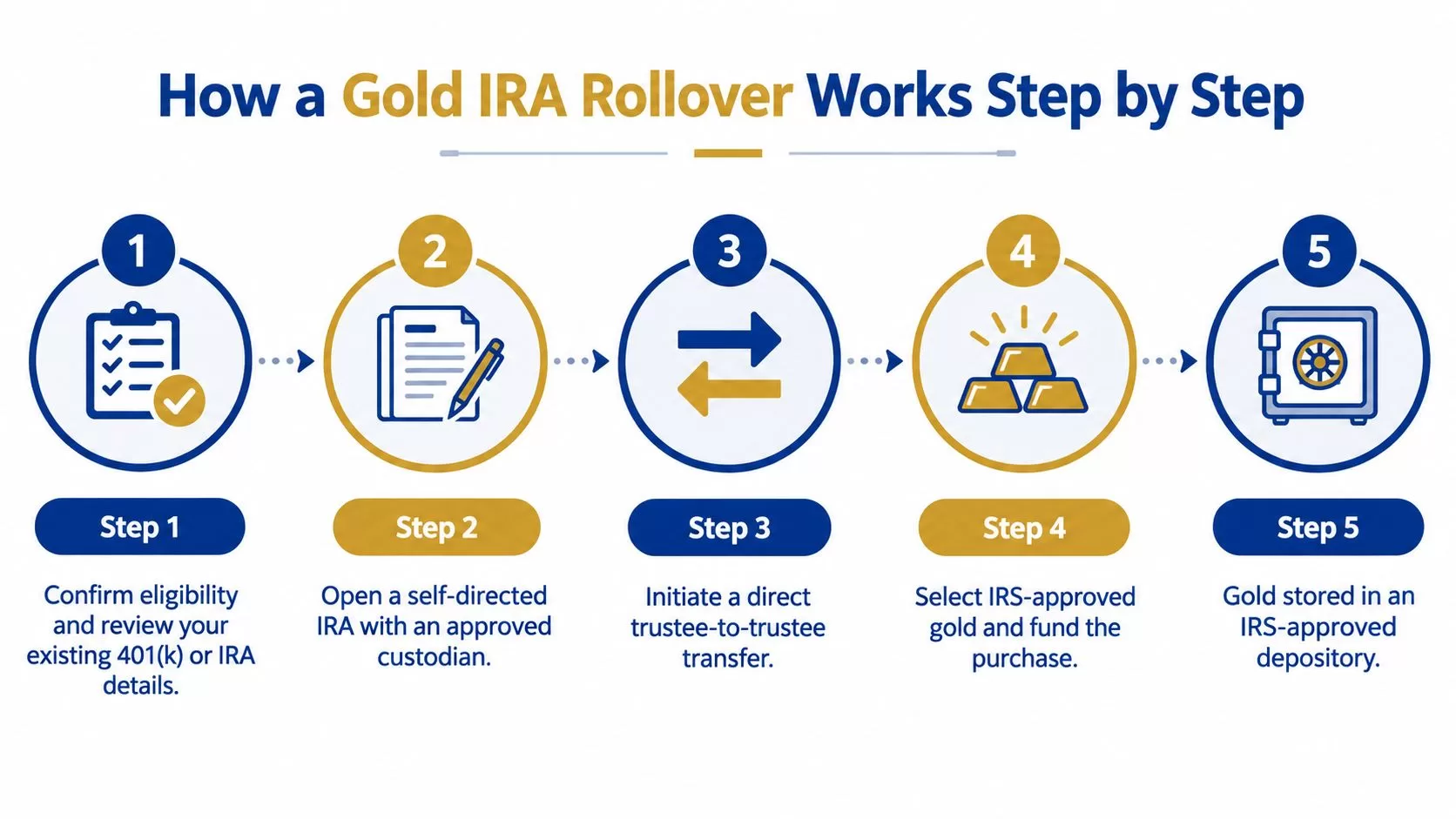
How a Gold IRA Rollover Works Step by Step
A rollover becomes easier to manage when the investor treats it as a sequence rather than a single transaction.
Confirm eligibility. Ask the current plan administrator whether the 401(k), 403(b), or IRA can be moved and whether the plan accepts the requested type of transaction. A former-employer plan may have different options from a current-employer plan.
Select a custodian. The receiving institution should administer self-directed precious-metals IRAs and coordinate with an approved storage facility. The custodian, not the investor, controls the account's administrative process.
Open the new IRA. Complete the application, beneficiary designations, transfer paperwork, and identification requirements before requesting the movement of funds.
Request a direct transfer. The new custodian normally provides instructions for the old plan administrator. A direct trustee-to-trustee transfer keeps the money out of the investor's personal possession.
Wait for funding. Processing time varies by plan administrator, custodian, and paperwork quality. A routine transaction may take several weeks, so the investor should follow up if the expected processing window passes.
Choose eligible products. Once the account is funded, the investor directs the purchase of qualifying gold or other permitted metals. The custodian and dealer should verify eligibility before the order is placed.
Arrange approved storage. The metal goes to an IRS-approved depository rather than the investor's home. The custodian records the holdings and provides account documentation.
The final checkpoint is the account statement. It should show the cash movement, metal purchases, storage arrangement, and valuation reporting. If any document shows the check was made payable to the investor personally, or the shipment is directed to a home address, the custodian should be contacted before proceeding.

IRS Rules That Govern Gold IRA Rollovers
A gold IRA has two separate compliance questions. First, did the retirement money move correctly? Second, does the purchased metal meet the account's eligibility and custody requirements?
For gold, the commonly used minimum fineness is 99.5%, with the American Gold Eagle allowed despite its 91.67% fineness. Silver generally must meet 99.9% fineness, while platinum and palladium generally require 99.95%, according to the IRA-allowable precious-metals standards.
| Rule | Requirement |
|---|---|
| Gold purity | Generally 99.5% fineness, with the American Gold Eagle exception |
| Silver purity | Generally 99.9% fineness |
| Platinum and palladium purity | Generally 99.95% fineness |
| Custody | Metal must be held by a bank or IRS-approved nonbank trustee or depository |
| Indirect rollover timing | Funds generally must be redeposited within 60 days |
| IRA-to-IRA indirect rollovers | One rollover across all IRAs in a 12-month period |
Personal storage creates a serious compliance concern. IRA-owned coins and bars aren't meant to sit in a home safe, personal safe-deposit box, or another location controlled by the account holder. The custodian must arrange custody through an approved institution.
Investors should also separate bullion eligibility from investment appeal. A collectible, rare coin, or attractive product may carry a high premium without being appropriate for a precious-metals IRA. Before funding an account, readers can review the precious-metal IRA rules and ask the custodian to confirm each product in writing.
The 60-day rule applies to indirect rollovers, not direct trustee-to-trustee transfers. Late-rollover relief may exist in qualifying circumstances, including automatic waivers and self-certification procedures under Revenue Procedure 2020-46. Some waiver requests carry a $10,000 user fee, so prevention is far preferable to repair.
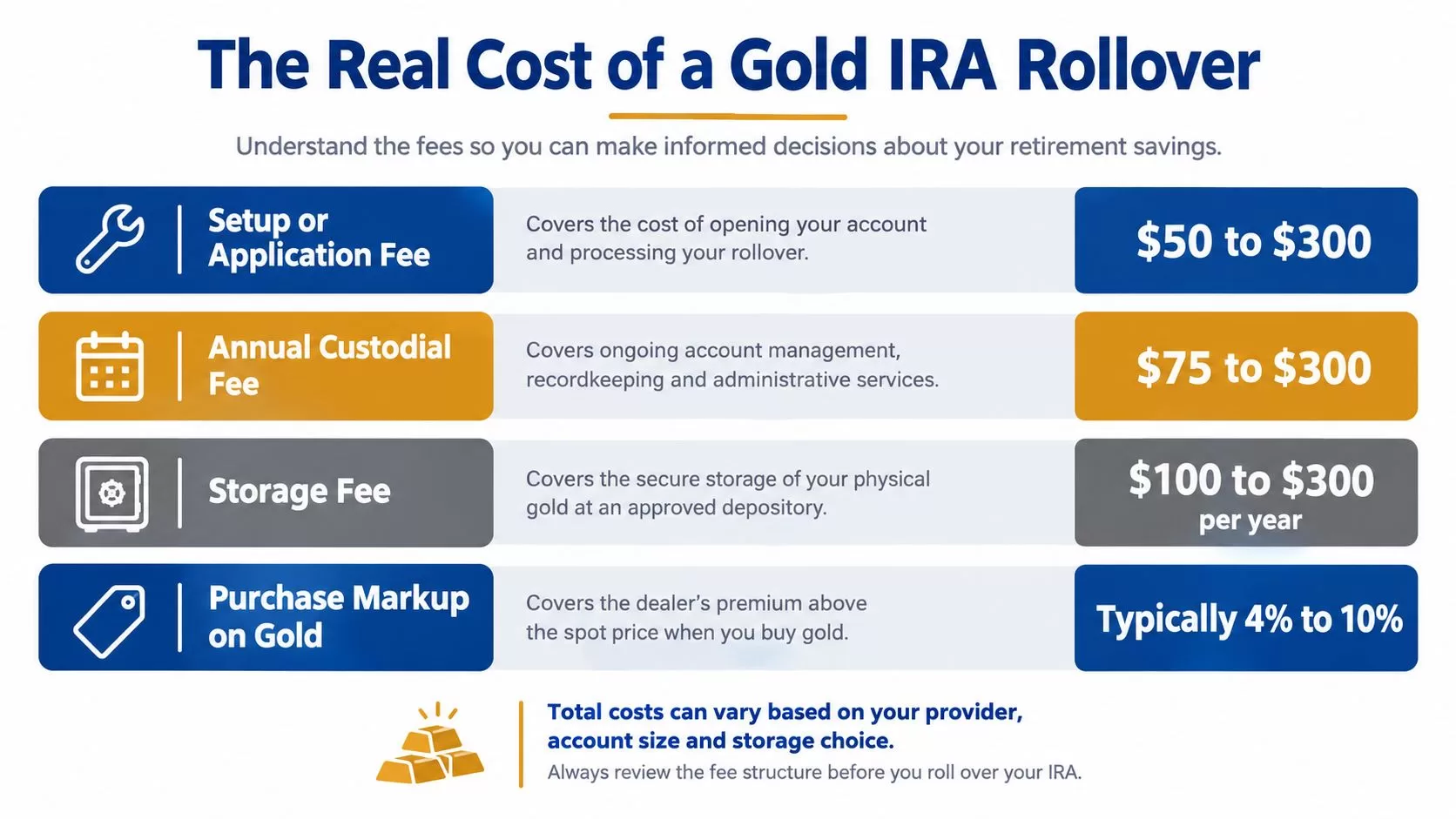
What a Gold IRA Rollover Actually Costs
A rollover can be tax-free when completed correctly, yet owning physical metal inside an IRA still carries expenses. The transfer moves retirement funds into the account; it does not erase the costs of buying, storing, and eventually selling the metal.
The cost stack may include:
- Account setup or application charges. A custodian may charge when the self-directed IRA is opened.
- Annual administration. Recordkeeping, statements, reporting, and account administration may create a recurring fee.
- Storage and insurance. The depository charges for holding the metal, and insurance is commonly part of that arrangement.
- Dealer markup. The purchase price may exceed spot price because of distribution, manufacturing, or other product costs.
- Transaction expenses. Wire, shipping, and handling charges may apply.
- Selling spread. The liquidation price may differ from the purchase price, so ask how buybacks are calculated.
Here is an illustrative way to view the total over time. On a $50,000 rollover, a first-year estimate might include a $50 setup charge, a $75 annual administration fee, and $150 for storage and insurance. A 3% to 5% dealer markup would add $1,500 to $2,500 to the purchase. That puts the initial cost at roughly $1,775 to $2,775, before transaction charges or any selling spread. Over three to five years, recurring administration and storage costs would be added each year. These figures are illustrative ranges, not a quote.
The CFTC's guidance on precious-metals fees recommends requesting every fee in writing, including setup, administration, storage, insurance, purchases, transfers, and liquidation.
A useful Gold IRA fees guide can organize those questions. Compare the written schedule with your expected holding period, then weigh the full ownership cost against your diversification goal, liquidity needs, and retirement income plan.
Common Mistakes and Pitfalls to Avoid
Most rollover problems come from treating a retirement transfer like an ordinary bank withdrawal. The account holder receives the money, assumes there's plenty of time, and discovers later that the IRS treats the transaction differently.
Missing the 60-day deadline is the clearest example. An indirect distribution generally becomes taxable if the money isn't redeposited into an eligible account within the required window. A person under age 59½ may also face the 10% early-withdrawal penalty, subject to the applicable rules and exceptions.
Overlooking withholding creates a second problem. When an employer plan pays an indirect distribution to the account holder, federal withholding can reduce the check. Completing a full rollover may require replacing the withheld amount with other funds, or the shortfall may be treated as a taxable distribution.
A direct transfer avoids the most common personal-possession and deadline mistakes because the institutions handle the movement.
Other errors deserve equal attention:
- Confusing a rollover with a transfer. A direct trustee-to-trustee transfer doesn't place the funds in the account holder's hands and isn't governed by the same 60-day clock.
- Using personal storage. Home safes, personal safe-deposit boxes, and other arrangements outside approved custody can jeopardize the account's treatment.
- Repeating indirect IRA rollovers. The one-rollover-per-12-months limit applies across the investor's IRAs, not separately to each account.
- Buying unsuitable products. Numismatic premiums and bullion pricing aren't the same. A product's appearance or rarity doesn't establish IRA eligibility.
- Ignoring related-party rules. Prohibited transactions involving disqualified persons can create additional compliance problems.
Late-rollover relief may be available in specific circumstances, including IRS waiver mechanisms or self-certification. Forms such as Form 5329 and a letter of explanation may become relevant, but the correct response depends on the facts. A tax professional should review an actual mistake before the investor files anything.
Choosing a Custodian or Gold IRA Company
Provider selection should start with a checklist, not a sales presentation. The custodian administers the retirement account, while a metals dealer handles product sales. In some arrangements, related businesses may perform several roles, so the investor should understand who earns each fee.
Review legal standing and administration
Ask whether the institution serves as an IRS-approved custodian for self-directed IRAs, how long it has operated, and where complaints or accreditation information can be reviewed. A company should explain its administrative responsibilities without suggesting that IRS approval endorses a particular investment or provider.
Demand an itemized fee schedule
The written schedule should identify setup, annual administration, storage, insurance, wire, shipping, and liquidation charges. It should also explain whether storage is segregated or commingled and whether any fee is flat or based on asset value.
Check the product and exit process
The provider should identify which coins and bars meet the applicable purity standards and explain how purchases are priced. Before signing, request the buyback policy, expected liquidation process, shipping arrangements, insurance terms, and the process for moving assets to another custodian.
The Gold IRA custodian guide provides a framework for evaluating these roles. The investor should still verify every term directly.
Red flags include pressure tied to “limited inventory,” bundled fees that aren't broken out, unwillingness to provide a sample transaction receipt, and vague answers about storage. A practical final test is simple: request the fee schedule and a sample receipt, then ask the current plan administrator whether a direct trustee-to-trustee transfer is supported.
Gold IRA Rollover Questions and Next Steps
How long does the process take? Timing depends on the existing plan, paperwork, custodian, and depository. Delays often come from incomplete forms or a plan administrator that requires additional verification.
Can the rollover be partial? A partial movement may be possible, but the current plan's rules control. The investor should ask how much can move and whether any restrictions apply.
What happens to employer stock? Employer stock can involve special tax considerations, so it shouldn't be moved without reviewing the plan documents and asking a qualified tax professional.
How are inherited IRAs handled? Beneficiary and distribution rules can differ from ordinary owner rollovers. The inheritor should obtain account-specific guidance before requesting a transfer.
Can Roth funds move into a Gold IRA? Roth assets generally require a compatible Roth receiving account to preserve their tax character. The custodian and tax professional should confirm the structure before paperwork is submitted.
The IRS doesn't endorse a particular precious-metals dealer or custodian. Holding gold inside retirement accounts is an allocation decision, not a tax-advantaged necessity.
The next step is to request a written fee schedule and a direct-rollover request form from a vetted custodian. Then confirm with the current plan administrator that a direct trustee-to-trustee transfer is supported. This article is educational, not individualized financial, tax, or legal advice. Consult a licensed financial advisor, CPA, or tax professional before making investment decisions.
Gold IRA Association offers educational guides, fee explanations, rollover checklists, and company reviews for people comparing precious-metals retirement options. Visit Gold IRA Association to review the available resources before requesting documents or speaking with a custodian.


