




Most articles define self directed IRA limits as one annual contribution number and stop there. That answer is incomplete. A self-directed IRA uses the same contribution rules as other IRAs, but its broader investment menu creates additional limits involving transactions, asset eligibility, distributions, taxes, custody, and costs. This guide explains what the IRS allows in 2026 and where account owners can create problems even when their contributions are within the stated ceiling.
Why Self Directed IRA Limits Are Bigger Than the Contribution Cap
A self-directed IRA, or SDIRA, is an IRA whose custodian permits a broader range of investments than a conventional account. Depending on the account structure and custodian, those investments may include real estate, private placements, precious metals, and other alternative assets. The self-directed label changes the available investment choices, not the basic IRA contribution framework.
The popular answer, “the limit is the annual IRA cap,” is technically correct but practically incomplete. An investor can contribute an amount allowed by the IRS and still create a serious tax problem by using IRA property personally, dealing with a disqualified person, buying an ineligible asset, or failing to handle required distributions.
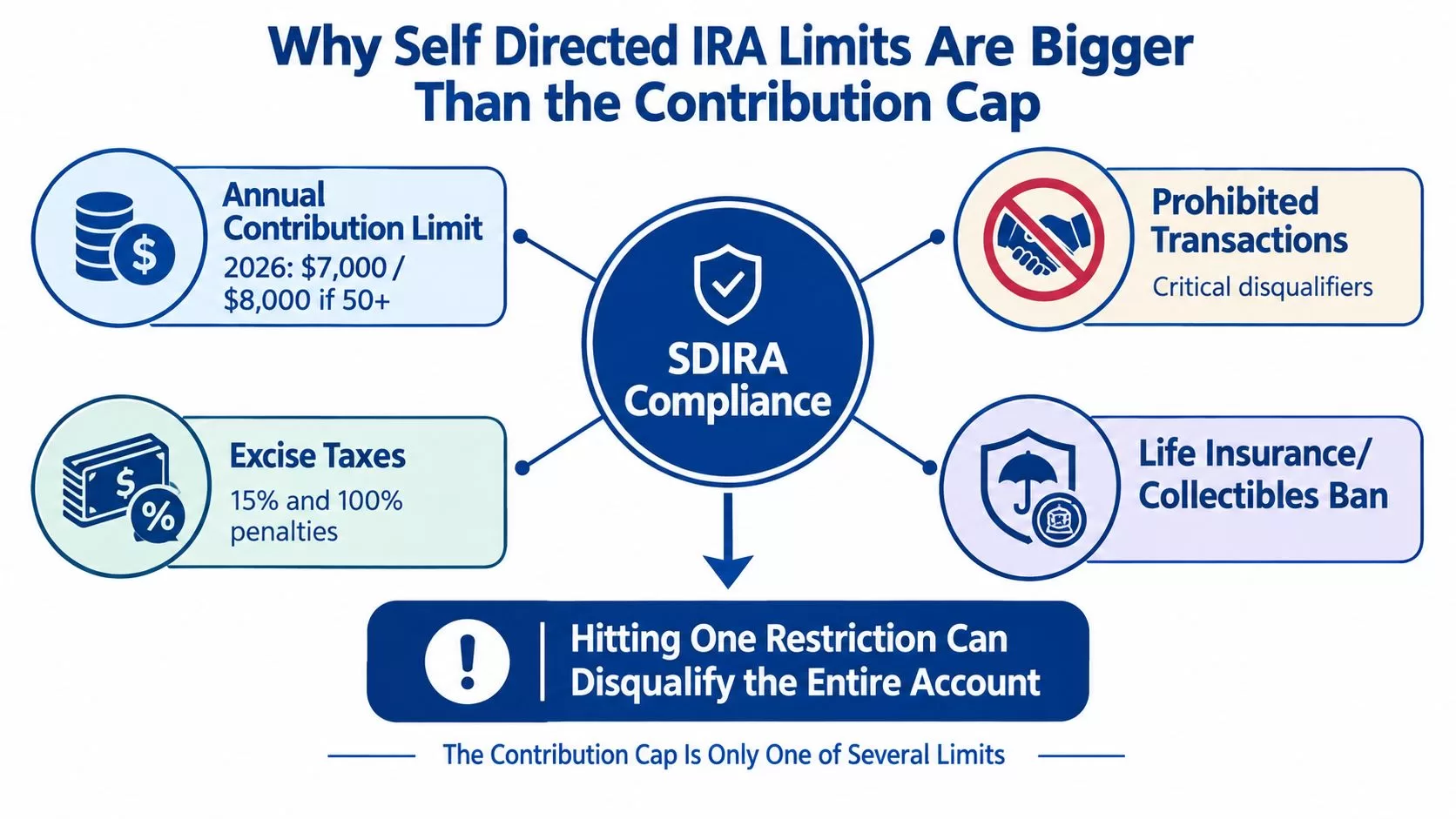

The main ceilings are separate
Think of SDIRA limits as several compliance boundaries rather than one number:
- Contribution limit: The amount that can enter all of an individual's traditional and Roth IRAs during the year.
- Transaction limit: The account can't buy from, sell to, lend to, lease to, or personally benefit a disqualified person under the prohibited-transaction rules described by Intuit's tax guidance on SDIRA transactions.
- Asset limit: Collectibles and life insurance receive special treatment, while qualifying precious metals must meet applicable IRA requirements and remain in approved custody.
- Distribution limit: Traditional accounts must follow required minimum distribution rules, even when the underlying asset is difficult to sell.
- Tax limit: Debt-financed or operating-business income may create unrelated business taxable income, commonly called UBTI.
- Operational limit: Custody, valuation, storage, insurance, and transaction charges reduce the money available for investments.
Practical rule: The important question isn't only “How much can enter the SDIRA?” It's also “What can the account do after the money arrives?”
That broader view matters most for near-retirees using real estate, private investments, or physical metals. The account may offer more control, but the owner also carries more responsibility for checking the asset, counterparty, documentation, and tax treatment before funds move.
2026 IRS Contribution Limits That Apply to Every SDIRA
The 2026 contribution rule is simpler than many advertisements suggest. A self-directed traditional IRA and a self-directed Roth IRA use the same combined annual IRA contribution ceiling as other traditional and Roth IRAs. The account's investment menu doesn't create a separate SDIRA allowance.
For tax year 2026, the total contribution limit is $7,500 for an individual under age 50 and $8,600 for an individual age 50 or older. The IRS IRA contribution-limit guidance confirms that the limit applies across all personal traditional and Roth IRAs together.
The limit follows the person, not the account
Suppose an investor contributes to a traditional SDIRA and also contributes to a Roth IRA held elsewhere. Those deposits share one annual IRA bucket. The investor can't place $7,500 in the SDIRA and another $7,500 in the Roth IRA during 2026 unless the combined amount stays within the applicable limit.
| Contribution Type | Under 50 | Age 50+ | Notes |
|---|---|---|---|
| Combined traditional and Roth IRA contributions | $7,500 | $8,600 | Applies across all personal traditional and Roth IRAs, including SDIRAs |
| Additional catch-up amount reflected in the age-50+ total | Not applicable | $1,100 | The age-50+ total is the combined annual ceiling |
The $8,600 amount includes the age-based catch-up provision. It isn't an additional $8,600 on top of the under-50 limit. Contributions to a traditional IRA and a Roth IRA must be counted together.
Compensation can impose a lower ceiling
The IRS also says contributions can't exceed taxable compensation for the year. That means earned income may be the practical limit when compensation is lower than the statutory IRA ceiling. An investor shouldn't instruct a custodian to accept the full annual amount without checking both the applicable age limit and available compensation.
Rollovers and transfers of existing retirement funds are different from new annual contributions. The contribution cap governs new IRA contributions, while a rollover moves previously held retirement money under separate rules. The self-directed structure doesn't turn a rollover into a new annual contribution allowance.
Traditional IRA Deduction Limits and the MAGI Phase-Out
The annual contribution limit answers one question: how much can enter the IRA? The deduction rules answer another: how much of a traditional IRA contribution can reduce taxable income?
A traditional SDIRA contribution may be nondeductible, partially deductible, or fully deductible depending on modified adjusted gross income, filing status, and workplace retirement-plan coverage. The contribution can still be made when the deduction is limited, but the tax reporting consequences differ.
Read the rule in the right order
A taxpayer should work through these steps:
- Identify the account type. This deduction discussion applies to traditional IRA contributions, not Roth contributions.
- Check workplace coverage. The phase-out rules apply differently when the taxpayer or spouse participates in an employer retirement plan.
- Use the correct filing status. Single, head of household, and married filing jointly taxpayers use different ranges.
- Compare MAGI with the applicable range. The result determines whether the deduction is full, partial, or unavailable.
For 2026, the IRS cost-of-living adjustment guidance gives a $81,000 to $91,000 phase-out range for a single filer or head of household who is covered by a workplace plan. For married filing jointly, the range is $129,000 to $149,000 when the relevant taxpayer is covered.
| Filing Status | Active Participant? | Phase-Out Range | Fully Deductible Below |
|---|---|---|---|
| Single filer or head of household | Taxpayer covered by a workplace plan | $81,000 to $91,000 | $81,000 |
| Married filing jointly | Relevant taxpayer covered by a workplace plan | $129,000 to $149,000 | $129,000 |
A taxpayer below the listed range generally has a stronger basis for a full deduction, while a taxpayer inside the range may receive only a partial deduction. Above the range, the deduction can be unavailable under the applicable rule. The exact result depends on the taxpayer's circumstances and tax return.
Separate contribution eligibility from tax treatment
Readers often confuse a contribution being permitted with a contribution being deductible. Those are not the same decision. A custodian can hold a traditional SDIRA contribution even when the investor must report some or all of it as nondeductible.
The safest process is to determine the tax treatment before directing the deposit. A CPA or tax professional can review MAGI, workplace coverage, prior nondeductible contributions, and filing status. This is not financial advice. Consult a licensed financial advisor, CPA, or tax professional before making investment decisions.
Prohibited Transactions as the Binding Compliance Limit
The binding limit in a self-directed IRA is often not the annual contribution cap. It is the rule against using IRA property for personal benefit. A contribution can fall within the permitted amount while one prohibited transaction places the account's tax treatment at risk.
Under IRC Section 4975, prohibited transactions can include sales, exchanges, leases, loans, and the furnishing of goods or services between the IRA and a disqualified person. The rules also restrict using IRA income or assets for that person's benefit. The Gold IRA Association's guide to SDIRA disqualified persons explains the relevant relationship boundaries.
Who requires special caution
Disqualified persons can include the IRA owner, the owner's spouse, lineal family members such as parents and children, and entities controlled by those individuals. These relationships can turn an ordinary arrangement into a compliance problem. An IRA-owned property generally cannot serve as the owner's vacation home, and the owner should not provide unpaid labor that benefits the IRA's investment.
Commercially reasonable terms do not automatically make a transaction permissible. A fair interest rate, written agreement, or repayment schedule does not resolve the issue if the borrower is the owner's company or another disqualified person.
| Prohibited Transaction | Statutory Source | Tax Consequence |
|---|---|---|
| Sale or exchange between the IRA and a disqualified person | IRC Section 4975 | Can jeopardize the account's tax-advantaged status |
| Lending IRA money to a disqualified person | IRC Section 4975 | Can cause severe tax consequences and possible penalties |
| Using IRA property personally | IRC Section 4975 | Personal use can be treated as a prohibited benefit |
| Furnishing services to an IRA investment for personal benefit | IRC Section 4975 | May create a disqualifying transaction |
A loan to the owner's LLC
An investor who lends $40,000 from an SDIRA to the investor's own LLC at 6% interest may have a promissory note and repayment schedule. The owner's control of the LLC still creates a prohibited-transaction concern. The verified SDIRA prohibited-transaction discussion describes the potential for severe tax consequences, including account-distribution treatment and penalties that can reach 15% per year or 100% in some cases.
Private lending is not automatically forbidden. The borrower, ownership structure, personal benefit, collateral, and services require review before the SDIRA commits funds. A transaction can remain below the contribution ceiling and still endanger the entire account.
Loan, Collectibles, and Life Insurance Restrictions Inside an SDIRA
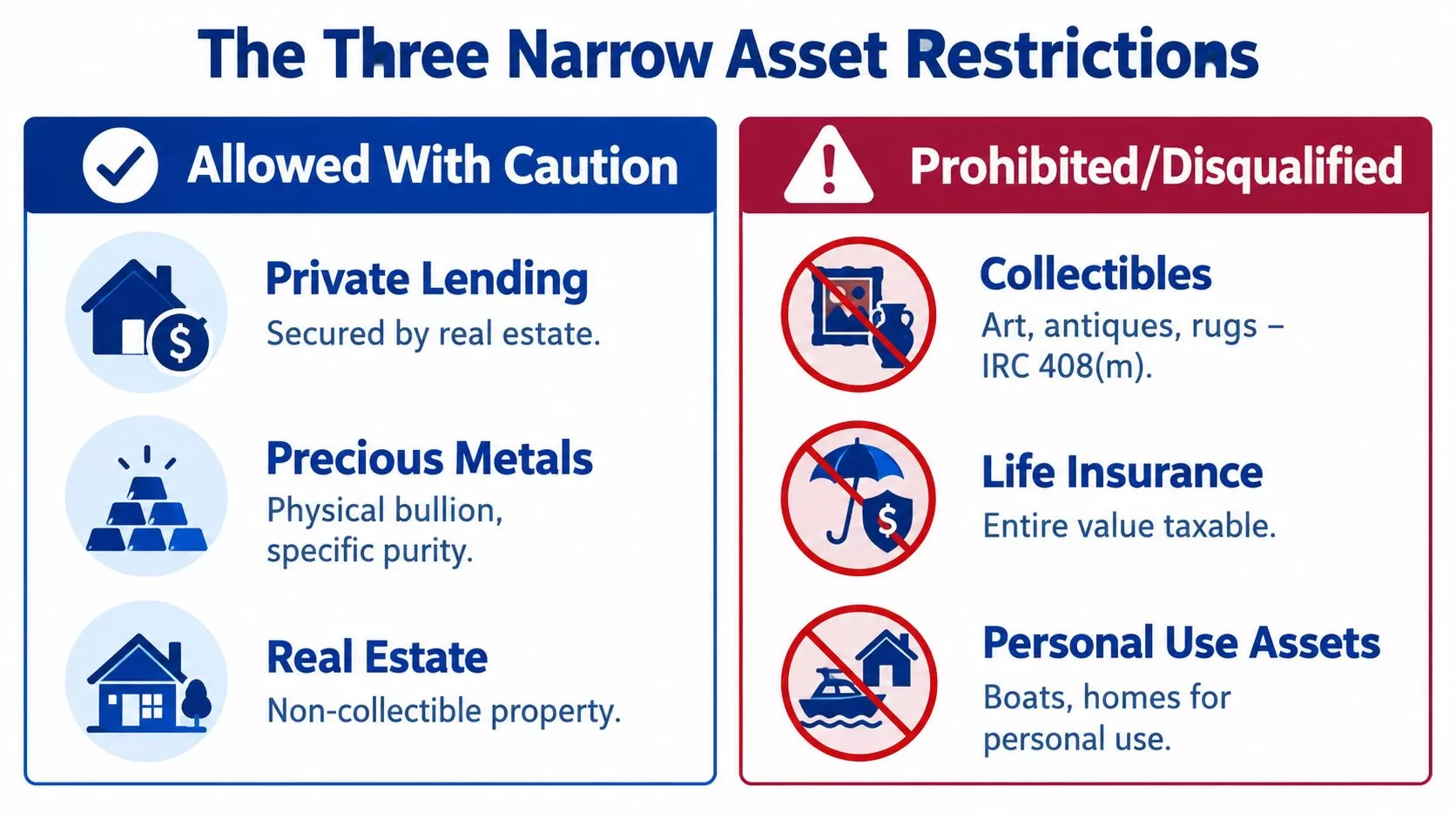
Three special restrictions deserve separate attention because they often appear during asset selection. A broad investment menu doesn't mean every asset is permitted, and a permitted asset doesn't mean every ownership arrangement is safe.
Collectibles receive narrow treatment
IRC Section 408(m) generally bars collectibles from IRA ownership. The category can include art, antiques, rugs, certain coins, metals, and other tangible property. The statutory exceptions are narrow, so an investor shouldn't assume that a valuable coin or precious-metal item qualifies merely because it has investment value.
Gold and silver buyers should verify IRA eligibility before purchase. Qualifying bullion must satisfy applicable purity rules, and the asset must remain with an approved custodian or depository rather than being delivered to the owner's home.
Lending and insurance have their own boundaries
The lending rules also matter. An SDIRA may be able to make a properly structured nonrecourse mortgage loan to a non-disqualified party, but a loan to the owner or another disqualified person creates a different analysis under IRC Section 4975.
Life insurance receives separate treatment under IRC Sections 408(a)(3) and 408(b)(3). Because the statutory rules are technical and depend on account structure, policy type, ownership, and beneficiary arrangements, an investor should obtain specialized tax advice before treating life insurance as an SDIRA asset.
The practical screen for an alternative investment is straightforward:
- Asset: Is the investment permitted, or does it fall within a restricted category?
- Counterparty: Is the seller, borrower, tenant, manager, or service provider a disqualified person?
- Custody: Will the asset remain under the required custodian or depository arrangement?
- Use: Will anyone connected with the account receive personal use or an improper benefit?

Precious metals illustrate why all four questions matter. A metal may satisfy the asset rules, yet home storage or personal possession can create a separate compliance problem. The account's real ceiling is determined by the complete arrangement, not by the product name alone.
RMDs, UBTI, and the Rollover Ceiling on Self Directed IRAs
Traditional SDIRAs face obligations after the owner reaches the applicable required minimum distribution age. The account may hold an illiquid property, private placement, or physical metal, but the distribution rule doesn't disappear because the asset is difficult to sell.
Under the current age framework, required minimum distributions begin at age 73 for people born from 1951 through 1959 and at age 75 for people born in 1960 or later. The IRS also recalibrated the uniform life tables. A missed RMD can trigger an excise tax of 25%, with a 10% correction tier in qualifying circumstances, according to the IRS retirement-plan guidance on RMD rules.
Three limits that affect liquidity
| Limit | Threshold | Statute |
|---|---|---|
| Required minimum distribution | Applicable starting age and annual calculation | Internal Revenue Code Section 401(a)(9) |
| Unrelated business taxable income | More than $1,000 of gross unrelated trade or business income can require Form 990-T | IRC Sections 511 through 514 |
| Indirect rollover | Once-per-12-month limitation and a 60-day completion deadline | IRS rollover rules |
UBTI can arise when an SDIRA owns an investment with debt or an operating business. If the account receives more than $1,000 of gross unrelated trade or business income, the account may need to file Form 990-T, and the UBTI portion can be taxed under the applicable corporate tax schedule.
Rollover timing creates another operational ceiling. An indirect rollover generally must be completed within 60 days, and the once-per-12-month rule limits how often an individual can use that method across IRAs. Direct trustee-to-trustee transfers usually avoid the same handling risk, but the paperwork still requires careful review.
Illiquid assets can collide with RMDs
An investor with $1.2 million in a traditional SDIRA can face a mandatory distribution of roughly $50,000 at age 75, depending on the applicable life-expectancy divisor and account value. That obligation exists even when the account holds an asset that can't be sold quickly.
RMD calculations can aggregate traditional IRAs for distribution purposes, but the owner still needs a practical plan for which account or asset will provide the cash. Readers approaching distribution age should review the issue early using the required minimum distribution rules resource.
Custodian, Storage, and Transaction Costs That Shrink Your Effective Limit
A contribution cap doesn't tell an investor how much capital will remain available after account administration. Custody, storage, insurance, valuation, shipping, dealer spreads, and transaction charges can reduce the amount deployed into an alternative asset.
Costs vary by custodian, asset type, and activity. A flat annual charge may suit an account with occasional transactions, while a per-transaction model may become less attractive when the owner makes repeated purchases or sales. Precious metals can add assay, shipping, insurance, and storage charges, with segregated storage often priced differently from commingled storage.
Compare the fee model, not just the headline
| Fee Category | Typical Range | How It Reduces the Account |
|---|---|---|
| Annual custodial administration | $50 to $300 | Reduces cash available for investment or distributions |
| Purchase or sale transaction | Varies by provider and activity | Makes frequent trading more expensive |
| Assay and shipping | Varies by metal and transaction | Adds costs before the asset reaches storage |
| Storage and insurance | Varies by custody arrangement | Creates recurring expenses for physical holdings |
| Dealer markup or spread | Varies by product and dealer | Means the purchase price can exceed spot value |
These ranges are illustrative categories, not universal quotes. Investors should request a complete written schedule before opening an account. The self-directed IRA fee breakdown can help readers identify setup, custody, storage, and transaction charges that deserve comparison.
Account-paid and personally paid expenses
A fee paid from personal funds outside the SDIRA may be acceptable in some circumstances, but the arrangement should be reviewed before payment. Fees paid from inside the account reduce the balance and therefore reduce the capital available for future purchases, taxes, or distributions.
Consider a hypothetical 0.9% all-in annual drag on a $200,000 balance over 20 years. Depending on returns and compounding, that drag can reduce the ending balance by roughly $45,000. The calculation is an illustration of fee compounding, not a forecast. It shows why a small recurring charge can become an unofficial limit on account size and activity.
Fee comparison should include every recurring and transaction-based charge, not just the opening fee.
Quick Reference Checklist for Staying Under Every SDIRA Limit
A compliant SDIRA process begins before the investment order. The following checklist separates the limits so an owner can review the correct issue instead of treating every question as a contribution question.
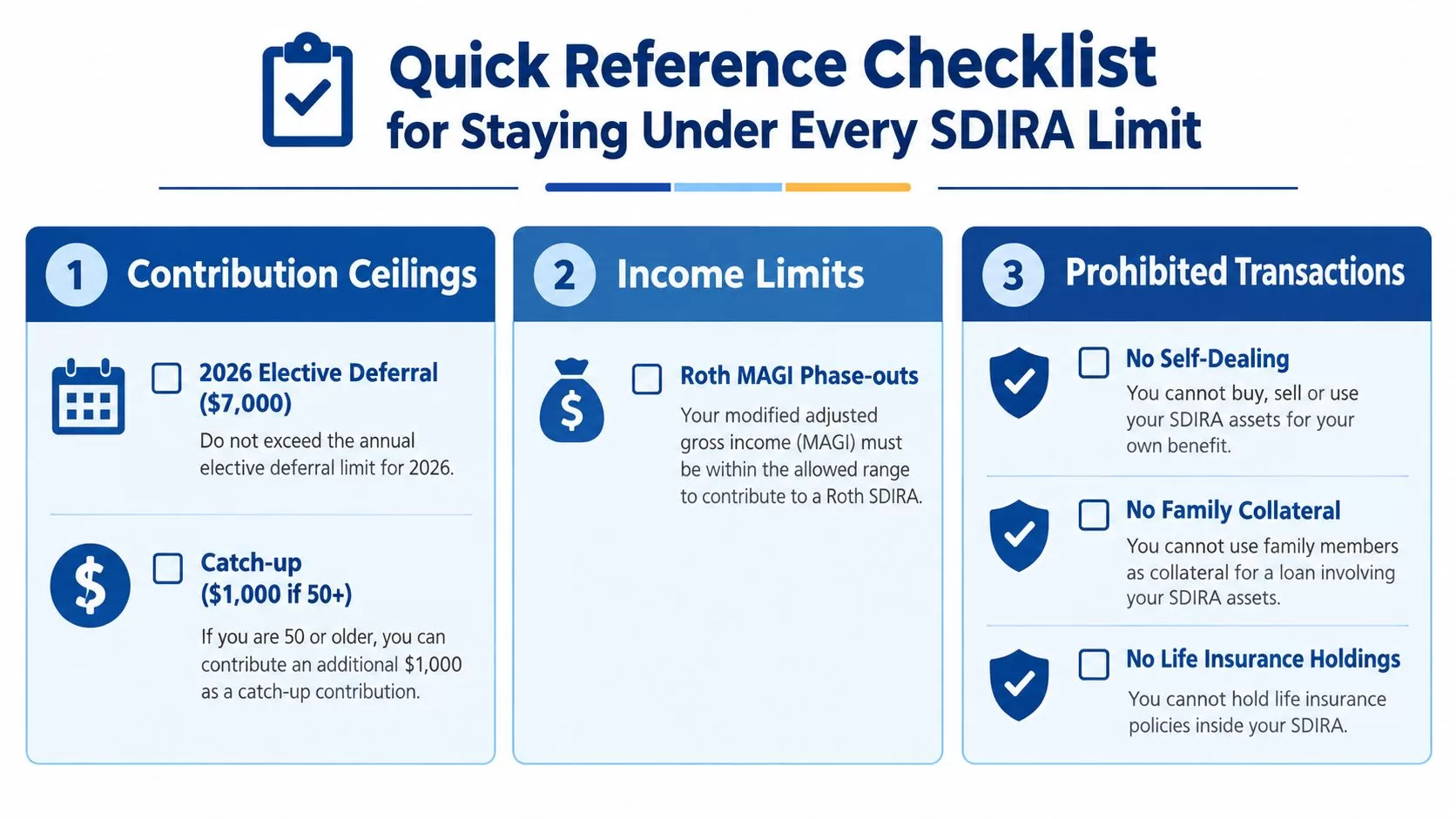
Contributions and income
- Combine IRA deposits: Count traditional and Roth IRA contributions together across all accounts, using the 2026 ceilings of $7,500 under age 50 and $8,600 at age 50 or older, as stated by the IRS contribution-limit rules.
- Check compensation: Confirm that taxable compensation supports the intended contribution amount.
- Separate deduction from eligibility: Review MAGI, filing status, and workplace-plan coverage before claiming a traditional IRA deduction.
- Document Roth eligibility: If contributing to a Roth SDIRA, verify the applicable income rules rather than assuming the self-directed label changes them.
Transactions and assets
- Screen every counterparty: Check whether the seller, tenant, borrower, manager, service provider, spouse, parent, child, or controlled entity is a disqualified person under IRC Section 4975.
- Reject personal use: Don't occupy, borrow, use, or personally benefit from IRA-owned property.
- Review collectibles: Apply IRC Section 408(m) before buying coins, artwork, antiques, rugs, or other tangible property.
- Confirm metal custody: Verify IRA eligibility, purity, approved storage, insurance, and depository records before wiring funds.
- Check lending structure: Review whether a proposed loan is permitted and whether any disqualified person is involved.
Taxes and operations
- Plan for RMDs: Identify the applicable starting age and create a liquidity plan for traditional SDIRA distributions.
- Screen for UBTI: Ask whether borrowing or an operating business could generate unrelated trade or business income, and determine whether Form 990-T may be required.
- Control rollover timing: Use direct transfers where practical, and track the 60-day deadline and once-per-12-month limitation for indirect rollovers.
- Maintain valuations: Obtain annual fair-market values for illiquid assets and retain supporting documentation.
- Track all charges: Record custodial, storage, insurance, shipping, valuation, and transaction fees, then confirm how each will be paid.
Before wiring funds, confirm asset eligibility, counterparty eligibility, storage documentation, and UBTI exposure.
Gold IRA Association provides educational guides, rollover materials, fee explanations, and company comparison resources for readers evaluating precious-metals IRAs and broader SDIRA questions. Visit Gold IRA Association to review the relevant rules and prepare questions for a qualified financial, tax, or legal professional.


