




A retiree can spend decades saving in a traditional IRA, then discover that the IRS requires withdrawals even when the money isn't needed for living expenses. Those withdrawals can create taxable income, affect other retirement decisions, and become difficult for heirs to manage. The required minimum distribution rules determine when withdrawals begin, how much must come out, what happens after a missed deadline, and how inherited accounts are handled.
Why Required Minimum Distribution Rules Catch Retirees Off Guard
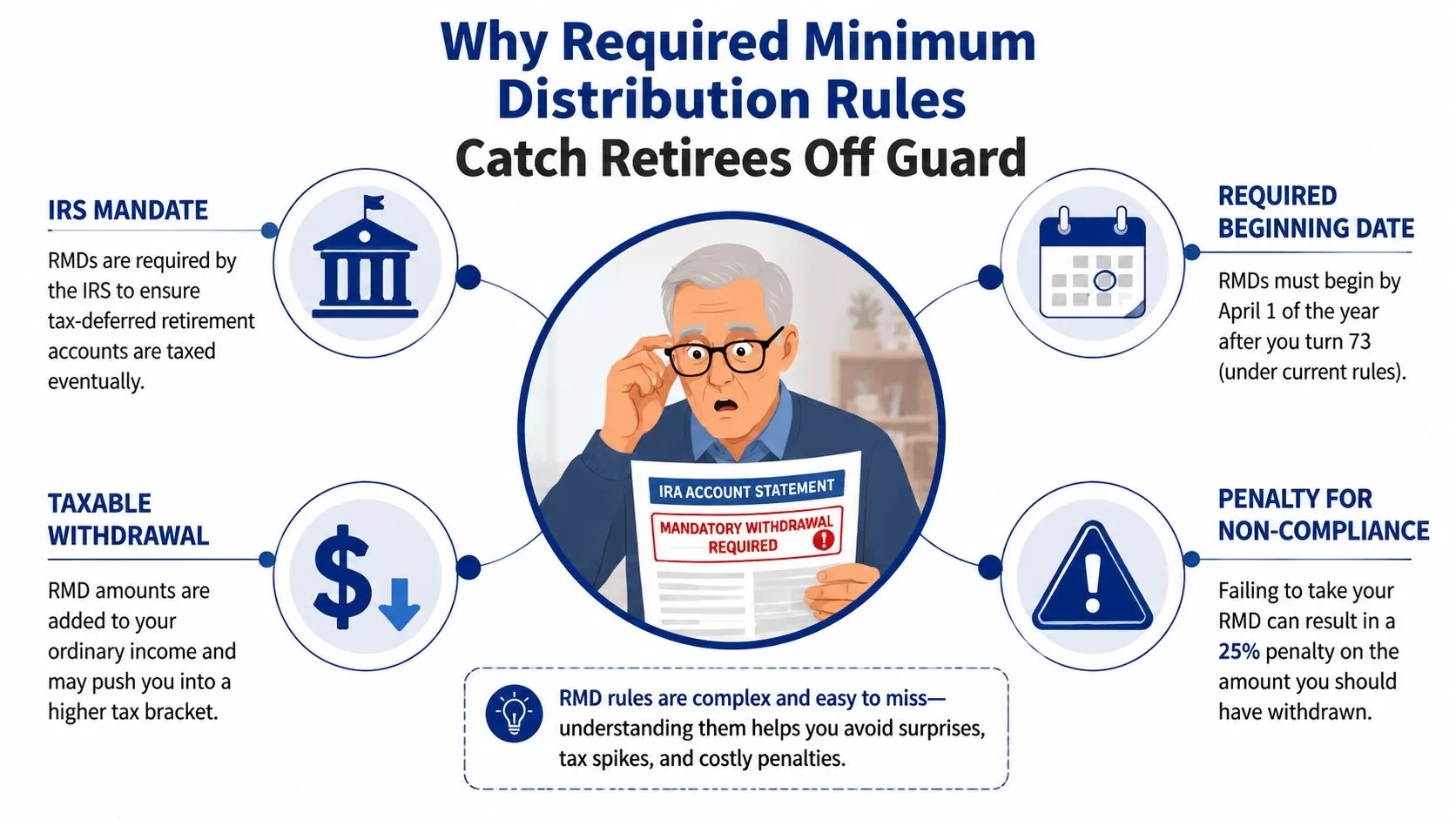
Consider a retiree who has reached the applicable RMD age and assumed her IRA could remain invested indefinitely. She may be surprised to learn that the IRS requires a distribution from the account, whether she needs the cash or not. The issue isn't just receiving money. A traditional IRA withdrawal generally becomes taxable income, which can change the year's tax picture and complicate an otherwise predictable retirement budget.
The withdrawal can also affect decisions outside the IRA. Additional taxable income may contribute to higher Medicare premiums or increase the portion of Social Security benefits included in taxable income. If the account is invested, the owner may also need to sell investments to raise cash, potentially at an inconvenient time during a market decline.

The questions that matter most
An RMD is the minimum amount that must be withdrawn from an eligible tax-deferred account for a particular year. The amount isn't chosen arbitrarily. It's based on the account's prior year-end value and an IRS life-expectancy factor.
Readers usually need clear answers to these questions:
- Which accounts are covered? Traditional IRAs and many employer plans generally have RMD obligations. Original Roth IRAs are treated differently during the owner's lifetime.
- When does the obligation begin? The answer depends largely on birth year and, for some employer plans, retirement status and plan terms.
- How is the amount calculated? The prior December 31 balance is divided by the applicable IRS factor.
- What happens after a missed withdrawal? The shortfall can be subject to a substantial excise tax.
- How do inherited accounts work? Beneficiary type, the owner's death date, and whether the owner had reached the required beginning date can change the result.
Planning point: The deadline is only one part of the decision. The timing of a first withdrawal can matter just as much as the amount.
The two-RMD-year trap makes that timing especially important. A first withdrawal may be delayed until April 1 of the following year, but doing so can place the first and second required withdrawals in the same calendar year. Inherited accounts add another layer of uncertainty because proposed regulations and later guidance affect how beneficiaries apply annual withdrawal and payout rules.
What an RMD Actually Is and How the Calculation Works
A required minimum distribution, or RMD, is the minimum amount the IRS requires an account owner to withdraw each year from most non-Roth tax-deferred retirement accounts after reaching the applicable starting age. The withdrawal generally comes from the account's pre-tax balance and is usually included in taxable income. The investments that remain in the account don't have to be liquidated because an RMD is due.
The basic calculation has two parts:
- Find the account balance on the prior December 31.
- Divide that balance by the IRS life-expectancy factor for the owner's age.
The formula is:
Prior December 31 account balance ÷ applicable IRS distribution period = RMD
For example, a $500,000 balance divided by the age-75 factor of 24.6 produces an RMD of approximately $20,325. The age-75 factor of 24.6 is illustrated in a current RMD reference guide. The same balance generally produces a larger withdrawal at older ages because the distribution period becomes shorter.
Selected factors
The following selected factors illustrate the calculation's direction. The applicable table can differ in specialized situations, so an account owner should verify the correct table before making a withdrawal.
| Age | Distribution Period (Factor) |
|---|---|
| 73 | 26.5 |
| 74 | 25.5 |
| 75 | 24.6 |
| 76 | 23.7 |
| 77 | 22.9 |
An owner with multiple traditional IRAs generally calculates the RMD for each IRA using its own balance, then may take the combined amount from one or more traditional IRAs. That flexibility doesn't mean the records can be combined casually. Each account's prior year-end balance must be included correctly, and the owner must confirm that the total withdrawal satisfies the separate calculation basis.
Employer plans can have different aggregation rules. A plan participant should ask the plan administrator whether each account must distribute its own calculated amount rather than assuming IRA treatment applies everywhere.
RMD Ages, Deadlines, and the SECURE 2.0 Shift
A retiree born in 1959 may face a different first RMD deadline from a sibling born one year later. SECURE 2.0 moved the starting age in stages. People born from 1951 through 1959 generally begin at age 73, while people born in 1960 or later generally begin at age 75, according to Congressional Research Service guidance on SECURE 2.0. Earlier law used age 72 for another group, which explains why older retirement articles can conflict with current planning.
Birth year provides the first checkpoint. Account type and work status provide the next ones. Traditional IRA owners generally have a first deadline of April 1 of the year after reaching the applicable RMD age. Later annual withdrawals are generally due by December 31. For an employer plan, the first deadline may depend on the later of reaching the applicable age or retiring, if the plan permits a still-working exception.
Why the April 1 option can backfire
Delaying the first RMD keeps the money invested longer, but it can place two required withdrawals in the same tax year. The first is due by April 1, followed by the next year's RMD by December 31.
That two-RMD-year trap can create a measurable tax cost. Suppose each required withdrawal is $20,000. Taking the first distribution in the initial RMD year spreads $20,000 across each of two tax years. Waiting until April can place $40,000 in one return instead. The added income may reach a higher marginal tax bracket, raise Medicare Part B and Part D premiums, or increase the taxable portion of Social Security benefits. The actual cost depends on the full tax return, so the April 1 option needs a side-by-side projection rather than an automatic recommendation.
Use this comparison:
- Take the first RMD in the initial RMD year: Income is spread across two tax years.
- Delay until April 1: The first RMD and the next year's RMD can fall in one tax year.
- Coordinate with other income: Pension payments, wages, investment income, and Social Security can change the result.
The Treasury and IRS have indicated that portions of forthcoming final RMD regulations are expected to apply no earlier than the 2026 distribution calendar year. This matters especially for inherited-IRA planning. Beneficiaries should avoid treating the 2024 proposed regulations as final rules already in force, then review the scheduled 2026 framework with the account custodian and tax adviser. The timing can affect whether withdrawals are planned evenly or coordinated with other income.
For precious metals held in retirement accounts, precious metal IRA rules should be reviewed separately from the RMD calculation. The asset type does not remove the obligation. It can affect liquidity, valuation, and account administration when the withdrawal must be made.

Penalties, Roth Exemptions, and QCD Planning Options
A missed RMD can turn an administrative oversight into a tax bill. Under current IRS guidance on RMD penalties, the excise tax can be 25% of the amount that should have been withdrawn. If the shortfall is corrected in the prescribed manner, the charge may fall to 10%. The account owner should correct the error promptly, keep records of the steps taken, and ask a tax professional about any required filing.
The timing can create a second problem. If the first RMD is delayed until April 1, the next year's RMD is still due by the usual year-end deadline. Both withdrawals can therefore land in one tax year, potentially pushing more income into a higher tax bracket. A projection that includes pensions, wages, investment income, and Social Security can show the cost of that two-RMD year before the deadline arrives.
Original Roth IRAs generally have no lifetime RMD for the original owner. Some designated Roth employer-plan accounts receive similar treatment. A Roth conversion does not remove an RMD already due from a traditional IRA. That traditional withdrawal must be completed before the remaining balance is converted or repositioned.
Comparing common choices
| Action or status | Potential tax result | Important limitation |
|---|---|---|
| Miss the required withdrawal | A 25% excise tax can apply to the shortfall, with a possible reduction to 10% after correction | The correction process and documentation matter |
| Take an ordinary IRA withdrawal | Generally included in taxable income | It may not be the most tax-efficient way to satisfy a charitable goal |
| Make a qualified charitable distribution | May count toward an IRA RMD and generally excludes the eligible amount from adjusted gross income | Eligibility, timing, and account restrictions must be confirmed |
| Hold an original Roth IRA | No lifetime RMD generally applies to the original owner | Beneficiary rules still apply after death |
A qualified charitable distribution, or QCD, can let an eligible IRA owner support charity while satisfying all or part of an RMD. In 2026, the maximum QCD is $111,000 per person, and the donor must be at least 70½ when the transfer occurs, according to Congressional Research Service information on QCDs. The payment must go directly to an eligible charity, and its treatment should be coordinated with the tax return.
For example, a $10,000 QCD may count toward the RMD and generally remain outside adjusted gross income. An ordinary $10,000 withdrawal generally becomes taxable income. Confirm eligibility for SEP or SIMPLE arrangements that remain active, and review any applicable gift-tax reporting.
A charitable remainder trust serves a different planning purpose from a QCD. Readers examining that broader structure can review estate planning with CRTs. Precious metals require separate attention as well. Review the gold IRA tax rules because the account still needs proper custody, valuation, liquidity, and timely RMD administration.
Inherited IRAs, Spousal Rules, and the 10-Year Payout
A beneficiary can inherit an IRA and still face a tax deadline that feels far away. The right withdrawal plan depends first on who inherited the account, then on whether the original owner died before or after the required beginning date. Those facts determine whether the beneficiary has a long payout window, annual distribution duties, or a choice of methods.
For many non-spouse designated beneficiaries, an inherited account generally must be emptied by the end of the tenth calendar year after the owner's death if the owner died before the required beginning date. That rule creates flexibility, but it does not always mean the beneficiary can wait until the final year. Certain eligible designated beneficiaries, including qualifying spouses and people with specified circumstances, may instead use a life-expectancy method.
A practical beneficiary decision path
- Identify the account type. Traditional and Roth inherited accounts have different tax treatment, even when their payout framework looks similar.
- Check the death date against the RBD. The owner's status at death may determine whether annual withdrawals are required during the ten-year period.
- Classify the beneficiary. A surviving spouse, eligible designated beneficiary, other individual, trust, estate, or charity may have different options.
- Mark the final distribution year. Count the ten-year period from the year of death, not from the year withdrawals begin.
- Keep the five-year and ten-year rules separate. They are different payout frameworks.
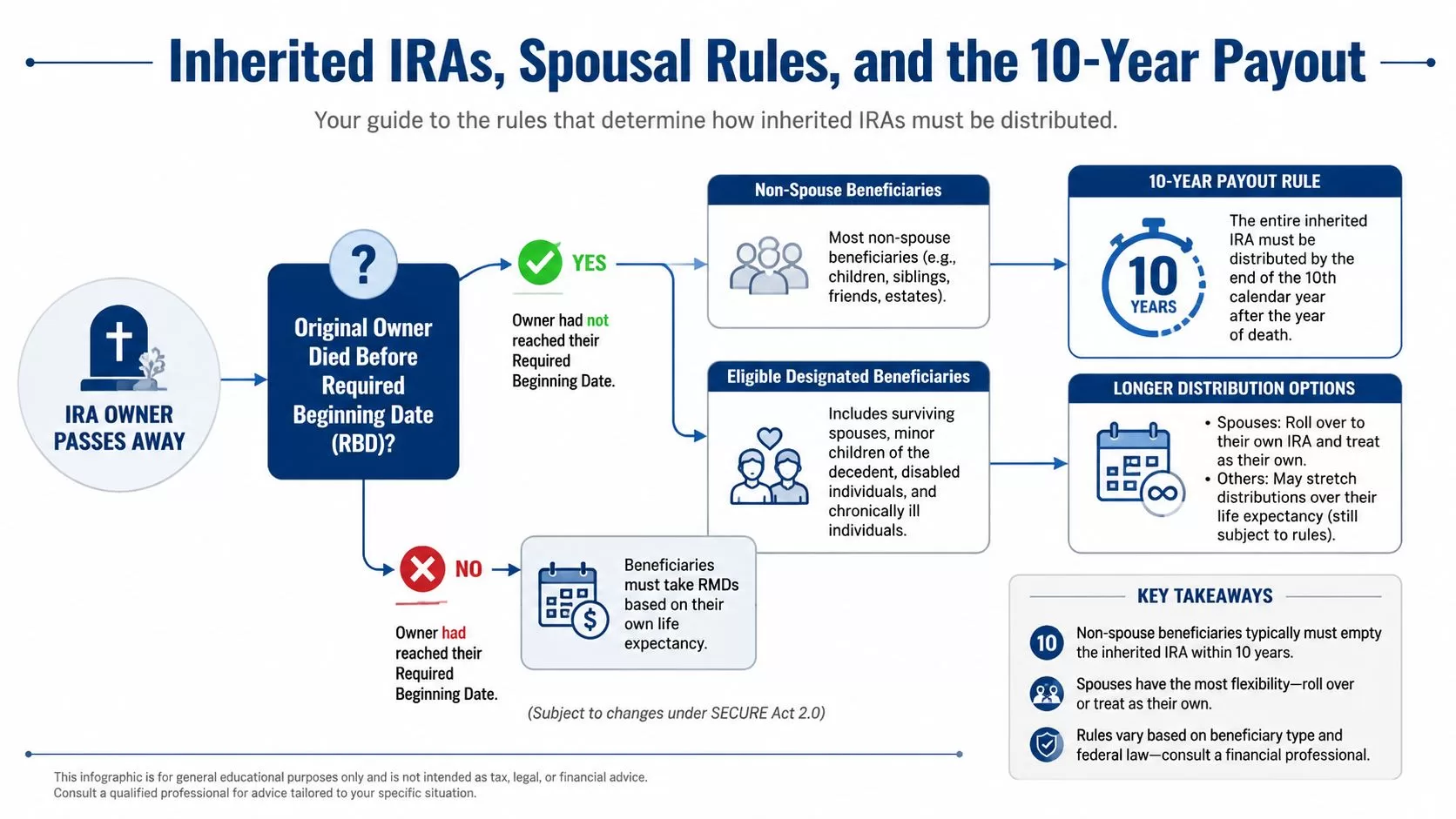
A surviving spouse may have choices unavailable to other beneficiaries. Depending on the facts, the spouse may keep the assets in an inherited IRA, roll eligible assets into the spouse's own IRA, or use another permitted treatment. Each route can change when distributions begin and which life-expectancy calculation applies. The decision should account for the spouse's age, income, and need for withdrawals.
Roth IRA beneficiaries also must follow an applicable payout period. Qualified Roth earnings may receive favorable treatment when the holding-period requirements are met, but an inherited Roth IRA is not automatically free from distribution rules. Verify the owner's age, the beneficiary relationship, and the plan documents before transferring or withdrawing funds.
The proposed RMD regulations issued for 2024 and scheduled to apply no earlier than the 2026 distribution calendar year matter most when the owner died after RMDs had begun. They may clarify annual withdrawal calculations and beneficiary elections. In practical terms, the rules can turn the ten-year window into a period requiring yearly withdrawals, creating a two-RMD-year trap when a beneficiary postpones the first distribution and must take it alongside the next year's RMD. Two taxable withdrawals in one year can push more income into a higher tax bracket, increase taxation of other income, and reduce the benefit of waiting. Treat “ten years” as a planning period, not permission to ignore annual requirements.
Worked Example of an RMD Calculation Step by Step
Suppose a traditional IRA had a value of $492,000 on December 31, 2025, and the owner reached age 75 in 2026. Using the age-75 factor of 24.6, the estimated 2026 RMD is:
$492,000 ÷ 24.6 = $20,000
This is an estimate of the required amount before considering whether an eligible QCD satisfies part of the obligation. The factor example reflects the age-75 distribution period described in RMD reference guidance.
The calculation in table form
| Step | Calculation | Result |
|---|---|---|
| 1 | Find the prior December 31 balance | $492,000 |
| 2 | Identify the applicable age-75 factor | 24.6 |
| 3 | Divide the balance by the factor | $492,000 ÷ 24.6 |
| 4 | Estimate the annual RMD | $20,000 |
The owner should then decide when to take the distribution. If this is the first RMD, April 1 of the following year may be available as the deadline. That choice can place the first RMD and the next year's RMD in the same calendar year. Later RMDs are generally due by December 31.
The calculation changes when the owner reaches a different age because the applicable factor changes. It can also change when a different IRS table applies, such as in a specialized spousal situation. The account owner's required beginning date and the exact plan structure must be checked before treating the estimate as a final instruction.
An inherited-account illustration
Now consider a $250,000 inherited traditional IRA. The beneficiary cannot just divide that balance by the original owner's age-75 factor and assume the result is correct. The beneficiary must first establish whether the owner died before or after the required beginning date and whether the beneficiary qualifies for a life-expectancy method.
If the beneficiary is subject to a ten-year payout, the account must be emptied by the applicable final deadline. If annual distributions apply during the payout period, the beneficiary needs a year-by-year calculation rather than a single end-of-period withdrawal. The example demonstrates why the account balance alone never answers an inherited-IRA question.
Common Mistakes to Avoid and Your Next Steps
Most RMD errors come from calendar management, account classification, or beneficiary assumptions. The following mistakes deserve a review before the next distribution year begins.
Seven problems that create avoidable trouble
- Missing the first-year April 1 deadline: The owner may overlook the first required withdrawal because the deadline falls in the following calendar year.
- Stacking two taxable distributions into one year: Delaying the first RMD can combine it with the next annual RMD, increasing taxable income in a single return and potentially affecting Medicare premiums or Social Security taxation.
- Aggregating the wrong accounts: Traditional IRAs may allow an owner to calculate balances together for distribution purposes, while employer plans can require separate calculations and withdrawals. A plan administrator should confirm the treatment for each account.
- Withdrawing the wrong amount: Using the current balance instead of the prior December 31 balance, or applying the wrong life-expectancy factor, can produce a shortfall.
- Forgetting beneficiary designations: An inherited IRA doesn't automatically follow the original owner's timeline. Beneficiary status and the owner's RBD status must be documented.
- Ignoring state taxes: Federal RMD treatment doesn't answer how a state taxes the distribution, particularly when the account owner has moved or receives a distribution connected to another state.
- Overlooking regulatory updates: The proposed RMD regulations and their expected no-earlier-than-2026 applicability can matter for inherited accounts and annual payout decisions.
A partial Roth conversion may reduce the balance subject to future RMDs, but it doesn't eliminate a required distribution from the traditional account for the year in which that obligation already exists. A Roth account can have different lifetime RMD treatment, yet beneficiaries still need a separate inheritance review. Readers evaluating that distinction can review the Roth Gold IRA guide for educational background on Roth structures and precious metals.
A practical review checklist
- Request year-end statements early. The prior December 31 balance is the starting point for the calculation.
- Confirm the applicable factor. Check the owner's age, marital circumstances, account type, and required beginning date.
- Ask the custodian for its calculation. Compare the custodian's figure with the account owner's records rather than accepting an unexplained number.
- Model the first-RMD year. A tax professional can compare taking the first distribution during the initial year with delaying it until April 1.
- Evaluate a QCD if charitable giving is part of the plan. The transfer must meet the applicable eligibility and timing requirements.
- Review beneficiary paperwork. Confirm that designations are current and that inherited-account deadlines are written on a calendar.
- Consider diversification only after satisfying the RMD. Qualified funds may be eligible for a partial rollover into a self-directed precious metals account, but the RMD itself generally must be distributed rather than rolled over.
Inherited retirement funds may also interact with trusts and estate administration. For readers handling trust-owned or trust-distributed assets, a plain-language review of how trust distributions are taxed can provide useful background, although an individual tax professional must apply the rules to the specific trust.
Calendar habit: Keep the RMD deadline, tax-return preparation date, beneficiary review, and year-end account statement in the same planning file.
The safest approach is to verify the threshold, deadline, factor, account aggregation rule, and beneficiary status before year-end. IRS guidance continues to evolve as SECURE 2.0 implementation develops, and a custodian's generic estimate may not capture every exception. This is not financial advice. Consult a licensed financial advisor, CPA, or tax professional before making investment decisions.
Gold IRA Association provides educational resources on RMD planning, retirement accounts, precious metals IRAs, and rollover considerations. Readers can review the independent guides and account-planning material at Gold IRA Association before speaking with a qualified financial or tax professional about their next step.


