




A federal employee nearing retirement may be asking whether moving part of a TSP balance into physical gold or silver could add diversification. The difficult part isn't choosing a metal. It's moving retirement funds, buying an eligible asset, and placing that asset into qualified custody without creating an unintended taxable distribution. This guide explains how to control each handoff in a precious metals IRA rollover, from the employer plan to the depository.
Why the Rollover Method Comes First
A federal employee nearing retirement faces a harder question than which metal to buy. The first decision is how retirement funds will move without creating an unintended taxable distribution. In a precious metals IRA rollover, the sequence matters: employer-plan distribution, receiving IRA setup, metal purchase, and qualified storage must connect correctly.
The legal framework separates two issues that are often confused. The 1997 Taxpayer Relief Act expanded IRA eligibility to certain U.S.-minted gold and silver coins. Later rules under Internal Revenue Code Section 408(m) established fineness standards for eligible bullion. Those provisions address the asset itself. Rollover rules under Section 402(c) address whether retirement funds can move into another eligible account without becoming a distribution.
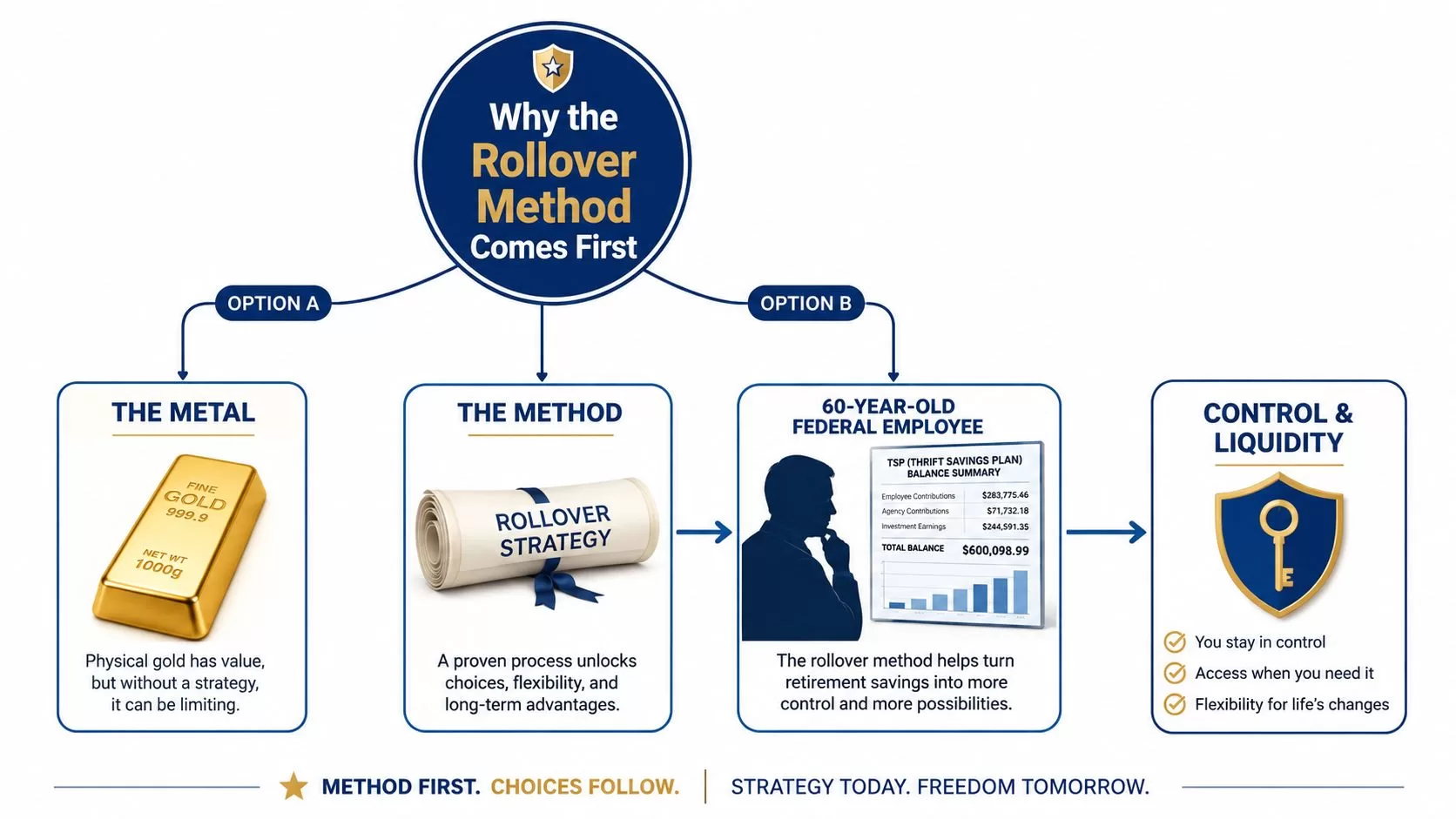

Four handoffs can determine the result
A rollover usually passes through four operational points:
- Employer-plan distribution: The current plan must release eligible funds using the correct paperwork and destination instructions.
- Receiving custodian: The self-directed IRA must be able to accept and administer precious metals assets.
- Dealer purchase: The custodian needs a valid instruction to purchase metals that meet applicable eligibility rules.
- Depository storage: The metals must reach an IRS-approved depository and remain under qualified custody.
Each handoff has a different failure point. Incorrect distribution instructions can delay or misdirect the funds. A receiving custodian that cannot administer physical metals cannot complete the intended structure. A purchase order does not correct an ineligible product, and personal possession of IRA-owned metals can be treated as a distribution.
Cash handling creates another gap. Taking possession of the funds can start a 60-day redeposit requirement. Missing that deadline may make the distribution taxable. A person under age 59½ may also face an additional 10% tax.
Practical rule: Choose the rollover method before choosing the metal. The method controls how funds leave the employer plan and enter the IRA. The custodian then verifies whether the proposed asset can be purchased and held within that account.
A direct trustee-to-trustee structure generally keeps the account owner out of the cash-transfer chain. The institutions send the funds between accounts, reducing the timing risk associated with an indirect rollover. Process control comes first. Product selection follows only after the receiving account, purchase instructions, and storage arrangement are ready.
Choosing a Direct or Indirect Rollover
The terms sound similar, but the custody chain makes the difference. A trustee-to-trustee transfer sends funds directly from one IRA custodian to another. A direct rollover sends eligible employer-plan funds to the receiving retirement account. An indirect rollover sends the distribution to the account holder first, who must then complete the redeposit.
The IRS rollover guidance explains the central timing and tax issues. An indirect rollover must generally be redeposited within 60 calendar days. An eligible employer-plan distribution paid to the participant can also involve 20% federal withholding, meaning the participant may need outside funds to redeposit the full eligible amount. If the deadline is missed, the distribution can become taxable, and an investor under age 59½ may also face an additional 10% tax.
| Method | Custody Chain | Withholding | Deadline | Tax Risk |
|---|---|---|---|---|
| Trustee-to-trustee transfer | IRA custodian to IRA custodian | None in the usual direct structure | No participant-held 60-day clock | Lowest, provided both accounts and instructions are eligible |
| Direct rollover | Employer plan to receiving IRA custodian | No withholding when sent directly to the receiving account | The institutions coordinate receipt | Low, but paperwork and receiving-custodian details must be correct |
| Indirect rollover | Employer plan or IRA to participant, then participant to IRA | Employer-plan distributions can carry 20% withholding | Funds must be redeposited within 60 calendar days | Highest, because the participant controls timing and must replace withheld funds when required |
What makes indirect rollovers fragile
An indirect rollover creates several points where ordinary cash-flow problems become tax problems. The participant might deposit only the check received, overlook the withheld amount, send funds to the wrong account, or wait until the deadline is close before asking the receiving custodian to process the deposit. The withheld amount may be recoverable through tax filing, but that doesn't remove the need to complete the rollover correctly.
IRA-to-IRA indirect rollovers also face the one-rollover-per-12-months rule, regardless of how many IRAs an individual owns. That limitation applies to rollovers passing through the account holder. Direct custodian-to-custodian transfers aren't counted in the same way, as described in this guide to precious metals in an IRA.
The practical decision rule is simple: default to a trustee-to-trustee transfer unless the plan's rules prevent it. If a direct rollover is available, the account owner should provide exact receiving-custodian instructions and confirm acceptance before the current plan releases funds. Readers comparing the mechanics with an employer plan can review this 401(k) to Gold IRA rollover guide.
Completing the Precious Metals IRA Rollover
A clean rollover is easier to manage when each handoff has a record. The account owner should treat the process as a sequence of checkpoints, not as a single request submitted to a metals provider.
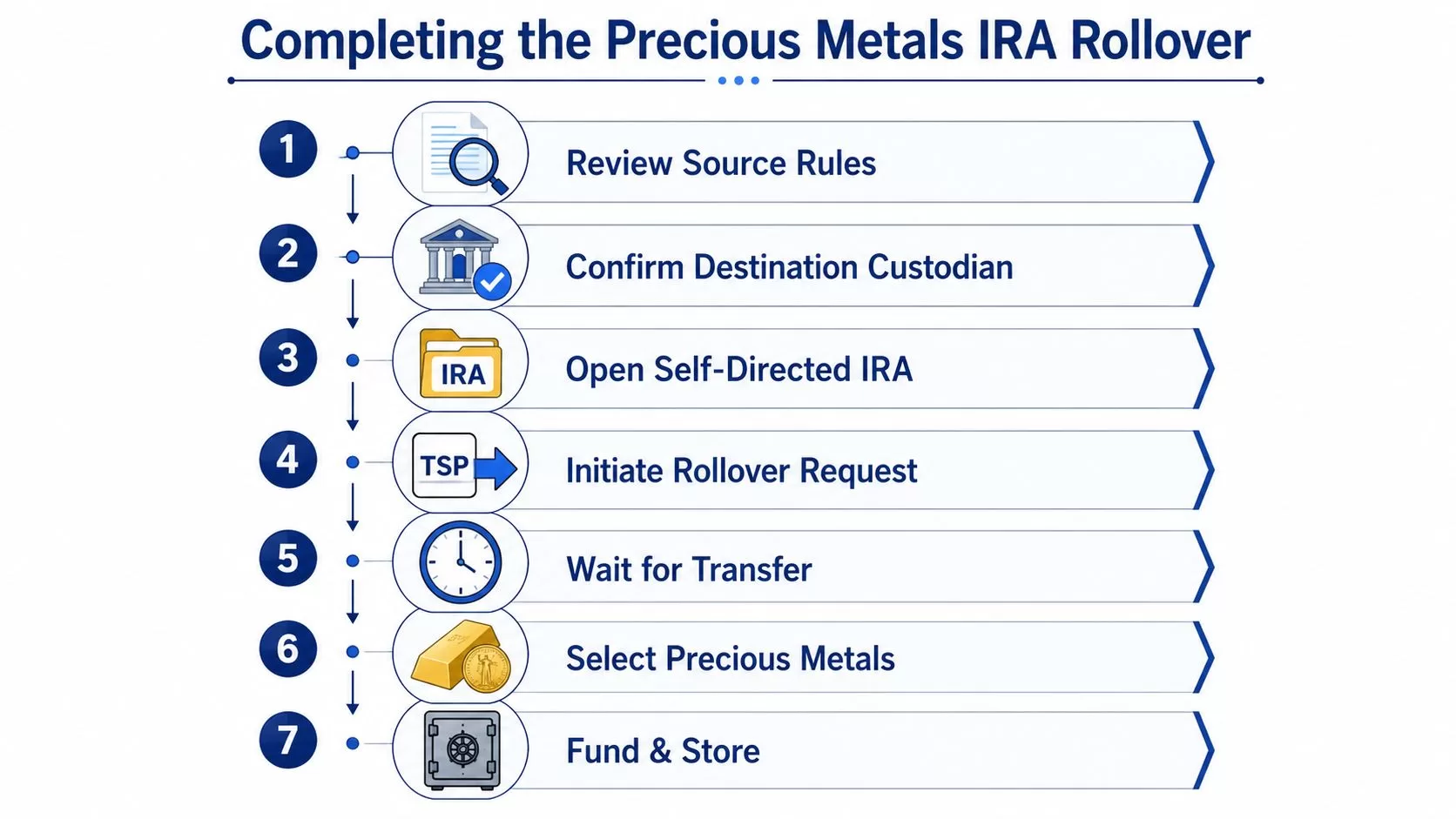
Seven checkpoints for a controlled transfer
Review the source plan. Ask the current plan administrator whether the account permits a rollover, whether an in-service distribution is available, and which forms apply. A former-employer plan and an active workplace plan may follow different procedures.
Confirm the destination custodian. The receiving account should be a self-directed IRA administered by a qualified custodian that accepts IRS-eligible precious metals. A generic brokerage IRA may not support physical bullion.
Open the account correctly. The application should identify the self-directed IRA structure and include accurate owner and beneficiary information. A missing beneficiary designation can create an administrative problem later.
Initiate the transfer. Trustee-to-trustee movement is generally the cleaner route. The transfer authorization should use the receiving custodian's exact legal name, mailing details, account title, and account number.
Wait for funding confirmation. Don't send metal purchase instructions merely because the plan administrator says a check has been issued. Obtain confirmation that the receiving custodian has received and credited the funds.
Authorize the purchase through the custodian. The dealer may provide product and pricing information, but the custodian should execute the IRA transaction after receiving the account owner's investment direction and confirming available funds.
Verify depository receipt. Request evidence that the metals left the dealer's control and were allocated to the approved storage facility under the IRA's custody arrangement.
The file may include a recent account statement, plan distribution form, custodian application, transfer authorization letter, purchase order, invoice, and depository receipt. The exact requirements vary, so the account owner should ask each institution for its current forms before submitting anything.
Timing should be treated as a range
Plan distributions often take 7 to 21 days, custodian onboarding can take 5 to 10 business days, metal purchase and assay confirmation may require 5 to 15 days, and depository allocation may take 3 to 7 days, according to this precious metals IRA rollover process reference. These periods can overlap or extend when paperwork needs correction.
Typical gaps include stale distribution forms, mismatched account titles, dealer instructions sent before funding clears, and metals remaining with the dealer instead of reaching the depository. Readers researching how precious metals fit alongside other nontraditional assets may also find that Senki reviews alternative asset options useful for broader context.

A completed rollover isn't confirmed by a verbal assurance. It's confirmed when the receiving custodian shows the funds, the purchase record matches the instruction, and the depository confirms receipt.
Selecting Custodians, Dealers, and Storage
A precious metals IRA depends on three separate provider roles. The custodian administers the IRA and holds legal custody of the account assets. The dealer sources the metals and quotes the purchase price. The depository stores the IRA-owned bullion under an approved custody arrangement. Keeping these roles distinct helps the account owner identify who is responsible for each handoff.
A custodian deserves scrutiny beyond its marketing language. The account owner should review whether the fee schedule is clear, how wire and storage charges are billed, how quickly transfer paperwork is handled, and whether the institution has experience administering metals covered by Section 408(m). A dealer should explain pricing, the bid-ask spread, buyback procedures, shipping insurance, and when a price becomes binding. A depository should provide information about its location, insurance, audit practices, and whether storage is segregated or commingled.
| Provider | Primary Role | Key Evaluation Criteria | Red Flags |
|---|---|---|---|
| Self-directed IRA custodian | Opens and administers the account, processes transactions, and maintains records | Transparent fees, responsive paperwork handling, metals experience, clear reporting | Vague charges, unclear responsibility for purchase approval, pressure to rush |
| Precious-metals dealer | Sources eligible bullion and provides pricing | Written quote, product details, buyback terms, shipping insurance, clear premium disclosure | Verbal-only pricing, unclear product identity, refusal to coordinate with the custodian |
| Approved depository | Stores IRA-owned metals | Storage terms, insurance information, allocation records, segregation options | Home-storage suggestions, unclear receipt records, no documented chain of custody |
Alignment matters more than branding
No single provider is automatically appropriate for every retirement saver. A custodian may have strong administration but limited product support. A dealer may offer a broad inventory but provide incomplete documentation. A depository may offer storage choices that affect recordkeeping and fees.
The account owner should compare the full chain, including who sends instructions, who confirms funding, who receives the shipment, and who reports the transaction. The precious metals storage guide provides additional context for evaluating depository arrangements.
Personal possession is not a workaround. IRS rules require IRA-held metals to remain in the physical possession of a qualified trustee or custodian, or in an IRS-approved depository. Home storage or constructive receipt can be treated as a distribution and create tax consequences, as explained in this overview of self-directed IRA metals rules.
Verifying Eligible Metals and Purity
A rollover can clear the account-transfer stage and still fail at the purchase stage if the selected metal does not meet IRA requirements. Verify the product before placing the order, while the custodian can still stop an incorrect transaction. Eligibility depends on the metal, its fineness, its form, and the applicable approval rules. Written confirmation from the custodian should precede any purchase authorization.
The core fineness standards are 99.5% for gold, 99.9% for silver, and 99.95% for platinum and palladium, as summarized in the rules for precious metals IRA rollovers. The proposed item should also come from an approved manufacturer or refiner and appear on the custodian's approved-product list.
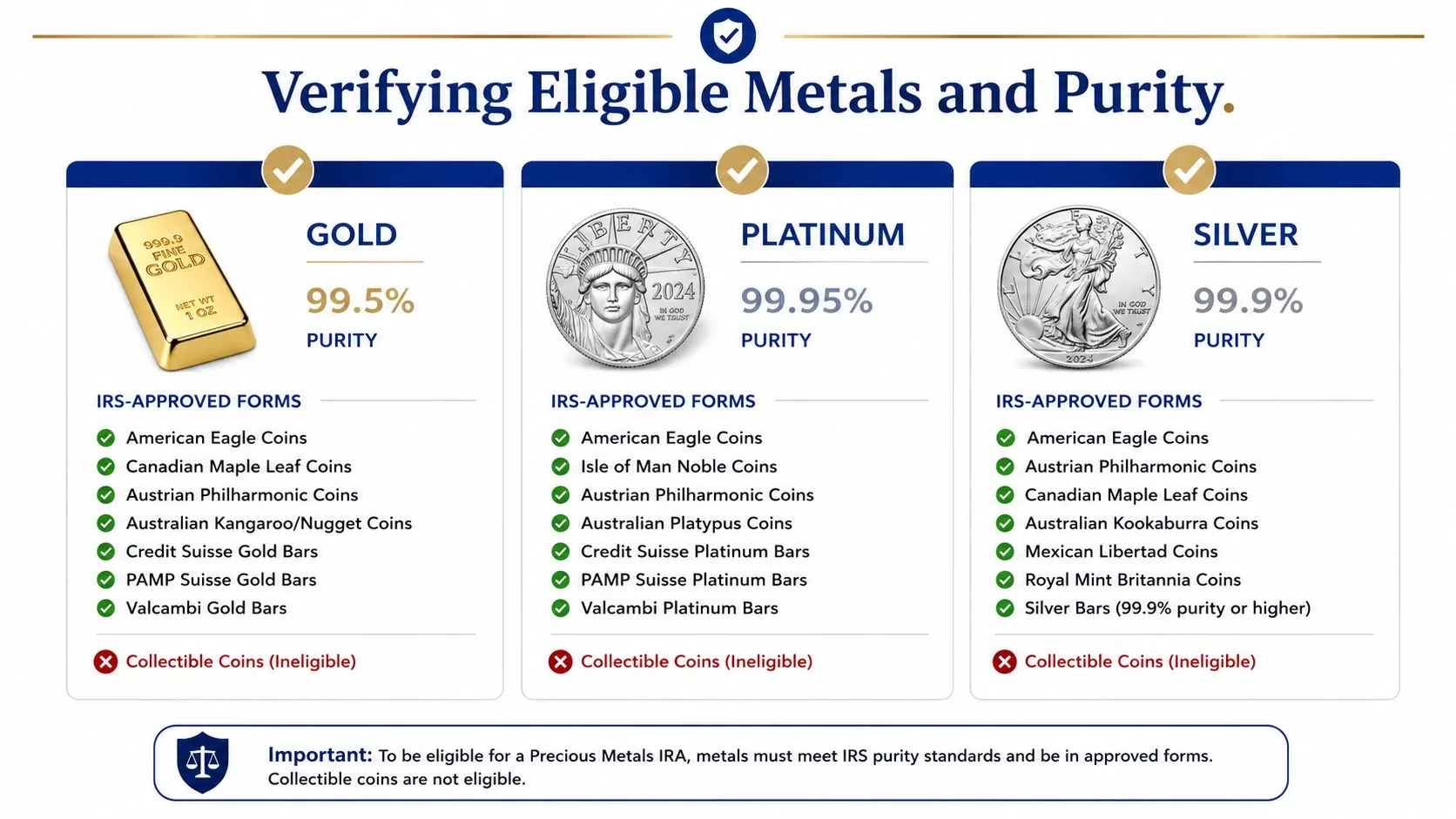
Match the exact product to the records
Treat product verification like checking a shipment against its receiving documents. Every record should identify the same item:
- Product identity: Confirm the exact SKU, coin or bar name, weight, and manufacturer.
- Fineness: Match the stated purity with the applicable IRS threshold.
- Assay documentation: Request a written assay certificate or equivalent product record.
- Coin treatment: Some legal-tender coins can qualify under specific rules even when their nominal purity differs from the bullion threshold.
- Storage destination: Confirm that the metals will be delivered directly to a qualifying depository.
American Eagles, Austrian Philharmonics, and Canadian Maple Leafs are examples of legal-tender coin types discussed in eligibility guidance. The account owner should still verify the exact product with the custodian before approving the purchase. A collectible or decorative coin requires separate scrutiny, even when it contains precious metal.
Before funding a purchase, the custodian should confirm the exact product, not merely the general category of gold or silver.
Keep the purchase order, invoice, assay documentation, custodian statement, and storage confirmation together. This file connects each handoff and helps the account owner identify a disallowed purchase before it becomes embedded in the IRA.
Managing Fees, Mistakes, and Tax Risks
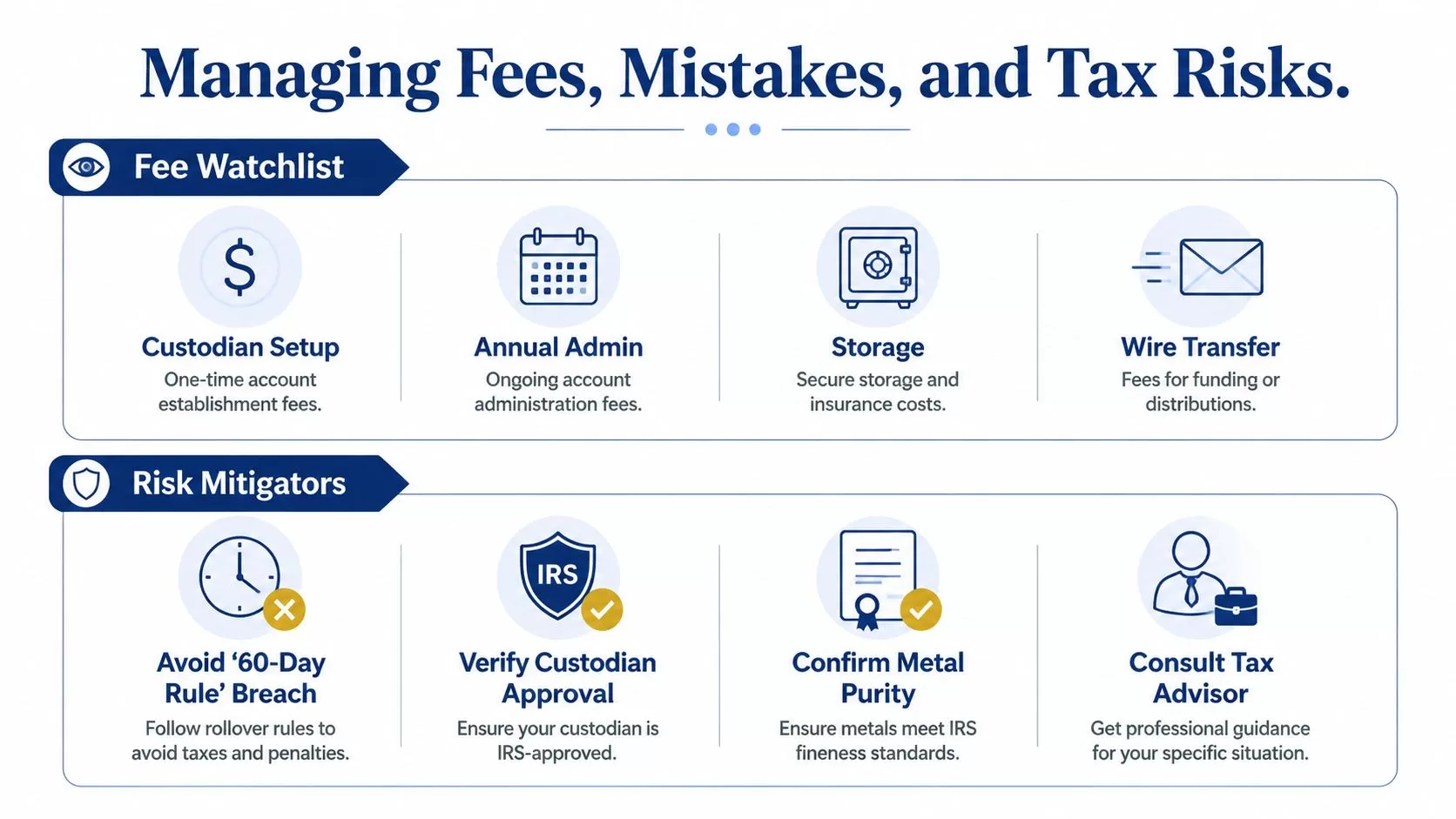
Physical metals introduce costs that a conventional securities account may not show in the same way. A rollover can involve a custodian setup charge, annual administration fees, storage charges, wire fees, transaction commissions, and dealer markups. The quoted premium may not represent the entire cost of acquisition, so the account owner should request a written, itemized schedule.
Separate expected charges from preventable costs
The goal isn't to eliminate every fee. Custody, administration, storage, and transaction processing support the account structure. The goal is to understand who charges what, when the charge occurs, and whether the amount changes with account value or transaction activity.
The review should cover:
- Custodian setup: Identify one-time account-opening charges and any document-processing fees.
- Annual administration: Confirm charges for recordkeeping, statements, and tax reporting.
- Storage: Ask whether the depository bills separately and whether storage is segregated or commingled.
- Transactions: Review purchase, sale, wire, and distribution charges.
- Dealer pricing: Compare the quoted metal price with the underlying market reference and stated premium.
- Exit costs: Ask how a future sale or in-kind distribution is processed and priced.
A useful fee file contains the signed schedule, written quote, invoice, wire confirmation, and account statement. Readers examining the tax side of retirement-account movements can also consult the IRA rollover taxes guide.
Mistakes that can turn paperwork into a tax event
The most serious errors usually involve control of funds or assets:
- 60-day failure: An indirect distribution isn't redeposited within the required period.
- Withholding shortfall: The participant redeposits only the amount received and doesn't replace employer-plan withholding when required.
- Rollover frequency breach: An indirect IRA-to-IRA rollover is attempted more than once within the applicable 12-month period.
- Product failure: Non-approved metals enter the account.
- Storage failure: IRA-owned metals are kept at home or outside an approved facility.
- Distribution confusion: An account owner treats required minimum distributions as eligible rollover funds. RMDs aren't eligible for rollover, according to recent retirement-rule coverage.
A precious metals IRA is not a separate IRS account class. It's a self-directed IRA subject to ordinary IRA rules, with additional requirements for eligible metals and custody. A documentation file should include transfer confirmations, custodian statements, purchase invoices, assay certificates, depository records, and any tax forms received. This is not financial advice. Consult a licensed financial advisor, CPA, or tax professional before making investment decisions.
Following the Rollover Checklist and Timeline
A successful precious metals IRA rollover depends on each handoff: funds must reach the correct account, metals must satisfy applicable rules, and the depository must receive them under qualified custody. Precious metals can be one portfolio choice, but they do not guarantee protection from inflation, market volatility, or retirement-income needs.
A practical four-week sequence
- Week one: Review the current 401(k) or IRA terms, confirm whether a direct transfer is available, and shortlist two qualified self-directed IRA custodians.
- Week two: Open the self-directed IRA, request source-plan paperwork, and identify a dealer and approved depository.
- Week three: Verify fineness, manufacturer approval, exact product details, and storage assignment before authorizing the purchase or wiring funds.
- Week four: Reconcile custodian statements, retain IRS Form 5498 or Form 1099-R, and document the complete chain of custody.
Institutions process paperwork differently, so the timeline can change. A missing signature, incorrect account title, or premature purchase instruction may delay the transfer or create tax risk. Confirm the mechanics with the current plan administrator before selecting a precious-metals provider.
Gold IRA Association offers educational guides, rollover checklists, tax-rule explanations, and company comparisons covering custody, metal eligibility, storage, and fees. Review the resources at Gold IRA Association before speaking with a provider or authorizing a transfer.


