




A Gold IRA is a good investment strictly as a 5% to 10% diversification tool for long-term capital preservation, not as the core of a retirement portfolio. It becomes a poor choice when high custodial fees or short-term liquidity needs erode the returns.
The popular advice says gold belongs in every retirement account because inflation, market volatility, or currency weakness could damage traditional assets. That argument is incomplete. Gold can diversify a portfolio, but a physical Gold IRA also adds custody costs, storage requirements, dealer markups, tax complexity, and distribution friction. The right question isn't whether gold sounds reassuring. It's whether the account's diversification benefit justifies its all-in cost for a particular retiree.
The Reality of Gold IRAs as a Retirement Asset
Gold is a store of value and a portfolio diversifier, not a high-growth engine. It doesn't produce earnings, dividends, or interest, so its investment result depends on the metal's price appreciation and the discipline used to buy, hold, and eventually sell it.
A Gold IRA is a type of self-directed Individual Retirement Account that permits qualifying physical precious metals instead of limiting the account to conventional marketable securities. The account can retain the tax structure of an IRA, but the investor needs a specialized custodian to administer the account and an approved depository to hold the metal.
That structure creates an important distinction:
- A standard IRA generally provides access to familiar financial assets through a brokerage or retirement provider.
- A Gold IRA adds physical metal, but the investor doesn't store the coins or bars at home.
- The custodian handles account administration, reporting, and transactions.
- The depository holds and secures the IRA-owned metals under the applicable rules.
Practical rule: A Gold IRA should solve a diversification problem, not satisfy a fear-driven urge to move an entire retirement account into metal.
Gold's role is closer to a reserve asset than a replacement for productive businesses and income-producing securities. A retiree who puts too much capital into a non-yielding asset may sacrifice the growth and cash-flow potential needed to fund a long retirement. A retiree who has no exposure to assets that behave differently from stocks and bonds, however, may decide that a modest allocation has a place.
The answer to “is Gold IRA a good investment” is therefore conditional but clear. It can be suitable for a long-term investor who already has a broad retirement portfolio, understands the costs, and wants physical metal as a satellite holding. It is usually unsuitable for someone seeking regular income, rapid access to cash, or a simple low-cost retirement account.
How Physical Gold Protects a Retirement Portfolio
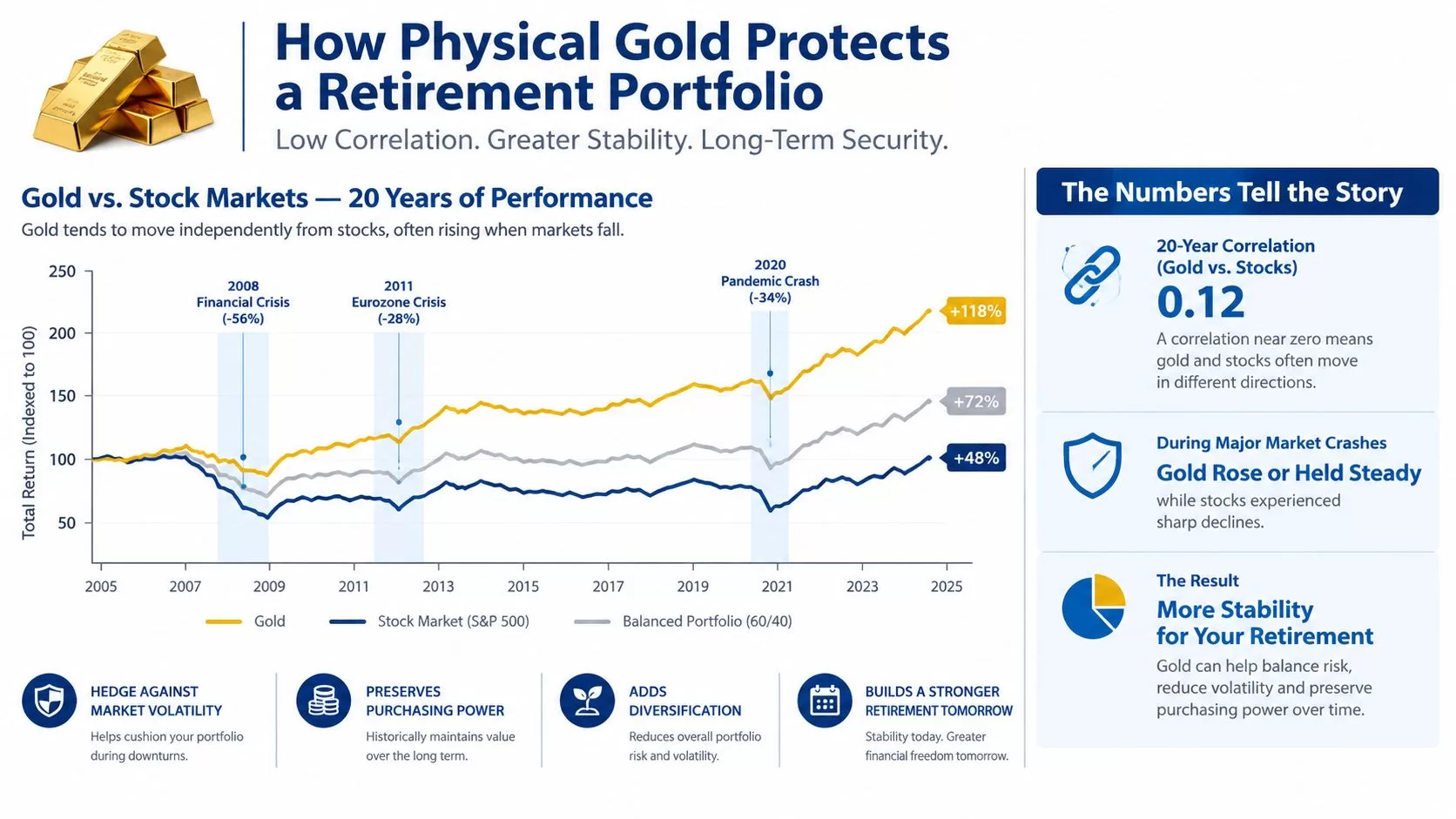
The strongest argument for gold isn't that it will outperform stocks. It's that gold may behave differently when stocks and bonds are under pressure. Portfolio theory calls this low covariance, meaning the asset's returns don't move in close lockstep with the rest of the portfolio.
That difference matters during a drawdown. If equities fall while gold holds its value or rises, the combined portfolio may experience less severe volatility than an equity-heavy portfolio. Gold doesn't need to produce the highest standalone return to improve the overall result for a risk-conscious investor. It needs to contribute a return pattern that differs from the assets already owned.

Long-term returns are meaningful, not guaranteed
Historical performance also argues against describing gold as merely a panic trade. Since the U.S. gold standard ended in 1971, gold delivered roughly 8% to 9% annualized U.S.-dollar returns over more than half a century, with separate World Gold Council analyses estimating 9% annualized and 8% annualized returns over that post-1971 period. Other long-run analyses from the same organization report average annual returns of 10.4% since 1971 in one study and a compound annual return of 7.6% in another, placing gold in the same broad long-term return discussion as equities and above bonds in those datasets, as detailed in the World Gold Council analysis of gold's long-term returns.
Those figures don't make gold a guaranteed high-growth investment. Returns vary by market regime, and gold can lag cash or bonds when real interest rates are high. The data supports a more measured conclusion. Gold has historically compounded across different market environments, but its most defensible retirement role is diversification and capital preservation, not portfolio domination.
Inflation protection depends on the holding period
Gold's inflation-hedging record is also more nuanced than many sales pitches suggest. Long-run studies find that gold can hedge headline, expected, and core U.S. consumer inflation, while short-run results can be unstable and country-specific. Gold prices also respond to real interest rates, dollar strength, inflation expectations, and the costs of holding the asset.
A time-varying analysis found that gold's relationship with U.S. inflation was positive over very long horizons above 128 months, but volatile over 32 to 128 months, according to the research on gold and inflation over changing time horizons. That finding matters to near-retirees. Gold may help preserve purchasing power over long cycles, but it isn't a dependable month-to-month inflation trading instrument.
A separate portfolio study found that adding gold to an international diversification mix produced favorable downside characteristics during and after a crisis period for investors focused on capital preservation, as reported in the study of gold's portfolio diversification benefits. The practical conclusion is straightforward. Gold can act as a shock absorber, but it works best as one component of a portfolio rather than as the portfolio itself.
The Hidden Fee Drag That Erodes Long-Term Returns
The fee question deserves more attention than it receives. A physical Gold IRA may carry setup fees, annual custodian charges, storage costs, insurance costs, dealer markups, transaction charges, and liquidation fees. Each individual charge may look manageable, but the combined cost reduces the return the metal must earn before the investor reaches break-even.
A recent analysis estimated that recurring charges can amount to roughly 0.4% to 1.2% of a $50,000 balance per year, before dealer markups and transaction costs. Standard bullion premiums may also run about 2% to 5% above the spot price, according to the analysis of Gold IRA fees and costs.
Typical Gold IRA Fee Structure
| Fee Type | Typical Cost Range | Frequency |
|---|---|---|
| Account setup | Varies by provider and custodian | Usually one time |
| Custodial administration | Part of recurring account charges | Annual |
| Storage | Varies by storage arrangement | Annual |
| Insurance | May be bundled with storage | Annual |
| Dealer markup | Standard bullion premiums may be about 2% to 5% above spot | At purchase |
| Transaction or liquidation fee | Varies by provider and transaction | When incurred |
The table shows why a “fee-free” sales message requires scrutiny. A provider may waive one visible charge while earning revenue through the metal's spread, product pricing, or another account expense. A buyer should request the complete fee schedule in writing, including the cost to sell, transfer, or close the account.
The break-even calculation matters
Suppose gold rises, but the account pays recurring expenses and begins with a dealer premium. The investor doesn't receive the full market increase. The metal must first overcome the purchase spread, then cover ongoing custody and storage charges, and finally absorb any selling costs.
That doesn't make the account automatically uneconomic. Diversification has value even when it doesn't maximize return. It does mean the investor shouldn't compare gold's published spot-price performance with the Gold IRA's net result. The relevant comparison is after-fee performance against a lower-cost alternative serving the same portfolio purpose.
The Gold IRA fee guide can help readers organize that review. Before transferring funds, a near-retiree should ask for the total annual cost at the expected account balance, the purchase premium for each proposed product, and the exact process and charges for liquidation.
Navigating IRS Rules and Eligible Precious Metals
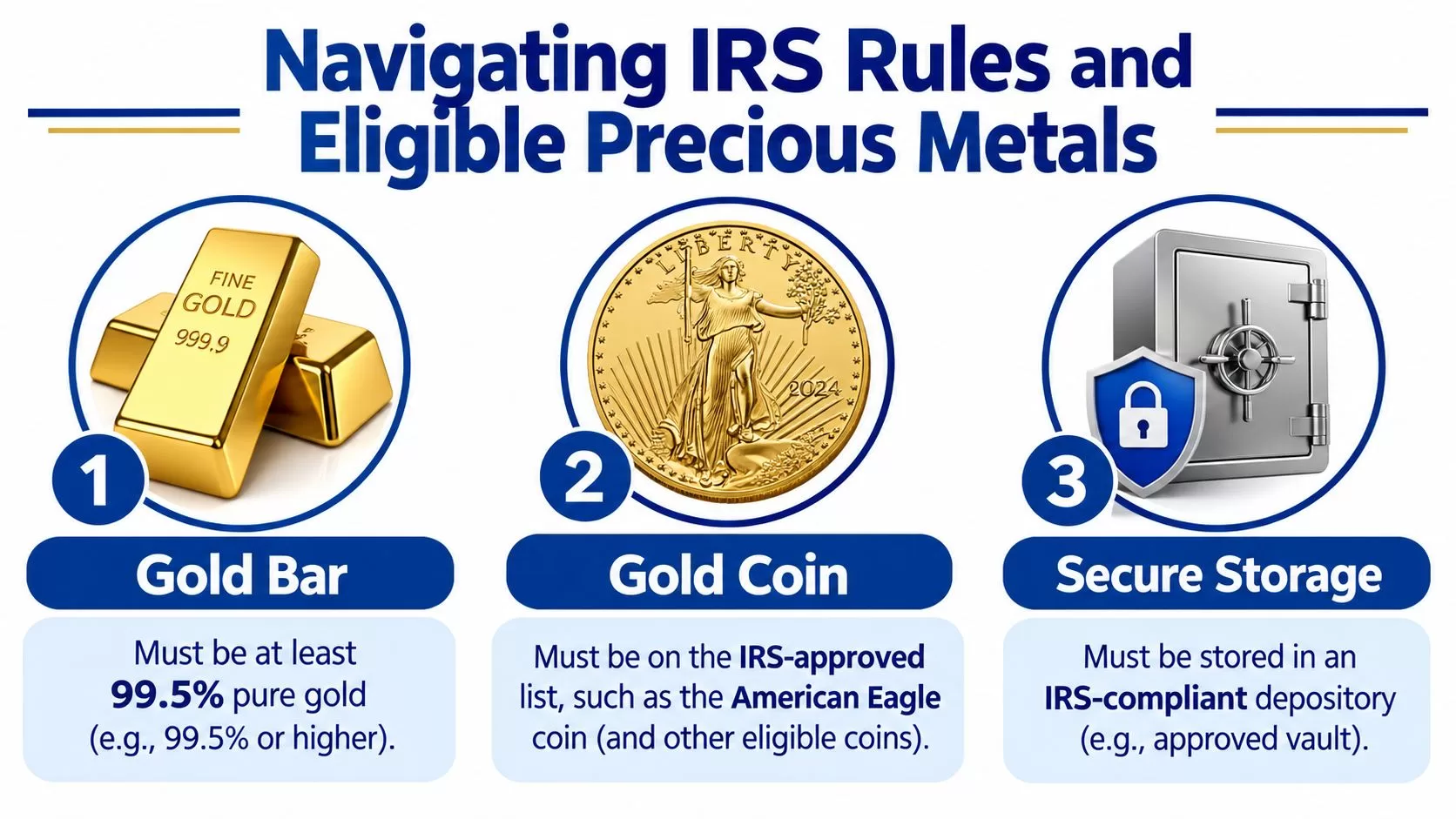
A Gold IRA does not permit any coin or bar that looks valuable. The metal must meet federal eligibility standards, and the account must follow custody rules that prevent personal possession.
The principal fineness standards are:
- Gold: At least 99.5% pure.
- Silver: At least 99.9% pure.
- Platinum: At least 99.95% pure.
- Palladium: At least 99.95% pure.
The American Gold Eagle is a statutory exception. It can qualify despite its 22-karat composition because approved coins may qualify under law rather than the general 99.5% gold purity standard. Investors should still verify the exact product with the custodian before ordering. A guide to IRA-eligible precious metals and the Gold IRA rules guide provide product and account checklists, but the custodian remains responsible for confirming eligibility.
Custody is required
IRA-owned gold generally must remain with a qualified trustee or custodian in an approved depository. Personal storage can be treated as a taxable distribution, as described in this coverage of IRS storage rules for Gold IRAs.
The practical tradeoff is direct. Investors who want coins at home should choose a different ownership structure. A Gold IRA provides retirement-account treatment, while custody rules limit personal control and add administrative dependence.
Rollovers require procedural care
A rollover from an eligible employer plan can fund a self-directed IRA. IRS materials identify 401(k), profit-sharing, money purchase, and defined benefit plans as qualified plans that may participate in rollover transactions, according to the IRS rollover chart.
The one-rollover rule also matters. Generally, an individual cannot make more than one rollover from the same IRA within a 12-month period, regardless of how many IRAs they own. Direct transfers and many employer-plan rollovers are treated differently, according to IRS rollover guidance.
A direct trustee-to-trustee transfer is usually the cleaner administrative route. Confirm the transaction with the current plan administrator, receiving custodian, and tax professional before moving funds. That check can prevent an avoidable taxable distribution, which matters more than a smooth sales pitch when retirement savings are involved.
Tax Traps and Liquidity Challenges During Distribution
Accumulation is the easy part of the Gold IRA story. Distribution is where many retirees discover that a non-yielding physical asset doesn't fit neatly into a monthly spending plan.
Gold produces no dividends or interest. A retiree who needs cash must sell metal or take a distribution of the asset, depending on the account arrangement and applicable rules. Selling can involve dealer coordination, shipping or verification procedures, pricing spreads, and settlement time. That may be manageable for an occasional withdrawal, but it creates more friction than selling a liquid market security to fund a regular expense.
Tax treatment can complicate the exit
Physical gold may be taxed at the collectible rate on gains, which can be as high as 28%, and IRA withdrawals generally follow ordinary IRA tax rules. A withdrawal before age 59½ may also trigger a 10% early withdrawal penalty, subject to applicable exceptions, as explained in the overview of Gold IRA taxation and withdrawals.
The tax result depends on the account type, the character of the transaction, the investor's circumstances, and whether the metal is held inside or outside a retirement account. The point isn't that every Gold IRA withdrawal receives the collectible rate. The point is that retirees shouldn't assume physical gold receives the same tax treatment as every other retirement asset.
Liquidity is a planning issue, not a scare tactic
A retiree should map expected spending before allocating to physical metal. Essential expenses may require dependable cash, while gold's value is determined by the market at the time of sale. If the investor sells during a weak price period, the account may provide less cash than expected. If the investor delays a required transaction because the sale process feels cumbersome, the account may complicate tax and distribution planning.
Gold may diversify a retirement portfolio, but it doesn't create a paycheck.
A sound withdrawal plan can keep a cash reserve and income-producing assets available for near-term needs, leaving gold to serve its longer-term reserve function. Investors should also clarify how the custodian handles in-kind distributions, sales, valuation, and required withdrawals before opening the account.
Deciding If a Gold IRA Fits Your Retirement Profile
A Gold IRA fits some retirement profiles and fails others. The decision should begin with the investor's portfolio structure, time horizon, liquidity needs, and fee tolerance, not with a prediction about the next gold-price move.

A suitable profile
A Gold IRA may deserve consideration when the investor:
- Already owns diversified assets: Gold works better as a satellite allocation than as the only retirement holding.
- Has a long horizon: The account makes more sense when the investor can tolerate periods of weak performance and doesn't need immediate access to the capital.
- Values physical ownership: Some investors specifically want exposure to tangible metal rather than an instrument tied to a financial intermediary.
- Accepts recurring costs: The investor has compared all-in fees with lower-cost ways to obtain similar diversification.
- Can follow custody rules: The account owner understands that the metal stays with an approved custodian and depository.
This profile describes a cautious diversifier, not a speculator. The investor doesn't need to believe that financial markets will collapse. Gold can have a place because retirement portfolios benefit from exposure to assets with different drivers.
The following video offers another educational perspective on evaluating Gold IRA suitability:

A poor profile
A physical Gold IRA is usually a weak fit when:
- Liquidity is a priority: Someone funding near-term living expenses may need simpler access to cash.
- The account is small: Fixed or recurring charges can take a larger share of a smaller balance.
- Income is required: Gold doesn't pay interest or dividends.
- The investor is fee-sensitive: A paper alternative may provide gold exposure with less administrative friction.
- The investor wants personal possession: IRA-owned metals generally can't be stored personally without risking noncompliance.
The decision matrix is simple. If gold's purpose is diversification and the investor can hold through multiple market conditions, a modest allocation may be rational. If the purpose is income, instant liquidity, or a guaranteed inflation response, the structure doesn't match the goal.
Gold IRA Association publishes educational guides, rollover explanations, fee information, and provider comparisons for readers evaluating those questions. This is not financial advice. A licensed financial advisor, CPA, or tax professional should review the decision before any transfer or purchase.
Comparing Physical IRAs to Paper Gold Alternatives
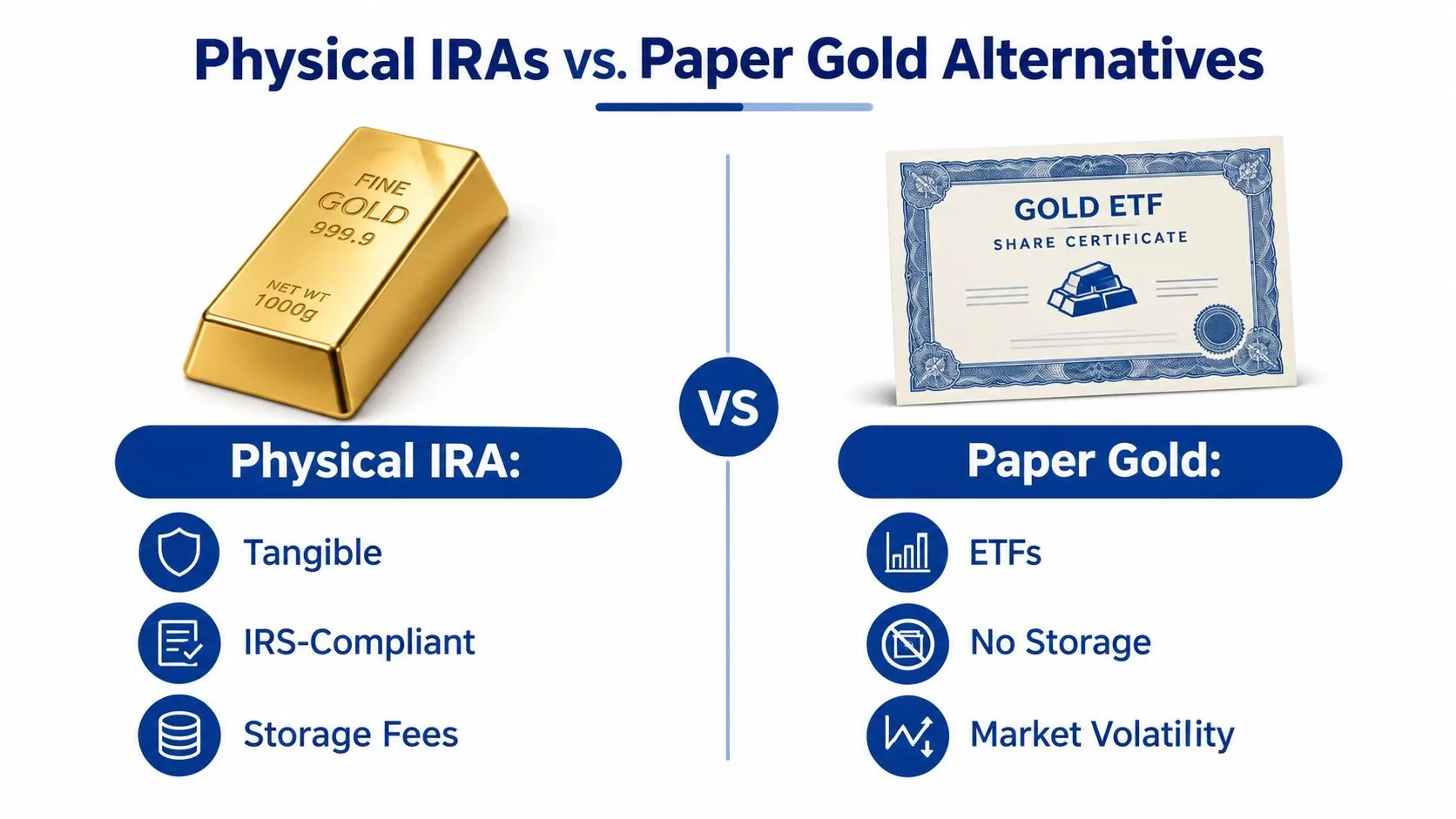
Physical metal is only one way to obtain gold exposure. A gold-backed exchange-traded fund, a mutual fund with precious-metals exposure, or a mining-stock fund may offer easier trading and lower administrative complexity. Mining companies can also provide gold-related exposure, but their results depend on business costs, management decisions, financing, labor, geology, and broader equity-market conditions.
The trade-off is direct:
| Physical Gold IRA | Paper gold alternatives |
|---|---|
| Holds qualifying physical metal through an approved custodian and depository | Holds a financial instrument or shares connected to gold prices or gold-related businesses |
| Adds storage, insurance, custody, and potential dealer costs | Usually avoids personal-metal storage logistics |
| May appeal to investors concerned about direct ownership and systemic risk | Generally offers simpler trading and easier portfolio rebalancing |
| Does not produce dividends or interest | Some funds or companies may distribute income, though this isn't guaranteed |
| Distributions can require selling or transferring physical metal | Market transactions are typically more straightforward |
Choose the vehicle that matches the objective
An investor seeking low-cost tactical exposure may prefer a paper instrument because it can be bought or sold through an existing investment account. An investor seeking tangible metal within a retirement structure may accept the added custody and storage burden of a physical IRA.
The distinction isn't just “real gold versus fake gold.” Paper products can track gold prices efficiently, while mining shares can provide amplified exposure to the economics of gold production. Physical metal offers a different ownership experience, but that experience costs money and reduces flexibility.
The comparison of ETFs and physical gold can help investors assess the trade-offs before choosing an account type. The comparison should include taxes, liquidity, expenses, custody, and the intended withdrawal strategy, not just the hoped-for gold price.
The most defensible answer to “is Gold IRA a good investment” remains narrow. It can be a good investment for long-term diversification and capital preservation when the allocation is modest, the portfolio is already sound, and the investor has confirmed the fee and distribution math. It isn't a good default for every retiree, and it shouldn't replace assets that provide growth, income, and ready liquidity.
Gold IRA Association offers educational guides on precious-metals IRAs, rollover procedures, IRS eligibility rules, fees, and company comparisons. Readers can review the resources and visit Gold IRA Association to compare their options before speaking with a qualified financial or tax professional.


