




Over 10 million rollovers happened in 2024, and nearly 80% of savers needed help while 42% said the process took two months or longer. That gap between easy promises and real timelines is exactly why gold IRA rollover reviews matter.
A good review does more than repeat sales copy. It shows where the money goes, how the rollover is executed, and whether a provider is clear about custody, storage, and buyback terms before a dime moves.
| Provider Category | Credibility | Fee Transparency | Storage Options | Rollover Execution |
|---|---|---|---|---|
| Education-led provider | Strong when disclosure is written and complete | Usually clearer on first-year costs | Often offers multiple depository choices | Good when paperwork support is explicit |
| Fee-first provider | Varies by disclosure quality | Best when all cost lines are itemized | Should state segregated vs commingled clearly | Strong if trustee-to-trustee transfers are handled cleanly |
| High-balance provider | Often geared to larger accounts | Must be checked for annual drag | Usually more room for storage choice | Best when the onboarding process is structured |
Why Gold IRA Rollover Reviews Matter
The rollover market is huge, and the stakes are real. IRS-linked reporting cited by CNBC says investors rolled $682 billion into IRAs in 2023, and that's a reminder that rollover mistakes are not rare edge cases, they're a routine retirement risk IRS-linked reporting cited by CNBC.
Gold IRA rollover reviews exist to cut through the marketing noise. They help readers spot hidden fees, weak disclosure, shaky storage arrangements, and sloppy transfer handling before retirement money lands in the wrong setup. A provider can sound polished and still leave out the details that matter most.
Practical rule: if a review doesn't address cost, custody, and execution, it's not a useful review. It's advertising.
The biggest mistake near-retirees make is focusing on the metal and ignoring the account structure. A gold IRA is still an IRA, which means the rollover method, the custodian, the depository, and the fee schedule all matter as much as the coins themselves.
For readers who want to spot red flags early, the best place to start is a scam-awareness checklist like this Gold IRA scam guide. It's the right mindset before anyone compares providers, because bad actors usually rely on speed, pressure, and incomplete pricing.
How to Compare Gold IRA Companies
A low setup fee proves very little. Compare each provider against the same five questions: Is the firm credible? Are all charges disclosed? Does the storage arrangement comply with IRS rules? Can the rollover be handled correctly? Will you see the full first-year cost before funding?
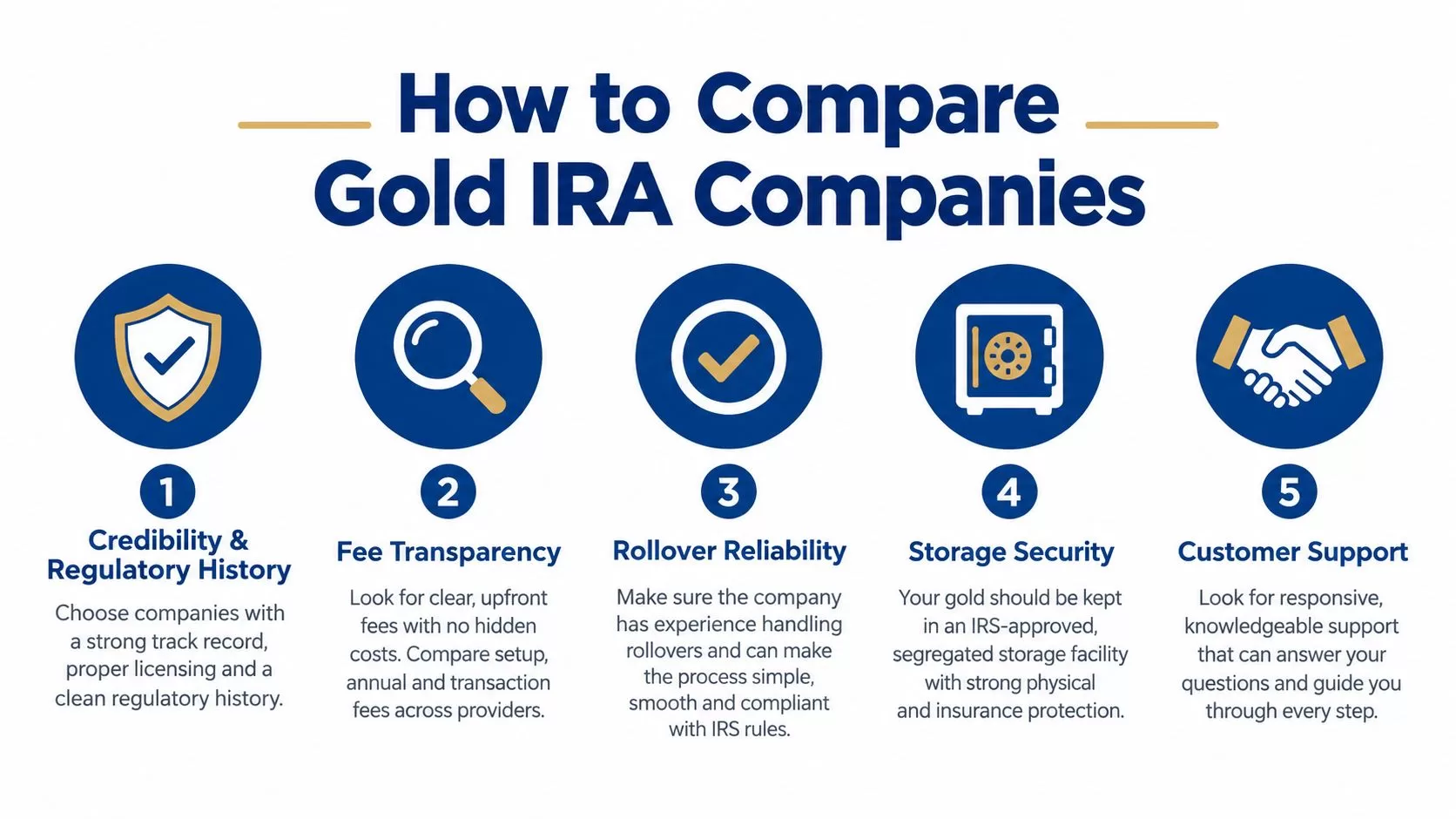

Five checks that expose weak providers
Credibility and regulatory history should be the starting point. Look for consistent disclosures, a track record of handling retirement accounts, and written answers to direct questions. Polished branding is not evidence of sound administration.
Fee transparency deserves equal attention. Request the complete first-year cost, including setup, annual administration, wire charges, storage, dealer markup, and the buyback spread. A review that highlights only the opening fee leaves out the charges most likely to affect the account's outcome.
Apply the same test to every provider:
| Comparison area | What to verify |
|---|---|
| Credibility | Written policies, clear ownership, and consistent answers |
| Fees | Complete schedule covering account, transaction, storage, markup, and buyback costs |
| Storage | Qualified custodian, approved depository, insurance, and stated storage arrangement |
| Rollover handling | Written instructions, paperwork support, and coordination with the existing plan |
Storage security matters because IRA metals must remain with a qualified custodian in an approved depository, not in a private home IRS retirement plan FAQ. Ask whether holdings are segregated or commingled and identify the party responsible for custody and insurance.
Rollover execution quality shows whether the provider can manage timing, forms, and communication without avoidable delays. Require written steps before money moves, confirm who contacts the existing plan administrator, and ask how errors are corrected. For the timing and risk differences between the two methods, Learn how direct transfers and indirect rollovers differ in timing and risk.
Reject any quote that leaves pricing or custody details open. The provider should make the total commitment clear before you authorize the rollover.
Understanding Real Total Cost of Ownership
A first-year Gold IRA quote can carry several separate charges. The headline setup fee is only one line item. Administration, wire fees, storage, dealer markup, and the buyback spread determine what the rollover actually costs.
Consumer cost examples list a $50 setup fee, $30 wire fee, $125 annual fee, and $110 storage fee, before dealer markup of about 5% to 10% over spot J.M. Bullion cost guide. Annual custodial and storage charges may also be stated as 0.5% to 1.5% of account value, so the same account can produce a very different first-year bill depending on its balance and fee structure.
Here is the practical comparison. Provider A's listed setup, wire, administration, and storage charges total $315 before markup. Provider B may advertise a lower opening fee, yet charge a markup near 10% instead of 5%, then offer a weaker buyback price. On the same metal purchase, that five-point markup gap can outweigh a modest setup-fee saving. The buyback spread can widen the difference when you sell.
Judge the first-year total, not the signup fee.
What a serious quote should include
Require these items in writing before funding:
- Setup and administration: account opening and annual handling charges.
- Storage and insurance: segregated or commingled storage, vault arrangements, and annual cost.
- Transaction costs: wire, dealer, liquidation, and transfer charges.
- Pricing spread: spot-to-product pricing and the method used to set buyback offers.
Ask for a side-by-side first-year estimate using the same purchase amount. The quote should show both fixed charges and percentage-based costs, including the amount you could lose through the buyback spread. For an account-level review, consult this Gold IRA fee breakdown guide before authorizing the rollover.
Direct Versus Indirect Rollover Methods
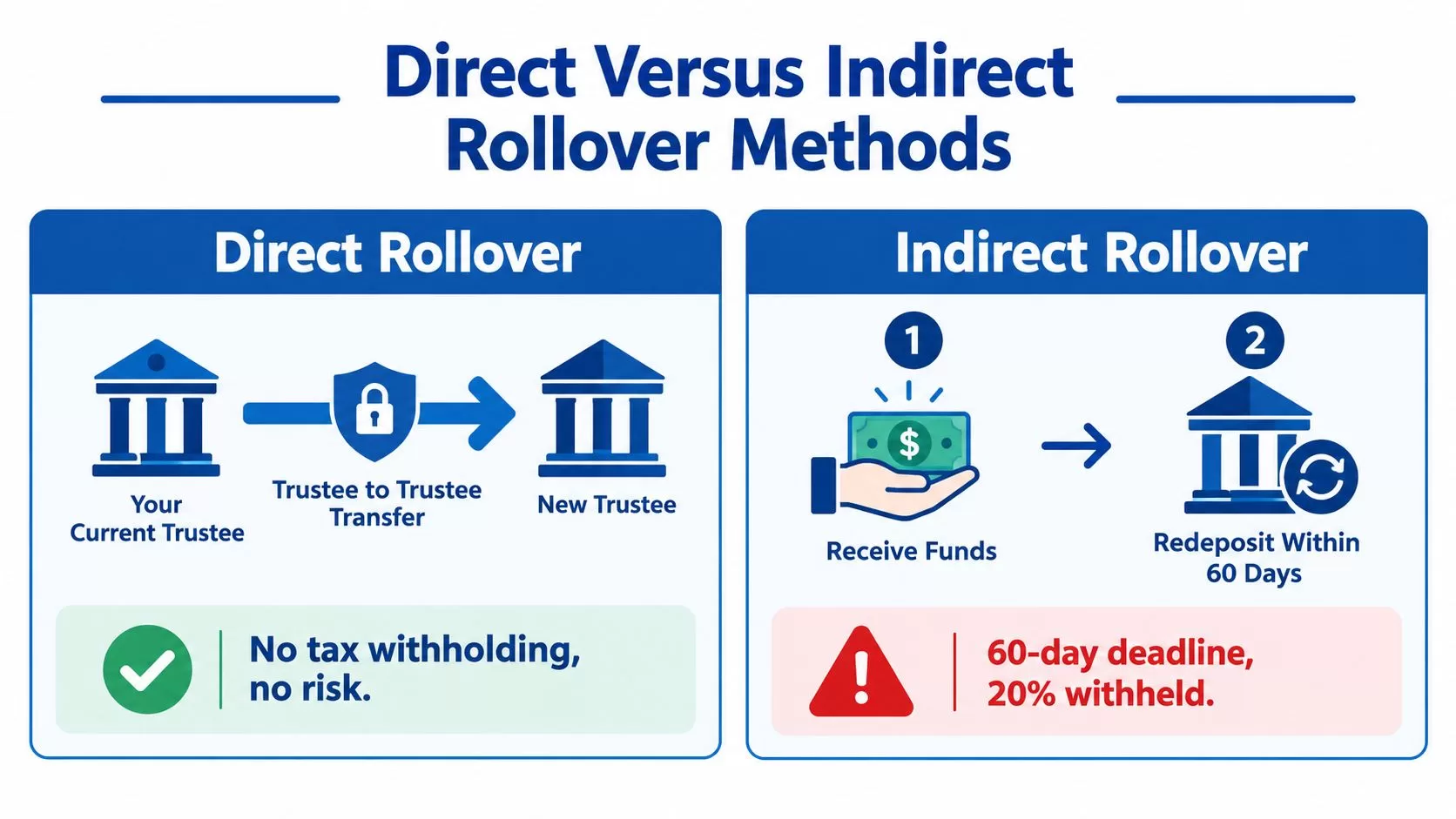
The rollover method matters as much as the provider. A direct rollover moves money institution to institution, while an indirect rollover sends the funds to the individual first, which starts the clock and adds avoidable risk IRS rollover rules.

The safer path
A properly executed direct rollover is generally non-taxable when the transfer is handled correctly, and it avoids the 60-day deadline altogether IRS rollover rules. That's the route most retirees should prefer because it reduces timing mistakes and withholding confusion.
Where people get burned
An indirect rollover starts when the funds hit the person's hands. If the money isn't redeposited within 60 days, the distribution can become taxable, and IRA rollovers are generally limited to one per 12 months IRS rollover rules.
Rule of thumb: if a provider seems casual about deadlines, choose another provider.
The operational friction often shows up on the outgoing side, not the incoming one. That means the old plan administrator, not just the new custodian, can create delays through closeout procedures, wire charges, or paperwork backlogs.
A clean rollover usually follows a simple path. Confirm the transfer method in writing, verify the receiving custodian's instructions, and avoid touching the money personally unless the rollover strategy specifically requires it.
See the direct transfer versus rollover guide

Best Gold IRA Providers for Different Situations
Which provider fits your rollover size, service needs, and tolerance for ongoing costs? The right choice depends on how the account will operate after funding, not just on the advertised setup fee.
Start with the first-year total cost. Request the setup charge, annual administration fee, wire fee, storage and insurance cost, dealer markup, and expected buyback spread in writing. A provider with a low opening fee can still produce a more expensive account if its ongoing charges and metal pricing are unclear.
For the fee-conscious saver, choose a provider that shows the full fee schedule before requesting funds. The quote should identify the exact products, dealer markup, and same-day spot reference used to price the purchase. Ask how the buyback price is determined as well. Selling costs affect the result even when the account statement shows a gain.
For the service-focused investor, an education-led onboarding process may justify choosing a provider that spends more time explaining the paperwork, account roles, and purchase process. The service should clarify costs rather than distract from them. A higher-touch process fits investors who want guidance before committing a larger rollover.
For the compliance-first retiree, require plain-language answers about the custodian, approved storage, insurance, and eligible metals. Written documentation should support each answer. If representatives cannot explain these details clearly, keep comparing providers.
Use this practical test before signing:
- Smaller rollover with tight fee sensitivity: select the firm with complete first-year pricing and no unexplained charges.
- Large rollover needing decision support: select the firm that documents each step and allows time for questions.
- Storage-focused buyer: select the firm that identifies the depository arrangement and storage type.
- Exit-focused buyer: select the firm that explains its buyback process and spread before purchase.
Gold IRA Association offers educational rollover and fee guidance for readers reviewing process details before contacting a provider. Use that information to examine the fee schedule, then judge the provider by documented costs and execution rather than sales language.
Gold IRA Rollover Reviews Final Recommendations
A strong review should answer three things: what the rollover costs, how reliably it will be executed, and whether the metals and storage arrangement comply with applicable rules. A low setup fee proves little if recurring charges and trading spreads consume the account's return.

Use the provider's written quote to calculate the true first-year cost. Add the setup fee, annual administration, wire charge, storage and insurance, and dealer markup. Then record the buyback spread as the estimated cost of exiting the position. This calculation shows whether the account remains reasonably priced after the headline promotion disappears.
For example, a quote with a modest setup charge can still become expensive when administration, storage, wire fees, and the purchase markup are added. If the provider will not disclose the buyback spread, treat the first-year estimate as incomplete and keep comparing.
Before funding, confirm the custodian, depository, storage terms, insurance, and eligible metals. Gold must meet 99.5% fineness, silver 99.9%, and platinum or palladium 99.95% IRS publication 590-A.
Choose the provider that documents the full cost, explains each rollover step, and answers exit questions plainly. Consult a licensed financial advisor, CPA, or tax professional before investing.
Frequently Asked Questions About Gold IRA Rollovers
What metals qualify for a gold IRA? Eligible metals must meet IRS purity rules: gold 99.5%, silver 99.9%, and platinum or palladium 99.95%. The American Gold Eagle is a statutory exception despite its lower gold content IRS publication 590-A.
Does rollover method affect taxes? Yes. A direct rollover transfers funds between institutions and avoids the 60-day personal receipt deadline. An indirect rollover gives you the funds first, starting that clock. Review the IRS rollover rules before choosing a method.
What should I include in first-year cost? Request setup, annual administration, wire, storage, insurance, dealer markup, and buyback spread in writing. Judge total ownership and exit costs, not the advertised setup fee.
How long does a rollover usually take? Timing depends on the administrator, paperwork, and method, so use the rollover process guide before starting.
How can a reader check a provider's credibility? Request a written fee schedule and ask the custodian to confirm the depository name in writing before funding. Require written storage, insurance, and buyback terms.
Gold IRA Association publishes rollover guides, fee breakdowns, and provider comparisons. Visit Gold IRA Association for educational resources on fees, storage, and transfer rules.


