




If retirement is getting close, the gold question gets more practical than philosophical. A near-retiree usually isn't asking whether gold has a place at all, but whether an ETF or physical bullion is the cleaner fit for savings that need to last. The central issue is not just price exposure, it's ownership, access, and who controls the asset when markets get rough.
| Comparison Point | Gold ETF | Physical Gold |
|---|---|---|
| What you own | Shares in a fund that holds gold | Direct ownership of coins or bars |
| Where it sits | Inside a brokerage or IRA account | In your possession or in a depository |
| Trading access | Exchange-traded during market hours | Bought and sold through dealers or private buyers |
| Redemption | Usually cash settlement for ordinary investors | Direct possession from day one |
| Ongoing costs | Fund expenses and management fees | Storage, insurance, and dealer spreads |
| Best fit | Simple market exposure | Direct, outside-the-system ownership |
For many retirement investors, that table is the whole debate in miniature. Gold ETFs are easier, cleaner, and more flexible inside a standard account. Physical gold gives something different, a hard asset you own, not just a claim on price movement. Gold IRA Association's guidance on whether gold is worth it for stability and growth is a useful companion read for readers deciding how much gold exposure belongs in a retirement plan, not just which form to buy (gold investment worth it for stability and growth).
Why Retirement Investors Are Weighing Gold ETFs Against Physical Gold
A lot of near-retirees get to the same moment. The 401(k) statement looks choppy, inflation still feels sticky, and the instinct is to add something that doesn't move exactly like stocks or bonds. Gold comes up fast because it has a long reputation as a diversifier, but the next question is harder, do you want a paper claim on gold, or do you want the metal itself?
That choice matters more than many investors realize. A gold ETF gives exposure through the financial system. Physical gold gives direct ownership outside it. Both are linked to the same underlying metal, but they live in very different custody structures, and that changes how they behave in retirement planning.
Practical rule: If the goal is simple portfolio exposure, an ETF can work. If the goal is direct control and contingency planning, physical ownership changes the risk profile.
A lot of comparisons stay too shallow. They focus on convenience and fees, but a retiree should care just as much about what happens if a broker, custodian, or trading platform becomes a bottleneck. That's why the key question isn't “which one is better in theory,” but “which one fits the role gold is supposed to play in this portfolio.”
The rest of the decision comes down to four things. Ownership structure, long-term cost, IRA fit, and liquidity. If those are clear, the choice gets much easier.
How Ownership Structure Differs Between Gold ETFs and Physical Bullion
What the investor actually owns
Physical gold is simple at the ownership level. A coin or bar is a tangible asset the investor directly owns, whether it sits in a home safe or an approved storage facility. A gold ETF is different. It's a security that gives exposure to gold held by a fund structure, so the investor owns shares, not metal.
That distinction sounds technical, but it drives the whole retirement decision. An ETF holder is tied to the brokerage and fund structure. A physical gold holder owns the bullion itself. Those are not the same thing, especially when the reader is thinking about emergency access or legacy planning.
Physically backed gold ETFs are typically supported by bullion that meets global standards such as 99.5% fineness, and each ETF unit represents a fractional interest in that gold, according to the industry descriptions in the verified research. That still doesn't make the investor a direct bullion owner. It makes the investor a shareholder with a claim on the fund's gold exposure.
The redemption gap most investors overlook
This is the part that gets ignored in flashy comparisons. Ordinary ETF investors usually can't walk away with bars or coins. The holding is generally settled in cash, not delivered metal. So if the broker goes down, the fund structure changes, or the investor wants metal in hand, the ETF doesn't solve that problem.
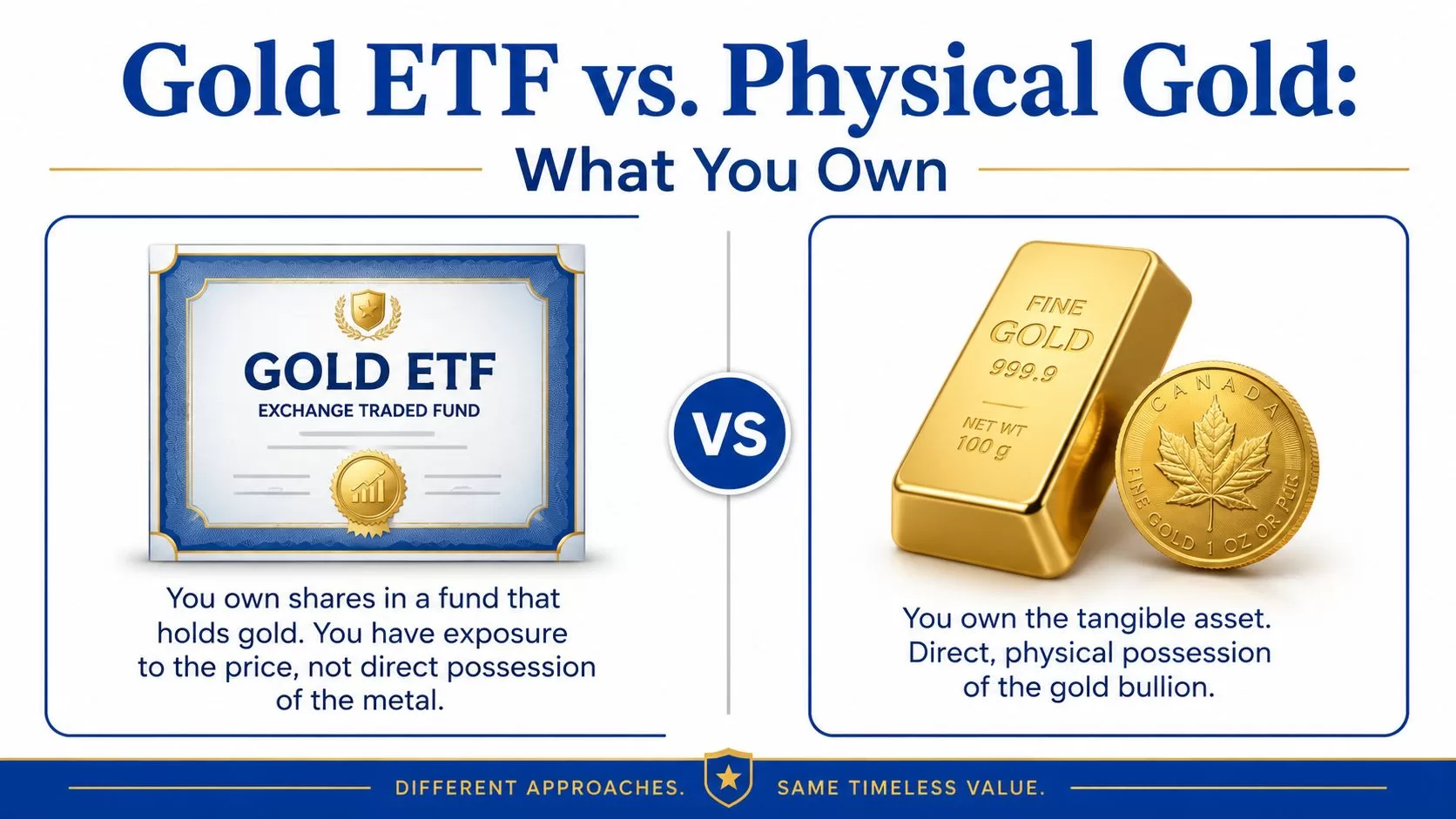

The point isn't that ETFs are bad. They're useful. The point is that they are financial claims on gold exposure, not the same as holding the metal outright. For a retiree, that difference can matter if the gold allocation is meant to serve as a contingency reserve, not just a market position.
If the investor wants gold as an asset outside the brokerage stack, only direct ownership gives that outcome.
Comparing Fees and Long-Term Return Performance
The cost drag is real, but it works differently
Gold ETFs usually charge ongoing expenses that reduce net return over time. Verified industry data shows gold ETF expense ratios typically range from 0.3% to 1%, and another market overview notes ongoing charges around 0.4% per year in some products, plus brokerage-related costs (JETIR study and market overview, physical gold vs. gold ETFs). Physical gold avoids annual fund fees, but it isn't free. Buyers usually pay dealer premiums, then face storage and insurance costs if they want safe custody.
Over long holding periods, that difference matters because fees compound. The verified study covering a 10-year period found ETF returns of 11.16% to 11.36% versus 11.01% for physical gold, which shows that the gap can be narrow over a full cycle (JETIR study). A separate market comparison notes that physically backed gold ETFs closely follow bullion prices, with tracking differences often near the fund's annual expense ratio, and major U.S.-listed funds such as GLD and IAU have been cited with annual tracking differences around 0.25% to 0.45% because of management and vaulting costs (tracking discussion).
Cost comparison, side by side
| Cost Category | Gold ETF | Physical Gold |
|---|---|---|
| Upfront purchase costs | Brokerage-related costs may apply | Dealer premiums are common |
| Ongoing annual costs | Fund expense ratio and related charges | No fund fee, but storage and insurance can apply |
| Tracking drag | Net returns can be slightly lower than spot gold over time | No management fee drag |
| Convenience cost | Lower operational burden | Higher handling and storage burden |
The practical takeaway is blunt. ETFs often win on simplicity, physical gold often wins on direct cost control after purchase. Which one is cheaper depends on how long the investor holds it and how much they pay to store and protect physical bullion. That's why a retiree should compare total cost of ownership, not just the headline fee.
IRA Eligibility and IRS Rules for Retirement Accounts
What fits inside an IRA and what doesn't
Gold ETFs are easy to place in a standard brokerage IRA because they're securities. Physical gold is different. To hold bullion inside a retirement account, the investor usually needs a self-directed Gold IRA, an IRS-approved custodian, and approved storage with a depository. Home storage is generally not the route for IRA-held metals.
The metal itself also has to meet purity rules. The verified data notes bullion standards such as 99.5% fineness for physically backed ETFs, and the broader retirement-setup discussion points to IRS-style eligibility standards for IRA gold, which is why metal quality and custody both matter in a Gold IRA context (precious metal IRA rules). In plain English, not every gold product qualifies, and the structure matters as much as the metal.
How the two paths usually work
For a retiree moving money from a 401(k) or traditional IRA, the mechanics differ:
- Gold ETF route. The investor keeps the account structure simple. Gold ETF shares are bought inside the existing brokerage IRA, and no special vaulting setup is needed.
- Physical gold route. The investor uses a self-directed Gold IRA. The custodian handles the account, the depository handles storage, and the metal has to meet the plan's eligibility rules.
- Outside the retirement account. The investor buys physical bullion directly and holds it personally, outside the IRA system.
The design choice matters because the tax wrapper and the asset wrapper are not the same thing. ETFs fit neatly into standard accounts. Physical bullion inside an IRA gives the retiree direct metal ownership while still keeping the retirement tax structure.
The simplest summary is this. If the goal is retirement-account convenience, ETFs are easier. If the goal is direct bullion ownership inside a tax-advantaged structure, the Gold IRA route is the one that does that. A useful internal explainer on precious metal IRA rules is here: precious metal IRA rules.

Liquidity and Trading Differences That Affect Your Access to Gold
Selling an ETF is not the same as selling bullion
Gold ETFs are generally more liquid because they trade on exchanges during market hours. A brokerage order can usually be placed quickly, which makes them easy to use when the investor wants a fast portfolio adjustment. Physical gold is less immediate. It usually has to be sold through dealers, mints, or private buyers, and the process can include authentication, shipping, and price negotiation.
That difference matters for retirement income planning. If a portfolio needs to be rebalanced, or if cash is needed for an unexpected expense, an ETF is usually the cleaner transaction. Physical gold can absolutely be liquid, but it isn't frictionless.
Trading access also works on different clocks
Bullion lives in a global 24-hour market. ETFs do not. They only trade during exchange hours, which creates a structural difference in access and pricing. A gold holder who wants continuous market exposure gets that more naturally through bullion pricing, while ETF shares wait for the market to open.
The practical result is straightforward:
- ETF sale: A retiree can exit through a brokerage platform with a few clicks during market hours.
- Physical sale: A retiree may need to contact a dealer, verify the metal, and accept the bid available at that moment.
- Timing pressure: ETFs are easier when speed matters, physical gold takes more planning.
For readers comparing the general menu of gold investment options, Gold IRA Association has a separate overview here: gold investing options.
Bottom line: ETFs are easier to transact. Physical gold is easier to hold directly. Those are different strengths, not competing versions of the same thing.
Which Option Fits Different Retirement Goals and Risk Profiles
Simple exposure inside an existing IRA
An investor who wants gold as a portfolio sleeve, without creating a separate custody arrangement, usually fits the ETF path. It's cleaner for someone who already has a brokerage IRA and just wants a modest gold allocation as part of a broader retirement mix. The investor keeps the account structure simple and avoids vault logistics.
This is the right answer when convenience is the priority. It is not the right answer when the goal is to hold metal outside the financial system.
Direct control and contingency planning
An investor who wants a hard asset in hand should not confuse an ETF with ownership. A physical gold holder takes on storage and insurance burdens, but also gets direct possession. That matters for people who are less concerned about trading convenience and more concerned about having something tangible that doesn't depend on a brokerage stack.
Direct metal ownership inside retirement savings
There's a third lane. A retiree who wants both retirement-account structure and physical ownership can use a self-directed Gold IRA. That path gives direct metal exposure while keeping the retirement wrapper intact, provided the custodian and depository are set up correctly.
The custody difference is the dividing line. ETF holders depend on sponsors, custodians, and brokers. Physical holders depend on storage and insurance if they're not keeping the metal personally, but they still own the asset directly. For retirement planning, that's the question that should lead the decision, not the marketing language around “gold exposure.”
Practical rule: If the investor wants the fewest moving parts, choose the ETF. If the investor wants direct ownership, choose physical gold. If the investor wants direct ownership inside retirement savings, use a Gold IRA structure.
Your Decision Checklist and Recommended Next Steps
Use these questions to make the call
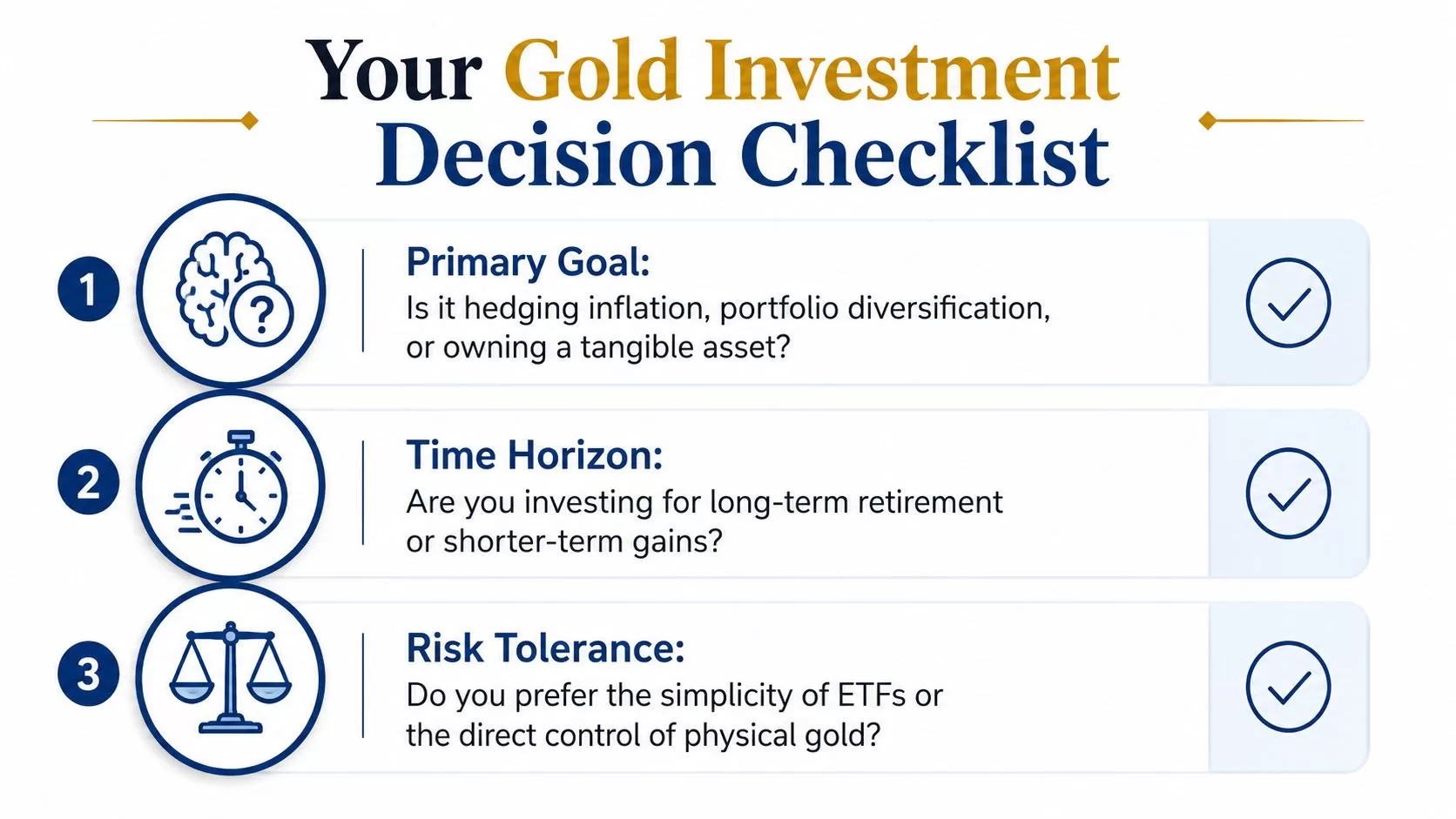
A retiree does not need a complicated framework here. The decision gets easier when the right questions are asked in order.
- Primary goal: Is the priority convenience, direct control, or tax-advantaged ownership?
- Access preference: Does the investor want to stay inside a standard brokerage account, or hold a hard asset outside it?
- Counterparty comfort: Is dependence on a fund structure acceptable, or is direct possession the priority?
- Storage tolerance: Is the investor willing to manage storage and insurance, or would that be a burden?
- Time horizon: Is this meant to be a long-term retirement allocation, or a tactical position that may change more often?
If the answers point to simplicity, a gold ETF is the cleaner fit. If the answers point to direct possession, physical gold is the stronger fit. If the answers point to retirement savings plus direct bullion ownership, a Gold IRA is the middle path worth studying carefully.
The next step should match the choice, not the other way around. ETF buyers can add gold exposure inside an existing IRA without changing the account structure. Physical gold buyers should review custodian, storage, and eligibility rules before moving retirement money. The self-directed route deserves a close read because mistakes in setup create unnecessary friction later.
This is not financial advice. Consult a licensed financial advisor, CPA, or tax professional before making investment decisions.
A CTA for Gold IRA Association. If the retirement goal is direct gold ownership inside a tax-advantaged account, request a free Gold IRA kit and review the rollover rules before moving any funds.


