




A near-retiree looking at a 401(k) or traditional IRA often wants the same thing, a way to add physical gold without losing the tax advantages that make retirement accounts valuable. A Roth Gold IRA sounds simple on the surface, but the rules behind it can be confusing, especially when people mix up Roth taxes, precious-metals eligibility, rollover rules, and storage requirements.
Gold IRA Association's educational guide breaks that problem apart step by step. It defines what a Roth Gold IRA really is, shows where the IRS draws the line on eligible gold, explains how contributions and conversions work, and compares the structure with taxable gold and gold ETFs so the trade-offs are clearer. This is educational content, not personalized tax or legal advice, so readers should confirm their own situation with a licensed financial advisor, CPA, or tax professional.
Why Near-Retirees Are Asking About a Roth Gold IRA
A lot of people reach their mid-50s and start asking the same question. They already have retirement money parked in a 401(k) or traditional IRA, they've watched markets swing around, and they want to know whether a slice of that savings can sit in gold with the possibility of tax-free withdrawals later.
That question makes sense because a Roth Gold IRA sits at the intersection of two separate ideas. One is the Roth wrapper, which uses after-tax money and can allow qualified tax-free withdrawals. The other is the physical gold component, which adds custody, storage, and purity rules that paper accounts don't have. The job is not to chase a shiny label, it's to figure out whether the account structure fits the reader's timeline, tax bracket, and retirement plan.
Practical rule: If a reader can't explain the tax difference between a Roth account and a traditional one in one sentence, the account probably isn't ready to open yet.
This guide answers the questions that matter most. What exactly is a Roth Gold IRA, which gold products can go in it, how does someone open or convert one, and when does the structure make sense compared with taxable gold or a gold ETF? It does not promise tax savings, and it doesn't try to guess what the market will do next.
What a Roth Gold IRA Actually Is
A Roth Gold IRA is not a separate IRS account class. It's usually a self-directed Roth IRA that holds IRS-eligible physical gold through an approved custodian and depository, which means the Roth account is the shell and the precious metals are the filling. That structure matters because many people assume they are opening a special gold account, when they're really combining a Roth IRA with self-directed precious-metals rules.

A regular Roth IRA at a brokerage usually holds paper assets like stocks, bonds, or funds. A traditional Gold IRA uses pre-tax money and defers taxes until withdrawal, while a Roth Gold IRA uses after-tax contributions and aims for tax-free qualified withdrawals later. A taxable account holding coins at home is a completely different setup, because it doesn't get the retirement-account tax shelter at all.
The biggest practical difference is custody. The account holder can't just take the metal home and keep it in a safe, because personal possession is treated as a distribution. That can create tax consequences and, in the wrong setup, can break the account's compliance status.
The cleanest way to think about it is this, a Roth Gold IRA is a Roth retirement account that holds approved physical gold under third-party custody.
For readers who already know retirement accounts, that one sentence usually clears up the confusion. The Roth part decides how the money is taxed, and the gold part decides which metals can be bought, stored, and withdrawn under IRS rules.
IRS Purity and Custody Rules for IRA Gold
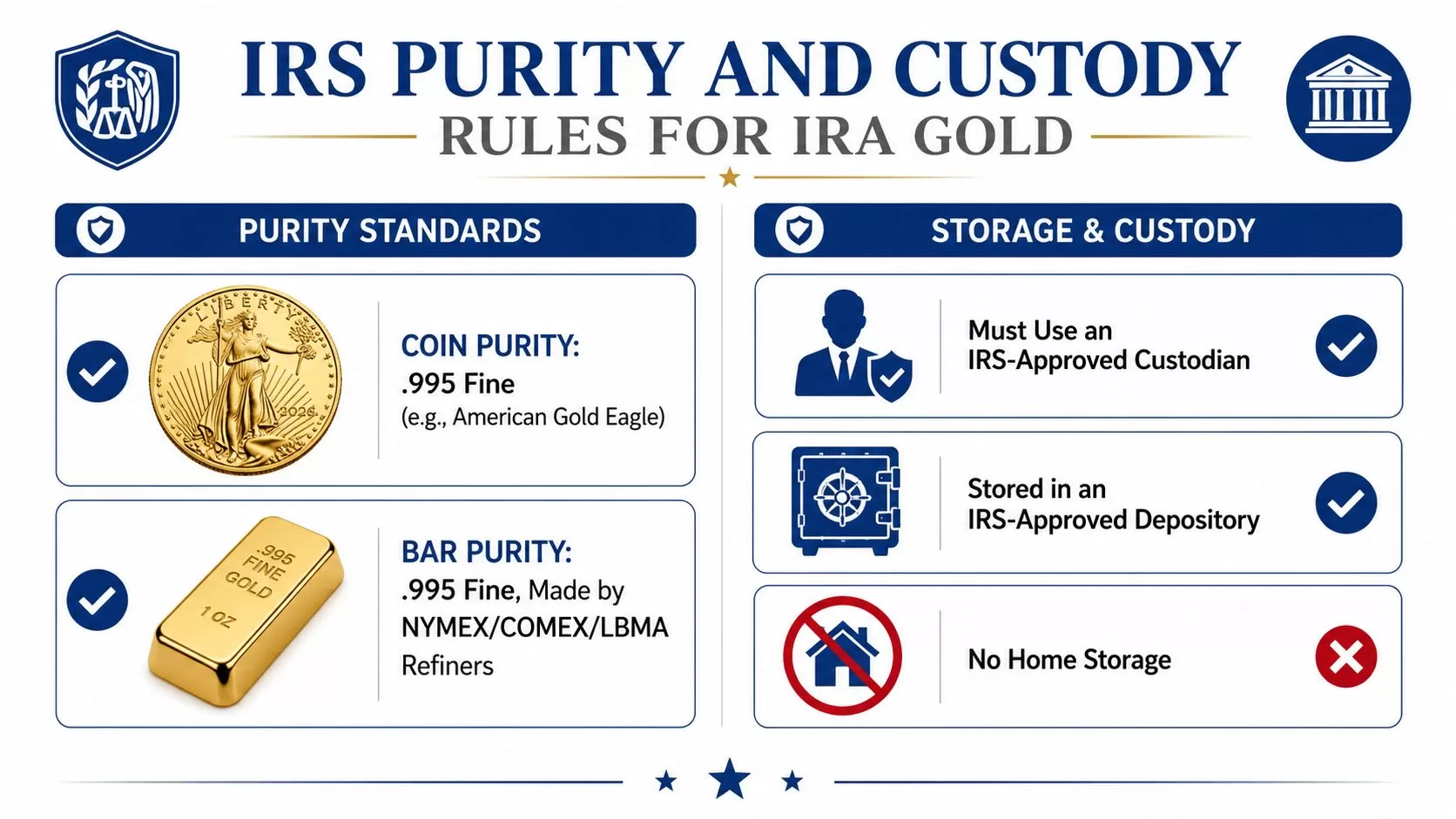
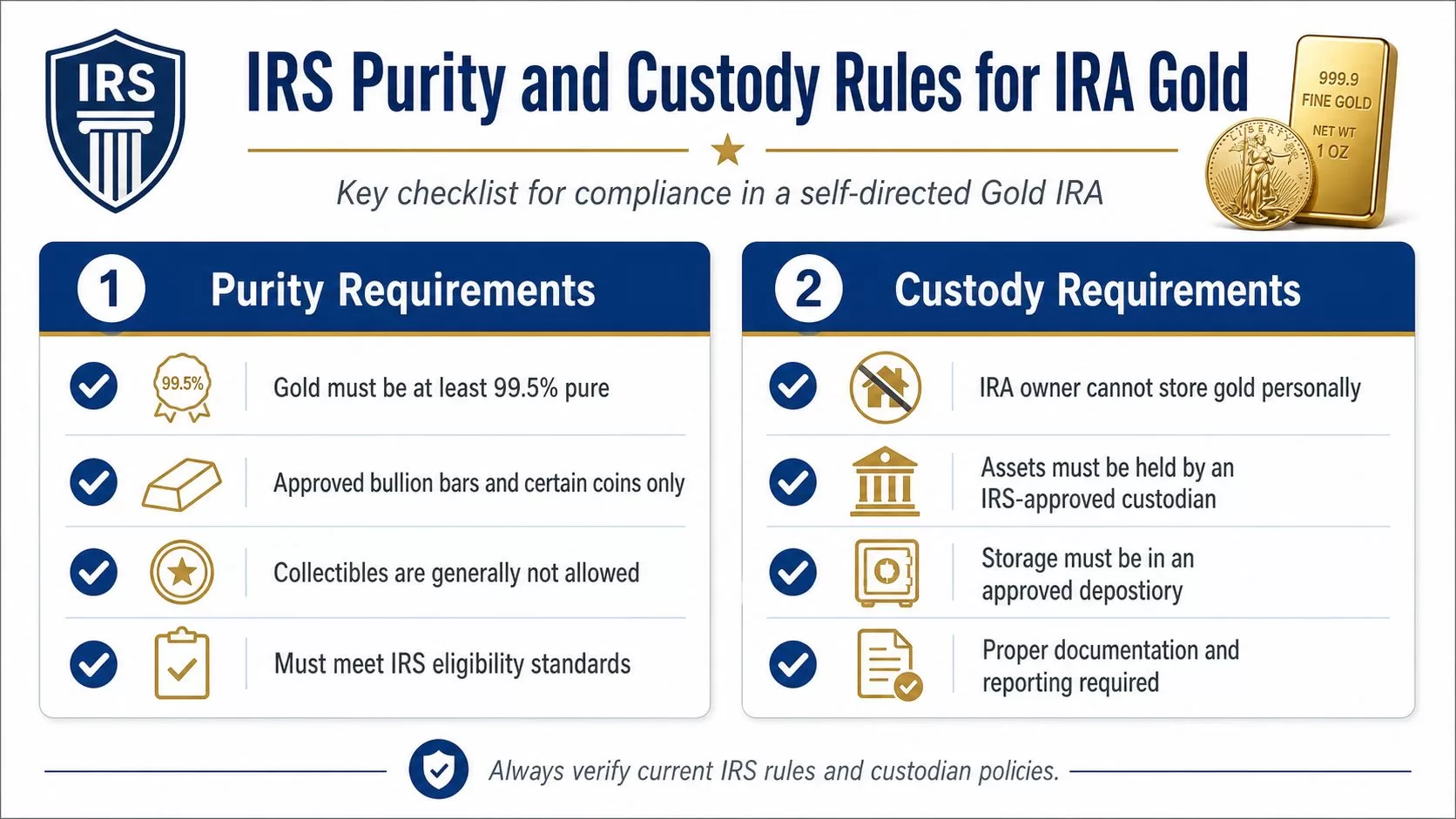
Most mistakes in a Roth Gold IRA come from buying the wrong product or storing it the wrong way, not from the Roth account itself. The IRS standard for gold bullion is 99.5% pure, or 0.995, and that purity screen is the first thing a dealer or custodian should verify before anything gets funded. A major exception exists for the American Gold Eagle, which is 91.67% pure but is specifically allowed for IRA use.
A compliant inventory usually comes from a short list of recognizable categories:
- American Eagle and American Buffalo coins, because they're widely used in IRA setups and are easy to document.
- Canadian Maple Leaf and Austrian Philharmonic coins, which are commonly recognized as eligible bullion when they meet the required standards.
- Approved gold bars from qualified refiners, especially bars produced by NYMEX- or COMEX-approved refiners.
- Hallmarked bullion, because clear markings make compliance checks easier for the custodian.
Proof coins and rare collectibles are usually a bad fit. The issue is not that they're made of gold, it's that collectible status and numismatic premiums can complicate IRA eligibility and make the product less straightforward under the rules. For a retirement account, simplicity matters more than novelty.
The custody rule is just as important as the purity rule. The metal must live at an IRS-approved depository, not in a home safe, not in a bank safe-deposit box labeled to the owner, and not inside a self-storage arrangement dressed up as an LLC workaround. Gold IRA Association's detailed overview of precious metal IRA rules is a useful reference point for readers who want the product list and storage standards in one place: precious metal IRA rules.
Roth Tax Rules, Contribution Limits, and the Five-Year Clock
A Roth Gold IRA follows the same Roth rules as any other Roth IRA, and that's where many readers get tripped up. Contributions are made with after-tax dollars, so they aren't deductible, but qualified withdrawals can be tax-free if the account and the owner both meet the Roth distribution rules. The gold inside the account doesn't change that framework.
The main test for a qualified distribution has two parts. The Roth IRA has to be open for at least five years, and the owner has to be at least 59½, disabled, deceased, or using an eligible exception such as a first-time home purchase up to $10,000. That means the tax clock and the age rule both matter, not just one of them.
The contribution side also has limits. For 2024, the Roth IRA contribution limit is $7,000 for investors under 50 and $8,000 for those 50 or older because of the catch-up contribution, and those limits apply across all IRA accounts, not separately to each IRA (source). Independent industry guidance also cited 2026 IRA contribution limits of $7,500 plus a $1,100 catch-up for investors 50 and older, with phase-out thresholds of $146,000 for single filers and $230,000 for joint filers (source). Because limits change over time, readers should verify the current year before acting.
A few caution points matter here:
- No deduction for Roth contributions means the tax benefit arrives later, not upfront.
- Excess contributions can trigger a 6% excise tax each year they remain in the account.
- Roth eligibility and the five-year rule are separate tests, so passing one doesn't automatically solve the other.

| Category | Under 50 | 50 and Older | Income Phase-Out |
|---|---|---|---|
| Roth IRA contribution limit for 2024 | $7,000 | $8,000 | Applies across all IRA accounts, not separately |
| Independent 2026 guidance | $7,500 | $8,600 total with catch-up | $146,000 single, $230,000 joint |
Opening, Rolling Over, or Converting to a Roth Gold IRA
There are three legal doors into a Roth Gold IRA, and they don't work the same way. A person can make an annual Roth contribution, complete a Roth conversion, or use a direct rollover or trustee-to-trustee transfer from another eligible retirement account. The tax result depends on which door is used.
The sequence usually starts with the custodian. First, confirm that the existing 401(k) or IRA allows the transfer or rollover. Then open a self-directed Roth IRA with a custodian that supports precious metals, complete the paperwork, and fund the account through the correct transfer method so the money doesn't touch the account holder's hands.
After the account is funded, the dealer selects IRA-eligible metals and the custodian arranges shipment to the approved depository. The physical gold is never shipped to the investor personally, because that would create a distribution problem. The ordering step is simple in theory, but every detail has to match the custody rules.
The most common mistakes are easy to name:
- Taking a check payable to yourself instead of to the new custodian.
- Confusing rollover rules with contribution rules, especially when people assume every IRA move is treated the same way.
- Trying home storage to cut fees, which can blow up the compliance structure.
- Mixing conversion and contribution language, which can lead to tax surprises.
High earners often look at the backdoor Roth path when direct Roth contributions aren't available. That usually means a nondeductible traditional IRA contribution followed by a conversion into a Roth IRA, then using the Roth structure for whatever eligible investments the custodian permits. Gold IRA Association's rollover guide gives readers a stepwise starting point for the retirement-account transfer side: 401(k) to Gold IRA rollover.
How a Roth Gold IRA Compares to Taxable Gold and Gold ETFs
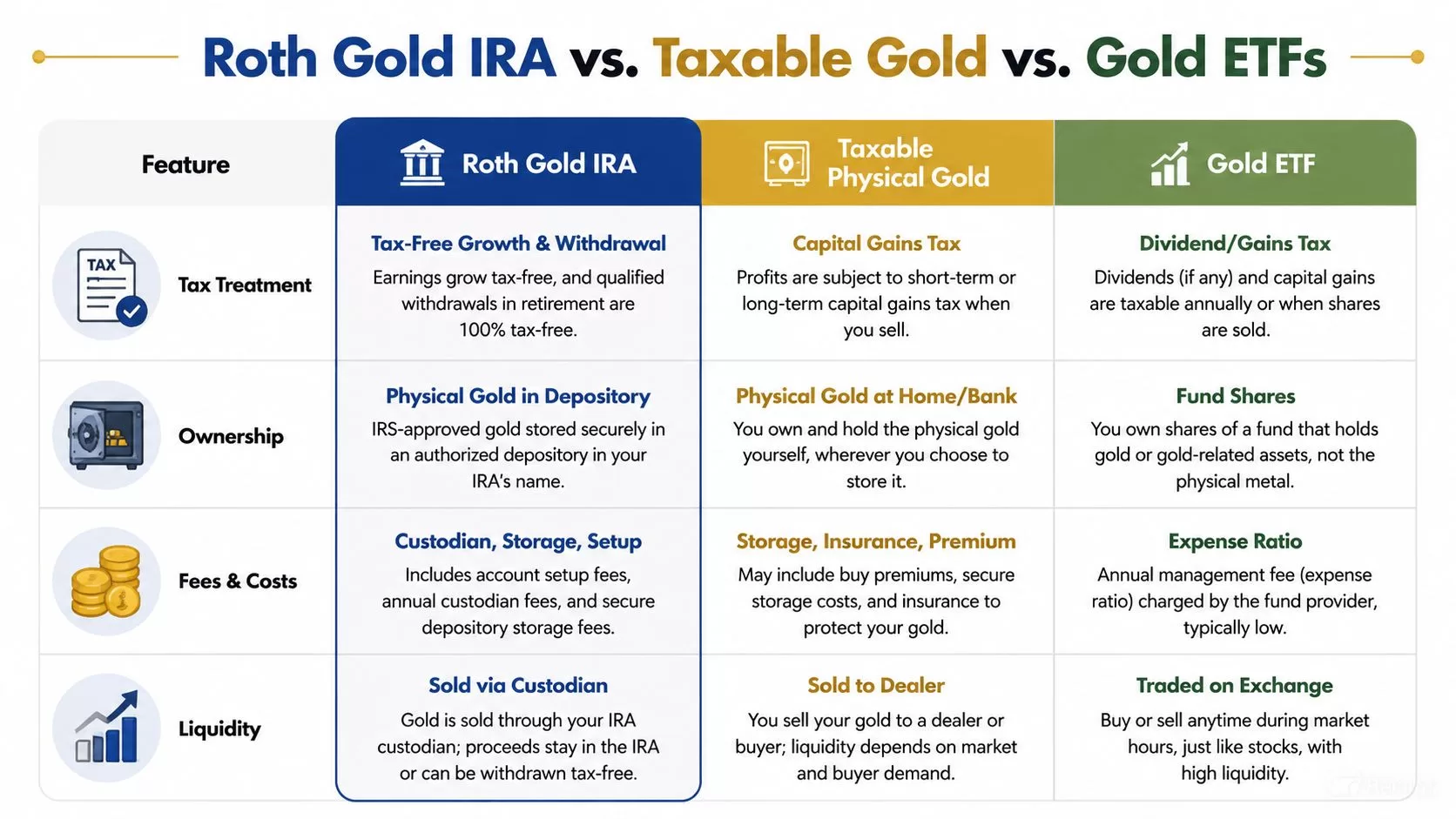
This is the question most explainers skip. A Roth Gold IRA can be attractive, but only if the tax wrapper is worth the extra custody, storage, and dealer costs. The honest comparison is between three different ways to own gold, and the tax treatment changes the answer.
A taxable account holding physical gold has the harshest tax drag on the exit side, because long-term gains on collectibles can face the U.S. 28% collectibles rate. A gold ETF in a taxable account can be simpler and cheaper to hold, but it still creates taxable events as gains are realized. A Roth Gold IRA can let approved metals compound without annual tax drag and, if the Roth rules are met, come out tax-free.
That tax benefit comes with real costs. A physical-metal Roth IRA usually involves setup fees, annual custodial fees, storage charges, dealer markups on coins or bars, and shipping plus insurance on every movement of metal. A paper ETF avoids most of those custody costs, which is why the Roth wrapper only becomes compelling in certain situations.
Balanced takeaway: The Roth Gold IRA tends to make the most sense when the investor has a long horizon, expects taxes to be higher later, and already has enough savings that fixed account fees don't swallow the benefit.
That same logic also explains when it may not be the best fit. If the balance is small, or if the investor mainly wants low-friction gold exposure, a taxable ETF or a simpler paper asset may be easier to live with. Gold IRA Association's ETF-versus-physical guide is a useful companion for that decision: ETF vs physical gold.
Choosing a Gold IRA Company Without Falling for the Hype
A provider looks attractive only after the account rules are clear. If the custodian, storage setup, or paperwork is weak, a polished sales pitch does not fix the account later. Start with the basics. Who holds the metal, what fees apply, and what does the written agreement say about ownership and control?
Gold IRA Association's editorial coverage of the category can help readers compare provider types by looking at credibility, service quality, fees, and investment options, without treating any one brand as the default answer. The point is to match the structure to the account and to the investor's timeline, especially when the choice is being made for retirement money that may need to stay in place for years.
A few criteria matter more than advertising language:
- Custodian control: The custodian, not the dealer, should hold the administrative role.
- Storage type: Segregated storage and commingled storage are not the same thing. Segregated storage keeps one investor's metal separate, while commingled storage places similar holdings together.
- Written fees: Setup, custodial, storage, and transaction charges should be spelled out clearly.
- Buyback terms: The spread between purchase and repurchase matters when the metal is eventually sold.
- Minimum investment: A high minimum can make the account impractical for smaller balances.
A promotion that sounds free can still cost more than expected if the spread on the metal is wide. The same caution applies to claims about no fees for life, because the charge may appear in another part of the transaction. A clear fee schedule is easier to compare than a vague discount, especially when the investor is trying to judge the trade-off against holding gold in a taxable account or using a paper-gold fund.
The two questions that cut through the noise are simple. Who owns my metal, and what do I get in writing about the all-in cost over the next ten years?
Common Questions About Roth Gold IRAs
Can a Roth Gold IRA hold silver, platinum, or palladium too?
Yes, many self-directed precious-metals IRAs can hold more than gold if the metals meet IRS eligibility rules and the custodian permits them. The exact product list still has to be checked before buying.
Do Required Minimum Distributions apply to a Roth Gold IRA?
Roth IRA owners generally aren't subject to the same lifetime RMD rules as traditional IRA owners, but inherited Roth accounts can follow different payout timing. That's why the account type and the beneficiary situation both matter.
What happens when heirs inherit a Roth Gold IRA?
Heirs usually have to work within the inherited-IRA payout rules, including the 10-year window in many cases, and the five-year Roth rule can still matter for tax treatment. Beneficiary timing gets technical fast, so estate planning advice helps here.
Can a Roth Gold IRA be opened with a backdoor Roth strategy?
Often, yes, if the account holder uses a valid Roth conversion path and the custodian supports precious metals after the Roth funds are in place. The order of steps matters, because a conversion mistake can create an unexpected tax event.
None of this replaces personalized advice. Readers should confirm current IRS limits, contribution thresholds, and eligible-product lists with a licensed financial advisor, CPA, or tax professional before opening or converting an account.
Gold IRA Association publishes plain-English guides on gold and silver IRAs, rollover rules, and IRS-eligible metals so readers can compare their options without guessing at the fine print. If this topic is on the table for a retirement portfolio, visit Gold IRA Association to compare account rules, rollover paths, and precious-metals basics before speaking with a custodian or tax professional.


