




A rollover can feel simple until the paper shows up with deadlines, withholding, and tax language that's easy to misread. A near-retiree who gets a distribution notice usually has one urgent question, can these funds move without turning into taxable income? The answer depends on which rollover path is used, how fast the money moves, and whether the distribution includes amounts that the IRS says can't be rolled over.
Understanding the IRA Rollover Decision
A lot of people use the phrase IRA rollover rules as if there's one single rulebook. There isn't. The IRS treats a direct transfer, an indirect 60-day rollover, and a move from an employer plan into an IRA as different transactions, and the tax result depends on which one happens.
The safest place to start is with the question, “Did the money ever get paid to the account holder?” If it did, the rollover usually becomes more fragile. If the funds moved directly from one custodian to another, the process is simpler and the risk of a tax mistake drops.
Practical rule: if the retirement money never lands in the investor's hands, the process is usually easier to keep clean.
For people moving savings into a self-directed account, that distinction matters even more. A direct movement can preserve tax deferral without forcing the investor to manage a short deadline or replace withheld funds later. That's why many people compare rollover choices before they ever request a distribution.
What Counts as an IRA Rollover
A rollover is not just “moving money.” It is a specific IRS transaction with different versions, and each version behaves differently. The easiest way to avoid confusion is to separate the three main paths: direct trustee-to-trustee transfers, indirect 60-day rollovers, and rollovers from employer-sponsored plans into IRAs.
A direct trustee-to-trustee transfer moves assets from one IRA custodian to another without paying the money to the account holder. In plain English, the funds travel institution to institution. A direct rollover from a workplace plan to an IRA also moves money without the investor taking possession, but it follows the employer-plan rules that apply to that distribution type. An indirect rollover is the one people usually picture when they say “rollover.” The account holder receives the funds and then redeposits them into another eligible retirement account within the allowed window.
Here's a quick comparison.
| Comparing IRA Rollover Types | Rollover Type | Tax Withheld | 60-Day Limit | Annual Limit |
|---|---|---|---|---|
| Direct trustee-to-trustee transfer | Generally no withholding from the transfer amount | No | No one-per-12-month IRA limit | |
| Indirect 60-day rollover | Withholding can apply to certain distributions | Yes | Yes, for IRA-to-IRA indirect rollovers | |
| Employer plan to IRA rollover | Withholding can apply depending on the distribution type | If indirect, yes | Not subject to the IRA one-per-12-month rule when done as a plan-to-IRA rollover |
For a detailed walkthrough of one common path from a workplace account into an IRA, see the guide on a 401(k) to Gold IRA rollover.
The key is to pick the path before the distribution starts. Once the money is out, the deadline clock and withholding rules begin to matter.
The 60-Day Rule and One-Rollover Limit
The most famous rule is the 60-day deadline. If a distribution is paid to the investor, the IRS generally expects it to be redeposited into another eligible retirement account within 60 days of receipt, or it becomes taxable and may trigger penalties. The IRS also says that, beginning after January 1, 2015, an individual can make only one rollover from an IRA to another, or the same, IRA in any 12-month period, on an aggregate basis across all IRAs. That means a single indirect rollover can create a 365-day lockout for additional IRA-to-IRA 60-day rollovers. The IRS rollover chart makes clear that this limit does not apply to trustee-to-trustee transfers or to rollovers between employer plans and IRAs. IRS rollover rules overview
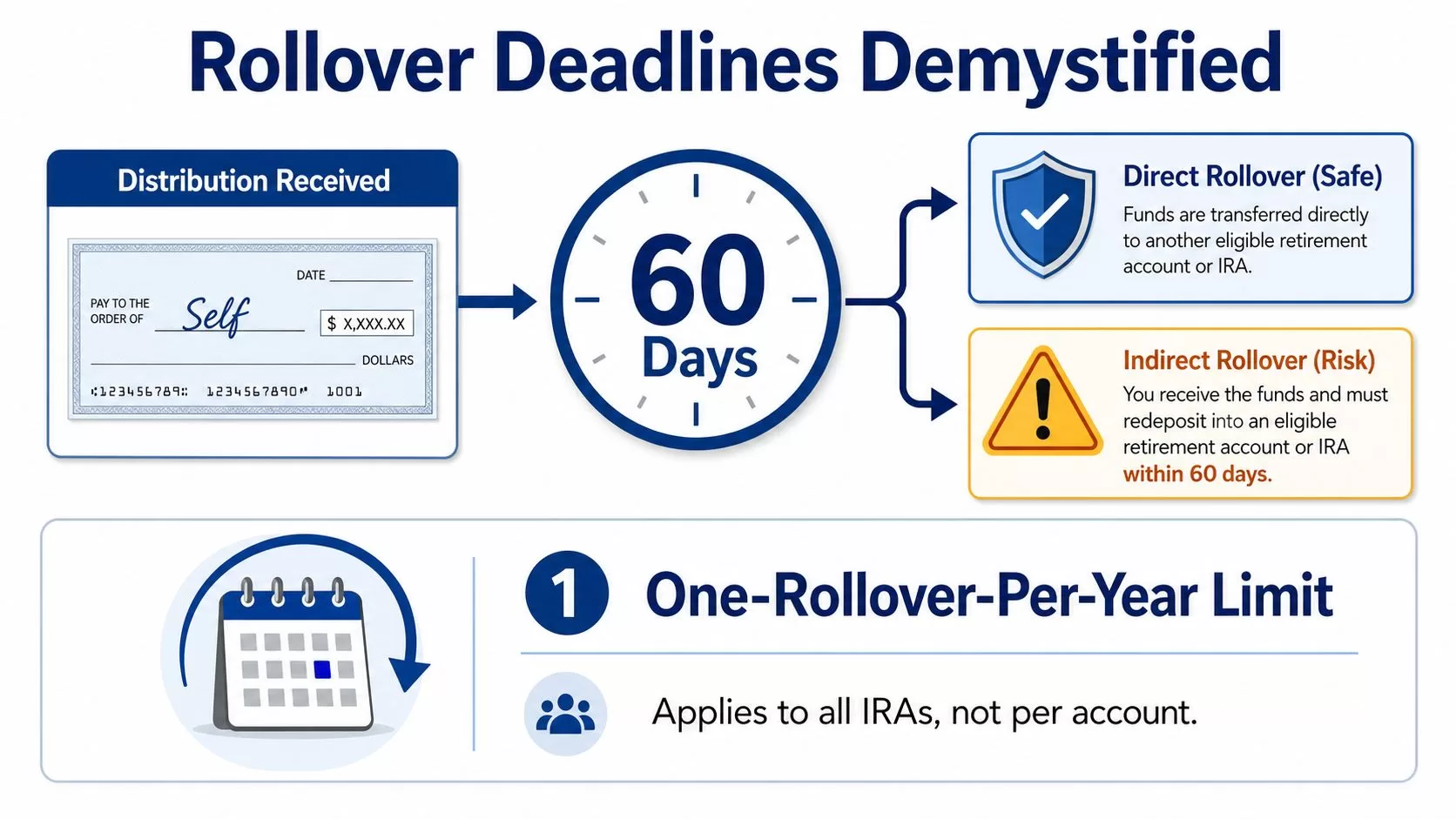

The deadline sounds straightforward, but the trap is timing. A check made payable to the investor starts the clock the day the funds are received, not the day the investor opens the envelope or decides what to do. Missing the window doesn't just create paperwork, it can convert the distribution into taxable income.

The one-rollover-per-12-month rule is where many people get surprised. It applies across all IRAs, not account by account, so splitting money between several IRAs does not create extra rollover capacity. That's why a direct transfer is usually safer when the goal is to reposition retirement assets.
For a form-focused view of what the reporting side looks like, see the page on IRA rollover tax forms.
A direct transfer avoids the two biggest traps at once, the 60-day deadline and the once-per-year rollover limit.
Taxable Events and Mandatory Withholding
A rollover can be tax-free and still be reportable. That surprises many savers the first time they see it on a tax form. The IRS says a rollover is generally tax-free when it is completed correctly, but any taxable portion that is not rolled over belongs in income, and if the taxpayer is under 59½, the 10% additional tax may also apply. Even a clean rollover still has to be reported on the federal return. The IRS explains this reporting treatment in Topic 413 on rollovers.
The amount a person receives may also be smaller than the account balance they expected. That happens when the payer withholds taxes from the distribution before sending the check. If the goal is a full rollover, that withheld amount usually has to be replaced with outside cash, because only the amount rolled over reaches the new retirement account. This is one of the easiest places for a rollover to fall short in real life.
A simple breakdown helps make the tax mechanics clearer:
- Eligible amount: money the IRS allows to move into another eligible retirement account.
- Ineligible amount: money that cannot be rolled over and may be taxable.
- Withheld amount: money the payer keeps back, which can create a gap if it is not replaced from outside funds.
If only part of the distribution is rolled over, the rest usually stays taxable. That is why the destination account is only part of the decision. The source distribution, the withholding, and the amount that qualifies all have to line up if the investor wants the rollover to work as intended.
For readers who want a plain-English walk-through of the tax side, the guide on IRA rollover taxes helps explain how the reporting piece fits before filing season.
When Rollovers Interact with RMDs and Conversions
Required minimum distributions create a hard stop. The IRS says a required minimum distribution, or RMD, generally can't be rolled over, and any rollover contribution of an RMD is not allowed. Publication 590-B also says that an excess contribution tied to an improper RMD rollover is subject to the 6% tax on excess contributions. That makes RMD treatment one of the clearest boundary lines in rollover planning. IRS Publication 590-B
A good way to avoid trouble is to separate the distribution into parts before anyone moves the funds. If a statement or payout notice includes an RMD portion, that portion should be treated as off-limits for rollover purposes. The rest of the distribution may still be eligible, depending on the account type and the transaction structure.
Roth conversions sit beside rollovers, but they aren't the same thing. A conversion moves money from a traditional IRA or eligible workplace account into a Roth IRA, and the tax treatment is different from a standard rollover. In plain terms, a conversion is a tax-event transaction, while a standard rollover is intended to preserve tax deferral if the rules are followed. The right choice depends on the investor's broader tax picture, not just on account mechanics.
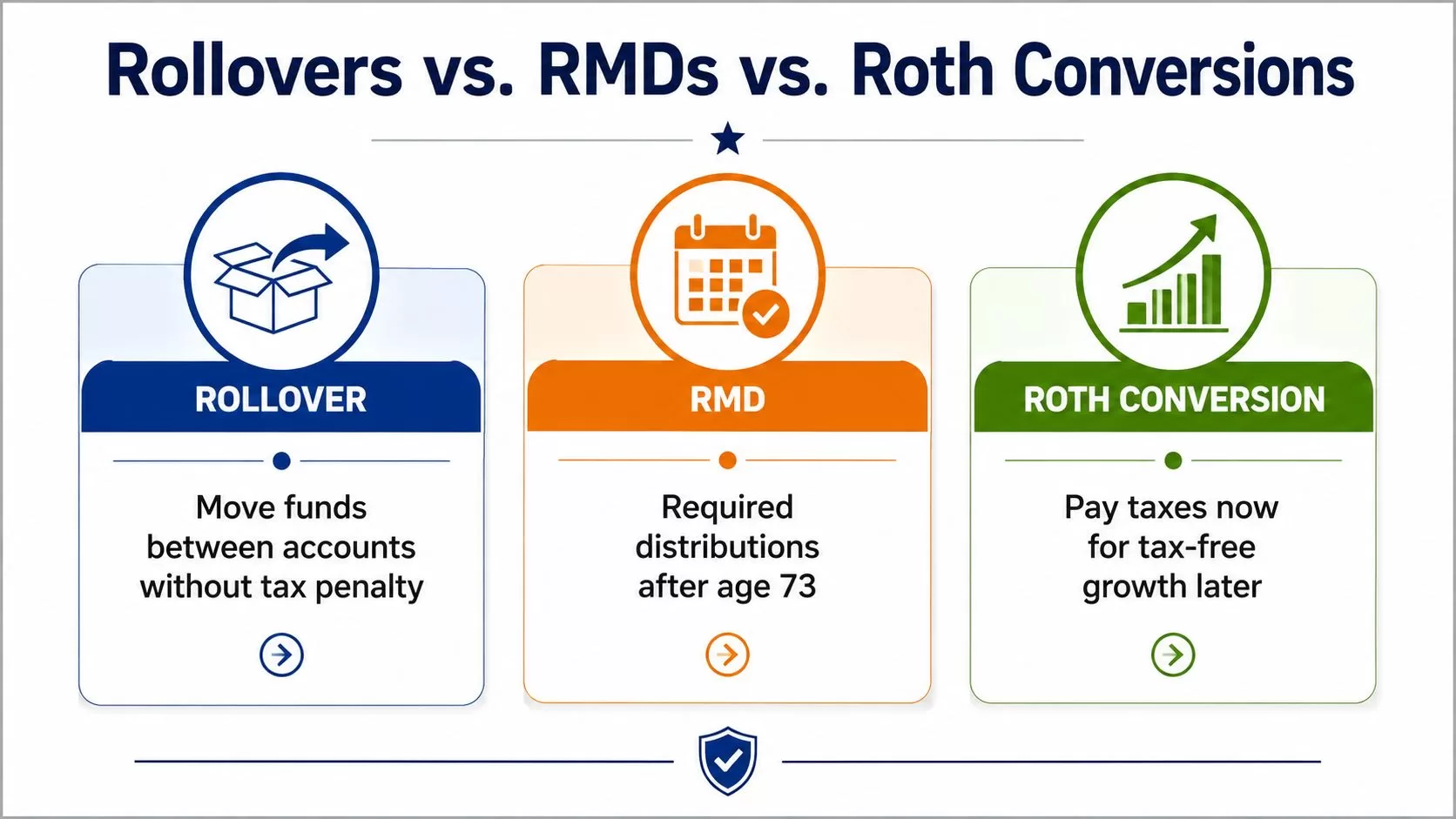
A careful investor treats RMDs as a boundary and Roth conversions as a separate planning tool. Mixing the two concepts is one of the fastest ways to create avoidable tax trouble.
Exceptions and IRS Hardship Waivers
A rollover deadline can still be missed even when the taxpayer never intended to break the rules. Serious illness, a natural disaster, or an error by a financial institution can interrupt the process and make a timely redeposit impossible. The IRS does allow relief in limited cases, but that relief is narrow and meant for unusual situations, not for routine planning.
A common real-world pattern looks like this. A retirement account holder gets a distribution check, then a bank delay, a medical emergency, or a paperwork mistake pushes the redeposit past the deadline. The taxpayer may ask the IRS for relief, but the burden is on the taxpayer to show why the rollover failed and why the delay was outside normal control. The IRS says a waiver of the deadline is possible in limited circumstances beyond the taxpayer's control, as outlined in its guidance on rollovers and waiver requests. See IRS Topic 413 on rollovers.
There is a similar sense of rarity around relief from the one-rollover-per-12-month limit. The rule has narrow exceptions, but a retiree should not build a transfer plan around the hope of getting one. A direct trustee-to-trustee transfer is still the safer route, because it keeps the money moving between institutions without putting the taxpayer at risk of missing the clock.
If a deadline waiver becomes the backup plan, the original plan was already too risky.
That is why waiver language belongs in the emergency folder, not in the standard checklist. If a direct transfer is available, it usually removes the need to rely on hardship relief at all.
Compliance Checklist and Common Mistakes
A rollover goes much smoother when the decision points are handled in the right order. The safest approach is to verify the transaction type first, then confirm which amounts are eligible, and only then move the money. That sequence matters because the IRS rules are much less forgiving once the distribution has already occurred.
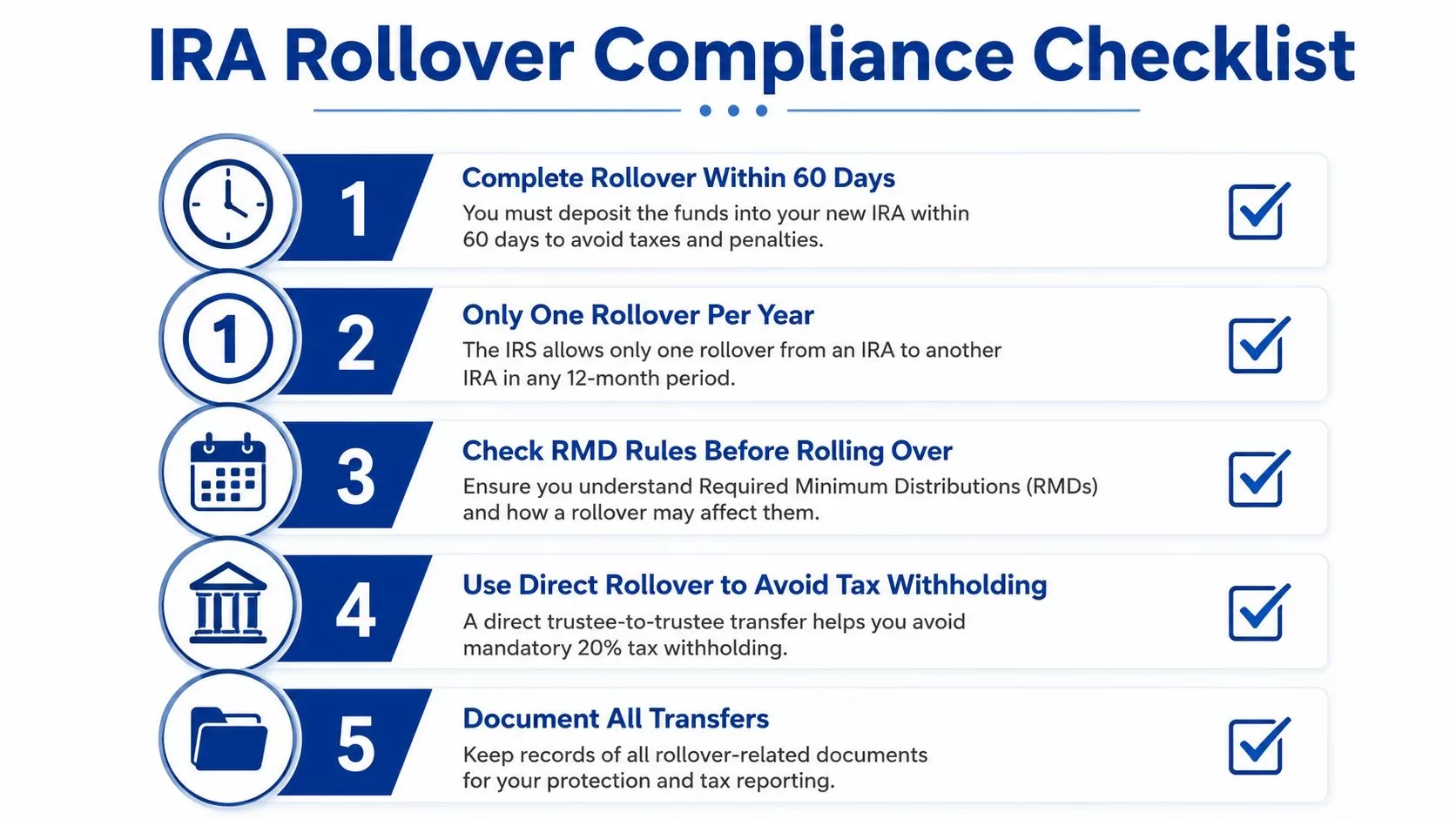
A practical checklist
- Confirm the transaction type: Make sure it is a direct transfer, a direct rollover, or an indirect rollover before the distribution leaves the account.
- Check for RMD amounts: Any RMD portion must stay out of the rollover calculation.
- Track the deadline day one: The 60-day clock begins when the funds are received.
- Plan for withholding: If money is withheld, decide in advance whether outside cash will replace the shortfall.
- Keep the paperwork: Distribution records, redeposit records, and tax forms should all match.
The most common mistakes
- Treating a direct transfer like a rollover. The paperwork may look similar, but the tax consequences are not.
- Missing the 60-day window. That turns a clean plan into a taxable event.
- Forgetting the once-per-year limit. One indirect IRA rollover can block another for 12 months.
- Trying to roll over an RMD. The IRS does not allow it.
- Ignoring mandatory withholding. A shortfall can make the rollover incomplete.
- Assuming every dollar in the distribution is eligible. Some amounts are not rollover-eligible.
- Forgetting that the transaction still gets reported. Tax-free does not mean invisible.
- Using a waiver as a strategy. It is for emergencies, not routine planning.
- Mixing conversion rules with rollover rules. They answer different tax questions.
- Starting the move without confirming the receiving account can accept the funds. The destination matters as much as the source.
A clean process is usually the boring one. That's a good thing in retirement planning.
Your Next Steps After Learning the Rules
The three rules that matter most are the 60-day deadline, the one-rollover-per-12-month limit, and the RMD prohibition. Once those are clear, the safer path becomes easier to see, and that path is usually the direct trustee-to-trustee transfer. It avoids the two biggest rollover traps and keeps the investor from having to manage timing risk.
For anyone thinking about moving retirement money into a self-directed precious metals IRA, the best next step is to slow down and verify the transaction type before any distribution happens. A qualified financial advisor, CPA, or tax professional can help confirm the tax treatment for an individual situation. This is not financial advice. Consult a licensed financial advisor, CPA, or tax professional before making investment decisions.
Gold IRA Association publishes plain-English guides on rollover mechanics, precious metals IRAs, and account rules so readers can make better-informed decisions before moving retirement savings. If this topic is on the table for a rollover or transfer, visit Gold IRA Association for more educational resources and next-step guidance.


