



A near-retiree staring at a 401(k) balance has a fair question. If the goal is to protect retirement savings, should the next dollar go into gold, silver, or a mix of both? The answer is not “which metal is better” in the abstract. It is which metal fits the job you want it to do inside a retirement portfolio.
| Criterion | Gold | Silver |
|---|---|---|
| Portfolio role | Core defensive holding | Tactical satellite holding |
| Volatility | Lower | Higher |
| Long-run compounding | Strong | Strong, but more cyclical |
| Bull-market upside | Usually steadier | Often sharper |
| Industrial exposure | Limited | Meaningful |
| IRA practicality | Easier to size as a core allocation | Better in smaller, disciplined slices |
A practical rule emerges fast. Gold usually belongs in the role of portfolio ballast. Silver belongs in the role of upside torque. Near-retirees who treat them as interchangeable usually end up disappointed, because the metals solve different problems and behave very differently when markets get stressful.
Why Retirement Investors Face a Real Choice Between Gold and Silver
A 55-year-old with a rolled-over IRA doesn't need more noise. That investor usually wants one thing, a sensible way to shield part of a nest egg from inflation, market stress, and the temptation to chase whatever asset is hot this month. Precious metals can play that role, but the choice between gold and silver is not cosmetic. It changes how much risk the portfolio is taking and how the account behaves in a drawdown.
That's why the right question is not whether to invest in silver or gold, but how each metal fits into a retirement plan. Gold has the deeper defensive profile. Silver has the bigger swings. In a retirement account, that distinction matters more than the shiny finish on the coin or bar.
Practical rule: if the metal has to help preserve sleep at night, gold usually gets the larger seat at the table.
For a near-retiree, the decision framework is simple. A conservative saver who is approaching required withdrawals and wants less drama should lean toward gold as the core metal. An investor with a longer runway, stronger risk tolerance, and a desire for more cyclical upside can add silver, but only as a smaller, more deliberate slice.
This article follows the same logic throughout, because that's how a real retirement plan works. First comes the historical record, then the volatility gap, then the IRS rules, then the cost structure, and finally the allocation choices that make sense for actual households. For readers looking for a deeper primer on silver's role as an investment, this overview of silver coins as an investment is a useful companion read.
Historical Returns and Volatility Compared
Gold and silver both have strong long-term records, but they do not reach those results the same way. Over the 1976 to 2016 span, a $1,000 investment in silver grew to about $20,126, while the same $1,000 in gold became about $37,944. That means gold delivered roughly 88% more ending value than silver over that multi-decade hold, even though silver still produced a very large gain, and the same market recap shows silver rising from about $4.33 per ounce to about $19.33 per ounce, while gold moved from about $105 to about $1,350 per ounce. Yahoo Finance
The long-run picture gets clearer when you look at even broader history. From 1925 to 2020, gold rose from $20.63 to $1,893.66 per ounce, compounding at 4.87% annually, while silver rose from $0.68 to $17.14 per ounce, compounding at 3.46% annually. That is one reason gold is usually the better fit for a retirement account that needs steadier compounding rather than dramatic swings. Yahoo Finance
Silver's upside can be explosive, but the price of that upside is volatility
The same dataset that flatters silver in bull markets also warns against using it too aggressively. Silver's best calendar year was 1979, when it gained an average of 376.3% across nine currencies, while gold's best year was also 1979 at 127.5%. Silver's worst year in that sequence came in 1981, with an average loss of 44.0%, while gold's worst year was a 25.1% decline in 1981. In Gold We Trust
That pattern matters for retirement planning. A metal that can soar can also collapse hard, and a 40% plus drawdown is not a small issue if retirement is only a few years away. Another benchmark comparison using GLD and SLV showed SLV with a 65.5% 1-year return versus 22.3% for GLD, but also a much larger 5-year max drawdown of -51.0% versus -26.2% for GLD, along with a higher beta of 0.49 versus 0.17 for gold. Yahoo Finance
A retirement portfolio does not need the most dramatic metal. It needs the metal that can survive bad sequences without forcing bad decisions.
What volatility means for position size
Long-run volatility also leans in gold's favor. One market analysis reported annual return standard deviation for 2000 to 2023 at roughly 18 to 20% for gold versus 30 to 35% for silver, while another long-run comparison found silver's volatility to be about 1.5 to 2x gold's. Discovery Alert That gap is why silver usually needs a smaller position size if the goal is to keep total portfolio risk in check.
For a retiree, that's not a theory exercise. If the account is going to need withdrawals soon, drawdowns become more than a paper loss. Gold's lower realized volatility makes it easier to treat as a defensive allocation, while silver's higher beta makes it more appropriate for investors who can tolerate sharper reversals without changing course.
Five Decision Criteria That Matter for Retirement Portfolios
The right choice starts with how the metal behaves inside the portfolio, not with the metal itself. Gold and silver are both precious metals, but they are not serving the same economic role. Gold has a broader demand base, deeper liquidity, tighter spreads, and lower volatility, while silver is more industrially exposed, more cyclical, and materially more volatile. That difference changes everything from sizing to timing.
| Criterion | Gold | Silver |
|---|---|---|
| Price stability | Better for capital preservation | More prone to sharp swings |
| Liquidity | Deeper and smoother | Good, but more sensitive to trading conditions |
| Demand profile | Monetary and reserve-driven | Industrial plus monetary |
| Entry cost | Higher per ounce | Easier for smaller purchases |
| Retirement fit | Core defensive position | Tactical satellite position |
Stability and drawdown control
Gold is the cleaner fit for a near-retiree who wants fewer surprises. Its lower volatility makes it more usable as a stabilizer, especially when the rest of the portfolio already has enough equity exposure. Silver can outperform, but it asks the investor to tolerate bigger pullbacks and a more uneven path.
Liquidity and buying flexibility
Gold's broader demand base generally makes it easier to size as a core holding, especially for investors who want a cleaner relationship between allocation amount and storage logistics. Silver is more accessible on a per-ounce basis, which helps smaller accounts build exposure gradually, but that same affordability can tempt investors into over-accumulating a metal that moves faster both up and down. Forbes reported in May 2024 that gold was about $2,422 per ounce while silver was about $32 per ounce, which explains why silver often feels like the easier starting point for limited capital.
Industrial demand and cyclicality
Silver's demand profile is more tied to the economy than gold's. One market guide estimated that roughly 50% to 55% of annual silver demand comes from industrial uses such as solar panels, electronics, electric vehicles, and medical devices, while gold's industrial use is only about 7% to 10% of demand. MetalCharts That makes silver more sensitive to growth cycles, which can be a plus in expansions and a minus in recessions.
Inflation and crisis behavior
Gold remains the metal most associated with monetary protection. It has the broader reserve role, and that gives it a different kind of support when financial confidence weakens. Silver can help in inflationary stress too, but it is not usually the first metal a cautious retiree reaches for when the goal is defense.
Entry cost and account sizing
Silver's lower price per ounce can make it easier to start small, but that does not mean it should automatically take the larger share. For retirement investors, the right allocation is usually the one that fits the account's role in the overall plan, not the metal that looks cheaper at the counter.
IRS Eligibility Rules for Gold and Silver IRAs
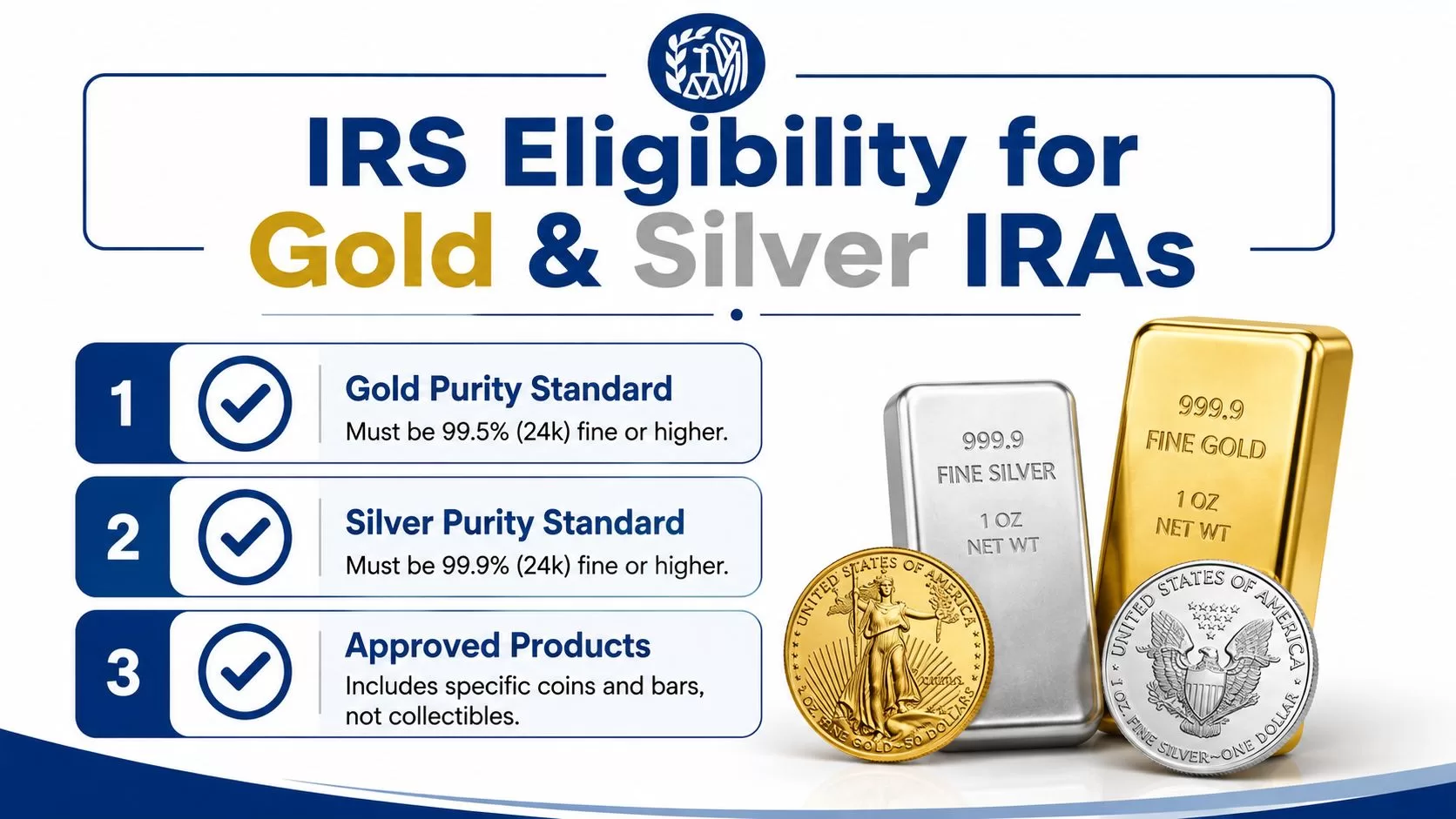
Compliance comes first. A retirement investor can have the right thesis and still create a mess by buying the wrong product. For a precious metals IRA, the metal must meet IRS standards and be held by an approved custodian in an IRS-sanctioned depository. Home storage is not the rule here, and a mistake can turn the purchase into a taxable problem.
The basic purity standards are straightforward. Gold must generally be 99.5% fine, and silver must generally be 99.9% fine. There are important product-specific exceptions and approved coin types, so the safe move is to ask for IRA-eligible products only and verify everything before funding the purchase. The core rule set is outlined in this precious metal IRA rules guide.

What to ask for and what to avoid
A clean way to screen a purchase is to keep the conversation focused on eligibility, not marketing language.
- Check the purity first: Gold and silver need to meet the applicable IRS purity standard before they belong in an IRA.
- Ask for approved forms only: Common IRA-eligible products include certain government-issued coins and approved bars from recognized refiners.
- Reject collectibles and numismatics: If the pitch leans on rarity, grading hype, or special collector value, that is a red flag for IRA use.
- Confirm storage before settlement: The metal must go to an approved depository, not to the owner's home or personal safe.
Approved examples commonly include American Eagle coins, which have a special exemption from the purity rule, along with Canadian Maple Leaf coins, Austrian Philharmonic coins, and approved bars from COMEX- or NYMEX-approved refiners. The key is not to improvise. If a product sounds exotic, unusual, or hard to verify, it probably does not belong in a retirement account.
Practical rule: if the dealer starts talking about rarity before purity, the buyer should slow the conversation down.
When Each Metal Earns a Larger Portfolio Role
Gold has been getting strong official-sector support, and that matters for retirees who want the metal to behave like a defensive reserve asset. The World Gold Council reported that central banks bought 166 tonnes of gold in Q2 2025 and 415 tonnes in the first half of 2025, which reinforces gold's role as the metal institutions still want on the balance sheet. That is not a guarantee of future price direction, but it does support the case for gold as the larger core holding in a retirement metals allocation. World Gold Council
Silver lives in a different world. Its demand is increasingly discussed through industrial channels, especially solar, EVs, and 5G infrastructure, which means silver's behavior can improve when growth is strong and capital spending is healthy. That makes silver useful, but not as a substitute for gold. It is the upside sleeve, not the foundation.
Which regime favors which metal
A simple framework helps.
- Stagflation or policy stress: gold usually gets the larger role because investors want stability and monetary protection.
- Growth-driven expansion: silver can justify a larger share because industrial demand has more room to help.
- Deflationary or risk-off stress: gold again tends to be the steadier choice, while silver can get hit harder.
That leads to a clean allocation logic for retirees. Gold deserves the broader role when the account needs steadiness, income planning, and less frequent rebalancing. Silver earns a larger role only when the investor has time, higher risk tolerance, and no need to tap the funds soon.
For many households, the smartest mix is not a 50-50 split. It is a core gold position with a smaller silver satellite layered on top. The exact blend depends on the retirement horizon, but the hierarchy should stay the same. Gold protects. Silver amplifies.
Understanding the Full Cost of Precious Metals IRAs
A precious metals IRA is not just a metal decision. It is a fee decision, and fees matter more in retirement than many admit. The account can carry setup charges, annual custodial and administrative fees, storage costs, wire fees, and the dealer spread on the metal itself. If those costs are not compared carefully, the account can look reasonable at the start and drag on returns for years.
Silver IRAs can also carry a practical cost issue that catches people off guard. Because silver is much cheaper per ounce, it takes more physical metal to reach the same dollar allocation, which can mean more vault space and a different storage profile. That does not make silver bad. It just means the all-in ownership cost should be reviewed with extra care.
A good quote should separate the pricing buckets clearly. If it doesn't, that's a problem. Investors should ask for the annual number that includes custodial, storage, and expected transaction costs, then compare that number across account structures instead of getting distracted by one low advertised fee.
How to read a fee quote without getting fooled
- Setup costs: These are the opening charges. They matter, but they are only the beginning.
- Ongoing custodial and administrative fees: These are the recurring costs that can compound.
- Storage pricing: Segregated and commingled storage are not the same thing, and the pricing should reflect that difference.
- Dealer premiums and liquidation spreads: The spread matters on the way in and on the way out.
- Transfer and wire fees: Small charges can stack up during rollovers and rebalancing.
For a more detailed breakdown of rollover-related expenses, the IRA rollover fees guide is the right place to start. The main point is straightforward, low-cost marketing is not the same thing as low-cost ownership.
Recommended Allocation Scenarios and Next Steps
A sensible retirement metals allocation should follow the investor's timeline, not the market headline of the week. The numbers already point to a clear hierarchy. Gold has the better long-run compounding record, lower realized volatility, and the cleaner defensive profile. Silver has the bigger bursts of upside, but it also brings a much rougher ride.
Three allocation paths that make sense
- Conservative: 100% gold, 0% silver within the metals sleeve. This fits investors within about five years of retirement who care most about capital preservation and drawdown control.
- Balanced: 70% gold, 30% silver. This works for investors with a 7 to 15 year horizon who want a steadier anchor with some cyclical upside.
- Growth-oriented: 50% gold, 50% silver. This is for higher-risk investors who can tolerate a choppier ride and want stronger exposure to precious-metals bull markets.
Those percentages are about portfolio role, not ego. A retiree who needs stability should not force silver into the core just because it looks affordable. A pre-retiree with time and discipline can afford more silver, but only if the rest of the retirement plan can absorb the volatility.
A rollover checklist keeps the process clean. Confirm the account type first, choose a custodian that understands precious metals IRAs, verify fee transparency in writing, review storage arrangements before funding, and make sure every product on the order is IRA-eligible. The provider should also explain the rollover paperwork clearly and show how the metals will be reported for tax purposes, because ambiguity here creates expensive mistakes.

Gold IRA Association helps retirement investors compare gold and silver IRA choices with a focus on IRS rules, rollover mechanics, and real-world allocation trade-offs. If you're deciding whether gold should be the core holding and silver the satellite, visit Gold IRA Association for clear educational guides and a practical next step. This is not financial advice. Consult a licensed financial advisor, CPA, or tax professional before making investment decisions.


