




A Gold IRA can look simple on the surface, until the tax rules get involved. A retiree might be deciding whether to move old 401(k) money, buy approved bullion, or take an RMD, and each choice carries different IRS consequences. The rules are manageable once they're broken down, but one small procedural mistake can turn a tax-deferred move into a taxable event.
Gold IRA tax rules are best understood as a set of guardrails, not a loophole. The account can defer taxes, but only if the metals, the custodian, the depository, and the withdrawal process all stay inside IRS boundaries. That's where most confusion starts, and where the practical traps begin.
Understanding Gold IRA Tax Fundamentals
A Gold IRA is really a self-directed IRA that holds physical precious metals under special IRS rules. The tax advantage comes from the IRA wrapper itself, not from the metal. Inside the account, gold trades do not create annual capital-gains tax in the way a taxable brokerage account would, because the tax event is generally pushed to distribution time. Outside an IRA, physical gold can face a federal 28% collectibles rate on long-term gains, which is one reason the account structure matters so much. Source on Gold IRA tax treatment and collectibles taxation
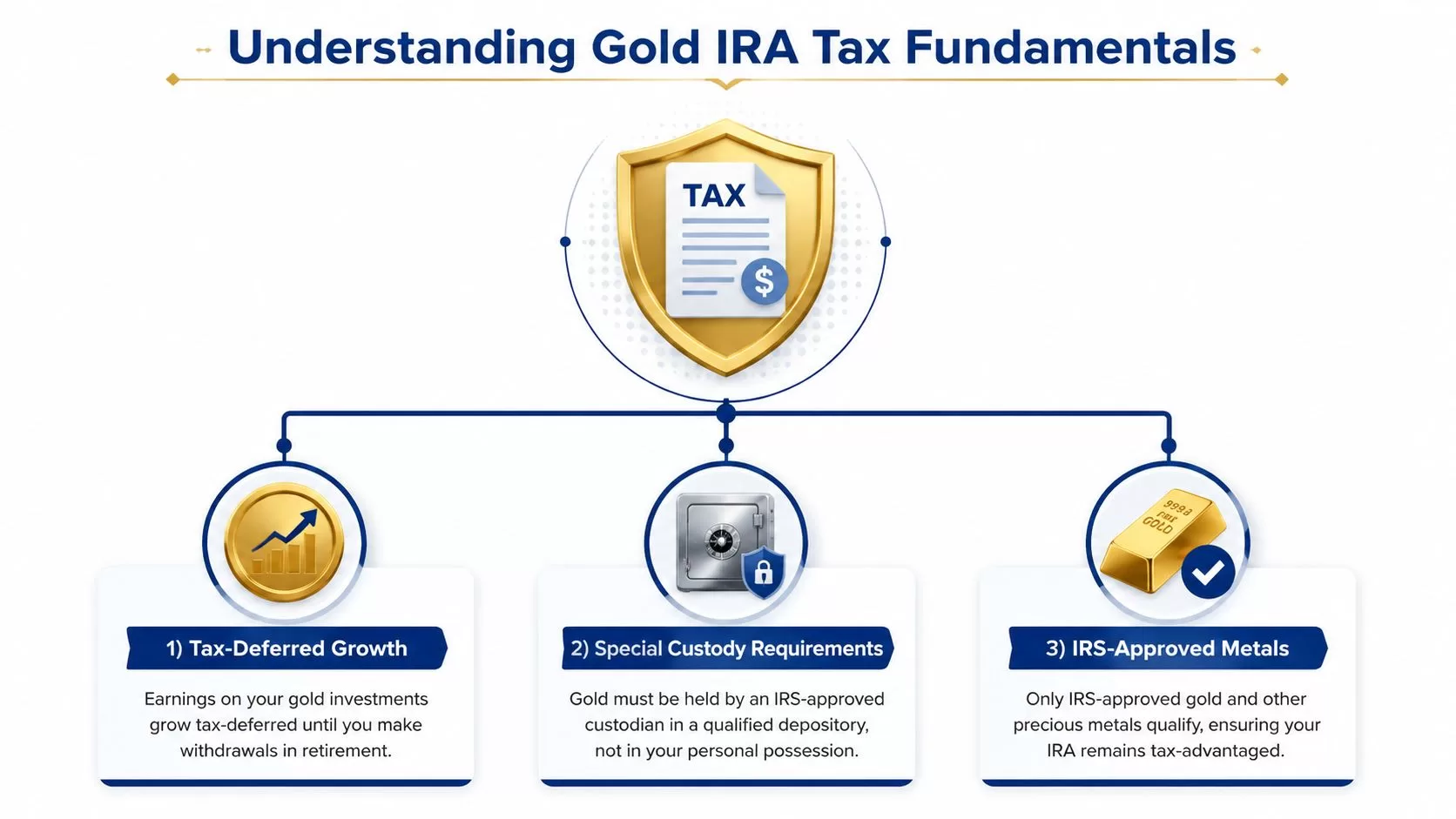

The two compliance pillars that matter most
The first pillar is metal eligibility. IRA-owned gold generally has to meet a 99.5% fineness threshold, and silver, platinum, and palladium have their own purity standards. The exception that often surprises people is the American Gold Eagle, which is legally permitted even though it is 91.67% pure. That exception exists because IRA eligibility depends on statutory rules, not just a simple purity test. IRS-style eligibility standards and the American Gold Eagle exception
The second pillar is custody. IRA gold must be held by an approved custodian in an approved depository, not at home. That rule is not a technicality. If the account owner stores the metal personally, the IRS treats that as a distribution, which can create tax and penalty exposure. Approved depository and custodian requirement
Practical rule: if the metal or the storage arrangement would be unacceptable in a normal IRA audit, it probably isn't compliant in a Gold IRA either.
For readers comparing account setups, the most useful internal overview is the precious metals IRA rules guide. It helps connect the purity standards, approved product types, and storage rules into one compliance picture.
Funding Your Account with Contributions and Rollovers
Money can enter a Gold IRA in three broad ways, but they do not all carry the same tax risk. Annual contributions are fresh money subject to contribution rules. Direct rollovers move retirement money between custodians. Indirect rollovers put the funds in the owner's hands first, which is where many people get into trouble.
Why direct rollovers are safer than indirect ones
A direct trustee-to-trustee transfer is the cleaner path because the money never becomes personally controlled by the account owner. Neutral guidance notes that when done correctly, a direct rollover carries no tax or penalty. The account changes custodians or account types, and the retirement money stays inside the tax-advantaged system. By contrast, an indirect rollover can trigger tax consequences if the redeposit is late. The practical issue is timing, not intent. Direct versus indirect rollover mechanics and the 60-day issue
An indirect rollover is where people get trapped. The distribution check arrives in the owner's name, the clock starts, and the funds must be redeposited within the allowed window. If the deadline is missed, the distribution can be treated as taxable. That means the account owner may owe tax on money that was supposed to stay tax-deferred.
Best practice: if a rollover is available directly between custodians, that route is usually the lowest-friction option for avoiding a paperwork mistake.
The difference matters even more because rollovers are not the same thing as new contributions. A rollover is a movement of existing retirement money, while a contribution is new money coming into the IRA. That distinction matters for people who assume a rollover counts against annual limits. It doesn't, but only when the rollover is handled properly.
A simple decision framework
- Choose a contribution if the money is new and eligible for IRA funding.
- Choose a direct rollover if retirement money is already sitting in another account and the custodian can move it cleanly.
- Treat an indirect rollover cautiously because the owner receives the funds first, and the 60-day deadline can turn a simple transfer into a taxable mistake.
For readers who want a process-oriented walkthrough, the Gold IRA rollover guide is the right companion resource. It's especially useful for pre-retirees moving money from old workplace plans.
Taxing Your Nest Egg Rules for Gold IRA Distributions
The tax treatment at withdrawal depends on the account type. A Traditional Gold IRA and a Roth Gold IRA do not behave the same way when money comes out, even if both hold the same bars or coins. That's why distribution planning matters just as much as purchase planning.

Traditional and Roth accounts are taxed differently
Withdrawals from a Traditional Gold IRA are generally taxed as ordinary income. The metal's fair market value at distribution is what matters, not what the owner originally paid for it. That is a key difference from taxable gold ownership, where gains are often discussed through a capital-gains lens.
A Roth Gold IRA works differently. When the distribution qualifies, the money can come out tax-free. That favorable treatment is tied to Roth rules, not to the fact that the account happens to hold gold. The asset inside the account doesn't change the account's basic tax character.
The age rule also matters. Withdrawals before 59½ can trigger the 10% early withdrawal penalty, unless an exception applies. The penalty is separate from ordinary income tax in a Traditional account, which means early access can get expensive fast. Withdrawal rules, penalties, and ordinary-income treatment
What the owner should think about before taking money out
The tax question is not just, “Can the account owner withdraw?” It's also, “What happens after the metal leaves the IRA?” A person who takes physical gold rather than cash still has a taxable distribution event in a Traditional account, and the value at the time of distribution controls the tax reporting.
A useful way to think about it is this. Inside the IRA, the metal is sheltered. Outside the IRA, the tax rules follow the distribution, not the metal's sentimental value or original purchase price.
Practical rule: if the account owner wants the gold personally, the distribution date becomes the tax date, and the fair market value on that date matters.
For a side-by-side review of account tax behavior, the gold IRA versus traditional IRA guide helps explain why the same asset can produce different tax results depending on the wrapper around it.

Required Minimum Distributions for Gold IRAs
Required minimum distributions are where a Gold IRA can become awkward. The account may hold a valuable asset, but gold doesn't naturally generate cash. That creates a planning problem for older account owners who must start withdrawals under the RMD rules.
Traditional, SEP, and SIMPLE Gold IRAs must begin RMDs at age 73 under SECURE 2.0, and missed amounts can be hit with a 25% excise tax, which can fall to 10% if corrected promptly. RMD age and penalty treatment
How RMDs are usually satisfied
There are three practical ways to satisfy an RMD from physical gold holdings.
- Sell part of the metal for cash. The custodian liquidates enough gold to create the distribution amount.
- Take an in-kind distribution. The owner receives physical metal and pays tax on its value if the account is Traditional.
- Use a combination. Some owners split the difference, selling part and taking part in kind.
The hard part is liquidity. Gold may have risen in value, but that does not mean the account has cash available for a withdrawal. A retiree can be asset-rich and cash-poor at the same time. That's why RMD planning for bullion is different from planning for mutual funds or cash positions.
Why valuation and timing matter
An RMD is calculated from the account's value, so the metal must be valued correctly. If the valuation is off, the distribution may be too small, which can create a compliance issue. The owner should not wait until late December to solve that problem, because the account may need time to sell metal or process an in-kind transfer.
Practical insight: Gold IRA owners often need a cash reserve or a liquid companion account so the RMD doesn't force an untimely sale of bullion.
For older account owners, that planning step is more than a convenience. It can prevent a situation where the account has strong value on paper but no easy way to satisfy the year's required withdrawal.
Reporting Your Gold IRA Activity to the IRS
Tax paperwork is easier to handle when the forms are understood in plain English. Gold IRA owners usually see two forms most often, and each one serves a different purpose.
Form 5498 and Form 1099-R do different jobs
IRS Form 5498 reports contributions and rollovers into the IRA. It functions as a record of money entering the account, not leaving it. If the owner funded the account by rollover or contribution, this is one of the main documents that helps show the account stayed within the IRA system.
IRS Form 1099-R reports distributions out of the account. If the owner took cash, received metal, or completed another taxable withdrawal, this form is the paper trail that supports income-tax reporting. The form matters because the IRS wants to know what left the account and how it was categorized.
The practical habit here is simple. Check the account type, the amount reported, and whether the distribution or rollover was labeled correctly. Small reporting errors can create unnecessary follow-up with a tax preparer later.
What to watch for at tax time
A Gold IRA owner should make sure the paperwork lines up with the actual transaction. A rollover that was meant to stay tax-deferred should not look like a taxable withdrawal. A distribution that was meant to count as income should not be left off the tax return by mistake.
The accounting logic is straightforward, but the practical process can get messy when metals are involved. Bars have to be valued, custodians have to process transfers, and the tax documents have to reflect what occurred. That's why these forms are more than mail. They are the record of compliance.
Navigating Common Gold IRA Tax Traps
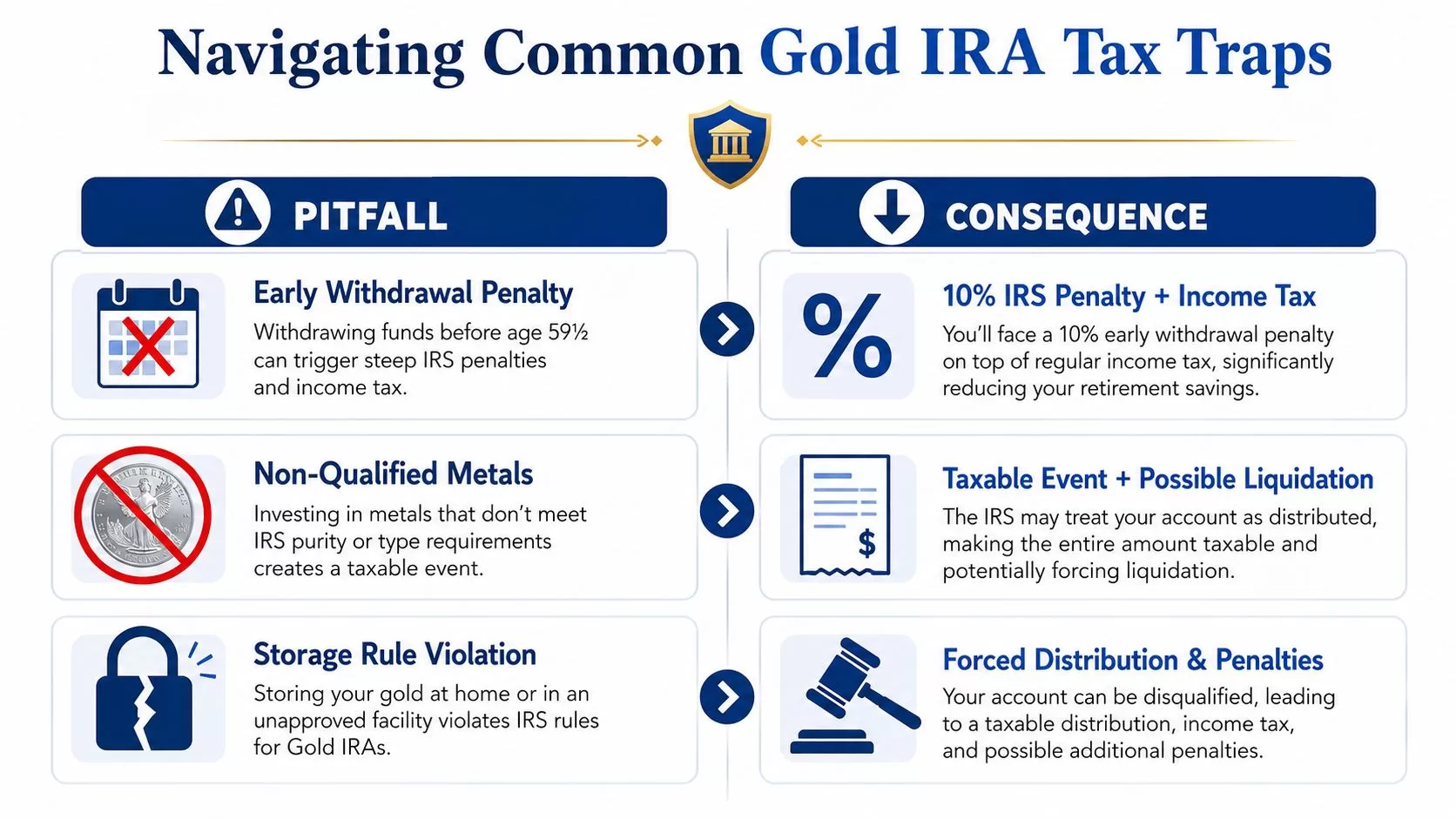
Some Gold IRA mistakes are expensive because they are simple. The account owner thinks the rules are flexible, but the IRS often sees the transaction as a distribution, a prohibited asset, or a storage violation. These are the errors that deserve the most caution.
Home storage is the biggest mistake to avoid
If IRA gold is stored at home, the IRS treats that as a distribution. That can create immediate tax exposure, and if the owner is under 59½, it can also bring the 10% penalty into play. The problem is not where the owner feels safer, it's where the IRS says the asset must sit.
Non-qualified coins can break the tax treatment
Another common trap is buying metal that looks suitable but fails the IRA eligibility rules. Common non-eligible forms include jewelry, scrap, and most sovereign coins that do not meet the statutory requirements. Even if the item is physically gold, it still may not qualify for IRA treatment. The issue is composition and legal status, not appearance.
Early withdrawal is not the same as a rollover
Some owners accidentally treat a distribution like a transfer. That's dangerous. If the money or metal leaves the tax shelter without being handled correctly, the event can become taxable even when the owner's original intention was just to move retirement assets.
Short version: a Gold IRA is protective only when the custodian, the depository, and the transaction method all stay within the rules.
The safest mindset is to assume the IRS cares about process as much as outcome. If the process is wrong, the tax result can be wrong too.
Gold IRA Tax Rules FAQ
Are Gold IRA fees tax-deductible? Usually, no. After changes under the Tax Cuts and Jobs Act, many miscellaneous itemized deductions were suspended for individual taxpayers, which means custodial and storage fees generally don't get the easy deduction treatment some retirees expect. A tax professional should review the owner's broader return, because individual circumstances can still matter.
Do state income tax rules apply to Gold IRA distributions? Yes, they can. Federal IRA rules set the baseline, but state income tax treatment varies. A distribution that's federally taxable can also be taxable at the state level depending on where the retiree lives.
What happens if a beneficiary inherits a Gold IRA? Inherited IRA rules still apply, but the beneficiary's tax treatment depends on whether the account was Traditional or Roth and how the inherited account is distributed. The metal doesn't escape the inheritance rules just because it's physical gold. The distribution method and the beneficiary's timeline remain important.
Can the owner take physical gold instead of cash? Yes, in some cases. But the tax result depends on the account type, and the metal's fair market value at distribution controls the reportable amount.
Gold IRA tax rules are manageable when the owner keeps the big three priorities straight, qualifying metals, proper custody, and correct distribution handling. The details matter because every step can change the tax outcome, especially when a rollover, an RMD, or an in-kind withdrawal is involved. This is not financial advice. Consult a licensed financial advisor, CPA, or tax professional before making investment decisions.
Gold IRA Association publishes plain-English guides on rollovers, eligible metals, RMDs, and tax rules so retirees can make better decisions without guesswork. If the next step is to compare account mechanics or review how a rollover would work in a real retirement plan, visit Gold IRA Association for more educational resources and a clearer path forward.


