




Does a custodian's willingness to hold an investment mean someone has checked whether it belongs in a retirement portfolio? That gap matters more than a long investment menu. Finding the best self-directed IRA custodian means matching the account's assets to reliable administration, clear charges, useful reporting, and a compliance process that doesn't confuse transaction processing with investment approval.
Best Self Directed IRA Custodians at a Glance
No single custodian is best for every account. A property investor needs different transaction support from a retiree buying physical bullion. The right starting point is the custodian's operating model, not its advertising.
These categories can overlap. A trust company might also specialize in metals, while a dealer might introduce customers to a separate custodian rather than provide custody itself.
Custodian types and what to check first
| Custodian type | Best fit | Check first | Watch for |
|---|---|---|---|
| Broad self-directed IRA custodian | Investors holding real estate, promissory notes or private placements | Asset acceptance policy and valuation process | A wide asset menu that doesn't imply investment vetting |
| Precious-metals-focused custodian | Investors whose IRA is mainly physical gold, silver or other IRS-eligible metals | IRS-eligible product list and storage arrangement | Dealer ties that may influence product pricing or choices |
| Bank or trust-company custodian | Investors who want traditional administration within an existing banking relationship | Whether alternative or metals assets are accepted | A narrower asset menu and fewer metals options |
| Dealer-affiliated custodian | Investors buying metals through a dealer who want a single point of contact | Written fee schedule and whether another dealer can be used | Pricing and product options tied to a single company |
Decisions to make before requesting proposals
- Intended assets: Identify the actual investments, not “alternatives.” A rental property, private loan, and bullion purchase require different paperwork.
- Physical-metals custody: Establish whether metals will go into an appropriate depository arrangement and which organization will maintain the ownership records.
- Funding route and timing: Distinguish a new contribution from a rollover involving an employer plan or an existing IRA. Confirm when the current administrator can release funds before committing to a purchase.
Individual firms differ in their written policies, statements, and transaction procedures. A category is a starting filter, not a verdict on any business.
Shortlist rule: Write down the asset list and funding status before contacting providers. Compare only firms willing to document how they'll administer that specific account.
What a Custodian Does and How to Score It
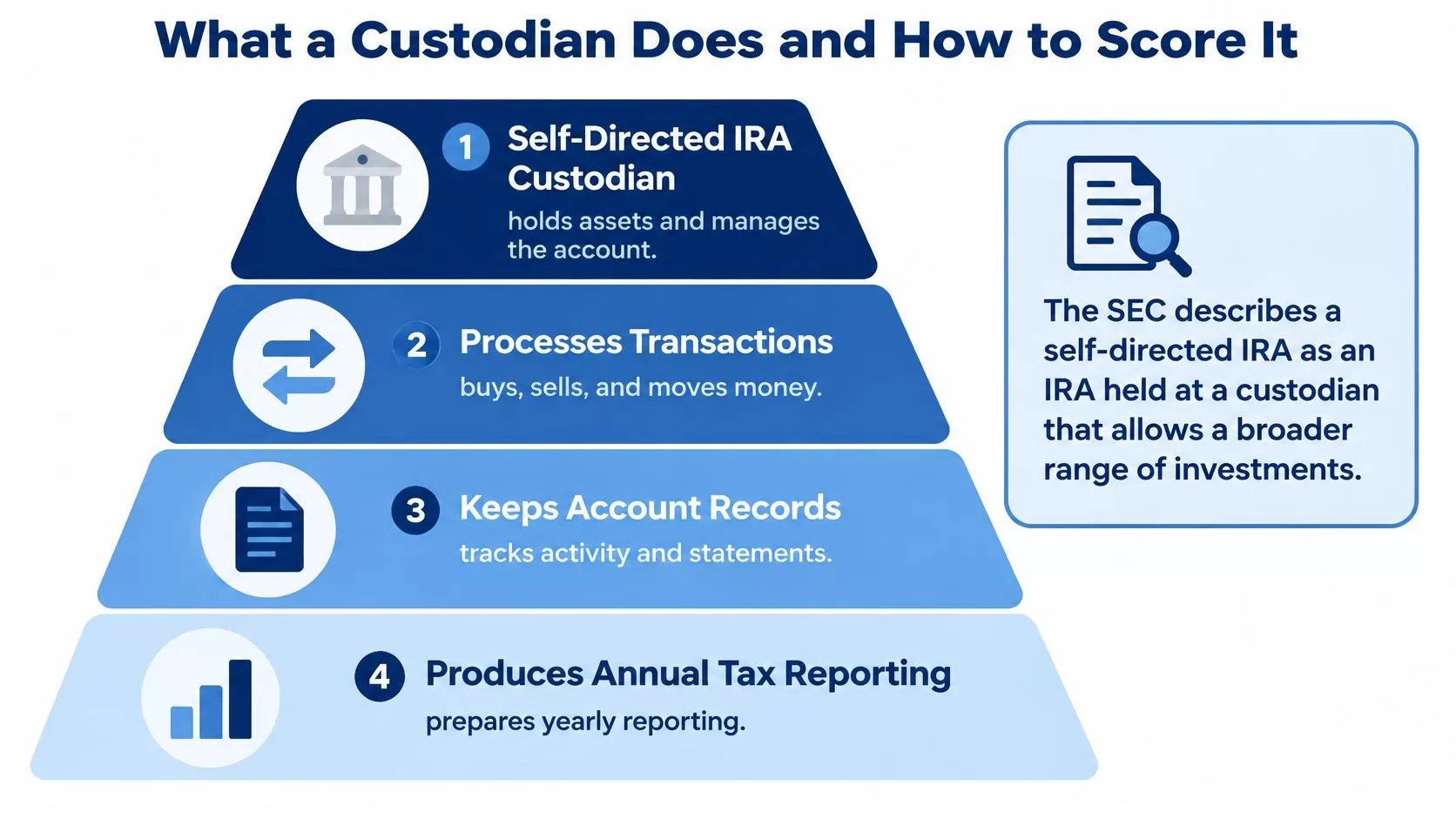
A self-directed IRA custodian provides the administrative structure around the account. Its work includes holding assets or arranging custody, processing authorized transactions, maintaining records, and producing statements and annual tax reporting.
The SEC's self-directed IRA investor alert describes an SDIRA as an IRA held by a trustee or custodian that permits broader investments, including real estate, promissory notes, tax-lien certificates, and private-placement securities, while warning about limited disclosure, illiquidity, fraud, high fees, and volatile performance. A wider menu therefore creates more due-diligence work, not evidence of better custody.
The administrative functions are illustrated below.

Separate the custodian, seller, and account owner
The custodian handles account administration according to its agreement. The dealer or investment seller supplies the product, quotes the price, and provides transaction documentation. The account owner evaluates the investment, its eligibility, valuation, risks, and eventual exit.
Consider a proposed bullion purchase. A custodian's acceptance means it is willing to process and administer the transaction under its policies. It doesn't establish that the dealer's markup is reasonable, that the coin suits the retirement strategy, or that a projected return is credible.
The SEC Investor Advisory Committee's IRA recommendation notes that many custodians don't verify investment statements, ensure complete disclosure, or confirm that assets satisfy IRS requirements. Clear disclaimers are therefore useful evidence of an honest service boundary, not necessarily a service weakness.
A provider should also identify who holds the asset. An account administrator, dealer, and storage operator can be separate businesses, even when the customer experiences a single sales process.
Use evidence-based scores rather than star ratings
Assign each criterion a status: Pass, Needs clarification, or Fail. A pass requires written evidence that applies to the proposed account. A reassuring telephone answer without supporting documents remains unresolved.
Custodian credibility and service scorecard
| Criterion | Priority | What to verify | Red flag |
|---|---|---|---|
| Asset acceptance policy | High | Written accepted asset types and product restrictions | Accepts any asset without written review criteria |
| Transaction-processing workflow | High | Steps from request to settlement, including timelines | No written process or unclear responsibility for delays |
| Documentation and statements | High | Sample statement, transaction records, ownership documents | Missing asset descriptions or valuation dates |
| Valuation procedures | High | Pricing method and identity of price supplier | Valuations supplied only by a related dealer |
| Annual tax reporting | Medium | Forms issued and reporting timetable | Unexplained reporting fee add-on |
| Written due-diligence disclaimers | High | Clear limits on investment validation and IRS eligibility review | Language implying investment approval |
| Customer service responsiveness | Medium | Compliance contact, response expectations, callback process | Unreturned questions before opening |
| Complaint and enforcement history | High | Regulator and complaint searches for firm and principals | Unresolved complaints or undisclosed enforcement actions |
| Operating history and ownership | Medium | Operating history, ownership, leadership | Missing or vague ownership and leadership details |
For transaction workflow, ask the provider to walk through a realistic purchase. Who reviews the invoice? Who authorizes payment? How does the customer learn that settlement failed? Answers should identify responsible staff functions rather than merely promise fast service.
For reporting, request a redacted sample statement. An investor should be able to distinguish cash from investments, recognize each holding, and identify the date and source of its reported value. A polished portal isn't enough if those details are missing.
Interpret the results conservatively
A High-priority failure should remove a provider from the shortlist until the underlying problem is resolved. Strong customer service shouldn't offset unclear ownership records or misleading claims about investment approval.
Medium-priority gaps still deserve attention. For example, an unclear reporting timetable may become a practical problem when an owner needs records for tax preparation or distribution planning.
Complaint reviews require context. An allegation, a resolved service dispute, and a formal enforcement action aren't equivalent. Examine the underlying issue, the firm's response, and whether the same operational weakness appears repeatedly.
A useful scorecard measures what the provider can document and execute. It doesn't award points for predicting investment returns.
Fees to Compare Across Custodians
The true cost of custody includes every charge associated with opening, maintaining, using, and eventually leaving the account. A low advertised administration fee can look different after transaction, valuation, storage, and exit charges are included.
Flat pricing and balance-tiered pricing also behave differently as an account changes. Storage may be billed separately by another organization, so a custodian's invoice may not show the complete cost.
Fee types to request in writing
| Fee type | When it applies | How it is billed | Question to ask |
|---|---|---|---|
| Account setup | At opening | Flat or tiered opening charge | Is the setup fee waived for a rollover? |
| Annual administration | While the account remains open | Flat or balance-tiered | Does the fee change with account value? |
| Transaction fee | Purchase, sale, or transfer | Per transaction | Are dealer purchases and sales charged separately? |
| Asset or valuation fee | When an outside valuation is needed | Per asset or valuation | Which assets trigger this charge? |
| Storage fee | While metals remain in a depository | Flat, per item, or percentage-based | Is storage separate from administration? |
| Distribution or wire fee | Withdrawal or outgoing transfer | Per event | What does an outgoing transfer cost? |
| Closure or transfer-out fee | Account closure or departure | One-time charge | Is moving the account subject to a separate fee? |
Compare an identical account scenario
Send each shortlisted provider the same proposed balance, asset list, and expected transaction activity. Request an opening-year estimate and a normal ongoing-year estimate, with promotional waivers shown separately.
The comparison should identify:
- Recurring expenses: Administration, storage, and routine asset charges.
- Activity-driven expenses: Purchases, sales, wires, distributions, and outside valuations.
- Exit expenses: Liquidation, shipping where applicable, closure, and transfer-out charges.
For metals, obtain the dealer's purchase quote and resale terms separately. A trading spread isn't the same thing as a custodial fee, but both affect the investor's economics.
The self-directed IRA fee guide provides a framework for organizing these charges. Request the actual schedule and calculate a full-year cost comparison before choosing a provider.
Cost check: Ask what charges continue if an investment becomes illiquid or loses its value. Difficulty selling an asset doesn't necessarily stop account expenses.
Storage Options and Who Holds the Metal
Where does IRA-owned metal sit, and how can you tell what your account owns? The custody arrangement answers both questions. Precious metals held in an IRA are generally kept through a trustee or custodian at a depository; personal home storage is not a substitute for that arrangement. Review the requirements that apply to your account with a qualified tax professional before arranging delivery.

Understand what the storage agreement promises
The storage agreement connects the account's ownership records to the metal held at the depository. Read how it describes identification, substitution, and release procedures.
- Segregated or individually identified holdings: Check whether specific items are assigned to the account and remain identifiable. “Allocated” describes ownership attribution; it does not, by itself, promise a separate physical compartment.
- Pooled or commingled holdings: Metal may be stored alongside other customers' holdings. The agreement should clarify whether the account owns identified metal or has a right to equivalent metal, and explain what happens if the account requests withdrawal or liquidation.
Segregated storage can make item-level reconciliation easier. With pooled storage, focus on the ownership records and recovery terms. A statement balance alone does not explain how metal is identified or released.
The precious-metals storage guide outlines questions to compare against the agreement that applies to your account.
Request evidence of custody protections
Ask for the depository's legal name and location, its item-identification practices, and details of its audits. If bars have serial numbers, find out whether account-level records include them.
Review insurance separately. Confirm who holds the policy, which risks it covers, and how claims are handled. Insurance does not promise protection against every loss.
A custody diagram should trace the relationship from IRA account to custodian to depository, then distinguish metal recorded to one account from metal held in a pool. Use the same path to check whether the agreement, account records, and storage description tell a consistent story.
Request the storage agreement and a recent audit or insurance summary before approving a shipment. If you take personal possession through a distribution, tax consequences may apply, so review delivery instructions with a qualified tax professional.
Prohibited Transactions and Compliance Red Flags
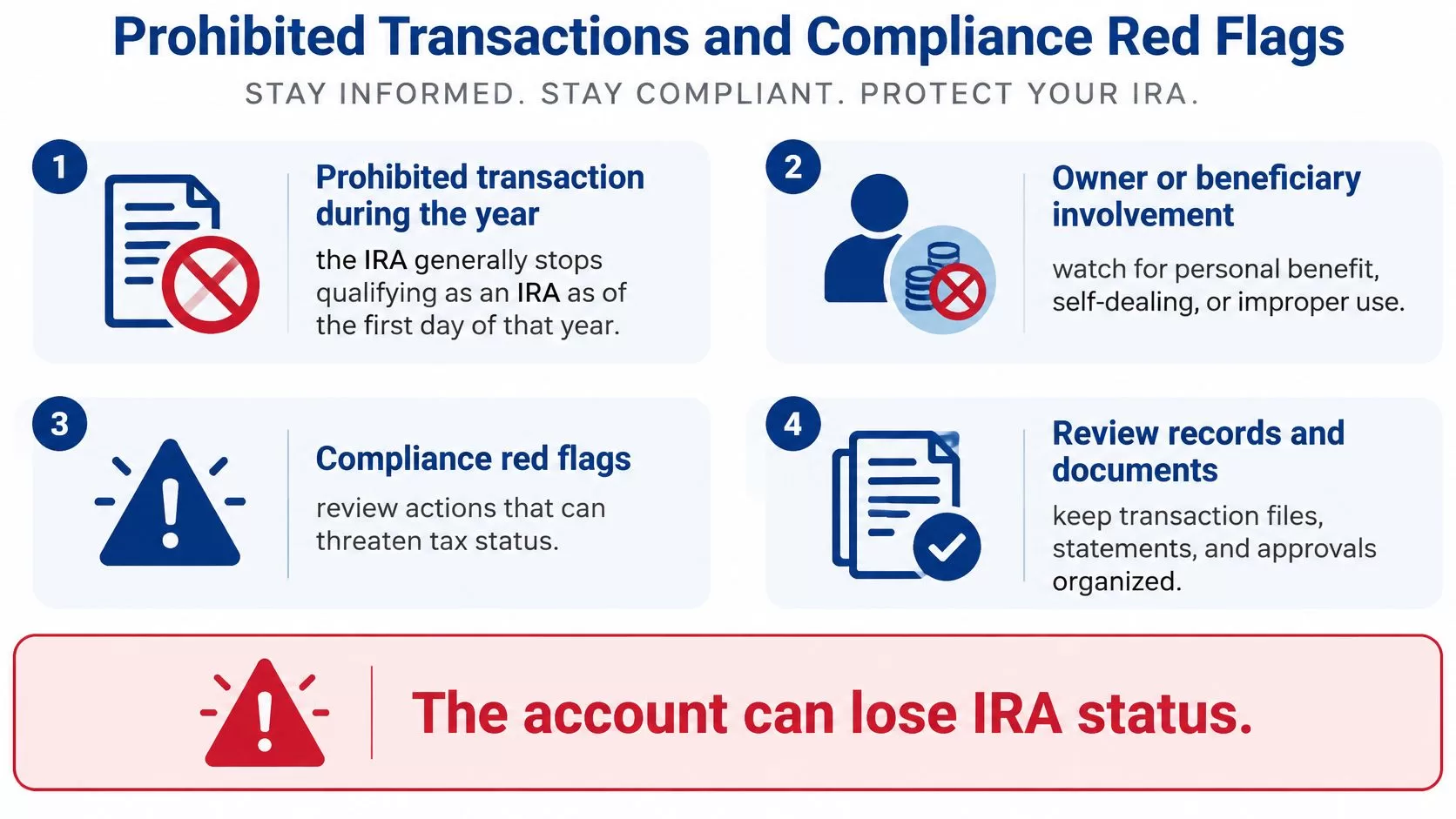
A prohibited transaction can threaten the account's tax status, not merely create an administrative correction. According to IRS prohibited-transaction guidance, an owner's or beneficiary's prohibited transaction generally causes the IRA to stop qualifying as of the first day of that year, with all assets treated as distributed at fair market value and amounts above basis potentially included in taxable income.
The IRS publication on IRA distributions identifies borrowing from an IRA, selling property to it, pledging it as loan security, and buying property for personal use as prohibited examples, and identifies related parties including spouses, ancestors, lineal descendants, and their spouses. Ownership, beneficiary, and fiduciary relationships also require screening.
The compliance risks deserve review before money moves.
Turn compliance promises into questions
The SEC's investor guidance on self-directed IRAs warns about fraud and potentially higher fees, reinforcing the need to examine controls rather than treat custodial acceptance as investment approval.
A provider should answer these questions in writing:
- Relationship screening: How does onboarding identify disqualified persons and related-party interests?
- Transaction evidence: Are invoices, ownership records, and payment instructions required?
- Escalation: Who reviews distributions, personal-benefit concerns, and related-party activity?
- Professional boundaries: Does the agreement explain that processing provides no legal or tax clearance?
Pressure to move funds before questions are answered is a warning sign. So are guaranteed-return promises and staff descriptions of an investment as already approved.
The disqualified-person guide helps identify relationships that need examination. Before any related-party transaction, assemble the ownership chart, proposed agreement, payment instructions, and explanation of who benefits, then obtain review from a licensed tax professional.
Named Gold IRA Providers Compared on Criteria
Which provider can document the controls, costs, and reporting your account needs? Compare each candidate using the same scorecard, and treat the result as a shortlist rather than a universal ranking. The right fit depends on the account and the services offered.
Score each candidate against the same evidence
| Criterion | What to request or check | What a strong score looks like |
|---|---|---|
| Operational controls | Written procedures for purchases, failed transactions, storage discrepancies, and outgoing transfers | Responsibilities and escalation steps are clearly assigned |
| Fee transparency | A complete schedule covering each billing party and the proposed account | Charges and billing frequency are stated in writing |
| Reporting | Sample statements and records for holdings, transactions, and fees | Reports make it possible to reconcile account activity |
| Storage and custody | The agreement identifying the custodian, depository, and storage terms | Each party's role and the applicable arrangements are clear |
| Service process | The contact route for questions, complaints, and account changes | The provider explains who handles each request and how it is resolved |
Use the same evidence standard for every candidate. A brochure can introduce a service, but the agreement, fee schedule, and sample reports show how the account will operate.
Record each score alongside the document that supports it. If an item remains unverified, mark it as an open question and ask for the relevant document before comparing providers.
Use the scorecard to build a shortlist
Ask how the provider handles a failed purchase, a disputed valuation, a storage discrepancy, and an outgoing transfer. The answers reveal how responsibilities are divided after account opening. Keep unresolved questions beside the score so a polished sales presentation does not outweigh missing operational detail.
The publisher earns affiliate commissions from some providers it reviews. A listing does not signal endorsement; compare providers by their documented controls, fee transparency, and reporting.
Self-Directed IRA Custodian Questions Answered
What if the dealer recommends a different custodian than the one in my account agreement?
Pause before signing or sending funds. Ask the dealer and the named custodian to explain in writing which entity will administer the IRA, receive the investment instructions, hold the assets, and process any sale or transfer. For example, if the agreement names one trust company but the dealer's paperwork directs payment to another, resolve the mismatch before proceeding.
Can I change custodians after opening the IRA?
A change may require a transfer between custodians, along with updated account and asset paperwork. Before starting, ask both custodians who will initiate the transfer, what documents they need, and how they will handle assets that cannot be moved in kind. Keep copies of the instructions and confirmations so you can track the transfer from request to completion.
What should I do if the purchase details change after I approve them?
Ask the custodian how it handles revised instructions, such as a different asset, price, or seller. Do not assume an earlier approval covers a changed transaction. For instance, if the invoice no longer matches the purchase instruction, request corrected documents and confirmation of the next step before the transaction proceeds.
Are self-directed IRA fees higher than conventional IRA fees?
They can be, especially when specialized administration, transactions, and storage are involved. Compare written estimates for the holdings and activity you expect, rather than relying on an advertised starting fee. A low account fee may not reflect the total cost if other parties charge separately.
Is a direct rollover safer than a check payable to the owner?
A direct institution-to-institution funding route is generally simpler to administer. An indirect rollover can involve withholding and strict deadlines, so ask the current administrator and a tax professional to confirm the appropriate method before funds are released.
Confirm Your Custodian Shortlist Before You Move Funds
Selecting a custodian and authorizing a retirement-account transfer are separate decisions. The final review should confirm that the documents match the proposed investment and that every organization understands its role.
Complete the final review in order
Define the proposed account. Record the assets to be held and whether funding involves a contribution, an existing IRA, or an employer-plan rollover. Include upcoming cash needs so the account isn't committed entirely to assets that may be difficult to sell.
Retain only candidates that pass essential controls. Resolve every High-priority scorecard issue before proceeding. A provider with attractive pricing shouldn't advance while custody, valuation, or ownership questions remain unanswered.
Collect the account documents. Obtain the written fee schedule, applicable storage agreement, sample statement, and compliance procedures. Save dated copies alongside any written explanations of exceptions or promotional terms.
Check the legal entities and principals. Search the appropriate regulator and complaint records using the exact names appearing in the agreements. Investigate material findings rather than relying on an overall review score.
Confirm the funding instructions. Have the current plan administrator identify the permitted route and recipient details, favoring direct movement where appropriate. Verify payment instructions independently before authorizing a transfer.
Arrange professional review. A licensed financial advisor, CPA, or tax professional should assess the proposed arrangement against the owner's circumstances. Particular attention belongs on tax treatment, liquidity, related-party involvement, and distribution planning.
Keep education separate from personalized advice
An educational comparison can organize the decision, but it can't determine whether a particular investment allocation suits a household. The editorial team operates as an independent information resource, not a financial advisor; company reviews are a starting point for applying consistent criteria.
This is not financial advice. Consult a licensed financial advisor, CPA, or tax professional before making investment decisions.
The strongest final choice is the provider whose written obligations, charges, and reporting fit the intended account without unresolved compliance concerns.
Gold IRA Association offers educational guides and company comparisons covering custodians, storage, fees, and rollover mechanics. Visit Gold IRA Association to compare top Gold IRA companies in the rankings hub using the same operational criteria before moving retirement funds.


