



Retirement investors often start the search for the best silver IRA companies by comparing fees and minimums. That's necessary, but it's not enough. The company you choose also controls how clearly you're educated, how quickly someone answers during a volatile market, and how easy it is to sell later if your plan changes.
That's where many investors make a bad choice. A silver IRA is a long-term relationship, not a one-time purchase, so the right provider is the one that handles service, compliance, and liquidity well when conditions get stressful.
How We Evaluated the Top Silver IRA Companies
A silver IRA company shouldn't win on marketing polish. It should win on the parts that affect a retiree's day-to-day experience once the account is open.
The editorial standard here focuses on four decision pillars. The first is price clarity. Not low advertised costs. Clear costs. If a company can't explain setup charges, annual administration, storage, transaction handling, and the spread between buy and sell pricing in plain English, that's a problem.
What matters more than a flashy pitch
The second pillar is education and support quality. A retiree rolling over part of a 401(k) needs patient explanations, not a rushed script. Good firms slow the process down, explain IRS rules cleanly, and help the investor avoid preventable mistakes.
The third pillar is reputation backed by verified reviews. A strong review profile doesn't prove perfection, but it does show whether a company repeatedly delivers a smooth onboarding process, responsive follow-up, and consistent service.
Practical rule: If a company's representative can explain fees in writing, outline storage rules clearly, and answer buyback questions directly, that company is already ahead of much of the field.
The hidden factors that shape the real experience
The fourth pillar is product suitability and compliance discipline. The right company steers investors toward IRA-eligible silver and away from collectible products or vague promises. That matters because precious metals IRAs carry strict eligibility and storage rules.
This framework also puts extra weight on three factors investors often ignore:
- Educational depth: Does the company teach, or just sell?
- Responsiveness in tense markets: Can the investor reach a real person when headlines turn ugly?
- Buyback transparency: Is there a clear process for liquidation, or does the answer get slippery once the sale is complete?
A company can look affordable on paper and still create a frustrating ownership experience. The best silver IRA companies tend to be the ones that combine clear communication, disciplined compliance, and a service model that still works when the investor is anxious.
2026's Best Silver IRA Companies at a Glance
You request a rollover during a rough week for the market. Silver is swinging, headlines are loud, and you need a straight answer on timing, storage, fees, and how selling would work later. That is the moment a Silver IRA company proves its value.
A quick shortlist still helps, but a useful shortlist should sort providers by investor fit, not by brand hype. If you need a refresher before comparing options, start with this guide on what a Silver IRA is.
The provider types worth considering
Instead of chasing brand names, match the company to the way you invest.
| Provider Type | Best For | What to Look For |
|---|---|---|
| Providers for Larger Rollovers | Investors moving a substantial retirement balance and expecting white-glove support | Clear account setup process, direct access to senior specialists, written fee disclosures, organized rollover assistance |
| Providers Focused on Customer Support | Retirees who want fast answers before and after funding | Short callback times, consistent phone access, patient explanations, support that stays responsive during volatile markets |
| Providers Built for Cost-Conscious Buyers | Investors watching spreads, storage costs, and transaction friction closely | Transparent pricing, no vague “call for details” answers, plain-language explanation of all recurring and one-time charges |
| Providers for First-Time Precious Metals Investors | Readers who want slower onboarding and stronger education | Good learning materials, simple explanations of IRS rules, realistic risk discussion, no pressure-heavy sales approach |
| Providers with Clear Buy-Back Policies | Investors who care about liquidity before they buy | Written buy-back process, realistic explanation of pricing on liquidation, no evasive language about timing or resale terms |
This format is more useful than a thin ranking table with missing minimums, incomplete ratings, or stale review snapshots. A Silver IRA is a service relationship inside a retirement account. The company's behavior after the sale matters as much as the opening pitch.
My editorial take
Start with support quality.
Fees matter, but weak service usually costs more in practice. A provider that answers quickly, explains custodial steps clearly, and stays reachable when markets get tense will save you time, stress, and expensive mistakes.
Education is the next filter. Good firms teach the rules, explain what silver products are IRA-eligible, and walk through storage and liquidation without rushing. Weak firms talk in slogans, avoid specifics, and push urgency.
Buy-back transparency is the hidden factor many investors miss. Ask how the sale process works before you fund the account. Ask who sets the repurchase price, how requests are handled, and what delays are realistic. If the answer turns vague, move on.
The best choice is usually the provider whose service model fits your account size, your experience level, and your need for direct human support during a stressful market.
In-Depth Company Profiles and Reviews
A retiree starts a rollover on a Monday morning. By Wednesday, the market is jumpy, the custodian needs another form, and a family member asks how quickly the silver could be sold if plans change. The right provider proves its value in that moment, not in the first sales call.
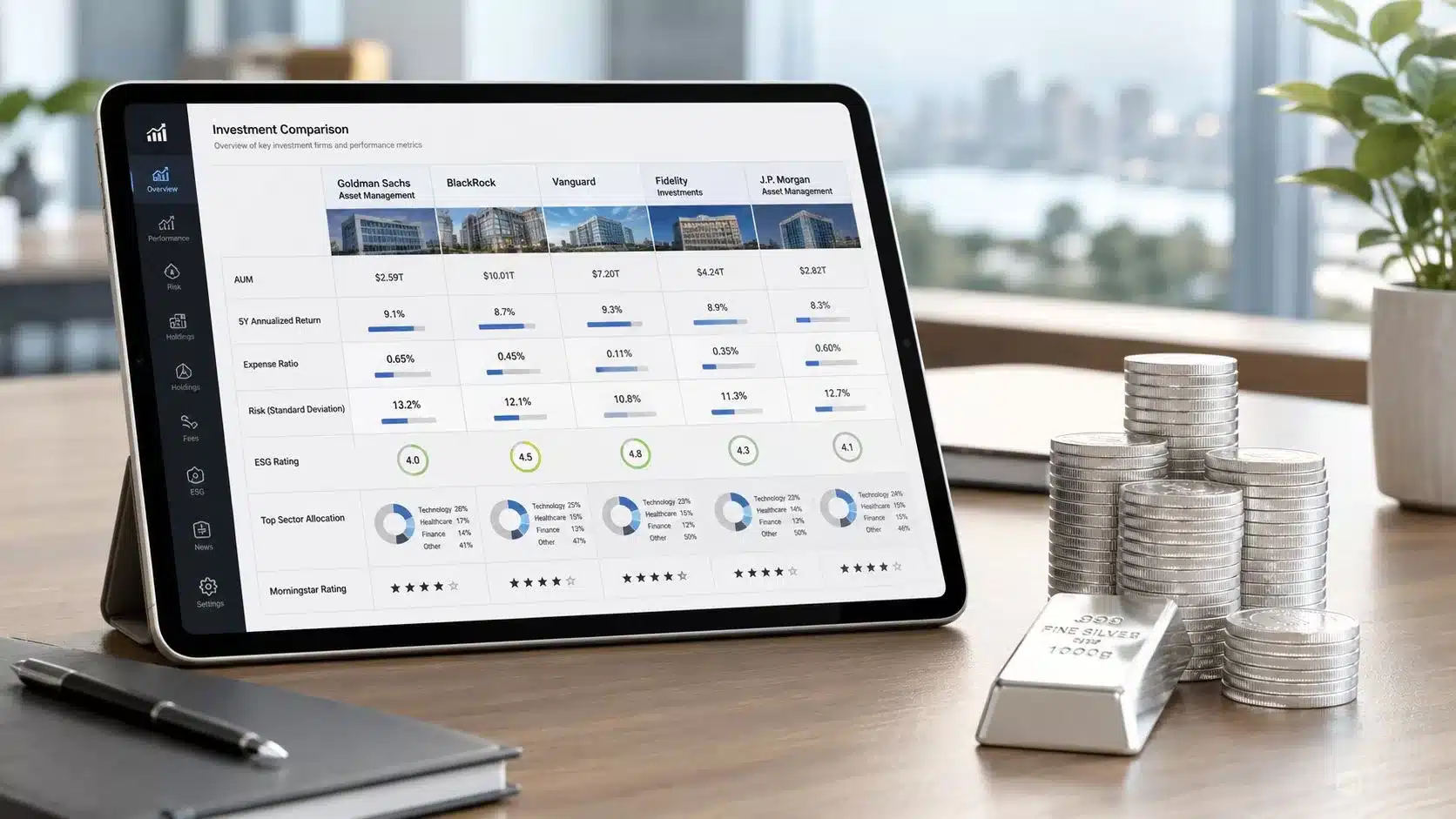

The best way to judge a silver IRA company is to look past headline pricing and ask what kind of service model you are buying into. Three provider types show up again and again. Each can work. Each also has tradeoffs that become obvious only after the account is funded.
The Education-First Provider
Best for: Larger rollovers, first-time precious metals investors, and retirees who want clear guidance before signing anything.
This type of firm puts teaching ahead of urgency. You usually get more time on the phone, clearer explanations of IRA-eligible silver, and better walkthroughs of custody, storage, and liquidation. That matters because confusion is expensive in retirement accounts. A rushed investor is more likely to misunderstand product rules, transfer timing, or resale mechanics.
What this provider type does well
- Explains account setup in plain language
- Answers detailed questions without pushing for an immediate decision
- Gives investors more context on how the buy-back process works
- Tends to be better for stressful periods when clients want a real person, fast
Potential drawback
- Higher minimums are common
- The process can feel slower because the firm spends more time on education and hand-holding
My view is simple. If you are rolling over a meaningful balance, this is usually the strongest fit. Good support during a tense market is worth paying for.
The Widely-Known Brand
Best for: Investors who feel more comfortable starting with a familiar name and broad market visibility.
This provider type wins attention early. The brand is easy to find, the marketing is polished, and the company often has a large footprint in retirement rollover conversations. That familiarity can reduce the intimidation factor for someone new to silver IRAs.
But recognition is not the same as service quality. A widely known brand can still route you to a representative who follows a script, avoids direct answers, or pushes product before explaining the account structure. The issue is not reputation alone. The issue is whether the firm stays responsive once paperwork stalls, prices swing, or you want to discuss selling.
What to test before choosing this type
- How fast they return calls during busy periods
- Whether they answer liquidation questions directly
- Whether educational materials explain rules clearly or just promote ownership
- Whether the buy-back policy is written, specific, and realistic
This category works best for investors who are comfortable asking tough follow-up questions and rejecting vague answers.
The Accessible Entry-Point Provider
Best for: Cautious investors who want a lower starting commitment and a simpler first step into precious metals.
This type of company appeals to retirees who do not want to commit a large amount on day one. That can be a smart approach. A smaller initial allocation gives you room to evaluate the service, reporting, communication, and funding process before committing more retirement assets.
The tradeoff is consistency. A lower barrier to entry helps only if the company is equally clear about storage, account administration, and selling procedures. Some entry-point providers are excellent at getting accounts opened and much weaker when clients ask detailed questions later.
What to confirm in writing
- Full fee schedule
- Storage arrangement and depository details
- Timeline for account setup and funding
- Step-by-step buy-back process, including how pricing is determined
A lower minimum is useful. It is not a substitute for clarity.
What actually separates a good company from a good fit
The right choice depends less on marketing strength and more on how the firm handles the parts investors usually overlook.
Start with educational quality. If a provider cannot explain eligible silver products, custodial roles, and liquidation steps in plain English, cross it off your list.
Then test crisis responsiveness. Send a follow-up question after your first call. Call back at a different time of day. Ask what happens if markets turn volatile during a transfer. You are not being difficult. You are checking whether support stays steady when retirement money is in motion.
Finally, press on buy-back transparency. Ask who handles the repurchase request, how the price is set, what fees may apply, and how long the process usually takes. Straight answers signal a firm built for long-term client service. Vague answers signal trouble.
A silver IRA is not just a metals purchase. It is an ongoing service relationship, and the best provider is the one that stays clear, reachable, and honest after the account opens.
Understanding Silver IRA Fees and Hidden Costs
You fund the account, the rollover clears, and then actual costs start showing up in pieces. One fee comes from the custodian, another from storage, another from wiring funds, and the biggest cost may not appear on a fee sheet at all. It shows up when you try to sell.
That is why the annual fee is only the starting point. A silver IRA is an ongoing service arrangement with layered costs, and weak disclosure usually shows up after the paperwork is signed.
The main fee categories to review
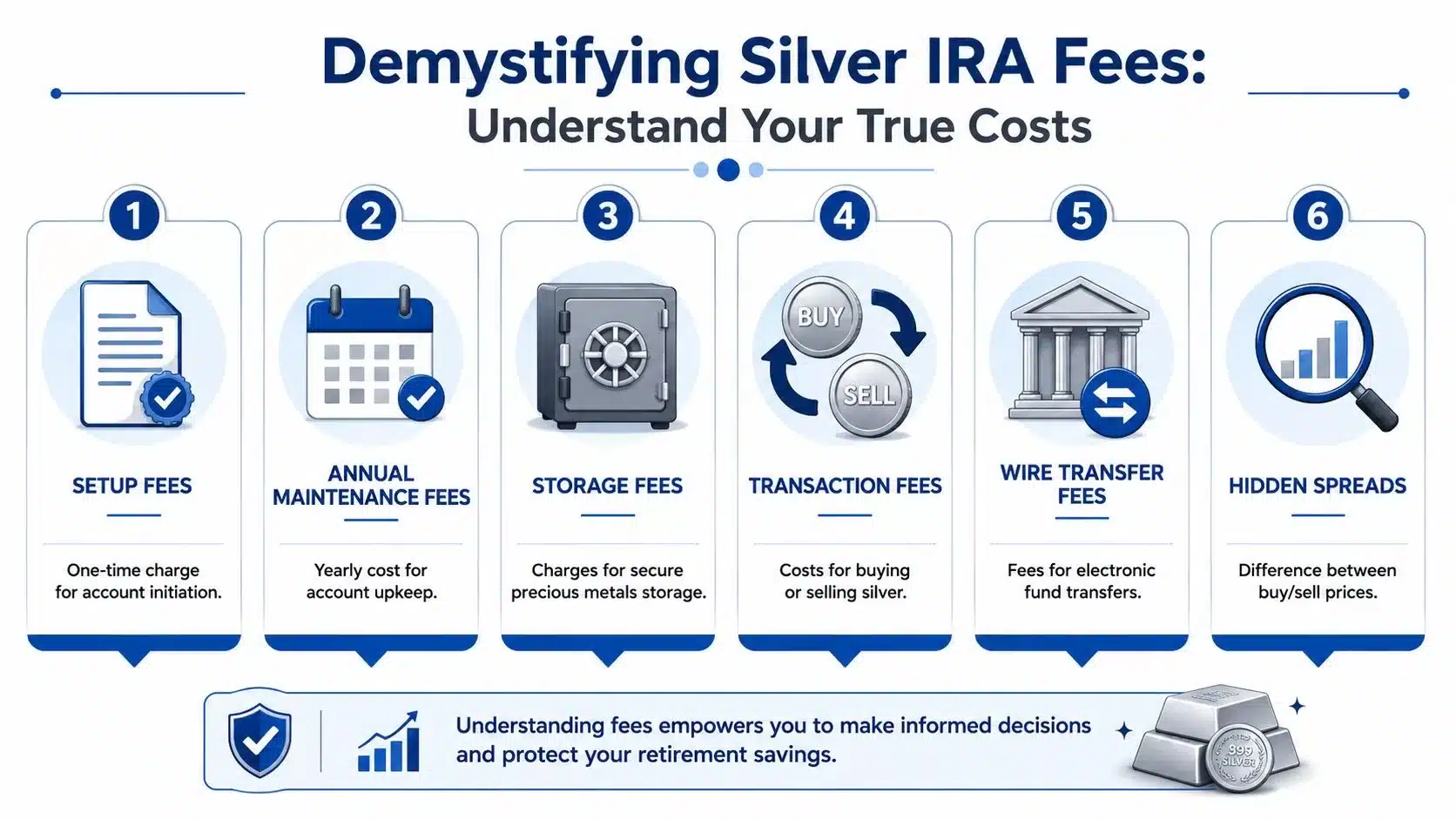
Ask for every charge in one written schedule. If a firm cannot provide that cleanly, keep looking.
Most silver IRA costs fall into these categories:
- Setup fees: One-time charges for opening the account.
- Custodial fees: Ongoing administration costs charged by the IRA custodian.
- Storage fees: Charges for keeping the metal at an approved depository.
- Transaction fees: Costs tied to purchases, sales, or account activity.
- Wire-related charges: Extra fees when money moves electronically.
- Spread risk: The gap between the price you pay and the price available if you sell back.
Spread risk deserves more attention than it usually gets. A company can advertise modest annual fees and still leave you with a poor exit price. That is why buy-back policy transparency matters as much as the published fee table.
Why minimums matter beyond the first deposit
Some premium providers require a higher minimum investment and present it as part of a high-touch service model. That only makes sense if the investor receives better service after funding, not just a polished sales call before funding.
Judge a higher-minimum firm by harder standards. Does it explain pricing clearly? Does it answer detailed questions about liquidation without stalling? Does it stay responsive during volatile periods, when investors are more likely to need fast answers and clean execution?
Fees tell you what the account costs on paper. Service quality tells you what the account costs in real life.
Questions that expose hidden costs quickly
Use this list before you sign anything:
- What one-time charges apply before the account is funded?
- What recurring annual charges apply, and who bills them?
- Is storage priced as a flat fee or a value-based fee?
- What spread should I expect between the buy price and a likely resale price?
- Who handles the buy-back request, and how is the repurchase price determined?
- How quickly are calls and emails returned during high-volume market periods?
- Will every fee and liquidation step be provided in writing before the rollover starts?
One more point matters here. Fee confusion often overlaps with compliance confusion. If you need a clearer view of how custodians, storage, and account rules fit together, review these precious metal IRA rules and account requirements.
Vague answers are a warning sign. Clear firms explain costs, timing, and resale terms without pressure.
Essential IRS Rules for Your Silver IRA
A silver IRA can go off track fast when an investor buys the wrong product or stores it the wrong way. The account may still look fine on a statement, but one compliance mistake can create taxes, penalties, and a messy correction process.
Start with the two rules that matter most. The silver has to meet IRS eligibility standards, and it has to stay in approved third-party storage. Those are the guardrails for the entire account.
The silver eligibility rule
Under IRC §408(m)(3)(B), IRA silver must meet a minimum fineness of .999 and must be bullion or coins that qualify under IRS rules. In plain English, collectible silver usually does not belong in an IRA, even if a sales rep says it is a smart long-term hold.
Investors need to slow down and verify the exact product before money leaves the account. A good silver IRA company does more than process the order. It explains why a product qualifies, gives the details in writing, and catches mistakes before they become tax problems. That matters more in real life than a polished fee sheet.
What the custodian and depository actually do
The custodian administers the IRA. The depository stores the metal in an approved facility. Those roles are separate, and serious investors should treat both as decision points, not back-office details.
Service quality matters here. During periods of market stress, weak firms get hard to reach, explanations get vague, and liquidation questions suddenly take too long to answer. Strong firms stay responsive, confirm storage procedures clearly, and document buy-back steps before you need them. If you want a broader compliance framework, review these precious metal IRA rules and account requirements.
If IRA silver is shipped to your home or held outside an approved depository, the IRS can treat that as a distribution or prohibited arrangement, depending on the facts. That can mean taxes and penalties.
The practical takeaway for buyers
Before you approve a silver purchase, confirm these three points in writing:
- Product eligibility: The silver meets the required fineness standard.
- Issuer or refiner qualification: The coin or bar comes from a source that fits IRS rules.
- Storage instructions: The metal will be sent directly to an approved depository, not to you.
Investors who get this part right usually avoid bigger problems later. Investors who rush here often learn that customer service, documentation quality, and buy-back clarity matter just as much as headline fees.
This is not financial advice. Consult a licensed financial advisor, CPA, or tax professional before making investment decisions.
Your Step-by-Step Guide to a Silver IRA Rollover
You open a rollover request expecting routine paperwork. Then the old plan administrator asks for one form, the new custodian wants another, and the metals dealer starts talking about product selection before the cash has even arrived. That is where investors make avoidable mistakes.
A silver IRA rollover works best when the order is controlled from the start. Choose the firm first. Then confirm the custodian, funding method, and depository process before any money moves. Companies that explain each step clearly tend to handle real-world problems better, especially when markets get volatile and investors need fast answers instead of sales language.
The rollover path in plain English
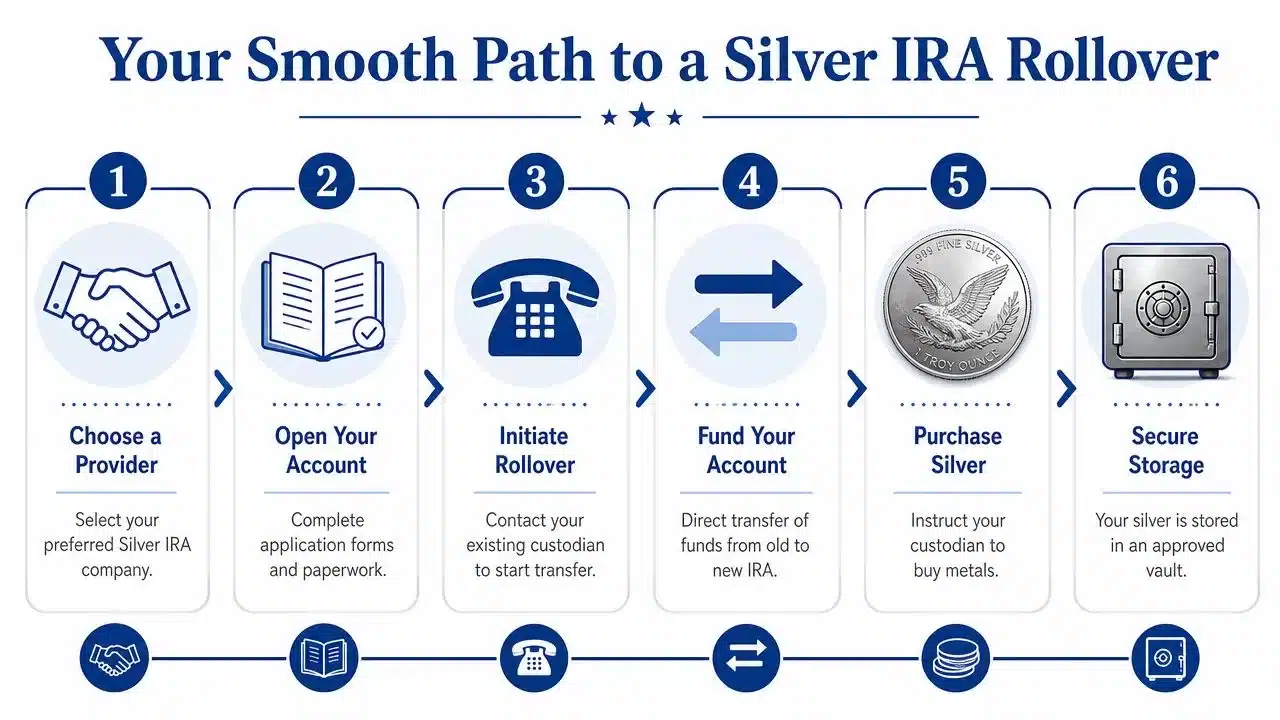

Follow this sequence:
- Choose the company and custodian. Judge more than fees. Read the account documents, test response times, and ask how liquidation works before you fund anything.
- Open the self-directed IRA. The account must be established before transfer paperwork can be processed.
- Request a direct transfer or rollover. Direct movement between institutions is the cleaner option and usually the safer one.
- Fund the new account. Confirm when cash is received and available for purchase. Good firms communicate this promptly.
- Approve IRA-eligible silver. The custodian buys approved products based on your instructions, not on a salesperson's impulse pitch.
- Send the metals to an approved depository. IRA silver is held in qualified storage, not shipped to your home.
If you want the broader mechanics before handling a silver-specific rollover, review this gold IRA rollover guide.
A short explainer can also help visualize the process:

Which silver products usually qualify
Stick to products that are commonly accepted for IRA use and meet the required purity standards. Common examples include the American Silver Eagle, Canadian Silver Maple Leaf, and British Silver Britannia, along with silver bars from approved refiners that meet IRA rules.
This step deserves more attention than many investors give it. The actual issue is not just whether a product is eligible on paper. It is whether the company explains eligibility clearly before the order is placed, documents the transaction properly, and corrects mistakes quickly if a product question comes up during funding.
Direct rollover versus avoidable mistakes
A direct rollover keeps control tighter. Funds move from one retirement institution to another, which reduces the chance of withholding problems, deadline errors, or an accidental taxable distribution.
The hidden decision factor is service under pressure. If markets drop sharply and you need status updates, a good firm answers the phone, confirms where the transfer stands, and explains what happens next. A weak firm turns a routine rollover into a guessing game.
If the team cannot explain the rollover timeline, storage chain, and buy-back process in plain English before you fund the account, choose a different company.
Investor Checklist and Your Next Steps
A silver IRA usually feels easy until you need the company to do something specific. A rollover stalls. You want a clear answer on storage. You ask about selling later and get a vague script instead of a straight process. That is the point where the right provider separates itself from the sales pitch.
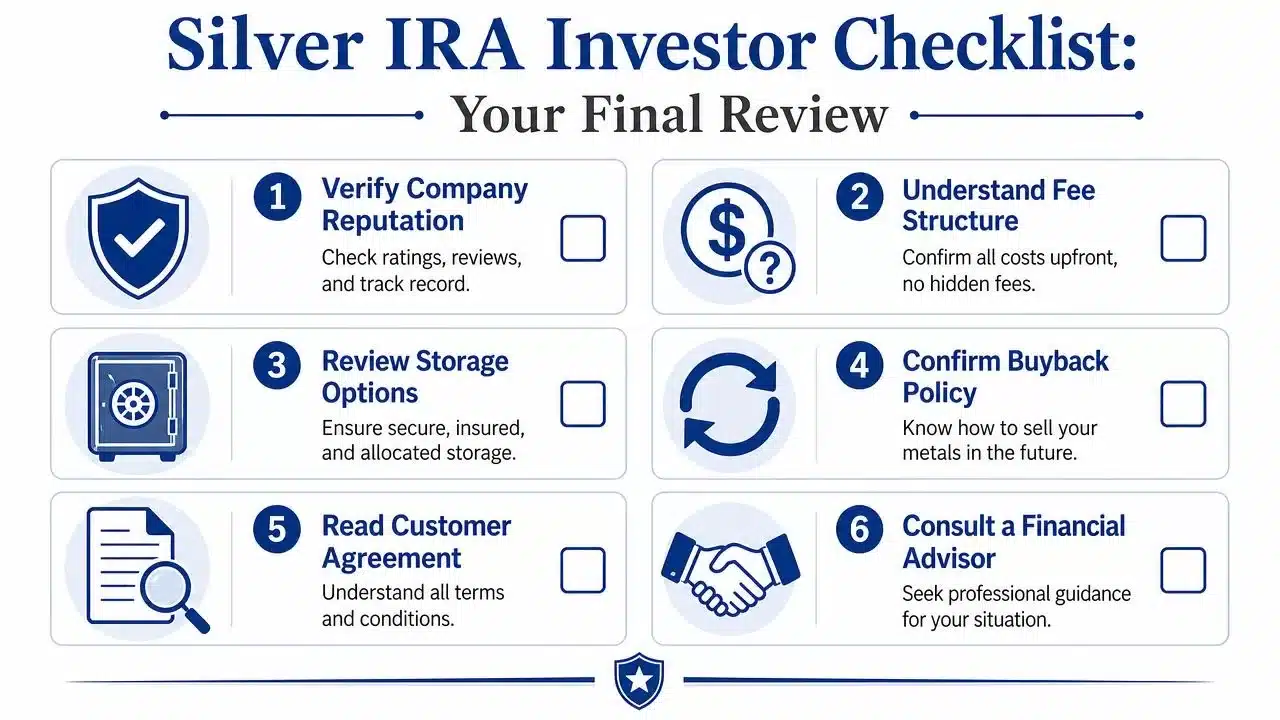
Final buyer checklist
Use this list before you sign the transfer forms or fund the account:
- Check how the firm teaches, not just how it sells: Good providers explain IRS rules, storage, liquidation, and product eligibility in plain language. If the educational material is thin or evasive, service usually is too.
- Ask for every fee in writing: Setup, annual custody, storage, wire charges, markups, and liquidation terms should be spelled out before you commit money.
- Verify who handles what: You should know the dealer, custodian, and depository roles clearly. Confusion here creates delays and finger-pointing later.
- Pressure-test the buyback program: Ask who buys the metals back, how pricing is quoted, how long the process takes, and whether any conditions apply. If the answers are slippery, expect trouble when you want liquidity.
- Call with a real problem: Do not ask a soft question. Ask what happens if your rollover is delayed, if a wire misses cutoff, or if you need to sell during a sharp market drop. Fast, specific answers matter more than polished marketing.
- Use outside advice when the account is large or the tax situation is messy: A licensed advisor or CPA can catch rollover mistakes before they become tax problems.
The strongest recommendation
For larger retirement investors who want premium guidance, the clearest top-tier choice is a provider with strong verified ratings, an education-first model, and a transparent buyback process. For investors with smaller balances or a simpler rollover, fit still matters more than branding. Choose the firm that answers direct questions clearly and treats service as part of the product.
This is not financial advice. Consult a licensed financial advisor, CPA, or tax professional before making investment decisions.
If more guidance would help, the next practical step is to visit Gold IRA Association and compare educational resources on silver IRAs, rollover rules, and provider reviews before speaking with a specialist.
Written with the Outrank tool


