




Most comparison advice starts with a fee ranking. Find the cheapest published annual charge, pick the company at the top, and move on. That approach breaks the moment a dealer spread sits inside the metal price where no fee table shows it, or a partial liquidation costs more than three years of administration.
The audience for a better comparison is large. The Federal Reserve reported that 61% of U.S. adults held a tax-preferred retirement account in 2024, and 67% held at least one asset specifically designated for retirement income once pensions and related assets were counted, figures cited in World Gold Council research on central banks. Most of those households will compare providers at some point, and a brand-name list won't tell them what the account costs to hold or to exit.
What follows is a companies comparison built on things a reader can check: five weighted criteria, a scorecard that works on any provider, the fineness and custody rules that disqualify products before price even matters, and the arithmetic for an all-in cost at three account sizes.
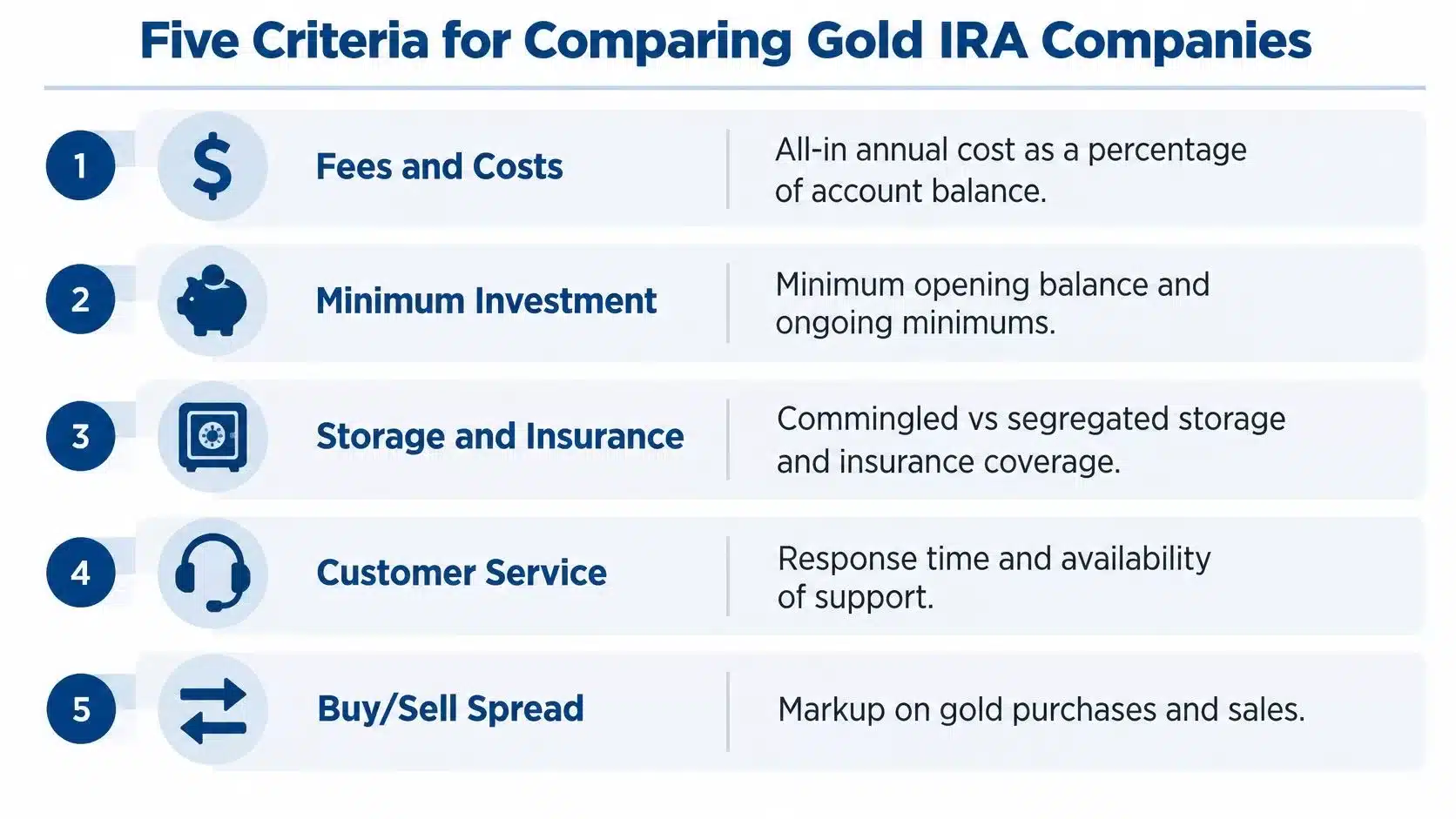
Five Criteria for Comparing Gold IRA Companies
A comparison built on brand names gives a reader nothing to verify. A scorecard does. Pick five criteria, score each candidate from 1 to 5, weight the scores, and the ranking explains itself instead of resting on whichever company bought the most advertising.
The five criteria are credibility at 25%, fees at 25%, custody and storage at 20%, customer service at 15% and investment menu at 15%. Those weights are an editorial ranking framework, not market data. Their job is to force trade-offs. A company that calls back within the hour but won't name its depository shouldn't beat one that answers slowly and documents everything.

| Criterion | Suggested Weight | Strong Answer Looks Like | Verify Before Choosing |
|---|---|---|---|
| Credibility | 25% | Named leadership and a multi-year operating record | Public complaint records and regulator actions |
| Fees | 25% | Written all-in schedule with one-time and recurring charges | Round-trip buy and sell cost at three balances |
| Custody and Storage | 20% | Independent IRA custodian and depository named | Insurance terms and shipment controls in writing |
| Customer Service | 15% | Specialist answers an IRA-eligibility question directly | Response time and whether fees are explained before a sale |
| Investment Menu | 15% | Item-level list of IRA-eligible products | Metal, fineness, mint, form and custody destination for each item |
What a Strong Answer Looks Like on Each Criterion
Credibility means names and dates, not badges. Look for executives you can identify, a record of years in business you can confirm, and a complaint history you can read. Verify it against the state business register and any published regulator actions.
Fees means a written schedule that separates one-time charges from recurring ones, and discloses the spread inside the metal price. A headline setup charge answers a different question than "what does this cost me to hold for five years."
Custody and storage means an independent IRA custodian and a named depository, with insurance terms attached. Commingled storage is normal and acceptable; segregated storage should be stated as such and priced clearly.
Customer service is a competence test, not a friendliness test. A specialist should answer a specific eligibility question about a named coin without transferring the call three times.
Investment menu means an item-level list rather than a catalog page. A company can advertise hundreds of coins and bars while only a small subset qualifies for the IRA exception.
Scoring rule: Drop any company that scores below 3 on fees or custody, however high its total. A provider that can't document those two items will cost the account more than a warm impression is worth.
Gold IRA Association reviews gold IRA companies, evaluating their credibility, customer service, fees, and investment options, so any published review can be checked line by line against this scorecard. To use it, score each shortlisted company 1 to 5 per criterion, multiply each score by the weight, and add the results to a total out of 100.
Side-by-Side Gold IRA Company Comparison
Affiliate disclosure: Gold IRA Association earns a commission from some providers discussed on this site, including Augusta Precious Metals, its primary affiliate partner. Commission has no bearing on the verification standard applied below.
| Company | Credibility | All-in Fees | Custody and Storage | Investment Menu |
|---|---|---|---|---|
| Augusta Precious Metals | Confirm years in business and any regulator actions on file | Request a written schedule at $50,000, $100,000 and $200,000 | Custodian and depository to be named in the account agreement | Item-level list of qualifying products required before purchase |
| Goldco | Named leadership and complaint history to be checked directly | Quote the round-trip buy and sell cost, not the setup fee | Ask whether storage is commingled or segregated, and what each costs | Confirm which coins clear the .995 gold threshold |
| Birch Gold Group | Verify the operating record year by year | Ask what is charged once and what recurs annually | Insurance terms and shipment controls supplied in writing | Product list must separate IRA-eligible stock from retail inventory |
| Noble Gold | Public complaint records and regulator actions to be reviewed | Convert every recurring charge into a percentage of the balance | Independent custodian named, not an in-house affiliate | Confirm mint, form and fineness for each item offered |
| American Hartford Gold | Leadership names and licensing to be confirmed | Selling and liquidation charges quoted at three balances | Depository location and insurance coverage stated plainly | Silver support at .999 fineness, item by item |
Every cell above is written as a task because that is what it is until the company answers in writing. Gold IRA Association reviews Augusta Precious Metals, Goldco, Birch Gold Group, Noble Gold and American Hartford Gold against the same four columns, and a cell stays open until a written fee schedule, a named custodian and depository, or an item-level product list arrives.
Weaknesses sit in the same format as strengths. A provider with an impressive operating history can still carry a storage structure that costs more at $50,000 than at $200,000, and a provider with a modest product list can still document every item it sells. Neither fact gets hidden in a footnote.
The right choice depends on the investor situation covered further on, not on a single winner. A rollover client and a retiree taking distributions are shopping for different things from the same menu.
Eligible Metals and Custody Rules to Verify
Eligibility comes before cost. A cheap provider selling a coin the IRS doesn't recognize creates a problem that dwarfs any fee saving, because the metal stops being an IRA asset. Treat product qualification as a pass or fail gate rather than a line item in a price comparison.
For bullion, the commonly applied minimum fineness thresholds are gold .995, silver .999, platinum .9995 and palladium .9995, as the IRA-approved precious metals reference sets out.
| Metal | Minimum Fineness | What to Confirm in Writing |
|---|---|---|
| Gold | .995 | Mint, form and fineness for each item |
| Silver | .999 | Mint, form and fineness for each item |
| Platinum | .9995 | Product eligibility and custodian |
| Palladium | .9995 | Product eligibility and custodian |
Eligible assets also depend on product category, and the metals must remain in the possession of an authorized IRA trustee or custodian rather than being held personally by the account owner. That single sentence rules out a home safe, a safe deposit box in the investor's name, and any arrangement where the investor takes delivery and promises to hold the metal for the IRA.
What Each Product Must Document
Request documentation item by item, not catalog by catalog. For every product on the list, ask for the metal, the fineness, the manufacturer or mint, the form factor (coin, round or bar) and the custody destination where it will sit. A company that advertises broad access to coins and bars may still have only some products that qualify for the IRA exception, and the difference only shows up at item level.
A provider that handles this well separates IRA-eligible inventory from ordinary retail inventory on paper, names the independent custodian and depository, explains shipment and insurance controls, and has a process for rejecting a non-qualifying purchase before funds are released. For silver buyers the .999 threshold does most of the filtering. For gold buyers, anything below .995 should be excluded regardless of brand recognition or collectible appeal.
Three Custody Items to Confirm in Writing
- The named custodian: the institution that holds the account, not a marketing affiliate. The role and selection process are explained in this guide to choosing an IRA custodian for gold.
- The named depository: the vault where the metal physically rests, including whether storage is commingled or segregated.
- The insurance terms: who insures the metal, what the coverage limits are, and how a claim is filed.
One last check belongs on the statement rather than the brochure. Account statements typically report a melt value based on bullion weight and the spot price, so compare that figure against what was purchased to confirm the metal is represented in the account.
Total Cost of a Gold IRA at Three Account Sizes
The number most comparisons leave out is the only one that decides whether a Gold IRA is worth holding: all-in annual cost as a share of the account. A fee that sounds small in dollars can be large in percentage terms once the balance is modest.

The SEC investor bulletin on fees and expenses draws the line that matters here: transaction fees are charged when an investment is bought, sold or exchanged, while ongoing fees such as annual account maintenance recur whether or not anything trades. Convert every recurring charge into a percentage of the intended balance before comparing two quotes. The SEC's own example does the work: a $300 annual fee equals 0.60% on a $50,000 account but only 0.15% on a $200,000 account.
| Annual Charge | On $50,000 | On $200,000 |
|---|---|---|
| $300 | 0.60% | 0.15% |
| $500 | 1.00% | 0.25% |
| $1,000 | 2.00% | 0.50% |
At $100,000, that same $300 charge works out to 0.30%. The pattern is the point: a fixed annual fee punishes small accounts and flatters large ones, so a comparison that doesn't state the balance it assumes is telling the reader nothing.
The Charges That Sit Outside the Headline Fee
Ask for a written schedule covering account establishment, annual administration, storage, insurance, wire transfers, liquidation, and dealer spreads or markups embedded in the metal price. Most published comparisons stop at the first two. The last one is usually the largest.
Investors who ask about fees tend to want the all-in figure, how it's calculated and what's included, rather than an advertised annual percentage, according to Investor.gov guidance on fees. The SEC also advises reading account-opening documents, statements, confirmations and product-specific disclosures to identify the types and amounts of fees being paid. The line-item breakdown of setup, custodial and storage charges in this Gold IRA fees guide is the format to ask for in writing.

Run a Round-Trip Cost, Not Just an Entry Cost
Model three transactions: an initial purchase, one partial liquidation, and a rollover or custodian transfer. Then compare the amount paid with the amount recovered. The gap between those two numbers is the true cost of using the account, and it exposes the provider whose low annual fee hides a fat spread or an exit charge.
Say a provider charges a $300 annual administration fee, 0.5% a year for storage and insurance, a $50 wire fee, and a 3% dealer spread on a $25,000 rollover. The spread alone costs $750 before any metal is held, so the account starts 3.2% behind. Annual costs run about $425, or roughly 1.7%.
- Held one year: about $1,225 total, roughly 4.9% of the account. Gold has to gain about 5% just to break even.
- Held five years: about $2,925, roughly 11.7%. The metal needs about 2.2% a year.
- Held ten years: about $5,050, roughly 20%. Break-even drops to about 1.9% a year, but the dollar cost keeps climbing.
Selling adds another layer. A partial liquidation may carry a second spread of 1% to 2% plus a processing charge, which is why the round-trip figure deserves its own line in any comparison.
Three questions for every provider: What is charged once, at the start? What recurs every year, stated in dollars and as a percentage of my balance? What does it cost to sell, and how quickly is cash paid out?
Credibility and Customer Service Checks
Trust is the criterion reviews weigh most often and evidence least often. Verification takes four steps and about twenty minutes. Check how long the company has operated. Confirm that leadership is named rather than described as "a team of experts." Search public complaint records. Look for regulator actions in the states where the company does business.
Warning signs are consistent. Pressure to fund the account during the first call. Reluctance to put fees in writing. A refusal to name the custodian or the depository, or an answer that names only a marketing partner. Any one of those ends the evaluation.
The cost of ignoring them is documented. The CFTC precious metals fraud advisory describes a complaint in which a gold dealer and IRA custodian charged nearly $150,000 in commissions and fees on a customer's $300,000 retirement account, approximately half the account value. The agency also reports that some fraud victims lost one-third to one-half of their savings through markups, fees and commissions, and recommends obtaining every fee, cost, commission and agreed retail price in writing before transferring money.
Test the Service, Don't Rate the Manners
Call with a narrow question: whether a specific coin at a specific fineness qualifies for an IRA, and which custodian would hold it. Note how long the answer takes and whether it arrives as a document or a verbal assurance. Then watch whether the representative volunteers fee information before discussing a purchase.
A specialist who explains the fee structure unprompted is demonstrating something more useful than enthusiasm. Clear fee communication builds more trust than a low headline price, and a salesperson who dodges the cost question on day one will dodge it again at liquidation.
Pass or fail: if a company won't send a written fee schedule and a named custodian before you transfer a dollar, it fails the credibility check regardless of how many reviews it has collected.
Run that test on every shortlisted company before moving to pricing. It is faster to disqualify three providers on documentation than to unwind one account later.
Which Gold IRA Fits Your Situation and When to Skip It
Suitability decides more than rankings do. Two readers can compare the same five companies and correctly reach different answers, because a 401(k) rollover, a distribution schedule and a small balance each put a different criterion first.

| Investor Situation | Priority Criterion | Question to Ask the Company |
|---|---|---|
| 401(k) rollover | Rollover handling and transfer costs | Who handles the direct rollover and what transfer charges apply? |
| Retiree taking distributions at age 73 or older | Liquidity and exit charges | How quickly can metal be sold and paid out in cash, and at what cost? |
| Smaller balance | Setup minimums and fixed charges | What is the all-in annual cost as a percentage of a $25,000 account? |
| Diversified portfolio adding metal | Concentration and product fit | What share of my savings would the metal represent, and which products qualify? |
The distribution question deserves its own attention, because a metals IRA must produce cash on a schedule. Traditional IRAs, SEP IRAs, SIMPLE IRAs and most retirement-plan accounts generally require required minimum distributions beginning at age 73, calculated for each year after that by dividing the account balance at the close of the preceding December 31 by the applicable IRS life-expectancy denominator, per the IRS required minimum distributions FAQs. Installments through the year are fine as long as the annual total is met. Roth IRAs owned by the original account holder carry no lifetime RMDs. An account holding physical bullion therefore needs a sale process fast enough and cheap enough to fund the withdrawal.
The Fit and No-Fit Checklist
A stronger fit usually looks like this: emergency savings held outside the account, a horizon measured in years rather than months, tolerance for a price decline without changing course, a target allocation small enough that a bad year doesn't alter retirement plans, and a clear idea of how withdrawals will work.
A weaker fit looks like the mirror image. Needing the money within a few years. Funding the metals account with most of the retirement savings. Holding no cash reserve. Expecting a guaranteed store of value rather than a diversifier that can fall. The trade-offs on both sides, from liquidity to allocation limits, are laid out in this review of Gold IRA pros and cons.
Understanding should come before commitment, and the gap is measurable. In survey findings reported by PlanSponsor on retirement-plan interest in private assets, 53% of participants still viewed private assets as risky and only 12% considered themselves knowledgeable, while 45% said they would invest in private assets in 2025, up from 36% in 2024. Demand rising faster than understanding is exactly the condition that a fit checklist is designed to catch.
Gold's claim on a portfolio rests on official-sector demand, not a forecast. The European Central Bank reported that central-bank gold demand stayed at record levels in 2024 and represented more than 20% of total global gold demand, against roughly 10% on average during the 2010s, while the World Gold Council recorded purchases of 1,082 tonnes in 2022 and 1,037 tonnes in 2023, its two largest annual totals on record (World Gold Council gold demand data). Strong official buying explains why gold belongs in diversification conversations. It doesn't show that gold will outperform stocks, bonds or cash.
A company with excellent reviews can still be the wrong account if its product structure encourages concentration or makes liquidation slow. This is not financial advice, and any decision should be confirmed with a licensed financial advisor or tax professional.
Frequently Asked Questions About Gold IRA Companies
Can I roll a 401(k) into a Gold IRA without an immediate penalty?
Generally yes, when the transfer is processed as a rollover. The duty shifts to the investor afterward: the CFTC advisory on precious metals notes that the investor, not the custodian, is responsible for researching and monitoring the investment, and that custodians typically charge more for self-directed IRAs than for conventional ones.
Do rollovers count against the annual contribution limit?
No. For 2026 the combined limit across traditional and Roth IRAs is $7,500, or $8,600 for taxpayers age 50 or older who qualify for catch-up contributions, and contributions can't exceed taxable compensation, per IRS guidance on IRA contributions. Rollover contributions are counted separately from annual contributions, subject to rules that vary by individual circumstances.
Do I have to take distributions at 73?
Traditional IRAs and most retirement-plan accounts generally do, starting at 73. A Roth IRA owned by the original account holder has no lifetime distribution requirement. The practical consequence for a metals account is liquidity, so test the sale process before the first distribution year arrives.
Are fees the only cost to watch?
No. Spreads and markups inside the metal price can outweigh a low annual fee by a wide margin, which is why the round-trip cost of a purchase and a sale belongs in every quote.
Which figures should I verify before acting?
Contribution limits and distribution rules change, so confirm the current IRS figures before transferring or contributing, and consult a licensed tax professional about your own situation.
Shortlist Two Companies and Confirm Fees in Writing
Shortlist two companies, get both sets of terms in writing, and move no money until the answers can be compared side by side. That sequence prevents the most common mistake in this market, which is choosing on presentation and discovering the cost structure afterward.
- Score the candidates. Rate each company 1 to 5 on the five weighted criteria, then keep the two highest totals that also clear the eligibility and custody checks.
- Request the all-in schedule. Ask for a written fee schedule at three balances plus the round-trip cost of a purchase and a sale.
- Demand item-level product documentation. Metal, fineness, mint, form and custody destination for every product on the list.
- Name the institutions. Confirm the custodian and depository by name, along with insurance terms, in writing.
- Run the fit checklist. Take the fit and no-fit questions to a licensed financial advisor or tax professional rather than answering them alone.
- Compare, then decide. Set the two written responses next to each other and act only when both are complete.
This is not financial advice. Consult a licensed financial advisor, CPA or tax professional before making investment decisions, since account rules, tax treatment and distribution requirements vary by individual circumstances. Readers who want help finding educational information about account rules and provider comparisons can send a direct message to Gold IRA Association.
The last step is the shortest one. Compare the top Gold IRA companies in the rankings hub, then hold every provider to the same documentation standard before anything moves.
Gold IRA Association publishes comparison reviews of gold and silver IRA providers, along with fee breakdowns and rollover guides that explain the rules in plain English, and its reviewers apply the five weighted criteria described here to every company they cover. If the next step is a shortlist rather than a purchase, use the published company comparisons and the free newsletter covering inflation hedging with a Gold IRA to check each provider's written terms before any money moves. Visit Gold IRA Association to start with the reviews and the fee questions that belong in every first call.


