



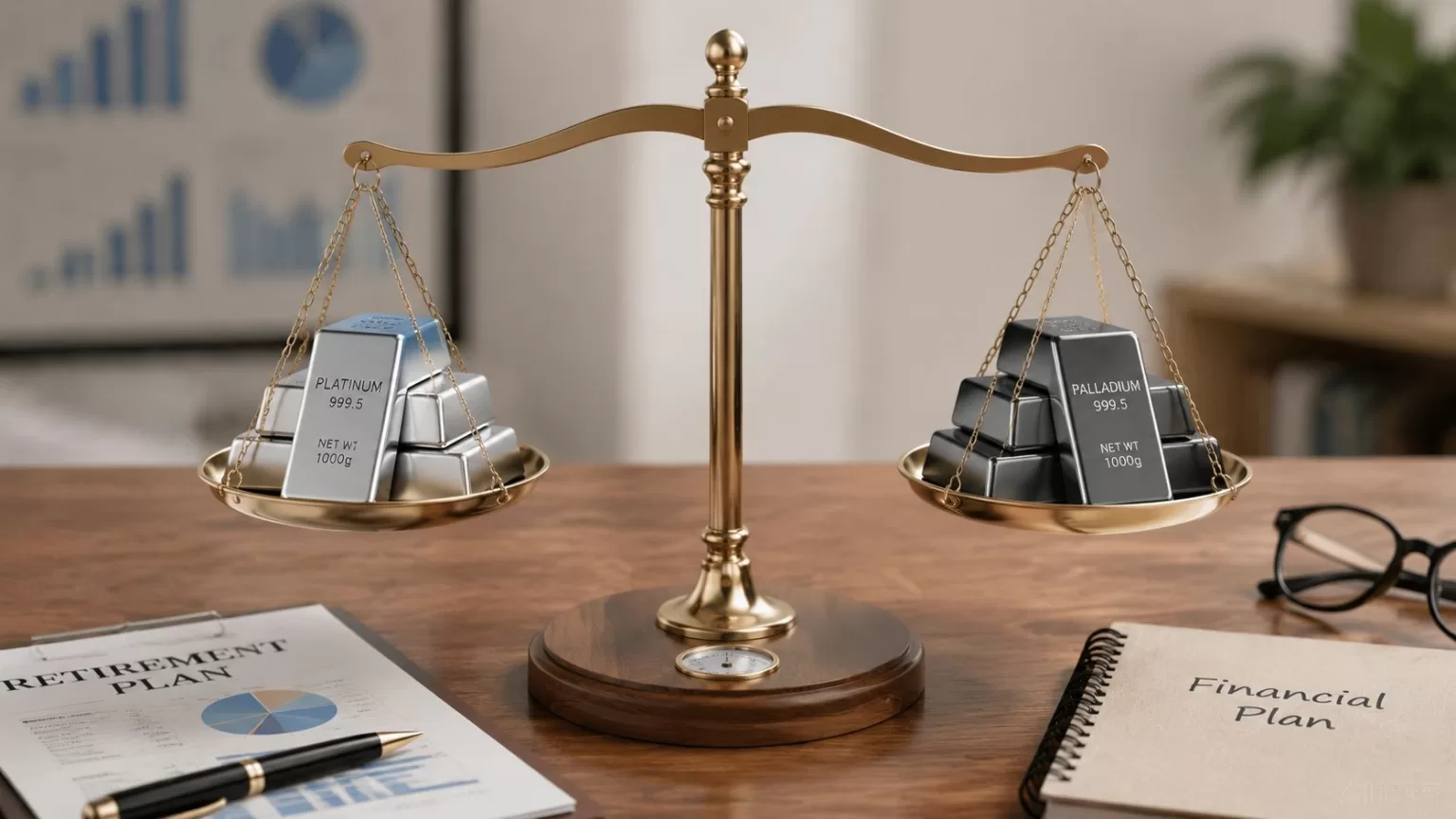
A near-retiree looking at a self-directed metals IRA usually wants the same thing, a cleaner way to protect a nest egg without chasing every market swing. That's where platinum vs palladium becomes a practical decision, not a trivia question. The two metals both qualify for IRA use under strict rules, but they behave differently in practice, and that difference should shape how much of each belongs in a retirement sleeve.
| Feature | Platinum | Palladium |
|---|---|---|
| Main retirement case | Broader industrial demand, hydrogen angle | Narrower auto-linked demand, higher sensitivity to cycles |
| Physical profile | Denser, harder, higher melting point | Lighter, lower melting point |
| IRA purity rule | 99.95% | 99.95% |
| Market behavior | Often treated as the steadier choice | Often treated as the more volatile choice |
Introduction to Platinum and Palladium Choices
A couple nearing retirement might already own stocks, bonds, and a cash reserve, but still feel uneasy about paper assets alone. They start asking whether platinum or palladium belongs in a precious metals IRA, and the right answer isn't to pick the shiny metal with the loudest pitch. It's to compare how each one behaves, how each one is stored, and how each one fits a long-term retirement plan.
That comparison matters because these metals aren't interchangeable. One has broader industrial uses and a clearer role in hydrogen-related demand, while the other is more concentrated in gasoline autocatalysts and can swing faster when vehicle trends change. The rest of this guide keeps the focus on practical retirement allocation, not hype, so the reader can make a cleaner choice with fewer blind spots.
Understanding Physical and Chemical Properties
Why the metal itself matters
Platinum has the heavier, more substantial profile. Independent comparison data put platinum at about 21.09 g/cm³ versus palladium at 12.023 g/cm³, and platinum's melting point is around 1,772°C compared with palladium's 1,554.9°C. The same dataset also shows higher Young's modulus and Vickers hardness for platinum, which points to greater resistance to deformation under load and heat, a useful trait in demanding industrial service material comparison data.
That matters for retirement investors because a metal with stronger thermal and mechanical stability tends to fit a wider range of industrial uses. It doesn't make one metal “safe” and the other “risky” on its own, but it does help explain why platinum has long been valued in applications where durability counts. Palladium is still a serious noble metal, but its lighter structure and lower melting point give it a different manufacturing profile.
Practical rule: if the investment thesis depends on industrial resilience over decades, platinum has the cleaner physical profile.
Chemical behavior and long-term usefulness
Both metals are noble metals, which means they resist corrosion and perform well in harsh environments. That's part of why they've stayed relevant in catalytic and chemical applications, and why they continue to draw investor attention even when broader markets are choppy. Physical properties don't create returns by themselves, but they do support long-lived industrial demand.
For retirement savers, the takeaway is simple. Platinum looks like the sturdier, more thermally stable choice, while palladium looks like the lighter, more specialized one. That difference should influence portfolio design, especially if the goal is to hold metals for many years rather than trade around short-term moves.
A useful starting point is understanding bullion form, because physical metal isn't just about the element, it's also about the product. This guide to bullion basics helps frame why bars and coins are evaluated differently inside retirement accounts.
Comparing Supply Demand and Historical Prices
Where the demand comes from
Palladium has been the more concentrated metal on the demand side. palladium vs platinum investment analysis says it is used mainly in gasoline vehicle catalytic converters, while platinum has a wider role in diesel catalysts and hydrogen fuel cells. That difference matters for retirement allocators because a narrower demand base usually makes a metal more exposed to changes in one industry.
Platinum's demand story is broader and easier to build around. It reaches into diesel catalysts and hydrogen fuel-cell applications, so it draws support from more than one industrial use. Palladium still has an important role, but its heavier reliance on a single end market makes it more vulnerable when automakers shift toward substitute materials.
Why the price gap narrowed
Palladium's price history shows how quickly that concentration can cut both ways. According to price history and parity shift, it reached an all-time high of about $3,440/oz in 2022 before falling back into the $900–1,100/oz range by early 2026, and the two metals moved close to parity for the first time since 2018. That shift matters for retirement portfolios, because palladium once held a long-running premium over platinum.
Palladium's old premium is no longer the default assumption. Retirement investors should treat the current spread as a live market condition, not a permanent rule.
Market commentary from early 2024 and later 2025 points to the same compression pattern, with palladium near US$935.02/oz in February 2024 and later estimates placing platinum and palladium near $1,543/oz and $1,440/oz, respectively. The practical lesson is clear. The relative value between these metals can change quickly, so retirement allocations should leave room for that movement and avoid assuming yesterday's price relationship will hold.
Investment Vehicles and IRA Eligibility
What can sit inside the account
A retirement investor can access these metals in more than one form, but a Precious Metals IRA only allows specific IRA-approved products. A self-directed IRA can hold physical gold, silver, platinum, and palladium, but only if the product meets IRS purity rules and depository standards, and collectible-style items tied mainly to rarity, history, or design are not allowed IRA eligibility basics.
For U.S. retirement accounts, the IRS-approved precious metals set includes gold, silver, platinum, and palladium, and each must meet a minimum fineness standard of 99.95% IRS-approved metals summary. That purity line is the key filter, not brand appeal or collector interest.
For palladium specifically, eligible products include the American Palladium Eagle, the Canadian Palladium Maple Leaf, and bars from eligible refiners such as LPPM-accredited sources IRA-eligible palladium details. Platinum products follow the same basic rule on purity, which keeps the decision focused on allocation and structure instead of eligibility confusion.
| Typical Precious Metals IRA Fees | Typical Range |
|---|---|
| Account setup | Varies by provider |
| Annual custodian fee | Varies by provider |
| Storage fee | Varies by storage type |
| Transaction fee or spread | Varies by trade size and product |
Which vehicle fits retirement use
Physical bullion is usually the cleanest fit for someone who wants direct ownership inside a tax-advantaged account. ETFs and futures can give price exposure, but they don't provide the same tangible metal ownership or IRA structure as approved physical products. For retirees, that difference matters because the point of a metals IRA is often diversification, not day-trading exposure.
The direct recommendation is straightforward. Use only IRA-eligible bullion and coins for a precious metals IRA, and treat non-physical instruments as separate exposure. That keeps the account aligned with IRS rules and avoids avoidable mistakes at the purchase stage.
Custody Storage Liquidity and Fees
How custody works in practice
A metals IRA is not a home-storage arrangement. It relies on an IRS-approved custodian and a qualified depository, and that means the investor should pay close attention to how the metal is stored, documented, and reported. The basic question is whether the storage setup protects the metal well and still leaves enough flexibility for a later sale.
Segregated storage keeps a client's metal separate, while commingled storage pools approved metal of the same type together. Segregated storage can feel cleaner for investors who want direct identification, but commingled storage is often easier to administer. Either way, the quality of the depository and the clarity of the records matter more than marketing language.
Investor discipline: ask how the vault handles auditing, access, and buy-back procedures before any transfer is funded.
What to watch before opening an account
Fees are a real part of the decision, even when a provider markets the account as simple. Setup charges, annual custody fees, storage costs, and transaction spreads all affect the actual experience of holding platinum or palladium in retirement form. The right comparison isn't just “which metal?” It's also “which storage model, and on what cost basis?”
This custodian guide is a useful checkpoint before any paperwork is signed. The best practice is to verify how the custodian handles reporting, what the depository requires, and whether liquidating a position is straightforward when the time comes.
Liquidity also matters. Both metals are tradable, but market depth can vary, so investors should understand how bid-ask spreads work and whether the depository or dealer has a clear buy-back process. A retiree who needs cash flow should favor the structure that turns metal into dollars with the fewest moving parts.
Tax and Rollover Implications for Metals IRAs
Move the money the right way
A rollover into a precious metals IRA should be handled with discipline, not speed. The transfer process is where paperwork errors create tax problems, so the account owner should make sure the money moves under the correct rollover method and that deadlines are respected. The most important mistake to avoid is letting the transfer drift into an unintended taxable distribution.
A traditional IRA or 401(k) balance can often be moved into a self-directed precious metals IRA, but the process has to match the account type and the custodian's requirements. The rules around traditional versus Roth treatment still matter after the metal is purchased, because the tax treatment follows the account wrapper, not the alloy inside it. This rollover guide is the right place to start before any transfer is initiated.
What changes at distribution time
Required minimum distributions can be awkward when the IRA holds physical metal. The account owner may need to sell metal or take a distribution in kind, depending on the plan and the retirement timeline. That's not a reason to avoid metals entirely, but it is a reason to plan ahead so a forced sale doesn't happen at a bad price.
Keep cash on hand outside the metals IRA if future distributions could create timing pressure.
The best move is to think about the metals IRA as one part of a broader retirement structure. The account should be funded cleanly, documented correctly, and paired with a distribution plan before retirement income starts to matter. This is not financial advice. Consult a licensed financial advisor, CPA, or tax professional before making investment decisions.
Allocating Platinum and Palladium in Retirement Portfolios
Core and satellite is the cleanest framework
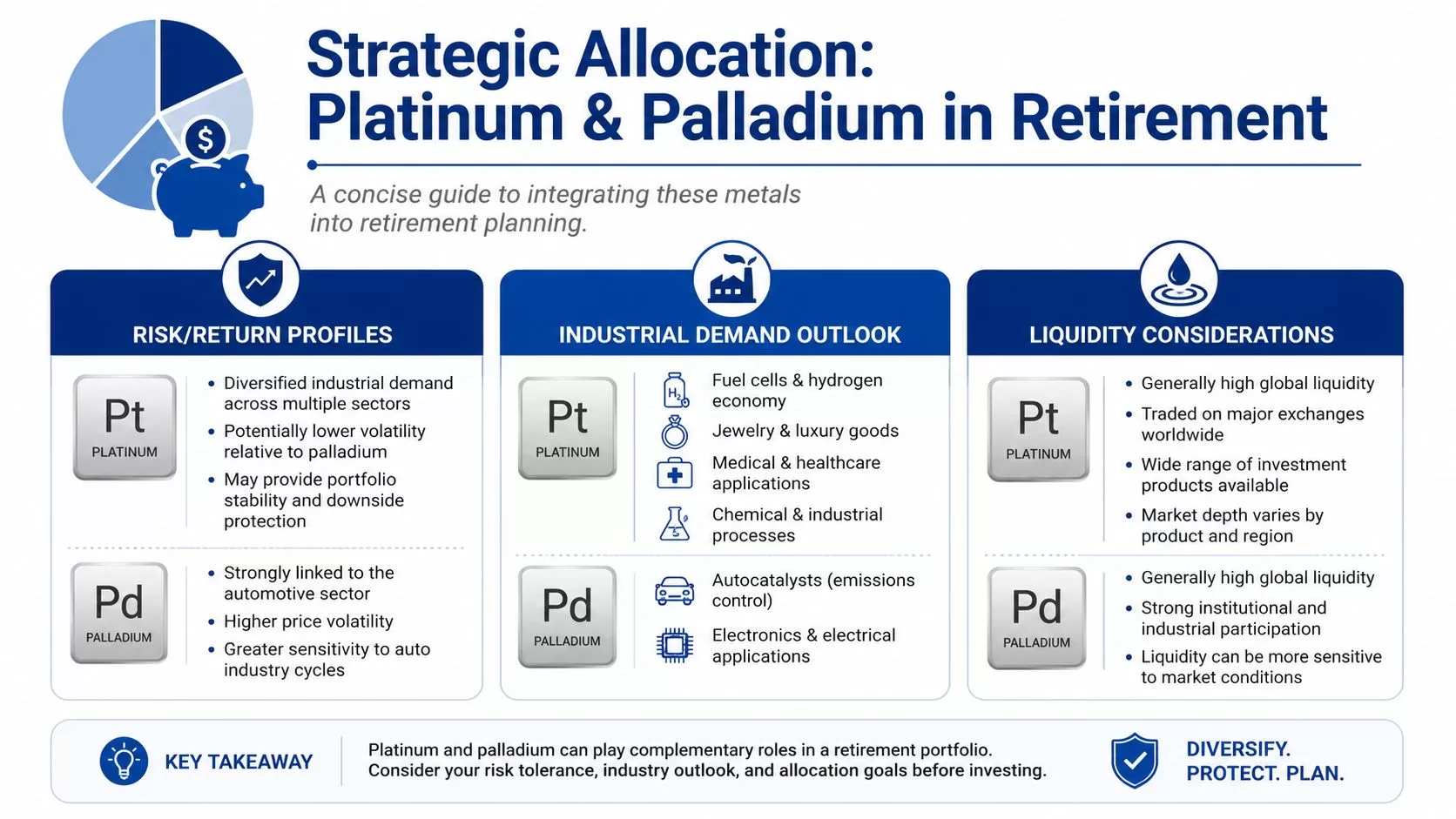
Many investors treat palladium as a satellite position because of its narrower demand base and volatility, while platinum is framed as a value play tied to hydrogen and diversified industrial demand allocation perspective. That framing works because it prevents the smaller, more volatile position from taking over the entire metals sleeve.
For a conservative retiree, the better choice is usually to lean more heavily toward platinum and keep palladium smaller. For a more growth-oriented retiree who understands the volatility, palladium can still play a role, but it should stay limited. The goal is not to predict the next price move. The goal is to build a metals allocation that can survive several market cycles.
A practical way to think about sizing
- Conservative profile: favor platinum as the primary holding, keep palladium minimal, and keep the metals sleeve modest overall.
- Moderate profile: hold both metals, but let platinum carry more of the allocation because of its broader industrial base.
- Growth-oriented profile: accept a larger palladium sleeve only if the rest of the portfolio can absorb sharper swings.
The logic is simple. Platinum fits the steadier industrial thesis, while palladium fits a tighter, more cyclical thesis. A retiree who wants diversification, not drama, should not let palladium become the anchor position.

Conclusion and Next Steps
Platinum and palladium both deserve a place in retirement planning, but they serve different jobs. Platinum is the steadier industrial metal, while palladium is the more concentrated, more volatile one. For a metals IRA, the sensible approach is to put platinum in the core position and use palladium as a smaller satellite holding.
That allocation fits retirees who want diversification without letting one metal dominate the sleeve. Platinum gives you broader industrial exposure and a more measured profile. Palladium can still add upside potential, but only in a controlled amount that matches your tolerance for sharper swings.
A practical next step is to review your current IRA structure and decide how much of your metals allocation should be tied to steadier demand versus cyclical demand. If you want clearer guidance on custody choices, IRA-eligible products, or how platinum and palladium may fit into an existing retirement account, explore Gold IRA Association's resources on precious metals IRAs. For direct questions about your allocation, a specialist can walk through the process and help you compare the options that fit your goals.


