




A saver leaves a job, finds an old SIMPLE IRA statement, and decides to consolidate retirement savings before choosing new investments. The transfer looks routine, but SIMPLE IRA rollover rules add restrictions that ordinary IRA guidance can miss. The safest approach is to establish eligibility first, confirm the destination second, and move the money only after both institutions agree on the transaction.
Why SIMPLE IRA Rollover Rules Trip Up Even Careful Savers
The account name creates false confidence. A SIMPLE IRA looks familiar enough that a participant may assume the same consolidation process used for another IRA will work without further investigation.
Consider a former employee who wants to move retirement savings into a self-directed IRA. The receiving institution offers the desired investment choices, the paperwork looks straightforward, and the participant no longer works for the sponsoring employer. None of those details establishes that the proposed transfer is eligible.
Start with eligibility, not investments
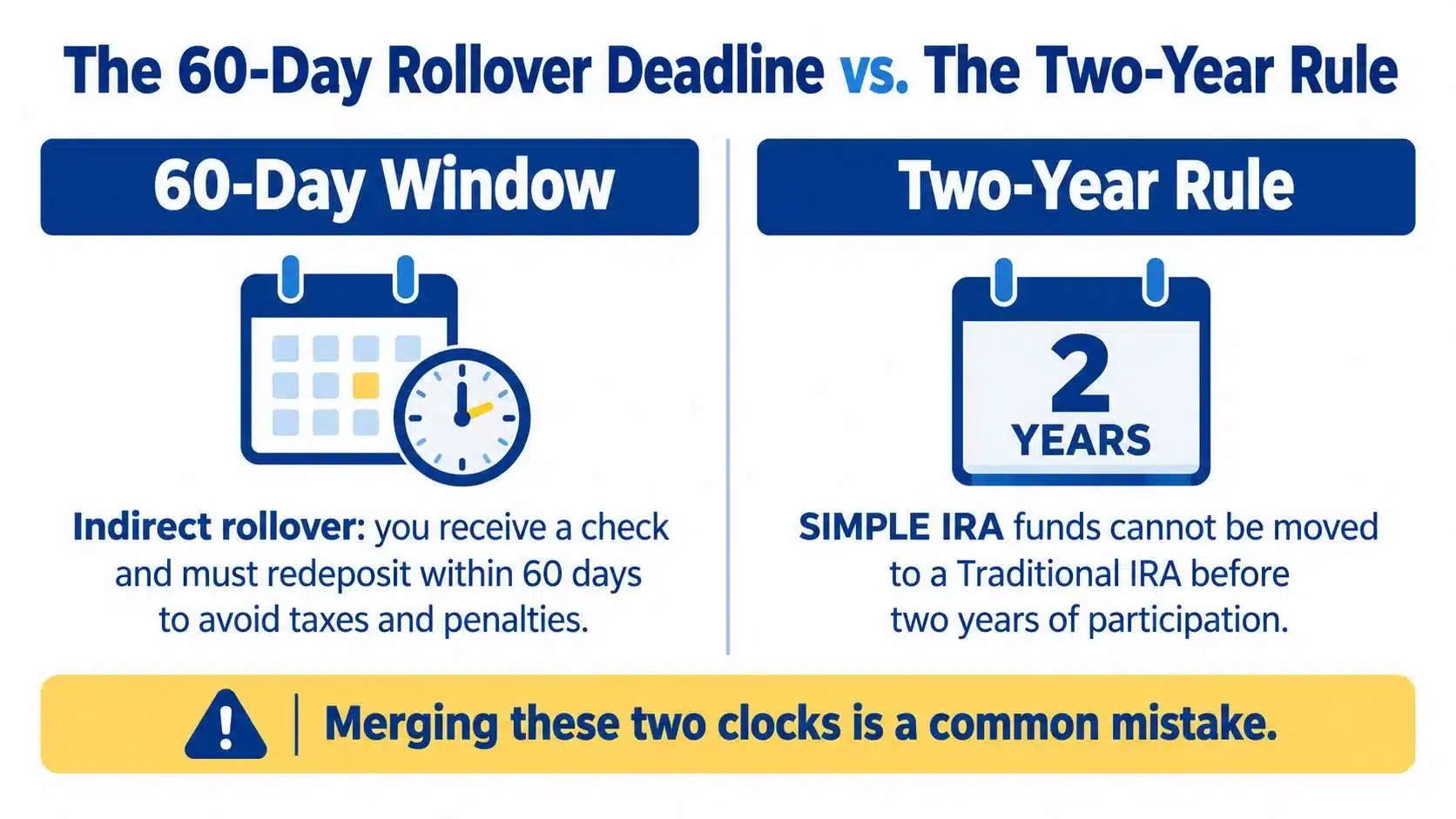
SIMPLE IRA transactions require attention to a two-year participation rule and, when the participant receives the distribution, a separate 60-day deposit deadline. These are independent requirements, not interchangeable waiting periods, as explained in the IRS SIMPLE IRA rollover FAQs.
Before discussing investments, the account holder should establish:
- Participation history. Which employer sponsored the plan, and what records establish the participant's start date?
- Account ownership. Is this the participant's own account or an inherited account?
- Transaction structure. Will the institutions move the assets directly, or will the participant receive the funds?
Practical rule: A receiving institution's willingness to open an account isn't proof that the proposed rollover qualifies.
The recommendation is straightforward: don't request a distribution while basic eligibility questions remain unanswered.
The Two-Year Participation Rule Explained
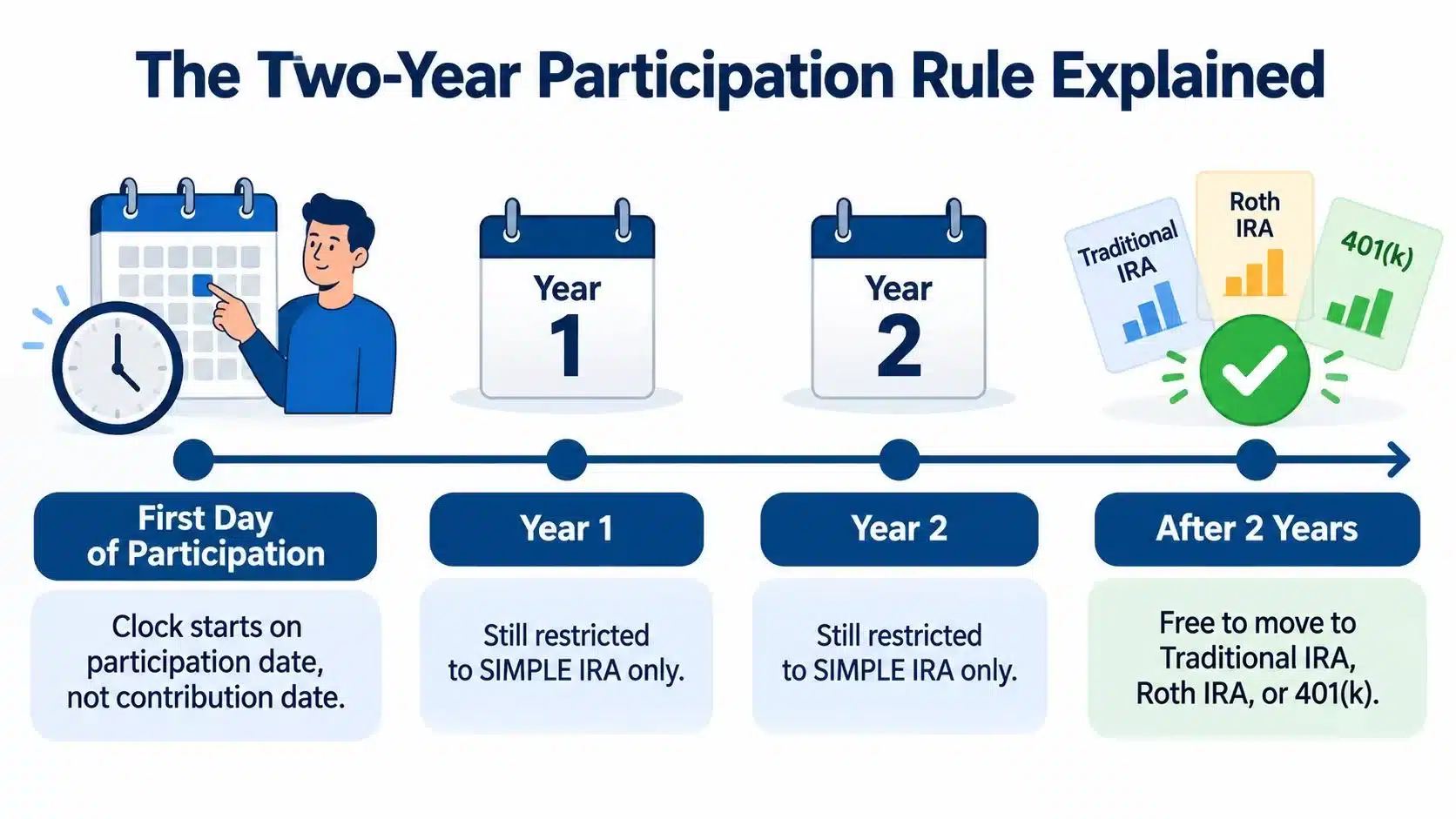
A job change can make an old SIMPLE IRA look ready to move, but leaving the employer does not start or end the participation clock. The relevant date is when the employee first participated in that employer's SIMPLE IRA plan. During the first two years, a tax-free transfer is generally limited to another SIMPLE IRA. After that period, other eligible destinations may be available. Confirm the date before choosing where the money should go.

Build a participation-date file
Do not infer eligibility from the oldest statement you have. Ask the employer or plan administrator to confirm the first participation date in writing, then compare it with enrollment documents, plan materials, and historical custodian records. The IRS Publication 590-A explains the SIMPLE IRA transfer restrictions.
An account-opening date can help, but it may not establish when participation began. If records conflict, get the administrator to resolve the discrepancy before authorizing a transfer. Keep the written confirmation with the account records.
Triage employer changes and inherited accounts
If the account is tied to the participant's current employer, verify the original participation date for that plan. If the participant changed employers, separate the records for each employer's plan and identify any previous transfers. Continuous employment or continuous saving doesn't establish participation in a particular plan. Don't assume the latest account-opening date determines eligibility for every asset.
Inherited accounts require a different review. Ask the custodian to confirm the deceased participant's participation history, the beneficiary registration, and which transactions are permitted for that ownership arrangement. Do not apply the participant-owned rollover process automatically to inherited assets.
If the participation date remains unknown, pause the transaction and obtain better records. Guessing can lead to an ineligible transfer and an avoidable tax problem. Once eligibility is established, choose the destination based on the account's status and the investments you intend to hold, whether traditional or Roth, brokerage-based or self-directed.
The 60-Day Rollover Deadline and the One-Rollover-Per-Year Rule
An indirect rollover adds a processing obligation because the participant receives the money. The eligible amount must generally reach the receiving retirement arrangement by the 60th day after receipt. Separately, the IRA-to-IRA rollover limit permits only one rollover within a 12-month period, aggregated across SIMPLE, SEP, traditional, and Roth IRAs since January 1, 2015, under the IRS IRA rollover FAQs.
The deposit deadline doesn't establish destination eligibility. It also doesn't reset the rolling limitation because a new calendar year begins.
Direct vs. Indirect SIMPLE IRA Rollover
| Feature | Direct Trustee-to-Trustee | Indirect (60-Day) |
|---|---|---|
| Who receives the assets | Receiving institution | Participant, before redeposit |
| Personal deposit deadline | No participant redeposit window | Deadline described above applies |
| IRA rollover frequency cap | Generally exempt | Applies to IRA-to-IRA rollovers |
| Main administrative concern | Correct receiving instructions | Timely deposit and rollover eligibility |
| Recommended use | Default choice for eligible IRA transfers | Only with a clear reason and documented plan |
Direct trustee-to-trustee transfers are the better default. They avoid the participant's possession of the funds and reduce the risk of turning a retirement-account move into an accidental taxable distribution.
Check the instructions, not just the label
An institution may use “rollover” casually when discussing several different transaction methods. The participant should ask who will receive the payment, how any check will be payable, and whether the receiving institution has approved the instructions.
- Payment details. Obtain the receiving institution's exact registration and delivery instructions.
- Prior activity. Review recent IRA distributions before choosing an indirect IRA-to-IRA rollover.
- Deposit evidence. Keep confirmation that the institution accepted the money as intended, not merely that a check arrived.
A direct transfer reduces execution risk. It doesn't make an otherwise ineligible destination permissible.
Where You Can Actually Move the Money
A SIMPLE IRA can move to several kinds of accounts, but the right destination depends first on the two-year participation period and then on your tax goal. Check eligibility before comparing investments. A brokerage account or self-directed IRA is only an option if the account's tax registration fits a permitted transfer path.
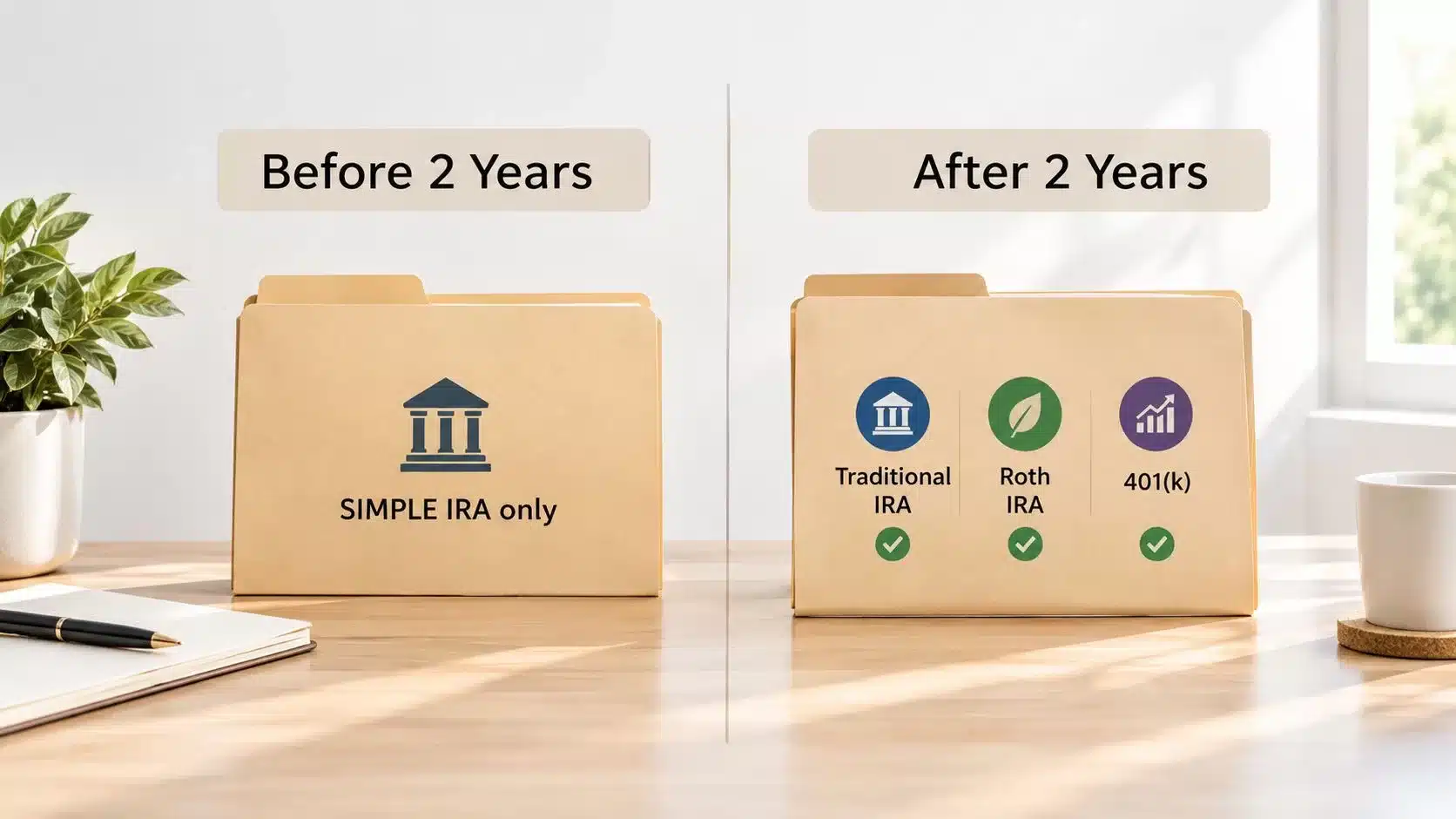

After the two-year participation period, SIMPLE IRA assets may generally move tax-free to another SIMPLE IRA, a traditional IRA, or an eligible employer plan, including a 401(k), 403(b), or governmental 457(b). A Roth IRA conversion may also be available, but previously untaxed amounts converted must be included in gross income. Confirm the permitted destinations in the IRS SIMPLE IRA withdrawal and transfer rules.
Match the account to the objective
| Objective | Destination to investigate | Decision that needs confirmation |
|---|---|---|
| Preserve the restricted transfer path | Another SIMPLE IRA | Correct account type and transfer handling |
| Consolidate IRA assets | Traditional IRA | Acceptance, investment choices, and costs |
| Consolidate with employer-plan savings | Eligible employer plan | Administrator's acceptance of SIMPLE IRA assets |
| Change tax treatment | Roth IRA | Conversion eligibility and projected taxable income |
For someone who has changed employers, start by asking the new plan administrator whether it accepts SIMPLE IRA assets. A plan can refuse them, so get approval before authorizing a transfer. If you do not know when your participation period began, confirm the date with the SIMPLE IRA custodian before choosing a destination.
Once eligibility is established, decide whether the priority is preserving tax treatment, consolidating accounts, or converting assets to Roth. Then compare the receiving account's investment choices and costs. A self-directed account may offer a different investment menu, including metals, but it does not change the rules governing an eligible destination.
Separate eligibility from execution
The account you choose and the method used to move the money are separate decisions. Review the practical differences between direct transfers and rollovers after confirming that the destination can accept the assets.
Get acceptance in writing. A verbal assurance that an institution “takes IRA money” does not confirm that it accepts SIMPLE IRA assets or can process the intended Roth conversion.
Tax Consequences and the 25% Additional Tax
A SIMPLE IRA distribution can create two separate tax costs: ordinary income tax on the taxable amount and, when applicable, an additional early-distribution tax. Assess each one separately. An exception to the additional tax does not make an otherwise prohibited rollover destination eligible.
During the restricted participation period, a taxable distribution that is not handled according to the rules may trigger the 25% additional early-distribution tax. Reaching age 59½, or qualifying for another exception, may remove that additional tax, but it does not make a prohibited destination permissible. Review the IRA rollover tax guide and confirm how the rules apply to your transaction.
Separate the costs before estimating exposure
- Income inclusion. Identify the portion of the distribution that must be reported as taxable income.
- Additional tax. Confirm whether an exception applies to the participant and the distribution.
- Withholding. Ask the custodian what it will withhold if the funds are paid to you.
- Replacement funding. Determine whether you need outside cash to complete the intended eligible rollover amount.
For example, the custodian may withhold part of a distribution before sending the remaining payment to you. If you redeposit only what you receive, the amount rolled over may fall short of the gross distribution. Get both figures before authorizing payment, and ask a tax professional to assess the consequences of any shortfall.
There is no reliable universal dollar estimate. The result depends on the distribution amount, its taxable portion, your other income, and any applicable exceptions. Have a tax professional calculate those components rather than relying on an assumed combined rate.
Tax distinction: Avoiding an additional tax does not necessarily avoid ordinary income tax.
Don't confuse withholding with the final bill
Withholding is a tax payment, not a decision about whether a rollover succeeded. Do not assume that an employer-plan withholding rule automatically applies to a SIMPLE IRA distribution. Ask the custodian for a written distribution estimate, then review the tax treatment before authorizing the payment. That review helps you understand the likely tax cost and whether the amount you intend to roll over matches the funds available.
Step-by-Step Execution Checklist
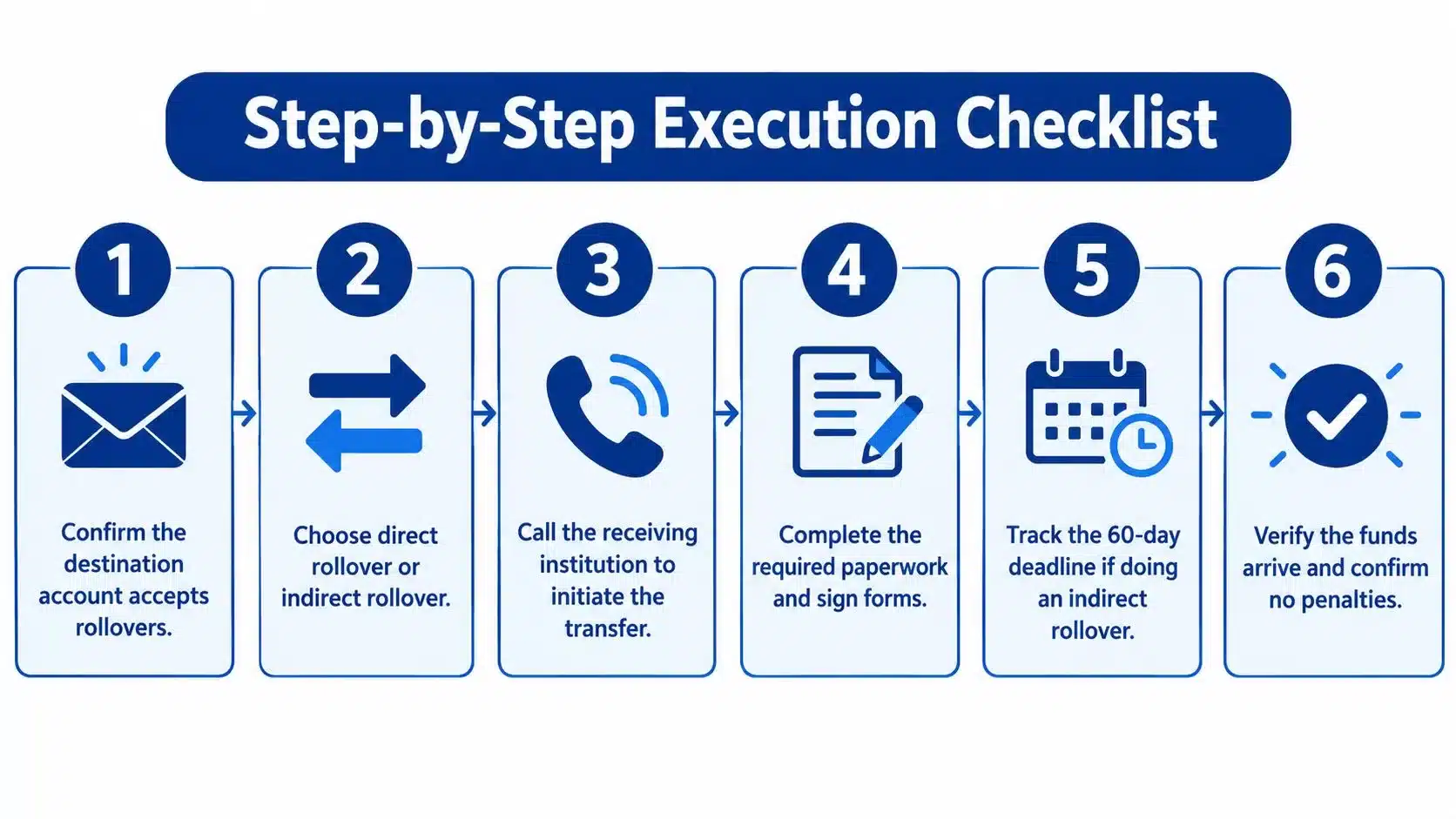
A compliant plan can still go wrong through mismatched paperwork or incomplete follow-up. The participant should assign responsibility for each part of the transaction and keep the evidence together.
Coordinate the transaction before releasing funds
- Confirm destination acceptance. Obtain written approval for the specific account type and SIMPLE IRA assets. An inherited account should receive an ownership-specific review first.
- Choose the payment method. Request institutional handling where available. If participant payment is necessary, document why and confirm the receiving institution's deposit procedure.
- Authorize the distribution carefully. Check account numbers, registration, payment instructions, signatures, and withholding arrangements. Keep a copy of the submitted request.
- Track receipt and completion. Record when the participant receives any distribution and when the receiving institution accepts the eligible deposit. Follow up promptly on missing paperwork or rejected payments.
- Review prior rollover activity. Check the participant's broader IRA history before proceeding with an indirect IRA-to-IRA transaction. Reviewing only the distributing account isn't enough.
- Reconcile reporting. Compare the distribution statement, deposit confirmation, and applicable Forms 1099-R and 5498. The IRA rollover tax-form guide can help organize that review.
The IRS confirms that the 60-day indirect rollover deadline generally applies to rollover contributions, with relief routes including an automatic waiver for qualifying institutional errors, self-certification for eligible reasons, or a private letter ruling, in Publication 590-A for 2025. Relief is a fallback, not a processing strategy.
Keep a permanent transaction file
- Participation evidence. Employer confirmation, Summary Description, and historical records.
- Transfer instructions. Acceptance confirmation and signed requests.
- Money trail. Gross distribution details, withholding information, and deposit confirmation.
- Tax records. Applicable reporting forms and correspondence about corrections.
A completed deposit should be verified with the receiving institution. Receipt of funds alone doesn't establish that the institution recorded the transaction correctly.
Choose investments separately from tax status
A traditional IRA versus Roth decision concerns tax treatment. A brokerage versus self-directed metals decision concerns investment access, custody, liquidity, and costs. Combining them into one hurried sales conversation makes comparison harder.
For a proposed Roth conversion, the tax professional should model the current tax cost and review the conditions governing later withdrawals. A conversion shouldn't be selected because a provider describes future withdrawals as tax-free.
For precious metals, the participant should request written information about custodial eligibility, qualifying metals and purity requirements, depository arrangements, storage charges, transaction expenses, and sale procedures. Rollover eligibility isn't approval of a particular metal or storage arrangement. Remaining in the existing account is also an option while those questions are resolved.
Common Pitfalls and How to Dodge Them
A rollover problem is easier to prevent than to correct. Before authorizing a distribution, resolve questions about the receiving account, prior IRA transactions, and the participant's SIMPLE IRA history.
Warning signs that deserve a pause
- Wrong destination. A receiving institution may offer an account without confirming that it can accept these assets. Get account-specific approval before releasing the funds.
- Unfinished deposit. The payment has arrived, but paperwork is still outstanding. Contact both institutions promptly and keep their responses.
- Unreviewed rollover history. The participant recalls recent IRA payments but hasn't checked how they were treated. Review statements and tax records before choosing an indirect rollover.
- Missing participation records. The current custodian's statements don't establish when participation began. Request records from the employer and any previous custodian.
Keep the original Summary Description in the retirement file. It gives future custodians and tax professionals a starting point if they need to reconstruct the account's history.
Frequently Asked Questions
How can a lost participation date be reconstructed?
Ask the employer for written confirmation, then compare enrollment materials with historical custodian records. If the dates conflict, have the plan administrator resolve the discrepancy before relying on a participation date.
Can a receiving employer plan refuse the rollover?
Yes. A plan's eligibility to receive a rollover does not mean it must accept the assets. Get approval from the plan administrator first, rather than relying on general plan descriptions.
What if the participant qualifies for an additional-tax exception after moving funds to the wrong destination?
An exception may prevent the additional tax, but it does not make an otherwise invalid rollover valid. Have a tax professional assess income inclusion and exception eligibility separately.
Do newer catch-up limits change rollover eligibility?
No. For 2026, the SIMPLE-plan catch-up limit is $5,250 for participants aged 60–63, compared with the $4,000 standard catch-up limit. These contribution-limit changes do not remove the separate rollover restriction.
This is not financial advice. Consult a licensed financial advisor, CPA, or tax professional before making investment decisions.
Gold IRA Association offers educational guides on rollovers and precious-metals IRAs, along with provider comparisons. After confirming transfer eligibility with the custodian and tax professional, review custody, storage, and fee considerations before choosing an account.


