




A pre-retiree with a 401(k) or traditional IRA may be considering physical gold and keep hearing the phrase “Gold IRA company.” The label can make it sound as if one business manages the account, sells the metal, and stores it, but those jobs are often handled by separate parties. Understanding who does what, how money and metals move, and what to verify before signing paperwork can help prevent costly misunderstandings.
Why Pre-Retirees Are Asking About Gold IRA Companies Right Now
For someone approaching retirement, a Gold IRA can sound straightforward: move eligible retirement funds into an account that holds certain physical precious metals. But the company advertising the service may not be the institution that legally administers the IRA, and it may not own the facility where the metals are stored. That difference matters before any transfer or purchase begins.
A Gold IRA is a self-directed individual retirement account that can hold eligible physical precious metals within the IRA's tax framework. It doesn't mean the account holder can buy any coin or bar and keep it personally. The account still has to follow the applicable rules for eligible investments, reporting, distributions, and prohibited transactions, as explained in the IRS guidance on retirement-plan investments.
The term “Gold IRA company” usually describes a provider that helps coordinate parts of the process. To evaluate one, it helps to answer three practical questions: Which parties are involved? How does the account and metal move from setup to storage? What should be verified before money is sent?
The answers begin with the roles, not the brand name. In a typical arrangement, a custodian administers the IRA, a dealer arranges the metal purchase, and a depository stores the assets. A separate administrator or broker may help coordinate paperwork and communication. Treating all of these functions as one service can make it harder to know who controls a decision, handles a fee, or responds when a problem arises.
The Four Roles Behind the Label Gold IRA Company
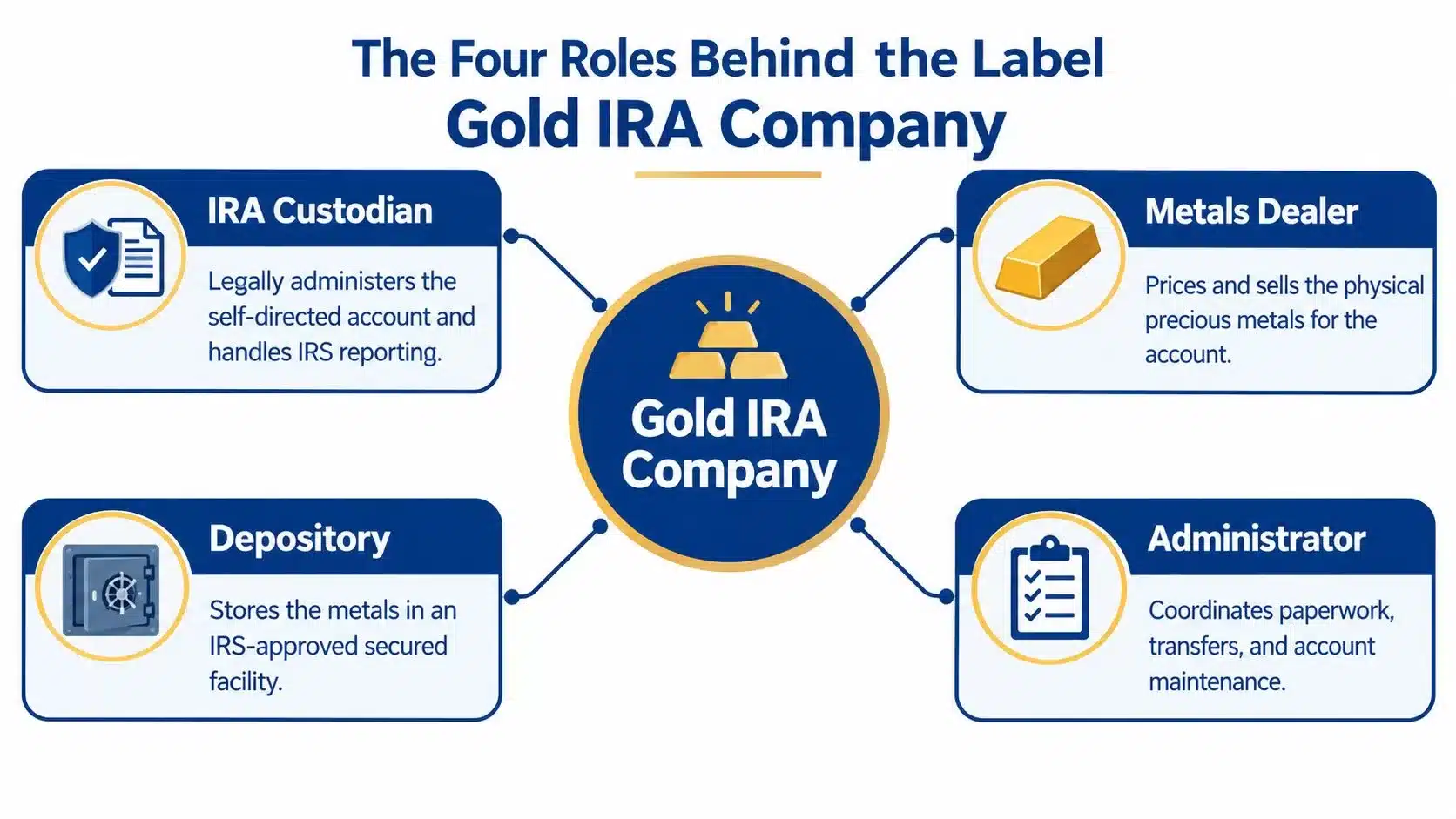
A Gold IRA is still an IRA, but its self-directed structure allows certain physical precious metals instead of limiting investments to conventional assets such as stocks, bonds, and mutual funds. The IRS describes an arrangement involving an account custodian or trustee, a metals dealer, and an approved depository. Some providers also use an administrator or broker to coordinate the process. These functions can be connected through one customer-facing company, but that doesn't mean one entity performs every job.

Who administers, sells, and stores the assets?
IRA custodian or trustee: This institution administers the self-directed retirement account, maintains account records, and handles required account processes. The IRA, rather than the individual, generally owns the assets while they remain in the account. For a clearer explanation of this role, see the guide to an IRA custodian for gold.
Metals dealer: The dealer offers and sells the bullion. It may provide a quote and arrange a purchase, but it isn't automatically the IRA's custodian or the facility that stores the metals. Ask how the dealer sets its price and whether the quoted amount includes a spread.
Approved depository: The depository holds the physical metal for the account. Confirm its identity and the storage arrangement directly through the account paperwork, rather than relying only on a sales conversation.
Administrator or broker: This party may help with education, forms, and communication among the investor, custodian, and dealer. Its precise duties can vary, so get them in writing.
This division helps answer the question, “Who do I contact if something goes wrong?” Account administration questions belong with the custodian; a purchase price or order question belongs with the dealer; and storage questions belong with the depository. The company that introduced the investor to those parties may help coordinate a response, but its sales reputation alone doesn't establish the quality of custodial administration or storage.
How the Gold IRA Workflow Actually Runs
The workflow is easier to follow when each handoff is clear. A provider may guide the paperwork, but it can't change the tax rules governing the transfer of retirement funds. The account holder should understand what happens at every step and confirm which institution is responsible.
From account opening to the first statement
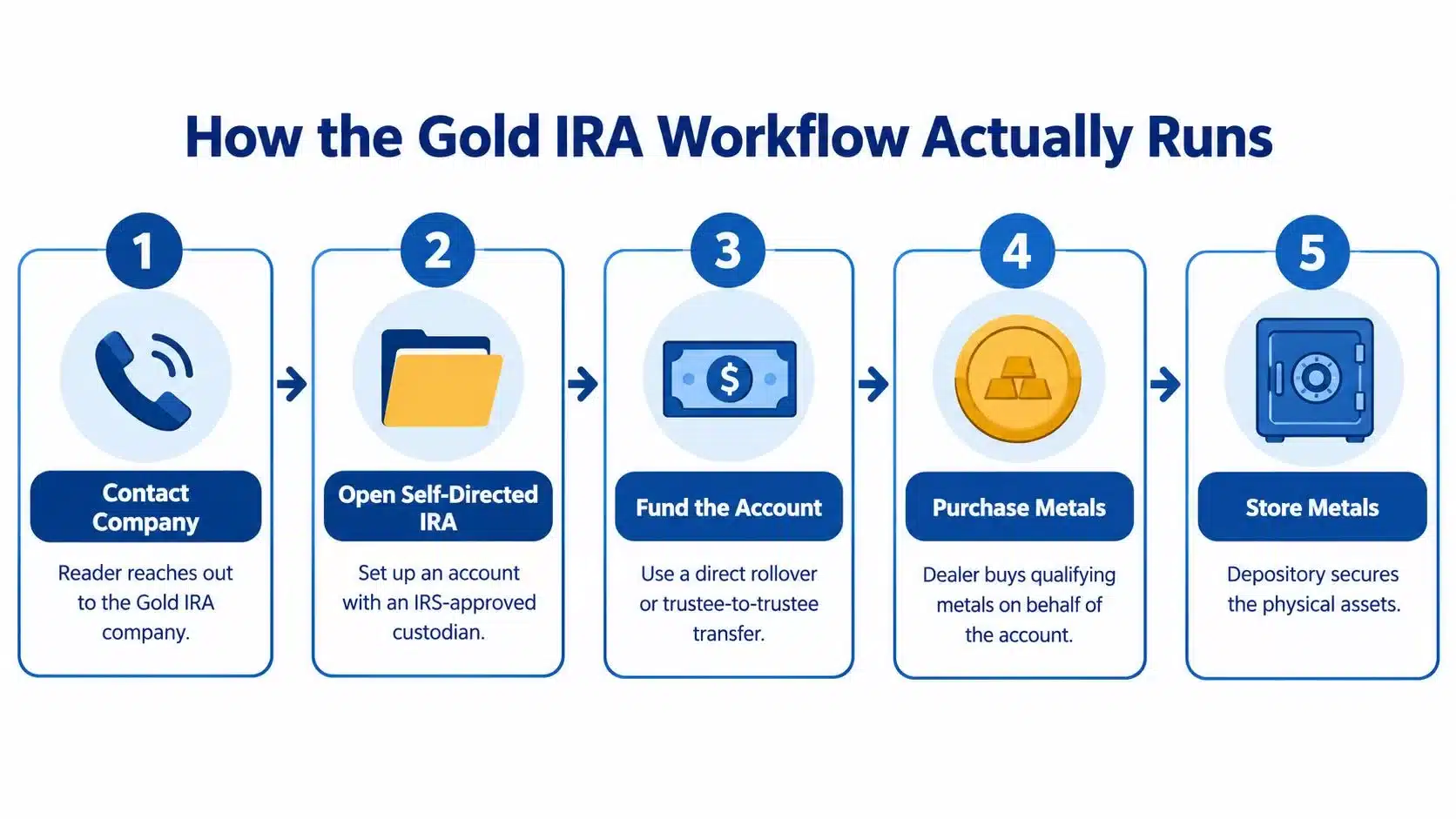
Contact a provider and identify the parties. Before authorizing a transfer, ask which custodian will administer the IRA, which dealer will sell the metals, and which depository will store them. Don't assume the name on the sales materials is also the name of the custodian.
Open the self-directed IRA. The custodian establishes the account and provides the documents needed to receive eligible retirement funds. Read the account paperwork and identify the receiving trustee before requesting a distribution from an existing plan.
Choose how to fund the account. A direct transfer or rollover generally sends eligible funds from one institution to another without the account holder receiving them personally. If an employer-plan distribution is paid directly to the receiving IRA, the IRS says federal income-tax withholding doesn't apply. By contrast, a distribution paid to the individual generally must be deposited into the new plan or IRA within 60 days. A taxable amount not rolled over may be included in income and may also face the 10% additional tax on early distributions, subject to applicable rules and circumstances. The IRS explains these mechanics in its rollover guidance for retirement-plan and IRA distributions.
Place the metal order. Once the account is funded, the investor selects eligible products and authorizes the purchase through the proper account process. The dealer arranges the sale; the custodian handles the IRA transaction.
Confirm storage and account records. The metal should be delivered to the agreed depository, not treated as the account holder's personal property. Review the custodian's statement and related paperwork to confirm the account holds the purchased assets.
Before approving a transfer: Request written confirmation of the transfer type, receiving trustee, distribution date, deposit date, and the account statement process.
Rollover assistance is primarily workflow coordination. It can help gather documents and communicate with institutions, but it doesn't remove the investor's responsibility to check deadlines, tax consequences, and transfer records.
What Metals Actually Qualify Inside a Gold IRA
A dealer can't put any gold product into an IRA because it looks like bullion or is marketed as an investment coin. The account must hold products that meet the legal eligibility rules. Internal Revenue Code Section 408(m) generally treats collectibles as prohibited IRA investments, while Section 408(m)(3) provides exceptions for certain coins and bullion. The statutory framework and commonly cited purity standards are summarized in this overview of gold IRA rules.

Eligibility is a product check, not a sales preference
Commonly cited minimum fineness thresholds are .995 for gold, .999 for silver, and .9995 for platinum and palladium. Certain specifically authorized coins can qualify under separate statutory provisions even when their composition differs from the ordinary bullion threshold. That distinction means an investor shouldn't assume a coin qualifies just because it's widely recognized or contains precious metal.
The dealer's job includes identifying products that can be purchased within the IRA and arranging the order accordingly. The investor should still ask for the product's name and specifications, then confirm eligibility with the custodian before authorizing the purchase.
In practical terms:
- Check both product type and composition. Purity alone doesn't establish that every product is IRA-eligible.
- Ask whether a coin qualifies under a specific exception. Some authorized coins follow a different route from the general bullion fineness standard.
- Don't treat collectible or numismatic appeal as proof of eligibility. A sales description isn't a substitute for confirming the rules.
A compliant process makes this check before the order is finalized. If eligibility is unclear, pause and ask the custodian to confirm in writing rather than relying on a dealer's verbal assurance.
Comparing the Fees You Should Expect to See
Gold IRA costs usually come from more than one party. A provider's quote may combine account setup, ongoing administration, storage, and transaction costs, or show some of them separately. Comparing only a headline fee can hide the total cost of holding and later selling the metal.
| Fee Category | Typical Structure | Who Charges It | What to Ask |
|---|---|---|---|
| Account opening or setup | One-time account or application charge | Often the custodian, sometimes collected through a provider | Is this a custodian charge, and is it billed once? |
| Annual custodial administration | Recurring account-maintenance charge | Custodian or trustee | What services are included, and when is the fee billed? |
| Storage | Recurring charge that can depend on the storage arrangement | Depository, sometimes collected through the custodian | Is storage segregated or non-segregated, and what does the quoted charge cover? |
| Transaction costs | May include transfer or wire charges, dealer spread, or sale-related costs | Depends on the transaction and party involved | What will the investor pay to buy, sell, or transfer the assets? |
Compare the complete written schedule
The dealer's spread is not the same as the custodian's administrative fee. A metal quote can include a difference between the dealer's purchase and sale prices, while the custodian and depository charge for separate services. Ask for those amounts and terms individually, then request an all-in schedule that shows what is due at setup, each year, and when the account buys or sells metal.
Storage arrangements also deserve a direct question. If the provider offers different storage options, ask how each one is documented and priced; don't assume that a quoted storage charge includes every related cost. The account paperwork should make clear which entity bills the investor and whether a fee is recurring or transaction-based.
Compare like with like: Put each provider's setup, custodial, storage, and transaction charges side by side before funding. A guide to Gold IRA fees can help clarify which line items to look for.
A provider that can't supply a clear written schedule makes informed comparison difficult. The issue isn't whether every charge is low; it's whether the investor can identify each charge, its recipient, and when it applies.
Red Flags and Due Diligence Questions to Ask First
A polished sales process doesn't prove that the account administration and storage arrangements are sound. This distinction matters in an active market: global gold investment demand reached 2,175 metric tons in 2025, while bar-and-coin demand rose 16% to a 12-year high, according to Reuters' report on global gold demand. Higher interest in gold makes it especially important to verify each party rather than treating the seller's reputation as a substitute for due diligence.
Checks to make before signing
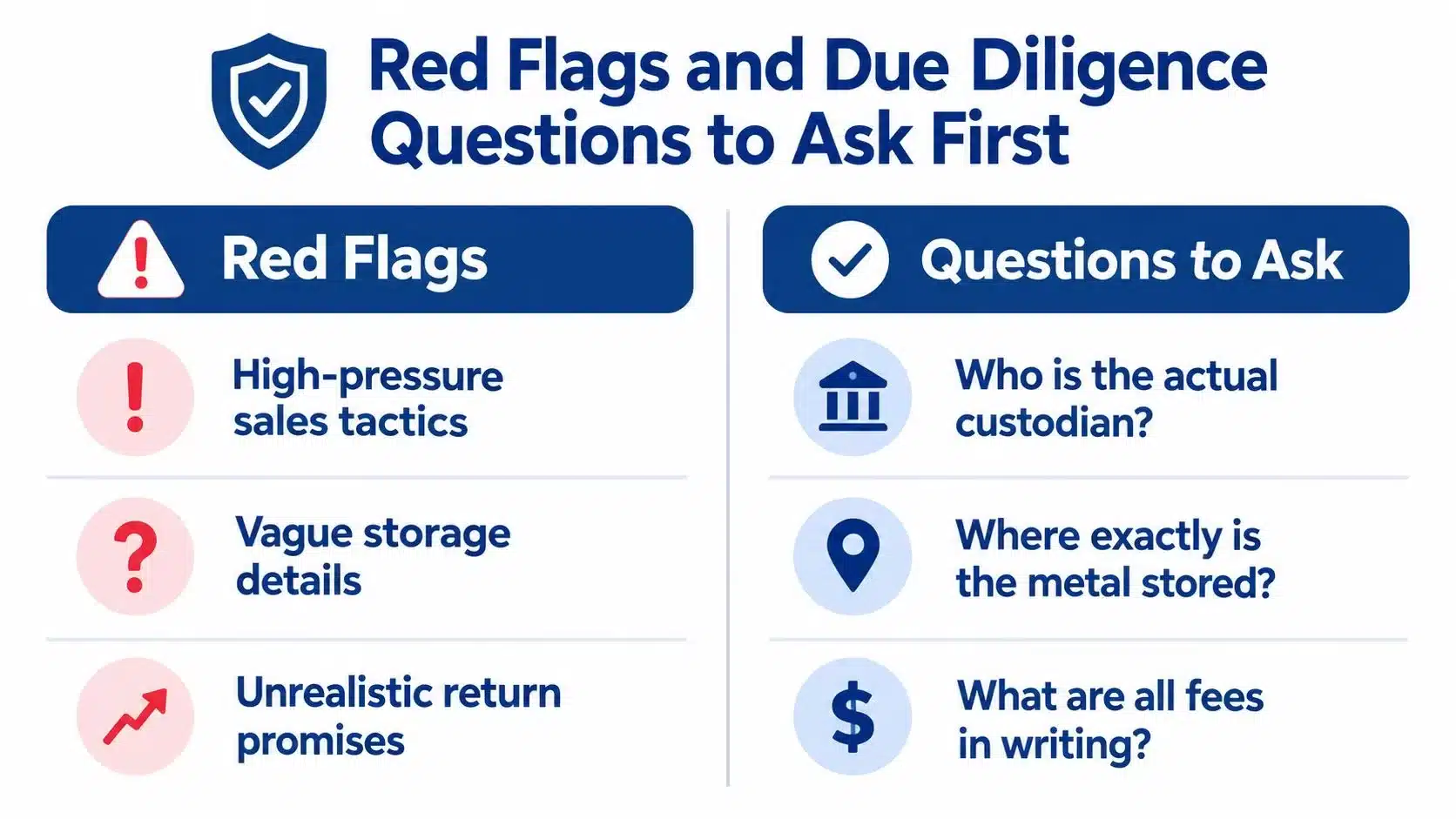
- Verify the custodian. Get the legal name of the institution that will administer the IRA and confirm that it appears in the account documents.
- Confirm the depository. Ask where the metal will be stored and how the storage arrangement will appear on account records.
- Request every fee in writing. Separate the custodian's charges from the dealer's price and any storage or transaction costs.
- Ask how liquidation works. Find out how the account can sell metal or take an in-kind distribution, and which party handles each step.
- Confirm the transfer route. Get written instructions for a direct transfer or rollover rather than relying on informal assurances about timing.
Be cautious if a salesperson creates pressure to act immediately, promotes scarce or collectible coins without clearly explaining eligibility, or won't provide an all-in fee schedule. Claims of guaranteed returns are also a reason to stop and seek independent guidance. So is any suggestion that the IRA's metal can be stored at home without compliance consequences.
The brand that sells or coordinates the service may not be the custodian or depository. Keep those entities separate in the investor's own records, and direct questions to the party responsible for the relevant function. For more warning signs, see this guide to Gold IRA scams.
Common Questions Near-Retirees Ask Next
Can Gold IRA metals be stored at home?
The account owner generally can't treat IRA-held bullion as personal property or store it informally at home. The IRA owns the assets until a distribution occurs, and personal possession may create compliance and tax problems. A licensed tax professional can help assess a person's circumstances.
Can the IRS waive the 60-day rollover deadline?
A late rollover isn't automatically excused. Under Revenue Procedure 2020-46, an individual may give the receiving plan administrator or IRA trustee a self-certification stating that the person qualifies for relief, but the contribution remains subject to verification and reporting. See the IRS guidance on accepting late rollover contributions, and consult a licensed tax professional before acting.
Can an investor take the metal home without a distribution?
Taking personal possession while the metal is held in the IRA can raise distribution and compliance issues. Ask the custodian how an in-kind distribution works and consult a licensed tax professional about the tax treatment.
What's the difference between a direct rollover and a trustee-to-trustee transfer?
Both generally move funds between institutions without the account holder receiving them personally, but the exact process depends on the type of account and transfer. Ask the sending and receiving institutions to confirm the route and documentation before funds move.
Putting It All Together and Your Next Step
A Gold IRA company is often a coordination label for separate roles. Before funding an account, verify the custodian, confirm the depository, check product eligibility, request a complete fee schedule, and understand the transfer method. This article is educational, not personalized financial, tax, or legal advice. Consult a licensed financial advisor, CPA, or tax professional before making investment decisions.
Gold IRA Association offers educational guides and comparative reviews to help readers understand provider roles, rollover procedures, eligible metals, and fees. Visit Gold IRA Association to review those resources and prepare questions before speaking with a provider.


