




Can your new 401(k) accept every dollar of your TSP balance, including the Roth and tax-exempt pieces? Most rollover guides answer a simpler question, how to move the money, and skip the one that decides whether the transfer works at all. A TSP to 401(k) rollover is really a matching exercise: each tax source in the account has a destination that can hold it and a tax result that follows it there.
Which TSP Money Can Move to a 401(k) and How It Is Taxed
Start with the statement, not the form. The table below sorts each type of TSP money by where it can go and what the move does for taxes.
| TSP money type | Allowed destination | Tax result of the rollover |
|---|---|---|
| Traditional TSP balance | Traditional IRA or employer plan that accepts pre-tax funds | Stays tax-deferred until withdrawal |
| Roth TSP balance | Roth IRA or Roth 401(k) only | Not taxed as income when moved to a Roth account; confirm basis and holding period |
| Traditional TSP balance sent to a Roth IRA | Roth IRA | Taxable in the year distributed, because it is a conversion |
| Tax-exempt military-service contributions | Only plans that accept them | No tax at transfer when the receiving plan accepts the funds and preserves their tax-exempt treatment |
The TSP's booklet on rollovers and transfers puts the same idea in procedural terms: the rollover rules differ for traditional and Roth balances, so account classification matters before paperwork is submitted. A traditional TSP balance rolled into a traditional IRA or an eligible employer plan generally remains tax-deferred, with income tax postponed until a later withdrawal. A traditional distribution rolled into a Roth IRA is generally taxable in the year distributed, because the transaction converts pre-tax money into a Roth account. The booklet also notes that withholding applies to the taxable portion of a payment, while amounts sent directly to a traditional IRA or eligible employer plan are not subject to current income tax at the time of the transfer.
The one rule behind each row
Every row follows a single rule. The destination account must match the tax character of the money. Pre-tax money goes to a pre-tax account and keeps its deferral. Roth money goes to a Roth account and keeps its tax-free treatment. Tax-exempt military-service contributions go only to a plan that agrees to hold them that way.
Break the rule and the move becomes a taxable event. Sending pre-tax TSP money to a Roth IRA is a conversion, not an ordinary rollover, and the converted amount is taxable in the year it is distributed. That is why a traditional vs. Roth 401(k) comparison belongs in the planning stage, before any request is filed.
Classification also decides how other retirement benefits are divided. Anyone who has read about splitting railroad pensions after divorce has seen the same principle at work: the type of benefit determines the rule that applies. TSP money behaves the same way.
Why one request can go to two places
The TSP lets traditional and Roth portions be directed separately, so one withdrawal request can send each part to a different account type. That flexibility helps a participant with a mixed balance, and it is also where errors begin. A request that names one destination for the whole balance can accidentally convert pre-tax money or send Roth money to a plan that cannot hold it.
Tax-exempt military-service contributions sit outside that split. They move only if the receiving plan accepts them, so that portion may need to stay in the TSP or go to a different destination. Pull the latest TSP statement before any call, list each balance by tax source, then read the receiving plan's incoming-rollover section. The goal is a written match between every source on the statement and an account that will accept it.
Confirm Eligibility and Plan Acceptance Before You Request a Transfer
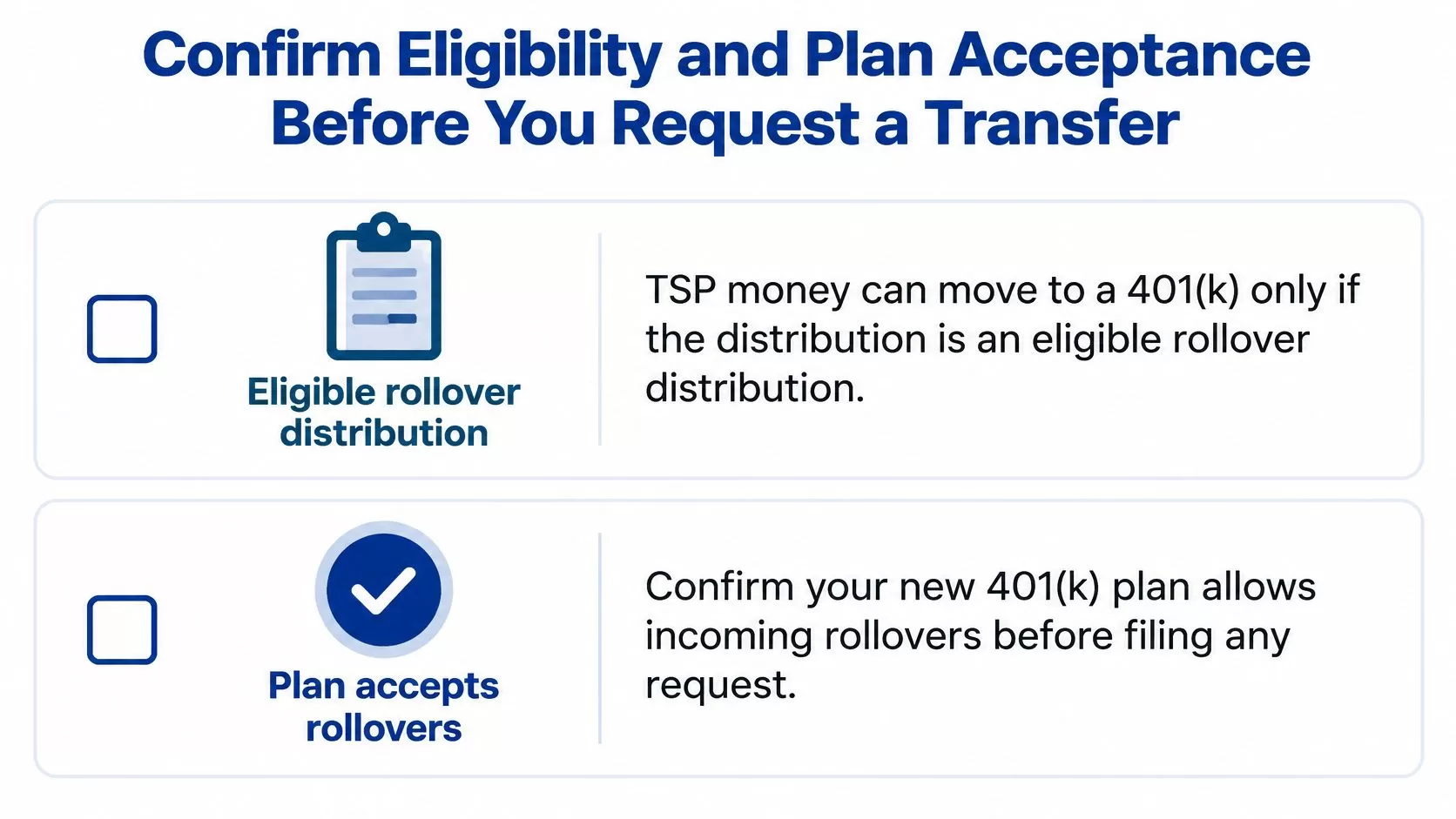
Two approvals stand between a TSP balance and a new 401(k), and neither one is automatic. The distribution must be eligible to roll over, and the receiving plan must agree to take it.

Eligibility comes before acceptance
The first check is on the TSP side. Money can move only if the distribution is an eligible rollover distribution. Required minimum distributions and certain hardship payments generally fall outside that category, and the TSP's rules on separation, in-service withdrawals and outstanding loan balances determine what can be requested at a given moment. Those rules change, so confirm the current version with the TSP rather than relying on how the account worked years ago.
The receiving plan makes the call
The TSP's guidance on taking money from your account is clear that the receiving plan, not the TSP, decides whether it accepts the funds. Federal rules permit traditional and Roth TSP portions to be directed separately, while tax-exempt contributions can be transferred only if the destination plan accepts them. A plan may take pre-tax money and reject Roth or tax-exempt military-service contributions, which leaves a mixed balance split across two or three destinations.
Call the plan administrator with a list, not a general question. Ask about pre-tax traditional money, Roth money and tax-exempt military-service contributions one at a time.
- Request the incoming-rollover policy in writing. Ask specifically whether the plan accepts governmental TSP assets.
- Ask about each tax source separately. A yes for pre-tax money is not a yes for Roth or tax-exempt money.
- Confirm Roth recordkeeping. Ask whether basis and five-year holding-period information will carry over.
- Get the mechanics. Obtain the incoming-rollover form, exact payee name, mailing address and deadline.
- Decide what happens to a rejected source. Leave it in the TSP, send it to another eligible account, or reconsider the move.
Plan rule: A verbal yes is not a yes. Get the acceptance in writing, with the exact payee name and each tax source listed.
The TSP cannot force a plan to accept money it does not take. The only useful answer is a written yes for every tax source, obtained before any form is signed. Readers with mixed balances or long military TSP histories can consult a professional advisor for advice specific to their own situation.
Direct vs. Indirect Rollover: Where the 20% Withholding Hits

Every TSP-to-401(k) transfer travels one of two routes, and the route decides how much of the balance arrives. In a direct rollover, the TSP sends the funds to the receiving plan or IRA. In an indirect rollover, the TSP pays the participant, who then has a fixed window to deposit the money into the new account.
The check below is the moment the two routes split.
The $100,000 example
Take a $100,000 distribution. Under the IRS rules on rollovers, a taxable eligible distribution paid directly to the participant faces mandatory 20% federal income-tax withholding, even when the person intends to complete a rollover later; a direct rollover avoids that withholding because the money never passes through the participant's hands.
Run the numbers on the indirect route. The TSP withholds $20,000, and the participant receives $80,000. To complete a rollover of the full $100,000, the participant must come up with the missing $20,000 from other funds and deposit the entire amount within 60 days.
| Factor | Direct rollover | Indirect rollover |
|---|---|---|
| Who receives the money | Receiving plan or IRA | The participant, who then deposits it |
| Mandatory 20% withholding | Does not apply | Applies to the taxable portion |
| Amount arriving first | $100,000 | $80,000 |
| Deposit deadline | Not applicable once transferred | 60 days from receipt |
| Amount not replaced | Not applicable | $20,000 taxable as income if not redeposited |
The missing $20,000 is the problem. Whatever is not redeposited within the 60 days counts as taxable income for that year, so the replacement cash has to exist before the distribution is even requested. The IRS may waive the 60-day requirement only in limited circumstances beyond the taxpayer's control, which makes the waiver a fallback and not a planning tool.
Withholding also differs by tax source. The 20% applies to the taxable portion of the distribution, so on a mixed TSP balance the traditional pre-tax money is the part that shrinks on the way to the participant. Roth and tax-exempt military contributions travel under different tax treatment, which is one more reason each tax source needs its own destination confirmed before the request is filed.
The short video below covers the same delivery decision at a slower pace.

When the indirect route makes sense
For a transfer between institutions, almost never. The indirect route is worth considering only when the participant already has the replacement cash, understands the 60-day deadline, and has a specific reason the money cannot move directly. Otherwise the direct route is the safer default.
If the money is leaving the retirement system entirely rather than moving to another plan, review the 401(k) withdrawal rules before requesting anything. A withdrawal is taxed differently from a rollover, and the difference is permanent.
How to Complete a TSP to 401(k) Rollover Step by Step
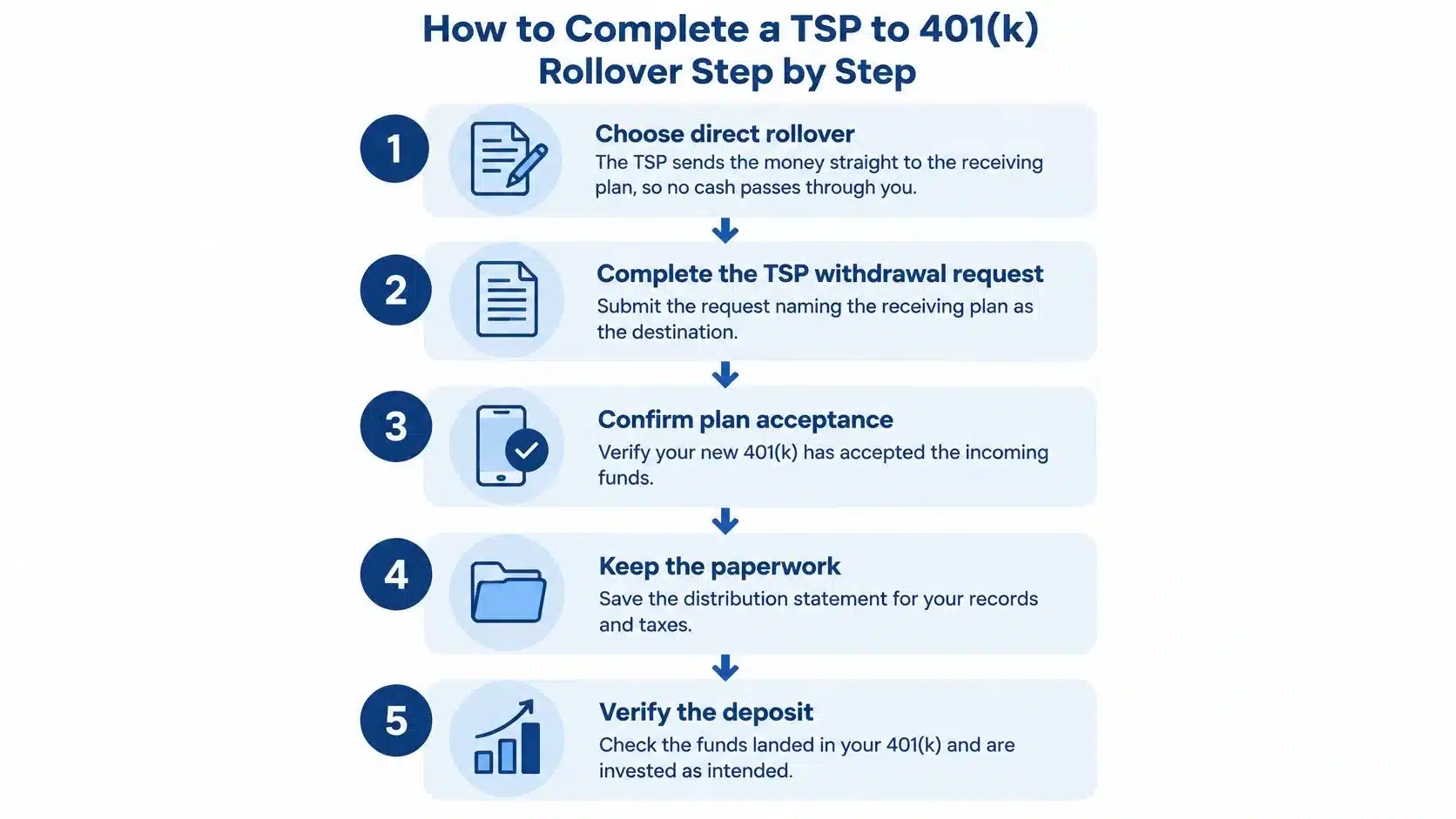
A TSP balance rarely holds just one kind of money. Traditional contributions, Roth contributions and tax-exempt military contributions can sit in the same account, and each piece has to land in a matching home inside the receiving 401(k). Five actions get the transfer done, and doing them in order protects every piece.
The five steps in order
- Choose direct rollover on the TSP request. The TSP's booklet on rollover rules explains that money directly rolled over is not taxed as income at the time of the rollover. Select the direct option unless there is a documented reason the money cannot move that way.
- Enter the receiving plan's details exactly as provided. That means the plan name, recordkeeper, mailing address, account number and the exact payee name for any check. A typo in an account number or payee name is a common cause of delays, and a check made out to the participant instead of the custodian changes the tax treatment.
- List each tax source separately. Traditional, Roth and tax-exempt military portions each go to a matching account type in the receiving plan. A single blended request can send pre-tax money to a Roth account or leave a piece with no accepted destination stranded, so flag any portion the 401(k) will not take before the request goes in.
- Track the transfer until every piece posts. Note the date the check was issued or the electronic transfer was sent. The three portions do not always arrive on the same day, and a mailed check has to reach the recordkeeper, clear its processing queue and be credited to the right account. A check sent to the wrong address can be returned and reissued, which starts the wait over.
- Read the request back before submitting. Confirm the direct rollover selection, the payee name and each listed tax source against the receiving plan's instructions. A mistake caught on the form is a correction. The same mistake caught after the TSP issues payment is a reversal.
The order matters because a request is hard to fix once payment leaves the TSP. Confirming that each tax source has an accepted home costs a phone call. Unwinding a payment that lands in the wrong account, or arrives with nowhere to go, costs far more.
Timing note: Ask both administrators for their processing timelines before the request goes in, then add a week for mail.
Mistakes That Turn a Rollover Into Taxable Income
A TSP rollover becomes taxable in four specific ways: cash you keep from the distribution, a deposit window you miss, money that lands in the wrong type of account, and a rollover you leave off the return. The dollar stakes differ for each. Unreplaced withholding is taxed on the amount kept, a missed window can tax the entire distribution, and a misclassified Roth balance can tax the full converted amount.
The withheld-cash error
Taking the money personally and redepositing only the net check is the costliest version of this mistake. The IRS guidance on rollover withholding gives the example: a participant who receives $50,000 and deposits only the $40,000 net amount generally owes tax on the unreplaced $10,000 that year, and a 10% early-distribution tax may apply depending on age and circumstances. The control is to reserve outside cash equal to the withheld amount before requesting any distribution, then deposit the entire gross amount within the window.
Practical rule: If a check ever arrives made out to you, do not deposit it. Ask the TSP to stop payment and reissue it to the receiving custodian.
The missed deadline
Mailing, endorsing and forwarding a check consumes days of the deposit window before the money ever reaches the custodian. The 401(k) rollover deadline checklist counts from the date of receipt, not the date of the request, because the window runs from the day the money reaches you.
The Roth misclassification
A traditional balance sent to a Roth account is a conversion, and the converted amount is taxable in the year distributed. Roth money sent to an account that cannot hold it creates a second problem. A receiving 401(k) that accepts the pre-tax portion of a TSP balance does not automatically accept the Roth portion or any tax-exempt military contributions, so one blended request can strand part of the balance. One control covers all three: write the tax character of each dollar on the request and confirm the receiving account matches it.
The reporting surprise
A tax-deferred rollover still generates a Form 1099-R, and the distribution belongs on the federal return even when the taxable amount is zero. Report the gross distribution exactly as the form directs and check the figures against the transfer records before filing. A form the IRS already has should never be missing from the return that answers it.
Confirm the Rollover Posted and Choose Your Next Step
The administrative part ends when the receiving 401(k) shows the deposit under the right sources: traditional pre-tax, Roth and any tax-exempt military contributions. If one source posted to the wrong bucket, treat that as an unresolved rollover and pause new elections until the plan corrects it.
Choose investments on purpose
A posted balance often lands in the plan's default or settlement fund, so the next decision is an investment election. Read the new menu the way you read the TSP's: what each fund owns, what it costs, how stable-value or bond options behave, and when withdrawals are allowed. Do not assume the G, C, S, I or F fund mix has a match. A plan can accept the rollover and still offer a shorter menu, different fixed-income mechanics, or rules that change how soon money can move.
Then set the allocation by source. Pre-tax dollars keep their ordinary-income treatment when withdrawn. Roth dollars need the plan's Roth source to preserve their rules. Tax-exempt military money should stay clearly identified so later statements do not blend it with pre-tax dollars. If the new plan cannot hold one of those sources correctly, keep that amount where it is while you compare options.
Bring the TSP final statement, the receiving plan's confirmation and fee disclosure, the rollover request, and any 1099-R or Form 5498 you receive to a meeting with a licensed financial advisor, CPA or tax professional. Gold IRA Association's materials are for informational purposes only and are not financial, legal or investment advice; readers can message Gold IRA Association for help finding educational information on account rules and provider comparisons, or review checklists at Gold IRA Association.


