



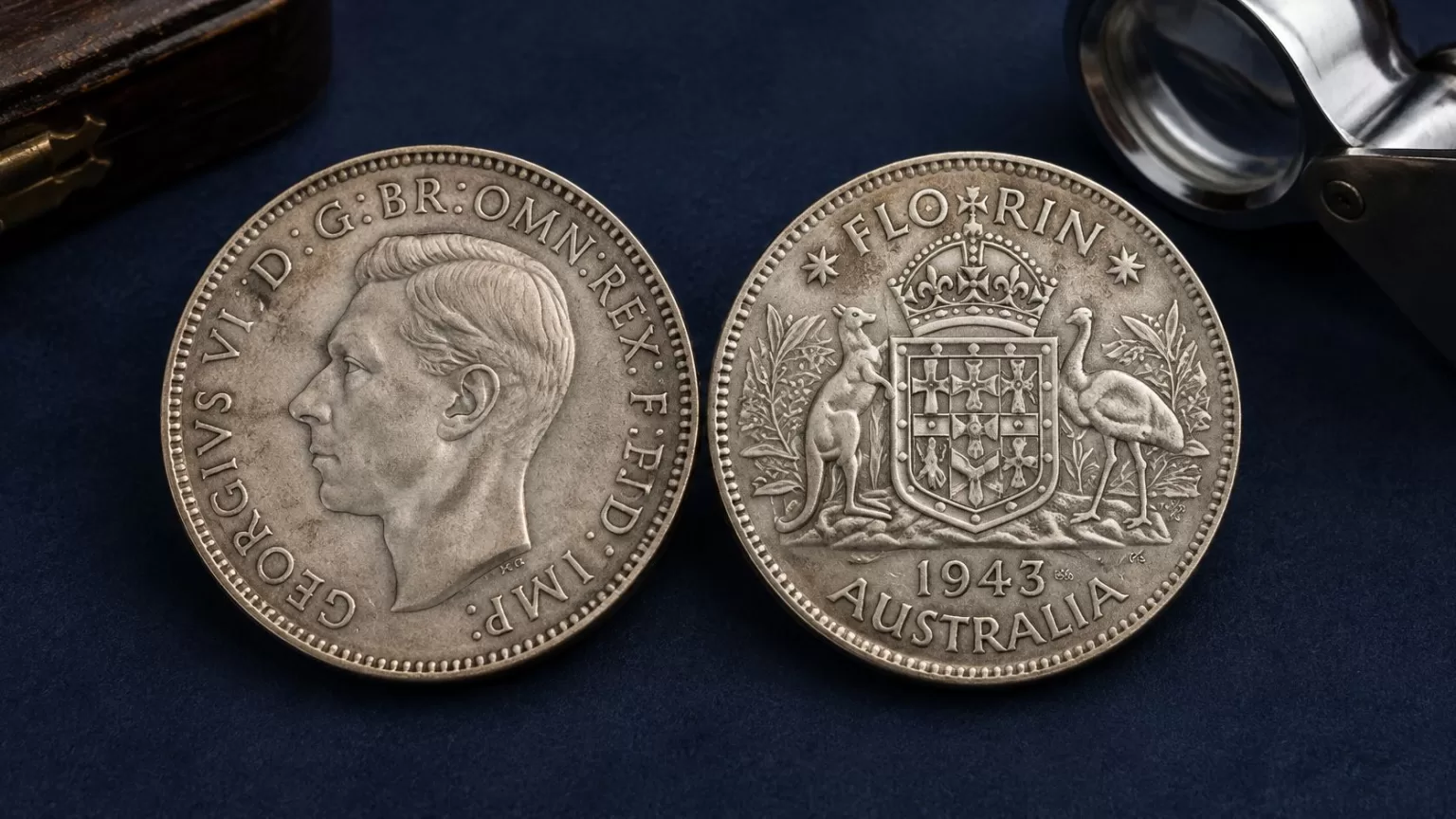
92.5% silver isn't the same as retirement-account eligibility. The Museums Victoria collection record identifies the 1943 Australian florin as a sterling-silver coin, a distinction that matters when separating its metal value from its collector appeal. For anyone assessing a 1943 florin Australian coin, the useful questions are what it is, how well it survives, what comparable buyers pay, and whether it belongs outside a retirement account.
1943 Florin Specifications and Design at a Glance
A standard 1943 florin weighs about 11.31 g, measures 28.5 mm across and is 2.00 mm thick. These figures are listed for the 1943 florin in the Museums Victoria collection record; individual coins may vary through wear or measurement.
Physical specifications
The coin's total weight and its pure silver content describe different things. Its sterling alloy is 92.5% silver, giving a standard coin about 10.46 g (0.336 troy oz) of pure silver.
| Specification | Value | Notes |
|---|---|---|
| Denomination | Two shillings (florin) | Pre-decimal circulating coin |
| Alloy | 92.5% sterling silver | Balance primarily copper |
| Total weight | About 11.31 g | Museums Victoria reference; specimens vary |
| Pure silver content | About 10.46 g (0.336 troy oz) | Derived from alloy and weight |
| Diameter | 28.5 mm | Measured across widest point |
| Thickness | 2.00 mm | Museums Victoria reference |
| Edge | Milled | Reeded rim |
| Planchet | Round | Standard blank shape |
| Obverse | King George VI, bare-headed, by Thomas Humphrey Paget | Latin royal legend |
| Reverse | Commonwealth coat of arms, by George Kruger Gray | Shield in six sections; FLORIN and 1943 |
The portrait and coat of arms are more useful identification features than colour alone. The six-part shield represents Australia's states.
Why the mint belongs in the description
Museums Victoria's record identifies a 1943 florin struck in San Francisco. An Australian denomination, therefore, does not by itself establish where a coin was manufactured.
Record the mint alongside the date, denomination and condition. This helps distinguish coins that share a design but have different production origins.
Start with weight and diameter. These measurements can help assess a coin, but neither proves authenticity; check the design, edge and surfaces as well.
Why the 1943 Florin Was Struck in Wartime
The florin was working currency during the Second World War, not a coin created primarily for collectors. Its historical interest comes partly from that ordinary purpose: Australia still needed circulating money while wartime conditions disrupted normal minting arrangements.
Consider an inherited group of florins with similar portraits and reverse designs. Their owner might reasonably assume that matching dates mean matching origins. Overseas production makes that assumption unsafe, because a national coinage can include pieces manufactured by different mints.
Historical distinction: The country that issues a coin and the mint that manufactures it aren't necessarily the same.
A circulating coin, not a promised rarity
The florin belonged to Australia's former pound-and-shilling currency system. Its denomination described purchasing money within that system, not a quantity of investment silver or an assurance of future collectible value.
This changes how a surviving example should be approached:
- Wear is evidence of use. Flattened high points and handling marks need assessment, not automatic dismissal.
- Mint attribution needs checking. Similar designs don't establish identical production histories.
- Historical appeal isn't a price guarantee. A wartime connection can explain collector interest without proving scarcity.
A sound description therefore separates historical context from market claims. Calling the coin a wartime circulating issue is informative; calling it rare merely because it survived from that period isn't sufficient.
How to Identify a Genuine 1943 Florin
No single measurement proves authenticity. The Museums Victoria specimen record records a diameter of 28.5 mm and a specimen weight of 11.211 g, compared with the commonly cited catalogue standard of approximately 11.31 g. That difference is a useful warning against treating a small weight discrepancy as a verdict.


Checks that work together
Weigh the bare coin. Use a calibrated digital scale that reads to hundredths of a gram. Remove loose packaging, but don't open a sealed professional grading holder merely to weigh its contents. A common mistake is including a capsule or holder in the reading.
Measure across the widest point. Use calipers gently, avoiding pressure against the rim. Rotate the coin and repeat the measurement. Measuring diagonally across a damaged edge, or squeezing the jaws tightly, can produce misleading results.
Inspect the edge and blank. The outline should be round and the edge milled. Look for interruptions, seams or filing, while allowing for ordinary knocks and wear. Don't confuse a damaged rim with proof of a counterfeit.
Compare the portrait and lettering. The museum identifies Thomas Humphrey Paget's bare-headed George VI portrait and Latin royal legend, with George Kruger Gray's Commonwealth arms on the reverse. Compare letter shapes, spacing and the relationship between design elements, not just general resemblance.
Check the mint attribution. Compare the mark's presence and placement against an attributed reference photograph. A seller's label isn't a substitute for examining the actual coin.
Examine the surfaces under angled light. Look for parallel hairlines, unusual texture, edge alterations or colour that appears inconsistent with the surrounding surface. Don't assume that brightness means originality, or that dark toning means forgery.
When to seek an opinion
A failed check identifies a question to investigate. Wear, past cleaning, measurement error and damage can complicate interpretation, so a suspicious result isn't automatically a final diagnosis.
For a potentially valuable example, an established numismatic dealer or independent grading service should examine the coin before a premium price is paid. Photographs help with preliminary screening, but they can't resolve every question about metal, surfaces or alteration.
Mintage Figures and Mint Marks Compared
Reported 1943 florin mintages differ by attribution. The Online Coin Club florin reference lists figures for Melbourne and San Francisco, while another reference gives an unattributed total.
Reported 1943 florin mintage by mint
| Mint | Reported mintage | Source |
|---|---|---|
| Melbourne | 12,762,000 | Online Coin Club florin reference |
| San Francisco (1943-S) | 11,000,000 | Online Coin Club florin reference |
| Combined | 23,762,000 | Sum of the Melbourne and San Francisco figures above |
| Unattributed reference | 12,562,000 | Online Coin Club florin reference |
The unattributed figure cannot be assigned to Melbourne or treated as the combined total without a mint breakdown. Adding the two attributed figures gives a combined total of 23,762,000, but that calculation does not resolve the discrepancy.

What production numbers can establish
Mintage records describe how many coins were produced, not how many survive in a given condition. They cannot establish the number with original lustre, the extent of later damage, or how readily buyers can find a well-preserved example.
The figures support a limited conclusion: the date alone does not establish scarcity. Mint attribution and the surviving coin's condition and strike quality all affect how collectors assess an example.
A figure without a clear mint attribution should be treated cautiously. Confirm the mint before assigning a scarcity premium, and assess the individual coin rather than assuming every example from a production run has the same collectible value.
What Silver Content and Grade Mean for Price
Indicative metal value equals pure silver content multiplied by the current silver price in the same unit. The Silver Age Coins specification lists a total weight of 11.3100 g, fineness of 92.5%, approximately 10.46 g of pure silver, and thickness of 2.00 mm for the San Francisco issue. Using the troy-ounce equivalent in the specification table allows comparison with a spot quotation expressed per troy ounce.
The result is a metal-value benchmark, not an appraisal or guaranteed cash offer. A buyer may deduct transaction costs or a commercial margin, while a collector may pay more for desirable preservation.
Grade before price comparison
Assess wear under a single angled light, rotating the coin slowly. The portrait's cheek and hair, together with raised shield details, offer useful places to inspect for flattening or interruption of the surface.
Use a preliminary description that the evidence supports:
- Worn circulated: Clear loss of detail and flattening from use.
- Lightly circulated: Limited wear, with much of the design preserved.
- Potentially uncirculated: No apparent circulation wear, subject to closer examination of lustre and high points.
The distinction between circulated and uncirculated coins is about wear, not whether a coin looks shiny. Polishing can make a circulated piece bright without restoring its original surface.
Why comparable silver can have different prices
Originality matters because collectors assess the surface as well as the remaining detail. Cleaning hairlines, polishing and other alterations can reduce the attraction of an otherwise sharp coin.
Toning requires judgment rather than a blanket premium or discount. Some buyers prefer an attractive, naturally toned surface; others prefer a different appearance. Colour alone doesn't establish either quality or authenticity.
Strike quality also needs separating from wear. A softly struck detail isn't necessarily circulation damage, while a sharp-looking coin can still have impaired surfaces.
For an owner, the useful sequence is to establish a defensible condition description and then compare completed sales of similar examples. A premium only becomes meaningful when the comparison matches the mint, preservation and surface quality.
What Dealers Charge and How to Buy or Sell Safely
Dealer listings are reference points, not a fixed valuation. Downies Collectables listed an uncirculated example at AUD 135.45 in 2024. A separate Bradford Coins listing records AUD 70 in 2026, reduced from AUD 80, for an example described as uncirculated.
Reference listings, not completed sales
| Source | Condition | Price (AUD) | Listing date |
|---|---|---|---|
| Downies Collectables | Uncirculated | 135.45 | 2024 |
| Bradford Coins | Uncirculated | 70, reduced from 80 | 2026 |
| Any dealer | Circulated, worn | Obtain an inspected buyback quote | Date the written quote |
| Auction or sold records | Match the assessed grade | Use the completed-sale amount | Check recent results |
The gap doesn't establish a market trend. Different dates, individual coins, surface quality and seller margins prevent a direct like-for-like conclusion.
Before comparing offers, establish whether photographs show the actual coin, whether delivery and tax are included, and whether returns are permitted. A dealer's asking price also isn't evidence of what that dealer would pay an owner.
A practical transaction checklist
Document identity and condition. Save clear photographs of both faces and the edge before negotiating. Retain the seller's written description.
Seek independent assessment when warranted. For a potentially substantial premium, compare the cost of authentication or grading with the uncertainty it could resolve.
Leave the surface untouched. Don't polish the coin to improve sale photographs. Surface alteration can undermine the very collector premium being claimed.
Compare complete costs. Record commissions, delivery, insurance and applicable tax rather than comparing headline prices alone.
Clarify inspection terms. Ask whether a purchase offer is provisional and what could cause the buyer to revise it after examination.
Use traceable payment and retain records. Keep the invoice, correspondence, transaction date and seller details. Cost and disposal records may also matter for tax reporting.
A sensible working reference uses several closely matched listings and then checks completed sales. The middle asking price can help organise comparisons, but it shouldn't replace evidence of an actual transaction.
Recognising pressure and misrepresentation
Warning signs include unsupported rarity claims, refusal to supply clear photographs, unexplained premiums and pressure to decide immediately. For readers evaluating questionable sales conduct, Kons Law on precious metals fraud provides context for recognising potential misrepresentation.
The broader question of silver coins as an investment also requires attention to resale costs and buyer demand. An appealing collectible isn't automatically an efficient investment.
Whether a 1943 Florin Qualifies for an IRA
A 1943 florin contains silver, but its sterling fineness is 92.5%, below the .999 fineness threshold generally applied to silver bullion held in a U.S. IRA. The coin can be worth collecting and still fall outside IRA eligibility rules. Confirm current requirements and any applicable exceptions before arranging a transaction.

Ownership and account eligibility are separate
Historical interest, measurable silver content and a willing buyer can support a coin's collectible value. Those qualities do not establish that it meets retirement-account requirements.
An owner should not assume that a personal coin collection can be transferred into an IRA. Product eligibility, account-funding rules and the custodian's acceptance procedures require separate confirmation.
The relevant questions differ by purpose:
- For personal ownership: Does the coin's collectible appeal justify its price and selling costs?
- For a retirement account: Does the proposed product meet current legal requirements and the custodian's acceptance criteria?
- For a rollover: Does the movement of funds follow the rules applicable to the owner's circumstances?
Suitable next steps
The florin can remain a personal collectible while eligible bullion is assessed separately. The guide to silver coins eligible for an IRA can help organise questions about qualifying products, custody and account administration.
Account safeguard: A seller's use of the word silver does not confirm that a coin qualifies for an IRA.
Grade and retail price do not settle eligibility. Have the custodian confirm whether it will accept the exact product before committing account funds.
This is not financial advice. Consult a licensed financial advisor, CPA, or tax professional before making investment decisions. Check current IRS requirements and individual tax circumstances before any transfer.
Confirm Your Next Step With Your 1943 Florin
Start with the coin's identity and condition. Clear photographs and an in-person assessment can help determine whether it is a typical circulated example or merits closer numismatic evaluation.
Match the action to the purpose
- For a worn coin: Ask buyers for inspected offers and compare them with an estimate of its metal value. The amount offered may be lower than the calculated silver content.
- For a potentially uncirculated coin: Seek a defensible grade and compare sales of coins in similar condition and with matching attribution.
- For retirement planning: Gather questions about account rules, costs and eligible products before discussing a purchase with a qualified professional.
Keep professional roles clear
A numismatic assessment focuses on the coin. A financial professional and the account custodian can address financial suitability, tax treatment and whether a proposed product is accepted.
Gold IRA Association offers educational resources on eligible metals, rollover procedures, fees and provider comparisons. Its listed phone number is 888-910-8386. The organization also provides personalized advice suited to an individual's retirement goals and financial situation.
Readers can use Gold IRA Association to review retirement-account materials and prepare questions before discussing a purchase with a qualified professional.


