




China's gold demand reached 1,003 tons in 2025, while purchases of bars and coins rose to 432 tons, according to the World Gold Council's China market analysis. That headline matters to a U.S. retiree because China's market combines two very different forces: official reserve accumulation and household investment demand. Understanding the difference can help retirement savers interpret gold-price headlines without turning a long-term allocation into a short-term speculation.
Why China Gold Buying Matters to U.S. Retirees
China's 2025 total gold demand reached a record value of 796 billion yuan, up 53% from 2024, even as jewelry consumption declined in tonnage terms. For U.S. retirees, that divergence matters more than the headline alone. It suggests that higher spending reflected price effects and a shift in household capital toward bars and coins, while official institutions may have been pursuing a separate reserve objective. (World Gold Council data)
The same market therefore contains two distinct signals. Central-bank accumulation is a policy-driven reserve decision with a longer horizon. Household buying is more sensitive to prices, currency concerns, local economic conditions, and preferences for physical wealth. Combining those flows can make a short-term price move look more informative than it is.
China is the world's largest single gold market, and gold carries both financial and cultural meaning there. The World Gold Council describes it as a long-standing symbol of good fortune and financial prudence among Chinese consumers and investors. That broad acceptance gives physical gold a larger role in China than it typically holds in a conventional U.S. brokerage account.
For retirement savers, the practical issue is transmission. Greater Chinese purchases can draw additional metal through global supply chains, affecting wholesale availability, regional premiums, and acquisition costs for investors elsewhere. China does not determine every daily price change, but its physical demand can influence the market at the margin.
Separate the signal before acting
A U.S. retiree evaluating a Gold or Silver IRA should ask three questions:
- Who is buying? Official institutions, banks, investors, or households.
- Why are they buying? Reserve diversification, wealth preservation, cultural preference, or a response to price.
- What can the flow support? A case for physical-demand support, not a dependable short-term forecast.
This distinction leads to different actions. Official-sector accumulation can support a measured view of gold as a long-duration diversifier. Household reallocation may signal changing investor preferences, but it can reverse if prices or local conditions change. Neither flow justifies treating a Gold or Silver IRA as a trading position.
Gold can complement a retirement plan for savers concerned about inflation or currency risk. The educational discussion of gold as an inflation hedge offers relevant context, but gold still carries price and liquidity risk. Any allocation should match the retiree's time horizon, cash needs, and tolerance for fluctuations.
Who Is Actually Buying Gold in China
The phrase China gold buying hides several buyer groups with different objectives. A central bank adding reserves isn't behaving like a household purchasing a small bar, and a bank distributing a gold-linked savings product doesn't have the same time horizon as a jewelry buyer.
Official institutions
The People's Bank of China is the clearest long-duration buyer. It extended its reported buying streak to 21 consecutive months by July 2026, bringing official holdings to 76.08 million fine troy ounces, about 2,366 tonnes, according to the World Gold Council's central-bank statistics. This type of accumulation is generally connected to reserve management rather than a household's reaction to a particular retail price.
State-owned financial institutions and other public investment vehicles may also influence distribution and wholesale flows. However, publicly available data don't establish that every such institution is buying in coordinated tranches, so retirees should avoid treating all institutional activity as a single confirmed program.
Private domestic banks occupy a different position. They can distribute gold savings products, facilitate transactions, and connect retail investors with physical or exchange-based exposure. Their activity may expand access without representing the same direct reserve accumulation as the central bank.
Households and investors
Households buy gold bars and coins for wealth preservation, gifting, cultural occasions, and portfolio diversification. Jewelry remains important, but it reacts more visibly to price because consumers can postpone purchases, choose lighter pieces, or shift toward investment products when bullion becomes expensive.
China's 2025 data illustrate that split. Bar-and-coin purchases reached 432 tons, a 28% year-over-year increase, while jewelry demand declined 25% to 360 tons. Jewelry spending still rose 8% to 281.4 billion yuan, showing that higher prices can lift total spending even as physical volume falls. (World Gold Council data)
| Buyer Group | Typical Volume | Time Horizon | Price Sensitivity |
|---|---|---|---|
| People's Bank of China | Large reserve transactions | Long term | Relatively low |
| Public and state-linked institutions | Varies by mandate | Medium to long term | Depends on policy |
| Domestic banks | Distributed across clients | Product dependent | Moderate |
| Households and private investors | Fragmented physical and financial demand | Short to long term | Often high |
| Jewelry buyers | Retail purchases | Occasion based | High |
The key analytical point is that official accumulation can continue while household demand weakens. Those forces may overlap in the same headline, but they shouldn't be assigned the same meaning.
Recent Purchase Trends and the Data Behind Them
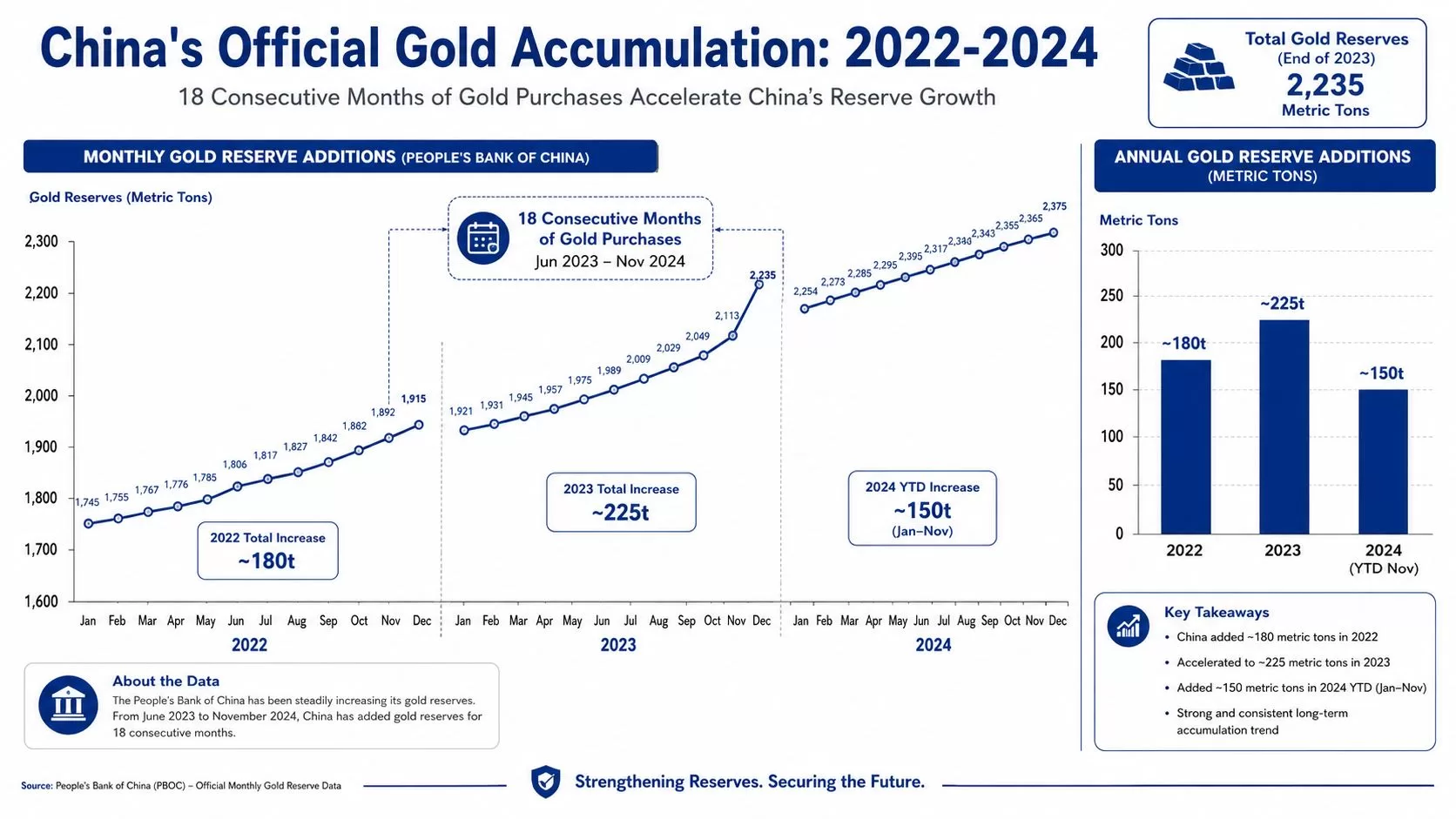
China's 2025 gold demand reached 1,003 tons, the highest annual volume since 2021 and a 6% year-over-year increase. The composition matters more than the headline: bars and coins reached 432 tons, while jewelry volume fell to 360 tons as higher prices reduced retail appetite. That split points to stronger investment allocation alongside weaker consumption of gold for adornment. (World Gold Council data)
The available evidence supports this recent picture more clearly than several older claims in market commentary. Monthly additions through late 2024, 2023 imports above 1,300 tons, specific Shanghai Gold Exchange withdrawals, and activity on particular retail platforms are not established by the verified data here. They should not anchor a retirement-investment decision.

Imports provide a separate signal
Import figures show how quickly physical flows can change. In the first half of 2026, China imported 864.95 tons, up 89.1% from 457.39 tons in the same period a year earlier, according to customs data reported by Anadolu Agency. Monthly imports reached 94.16 tons in January, 161.86 tons in March, and 173.34 tons in June, with each comparison measured against a lower level in the prior year.
Hong Kong flows supplied another indication. June net gold imports reached 50.679 tons, compared with 19.366 tons in June 2025. Total imports through Hong Kong reached 78.147 tons, up 19% from May, according to the reported figures. These numbers do not establish a guaranteed price increase. They do show that Chinese physical demand can place sudden pressure on international supply chains.
For a U.S. retiree, the practical distinction is straightforward. Official-sector accumulation signals long-horizon reserve demand, while import and bar-and-coin data reflect changing private allocation. A Gold or Silver IRA should therefore treat Chinese buying as context, not a timing signal. A retiree can use executive communication signals explained as a framework for separating reported activity from the behavior it may represent, then review position size, liquidity, and rebalancing rules before adding metals.
Drivers Behind the Buying Spree
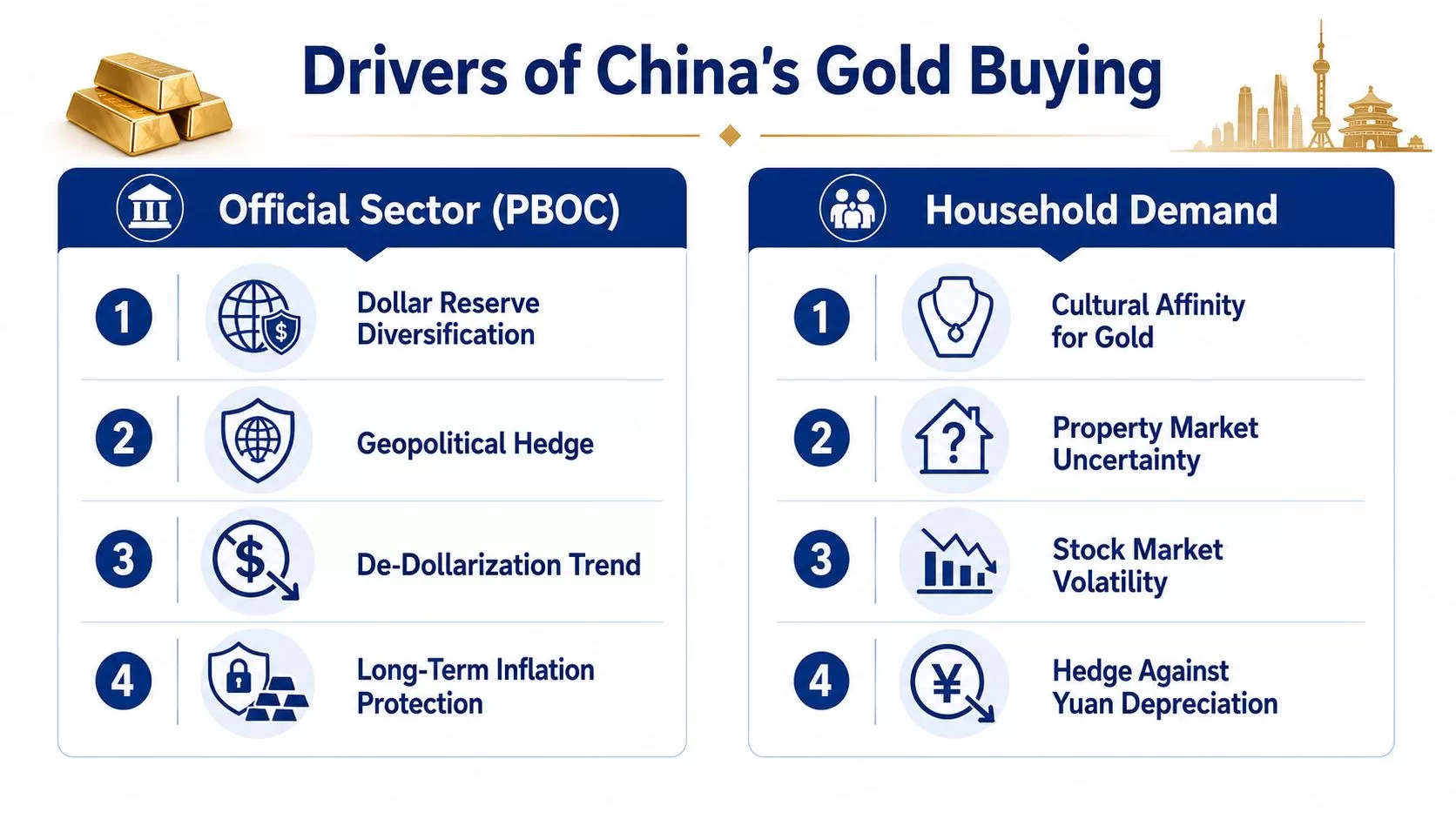
China's official institutions and households buy gold for different purposes. Official accumulation reflects reserve management and can continue through price swings. Household demand responds more quickly to affordability, local conditions, and investor sentiment. Separating these channels gives U.S. retirement savers a clearer way to interpret Chinese buying.
The official-sector rationale
The People's Bank of China's purchases fit a long-term reserve strategy. By July 2026, the bank had bought gold for 21 consecutive months, with reported holdings of approximately 2,366 tonnes. It added 480,000 ounces in June, the largest monthly increase since October 2023, then added 640,000 ounces, roughly 20 tonnes, in July, according to Reuters' report on the faster buying pace.
Several structural motives support that policy:
- Reserve diversification: Gold provides an asset outside any single foreign-currency system.
- Geopolitical resilience: Physical bullion does not carry the same jurisdictional or payment-system exposure as a foreign financial claim.
- Long-term wealth preservation: Official buyers can prioritize durability and liquidity over current income.
- Portfolio composition: Gold represents near 10% of China's reported reserves, a material allocation that still leaves room for other reserve assets, according to World Gold Council central-bank data.
The official buyer is not trying to trade every daily price movement. Its purchases may therefore prove more persistent than a short retail rush, although the pace can change.
For a U.S. retiree, the practical implication is limited but useful. Official accumulation supports gold's strategic relevance, not a precise entry point. In a Gold or Silver IRA, it is better used to review the intended allocation and rebalancing rules than to justify a sudden purchase.
The household rationale
Household demand follows a shorter feedback loop. Consumers may seek a tangible store of value when property markets seem uncertain, financial markets are volatile, or the renminbi appears vulnerable. Rising prices can reduce jewelry purchases while shifting investment toward bars and coins.
Cultural preference also supports demand. Chinese consumers and investors often associate gold with good fortune and financial prudence. That foundation can outlast one market cycle, yet households remain price-sensitive. The 25% fall in jewelry demand in 2025 shows how quickly buying volume can adjust as prices rise, as reported in World Gold Council data.
Practical rule: Treat official buying as a strategic signal and household buying as a sentiment signal. Official demand may persist through volatility, while household demand can reverse when prices or local premiums become uncomfortable.
The distinction matters inside a retirement account. A retiree can interpret official purchases as evidence of sustained institutional interest, while treating household shifts as a clue about stress or enthusiasm in a major physical market. Neither signal replaces a plan for position size, liquidity, or rebalancing.
The following video provides additional visual context for the different forces shaping gold demand.

Market Impacts on Price, Liquidity, and Correlations
China influences gold through more than headline demand. Official accumulation reduces metal available for private circulation, while imports and investment buying affect regional supply. The same global price can therefore coexist with different local premiums and varying degrees of physical tightness.
The PBOC's reported holdings of approximately 2,366 tonnes mark a substantial official position. In June 2026, it added 480,000 ounces, followed by 640,000 ounces in July, or roughly 20 tonnes. These purchases do not determine the daily price, but they reinforce the view that a major buyer remains active when other investors reduce exposure, as described in Reuters' reserve report.
Four channels investors should monitor
| Channel | Effect | Magnitude / Example |
|---|---|---|
| Official reserves | Reduces metal available for private circulation | PBOC holdings reached about 2,366 tonnes by July 2026 |
| Imports | Pulls physical bullion into China and can alter regional availability | First-half 2026 imports reached 864.95 tons |
| Retail allocation | Shifts demand between jewelry and bars or coins | Bars and coins rose to 432 tons in 2025 while jewelry fell to 360 tons |
| Investor expectations | Influences how markets interpret future demand | Persistent official buying may support confidence, but is not a price guarantee |
China's import rebound also exposes a liquidity risk. Banks, investors, and households competing for deliverable metal can tighten local availability even while financial-market trading remains active. A retiree purchasing an approved coin through a U.S. retirement account may not face the same premium as a Chinese household, yet wholesale sourcing conditions can still affect dealer spreads and execution.
Correlation requires the same caution. Gold may behave differently from equities during financial stress, but that relationship changes over time. Chinese official buying expands gold's demand base, while interest rates, currency movements, investor positioning, and geopolitical developments continue to shape returns.
For a broader comparison of precious metals and stocks, see this discussion of gold versus the S&P 500. The practical conclusion is not that gold always moves opposite equities. Gold can provide a different source of return and risk when a retirement portfolio is concentrated in financial assets.
Reserve value and reserve quantity can also move in opposite directions. China's gold reserve value rose to $369.58 billion in January 2026 and declined to $303.72 billion by June as bullion prices weakened, even as tonnage increased. A central bank can keep accumulating metal while the marked-to-market value of its holdings falls. For a U.S. retiree, that distinction supports using Chinese official buying as a signal about demand structure, not as a standalone timing rule.
Practical Implications for Gold IRA Investors
China's buying pattern can inform retirement planning, but it should not determine it. The key analytical distinction is between official-sector accumulation and household reallocation. Central-bank purchases may signal a long-term change in reserve composition. Household demand can shift more quickly between jewelry, bars, coins, and financial assets as prices, income expectations, and economic conditions change. A U.S. retiree should translate those signals into account decisions only after reviewing eligibility, custody, liquidity, and total cost.
Build the account around the rules
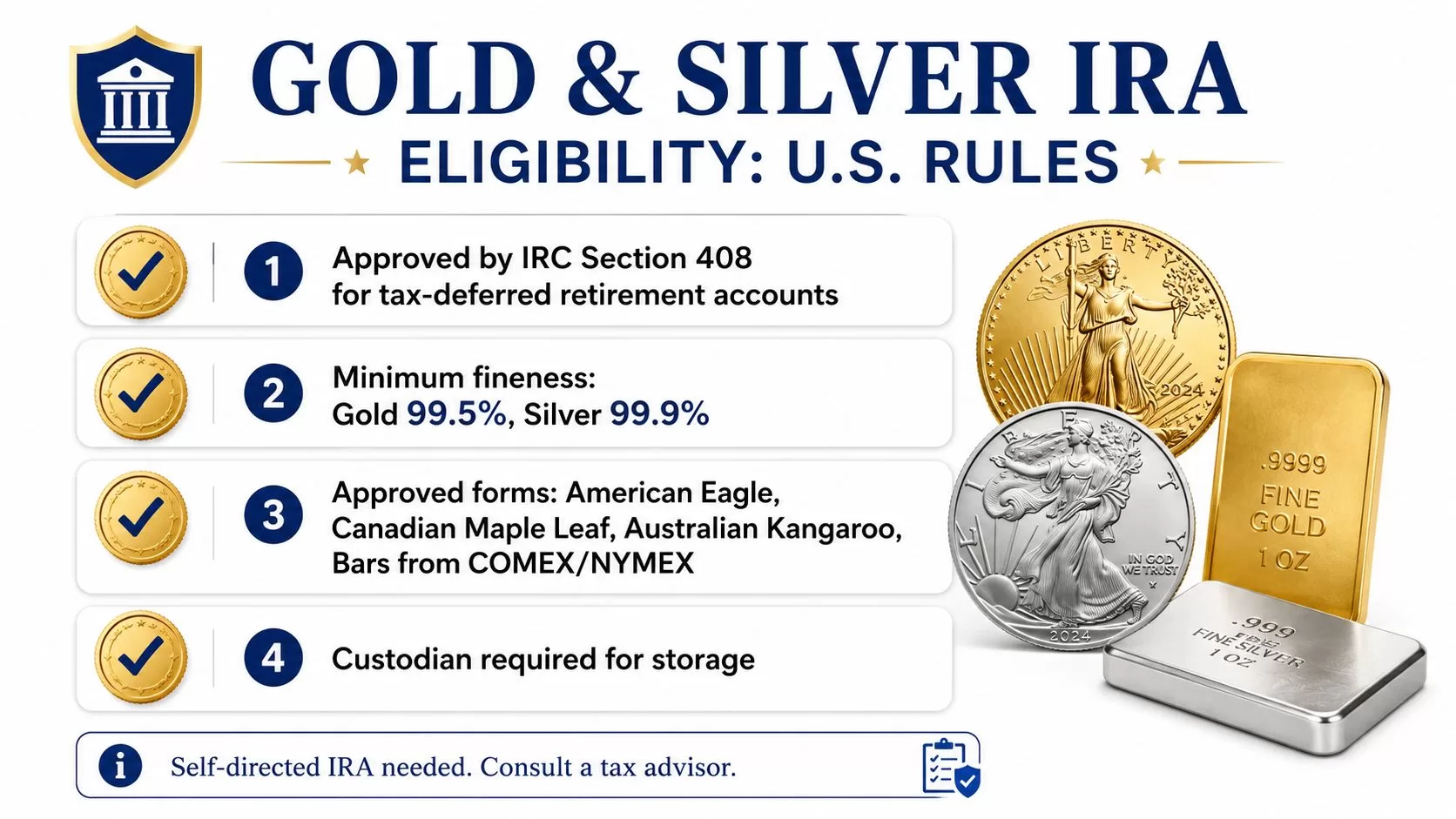
A precious metals IRA generally uses a self-directed IRA, an IRS-approved custodian, an authorized dealer, and an approved depository. The custodian administers the account and arranges storage. Personally owned bullion cannot be placed into an IRA and treated as compliant retirement property.
Under IRC Section 408, certain gold and silver products can qualify for individual retirement accounts when they meet applicable requirements. Common examples include American Gold Eagles, Gold Buffalos, certain approved coins, and bars meeting required fineness standards. The supplied eligibility framework identifies 99.5% fineness for gold and 99.9% for silver. Confirm the product, transaction, and tax treatment with the custodian and a qualified tax professional before purchasing.
Use a defined review sequence:
- Review the existing plan: Determine whether a rollover is permitted and identify restrictions on the current account.
- Select the custodian: Confirm administration charges, reporting procedures, insurance, and depository arrangements.
- Verify the metal: Check fineness, approved form, dealer spread, and buyback terms before authorizing a purchase.
- Document the transaction: Retain records of transfers, purchases, storage, and account statements.
The guide to buying gold in an IRA explains this process. Investors assessing physical bullion alongside mining shares or other market exposures can also see gold dividend data from Altymo. Those securities have different risks, income characteristics, and ownership structures from physical metals.
Size the allocation for the retirement plan
A commonly discussed planning range is 5% to 15% for precious metals, based on risk tolerance and the rest of the portfolio. It is not a universal prescription or a guaranteed optimal allocation. Cash requirements, concentrated equity exposure, and withdrawal timing can justify different decisions.
Gold is better evaluated as a long-duration diversifier than as a trade based on China's latest import figure. Official-sector buying may support gold's strategic relevance, while household buying may reveal changing preferences within China's private market. Neither signal removes price risk. Gold also does not produce the same income stream as an interest-bearing investment.
Review costs before allocating capital. Supplied planning guidance cites typical setup fees around $50 to $150 and annual storage fees of roughly $100 to $300. Collectible coins can carry additional spread premiums. Fee schedules vary, so request the full list of account, storage, insurance, product, and liquidation charges rather than relying on an advertised opening cost.
A sound comparison includes: account setup, administration, storage, insurance, dealer spread, product premium, liquidation process, and delivery policy.
This is not financial advice. Consult a licensed financial advisor, CPA, or tax professional before making investment decisions.
Key Takeaways and Next Steps
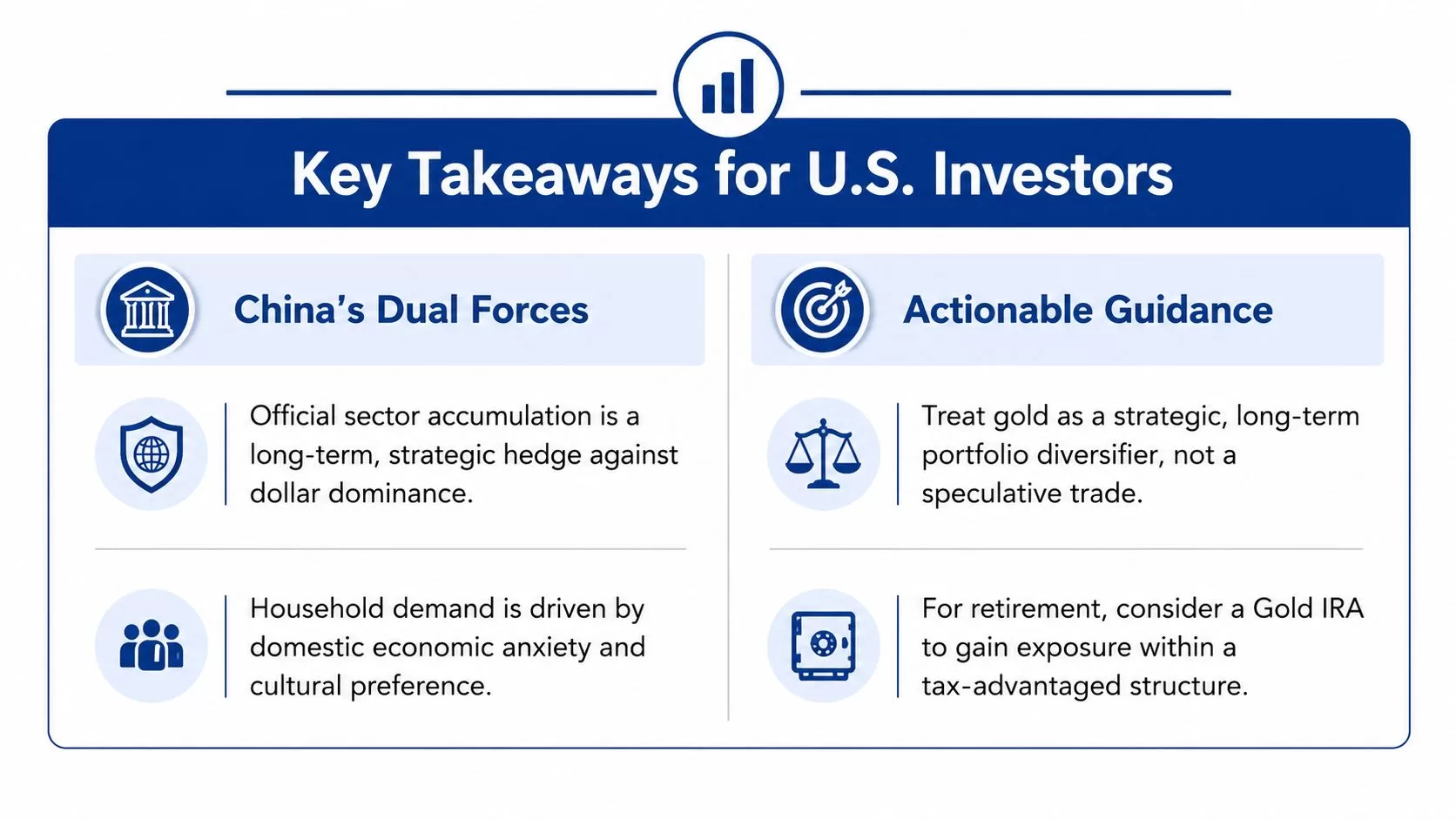
China's gold market reflects two separate flows. The People's Bank of China adds reserves according to a strategic timetable, while households and private investors adjust their holdings of jewelry, bars, and coins as prices and economic conditions change. For a U.S. retiree, separating these signals is more useful than treating every purchase as evidence of a single bullish trend.
Three conclusions guide the next decision.
First, official accumulation is persistent but not infallible. The PBOC extended its buying streak to 21 consecutive months by July 2026, and holdings reached about 2,366 tonnes. The pattern supports reserve diversification as a durable policy consideration. It does not remove price risk or ensure that the pace will continue. A Gold or Silver IRA should therefore treat official-sector demand as context for allocation, not as a timing signal.
Second, physical imports can move quickly. China imported 864.95 tons in the first half of 2026, up 89.1% year over year, while monthly imports accelerated through June. Such movement can affect physical supply chains over a short period. It can also reflect restocking or a response to changing prices rather than a permanent shift in household allocation. U.S. retirees should avoid converting a strong import period into a forecast for their own account.
Third, gold has a complementary portfolio role. Chinese buying can influence demand, liquidity, and investor expectations, but it does not replace diversified stocks, bonds, cash reserves, or a withdrawal plan. Investors who are new to retirement markets can review an introduction to investing from Monsa before assessing a specialized account.
A measured next step
A retiree considering precious metals should request a fee-and-custodian comparison from a self-directed IRA administrator before allocating funds. Check storage costs, eligible coins and bars, rollover procedures, reporting, liquidation terms, and delivery policies against the plan's restrictions and expected withdrawal needs.
Gold IRA Association offers educational guides and comparisons covering Gold and Silver IRAs, rollover mechanics, eligible metals, custodians, and account costs. Readers can use Gold IRA Association to identify questions about account structure and expenses, then discuss any proposed transaction with qualified financial and tax professionals.


