




A near-retiree comparing two American Eagle gold coins may see a striking price gap. One is described as circulated, the other as uncirculated, and both appear to contain the same precious metal. The cheaper coin can look like the obvious choice, but the question is whether either product meets the standards of the intended account, what premium the condition adds, and how easily the coin can be sold later.
Why the Coin Condition Matters for Your Retirement
You find two gold coins with similar metal content. One carries an uncirculated coin label and a much higher price. The other is circulated and costs less. Before choosing either, verify what the label describes, whether the specific product meets IRA requirements, and whether the added premium provides any retirement benefit.
The term uncirculated coin can describe physical condition or a specialized mint product. A product may receive an uncirculated label because of its production method, while ordinary buyers may use the same word to mean a coin that has not passed through everyday commerce. Those meanings overlap, but they are not interchangeable.
For a retirement buyer, the key rule is direct: condition is not the same as IRA eligibility. A visually attractive coin with no circulation wear can still fail the account's approved product requirements. A qualifying bullion coin does not become more eligible because it has a higher grade, special finish, or collector-oriented presentation.
The hidden cost behind the price tag
A dealer may offer two similar gold coins, with the uncirculated version carrying a substantial premium over the circulated one. That difference can reflect surface preservation, collector demand, packaging, grading, or a specialized minting process. It does not automatically mean the coin contains more gold or receives better tax treatment.
Treat the premium as a separate purchase decision. If the retirement objective is metal exposure, paying for appearance or collector appeal can raise the cost without improving account compliance or protection.
Custodians apply their own acceptance procedures. A dealer can describe a coin as IRA-suitable, but the custodian must confirm the exact product before funds are committed. That verification can prevent a costly correction, such as exchanging, shipping, or selling a coin outside the account.
Why liquidity belongs in the decision
Condition can change the likely resale audience. Buyers focused on metal content may prefer a circulated coin, while collectors may assess an uncirculated or highly graded coin by its strike, luster, and marks. These groups may assign very different value to the same condition features.
Required minimum distributions make eventual liquidity relevant. You may need to value or sell part of a retirement position without relying on a heavy numismatic premium. Use this order: verify eligibility, measure the premium, then decide whether the condition creates resale value you need.
Defining Circulated and Uncirculated Coins
You are comparing two gold coins for a retirement account. One carries an “uncirculated” label, while the other shows ordinary handling. The label may describe condition, not IRA eligibility. Treat those as separate questions before paying a premium or sending money to a custodian.
A circulated coin has entered commerce. Repeated handling creates friction on raised design points, gradually reducing luster and softening details. Scratches, rim marks, and contact damage may appear as the coin changes hands. The severity depends on the coin and its handling history.
An uncirculated coin has not experienced wear from public commerce. It can retain original luster and sharper design details, yet it is not automatically flawless. Production, packaging, and storage can leave small marks or cause toning. “Uncirculated” therefore describes handling and surface condition, not a promise of superior metal content, lower cost, or IRA approval.
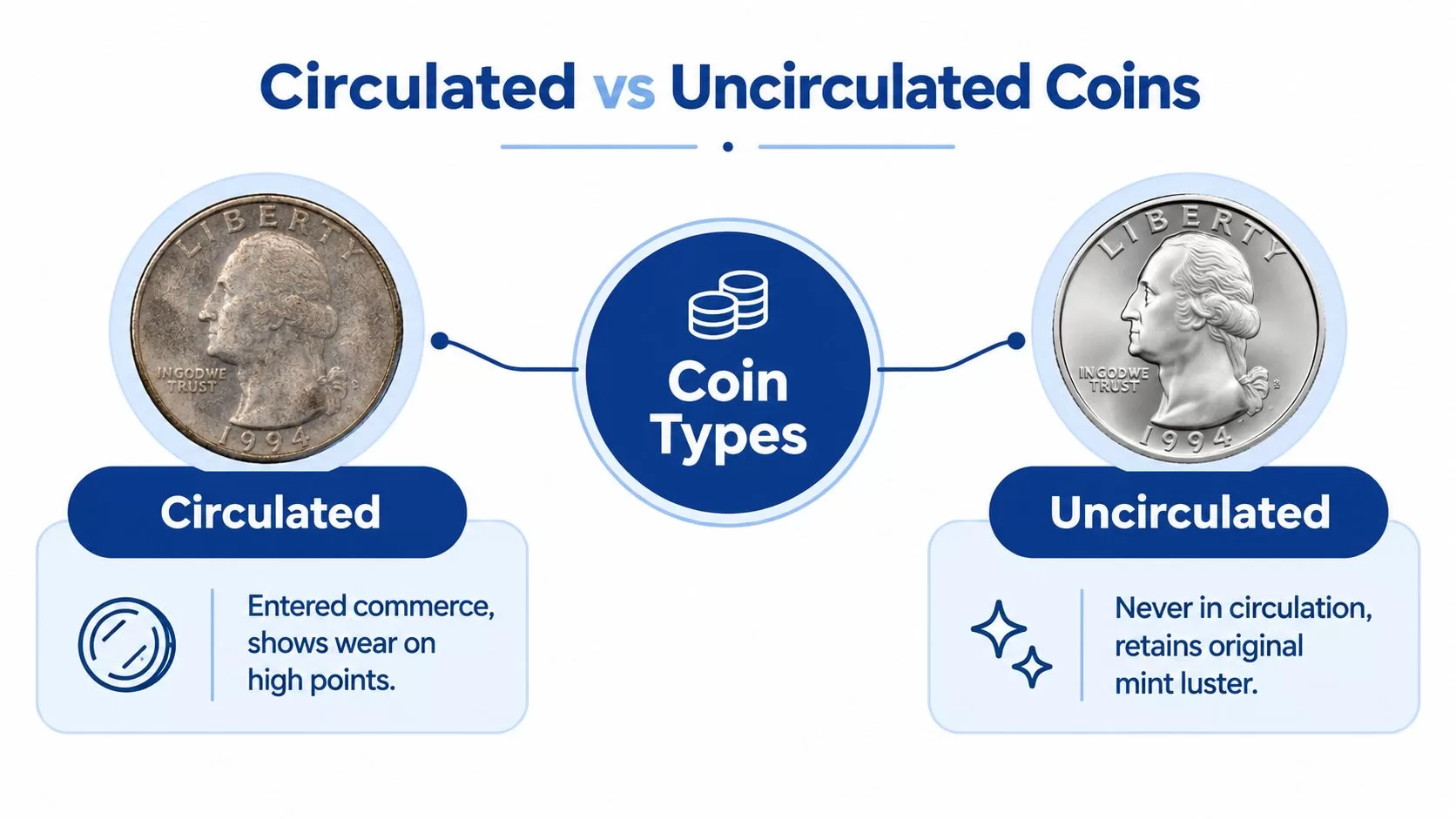

The commerce test
The practical question is whether wear from circulation is visible.
- Visible friction: Raised areas, including hair, cheekbones, lettering, and other exposed details, usually show wear first.
- Remaining luster: A circulated coin may retain shine, but friction interrupts the original mint appearance.
- Contact marks: An uncirculated coin may have marks from production, packaging, or handling without ever being used as money.
- Toning: Color changes do not prove circulation. Storage can tone an uncirculated piece.
For a precious-metals IRA, inspect the product description beyond its condition label. A bullion coin can reach investors without entering daily commerce, while another coin with the same design may have circulated. Confirm the metal content, exact product, and custodian acceptance separately. What bullion means explains why bullion value is closely tied to precious-metal content.
Circulated versus uncirculated describes condition and handling. It does not by itself establish IRA eligibility. Ask for written confirmation of the approved product before purchasing, and do not pay a collector premium until you know the account can hold it.
Side-by-Side Comparison of Circulated and Uncirculated Coins
The following comparison is designed for retirement investors, not just traditional collectors. It separates the features that affect appearance from the standards that affect an IRA purchase.
Circulated vs Uncirculated Coins at a Glance
| Attribute | Circulated Coins | Uncirculated Coins |
|---|---|---|
| Physical condition | Shows wear from commerce, especially on high points | Shows no commerce wear, though minor blemishes or toning may exist |
| Grading range | Circulated grades extend through AU-58, with wear determining the grade | Mint State grades begin at MS-60 and continue upward |
| Typical premium over spot | Often lower when the buyer is paying mainly for metal content | Often higher when preservation, finish, packaging, or grade adds collector demand |
| Secondary-market liquidity | May be easier to value when traded primarily for metal content | Can appeal to collectors, but premium recovery depends on buyer interest and grade |
| Collectibility | May have historical interest, rarity, or varieties | Generally stronger visual and condition appeal |
| IRA eligibility | Condition alone doesn't determine eligibility, and circulated status may create custodian questions | Uncirculated status alone doesn't guarantee eligibility |
| Main risk | Paying for a collectible feature that isn't well documented, or buying a product a custodian won't accept | Paying a large numismatic premium that adds no retirement-account advantage |
What the rows mean in practice
A circulated coin may be less expensive because it has lost some visual quality and collector appeal. That can make it attractive to a buyer seeking precious-metal exposure outside an IRA, but a lower price doesn't remove the need for authentication, product verification, and a clear resale plan.
An uncirculated coin usually offers stronger presentation. It may retain brighter luster and sharper details, but buyers should ask what exactly they're paying for. A generic “uncirculated” label is less informative than a documented product description that identifies the coin, metal content, weight, fineness, and any certification.
Premiums need disciplined review
The price above the metal value is where many retirement investors lose efficiency. A higher premium may be reasonable for a recognized collector market, but the buyer shouldn't assume that a better-looking coin will produce a better retirement result. The relevant question is whether the added cost can plausibly be recovered when the coin is sold.
Eligibility is a separate column
The final row deserves the most attention. The IRS doesn't approve a coin because it is uncirculated. Account rules focus on approved precious-metal products and required fineness, subject to applicable exceptions and individual circumstances. Custodians may also limit what they'll accept operationally, so written confirmation should come before purchase.
How Grading Scales Separate the Two Categories
A grading label can change the price without changing the metal, product type, or IRA treatment. That is the compliance trap. A dealer may quote an uncirculated coin by grade, while an account custodian evaluates the exact approved product and applicable specifications. Treat the grade as a pricing and resale detail, not as evidence of eligibility.
The Sheldon scale gives buyers a standard vocabulary for comparing condition. In broad terms, the AU range covers coins near their original appearance, while MS identifies coins graded as Mint State. The coin-grading guidance from Heritage explains the scale's condition framework and the distinction between circulated and Mint State designations.
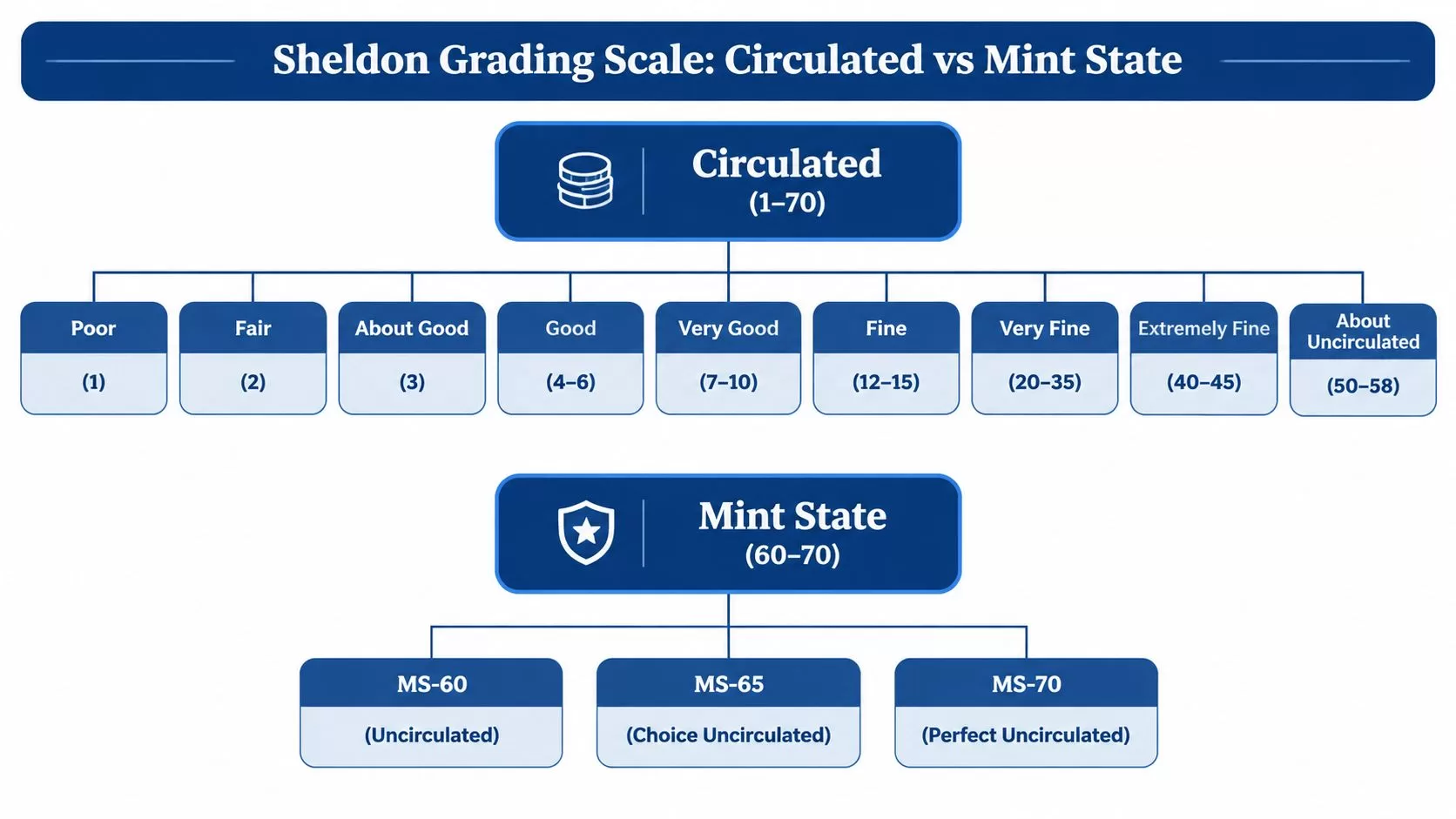
Grade is a cost decision
For retirement investors, the practical question is not whether MS-64 sounds better than MS-62. Ask what the higher grade adds to the dealer's buy price, what resale market supports that premium, and whether the custodian will accept the exact product. A higher grade can improve presentation, yet it does not add weight, fineness, or IRA status.
Request a written quote that separates:
- metal value;
- dealer premium;
- grading or certification cost;
- buyback terms;
- storage and account charges;
- the quoted purchase and resale prices.
If the dealer gives one combined price, ask for the breakdown before ordering. A vague “uncirculated” description can refer to a production designation, a Brilliant Uncirculated label, or a certified MS grade. Those terms do not answer the same question, and they should not carry the same premium.
Read the grade beside the product details
The Mint grading guide provides practical background on how condition grades distinguish quality within the Mint State range. Use that information to compare quotes, not to assume that the highest available grade is the best retirement purchase. Collector demand may support a premium in one market and fail to support it at distribution.
Keep the three evaluations separate:
- Condition: What grade or product designation is documented?
- Cost: How much of the price exceeds the metal value, and can the resale market support it?
- Compliance: Does the exact product meet the account's requirements and receive written custodian approval?
A bright appearance does not settle any of these questions. Cleaning, surface marks, certification, and strike quality can affect the grade, while purity and approved product status address separate requirements.
For a separate review of fineness, see this guide to the purest gold coin. Purity and grade answer different questions: one concerns metal specifications, and the other concerns condition and preservation. Keep both on the quote, then confirm the product with the custodian before funds move.
IRA Eligibility Rules You Cannot Ignore
For a Gold or Silver IRA, purity and approved product type matter more than the circulated or uncirculated label. The relevant rules generally focus on qualifying precious metals, required fineness, and approved coins or bars. American Eagles and Canadian Maple Leafs are examples of widely recognized product types, but a buyer should verify the exact coin, metal, and specifications with the custodian before ordering.
A coin can be uncirculated and still fail the account's requirements. A circulated coin may contain valuable metal yet be unsuitable for the IRA because it isn't an approved product or doesn't meet the applicable standard. Condition doesn't override the rules.
Separate the three questions
Every proposed purchase should pass three separate checks:
- What is the product? Identify the exact coin, issuing authority, metal, denomination, and size.
- Does it meet the applicable standard? Confirm fineness and any product-specific requirements.
- Will the custodian accept it? Obtain confirmation before funds move or the dealer ships the metal.
This process matters because dealer terminology can be broader than custodian procedures. A product marketed as “IRA-approved” still deserves independent confirmation, especially if it carries a strong collector premium or an unusual finish.
Investors who need general retirement-account background can consult Duncan & Associates Insurance Brokers IRA support as an educational resource. It shouldn't replace advice from a licensed professional or the account custodian, but it can help readers become more familiar with the structure and terminology of individual retirement accounts.
Don't confuse quality with compliance
Top-graded uncirculated coins may look exceptional, but a higher grade doesn't improve the coin's fineness. It doesn't automatically expand the list of products a custodian can hold, either. Paying for visual quality can reduce the amount of metal purchased and may leave the investor dependent on a collector buyer to recover the premium.
The IRA-approved gold coins guide can help investors identify the product category before discussing pricing. The safest order is compliance first, condition second, and premium third.
When to Choose Circulated Coins and When to Choose Uncirculated
The right choice depends on the account and the investor's objective. For a retirement account, the strongest default is to start with a qualifying bullion product and avoid paying a large numismatic premium unless the buyer understands the resale market and has a specific reason for accepting that cost.
Circulated coins can fit limited situations
A circulated coin may suit a budget-conscious buyer who wants precious-metal exposure outside an IRA. It can also work for a family collection or legacy plan where historical character matters more than pristine surfaces. In those cases, the lower acquisition cost may be more important than mint-state appearance.
That recommendation doesn't mean every circulated coin is a bargain. Rare dates, varieties, unusual errors, and documented provenance can create collector value, but those features require specialized evaluation. A retirement investor shouldn't assume that an old or worn coin automatically carries a meaningful premium.
Uncirculated coins make more sense when condition matters
Uncirculated products are generally preferable when the custodian accepts the exact item, the buyer values presentation, and the premium is transparent. Their lack of commerce wear may support stronger collector interest, but the investor still needs to distinguish a standard bullion product from a high-priced collectible.
For an IRA-funded purchase, the decision rule is direct:
- Verify eligibility first. Written custodian confirmation outranks a dealer's label.
- Compare the premium. Ask what portion of the price reflects metal and what portion reflects condition, grading, or packaging.
- Check the exit route. Determine whether the likely buyer will value the coin as bullion, as a collectible, or both.
- Keep records. Preserve invoices, product descriptions, and any grading documentation.

The collector-investor hybrid
Some buyers want both metal exposure and numismatic appeal. That can be reasonable, but the two objectives should be tracked separately. A collector premium is not the same as bullion value, and it may be harder to recover during a sale if the next buyer doesn't share the same preferences.
The cleanest retirement purchase is the one whose compliance, pricing, and resale logic can be explained in a single conversation with the custodian and dealer.
For most near-retirees, that means choosing recognized, qualifying products with understandable premiums. Circulated coins can remain a separate collecting decision, while the IRA portion stays focused on compliant bullion and manageable costs.
Next Steps for Building a Compliant Precious Metals IRA
Circulated versus uncirculated describes condition, not automatic IRA status. Circulated coins show commerce wear, while uncirculated coins retain mint-state characteristics but can still have marks or toning. For an IRA, the decisive checks are the exact product, applicable fineness, approved status, custodian acceptance, and total premium.
Before purchasing, send the full product description to the custodian and request confirmation in writing. This is not financial advice. Consult a licensed financial advisor, CPA, or tax professional before making investment decisions.
If a rollover is under consideration, a free educational kit or conversation with a Gold IRA specialist can help clarify product, storage, custodian, and fee questions without committing to a purchase.
Gold IRA Association offers plain-English guides on eligible precious metals, IRA rollovers, custodians, fees, and provider comparisons. Visit the site to review the circulated versus uncirculated decision points and prepare better questions for a custodian or licensed financial professional.


