



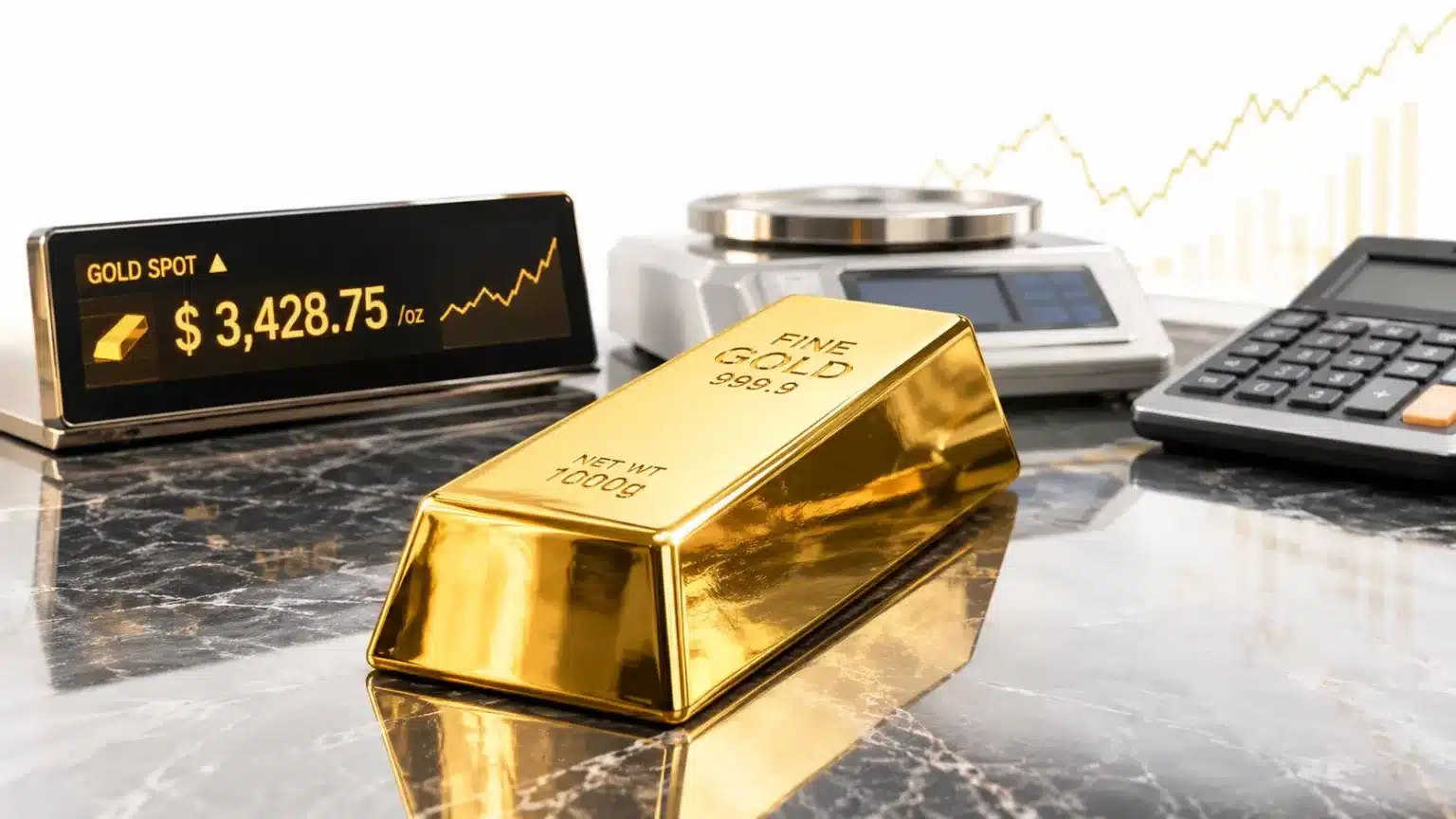
A standard 400 troy ounce Good Delivery gold bar is worth about 400 times the current gold price per troy ounce, so at September 2026 prices around $4,378 to $4,425 per ounce, one bar was worth roughly $1.75 million to $1.77 million. Retail bars usually cost spot plus a premium, so the amount a buyer pays can be higher than the bar's raw metal value.
Most answers stop at that multiplication. That's where readers often get misled.
When someone asks how much is one bar of gold worth, the answer depends on five things: the bar's size, its fine gold content, the price benchmark being used, the premium over spot, and the buyback spread if the owner later sells. A wholesale bar in the London market and a small retail bar can contain gold priced from the same market, yet lead to very different purchase and resale outcomes.
For retirement-focused readers, that distinction matters. A large institutional bar may have an eye-catching headline value, but that doesn't mean it's the product most individuals buy, hold, or place inside a precious metals retirement strategy. Smaller bars are far more common for individual investors, and those bars often come with higher transaction costs.
Gold IRA Association approaches this topic as an educational question first. The goal isn't to hype gold or predict prices. It's to translate bullion pricing into plain English so readers can understand the math, ask better questions, and avoid confusing a headline quote with an actual purchase price.
This is not financial advice. Investors should consult a licensed financial advisor, CPA, or tax professional before making investment decisions.
Introduction How Much One Gold Bar Is Really Worth
A gold bar doesn't have one permanent price tag. It has a base metal value, then a real-world transaction value that changes with market quotes, bar size, and dealer terms.
That sounds more complicated than it is. The core formula is simple.
The starting formula
The base value of any gold bar comes from:
- Fine gold weight: The amount of pure gold in the bar
- Current per-ounce gold price: The quote being used at that moment
- Market adjustment: The premium when buying, or the spread when selling
For a large institutional bar, the rough estimate is straightforward. Multiply about 400 troy ounces by the current gold price. That's why a standard wholesale bar can move by tens of thousands of dollars with relatively small price changes in the gold market.
Practical rule: Start with metal value first. Then ask what a buyer would actually pay and what a dealer would actually offer on resale.
Where readers usually get confused
Three mix-ups cause most of the confusion:
- They picture one universal bar size. There isn't one. A central-bank style bar is very different from a small retail bar.
- They assume “worth” means “purchase price.” It often means melt value only.
- They compare quotes from different benchmarks or different times of day. That can produce different dollar answers even before premiums enter the picture.
The useful way to think about value
For practical decision-making, it helps to separate gold-bar value into two buckets:
- Headline value: Weight multiplied by a market quote
- Transaction value: What it costs to buy, and what someone can likely recover on sale
That second number is the one many retirement savers care about most. It affects liquidity, planning, and whether a product is efficient to own over time.
What Counts as One Bar of Gold
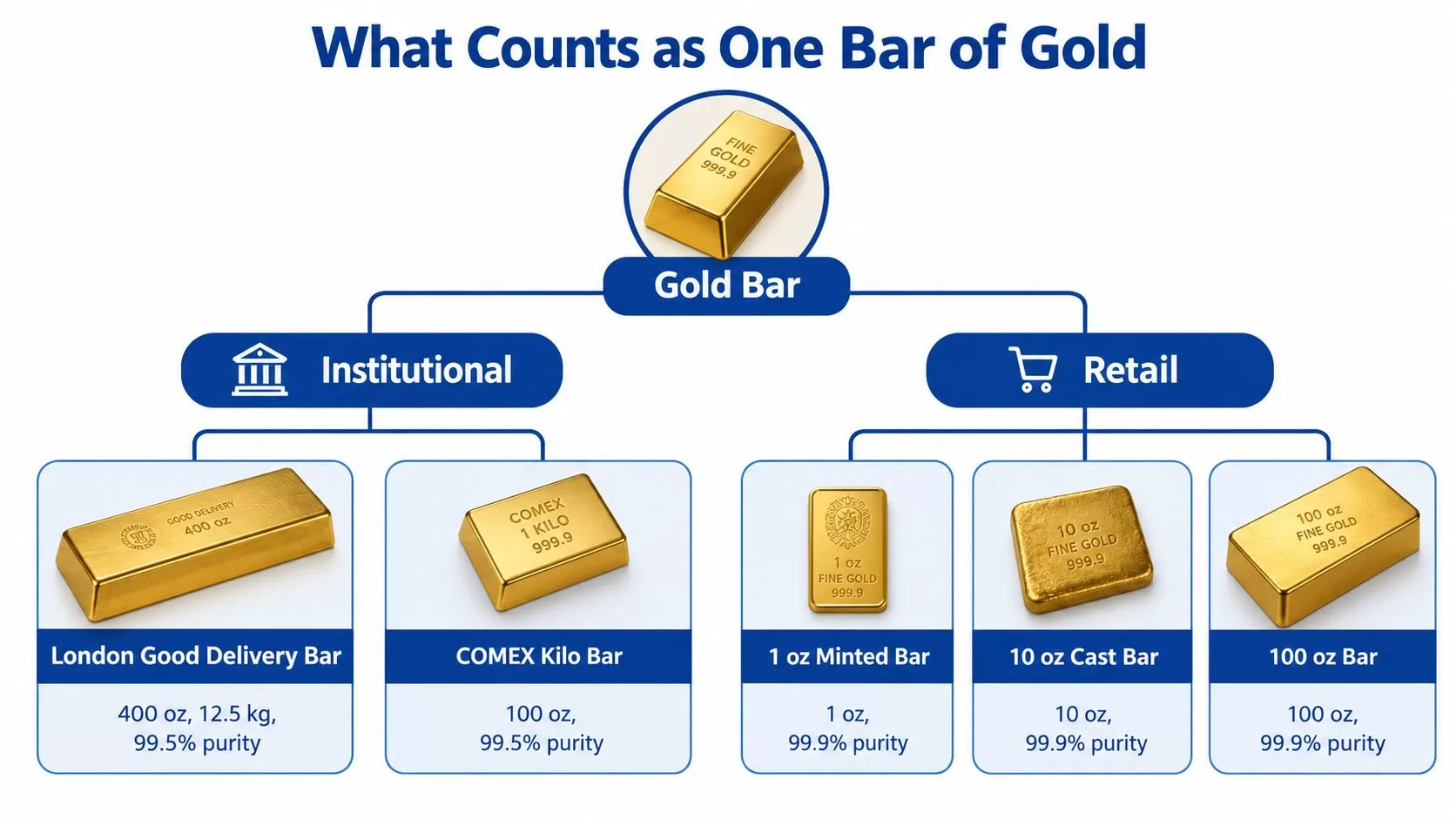
The phrase “one gold bar” sounds simple, but it covers several very different products. In the bullion market, the answer depends on whether the discussion is about institutional bars or retail bars.

The institutional benchmark
The standard international bar used by central banks and bullion dealers is the London Good Delivery bar. It weighs about 400 troy ounces, or roughly 12.4 kilograms and 27.4 pounds, and its permitted gold content can vary within a 350 to 430 troy ounce range, according to the gold bar overview.
This is the bar that comes to mind when dramatic headlines about the value of a gold bar appear. It's the wholesale benchmark, not the everyday retail product.
Retail bars are much smaller
Individual investors usually encounter bars in sizes such as:
- 1 gram
- 1 ounce
- 100 grams
- 1 kilogram
These products are easier to buy, store, and resell in smaller increments. They also sit in a different part of the market. A retirement saver researching bullion is usually comparing these bars, not arranging delivery of a wholesale London bar.
Readers who want a basic primer on bullion formats can also review what bullion means in practical investing terms.
Weight isn't enough by itself
A bar's label may show a gross weight, but the value calculation depends on its fine gold content. Gold is priced by the amount of pure gold in the bar, not just by the object's total mass.
That's why investors need to pay attention to:
- Troy ounces: The bullion market standard
- Grams: Common on retail bars
- Purity: The portion of the bar that is gold
- Assay or certification: The documentation that supports authenticity and content
The same-looking bar can represent a very different dollar value if the fine gold content, purity, or market acceptability differs.
Why the 400-ounce bar gets all the attention
The 400-ounce Good Delivery bar matters because it anchors wholesale gold trading. It's the reference point people often use for “one bar of gold.” But for most households, that benchmark is more educational than practical.
A retiree asking how much one bar of gold is worth usually needs two answers. First, the institutional benchmark for context. Second, the smaller-bar math that applies to actual consumer purchases.
How Spot Price and Benchmarks Set the Base Value
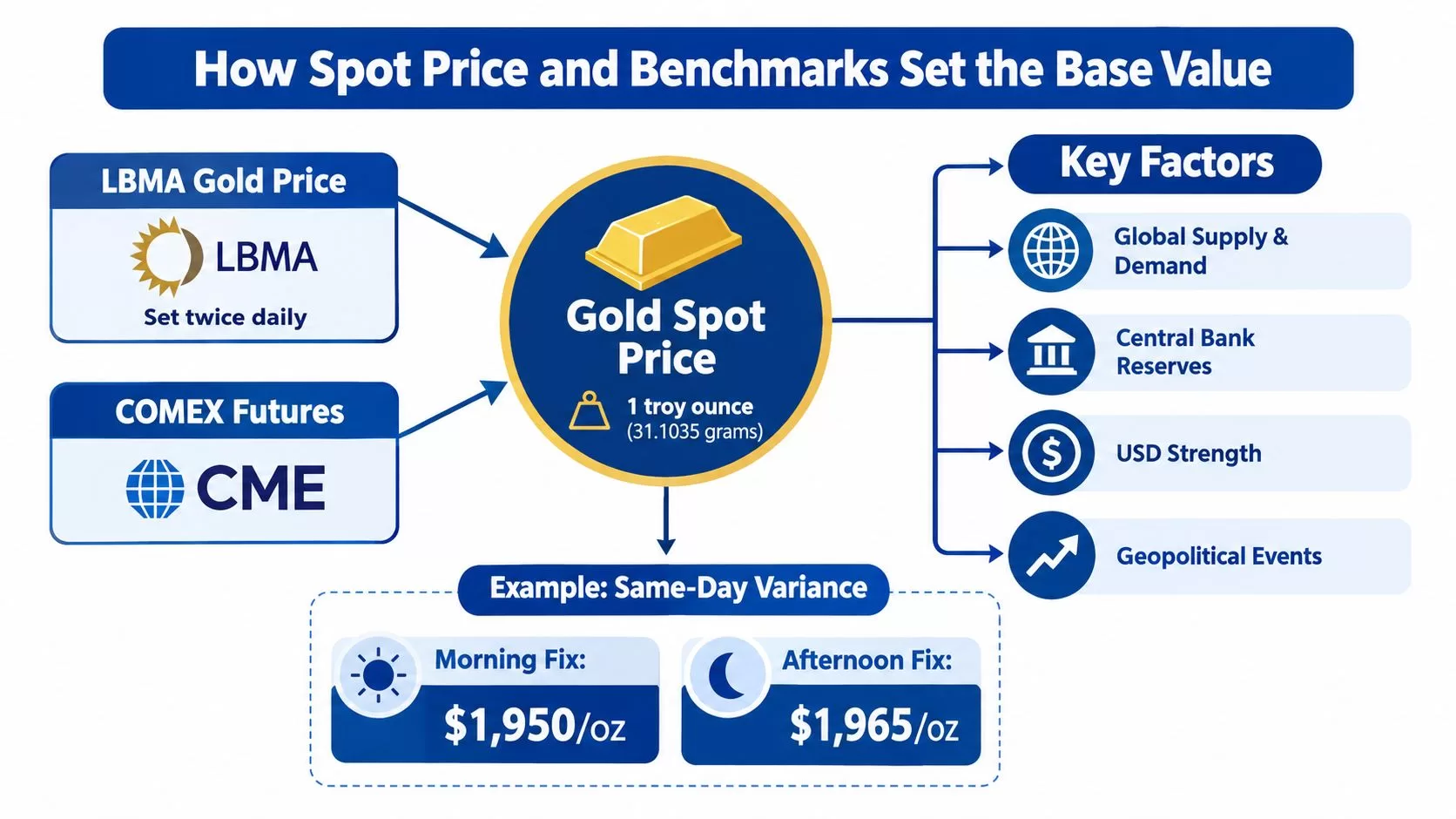
Gold pricing starts with one unit: the troy ounce. A troy ounce equals 31.1035 grams, and any bar's value begins with multiplying its fine-gold weight by the current per-ounce price, as explained in this gold pricing reference.

Spot price is the base, not the final bill
When investors hear that gold is at a certain dollar price, that number is usually a market reference price per troy ounce. It's the starting point for valuation.
That doesn't mean every gold product trades at that exact number. Retail bars, fabricated products, and dealer inventories are built on top of that reference.
Why one quote can differ from another
Gold doesn't have one universal number frozen across every screen and every market participant at every moment. The benchmark used matters.
The LBMA Gold Price is set twice each London business day, at 10:30 a.m. and 3:00 p.m. London time, and it's quoted in U.S. dollars per fine troy ounce of 995 gold, according to the LBMA benchmark guide.
That benchmark can differ from a live spot feed or a dealer quote taken at another timestamp.
What this means in practice
If two people ask, “How much is one bar of gold worth today?” they may both be correct while quoting different numbers, if they are using:
- A live spot quote
- The morning LBMA benchmark
- The afternoon LBMA benchmark
- A retail dealer's asking price
- A dealer's buyback price
That's why time and source matter. During fast price moves, the gap becomes more noticeable.
For readers comparing product prices to market prices, this explanation of Gold Maple Leaf pricing can also help show how benchmark pricing flows into actual retail products.
A simple way to avoid benchmark confusion
Use this checklist before trusting any quoted value:
| Question | Why it matters |
|---|---|
| What time was the price quoted | Gold can change during the day |
| Which benchmark was used | LBMA, live spot, and dealer quotes may differ |
| Is the quote wholesale or retail | Wholesale values usually don't include fabrication and dealer markup |
| Is the bar's gold content clearly stated | Value follows fine gold content, not assumptions |
A gold bar's value is always tied to a specific weight, a specific pricing source, and a specific moment in time.
Why the Same Gold Weight Can Cost Different Amounts
Two bars can contain the same amount of gold and still produce different outcomes for the buyer. This is the part many simple gold calculators leave out.
The missing piece is transaction economics. Buyers don't just pay for raw metal. They also pay for fabrication, distribution, marketability, and convenience. Then, when they sell, they usually face a buyback spread.
Premiums change by bar size
Recent coverage of retail bar pricing shows that small bars often carry much higher premiums over spot than larger bars. 1 gram bars can carry roughly 15% to 35% premiums, 1 ounce bars about 2% to 5%, while 1 kilogram bars often sit around 0.5% to 2% over spot in normal conditions, based on this gold bar pricing analysis.
That doesn't mean small bars are “bad.” It means convenience often costs more.
Typical Premiums and Spreads by Bar Size
| Bar Size | Typical Premium Over Spot | Liquidity and Resale Note |
|---|---|---|
| 1 gram | Roughly 15% to 35% | Easy to buy in small amounts, but often less efficient on a per-gram basis |
| 1 ounce | About 2% to 5% | Common retail format with broad familiarity |
| 1 kilogram | Around 0.5% to 2% | Often more efficient per unit of gold, but a larger-ticket item |
Why this happens
Several factors push the buy price above metal value:
- Manufacturing cost: Small bars still need refining, stamping, packaging, and handling.
- Distribution cost: Dealers build in margin and inventory risk.
- Recognition and trust: Well-documented products can be easier to resell.
- Lot size: A larger bar spreads fixed costs across more gold.
The cheapest sticker price isn't always the cheapest ownership cost
A small bar has a lower total dollar price than a large bar, but that doesn't automatically make it cheaper to own on a percentage basis. A buyer may find that a product with a lower entry ticket comes with a larger premium and a wider resale gap.
Buyers should ask two questions before purchasing: “How much over spot am I paying?” and “What is the dealer's buyback approach if I sell later?”
Questions worth asking before a purchase
- What benchmark is this quote based on: The answer reveals whether the bar is being priced from a wholesale reference or a retail shelf price.
- What premium is included: This helps separate metal value from product markup.
- How is buyback handled: Some bars are easier to resell than others.
- Is the bar widely recognized: Market acceptance can affect resale convenience.
For retirement savers, this matters because product efficiency can shape long-term costs, even when the underlying metal is the same.
Simple Math to Calculate Any Gold Bar Value
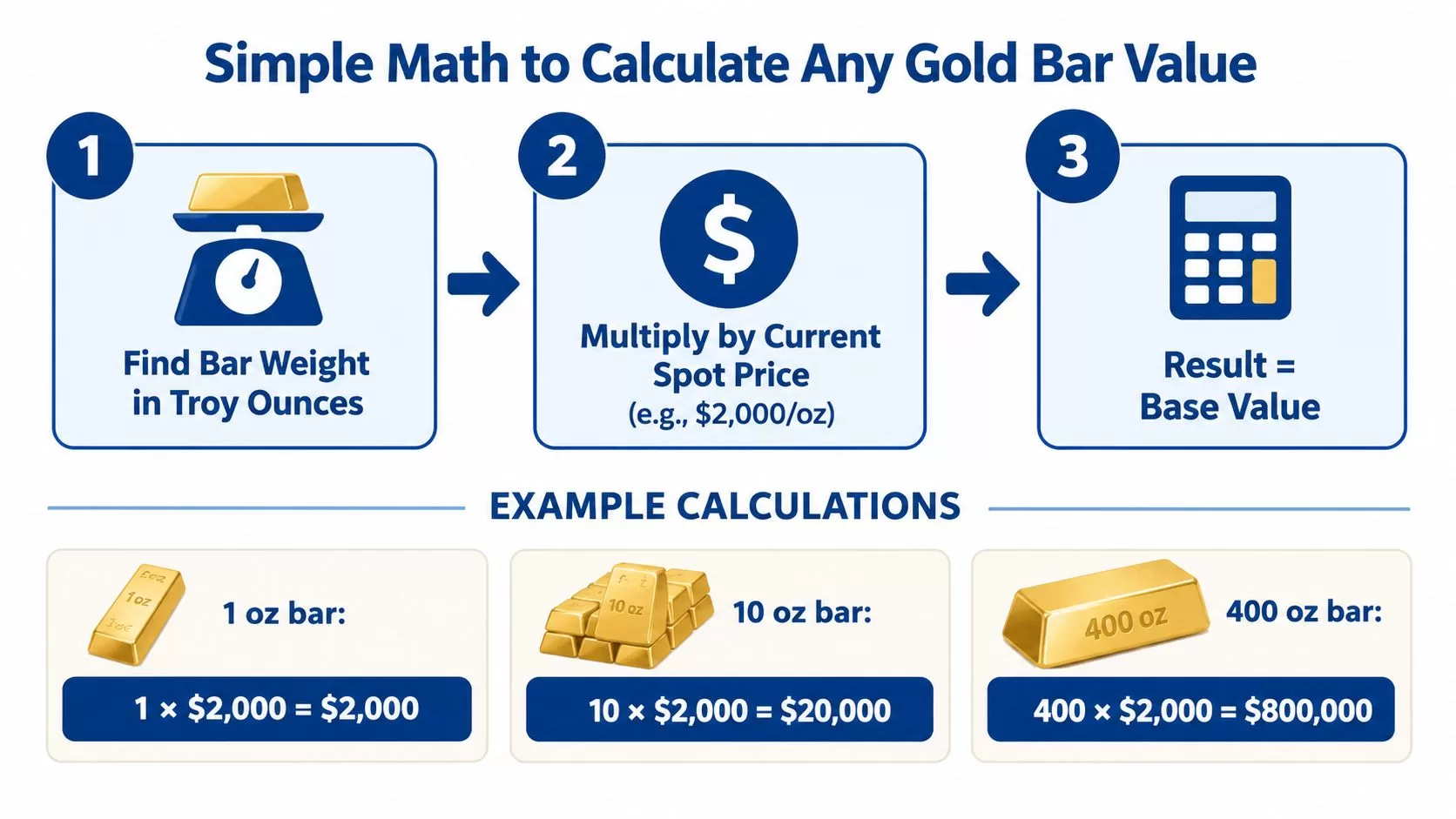
The good news is that the actual math is easy once the right inputs are in place. Investors don't need a complex model. They need a clean three-step process.
The three-step method
Confirm the fine gold weight
Use the bar's stated fine-gold amount, in troy ounces or grams.Choose the price source
Pick the market quote being used for the calculation.Adjust for the transaction
Add a premium if estimating a buy price, or subtract a spread if estimating a likely resale number.
A reader comparing weight units can use this guide to troy ounce vs regular ounce to avoid one of the most common conversion mistakes.
Base-value examples using current-style pricing
The article's opening used September 2026 market snapshots. Those snapshots placed gold around $4,378 to $4,425 per troy ounce, implying that a 400-troy-ounce Good Delivery bar was worth roughly $1.75 million to $1.77 million, based on this September 2026 market report.
That same logic works for smaller products.
Example 1. A 1 ounce bar
A 1 ounce bar has a base value equal to 1 × the chosen gold price per troy ounce.
If a buyer is shopping retail, the actual checkout price would usually be that base value plus a premium. The exact dollar amount depends on the dealer quote and product format.
Example 2. A 100 gram bar
A 100 gram bar must first be translated into its fine-gold equivalent using the troy-ounce standard discussed earlier. After that, the owner multiplies the fine-gold amount by the selected per-ounce price.
Some buyers make mistakes. They know the bar is “100 grams” but compare it directly to an ounce quote without converting the unit first.
Checklist: Confirm the unit, confirm the benchmark, then do the multiplication. Most pricing errors come from skipping one of those three checks.
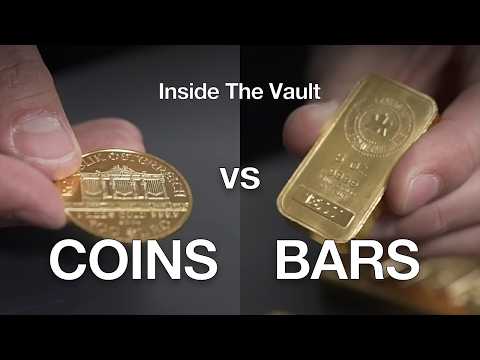
A short video can help visualize the process:
Example 3. A 1 kilogram bar
A 1 kilogram bar is valued the same way. Determine the fine-gold weight in troy ounces, multiply by the selected per-ounce quote, and then account for the premium if estimating a purchase price.
In practice, larger bars often look more efficient because their premium over spot tends to be lower than smaller products.
Example 4. The 400 ounce wholesale bar
For a classic institutional estimate, use the benchmark convention of about 400 troy ounces.
One worked example from the verified data uses a spot price around $4,376.90 per ounce, which gives a melt value of about $1,750,759.96 for a 400-ounce bar, based on the LBMA Good Delivery specifications reference.
The formula to remember
For any gold bar, the practical calculation is:
- Base value = fine-gold weight × current per-ounce gold price
- Estimated buy price = base value + premium
- Estimated resale value = base value minus spread
That's the simplest accurate answer to how much is one bar of gold worth. The formula stays the same. The inputs change.
How the Value of One Bar Has Changed Over Time
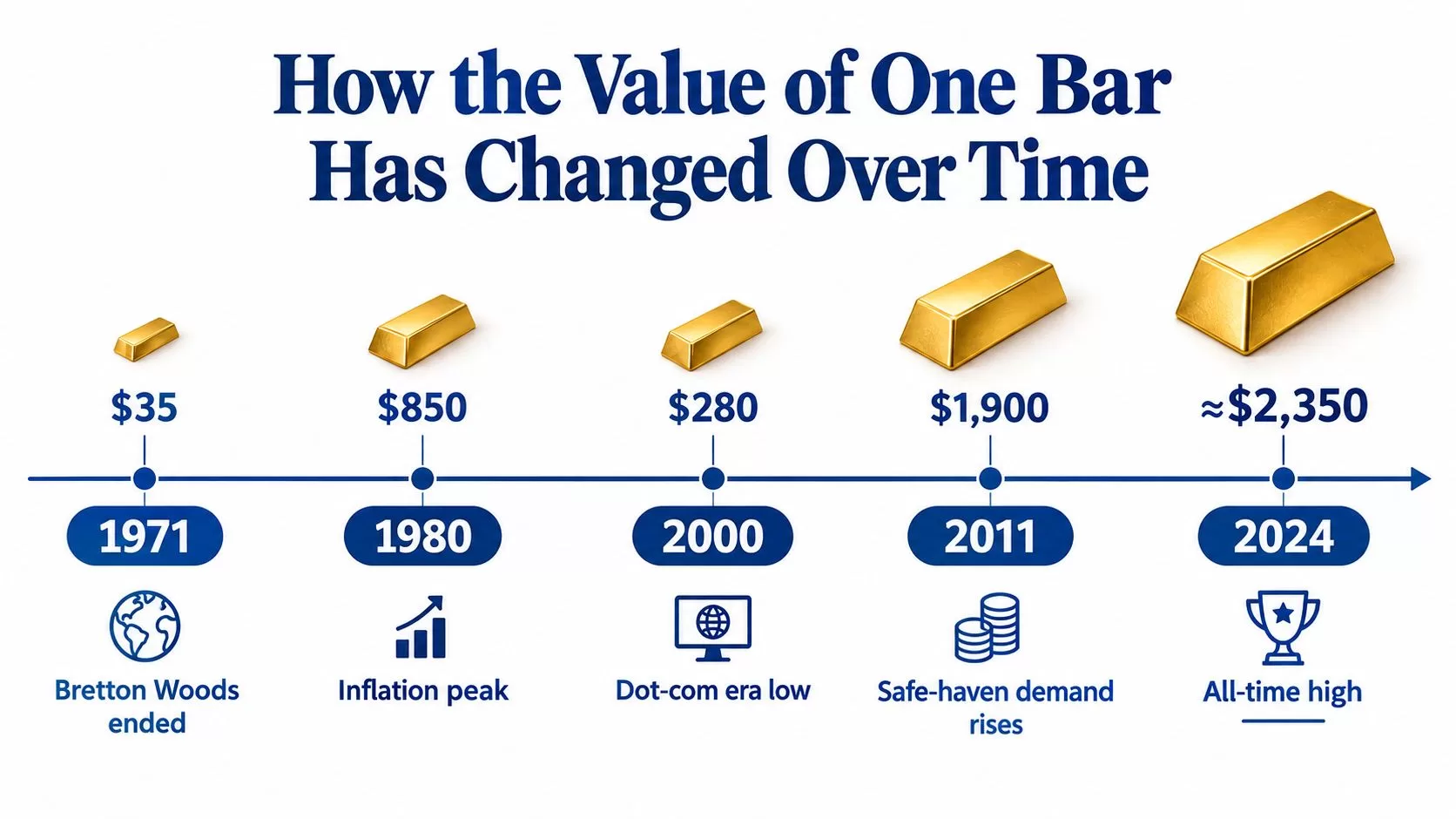
A gold bar's worth can change dramatically over the years because gold itself doesn't trade at a fixed price. Looking at history helps remove the false idea that “a gold bar” has one stable long-term dollar amount.
A simple historical timeline
A commonly cited historical sequence shows gold at about $35 per ounce in 1971, about $850 in 1980, about $1,920 in 2011, and around $2,075 in 2020, according to this gold price history timeline.
Using the 400-ounce benchmark, those levels imply approximate bar values of:
- About $14,000 in 1971
- Roughly $340,000 in 1980
- Around $768,000 in 2011
- About $830,000 in 2020
The same source notes that the long-run move from $35 to more than $2,000 per ounce amounts to a rise of roughly 5,700%+.
Why this matters to savers
Those changes didn't happen in a vacuum. Gold has often drawn attention during periods associated with inflation concerns, changing monetary conditions, and demand for perceived safe-haven assets.
That doesn't guarantee future results. It does show why a gold bar's dollar value can swing enormously across decades.
Even “today's value” can vary by source
Recent benchmark discussion also shows why readers should be careful with the word “today.” In mid-May 2026, LBMA-linked benchmarks were around $4,675.70 per troy ounce, while other live spot references in September 2026 were closer to $4,359.88 to $4,374.34 per troy ounce, based on this gold bar worth and pricing overview.
That's a meaningful difference when applied to a large bar.
One useful parallel appears outside bullion itself. Readers interested in how rising gold prices can affect other gold-linked assets may find this look at how gold surge changed watch values helpful, especially for understanding how metal value can influence resale floors in luxury items.
A gold bar isn't a fixed-price object. It's a moving store of metal value, priced by market conditions at a specific moment.
FAQ on gold bar value
Is one bar of gold always 400 ounces
No. The London Good Delivery bar is the standard institutional benchmark at about 400 troy ounces, but retail bars come in much smaller sizes such as 1 gram, 1 ounce, 100 grams, and 1 kilogram.
Why doesn't every website show the same gold bar value
Because the answer depends on the timestamp, the benchmark used, and whether the number reflects spot value or a retail quote.
Is the spot price what a buyer actually pays
Usually not. Retail bars are generally priced at spot plus a premium, and the premium varies by bar size and liquidity.
Are larger bars always better
Not always. Larger bars are often more efficient on a per-unit basis, but they may be less practical for some savers because they require a larger single purchase and may be less flexible to liquidate in smaller pieces.
What This Means for Retirement Savers and Next Steps
For retirement savers, the key lesson is simple. A gold bar's worth isn't just a headline number from a market screen. It's the combination of fine gold content, the benchmark price used, and the transaction costs wrapped around the product.
That matters because product choice affects efficiency. Larger bars often compress premiums, while smaller bars can be easier to access but more expensive relative to their gold content. The right format depends on the investor's goals, account structure, liquidity needs, and whether the purchase is for direct ownership or part of a retirement strategy that must follow account and product rules.
For readers exploring precious metals in retirement accounts, Gold IRA Association publishes educational guides on bullion standards, rollover steps, and product eligibility so investors can compare formats more carefully before making decisions.
A cautious approach helps. Confirm the benchmark. Confirm the fine weight. Ask about premiums and buyback terms. If the purchase is retirement-related, verify whether the specific metal product meets account requirements before moving money.
This is not financial advice. Consult a licensed financial advisor, CPA, or tax professional before making investment decisions.
Gold prices, bar formats, and retirement rules can get confusing fast. Gold IRA Association offers plain-English educational guides that help readers understand bullion valuation, Gold IRA mechanics, and how to compare providers with a clearer eye.


