



A lot of retirees reach the same point at the same time. They look at a 401(k) or traditional IRA built around paper assets, watch the market swing, and start asking whether part of that nest egg should sit in something tangible instead.
That's where confusion starts. Gold inside an IRA is allowed, but only if it follows strict IRS rules. The difference between an approved coin and a prohibited purchase can come down to purity, source, packaging, or who holds the metal. A mistake here isn't minor. It can create taxes, penalties, or worse, put the account's status at risk.
Securing Your Retirement with IRA Approved Gold
For near-retirees, gold usually isn't about chasing excitement. It's about control, durability, and reducing reliance on assets that exist only on a statement. Physical gold can play that role inside a retirement account, but only when the investor follows the rules exactly.
Many individuals start with the wrong question. They ask, “Which gold coins should be bought?” The better question is, “Which gold coins are legal to hold in an IRA?” Those aren't the same thing.
Practical rule: If a gold product isn't clearly IRA eligible before purchase, it shouldn't be purchased for an IRA at all.
The IRS doesn't treat all gold equally. Some coins qualify. Many don't. Some proof coins can work. Others can't. Personal gold already sitting in a safe at home is the biggest trap of all. Many retirees assume they can move that metal into an IRA later. They can't.
That's why IRA approved gold coins need to be understood as a compliance category first and an investment choice second. The order matters. A beautiful coin with collector appeal may be a terrible IRA asset. A plain bullion coin from the right mint may be exactly what the rules allow.
What matters most before buying
A careful buyer should focus on four things first:
- IRS eligibility: The product has to meet the legal standard for IRA use.
- Bullion status: The value should come from metal content, not rarity or collector hype.
- Approved handling: The purchase must move through the proper IRA structure.
- Qualified storage: The metal can't end up in personal possession if it's meant to stay inside the IRA.
Retirees who get these basics right usually avoid the expensive mistakes. Retirees who skip them often learn the rules after the money has already moved.
The IRS Rules That Define IRA Approved Gold
The IRS framework for gold in an IRA is strict for a reason. Retirement accounts get tax advantages, so the government limits what can go inside them. Gold is allowed, but only as regulated bullion, not as a free-for-all collection of coins and bars.
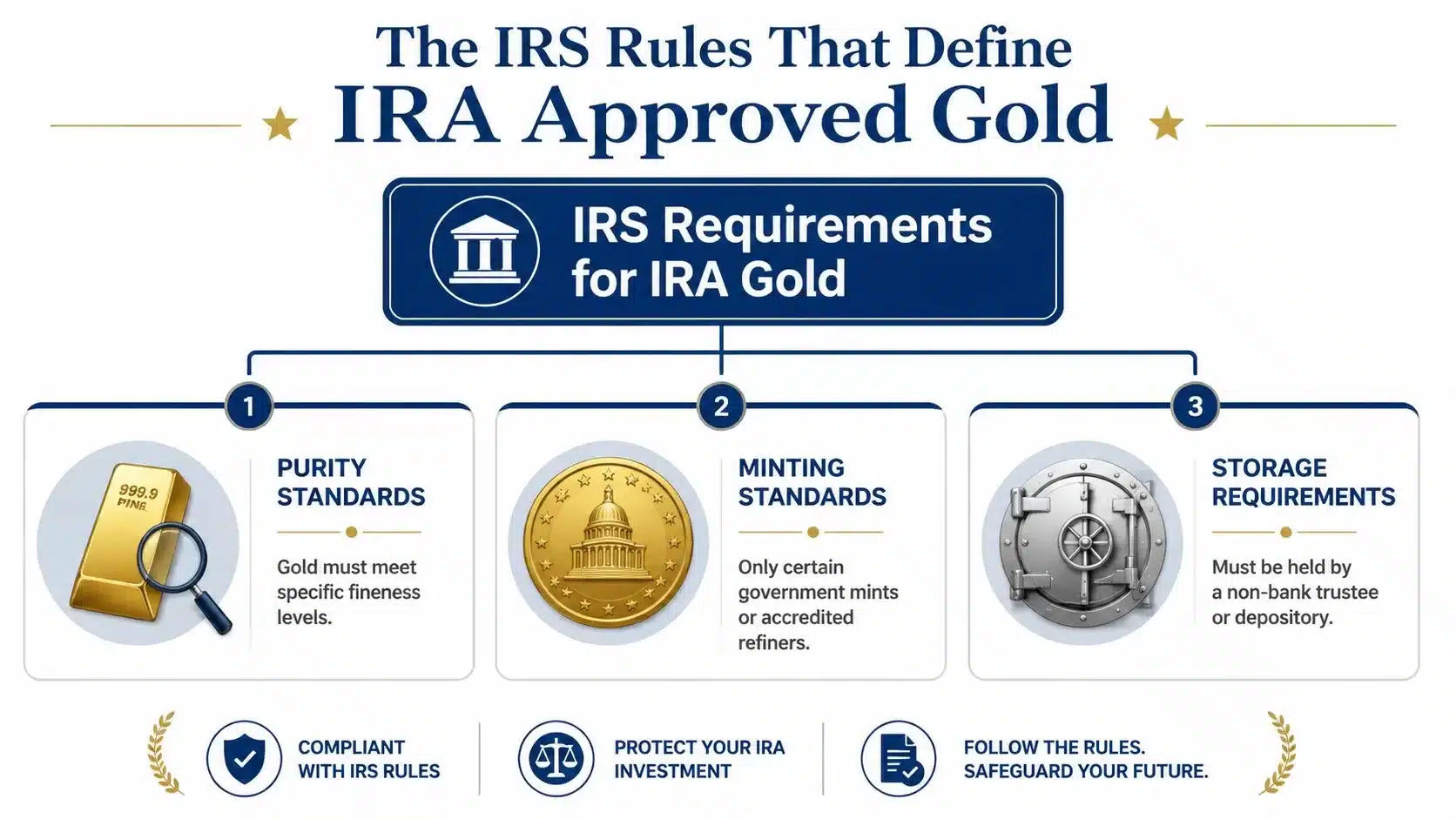
According to Fidelity's explanation of IRA-approved gold requirements, gold in an IRA must meet a minimum fineness of 99.5% pure gold, or 0.995 fineness. The same source notes the one explicit exception: the American Gold Eagle, which is eligible despite being about 91.67% pure because of its specific legal status under U.S. law. Fidelity also states that eligible gold must come from a government mint or from an accredited refiner recognized by major exchanges, and ties this framework to the Taxpayer Relief Act of 1997, which expanded the list of permissible precious metals holdings in IRAs.
The three non-negotiable tests
Most IRA gold decisions come down to three filters.
- Purity: If the gold doesn't meet the required fineness, it's out.
- Producer: If it wasn't made by a recognized government mint or accredited refiner, it's out.
- Form: If it's treated like a collectible rather than bullion, it's out.
That's the cleanest way to think about it.
Why the IRS is this strict
The IRS wants IRA metals to be easy to identify, easy to value, and easier to liquidate than collector pieces. That means the account should hold standardized bullion products with clear metal content and recognized sourcing, not rare coins whose price depends on scarcity, grading, or hype.
A lot of confusion disappears once that principle is understood. The rules aren't random. They're designed to keep IRA assets tied to verifiable metal value.
For a broader compliance overview, see these precious metal IRA rules.
Gold in an IRA isn't judged by how impressive it looks. It's judged by whether it meets the IRS standard for purity, source, and form.
Quick Reference List of Eligible Gold Coins and Bullion
The easiest way to shop for IRA approved gold coins is to start with products that are commonly recognized as eligible and avoid anything marketed mainly for rarity or collector appeal.
According to Summit Metals' summary of gold IRA rules, eligible gold coins must come from a recognized government mint or an accredited refiner, must remain in uncirculated pristine condition, and should include original mint packaging and a certificate of authenticity when applicable. The same source identifies several common IRA-approved gold coins, including the American Gold Buffalo, Canadian Gold Maple Leaf, Austrian Gold Philharmonic, and British Britannia from 2013 and newer, all meeting the 99.5% purity standard.
IRA Approved Gold Coins and Bullion
| Product Name | Mint/Refiner | Purity/Fineness | Notes |
|---|---|---|---|
| American Gold Buffalo | U.S. Mint | .995 | Common IRA-approved bullion coin |
| Canadian Gold Maple Leaf | Royal Canadian Mint | .995 | Widely recognized bullion coin |
| Austrian Gold Philharmonic | Austrian Mint | .995 | Sovereign-mint bullion coin |
| British Britannia (2013 and newer) | The Royal Mint | .995 | Later issues meet IRA threshold |
| Gold bars from accredited refiners | Accredited refiner | .995 | Must come from an approved source and meet specifications |
That table is a starting point, not a shopping shortcut. The exact item still needs to be purchased in IRA-compliant form and handled through the proper account structure.
Coins that usually make the process simpler
For many retirees, sovereign bullion coins are easier to understand than bars.
- American Gold Buffalo: Straightforward because it meets the required fineness and comes from the U.S. Mint.
- Canadian Gold Maple Leaf: Popular because it’s a modern bullion coin from a well-known government mint.
- Austrian Gold Philharmonic: Often chosen by buyers who want a sovereign-mint coin that clearly fits the bullion category.
- British Britannia (2013 and newer): Eligible only for newer issues meeting the required standard, so the date matters.
Bars can qualify too, but details matter more
Gold bars aren’t second-tier assets. They can be fully eligible. But they require more attention to sourcing and specifications.
A retiree considering bars should confirm:
- Accredited production: The refiner must be accepted under the IRS framework discussed earlier.
- Clear markings: The bar should carry a valid mint mark or refinery identifier.
- Original documentation: When applicable, keep the certificate of authenticity and packaging intact.
- Pristine condition: Damaged or altered products can create unnecessary compliance questions.
Buyers get into trouble when they assume “pure gold is pure gold.” In an IRA, the source and condition matter just as much as the metal itself.
The practical recommendation is simple. For most retirement investors, widely recognized bullion coins are easier to verify, easier to discuss with a custodian, and less likely to create avoidable friction.
Understanding the American Gold Eagle Exception
The American Gold Eagle causes more confusion than any other coin in this category. On the surface, it seems to break the rule. Most IRA gold must meet the higher fineness threshold, yet this coin remains eligible.
According to JM Bullion’s explanation of IRA-approved gold, IRA-approved gold must generally meet 99.5% purity, with the sole exception being the American Gold Eagle coin, which is allowed at 91.67% purity because of its legal tender status under U.S. law.
Why this exception exists
This isn’t a loophole. It’s a specific legal carve-out.
The American Gold Eagle qualifies because the law treats it differently from other lower-purity coins. That special treatment does not mean other 22-karat coins should be assumed eligible. Retirees often make that leap, and it’s the wrong one.
What retirees should take from this
The safest takeaway is blunt. If a coin doesn’t meet the normal fineness rule, don’t assume it’s allowed just because the Gold Eagle is.
Use the Gold Eagle as the exception that proves the rule. It should make investors more cautious, not less. For a closer look at the coin itself, review what American Gold Eagle coins are.
Common Pitfalls What Gold Is Not IRA Approved
The biggest errors in gold IRAs don’t come from obscure technicalities. They come from assumptions. Retirees assume rare coins are acceptable because they contain gold. They assume proof coins automatically qualify because they came from a mint. Most often, they assume the gold they already own can be transferred into the IRA.
That last mistake is the most expensive one.
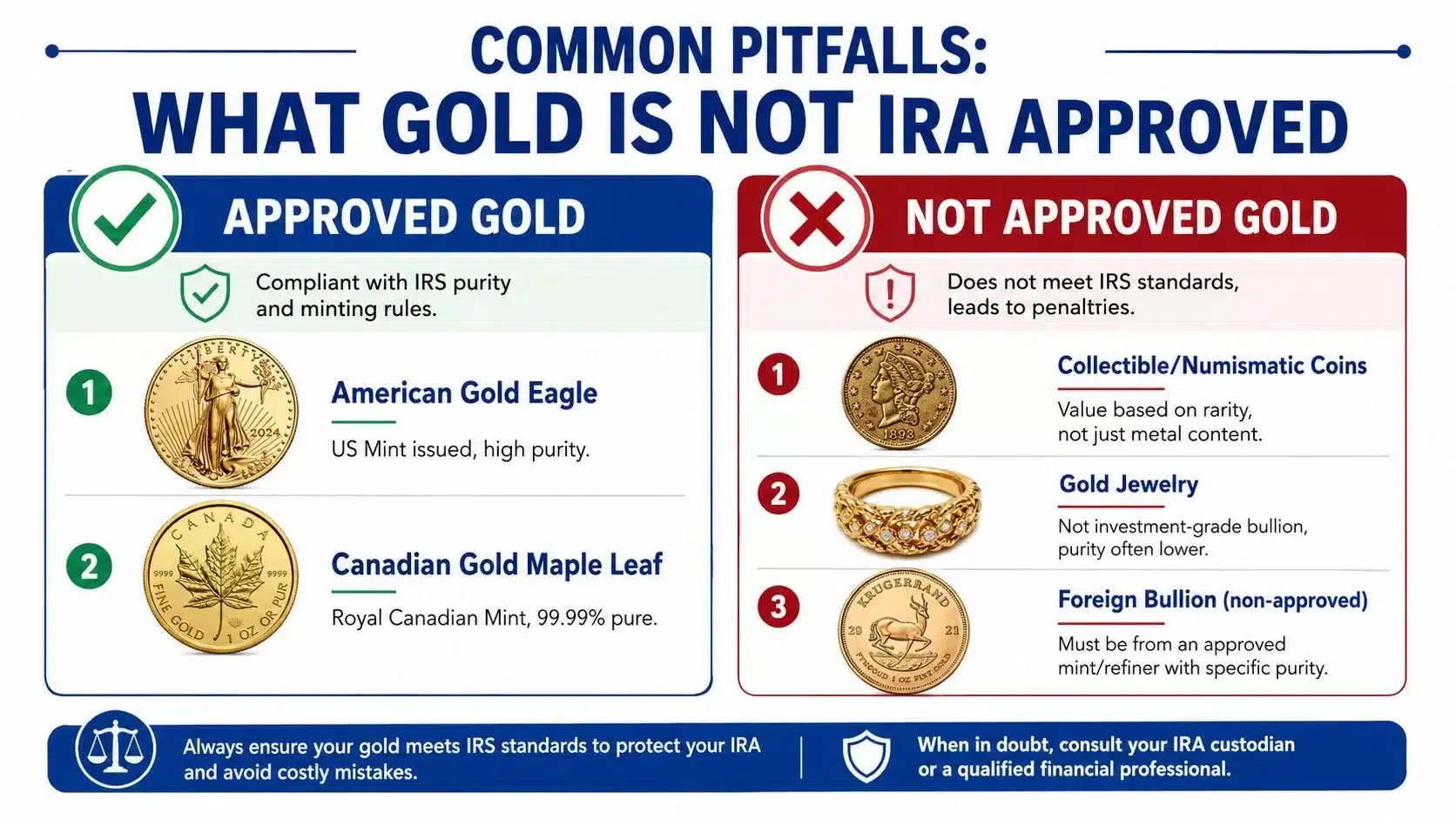
According to U.S. Money Reserve’s explanation of IRA-approved gold and silver, gold already owned personally, bars stored at home, and family heirloom gold cannot be placed into an IRA. That source also highlights the deeper issue: metals that fail certified sourcing can be treated as collectibles under IRC 408(m)(3), creating the risk of tax penalties or even disqualification of the entire IRA.
Personal gold does not belong in a new IRA purchase
A lot of readers want a different answer here. There isn’t one.
If the gold is already in personal possession, it isn’t the same as buying IRA-eligible bullion through the IRA itself. The chain of custody matters. The sourcing matters. The account structure matters. An IRA is not a place to warehouse personal gold after the fact.
If the metal started as a personal holding, assume it doesn’t belong in the IRA unless a qualified custodian confirms otherwise before any transaction happens.
Items that commonly fail the IRA test
Several categories should raise an immediate red flag:
- Collectible or numismatic coins: These are valued for rarity, scarcity, grading, or historical appeal.
- Family heirlooms: Sentimental value has no place in IRA compliance.
- Gold stored at home: Personal possession is the opposite of the required IRA structure.
- Jewelry and decorative gold: These products aren’t IRA bullion.
- Private-mint proof products presented like collectibles: Many buyers confuse these with approved proof coins.
The proof coin nuance people miss
Proof gold is where many beginner guides fall short. Some proof coins can qualify, but not automatically.
According to Hero Bullion’s review of gold products that are not IRA eligible, proof gold coins must be encapsulated before they are considered IRA eligible. That requirement matters. It’s a technical compliance issue, not a cosmetic one. The same source also reinforces the distinction between proof coins from sovereign mints and products that drift into collector territory.
The practical recommendation is simple. Treat proof coins with caution. If a proof coin isn’t clearly identified as IRA eligible in encapsulated form and tied to the right mint source, skip it.
How to Buy and Store IRA Approved Gold
Buying IRA approved gold coins is not the same as buying gold outright with personal money. The investor doesn’t buy coins and drop them into a home safe. The investor works through an IRA structure built around a custodian and an approved storage facility.
That process may feel more restrictive than a normal gold purchase, but that’s exactly what preserves the account’s tax treatment.

The required three-part structure
A compliant gold IRA usually involves three participants:
- The account owner chooses the allocation and approves the purchase.
- The custodian handles the IRA administration, paperwork, and transaction flow.
- The depository receives and holds the metal in approved storage.
That separation is the point. It keeps the assets inside the retirement account framework instead of drifting into personal possession.
What the buying process usually looks like
The sequence is straightforward when handled properly.
- Open a self-directed IRA: This creates the legal account structure for precious metals.
- Fund the account: Money typically comes from an existing IRA, a 401(k) rollover, or a new contribution.
- Select eligible bullion: The product must fit the IRA standards already covered above.
- Authorize the transaction through the custodian: The IRA, not the individual personally, is making the purchase.
- Ship the metals to approved storage: The metal goes to the depository, not to the investor’s home.
Retirees who want a step-by-step walkthrough can review how to buy gold with IRA money.
A short visual overview can also help clarify the process:
What investors cannot do
People often run into trouble. They can’t buy coins personally and decide later that those coins belong to the IRA. They can’t receive the metals at home for “temporary storage.” They can’t put IRA bullion in a personal safe deposit box and call it compliant.
Key point: Personal possession and IRA possession are not the same thing. Once the investor takes control of the metal outside the IRA structure, the compliance risk rises immediately.
The right approach is less glamorous and far safer. Let the custodian administer the purchase, let the depository hold the metal, and keep the transaction trail clean from start to finish.
Verifying Authenticity and Purity of Your Investment
Retirees worry about counterfeit gold for good reason. The best protection isn’t guesswork or home testing. It’s the structure of the IRA process itself when handled correctly.
A compliant purchase creates a chain of custody. The metal comes from an approved source, moves through the transaction process under the custodian’s supervision, and arrives at a professional depository instead of landing in a private drawer or safe.
Why the system itself helps protect the buyer
Each party in the process acts as a checkpoint.
- Dealer selection standards: The product must already fit IRA rules before it’s approved for purchase.
- Custodian oversight: The transaction is reviewed for account compliance, not just payment processing.
- Depository intake procedures: The receiving facility verifies what it accepts into storage.
- Documentation: Certificates of authenticity, mint marks, and product identifiers support the record.
That layered review is one reason retirement investors should avoid improvising with side deals, private sales, or inherited gold.
What to insist on before the purchase settles
A cautious investor should verify:
- Product identity: The exact coin or bar matches the approved item ordered.
- Recognized source: The mint or refiner is acceptable under the IRA rules.
- Condition and packaging: Products that require original packaging or documentation should arrive that way.
- Account records: The custodian’s paperwork should match the stored asset description.
A retirement portfolio doesn’t need mystery assets. It needs metal that can be traced, documented, and held without compliance drama.
FAQ Rollovers Contributions and Compliance
How does a gold IRA rollover work
A rollover moves retirement funds into a self-directed IRA that can hold approved precious metals. In practice, the cleanest route is usually a direct movement of funds through the proper account channels so the investor doesn’t create unnecessary tax complications.
Once the new account is funded, the custodian facilitates the purchase of eligible gold and the metals go to approved storage. The investor chooses the allocation, but the account structure handles the mechanics.
What are the contribution limits for 2026
According to Clute Journals’ discussion of IRA-eligible gold contribution limits, for 2026 the annual contribution limit is $7,000 for individuals under age 50 and $8,000 for those 50 or older, with an additional $1,000 catch-up contribution allowed for the 50+ group.
That means a Gold IRA follows the same general annual IRA contribution framework as traditional and Roth IRAs. Investors should still confirm how those limits apply to their own situation before funding.
Can gold already owned personally be moved into the IRA
No. This is one of the clearest no answers in the entire category.
Personally owned gold, gold stored at home, and inherited pieces don’t become IRA assets just because the owner wants them inside a retirement account. The purchase has to occur within the IRA structure using eligible products and approved handling.
Is home storage ever allowed for IRA gold
Home storage defeats the point of the IRA framework. IRA metals need to remain in approved custody and storage if the account is going to preserve its intended tax treatment.
Retirees should treat any pitch that makes home possession sound easy or routine with extreme caution. If the arrangement blurs the line between personal holdings and IRA holdings, it’s the wrong arrangement.
Are proof coins always disqualified
No, but they should never be assumed eligible. Proof coins need more scrutiny than standard bullion products.
The key issue is compliance detail. If the proof coin doesn’t satisfy the IRA standards in full, including the required condition and presentation requirements discussed earlier, it doesn’t belong in the account.
The bottom line is simple. Gold in an IRA can be useful, but only when the investor respects the rules more than the marketing. Start with eligibility, insist on approved handling, and never try to force personal gold into a retirement account after the fact.
Gold IRA Association offers plain-English education for retirees who want to avoid costly mistakes before opening or funding a precious metals IRA. Readers who want a practical next step can compare top Gold IRA companies or talk through the basics with a specialist at 888-910-8386. This is not financial advice. Consult a licensed financial advisor, CPA, or tax professional before making investment decisions.