




A pre-retiree with an old 401(k) or traditional IRA may be considering gold because market volatility, inflation concerns, and concentration risk have made a paper-heavy portfolio uncomfortable. The challenge isn't just choosing metal. The rollover method determines whether the move preserves tax deferral or creates an avoidable tax problem. This guide explains how an IRA rollover to gold works, why a direct transfer is usually the right choice, which metals qualify, what fees to examine, and where rollovers commonly go wrong.
What an IRA Rollover to Gold Actually Means
An IRA rollover to gold moves eligible retirement funds from an employer plan or existing IRA into a self-directed IRA that can hold IRS-approved physical precious metals. The account keeps its retirement-account structure, but the investment menu changes from conventional paper assets to qualifying gold and, where permitted, other precious metals.
That structure matters. The account holder doesn't buy a gold coin personally and place it in a retirement account afterward. The IRA custodian purchases the metal for the account, and an approved depository stores it. The account holder must not take personal possession of IRA-owned bullion.
The account types and routes
The funding source determines the paperwork and tax treatment:
- Former employer 401(k): A completed employment relationship often makes the plan eligible for a rollover, subject to the plan's rules.
- Current employer 401(k): The plan may restrict withdrawals while employment continues, so the plan document must be reviewed before any request is submitted.
- Traditional IRA: Funds can generally move into another traditional IRA through a transfer or rollover, provided the transaction follows IRS requirements.
- Roth account: A Roth-to-Roth move can preserve the account's Roth structure, while converting pretax money to Roth status is a separate taxable decision that requires individual tax analysis.
The broader IRA system is a major destination for workplace-plan money. By mid-2026, IRA assets had reached $19.2 trillion, with industry reporting connecting that growth to ongoing 401(k) transfer activity in retirement-account rollover reporting. Rollover amounts are separate from annual IRA contribution limits, which in 2026 were $7,500 for people under age 50 and $8,500 for those 50 or older, according to the same source. A rollover can therefore move a substantially larger existing balance without being treated as a new annual contribution, if processed correctly.
Advisor's view: Gold can serve a diversification purpose, but the account structure doesn't eliminate investment risk. Physical metal has no dividend or interest payment, and the account carries costs that should be understood before funding.
Direct Transfer vs. Indirect Rollover
The central decision is whether the money travels directly between custodians or first reaches the account holder. For a gold IRA, the recommendation is straightforward: use a direct trustee-to-trustee transfer whenever possible.
With a direct transfer, the current trustee sends funds to the new self-directed IRA custodian. No check is payable to the account holder, no 60-day redeposit clock begins, and the account holder avoids the administrative risks associated with receiving the distribution personally.
An indirect rollover works differently. The existing provider pays the funds to the account holder, who must redeposit them into another eligible IRA within 60 days. Missing that deadline generally removes tax-free rollover treatment. The IRS also explains that only one indirect IRA-to-IRA rollover is permitted in any 12-month period, regardless of how many IRAs the taxpayer owns. The restriction doesn't apply to direct trustee-to-trustee transfers or to rollovers from employer plans into IRAs. The IRS rollover guidance sets out these distinctions.
The practical comparison
| Feature | Direct Trustee-to-Trustee | Indirect 60-Day Rollover |
|---|---|---|
| Who receives the funds | New custodian | Account holder |
| Timing requirement | No personal 60-day clock | Funds must be redeposited within 60 days |
| One-rollover limit | Not subject to the IRA-to-IRA limit | One IRA-to-IRA rollover in any 12-month period |
| Administrative risk | Lower | Higher |
| Recommended for a Gold IRA | Yes | Generally no |
For employer-plan distributions paid to the account holder, federal withholding can apply. The account holder may then need to replace withheld funds to roll over the full eligible amount, creating a cash-flow problem even when the original intention was tax deferral.
The detailed distinction between these methods is covered in this guide to direct transfers versus rollovers. The conclusion remains firm: a direct transfer is cleaner, safer, and better suited to a retirement account holding physical metal. The small convenience of receiving a check isn't worth the deadline, withholding, and reporting risk.
Before You Move the Money
A rollover shouldn't begin with a metal order. It should begin with an eligibility and paperwork review.
First, identify the source account and confirm that it can move. A former employer's 401(k) may have different distribution procedures from a current employer's plan. A current employee should read the Summary Plan Description and ask whether the plan permits an in-service distribution, a partial rollover, or a rollover only after separation from service. Some plans also provide age-based distribution rights, including rules associated with reaching age 59½, but the plan document controls the actual process.
Complete the compliance checks
Before submitting transfer forms, verify:
- Account eligibility: Confirm whether the money comes from a former employer plan, current employer plan, traditional IRA, or Roth account.
- Distribution status: Check whether employment status or plan rules limit access.
- RMD obligations: Required minimum distributions generally must be taken separately before the remaining balance is used to purchase metals.
- Custodian acceptance: Confirm that the new custodian accepts incoming rollovers from the specific sending institution.
- Beneficiary records: Complete the first and last name fields exactly as requested on the self-directed IRA application and beneficiary forms.
- Fee disclosure: Request the full schedule for setup, administration, storage, dealer compensation, selling, wires, and shipping.
Required minimum distributions deserve special attention. IRA-owned gold can't be counted as an RMD without a custodian-managed distribution process. The account may need to sell enough metal for cash, or arrange an eligible in-kind distribution that is reported and valued properly. A tax professional should review the individual's RMD circumstances before the rollover is finalized.
The IRS also treats a rollover as separate from an annual contribution. That distinction is important because moving an existing balance isn't the same as making a new deposit. The custodian's documents should identify the transaction as a transfer or rollover, not a regular contribution.
Custodian brochures often emphasize account access and storage while giving less attention to total cost, dealer spreads, and the administrative limits of physical assets. Those details should be in writing before funds leave the existing plan.
How the Rollover Works in Practice
Once eligibility is confirmed, the direct-transfer process is methodical. The account holder authorizes institutions to move retirement funds without taking personal receipt of the money.
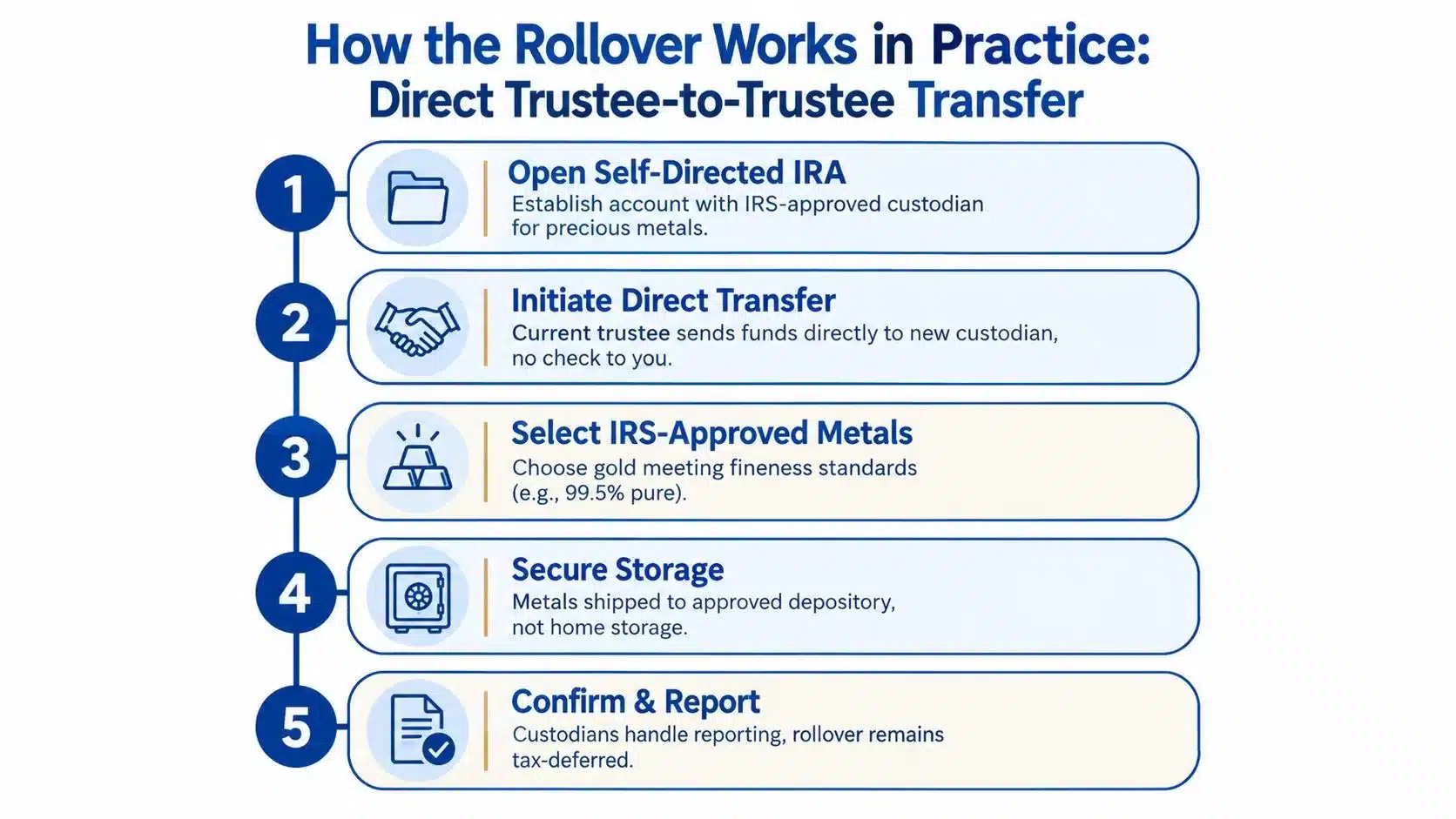

The five operational steps
Open the self-directed IRA. Choose a custodian that administers precious-metals IRAs, then complete the application, beneficiary designation, identity details, and account agreements.
Submit transfer instructions. The custodian's form typically asks for the sending plan or IRA name, account number, estimated amount, and whether the request covers a partial balance or the full eligible amount.
Let the institutions coordinate. The new custodian contacts the existing trustee or plan administrator. Funds move between institutions, rather than through the account holder's personal bank account. Processing time depends on the sending plan's paperwork, review procedures, and transfer method.
Authorize the metal purchase. After the new IRA receives cleared funds, the account holder selects qualifying products from the custodian's available list. The custodian executes the purchase for the IRA.
Confirm depository storage. The metals go to an approved depository. They don't go to the account holder's home, safe, or private storage facility.
Every stage should produce a confirmation, signed authorization, or account record. If the custodian can't explain who signs each form, where the funds go, and how the purchase is recorded, the process isn't ready to proceed.
The IRA rollover tax guide provides additional educational material on the paperwork and tax-sensitive parts of the transaction.

A direct transfer removes the personal custody problem, but it doesn't remove the need to review the account statements. The account holder should confirm the amount received, the date funded, the metal purchased, the price paid, and the depository destination.
Which Metals Qualify Inside the IRA
The IRS doesn't approve every item marketed as investment gold. Purity, product type, and custody determine whether a metal can remain inside the IRA.
Gold generally must meet at least 99.5% fineness, expressed as 0.9950, although the American Gold Eagle is a statutory exception and is permitted despite being 91.67% fine. The purity rule is summarized in this guide to IRA-approved gold. The key point is simple: physical gold isn't automatically IRA-eligible just because it contains gold.
Approved products and common exclusions
Typical approved lists may include qualifying sovereign bullion coins and bars from recognized refiners. Common examples include American Gold Eagles, American Gold Buffalos, Austrian Philharmonics, Canadian Maple Leafs, and qualifying bars meeting the applicable standard. A custodian should verify the exact product before purchase.
| Metal or Coin | Purity | Approved for IRA? |
|---|---|---|
| American Gold Eagle | 91.67% | Yes, statutory exception |
| Generic gold bullion | At least 99.5% | Generally, if all custody rules are met |
| Silver bullion | At least 99.9% | Generally, if all custody rules are met |
| Platinum bullion | At least 99.95% | Generally, if all custody rules are met |
| Palladium bullion | At least 99.95% | Generally, if all custody rules are met |
| Collectible or numismatic pieces | Varies | Generally no |
| Non-qualifying pre-1933 coins | Varies | Generally no |
A 90% silver coin can fail even though it is made of silver. A graded pre-1933 gold coin can fail even though its collector value is substantial. The IRS filter focuses on statutory eligibility and fineness, not the story, rarity, grade, or design appeal of the piece.
The technical gold standard and the American Gold Eagle exception are also described in this precious-metals IRA research guide. A custodian's approved-product list should be treated as a starting point, not a substitute for checking the exact item and documentation.
The cost of holding physical metal
Three fee categories drive the economics:
- Custodian administration: A flat-fee structure may charge $50 to $150 annually, while larger balances may use an asset-based structure. The range is provided in the IRS rollover and retirement-plan guidance context, but actual charges vary by provider and agreement.
- Depository storage: Storage may cost $100 to $300 per year for segregated or non-segregated arrangements. The choice affects how the metal is recorded and stored, not whether the account holder can take it home.
- Transaction costs: Dealer markups may run roughly 1% to 5% over spot when buying, with a similar range potentially applying when selling, plus wire or shipping charges. These costs should be confirmed in writing rather than inferred from a promotional quote.
For a $50,000 rollover held for ten years, the first-year cost includes the purchase spread, custodian administration, storage, and any stated setup or transaction charges. Ongoing years still carry administration and storage costs, while a later sale can create another spread and transaction expense. Because the exact fee schedule varies, no single total is honest without a provider's written quote.
Tax deferral is the principal structural advantage. Fee drag, lower liquidity than a conventional fund, and the absence of income payments are the trade-offs. Gold should have a defined role in the retirement plan, not an automatic claim on the entire balance.
Mistakes That Can Derail a Gold IRA Rollover
Most rollover failures come from process errors, not complicated investment theory.
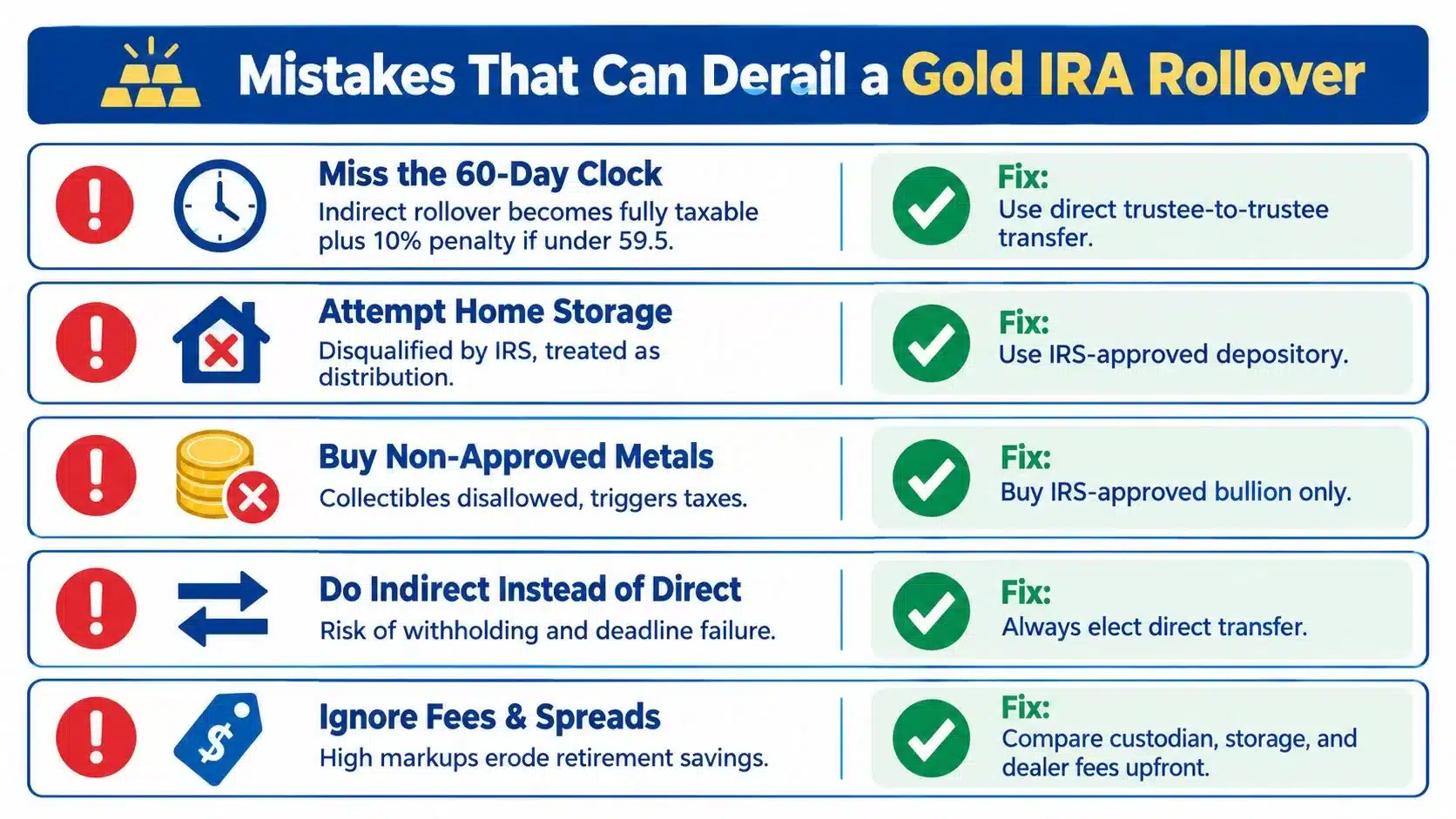
The avoidable errors
- Missing the 60-day deadline: An indirect rollover that isn't redeposited on time generally becomes taxable. For someone under 59½, an additional 10% early-distribution penalty may apply, subject to the applicable exceptions and individual facts.
- Taking possession at home: IRA metals must remain with a bank or IRS-approved nonbank trustee. Personal storage can create distribution and prohibited-transaction problems.
- Buying disallowed collectibles: A numismatic coin may have an attractive design or history but still fail the collectible rules. The custodian should approve the exact product before the order is placed.
- Using a second indirect rollover: The one-rollover rule applies across the taxpayer's IRAs, not separately to each account. The 12-month period is measured on a rolling basis from the date the prior distribution was received, as explained in this one-rollover rule reference.
- Skipping the custodian check: A sending plan may reject paperwork if the receiving custodian's details are incomplete or if the new account doesn't accept that type of incoming transaction.
- Ignoring the fee spread: A low-looking annual administration charge doesn't reveal the dealer markup, storage cost, selling spread, or shipping expenses.
A written allocation thesis matters too. Moving too much of a retirement portfolio into one physical asset can reduce flexibility and increase concentration risk. A commonly discussed allocation range is 10% to 20%, but the appropriate amount depends on objectives, time horizon, income needs, risk tolerance, and the rest of the portfolio. A fiduciary or licensed financial professional should review that decision.
Before signing, the pre-flight check is short: confirm direct transfer status, custodian acceptance, approved storage, product eligibility, complete fees, beneficiary records, and the plan for future liquidity.
Common Questions Pre-Retirees Ask
How long does an IRA rollover to gold take?
The timeline is driven primarily by paperwork review and the sending plan or current custodian. A direct transfer can move efficiently once both institutions have complete instructions, but no provider can guarantee an exact completion date. The account holder should ask which party currently has the file, whether any form is missing, and when the new IRA will show cleared funds.
Can an account holder take an RMD from a gold IRA?
Yes, but the distribution must be handled through the custodian. The account holder may request a cash distribution after selling enough metal, or ask whether an in-kind distribution is available and how it will be valued and reported. IRA-owned gold doesn't independently satisfy an RMD merely because it is held in the account.
Anyone approaching an RMD should coordinate with a CPA or qualified tax professional before choosing a sale or in-kind distribution. The tax result depends on the account type, distribution amount, age, and personal circumstances.
Is a partial rollover allowed?
A partial rollover may be possible, especially when the plan permits a partial distribution or the account holder is moving only part of an eligible IRA balance. The receiving custodian and existing plan administrator must confirm the permitted amount and transaction type before forms are filed.
Partial funding can preserve flexibility, but it also creates two account relationships to monitor. The decision should reflect the intended allocation to physical metal, expected liquidity needs, and the cost of maintaining each account.
How liquid is IRA-held gold?
The metal can generally be sold through a custodian-managed transaction, but the account holder doesn't receive cash just by taking the coins from storage. The custodian coordinates the sale, records the proceeds, and processes any distribution request under the applicable retirement-account rules.
The sale price can differ from the purchase price because dealer spreads and transaction costs apply. Anyone expecting a near-term cash need should compare the sale process, settlement timing, and fee schedule before funding the account.
The governing choice remains the same throughout the process: select a direct trustee-to-trustee transfer first, then verify the custodian, depository, qualifying products, and complete fee math. A practical next step is to request written fee disclosures from two approved custodians before opening a self-directed account.
This is not financial advice. Consult a licensed financial advisor, CPA, or tax professional before making investment decisions.
Gold IRA Association offers educational guides on rollover procedures, IRA-approved metals, tax-sensitive paperwork, fees, and provider comparisons. Visit Gold IRA Association to review the rollover resources and use the information to prepare focused questions for custodians and tax professionals.


