




Does a properly completed rollover also mean gold was a sensible purchase at the price paid? A physical gold IRA rollover involves separate decisions: moving eligible retirement funds under IRS rules, then choosing how much metal to buy, at what price, and under whose custody. Understanding that distinction helps retirees avoid confusing a compliant account transfer with a sound investment decision.
Comparing Direct and 60-Day Rollovers for Physical Gold
A rollover moves retirement assets into another eligible retirement account. It doesn't automatically purchase gold. For physical metals, the receiving account must support the investment, and the custodian must coordinate the purchase and approved custody arrangement.
The terminology matters. A direct rollover generally describes money moving from an employer plan to an IRA without being paid to the participant. A trustee-to-trustee transfer moves assets between IRAs without the owner receiving a distribution. Providers sometimes call both a gold IRA rollover, but the paperwork should identify the actual transaction.
Direct Rollover vs 60-Day Rollover for Physical Gold
The IRS rollover guide establishes the 60-day deadline, the 20% mandatory withholding generally applicable to employer-plan distributions paid to participants, and the one-per-12-month limit for IRA-to-IRA rollovers summarized below.
| Route | Who receives the money | Deadline | Federal withholding | Counts toward the one-per-12-month IRA limit | Best suited to |
|---|---|---|---|---|---|
| Direct rollover from an employer plan | Receiving custodian, not the investor personally | No participant-level redeposit deadline | Generally none | No | Eligible employer-plan money moving into a self-directed gold IRA |
| 60-day rollover | Investor receives a check or deposit | 60 days from receipt | Generally 20% on employer-plan distributions paid to the participant | Yes for IRA-to-IRA rollovers, not employer-plan-to-IRA rollovers | An investor prepared to manage the deadline and replace withholding |
| Trustee-to-trustee transfer between IRAs | Receiving custodian | No participant-level redeposit deadline | None | No | An existing IRA moving to a custodian that accepts precious metals |
| In-service 401(k) direct rollover | Receiving custodian | No participant-level redeposit deadline | Generally none | No | Current employees whose plans permit an eligible in-service distribution |
The practical default is direct execution. Keeping the distribution out of the investor's personal account removes avoidable deadline and withholding complications. It doesn't eliminate eligibility requirements, processing delays, or investment risk.
Practical rule: The payee on a distribution check matters more than who opens the envelope. A check payable to the receiving custodian for the investor's benefit isn't the same as a check payable personally to the investor.
Missing the redeposit window generally makes a distribution taxable, although limited IRS relief may apply when events beyond the investor's control prevent completion. The IRA rollover restriction applies across the owner's IRAs, not separately to each account.
If an administrator proposes payment to the participant, the investor should first ask whether a direct rollover is available and why it isn't being used. Administrative inconvenience shouldn't automatically become a personal tax deadline.
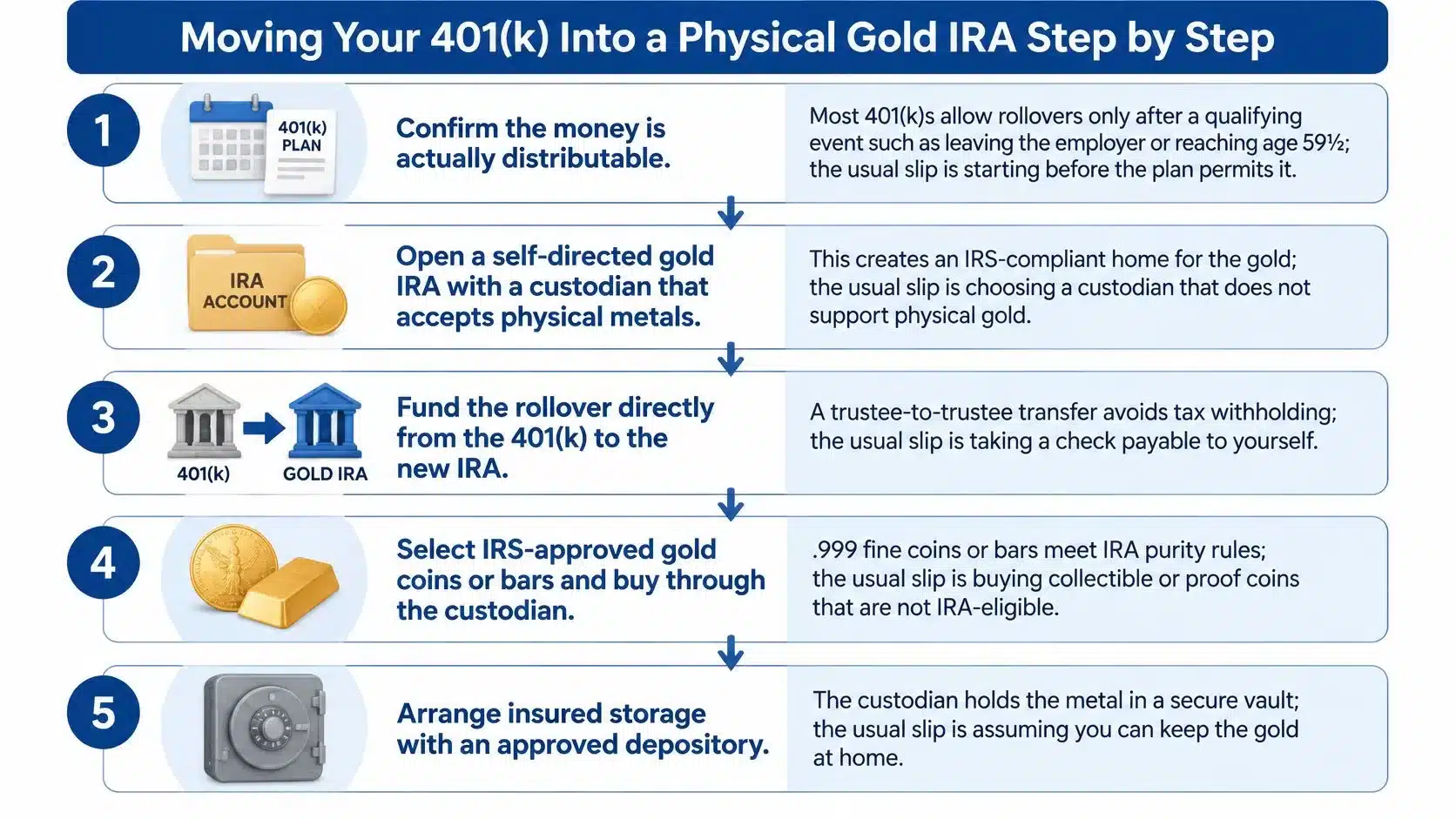
Moving Your 401(k) Into a Physical Gold IRA Step by Step
The transfer should follow a documented sequence, not a dealer's purchase deadline. The IRS guidance in Publication 590-A explains rollover treatment, distinguishes direct transfers from owner-received distributions, and confirms that a rollover can remain reportable even when no current tax is due.
The following visual summarizes the broad workflow; the detailed checklist separates account opening, funding, purchasing, and recordkeeping.

Complete the Account and Transfer Paperwork
Confirm that the money is distributable. The plan administrator should provide written confirmation that the proposed distribution is permitted, including any conditions for a current employee. Starting an application doesn't establish eligibility, and an IRA transfer shouldn't be confused with an employer plan's distribution rules.
Select a custodian that accepts physical precious metals. A custodian is the institution administering the IRA, while a depository is the facility holding the metal. The investor should identify both organizations and confirm their respective responsibilities before opening the account.
Open the receiving self-directed IRA. Complete the application, identification requirements, and beneficiary designation, making sure the account's tax treatment matches the intended transaction. Moving pretax retirement money and deliberately converting it to Roth treatment are different decisions, so unclear account labels require professional review before funding.
Submit the receiving custodian's transfer instructions. The paperwork should request a direct rollover from the employer plan, with the correct account number and payee wording. A check made payable personally to the investor is a recurring mistake, even when the investor intends to forward it immediately.
Confirm receipt before authorizing a trade. The receiving custodian should acknowledge that the funds have arrived and are available inside the IRA. Ordering coins while the transfer is still pending can expose the investor to payment deadlines, cancellation charges, or an unwanted price commitment.
Purchase, Store, and Reconcile
Authorize only eligible bullion purchases. The investor selects the proposed investment, and the custodian executes or facilitates payment through the IRA's approved process. A dealer's description of a coin as retirement suitable isn't a substitute for written custodian acceptance of the exact product.
Verify the storage arrangement. Obtain confirmation of the depository, the account's ownership records, the insurance arrangement, and whether holdings are allocated, segregated, or pooled. Personal delivery isn't a substitute for compliant custody, and a storage invoice alone doesn't explain which metal belongs to the account.
Collect and reconcile the paper trail. Retain the distribution request, receiving-account statement, trade confirmation, storage confirmation, and applicable tax documents, including Form 1099-R and Form 5498. The investor's tax preparer should reconcile the distribution coding and receiving-account reporting rather than assuming that a completed transfer needs no further attention.
The accompanying video provides another explanation of the rollover process.

Funding the account doesn't require an immediate purchase. An investor can complete the administrative work while still comparing eligible products, reviewing spreads, and deciding on a purchase schedule.
IRS Rules for the Gold Your IRA Is Allowed to Hold
Eligible IRA metals must pass a product test and a custody test. A qualifying coin held personally can create a custody problem, while an ineligible collectible doesn't become acceptable merely because a depository stores it.
The IRS guidance on collectibles in individually directed retirement accounts explains the exception for certain coins and qualifying gold, silver, platinum, and palladium bullion, with physical possession held by a bank or IRS-approved nonbank trustee. That exception, rather than the broad label precious metal, determines eligibility.
Minimum Fineness and Eligible Products for IRA Metals
The product families below are a screening aid, not a blanket approval of every version sold under a familiar name. The controlling standard is the applicable statutory coin exception or bullion fineness requirement, together with acceptable custody.
| Metal or product | Minimum fineness | Common eligible examples | Watch out for |
|---|---|---|---|
| Gold coins | Applicable bullion standard or statutory coin exception | American Gold Eagle, Canadian Gold Maple Leaf, Austrian Gold Philharmonic | The exact issue and version require confirmation |
| Gold bars | Applicable gold bullion fineness standard | Qualifying bars from recognized refiners | Refiner hallmark, documentation, and custodian acceptance |
| Silver coins | Applicable bullion standard or statutory coin exception | American Silver Eagle, Canadian Silver Maple Leaf, Austrian Silver Philharmonic | Collectible descriptions don't establish eligibility |
| Silver bars | Applicable silver bullion fineness standard | Qualifying refiner-hallmarked bars | Confirm treatment of rounds and unusual formats |
| Platinum | Applicable platinum bullion fineness standard | Qualifying Platinum Maple Leaf, Philharmonic products, and bars | Verify the specific product before ordering |
| Palladium | Applicable palladium bullion fineness standard | Qualifying Palladium Maple Leaf products and bars | Confirm availability, eligibility, and resale terms |
| Not IRA-eligible | No qualifying exception | Jewelry and nonqualifying collectible coins | Personally stored metal also fails the required custody structure |
Why Purity Alone Doesn't Settle Eligibility
A familiar product name isn't enough. The American Gold Eagle has a statutory exception, so applying a generic bullion purity rule to every gold coin would produce the wrong conclusion. Conversely, a highly refined object may still require scrutiny of its form, manufacturer, and custody.
Proof coins aren't universally prohibited, either. Certain qualifying coins may be acceptable, while grading, rarity, or a proof finish doesn't independently establish eligibility. Dealer premiums for those features also deserve separate investment scrutiny.
The explanation of IRA-approved gold helps distinguish product eligibility from marketing terminology. Before payment, the custodian should confirm acceptance of the exact coin or bar in writing, including any refiner and documentation requirements.
Custody checkpoint: A home safe or personal safe-deposit box isn't interchangeable with the required institutional custody arrangement.
Buying personally owned metal into the IRA, or arranging a transaction with a related party, also warrants tax-professional review. An acceptable product doesn't make an otherwise prohibited transaction permissible.
Tax Pitfalls That Turn a Rollover Into a Tax Bill
The withholding gap can surprise an investor who believes forwarding the received check completes the rollover. Under the IRS Publication 590-A draft's withholding explanation, a $100,000 employer-plan distribution paid to the participant may have $20,000 withheld, leaving $80,000 received, while a full rollover requires depositing $100,000 within 60 days.
The investor must therefore supply the withheld amount from other funds to complete the full rollover. Withholding is a tax payment, not proof that the entire distribution was successfully rolled over, and the draft document should be checked against the final applicable guidance before filing.
Rollover Pitfalls, Triggers and What They Cost
| Pitfall | How it happens | Consequence | Fix |
|---|---|---|---|
| Missed redeposit deadline | Money remains outside an eligible retirement account too long | Distribution generally becomes taxable; additional tax may apply | Prefer direct execution and obtain professional help promptly if a deadline is missed |
| Withholding shortfall | Investor deposits only the amount received | Unreplaced withholding can remain a taxable distribution | Replace the withheld amount from other funds or avoid participant payment |
| Repeated owner-received IRA rollovers | Investor treats separate IRAs as having separate rollover allowances | A later rollover may be ineligible and taxable | Use trustee-to-trustee transfers |
| Bullion stored at home or delivered personally | Investor takes possession outside the required custody structure | Distribution treatment and possible additional tax | Keep assets within the compliant custody arrangement |
| Prohibited transaction | Self-dealing, a transaction with a disqualified person, or inappropriate collateral use | Consequences can extend beyond an ordinary investment loss | Obtain tax review before any related-party or borrowing arrangement |
| Required distribution without an execution plan | Investor waits until the deadline to arrange a sale or delivery | A distribution shortfall can create excise-tax exposure | Plan cash needs, valuations, and processing time in advance |
Distribution Planning Requires More Than a Gold Valuation
A required minimum distribution doesn't necessarily require selling the metal. An in-kind distribution may be possible, with the distributed property's value used for tax reporting, but the custodian must support the process and the investor must understand the consequences of taking ownership outside the IRA.
That distinction matters for retirees who want to retain their coins. Shipping, valuation, administrative processing, and the availability of cash to pay taxes still require planning.
The guide to IRA rollover taxes provides additional context for evaluating transfer-related tax exposure. A tax professional should also determine whether an early-distribution exception applies and check current additional-tax rules, required-distribution requirements, and correction procedures.
Direct execution isn't a promise of tax-free treatment in every circumstance. Account type, distribution eligibility, prohibited transactions, and reporting can change the result. Keeping the transaction documents together makes it easier for the preparer to distinguish a rollover from a taxable withdrawal or conversion.
Costs, Allocation and Timing Before You Buy
A low account-opening charge doesn't establish that a gold IRA is inexpensive. The investor needs the entire fee schedule and a realistic estimate of what buying, holding, and eventually selling will cost.
Price the Account and the Trade Separately
- Setup and administration: Identify opening charges, annual custodial fees, and charges for additional services.
- Storage and insurance: Determine whether billing uses a flat charge, account value, metal weight, or another method, and whether insurance is included.
- Purchase and resale pricing: Obtain the purchase premium and an executable buyback quote for the same product, not just a headline spot price.
- Moving or closing the account: Check wire, shipping, transfer, liquidation, and termination charges.
The explanation of IRA rollover fees can help organize those costs. For a useful comparison, divide expected recurring expenses by the proposed account balance, then assess trading costs separately. A fixed annual charge consumes a larger share of a smaller account.
A Compliant Transfer Can Still Precede a Poorly Timed Purchase
According to Reuters' report on World Gold Council figures, global gold demand exceeded 5,000 metric tons in 2025, prices reached 53 all-time highs, and investment demand reached 2,175 tons, up 84% year over year; central-bank purchases were 863 tons, below the 1,000-ton-plus pace of the prior three years.
The World Gold Council's full-year report states that the average annual LBMA gold price reached $3,431 per ounce in 2025, up 44% from 2024. Strong past demand doesn't establish the next purchase's return.
The account-transfer date and the metal-purchase date don't have to be the same decision.
A written allocation plan should specify the intended share of retirement assets, a purchase schedule, a rebalancing rule, and a response to an immediate price decline. Staging purchases can reduce dependence on a single entry date, but it doesn't guarantee a lower average cost or prevent losses.
For retirees comparing spending needs with a proposed metals allocation, Mega Income Stream's discussion of withdrawal planning for a 30-year retirement provides broader planning context, not a personalized spending recommendation.
A gold ETF offers a different route to price exposure without arranging personal IRA bullion storage. It isn't ownership of specific allocated bars or coins, and the investor should compare liquidity, expenses, and the reason for wanting physical metal before choosing the account structure.
What to Verify About Custody and Getting Out
An account statement showing ounces doesn't, by itself, explain ownership, insurance, or the exit process. The investor needs written answers that connect the IRA's records to the actual storage and sale arrangements.
A Due-Diligence Script for the Custodian
- Ownership and identification: Who legally owns the bullion, how is the IRA's interest recorded, and are holdings allocated, segregated, or pooled?
- Depository and reconciliation: Where is the metal held, who audits inventories, and how are discrepancies resolved?
- Insurance limits: Which events are covered, what is excluded, and how would a claim be valued and paid?
- Sale pricing: How are bid prices set relative to spot, and what spread would apply to the proposed holdings?
- Settlement and transfers: How does a sell instruction become available cash, and can metal move to another custodian without personal delivery?
- Beneficiary handling: What documents must beneficiaries provide, and what options exist for selling, transferring, or receiving the assets?
The World Gold Council's central-bank analysis estimated that unreported buying represented 57% of official-sector purchases in 2025. That estimate concerns central banks, not private IRA vaults, but it illustrates why ownership figures need clear methodology and disclosure.
Market demand also isn't uniform. Strong investment interest shouldn't be treated as proof that every product will sell quickly or command its original premium.
Frequently Asked Questions About Custody
Does allocated mean segregated?
Not necessarily. Allocation identifies an ownership interest, while segregation concerns physical separation; the storage agreement should explain exactly what the investor receives on withdrawal or transfer.
Does insurance protect against a falling gold price?
Storage insurance shouldn't be confused with investment protection. The policy wording governs covered physical losses, exclusions, and valuation.
Does a buyback policy guarantee a favorable exit?
No. The investor needs the pricing formula, charges, and settlement conditions, not merely a promise that a dealer will consider repurchasing the metal.
The exit path should be documented plainly: sell instruction, accepted pricing, settlement to cash inside the IRA, then distribution or reinvestment.
Confirm the Details Before You Start the Rollover
A physical gold IRA rollover should begin with completed due diligence, not a reserved coin order. The investor's file should contain:
- Distribution eligibility: Written confirmation that the existing plan permits the proposed move.
- Account and custody details: A metals-accepting custodian, a named depository, and clear allocation and insurance terms.
- Complete pricing: The custodial fee schedule, storage charges, purchase premium, and resale terms.
- Product acceptance: Written approval of the specific coins or bars.
- Liquidity and allocation decisions: A cash buffer for expenses and distributions, plus a settled target allocation before trading.
For understanding how institutions document available funds, BankStatementWizard's guide to deposit verification provides useful background. Deposit verification isn't evidence that an IRA rollover is eligible or that a particular gold purchase complies with retirement-account rules.
The cleaner operational path is a direct rollover or trustee-to-trustee transfer into an appropriate self-directed IRA, followed by a custodian-facilitated purchase of eligible bullion under compliant institutional custody. That process addresses administration, not the possibility of losing principal.
This is not financial advice. Consult a licensed financial advisor, CPA, or tax professional before making investment decisions.
Gold IRA Association reviews gold IRA companies on credibility, customer service, fees, and investment options, helping readers compare providers before committing retirement funds. Visit Gold IRA Association to use its educational guides and provider comparisons as the next step in evaluating a physical gold IRA rollover. The site also publishes a free newsletter with news on hedging against U.S. inflation with a Gold IRA.


