




An IRA owner has selected gold coins, received a storage quote, and is ready to authorize the purchase. Then a practical question interrupts the process: can a relative supply the coins, can the owner pay the insurance bill, or can the metals stay in a home safe? Self directed IRA self dealing rules turn on who participates, who benefits, and how money and assets move, not whether the investment looks sensible.
Who Counts as a Disqualified Person
The rules target disqualified persons, not just the person whose name appears on the account. A transaction involving a covered relative or fiduciary can create a problem even when the owner never receives cash.
The IRS's Publication 590-A identifies IRA fiduciaries and specified family members as disqualified persons and explains prohibited uses involving these relationships. For a precious metals IRA, the practical screening list includes:
- The owner acting as a fiduciary. An owner directing investments generally can't arrange for the IRA to purchase bullion from the owner's personal collection.
- The IRA's fiduciary. A trustee or investment adviser acting in a fiduciary capacity must be screened for conflicts before participating in a metals transaction.
- The owner's spouse. A spouse selling personally owned gold to the IRA presents a prohibited related-party sale.
- Ancestors. Parents and grandparents belong on the list. A parent's company supplying coins requires scrutiny of the company's ownership and the benefit flowing to the parent.
- Lineal descendants. Children and grandchildren are covered. An IRA purchase from a child's owned and operated coin shop isn't made acceptable merely by using the shop's normal price.
- Spouses of lineal descendants. A son-in-law or daughter-in-law selling bullion to the account raises the same related-party concern.
Why the Family Connection Matters More Than the Price
Fair-market value doesn't cure a prohibited relationship. A dealer invoice, competitive quote, or favorable price can't by itself make an otherwise prohibited transaction acceptable.
Siblings aren't on the specified statutory family list. That doesn't make every transaction with a sibling's dealership safe: ownership arrangements, fiduciary roles, and indirect benefits still need review. The family list is a starting point, not a substitute for examining the complete arrangement.
An unrelated dealer conducting an arm's-length sale provides a cleaner starting point because there's no apparent family connection. Eligibility, custody, and payment arrangements still need separate confirmation.
Practical rule: Before a purchase, sale, or service agreement, record every counterparty, its owners, and its relationship to the IRA owner. A business name alone doesn't reveal a related-party conflict.
Prohibited and Permitted IRA Transactions at a Glance
A retirement account transaction can look ordinary while shifting money, access, or compensation to someone connected to the account. Use three categories to check each cost or task: paid by the IRA, paid personally by the owner, or prohibited. The table gives a starting point; the full arrangement still matters.
Prohibited and permitted IRA transactions with precious metals
| Transaction | Status | Example with precious metals | Why it matters |
|---|---|---|---|
| Selling personal property to the IRA | Prohibited | Transferring personally owned coins into the account for cash | A sale between the plan and a disqualified person |
| Buying property from the owner | Prohibited | The IRA purchases the owner's personal bullion | A sale or exchange with a disqualified person |
| Borrowing from the IRA | Prohibited | Taking a loan of IRA-held metals or cash | Lending between the plan and a disqualified person |
| Pledging IRA assets as loan collateral | Prohibited | Using IRA-held bullion to secure a personal loan | Pledging is a prohibited use |
| Personal use of IRA-owned assets | Prohibited | Using IRA-owned property for the owner's personal benefit | Personal benefit from plan assets raises self-dealing concerns |
| Taking physical possession of IRA metals | Requires review before acting | Taking IRA-owned bars into the owner's possession | Possession can produce distribution consequences |
| Compensated services by the owner | Prohibited self-dealing arrangement | Charging an IRA-owned entity a management fee | The owner receives personal compensation tied to a plan investment |
| Paying storage and custodial fees from the IRA | Generally permitted | Paying a depository's storage bill from the account | Account expenses may be paid from IRA assets when handled through documented procedures |
| Paying a personal expense from the IRA | Prohibited | Using IRA funds for an expense unrelated to account administration | IRA assets provide a personal benefit |
| Buying eligible metals from an unrelated dealer | Generally permitted, subject to review | The IRA buys eligible metals through an arm's-length dealer | Metal eligibility, account structure, payment, and custody arrangements all require review |
The IRS explanation of prohibited transactions under Internal Revenue Code §4975 covers sales, exchanges, leases, lending, and use of plan assets for a disqualified person's benefit. The key question is where value or benefit flows, not what an invoice calls a charge.
Separate Personal Transactions From Account Administration
Classify each proposed cost before it is paid. A legitimate account administration expense may be paid by the IRA through its established procedures. A personal expense belongs to the owner, and a payment or arrangement that gives the owner or another disqualified person a prohibited benefit should not proceed. Keep invoices, payment instructions, and written review together before authorizing a transaction.
A purchase from an unrelated dealer can be a reasonable starting point, but the dealer's relationship alone does not establish that the investment is suitable for an IRA. The metal, account structure, and custody arrangements need review. For borrowing arrangements, see the guide to self-directed IRA loan rules.
Taking IRA metals home can produce distribution consequences. Review any proposed possession arrangement before acting, and keep the reasoning and supporting documents in the transaction file.
For readers considering property-based retirement investing, retirement account insights from VerticalRent provide broader context on retirement-account structures for landlords.
Use the three-way lookup before each transaction: IRA-paid for documented account costs, owner-paid for personal expenses, or prohibited where the arrangement creates a disallowed benefit. If the category is unclear, pause and seek professional advice before the account acts.
Penalties for Self-Dealing and How They Add Up
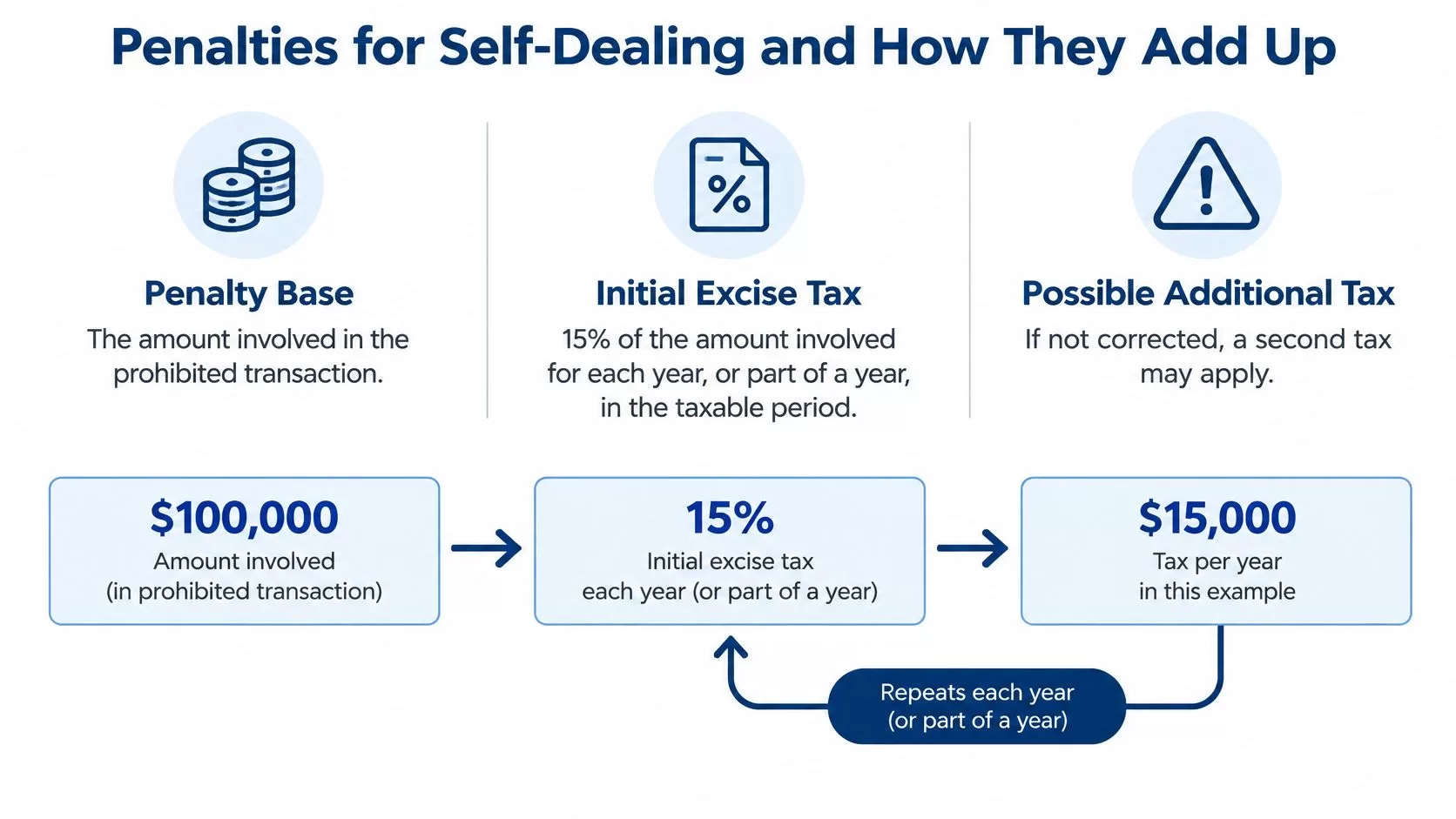
A $20,000 prohibited transaction can trigger an initial excise tax of $3,000 per year and, if it is not corrected, an additional $20,000 tax. These figures follow the rates in Internal Revenue Code §4975. The excise-tax calculation applies to participating disqualified persons, subject to statutory exceptions.
Excise tax on a $20,000 prohibited transaction. Rates and amounts are based on Internal Revenue Code §4975.
| Stage | Rate | Amount on $20,000 | Who typically owes it |
|---|---|---|---|
| Initial excise tax, each year in the taxable period | 15% of amount involved | $3,000 per year | Participating disqualified person, subject to applicable exceptions |
| Additional tax if the transaction isn't corrected | 100% of amount involved | $20,000 | Participating disqualified person, subject to applicable exceptions |
| Loss of IRA tax-favored status | Account treated as distributed | Full IRA balance treated as distributed, not merely the transaction amount | IRA owner bears applicable distribution consequences |
The diagram separates the transaction amount from the taxes calculated on it.

Why the Excise Taxes Aren't the Whole Calculation
The amount involved is the base for calculating the prohibited-transaction excise tax. It is not automatically the entire account balance, the investment's profit, or the amount of an invoice.
The initial tax applies for each year, or part of a year, in the taxable period. A participating disqualified person generally owes it, though the statute provides an exception for an IRA owner or beneficiary when the transaction causes the IRA to cease qualifying as an IRA.
The excise tax and the consequences of losing IRA status are separate issues. A qualified tax professional can assess which provisions apply before estimating the exposure.
What Correction Requires
Correction generally means undoing the transaction where possible and restoring the plan to a financial position no worse than it would have been under the highest fiduciary standards. Returning the original payment may not account for lost income or other harm.
Loss of IRA status can have consequences beyond the prohibited transaction itself. This discussion of potential tax liabilities from IRA distributions provides additional context on distribution exposure.
Before a proposed transaction, document the amount involved, who participated, the correction required, and which retirement assets may be affected. A repayment alone does not establish that the transaction has been fully corrected.
Gray Areas Around Storage, Insurance and Owner Labor
A storage invoice arrives before the IRA's payment instructions are clear. Should the IRA pay it, should the owner pay it without seeking reimbursement, or should the expense be avoided? Make that three-way decision before money or work changes hands. The IRS's Publication 590-B describes prohibited transactions as improper use of an IRA by its owner, beneficiary, or another disqualified person. Personal benefit can include access to assets, payment of a personal obligation, or compensation.
Who may pay or perform each precious metals task
| Expense or task | Category | Documentation needed |
|---|---|---|
| Depository storage fees | IRA-paid | Depository invoice billed to the IRA |
| Insurance on IRA-held metals | IRA-paid when the policy covers those metals | Policy and premium invoice identifying the IRA and covered holdings |
| Custodial and transaction fees | IRA-paid | Custodian statement |
| Owner reviewing statements or tracking prices | Owner-paid, no account charge | Owner's records showing no compensation |
| Owner advancing a personal payment and seeking reimbursement | Gray area, high risk | Written custodian review before paying, plus invoice and tax review when needed |
| Family member's company charging a handling fee | Prohibited related-party arrangement requiring avoidance or specialist review | Use an unrelated vendor instead |
| Owner taking a salary, fee, or other pay for work on IRA-owned assets | Prohibited self-dealing arrangement | No invoice can cure the conflict; avoid the arrangement |
Start With Expenses That Belong to the IRA
Storage fees belong in the IRA-paid category when they relate to identified IRA holdings and are charged to the account. The invoice, account title, service period, and payment record should match. Reviewing precious metals storage arrangements can help clarify the difference between professional custody and personal possession.
Insurance requires checking what the policy covers. The policy and premium invoice should identify the IRA's interest and the insured metals. A household policy does not, by itself, establish that IRA assets are properly covered.
Custodial and transaction fees are easier to trace when the account statement records the charge. A fee's label alone does not establish that the IRA may pay it.
Distinguish Oversight From Work for Compensation
The owner-paid category covers oversight with no compensation and no reimbursement. Reviewing statements, tracking prices, and asking the custodian questions fit that description. Operational work on IRA-owned assets can raise separate concerns, particularly if the owner seeks payment.
An owner who advances a storage payment and later requests reimbursement has put personal funds into an IRA expense. Settle payment instructions before paying; do not assume reimbursement will be harmless.
A relative's handling company raises a related-party concern. An owner's salary or fee creates a compensation concern. Useful work and a reasonable price do not remove the conflict.
Documentation checkpoint: Before acting, keep the written review, invoice, and payment instructions together. Record whether the cost is IRA-paid, owner-paid without reimbursement, or prohibited, and make that assessment before the transaction.
Real-World Self-Dealing Examples With Precious Metals
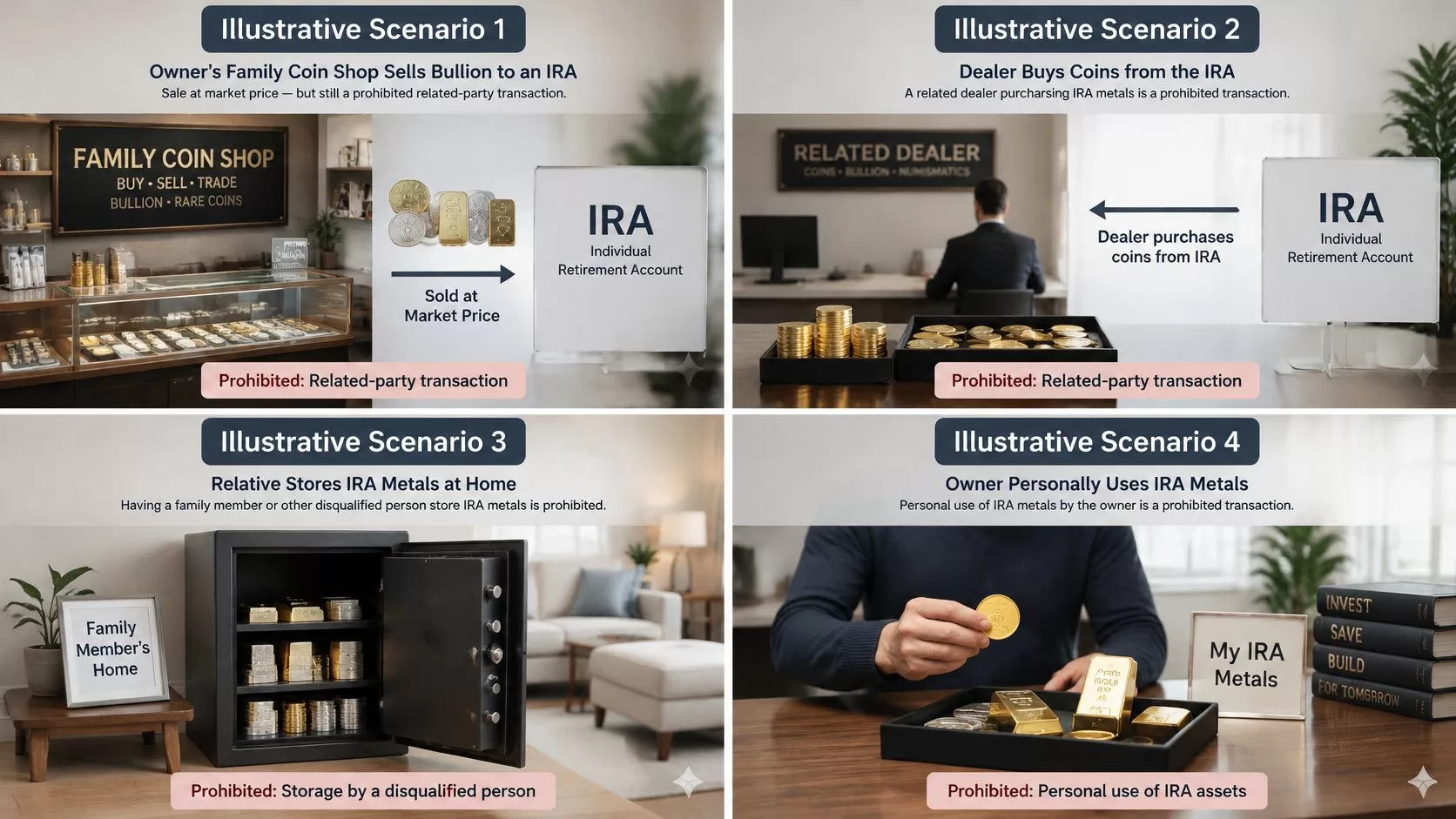
A transaction can appear routine on the paperwork yet create a personal benefit for the IRA owner or someone connected to them. These illustrative scenarios show how to examine the purpose of a transaction, who benefits, and what should be resolved before it proceeds.
A Family Coin Shop Offers a Competitive Price
An IRA owner compares dealers and finds that their child's coin shop offers bullion at the prevailing market price. The concern is whether the price is fair. The transaction directs business revenue to a family member, so the owner should not treat a competitive quote as resolving the conflict.
Before any purchase order is submitted, document the seller's relationship to the owner and have the proposed transaction reviewed. A custodian's processing of the order does not settle whether the arrangement is permitted.
A Shipping Delay Prompts a Change of Destination
A delivery is delayed, and the owner asks the seller to send the IRA's coins to a home address temporarily. That change can put the metals under the owner's personal control rather than within the account's custody arrangements.
Keep the destination aligned with the account's approved custody process. Personal possession may result in distribution treatment, taxes, and loss of the account's intended protection. Returning the coins later should not be assumed to undo the consequences.

An IRA-Funded LLC Pays Its Owner
An IRA invests through an LLC, and the owner proposes drawing a salary for managing its operations. The salary would give the owner a direct personal benefit. Using an LLC does not by itself remove the arrangement from self-dealing rules.
Have the management and compensation terms reviewed before funding the entity. Keep the written review with the proposed agreement, so the decision is documented before the transaction takes place.
Bullion Secures a Personal Business Loan
The owner's business needs financing, and a lender asks for IRA-held bullion as collateral. The owner may receive a personal benefit from the pledge even if the metals remain in storage and no sale occurs.
The IRS's IRA guidance on prohibited transactions identifies pledging IRA property as loan security, borrowing from an IRA, selling property to it, and buying property for personal use as examples of prohibited transactions. Keep IRA assets out of personal financing documents, and seek review of any collateral terms before signing.
Build an Audit Trail and Confirm Each Transaction Before You Act
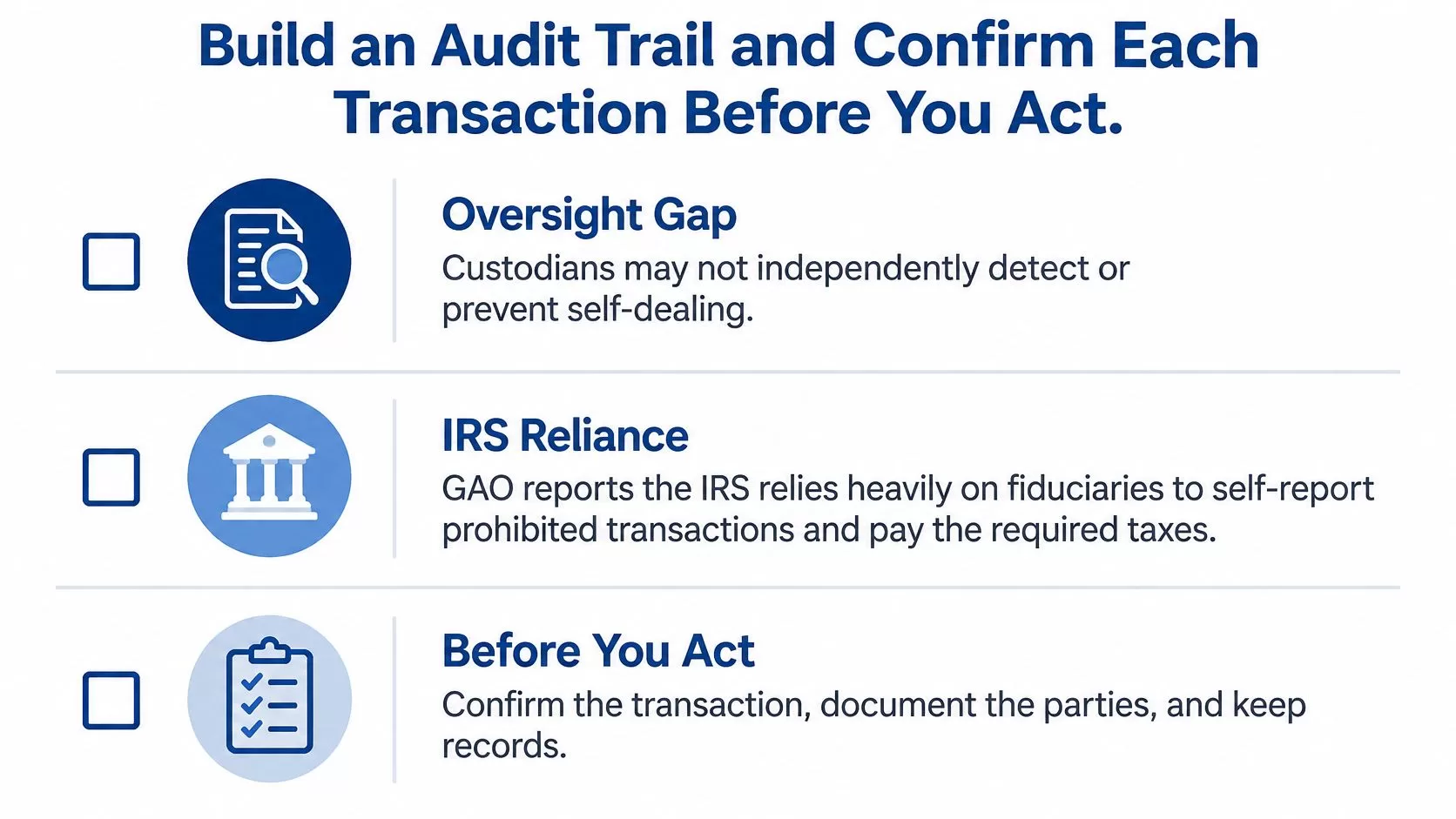
A professionally administered account doesn't transfer the owner's compliance responsibility to the custodian. Custodians may not independently identify or prevent self-dealing, so processing a payment shouldn't be mistaken for a legal opinion.
The Government Accountability Office's report highlights explain that the IRS relies heavily on IRA fiduciaries to self-report prohibited transactions and pay applicable excise taxes. They also describe the account-disqualification risk, including treatment of assets as distributed at fair market value on the first day of the year of a violation.
The checklist emphasizes preparation before money or metals move.
A Pre-Transaction Review Routine
- Identify the parties. Record the seller, purchaser, service provider, business owners, and relationships to the account owner.
- Confirm eligibility and custody. Obtain confirmation that the metals qualify and that the custodian and depository arrangements meet applicable requirements. A depository and a custodian perform different roles.
- Trace personal benefits. Identify compensation, personal use, collateral support, and expenses that would otherwise belong to the owner or family.
- Support the valuation. Obtain an independent valuation or appropriate market-price evidence for the asset being bought or sold.
- Secure written review. Get written custodian confirmation for new vendors and proposed reimbursements before payment. Obtain tax or legal advice where the arrangement raises unresolved questions.
- Preserve payment evidence. Keep invoices, account statements, payment instructions, and confirmations showing which account paid each charge.
Keep Evidence in Transaction Order
Create a folder for each transaction containing the initial proposal, relationship disclosure, valuation, review correspondence, invoice, and final settlement. Dates should demonstrate that review preceded authorization, rather than documenting a justification assembled afterward.
Bookkeeping and Accounting of Florida Inc.’s explanation of how bookkeepers help during IRS audits offers useful context for organizing supporting records. The tax compliance requirements guide provides additional account-focused preparation.
Have a qualified tax professional review the records annually. If a relationship, payment route, or custody instruction remains unclear, pause the transaction.
This article is educational and isn't legal or tax advice. This is not financial advice. Consult a licensed financial advisor, CPA, or tax professional before making investment decisions. Investing in precious metals and IRAs involves risk, including the potential loss of principal; advice specific to an individual situation belongs with a qualified professional.
Gold IRA Association offers educational guides and provider comparisons that help readers understand account rules, custody, and fees before authorizing a precious metals transaction. Visit Gold IRA Association to send a direct message for help finding relevant educational information, or talk to a Gold IRA specialist at 888-910-8386.


