




A retiree can do everything right on a Roth IRA, then miss the timing by one year because the IRS is not counting the calendar date the way many expect. That is why the five year rule keeps confusing even careful savers, especially when a contribution, a conversion, and an inheritance all use different clocks.
A 62-year-old who converted money last January and now wants to pull out principal this month may think age solves the problem. It doesn't. The answer depends on which five-year clock applies, what kind of money is being taken out, and whether the withdrawal is from contributions, conversions, or earnings.
Why the Five Year Rule Is Really Three Different Rules
The phrase five year rule sounds like one IRS test, but it covers three separate clocks. One clock follows Roth contributions, one follows Roth conversions, and one follows inherited IRA distributions. Each starts on a different date, and each produces a different result.
The first question is always who owns the clock
For a contributor, the key date is the first Roth contribution year. For a converter, the key date is the year of conversion. For a beneficiary, the key date is the year the original owner died. Those are not interchangeable.
A simple way to keep the clocks straight is to ask one question before anything else. Am I the saver, the converter, or the beneficiary? That answer usually tells the reader which IRS timeline matters. For a plain-English walk-through of another timing concept, an accelerated depreciation method works in a similar way, because the starting date changes the outcome.
Practical rule: If the money moved for a different reason, the clock may be different too.
A 62-year-old who converted money last January is not looking at the same test as a 40-year-old making a first Roth contribution this year. The contribution clock helps determine when earnings can come out tax- and penalty-free. The conversion clock helps determine whether a recent conversion can come out without the 10% early-withdrawal penalty. The inherited clock sets a deadline for emptying an account after death.
That separation matters because many articles blur all three together. The IRS does not. The reader who keeps the clocks apart usually avoids the most expensive mistake, which is pulling the wrong dollars at the wrong time. A worked example is coming next, so the date math is easy to follow on paper.
The Roth IRA Contribution Five Year Clock
The contribution clock is the easiest one to write down, but it still trips people up because of the IRS backdating rule. The clock begins on January 1 of the tax year of the first Roth contribution, not on the day the money lands in the account. A contribution made anytime during that year gets treated as if it started on January 1.
A notepad example makes the backdating clear
Say a saver makes a first Roth contribution on April 15, 2024. The IRS treats that as starting on January 1, 2024, so the five-year period ends on January 1, 2029. A December contribution would start on the same January 1 date, which is why late-year funding can still count toward the full waiting period.
That clock matters for earnings, not original contributions. Original contributions can generally come back out first under Roth withdrawal ordering rules, while earnings are the part that may trigger tax friction if the distribution is not qualified. The IRS says a Roth qualified distribution generally requires at least 5 years after the first Roth contribution plus age 59½ or another qualifying event. IRS Roth account guidance
A contribution can be available to withdraw before the earnings are, because the IRS treats those layers differently.
Now take a 40-year-old who opens a Roth IRA in March 2024 and withdraws $3,000 of earnings in 2028. The five-year contribution clock would still be running until January 1, 2029, so that earnings withdrawal is not yet past the waiting period. If the withdrawal is not qualified, the earnings portion can be taxed, and the under-59½ penalty can still apply. The IRS rule is about whether earnings are qualified, not whether the account has been open for a few tax seasons.
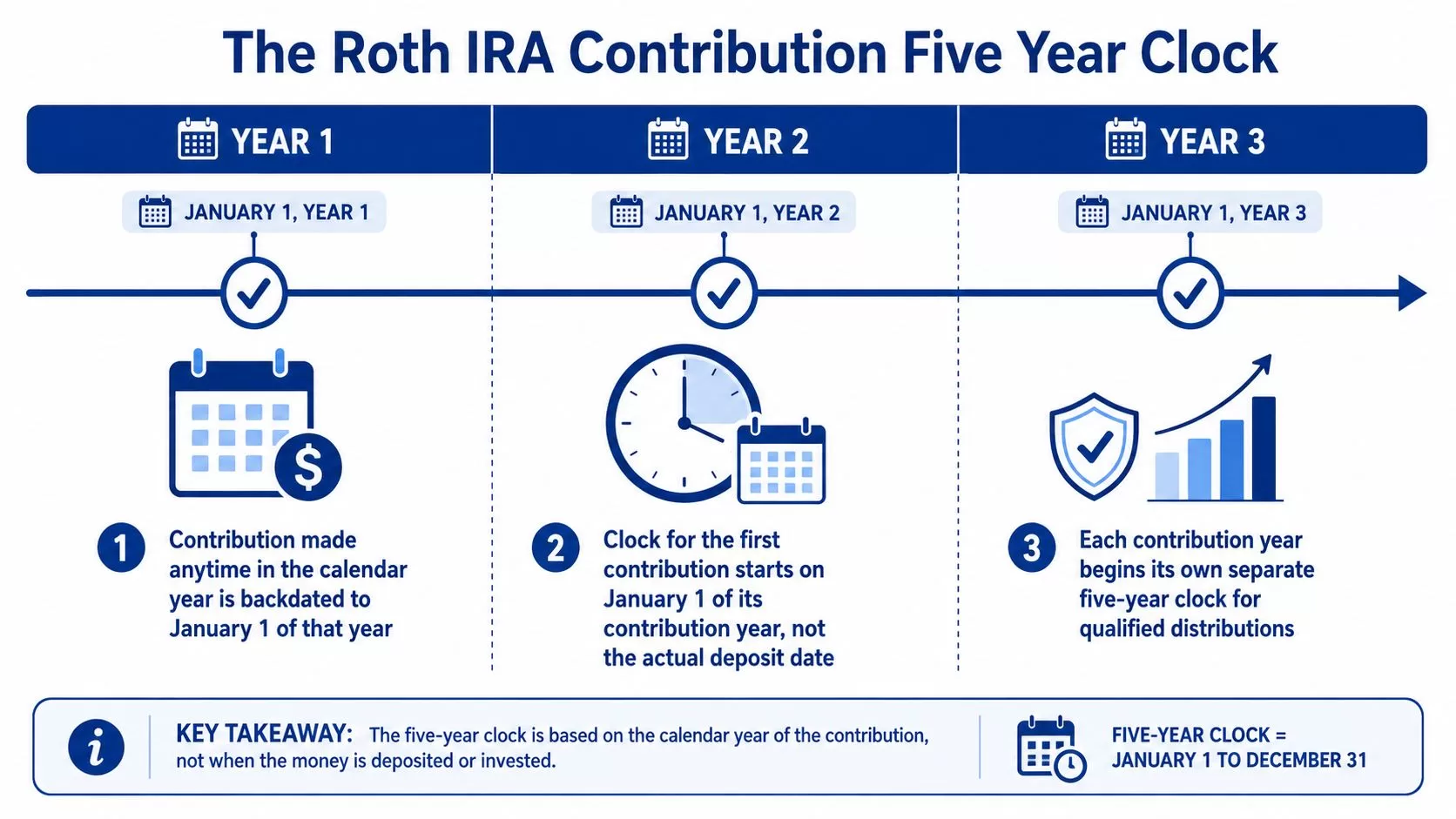

A Roth contribution made early in the year can be useful because the clock starts earlier on paper than many people expect. That backdating rule is one reason careful savers often mark the tax year, not the deposit date, on their notes.

For readers who want to compare Roth structure basics with rollover mechanics, the page on a Roth Gold IRA helps show how Roth timing rules sit inside a broader retirement-account setup.
The Roth Conversion Five Year Clock
The conversion clock is separate from the contribution clock, and age alone does not erase it. Each Roth conversion gets its own 5-year waiting period that starts on January 1 of the conversion year. That means one conversion can age out while a later conversion is still trapped inside its own clock.
A conversion example shows why age is not enough
Take a 61-year-old who converts $80,000 from a traditional IRA to a Roth IRA on February 14, 2023. The IRS treats that conversion as starting on January 1, 2023, so the five-year period runs until January 1, 2028. If she withdraws $20,000 of that converted amount on November 1, 2024, the conversion clock has not cleared yet.
Even though she is over 59½, that recent conversion can still be hit with the 10% early-withdrawal penalty on the taxable conversion amount. The key point is that age helps with one part of the Roth distribution test, but it doesn't wipe out the separate conversion clock. Roth conversion timing overview
A simple way to track it is to label each conversion by year.
- 2023 conversion: its own clock ends on January 1, 2028.
- 2024 conversion: a separate clock starts on January 1, 2024.
- 2025 conversion: another separate clock starts on January 1, 2025.
The IRS ordering rules also matter here because converted dollars come out before earnings. That means a withdrawal can be treated very differently depending on whether the account still holds contributions, conversion money, or earnings. For a tax-focused overview of account movement, the IRA rollover taxes page is a useful companion.
Bottom line: a recent conversion can still carry penalty exposure even after 59½, because the conversion clock is tied to the conversion year, not the birthday.
A retiree who treats every conversion as one shared timer can make the wrong withdrawal choice. The safer habit is to write each conversion year on a calendar and track its separate five-year anniversary before touching the money.
The Inherited IRA Five Year Clock
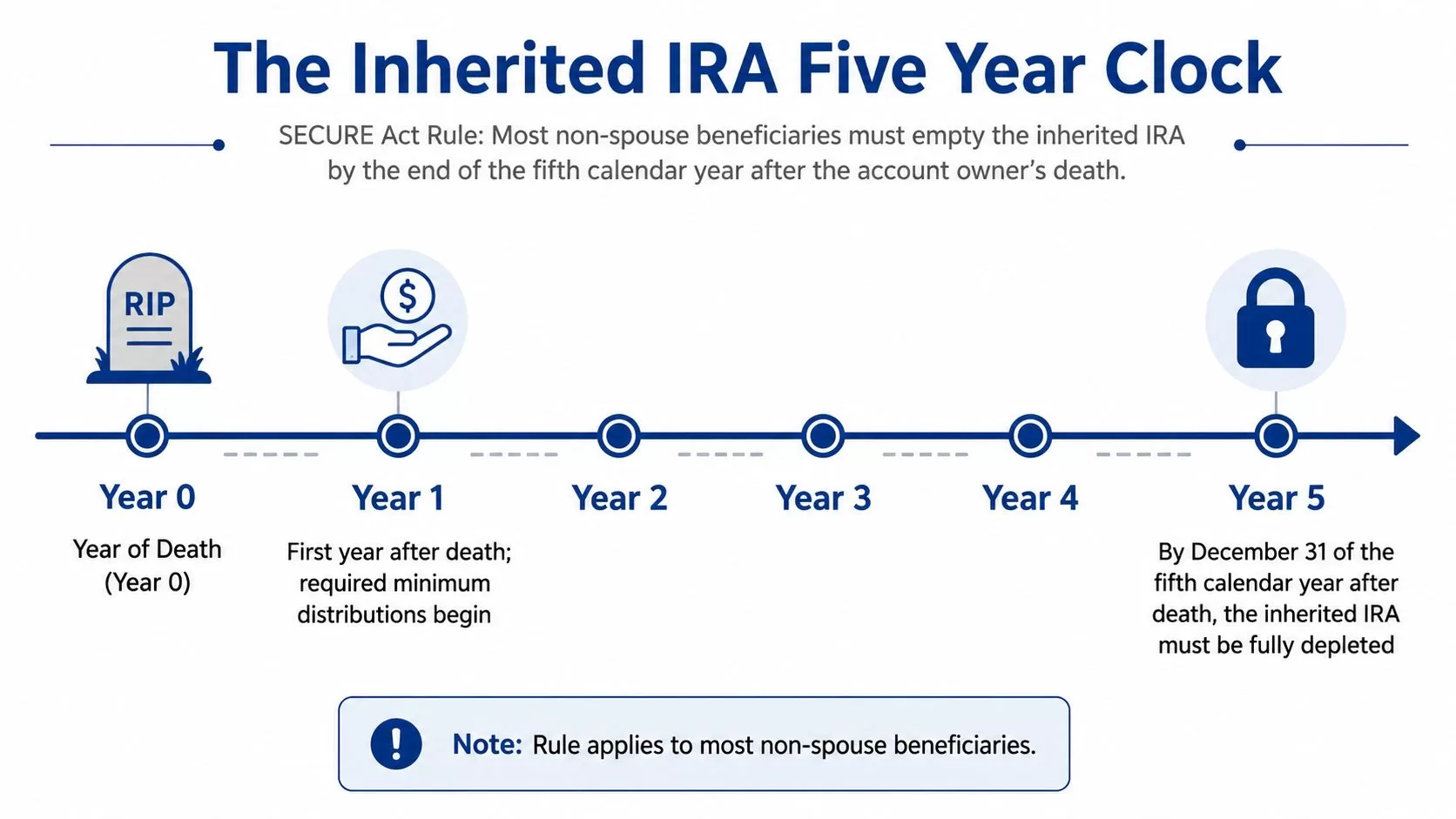
Inherited IRAs use a different calendar altogether. For beneficiaries who are not taking life-expectancy payments, the IRS says the account must be fully distributed by December 31 of the fifth year after the year of death, and no annual withdrawals are required before that deadline. The year of death is the starting point, but the full balance must be gone by the end of year five. IRS publication on inherited IRA distributions
The deadline is calendar-based, not balance-based
If the original owner dies in June 2024, year one is 2024, and the final deadline is December 31, 2029. The beneficiary can leave the money untouched during the window if the rule allows it, but the balance still has to be emptied by that date. That is very different from a personal Roth contribution clock, which is tied to the first contribution year.
The inherited rule also sits beside other beneficiary choices. Some beneficiaries can use life-expectancy payments instead of the five-year empty-by-deadline rule, and the IRS beneficiary guidance also discusses the 10-year rule for certain eligible designated beneficiaries. That is why the distribution method has to be identified before the calendar gets marked. For the broader beneficiary framework, the required minimum distribution rules page gives helpful context.
When an inherited account is also a Roth, one more layer matters. The original Roth's five-year period still has to be satisfied before earnings are treated as tax-free under qualified-distribution rules. A beneficiary can inherit a Roth and still need to pay attention to the original owner's timing history.
Someone handling an inherited account should also think about estate documents and family instructions together, not in isolation. A practical planning resource on that topic is to discuss estate planning with Lein Law Offices, especially when the beneficiary designation and the estate plan need to match.
Matching Your Situation to the Right Five Year Clock
The fastest way to sort out the five year rule is to match the person, the start date, and the consequence. The table below keeps the three clocks separate so a saver can see which one applies before making a withdrawal decision.
| Applies To | Clock Start Date | Penalty Trigger | Fully Unlocked |
|---|---|---|---|
| Roth contribution saver | January 1 of the tax year of the first Roth contribution | Earnings withdrawn before the five-year period and qualification rules are met | When the Roth contribution clock and the qualification test are both satisfied |
| Roth converter | January 1 of the conversion year | A taxable conversion amount taken out too soon can face the 10% penalty | When that specific conversion's five-year period has passed |
| Inherited IRA beneficiary | Year of the original owner's death | Money left in the account after the required deadline can create IRS problems | When the account is emptied by the deadline or distributed under an allowed alternate method |
A quick decision guide keeps the clocks straight
If someone is under 59½ and opening a Roth, the contribution clock is the first one to mark. If someone made a recent conversion, the conversion clock controls the timing on that converted amount. If someone inherited the account and is not using life-expectancy payments, the inherited clock controls the deadline.
The confusion usually starts when a saver assumes age solves everything. It doesn't. It also shows up when a beneficiary assumes inherited Roth timing works exactly like a personal Roth. It doesn't.
A practical note for readers with mixed account histories is to write the role first, then the date second. Contributor, converter, or beneficiary is the cleanest way to avoid mixing clocks. Once that label is on the page, the calendar usually gets much easier to read.
Common Mistakes and Mix Ups With the Five Year Rule
The most common error is treating the five-year concept like one universal rule. It isn't. A Roth contribution, a Roth conversion, and an inherited IRA each use their own timing logic, so a withdrawal that is fine under one clock can still fail under another.
The easy-to-miss traps
- Assuming age 59½ fixes everything. Age helps with qualified Roth treatment, but it does not by itself erase the separate conversion clock or the inherited deadline.
- Thinking one conversion starts a lifetime clock. Each conversion has its own five-year period, so a later conversion can still be trapped even when an earlier one is available.
- Treating every withdrawal as if it hits earnings first. Roth ordering rules matter, and contributions often come out before earnings, which changes the tax result.
- Ignoring inherited-account deadlines. A beneficiary can have time on the calendar and still have to empty the account by the applicable deadline.
- Confusing the five-year rule with a rollover deadline. A Roth conversion is not the same thing as a routine rollover, and the timing consequences are different.
A 62-year-old who converts $50,000 in 2024 and withdraws it in 2025 may think the birthday makes the distribution safe. It doesn't. If the taxable conversion amount is still inside its five-year window, the 10% penalty can still apply even though the account owner is already past age 59½. For a tax-planning perspective on how movement between accounts affects tax treatment, a guide by Bookkeeping and Accounting of Florida can help readers think more carefully about sequencing.
The mistake is usually not the math. It's using the wrong clock for the right money.
There's another mix-up that hurts beneficiaries. Some readers assume the inherited rule and the SECURE Act timing rules are the same thing, but beneficiary categories change the schedule. That's why inherited accounts need their own review before any money comes out.
Planning Tips Before You Convert or Withdraw
The cleanest planning move is to put every five-year clock on one sheet of paper. A retiree can use a printed calendar, mark the first contribution year, note each conversion year, and write the inherited-account deadline in a different color. That one page often prevents a bad withdrawal choice later.
A simple pre-action checklist
- Track the start date: Put the first Roth contribution year, each conversion year, and any inherited-account deadline on a single calendar.
- Front-load contributions: If a new Roth contribution is going to be made, doing it earlier in the calendar year starts the backdated clock earlier on paper.
- Separate conversion years: If conversions are planned over multiple years, give each one its own label so the five-year anniversaries don't blur together.
- Check Form 8606: Confirm that nondeductible IRA contributions and related Roth actions were reported correctly, because the paper trail matters when withdrawals are reviewed.
- Review custodian records: Make sure statements show the correct first contribution year and the correct conversion year.
- Ask before a large withdrawal: A CPA can help confirm whether the withdrawal order and timing line up with the tax result the saver expects.
A useful habit is to write the money source next to the date. “Contribution,” “conversion,” or “inheritance” is enough. That keeps the account owner from assuming one pile of money is the same as another.
For a retiree who is 62 and wants to wait until claiming Social Security, spacing conversions at 63, 64, and 65 can create three separate conversion clocks instead of one large lump with a single timing problem. The numbers are easy to see on paper, and the deadline risk is easier to manage when each year is labeled on its own line.
Gold IRA Association publishes educational guides on Roth timing, rollovers, and retirement-account rules so readers can make slower, clearer decisions before moving money. If the five-year clocks in this article match a current Roth, conversion, or inherited-IRA question, visit Gold IRA Association for more plain-English retirement guidance. This is not financial advice. Consult a licensed financial advisor, CPA, or tax professional before making investment decisions.


