




Does a cheaper ounce of silver protect a retirement account the same way an ounce of gold does? Most guides treat the two metals as twins, yet one responds mainly to monetary conditions and reserve buying while the other also moves with factories, electronics, and solar manufacturing. This gold and silver guide walks through how a precious metals IRA is built, which products can sit inside it, how a rollover stays compliant, and what fees and withdrawals change the overall cost. IRS rules change, so every figure should be checked against current guidance before any money moves.
How a Gold and Silver IRA Works
A gold and silver IRA is a self-directed individual retirement account that holds physical precious metals alongside, or instead of, stocks and bonds. The account is still an IRA. The difference is the asset inside it and the people who must handle that asset before ownership is compliant.
Three parties split the work, and mixing them up is where first-time buyers get stuck.
The account holder picks the metals and decides how much of the retirement balance goes into them. That person does not take the bars home.
The custodian, sometimes called the trustee, opens the account, holds title for the IRA, and reports to the IRS. Without an eligible custodian, the purchase is a personal buy, not an IRA holding.
The depository is the vault operator that stores the metal. The custodian keeps the records. The depository keeps the bars and coins. They are not the same job, even when one firm introduces the other.
Traditional and Roth wrappers
Readers meet two account types. A traditional IRA generally defers tax until money comes out. A Roth IRA is funded with after-tax money, and qualified distributions are generally tax-free. Each wrapper has its own distribution rules, so the label on the account changes the tax result even when the metal inside is identical.
Money usually arrives in one of two ways. A new contribution uses that year's IRA limit, which should be confirmed on current IRS guidance before funding. A rollover moves an existing 401(k) or IRA balance into the new account.
People look at these accounts for diversification. Physical metal may help hedge inflation or currency worries, and it can be one option inside a broader retirement plan. It does not lock in purchasing power or a higher balance.
Words that show up on day one
- Custodian: the trustee that administers the IRA and files the reports.
- Depository: the facility that stores the metal under the custodian's control.
- Fineness: purity, written as a decimal such as .995.
- Bullion: bars or coins valued mainly for metal content.
- Numismatic coin: a collectible priced for rarity or grade, which generally fails the IRA test.
A purity rule or deadline that was fine last year can be the wrong rule this year. Confirm the current text before signing paperwork.
Which Gold and Silver Products Qualify for an IRA
Eligibility depends on two tests: fineness and custody. For a U.S. self-directed precious metals IRA, the text of Internal Revenue Code §408(m) sets the purity floors for bullion and a short list of coin exceptions, while the account rules require an eligible trustee to hold whatever passes. A coin a neighbor already owns can clear the first test and still fail the second.
| Metal | Minimum fineness | Common eligible examples | Key check before buying |
|---|---|---|---|
| Gold bullion | .995 minimum | Gold bars from approved refiners; American Gold Eagle (statutory exception at 91.67% gold) | Confirm fineness, mint or refiner and invoice |
| Silver bullion | .999 minimum | American Silver Eagle, Canadian Maple Leaf silver, approved .999 bars | Confirm fineness and that the item is bullion, not numismatic |
| Platinum | .9995 minimum | American Platinum Eagle, approved platinum bars | Confirm fineness and custodian acceptance |
| Palladium | .9995 minimum | Approved palladium bars and coins | Confirm fineness and custodian acceptance |
| Numismatic or collectible coins | Not eligible as a general rule | Rare, graded or collector-value coins | Do not buy for an IRA without confirming eligibility in writing |
The fineness test
In plain terms, gold bullion generally needs at least 99.5% pure gold (.995 fineness). Silver bullion generally needs at least 99.9% pure silver (.999 fineness), and platinum and palladium generally need .9995 fineness. The notable statutory exception is the American Gold Eagle, which is authorized even though it is 91.67% gold. That exception does not spill over to every gold coin with a familiar name.
A familiar product is not automatically eligible. The exact specification, the refiner or mint, and the paperwork have to match what the custodian will accept. Numismatic or collectible coins are generally outside IRA purchase rules, because a rare or graded coin is priced for collector value rather than metal content alone.
The custody test
Passing purity is only half the test. The metal must stay in the physical possession of an eligible trustee or custodian, held at the depository that stores it on the account's behalf. Home storage does not qualify. A safe-deposit box the investor controls personally does not qualify either.
Buying qualifying bullion with IRA money does not create compliant ownership if the storage arrangement breaks that possession rule.
Documents to gather before any payment
Collect these before funds leave the account:
- Fineness: the purity stamped or stated for that exact item.
- Mint or refiner: the producer the custodian recognizes.
- Weight: troy ounces or grams as invoiced, not a rounded marketing figure.
- Invoice records: the dealer paperwork that names the product, not a generic "gold coin" line.
Then get written confirmation that the custodian will accept that exact item. A phone assurance is easy to misremember once the metal has shipped. Say the custodian's acceptance letter names one-ounce silver bars from a listed refiner, and the invoice later shows a different refiner. The purchase can stall, and unwinding it inside an IRA is slower than checking the letter first.
Gold and Silver Are Not Interchangeable Hedges
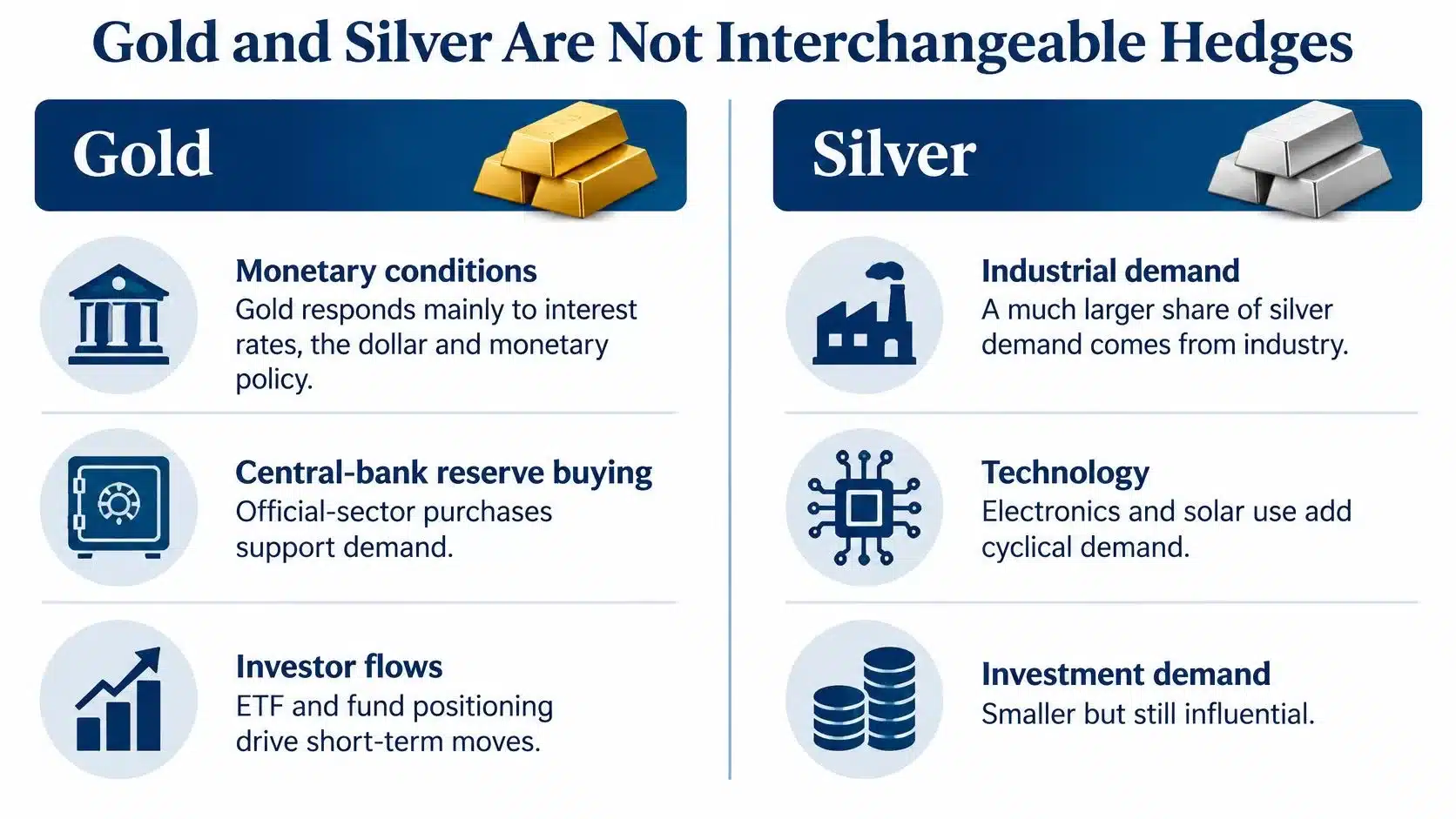
Gold is driven mainly by monetary conditions, central-bank reserve buying, and investor flows. Silver carries those investment uses and a much larger industrial and technology load. Treating the lower sticker price as "the same hedge, only cheaper" is the gap this comparison is meant to close.

| Factor | Gold | Silver |
|---|---|---|
| Main demand drivers | Monetary conditions, central-bank reserves, investor flows | Investor demand plus electronics, solar and other manufacturing |
| Industrial share of demand | Small relative to investment and jewelry | Large, including electrical, electronic and photovoltaic use |
| Sensitivity to business cycles | Lower, driven more by monetary and reserve factors | Higher, tied to manufacturing and substitution |
| Price per ounce | Higher | Lower, which does not mean lower risk |
| Portfolio implication | Often considered as a reserve-style holding | Needs tighter position limits and more frequent review |
Why the cheaper ounce can swing harder
Silver's lower price per ounce does not mean lower portfolio risk. Manufacturing slowdowns, substitution in electronics, and changes in how much metal a solar panel uses can move silver when gold is quiet. A saver who buys silver because the quote looks small can end up with the more volatile sleeve of the account.
Recent outlooks show the tension clearly. Silver has been expected to post another structural deficit, while industrial consumption was still forecast to decline because photovoltaic manufacturing used less silver. A deficit does not guarantee a higher price when the demand base is shrinking at the same time. Buyers can face a tight market and still see the price fall if factories and funds both step back.
What U.S. use actually looks like
The U.S. Geological Survey silver summary breaks estimated domestic use into separate buckets, and those buckets should stay separate. Physical investment in bars was 30% and coins and medals were 12%, so bars and coins together are 42%. Electrical and electronic applications were 29%. Photovoltaics were 12%. Investor demand matters. So do circuit boards and solar deployment. That mix is why silver can respond to forces that barely touch a gold holding.
Practical rule: Judge each metal by its economic exposure and by how that exposure fits the withdrawal timeline and the rebalancing rules, not by which quote looks smaller on a given afternoon.
A mixed allocation is a real choice, not a default. The Gold IRA Association piece on whether to invest in silver or gold sets the two metals side by side for retirement accounts so the cheaper ounce is not mistaken for the safer one.
How to Roll Over a 401(k) or IRA Into a Precious Metals IRA
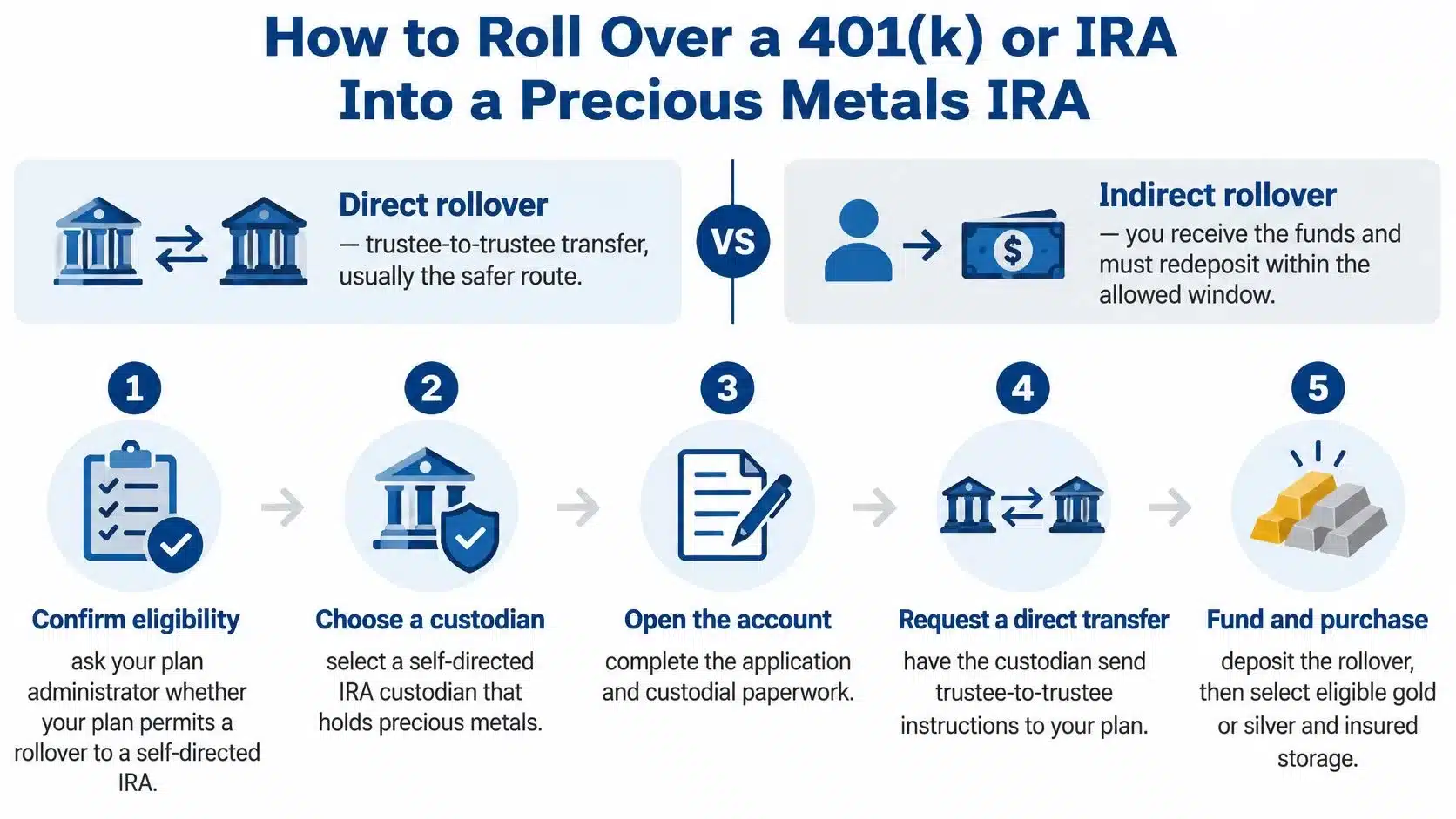
A rollover is either direct or indirect. The direct route is usually the safer choice because the account holder never holds the check. In a direct rollover the plan administrator pays the receiving IRA. In an indirect rollover the account holder receives the distribution and deposits it into another eligible retirement account. A properly completed rollover is generally non-taxable, and it is still reportable on the federal return.
Someone comparing local dealers may also read gold rollover advice for Idaho investors for a plain look at timing questions. The plan and the IRS set the account rules.
The routine, in order
Confirm the plan will release the money. Ask the administrator whether the plan allows a distribution or an in-service rollover, and which forms it wants. The common slip is requesting funds before the plan says yes, then discovering an in-service move is blocked until a later age or separation date.
Open the self-directed IRA before the request. The receiving custodian has to exist so the plan has somewhere to send a trustee-to-trustee payment. Opening the account after the check is cut is how people end up holding cash they did not mean to touch.
Ask for a direct transfer. The plan pays the new custodian, not the participant. That path avoids temporary possession and the deadline that comes with it. The Gold IRA Association rollover guide on a precious metals IRA rollover lays out that paperwork path in more detail.
If an indirect rollover is unavoidable, deposit within 60 days of receipt. The IRS Tax Topic on rollovers gives the recipient generally 60 days from the date of receipt to complete the deposit. Missing that window is the slip that turns a rollover into a taxable distribution. A waiver is rare, so do not plan around one.
Watch the 20% withholding. Mandatory federal withholding applies when a taxable employer-plan distribution is paid to the participant, as described in the IRS Tax Topic on rollovers. A direct rollover avoids that withholding. On an indirect rollover, the withheld slice still has to be made up from other cash if the full amount is going back into an IRA, or the shortfall can be treated as a distribution.
Buy only metal the custodian has already accepted. Instruct the custodian to purchase eligible metals, and match each item to the checklist in Which Gold and Silver Products Qualify for an IRA. Check fineness, mint or refiner, weight, and invoice line by line. All four should agree before the trade is placed.
Confirm the depository and the statements. The metal should be logged to the approved depository, and the account holder should receive statements that name the items. A trade confirmation without a storage record is an unfinished rollover.
A note on getting the forms straight
Readers can send a direct message to Gold IRA Association to get help finding educational information about account rules and provider comparisons. That help is educational. It is not a determination that a specific plan will approve the transfer.
Costs, Fees and Tax Treatment Compared
All-in cost matters more than any single line on a brochure. Published amounts differ by provider, so the useful move is a written fee schedule before the account opens. A low setup fee can sit next to a wide buy-sell gap that costs more on the first purchase than the annual bill.
| Cost | What it covers | What to ask the provider |
|---|---|---|
| Account setup fee | One-time opening of the self-directed IRA | Is it one-time or recurring? |
| Annual custodial fee | Account administration and trustee reporting | Is it flat or based on account value? |
| Storage fee | Holding metal in an approved depository | Is storage segregated or commingled? |
| Dealer markup or spread | Gap between buy and sell prices | How does the buy price compare with the spot price on the day? |
| Shipping and insurance | Delivery and coverage of metal | Who pays, and what is the insured value? |
| Transaction fee | Per-trade charges | How many trades are expected each year? |
What each layer actually changes
A setup fee is the cost of opening the self-directed IRA. Ask whether it returns every year under another name. The annual custodial fee pays for administration and trustee reporting. A flat dollar amount and a percent of account value behave very differently as the balance grows.
Storage is the depository charge. Segregated storage keeps specific bars or coins identified to the account. Commingled storage pools metal of the same type. The written schedule should say which one applies. Shipping and insurance cover movement and the insured value, and the schedule should say who pays.
The spread, the gap between the buy price and the sell price, is often the quiet part of the bill. On a smaller purchase, that gap can exceed a year of custody fees. Ask how the buy price compares with the spot price on the day of the trade, and how many transaction fees a year of rebalancing would add. The Gold IRA Association breakdown of precious metals IRA fees is a useful checklist for that conversation.
Tax inside the account, not a blanket exemption
A traditional IRA generally defers tax, and withdrawals are taxed as ordinary income. Qualified Roth distributions are generally tax-free. Required minimum distribution rules apply to traditional accounts. Metal held inside an IRA is not taxed the same way as metal held in a personal safe, where a sale can raise capital-gains questions instead of ordinary IRA distribution rules.
Gold IRA Association publishes articles on that tax treatment, including "Capital Gains Tax on Gold: A Plain-English Guide" and "Tax on Silver: What Retirees Must Know." Those explainers are general. For a high-balance household sorting gains outside an IRA as well as inside one, the HNWI guide to protecting investment gains from Blue Sage Tax & Accounting Inc. is a separate planning resource. Individual circumstances differ, and a CPA should confirm the treatment before a distribution or a sale.
Managing Volatility, Rebalancing and Withdrawals
Flows into gold ETFs can reverse within a single quarter. Metals demand has become increasingly flow-driven, so a crowded rush of buying can unwind as fast as it built. Strong investment demand and a soft industrial backdrop can sit in the same quarter, a poor setup for anyone who bought because the last move was straight up. Silver carries an extra exposure gold does not: its price leans partly on industrial consumption, so a manufacturing slowdown can pull on silver even while investment flows push it higher.

The split showed up plainly in 2026. In the third quarter, global physically backed gold ETFs added 211 tonnes, lifting holdings to a record 4,256 tonnes, while central banks purchased 321 tonnes and silver physical investment was forecast to climb roughly 20% to 227 million ounces even as industrial demand weakened, according to the Canadian Press summary of a 2026 metals outlook. Read those numbers as two different exposures. Gold's record holdings rested on ETF and central-bank flows that can stop or reverse. Silver's projected gain rested on investment demand while its consumption side sagged. The buyer who arrives late in either pattern owns the reversal.
A written policy, not a mood
A metals target near retirement belongs in a written plan reviewed with a licensed advisor. The document is what separates rebalancing from reacting: a spike tempts holders to add, a drop tempts them to sell, and a written target answers both impulses with the same rule.
Build the policy in three decisions:
- Target allocation: write the share of the retirement balance that may sit in metal, as a policy, before the next price spike.
- Concentration limits: cap any single metal so a silver swing cannot dominate the account.
- A rebalancing band: pick the drift, in percentage points away from the target, that triggers a review, and fix that number in the plan.
Sequence-of-returns risk is the practical reason for cash outside the metals sleeve. A price drop early in retirement, paired with withdrawals, locks in losses that a later recovery does not fully repair. Each year of spending money kept in cash is a year the metal can recover without being sold into a soft bid.
Write the sell rules before a sharp move. A liquidity shock is a bad moment to invent a strategy.
Withdrawals deserve the same advance work as rebalancing. Required minimum distributions from traditional accounts can force a sale of metal, so the cash for that distribution belongs in place before prices jump or drop. The alternative is an in-kind distribution, where the metal itself leaves the account and its value counts toward the required amount; confirm that option with the custodian before the deadline approaches. Investing in precious metals and IRAs involves risk, including the potential loss of principal.
The video below walks through how investors weigh metals inside a retirement mix.

Frequently Asked Questions About Gold and Silver IRAs
Can an IRA hold both gold and silver?
Yes, if each product passes the fineness, paperwork and custody checks. They can sit in one self-directed IRA, but treat them as separate exposures: different item sizes, different invoice trails and different rebalancing pressure. Each bar or coin still needs written custodian acceptance and an item record before the trade is final.
Is a gold IRA tax-free?
Not as a blanket statement. Treatment depends on whether the account is traditional or Roth, and on the person's circumstances. Have a CPA confirm the result before anyone calls the account tax-free.
What if a custodian rejects a purchase?
Stop before funds move. Ask for the reason in writing, then either correct the documentation, substitute a product that meets the fineness and acceptance tests, or cancel the order. A rejection handled before settlement is an paperwork problem; a rejection after delivery can become an expensive unwind.
What if an indirect rollover misses the 60-day deadline?
The IRS rollover guidance for plan participants notes that a missed deadline may sometimes be waived when the failure resulted from circumstances beyond the taxpayer's control. Treat that as a narrow exception for qualifying hardships, not a fallback plan.
Can I take metal out when I need cash?
A distribution is the controlled exit, not a home-delivery shortcut. Ask the custodian whether the account would raise cash through a sale or distribute metal under its procedures, then have a CPA confirm the tax result for that account type.
What to Confirm Before You Buy a Gold IRA
A gold or silver IRA is only as sound as the paperwork behind it. Eligibility, custody, rollover mechanics and cost all need checking before money moves. Skip one and a retirement transfer turns into a cleanup project.
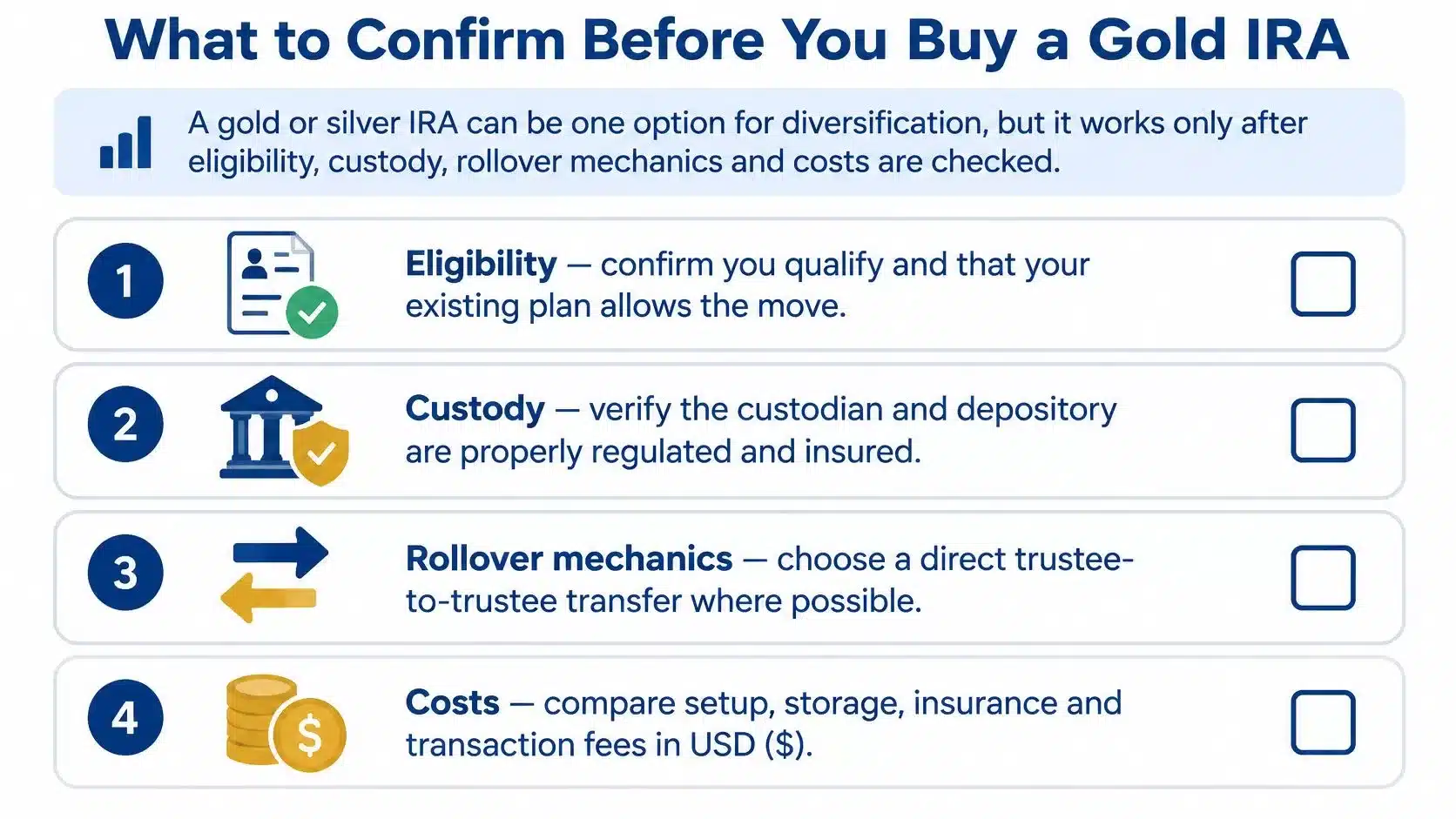
- Custodian and product. Confirm the custodian is an approved trustee and has accepted the exact coin or bar in writing. Run the fineness and paperwork tests before you approve the purchase.
- Depository. Confirm where the metal will sit and whether storage is segregated or commingled. Get both answers in the written fee schedule.
- Item record. Record fineness, mint or refiner, weight and invoice for every bar or coin before the trade is final. This record is what lets a custodian match the metal to your account later.
- Full fee schedule. Request every layer in writing. Compare the dealer's buy price with the spot price on the day, because the gap is part of your cost.
- Rollover method. Confirm a direct transfer when the plan allows it. If an indirect rollover is unavoidable, write down the 60-day deadline on the day the funds arrive.
- Tax. Confirm with a CPA how the metals and any distributions will be taxed for that specific account type.
Gold and silver do not move in lockstep, so the checklist applies to both while the allocation decision stays separate. The documentation does the same job in either case: it proves the account holds eligible metal, at a known purity, under the right custodian.
The Gold IRA Association team offers personalized advice on retirement goals and the account rules that fit them. For individual tax or legal decisions, consult a licensed professional. For account-rule questions, call 888-910-8386. Its published materials are provided for informational purposes only and are not intended as financial, legal, or investment advice.
Gold IRA Association publishes plain-language guides on precious metals IRAs, rollover steps, eligible gold and silver, and the fees that change what a retirement account keeps. Those materials match the checks in this gold and silver guide, from custody rules to a written fee schedule. Visit Gold IRA Association to keep reading before any transfer is requested.


