




A reader buying or selling gold coins may expect one simple answer to a simple question: does the transaction get reported? In practice, gold bullion reporting requirements can involve three separate compliance lanes. Dealer-to-IRS reporting may use Form 1099-B, large cash payments may create a Form 8300 obligation, and moving physical gold across a border can trigger customs declarations even when no sale occurs.
The key is to identify which event is taking place, then keep the product, payment, ownership, and travel records together. This guide explains the distinctions in plain language, including how a taxable account differs from a Gold IRA.
What Gold Bullion Reporting Requirements Actually Cover
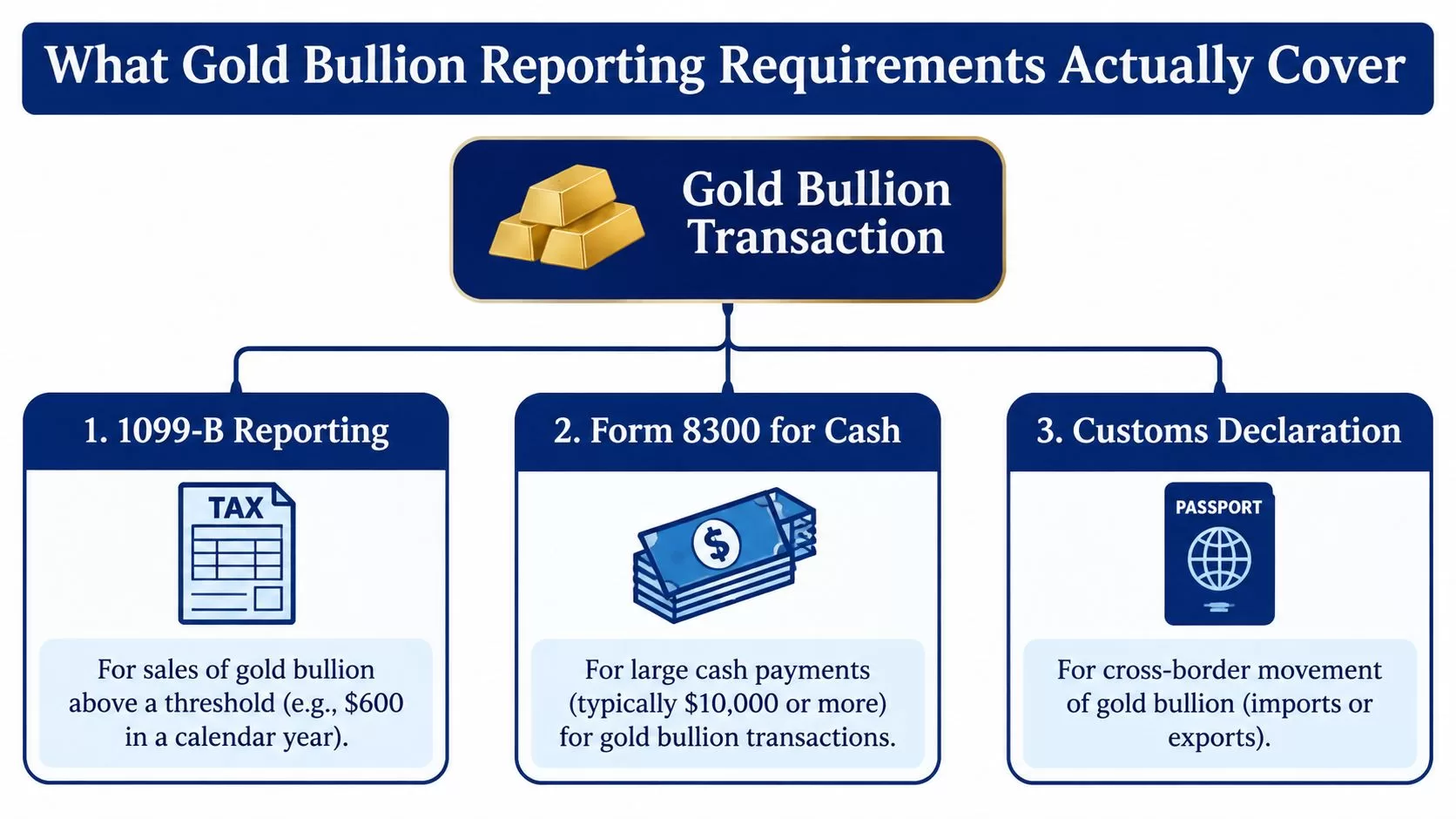
Gold bullion reporting requirements generally cover three different moments in a metal's life. The first is a qualifying sale, where a dealer may have to report the transaction to the IRS on Form 1099-B. The second is a cash payment that exceeds the applicable cash-reporting threshold, which can create a separate Form 8300 filing. The third is the physical movement of bullion across an international border, where customs authorities may require a declaration.
Those lanes can overlap, but one doesn't automatically replace another. A bank wire can be relevant to a product-based sale report without being actual cash for cash-reporting purposes. Conversely, a cash purchase may create a Form 8300 obligation even when the particular coin or bar doesn't meet the product threshold for Form 1099-B.
Physical bullion also differs from paper gold, such as an exchange-traded fund. With physical coins or bars, the product's form and quantity can matter to dealer reporting, and the metal itself can create customs questions when transported. Paper investments generally follow the reporting process associated with the financial account or security rather than the physical movement of a bar or coin.

For a basic explanation of physical bullion and how it differs from other forms of precious-metals exposure, readers can review what bullion means. The practical question is always the same: what was sold, how was it paid for, and did the metal cross a border?
Practical rule: Don't treat “reported” as a single category. Identify the form, quantity, payment method, account type, and location separately.
How Form 1099-B Bullion Reporting Works
A buyer sells a qualifying group of gold coins to a dealer and expects the sale price alone to determine reporting. The federal rule works differently. Form 1099-B generally depends on the product form and quantity, much like checking both the type and count of items on an inventory list.
The IRS Form 1099-B instructions state that a precious-metals sale generally is not reportable when the metal is not in a form approved by the Commodity Futures Trading Commission for regulated futures contracts. Even an approved form may remain exempt when the quantity is below the minimum deliverable contract size. The instructions give a gold example: a broker selling one gold coin does not have to file when the relevant contract requires delivery of at least 25 coins. Sales for one customer within a 24-hour period must be combined when testing the threshold.
The product and quantity are considered together:
| Metal | Coins per transaction | Bars |
|---|---|---|
| Gold | 25 or more coins | Any quantity in qualifying bar forms |
| Silver | 50 or more coins | Any quantity in qualifying bar forms |
| Platinum | 25 or more coins | Any quantity in qualifying bar forms |
| Palladium | 25 or more coins | Any quantity in qualifying bar forms |
Confirm the current IRS instructions and the dealer's compliance process before selling. Units and approved product form matter, rather than only the total proceeds. A fractional coin can count as one coin unit for threshold analysis. It is not automatically converted into grams for this test.
What the form means for the seller
When reporting is required, the dealer generally sends transaction information to the IRS and the customer. The form may show gross proceeds, cost-basis information where applicable, and whether the asset is treated as a covered security. A missing or delayed customer copy does not prove that the sale had no tax consequences. Information may still have been sent to the IRS.
Keep your own records. Prepare the tax return from purchase invoices, sale confirmations, dates, premiums, and other basis documents, not from Form 1099-B alone. A structured tax-season reconciliation process can help organize those records, but it does not replace tax advice.
Product-Based Versus Cash-Based Reporting Rules
A buyer can trigger one reporting rule through the bullion purchased and another through the way payment is made. Treat these as separate compliance moments, like two different checkpoints on the same transaction. Form 1099-B asks what product was sold and in what quantity. Form 8300 asks how much actual cash or cash equivalent a business received.
| Dimension | Form 1099-B | Form 8300 |
|---|---|---|
| Filing context | Qualifying precious-metals sale | Large cash or cash-equivalent payment |
| Main trigger | Product form and quantity | More than $10,000 received in a business transaction |
| Payment method | Can apply whether payment is by wire, check, or another method | Focuses on actual cash or cash equivalents |
| Filing party | Dealer or broker | Business receiving the payment |
| Document | Form 1099-B | Form 8300, with the filing obligation administered under federal cash-reporting rules |
As noted earlier, product-based reporting is not determined only by the sale price. A qualifying bullion sale can lead to Form 1099-B reporting even when the dealer pays by wire, check, or another non-cash method. Form 8300 follows a different path. Federal cash-reporting rules generally apply when a business receives more than $10,000 in cash in one business day, including related transactions.
The distinction is summarized in bullion reporting guidance. Use it to separate the product test from the payment test, then confirm the current requirements with the dealer or a tax professional when the facts are unclear.
Consider two buyer scenarios. A buyer pays by bank wire for ten qualifying gold bars. The product and quantity can create Form 1099-B reporting, while the wire itself is not a cash payment for Form 8300 purposes. In another scenario, a buyer pays $11,000 in used $100 bills across related visits for a single one-ounce coin. The cash amount can create a Form 8300 obligation even though the coin may not meet the product-based 1099-B threshold.
Payment method doesn't erase a product rule, and a smaller bullion item doesn't erase a cash rule.
Both filings can apply to one transaction. A dealer may ask questions, request identification, or combine related payments because splitting a payment pattern does not necessarily avoid reporting. The safer path is straightforward: answer accurately, keep every receipt, and do not structure payments around an assumed reporting result.
Cost Basis and Capital Gains on Bullion Sales
Cost basis is the starting tax value of the bullion. For a taxable purchase, it generally begins with the amount paid and may include documented dealer premiums, applicable sales tax, assay charges, and shipping costs. Adjustments should be supported by invoices and payment records. The basis determines the gain or loss when the metal is sold.
The holding period begins the day after acquisition. A sale held for one year or less generally creates a short-term gain, while a sale held beyond one year generally falls into the long-term category. Physical precious metals are commonly treated as collectibles for federal tax purposes, and the long-term collectibles rate is currently capped at 28 percent, subject to the taxpayer's circumstances and the applicable tax rules. Readers should verify current treatment with a tax professional before filing.
A simple example
An investor buys a one-ounce coin for $2,100 and sells it 13 months later for $2,400. Ignoring other adjustments, the gain is $300, and the holding period is long term. If the same sale occurs after 11 months, the gain is short term and is generally considered with the taxpayer's other ordinary-income items, such as wages or IRA distributions.
| Factor | Short-Term, one year or less | Long-Term, beyond one year |
|---|---|---|
| Holding period | One year or less | More than one year |
| Basic calculation | Sale proceeds minus adjusted basis | Sale proceeds minus adjusted basis |
| General treatment | Ordinary-income framework | Collectibles framework may apply |
| Records needed | Purchase date, basis, sale date, proceeds | The same records, with careful holding-period documentation |
Personal-use bullion losses generally don't receive the same treatment as losses on investment property. Investment bullion may follow normal investment-loss rules, but the classification and surrounding facts matter. Every 1099-B should be reconciled against personal records before filing, especially when a dealer's reported basis is incomplete or differs from the investor's documented cost.
Reporting Rules Inside a Gold IRA Versus a Taxable Account
A buyer sells the same gold coin through two different account structures. The paperwork may look unrelated because the tax event depends on who owns the asset and when money leaves the account. The metal's location, whether in a home safe or a vault, does not by itself determine the rule.
| Account type | Form issued | Where reported | General tax treatment |
|---|---|---|---|
| Self-directed Gold IRA | Custodian and distribution reporting | Retirement-account reporting | Sales inside the account generally aren't currently taxable to the account holder; distributions are reported when taken |
| Taxable account | Form 1099-B when applicable | Form 8949 and Schedule D | Gains and losses are reported by the owner |
| Personally held bullion | Usually no dealer 1099-B for a private sale | Owner's tax return when a taxable sale occurs | Owner maintains basis and reports the applicable gain or loss |
Three compliance moments can apply, and they should not be blended together. A dealer-to-IRS Form 1099-B report depends on the product and quantity rules discussed earlier. A cash-based Form 8300 obligation concerns qualifying cash payments to a business. A cross-border customs declaration concerns moving the metal across a border. Each rule has a different trigger.
Inside a self-directed Gold IRA, the custodian records purchases, sales, and distributions. A sale within the IRA generally does not create a current taxable event for the account holder. A later distribution is reported on Form 1099-R and is generally taxed as ordinary income, subject to the account type, the owner's age, and individual circumstances.
A taxable account places the reporting task with the owner. If a dealer sale meets the applicable product and quantity requirements, the dealer may issue Form 1099-B. The owner then uses personal records to report the transaction on Form 8949 and Schedule D. A missing 1099-B does not erase a taxable sale or the duty to report it.
Personally held bullion requires careful basis records. The absence of dealer paperwork does not remove that responsibility, and a home safe does not turn personal metal into IRA property. Storing IRA-eligible metals at home is generally treated as a prohibited transaction that can trigger taxation and penalties.
Before moving retirement funds, readers can review the IRA rollover tax form guide. A custodian can explain account administration, while tax and financial professionals can address tax effects and retirement planning.
Cross-Border and Custody Considerations for Physical Gold
A near-retiree can face a reporting obligation just by carrying or shipping bullion, even when ownership stays the same. A U.S. resident taking physical gold abroad must review U.S. customs requirements and the destination country's rules before departure. The trip itself is not a sale and does not automatically create a capital gain. The movement and declared value can still require disclosure.
For some European customs systems, gold may be treated as a cash-equivalent instrument. Germany includes gold coins with at least 90 percent gold content and gold bullion bars or nuggets with at least 99.5 percent gold content in that category. Travelers carrying cash or equivalent means of payment over 10,000 euros must declare it. During random checks, customs officers may request a verbal declaration covering value, provenance, beneficial owner, and intended use. Luxembourg applies the same 90 percent coin and 99.5 percent bullion thresholds, showing why a country's customs definition may differ from a U.S. dealer's reporting category. The details appear in German customs guidance for cash and equivalent instruments.
Italy uses a separate rule for investment gold. Under the described 2025 rules, investment gold transported into or out of Italy must be declared when its value reaches at least 10,000 euros, according to the regulatory update.
The safer approach is to prepare before travel. Gather invoices, ownership records, valuation support, and required customs forms. A carrier or customs broker may request identity and beneficial-owner information. As outlined in the earlier 1099-B discussion, the IRS form instructions govern product-based reporting thresholds. Those thresholds do not answer a border question, so a transaction that does not produce domestic dealer reporting may still require customs disclosure.
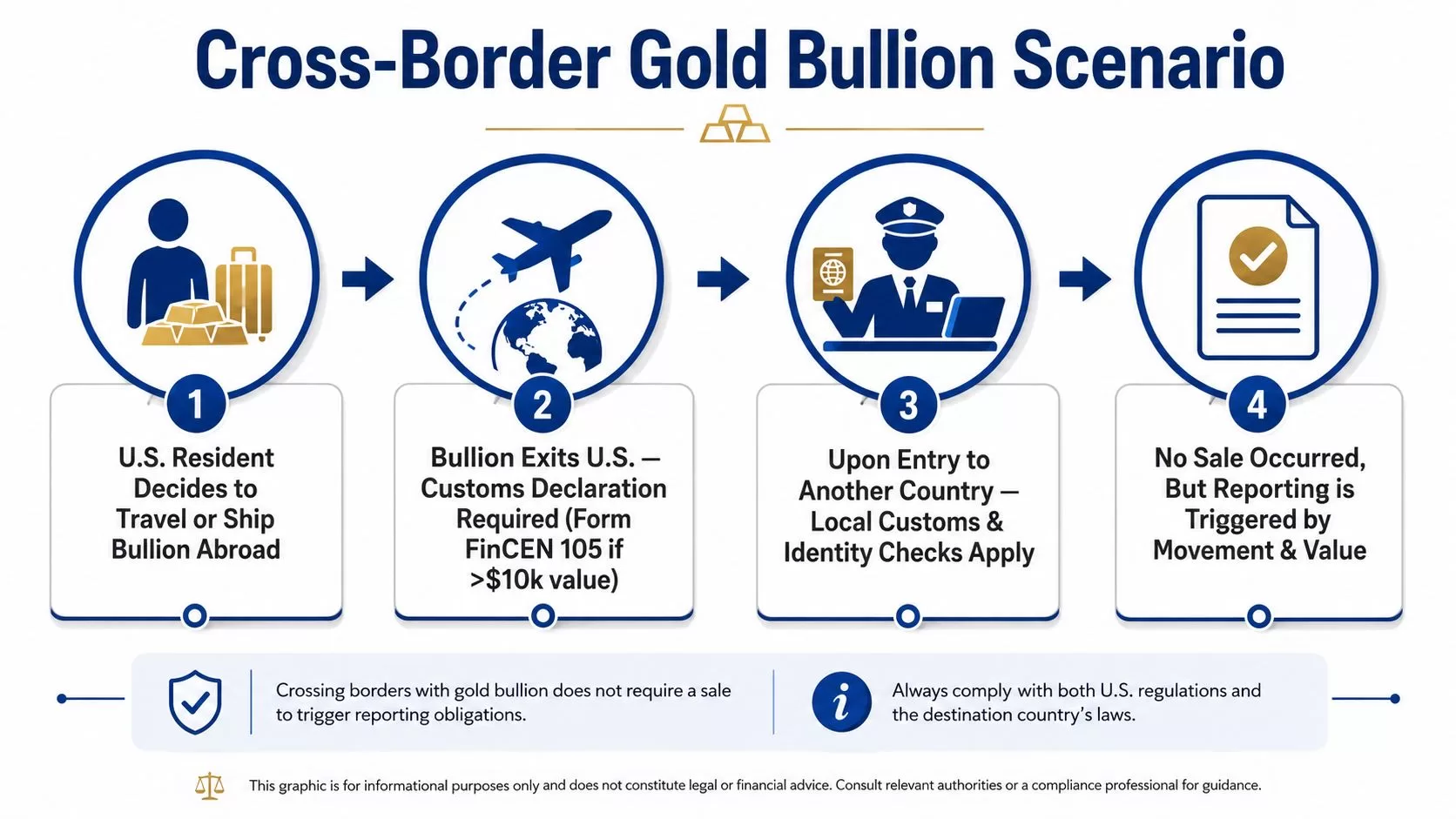

The following video reinforces the distinction between movement, ownership, and sale, which are separate compliance events.

Retirement-owned bullion raises a separate custody question. A Gold IRA normally uses an approved custodian and permitted storage arrangement rather than personal possession. Review precious-metals storage arrangements before arranging delivery or relocation, because the storage location can affect whether the account continues to follow IRA requirements.
A Practical Reporting Checklist and Next Step
Before buying, selling, or transporting bullion, a near-retiree can use a short compliance checklist. The purpose isn't to predict every outcome. It's to identify the right question early enough to obtain professional guidance.
- Classify the event: Is the metal being purchased, sold, distributed from an IRA, or moved across a border?
- Check the product: For a sale, confirm the metal form and quantity against the current IRS Form 1099-B instructions.
- Review the payment: Determine whether the business is receiving actual cash or cash equivalents above the applicable threshold. A wire and a cash payment don't create the same analysis.
- Preserve basis records: Keep purchase invoices, premiums, applicable taxes, shipping, assay information, acquisition dates, and sale confirmations together.
- Separate IRA custody: Confirm that retirement-owned metals remain under the required custodial and storage arrangement. Don't move them to a home safe.
- Prepare for travel: If bullion will leave or enter the United States, identify the required customs and financial declarations before the trip. Then check the destination country's rules separately.
- Reconcile forms: Compare any 1099-B or retirement-account form with the investor's own records. Missing paperwork doesn't automatically eliminate a reporting responsibility.
- Escalate unusual transactions: Related payments, inherited bullion, large private sales, and international transfers deserve professional review before completion.
The checklist helps organize questions, but it isn't personalized tax or legal advice. Rules can depend on the product, account, payment, taxpayer, and jurisdiction. This is not financial advice. Consult a licensed financial advisor, CPA, or tax professional before making investment decisions.
Gold IRA Association provides educational guides on Gold IRAs, rollovers, precious-metals custody, eligible products, and provider comparisons. Readers preparing a retirement-account metals transaction can visit Gold IRA Association to review those resources and prepare more focused questions for a qualified professional.


