




A finished gold IRA transfer can still leave a retiree unsure what the metal is worth, how quickly it can be sold, or what the account costs each year. Staying inside the tax rules is only half the job. Custody, pricing, and fees decide whether the move supports a retirement plan or slowly drains it. The steps below follow the paperwork in order, then list what still needs a professional's confirmation.
Gold IRA Transfer Rules by Account Type
Does moving retirement savings into gold mean cashing out the account first? No. The tax result depends on which account the money leaves, which Gold IRA it enters, and whether the dollars ever pass through the account owner's hands. Get the route right and the move stays tax-deferred. Get it wrong and the IRS can treat the money as income.
| Source account | Gold IRA destination | Method that avoids a taxable event | Key rule to know |
|---|---|---|---|
| 401(k) from current employer | Traditional Gold IRA | Direct rollover or trustee-to-trustee transfer | Only if the plan allows in-service rollovers; otherwise wait for separation |
| 401(k) from former employer | Traditional Gold IRA | Direct rollover to the new custodian | A direct rollover generally sidesteps the 60-day clock and the once-per-year IRA limit |
| Traditional IRA | Traditional Gold IRA | Trustee-to-trustee transfer | No 60-day clock when funds move directly between custodians; the once-per-12-months limit generally doesn't apply |
| Traditional IRA | Roth Gold IRA | Conversion | The amount converted is generally taxable as ordinary income in the year of conversion |
| Roth IRA | Roth Gold IRA | Trustee-to-trustee transfer | Generally not taxable; confirm the five-year holding rules with a tax professional |
| Any account paid to you (indirect rollover) | Any Gold IRA | Deposit within 60 days of receipt | A missed deadline can make the amount taxable and may add a 10% tax if under 59½ |
Under IRS rollover rules for retirement plans and IRAs, funds paid directly to the account owner generally must be redeposited within 60 days of receipt. Amounts left out usually lose tax-free rollover treatment and may become taxable. For someone under 59½, an extra 10% early-distribution tax can apply unless an exception fits. Limited relief exists when circumstances beyond the taxpayer's control caused the delay, but the deadline should be treated as firm.
Since January 1, 2015, a taxpayer may generally complete only one IRA-to-IRA rollover in any 12-month period, no matter how many IRAs are owned. The limit covers the distribution and also affects the receiving IRA. It doesn't generally apply to trustee-to-trustee transfers, direct rollovers from employer plans, or traditional-to-Roth conversions. A direct custodian-to-custodian move is the safer path because the investor never takes the money.
- Checks paid to the participant: Under IRS distribution rules for 401(k) plans, a distribution paid to the person is generally subject to mandatory 20 percent federal withholding. The full amount, including what was withheld, still has to be redeposited inside 60 days if the whole sum is meant to stay tax-deferred.
- Age: Per IRS guidance on the tax on early distributions, the 10% additional tax can sit on top of ordinary income tax before age 59½.
- Roth conversion: A traditional-to-Roth Gold IRA conversion is generally taxable in the year it happens, even when custodians move the cash directly.
A worked example. Suppose $100,000 leaves a former employer's 401(k). Wired straight to the new custodian, the entire $100,000 arrives in the Gold IRA with nothing withheld. Paid to the account owner instead, the plan keeps $20,000 for the IRS and hands over a check for $80,000. Keeping the full amount tax-deferred still requires a $100,000 deposit within 60 days, which means $20,000 comes out of pocket until the withholding returns as a refund at tax time. Deposit only the $80,000 and the missing $20,000 is treated as a distribution, taxable as income and possibly carrying the 10% additional tax for an owner under 59½.
Matching traditional to traditional and Roth to Roth keeps the tax deferral intact. It says nothing about what the metal costs to buy, how it will be priced later, or what the account charges each year. Those numbers come from the custodian's fee schedule and the dealer's quote, so confirm them alongside the tax rules with a CPA before signing anything.
How to Transfer a 401(k) or IRA Into a Gold IRA
The custodian and the old plan administrator have to coordinate, so the order of a gold IRA transfer matters as much as the forms. Skip a step and the money can stall, or worse, arrive as a check in the owner's name.
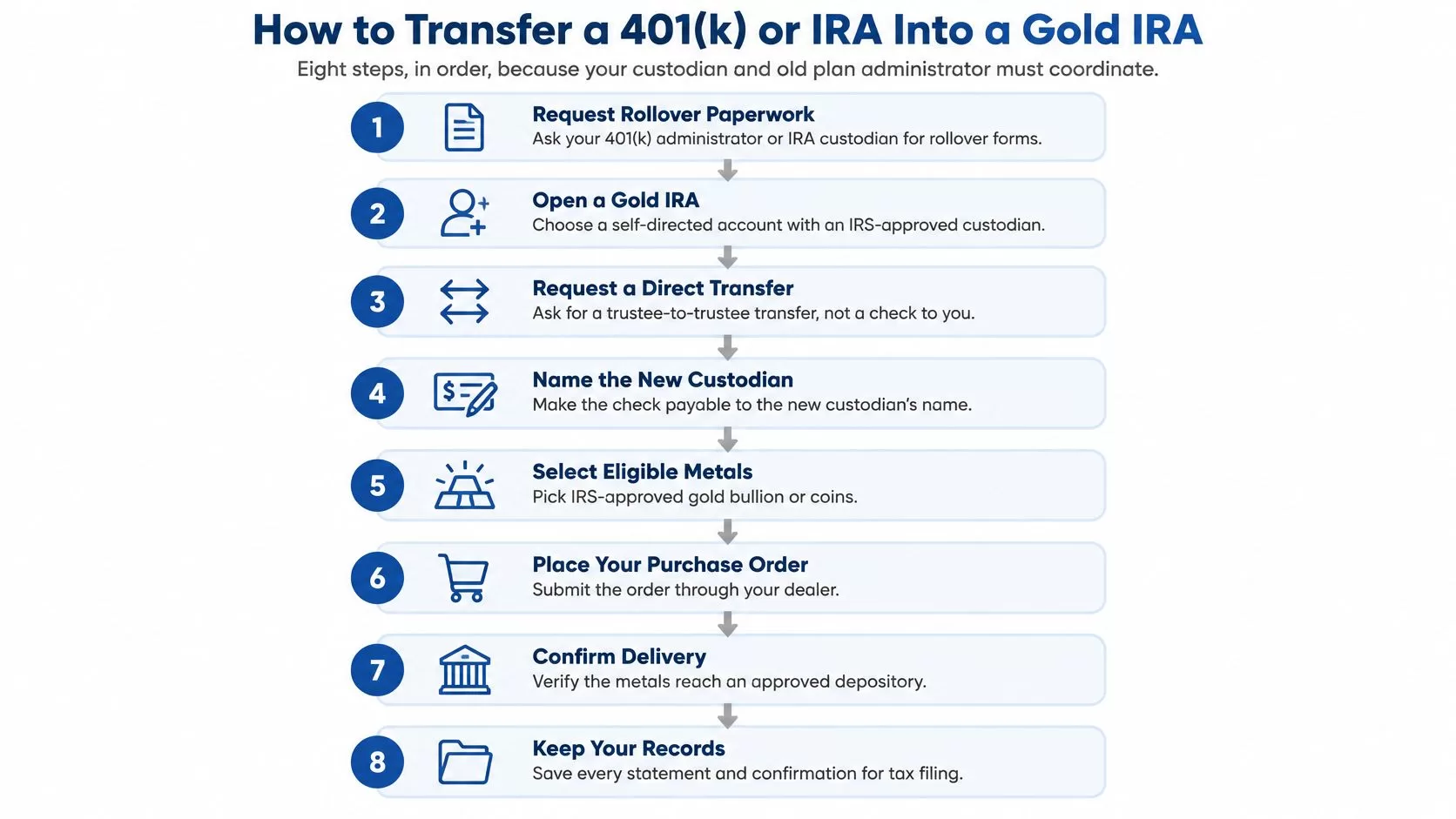

Eight steps and why each one matters
- Ask about eligibility in writing. Request, from the 401(k) administrator or IRA custodian, whether a rollout is allowed while still employed or only after separation, plus the distribution options. An in-service move that the plan doesn't allow will be rejected after weeks of waiting.
- Choose an IRS-approved custodian. The trustee must handle self-directed accounts and work with an approved depository. A brokerage that only holds funds and stocks can't take the metal.
- Open the matching account. Traditional source money goes into a traditional self-directed IRA. Roth source money goes into a Roth. Name beneficiaries at opening so a later death doesn't leave the account in limbo.
- Demand a direct movement of funds. Ask for a direct rollover or trustee-to-trustee transfer, with any check payable to the new custodian for the owner's benefit. The most common mistake happens here: accepting a check made out to the person. That starts the 60-day clock and, for an IRA, can use up the one-rollover year.
- Confirm the cash posted. Don't order metal until the new custodian shows the funds received. Keep that confirmation with the rollover request.
- Buy only from the eligible list. Place the order through the custodian, using the product rules in the next section. A pretty coin that fails the standard can be treated as a distribution.
- Confirm depository custody. The metal should be in the custodian's approved facility, with a storage record that lists weights and product details. A shipping notice to a home address is a warning, not a receipt.
- File the paperwork trail. Custodians report rollovers on Form 5498. A CPA should confirm how the transfer appears on the return. Save every letter.
What slows the handoff
Timing follows the old administrator, not the new custodian's brochure. Some plans batch distributions. Others require a medallion signature or a waiting period after the request. Calling both sides after the request goes out catches a mismatched account number before the check is cut wrong.
If the payable line doesn't name the new custodian for your benefit, stop and send it back for reissue.
Which Gold and Silver Products Qualify for an IRA
A coin can meet the IRA rules and still leave questions about its price or resale value. Check the product's eligibility, the custodian's acceptance, and how the dealer will price it before placing an order. IRS Publication 590-A explains the collectibles restriction and exceptions for certain coins and bullion.
| Metal | Product | Purity or standard | IRA-eligible? |
|---|---|---|---|
| Gold | 1 oz U.S. Gold Eagle | U.S. Treasury-minted coin | Yes |
| Gold | 1/2 oz, 1/4 oz, or 1/10 oz U.S. Gold Eagle | U.S. Treasury-minted fractional coins | Yes |
| Gold | 1 oz Canadian Gold Maple Leaf | Bullion coin; confirm acceptance with the custodian | Generally, subject to custodian confirmation |
| Gold | Gold bar from an approved refiner | At least 99.5% fineness, under IRS rules linked above | Yes, if it meets the bullion standard |
| Gold | Unbranded or below-standard gold bar | Below 99.5% fineness | No |
| Silver | 1 oz U.S. Silver Eagle | U.S. Treasury-minted coin | Yes |
| Silver | 1 oz Canadian Silver Maple Leaf | Bullion coin; confirm acceptance with the custodian | Generally, subject to custodian confirmation |
| Silver | Silver bar from an approved refiner | At least 99.9% fineness, under IRS rules linked above | Yes, if it meets the bullion standard |
| Platinum or palladium | Qualifying coins or bullion | At least 99.95% fineness for bullion under IRS rules linked above | Yes, if the applicable requirements are met |
| Collectible or rare coins | Numismatic or graded coins | Collectible status generally bars IRA treatment | No |
Coins, bullion, and fineness
Certain U.S. Treasury-minted coins qualify under exceptions to the collectibles restriction, including specified gold and silver coins. Bullion follows fineness standards: gold must be at least 99.5% fine, silver at least 99.9%, and platinum and palladium at least 99.95%, as described in IRS Publication 590-A. The standards vary by product, so ask the custodian to confirm a specific coin or bar before you buy it.
Eligibility is only one part of the decision. Two qualifying products can have different dealer prices and resale terms, so ask how the purchase price is set and what information you will receive to value the metal in your account.
Bullion versus collectibles
Rare, graded, or limited-edition coins may be treated as collectibles, even when they look like ordinary bullion. A high price or protective grading case does not make a coin IRA-eligible. Request the custodian's eligible-product list in writing, then check each item on the proposed invoice against it. The guide to gold that qualifies for an IRA can help you understand the categories, but the custodian should confirm the specific product.
Storage Options, Fees and Hidden Costs
The purchase price is only one layer. Custodians and dealers bill setup, reporting, storage, insurance, and the gap between buy and sell prices in different ways. Comparing a setup fee alone hides the annual bill.
| Cost or option | What it covers | How it is usually charged | Question to ask |
|---|---|---|---|
| Account setup fee | Opening the self-directed IRA | One-time charge | Is the full fee schedule in writing? |
| Annual custodian fee | Recordkeeping and IRS reporting | Flat annual or based on account value | Does the fee rise as the account grows? |
| Depository storage | Holding metal in an approved facility | Annual charge; segregated storage is typically priced higher than commingled | Is storage segregated or commingled, and what does each cost? |
| Insurance | Coverage of stored metal | Included or charged separately | What are the coverage limits and exclusions? |
| Dealer spread | Difference between buy and sell prices | Built into the purchase price | How far is the buy price from the current spot price? |
| Transaction or liquidation fee | Selling metal or taking a distribution | Per transaction | Can I sell through another dealer, and what does that cost? |
| Home storage | Not permitted for IRA-held metal | Not applicable | Must the custodian hold the metal in its approved depository? |
Segregated or commingled
Segregated storage keeps specific coins or bars identifiable as that account's property. Commingled storage pools metal of the same type. Segregated service usually costs more because the depository tracks individual items. Either way, the metal stays with the trustee. IRS IRA guidance allows certain highly refined bullion only when a bank or an IRS-approved nonbank trustee has physical possession. That rule can apply even if an IRA-owned limited liability company buys the metal. Home storage isn't a compliant shortcut. A closer look at how precious metals storage works helps frame the questions, while the written fee schedule is what gets signed.
The spread you don't see on the invoice
The dealer spread is the gap between the price paid and the price a buyer will offer later. A wide spread makes an early sale expensive even if the spot price hasn't moved. Insurance limits, annual storage, and a liquidation fee stack on top. Request the full schedule in writing and add a year of custody, storage, and insurance before comparing providers.
A low setup fee with a wide spread and rising storage can cost more over five years than a higher opening charge with a tight buy price.
Pitfalls That Derail a Gold IRA Transfer

A transfer can clear every IRS checkpoint and still lose money for the account owner. The funds arrive, the metal reaches the depository, the paperwork looks clean, and the problems surface later in pricing and in what a sale returns. These are the traps worth checking before anything gets signed.
Buying collectible coins or below-standard bars can be treated as a taxable distribution. Match every invoice line to the custodian's written eligible list before the trade settles, using the product rules covered earlier rather than a sales script. A disqualified purchase carries a tax bill similar to a failed rollover, and how IRA rollover taxes work shows what that bill looks like.
Storing IRA metal at home fails the possession test. Use only the custodian's approved depository.
A statement that looks precise may only show melt value, bullion weight times the spot price. Regulators at the CFTC caution in their precious metals fraud advisory that a reported figure may not equal what a sale returns after spreads, markups, and liquidation fees. A simplified example: an account buys $55,000 of coins with a $50,000 melt value. The dealer's buy-back desk then quotes 2% under melt, or $49,000, which means a $6,000 loss with the spot price unchanged. Ask for a written sell-back quote before buying.
A tax-advantaged wrapper doesn't validate the seller. In a 2020 SEC enforcement action, regulators alleged a nationwide precious-metals scheme, froze $185 million in assets, and described sales aimed at senior citizens. Check registration and complaint history before moving funds.
Each handoff adds a failure point. The more of the move that stays custodian-to-custodian and in writing, the less room for a stalled check, a misrouted wire, or a fee nobody mentioned. Never let a seller rush the transfer or pressure a same-day decision.
Gold IRA Transfer Questions Readers Ask
Can I move gold I already own into a Gold IRA? Generally no. Depositing personally held coins or bars counts as a contribution of property, which an IRA cannot accept, so the account buys eligible metal with IRA cash through an approved custodian and depository. Personal possession does not become compliant because retirement money once paid for the coins.
How long does a transfer take? Longer than a bank wire, in the cases we typically see. The old plan administrator's processing speed sets the pace for a direct rollover, and the receiving custodian cannot force it faster. The 60-day clock in the rules table applies to indirect rollovers, not a custodian-to-custodian move.
Can I take the metal in hand after it is in the IRA? Taking possession is a distribution. It can be taxable, and it may trigger the 10% additional tax before age 59½ unless an exception applies, per the IRS guidance on the tax on early distributions. Confirm the treatment with a CPA first, and ask the custodian who sets the sale price if you take the metal in kind rather than selling inside the account.
Get the custodian's distribution and liquidation policy in writing before you request any payout.
Confirm These Items Before You Sign a Transfer
The forms only confirm that money moved legally. They say nothing about what your metal costs, who prices it, or how you get it back out. Tick these off before a signature, while switching custodians is still easy.
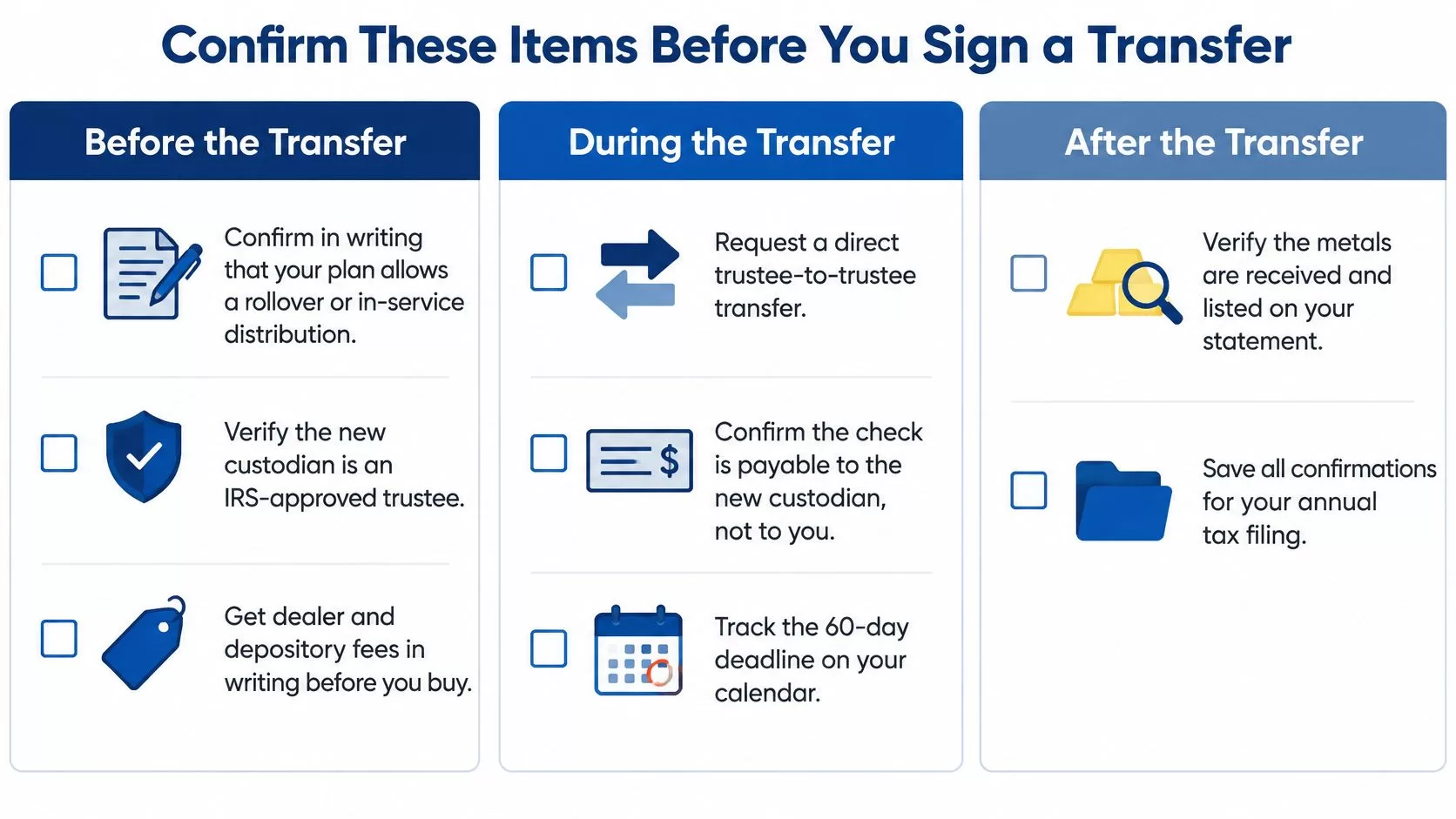
Pricing and valuation
- Dated sell-back quote: Ask the dealer to quote a sell-back price on one specific product on one specific date. The gap between the buy price and that quote is a cost nobody volunteers.
- Premium in dollars: Ask what the product costs above the melt value of its metal, stated in dollars rather than percentages.
- Statement value: Ask whether the quarterly statement shows market value, melt value, or a dealer quote, and who supplies that number.
- Price source: Ask whether the dealer quoting prices is affiliated with the custodian or works independently.
Custody and exit
- Depository in writing: Get the depository's name, the insurance limits, and whether storage is segregated or commingled.
- Sale mechanics: Ask who controls a sale inside the IRA, who sets the price, and what the timeline looks like before cash is available.
- Distribution handling: Ask how a required distribution would be met with physical metal, since a single coin cannot be split for a partial sale.
Records and review
- Proof: Keep the confirmation and the Form 5498 the custodian issues.
- Annual check: Recheck fees, storage terms, and current pricing once a year, and request a fresh sell-back quote at the same time.
- Fee type: Confirm whether each fee is a flat dollar amount or a percentage of account value, since percentage fees grow as the balance grows.
This is not financial advice. Consult a licensed financial advisor, CPA, or tax professional before making investment decisions. Compare custodians on the fee schedule and storage terms listed above.
Gold IRA Association publishes plain-language guides on rollover rules, eligible metals, storage, and the fees that show up after a gold IRA transfer. The editorial team compares custodians on cost and transparency so a near-retiree can see the questions worth asking before any form is signed. Visit Gold IRA Association to review those guides and company comparisons, then take the short list to a CPA.


