




Many investors reach the same uncomfortable moment. A dealer has explained the gold, the paperwork looks ready, and then the funding instructions direct a wire to a custodian with an unfamiliar name. That pause is justified. Understanding IRA custodian requirements before any transfer shows who legally holds the account, who touches the metal, and who still carries responsibility when a custodian accepts paperwork without endorsing the investment.
What an IRA Custodian Actually Does
That unfamiliar custodian is not a salesperson, an adviser, or a vault operator by default. It's the regulated account holder that makes the IRA exist in the first place. Under Internal Revenue Code §408(a) as summarized in IRS Publication 590-A, an IRA must be established as a trust or custodial account administered by an eligible trustee or custodian, such as a bank, a federally insured credit union, a savings and loan association, or another entity approved by the IRS.
A metals dealer can sell eligible products. A financial planner can discuss allocation. A depository can store physical bars and coins. None of those roles replaces the custodian, and none can hold IRA assets in an ordinary taxable account while preserving IRA treatment.
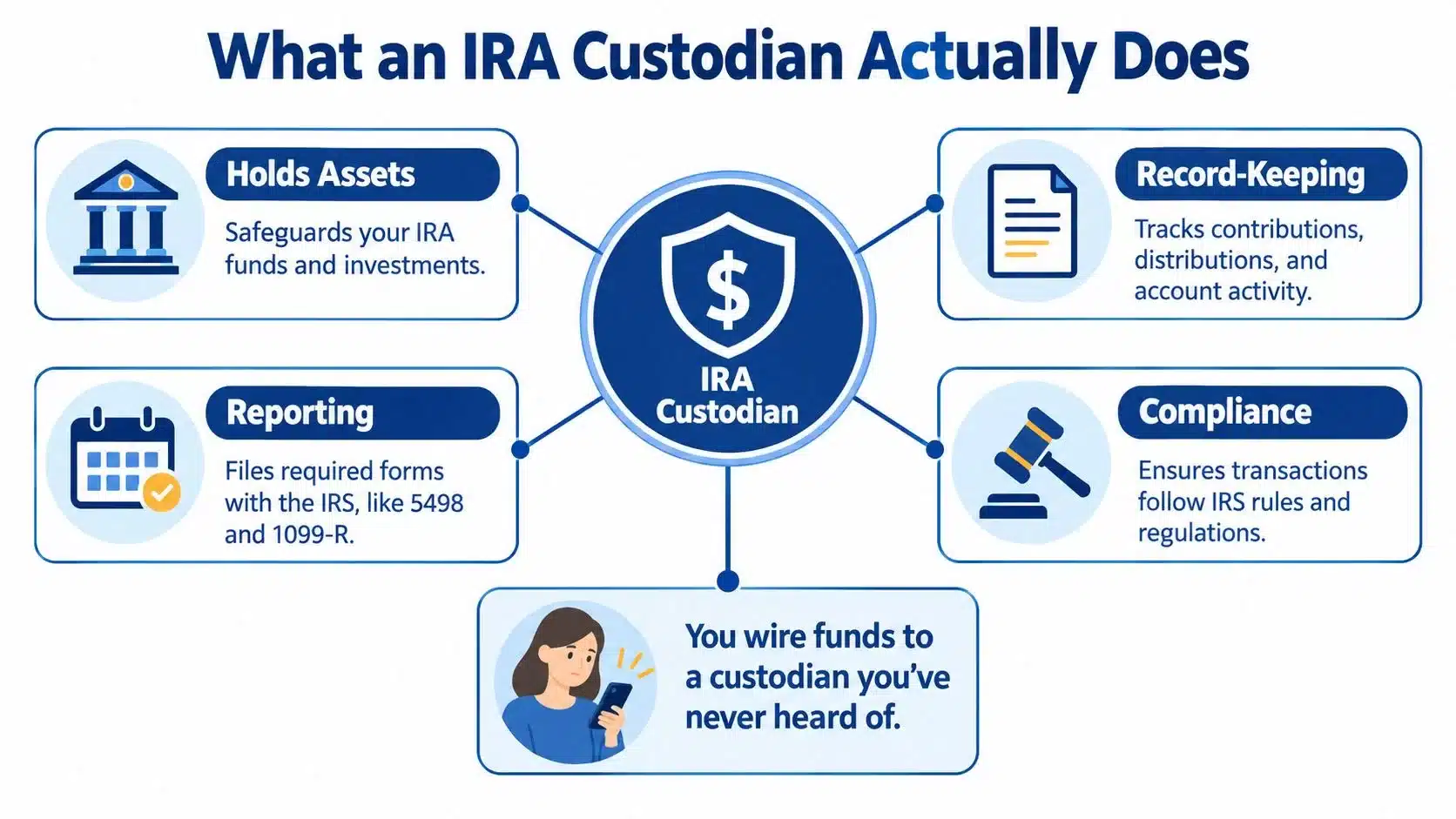

Mandatory Duties Versus Assumed Duties
The custodian's core job is administrative and structural. It establishes the account, processes contributions and rollovers, maintains required records, processes the owner's instructions, and reports transactions to the IRS. Those duties are mandatory because the account's tax status depends on them.
Other services vary by firm. Some custodians screen assets more closely, publish detailed liquidation procedures, or provide valuation support. Those services can help, but they're not the same as a legal duty to approve every economic decision inside the account.
- Account establishment: Opens the trust or custodial account before assets are purchased.
- Transaction processing: Receives rollovers, contributions, purchase instructions, and distribution requests.
- Recordkeeping and reporting: Maintains account records and sends required information to the IRS.
- Asset custody: Holds account assets directly or through its qualified custody arrangement.
Practical rule: The account must exist with a qualified custodian before IRA money buys metal. Buying first and fixing the account later isn't a compliant sequence.
The distinction matters from day one. A custodian is required to administer the IRA correctly. That doesn't mean it's required to decide whether gold fits a retirement plan, whether a dealer's price is fair, or whether a particular coin deserves a place in the account. Investors who confuse administration with recommendation start with the wrong risk model.
Eligible Custodian Categories Under IRS Rules
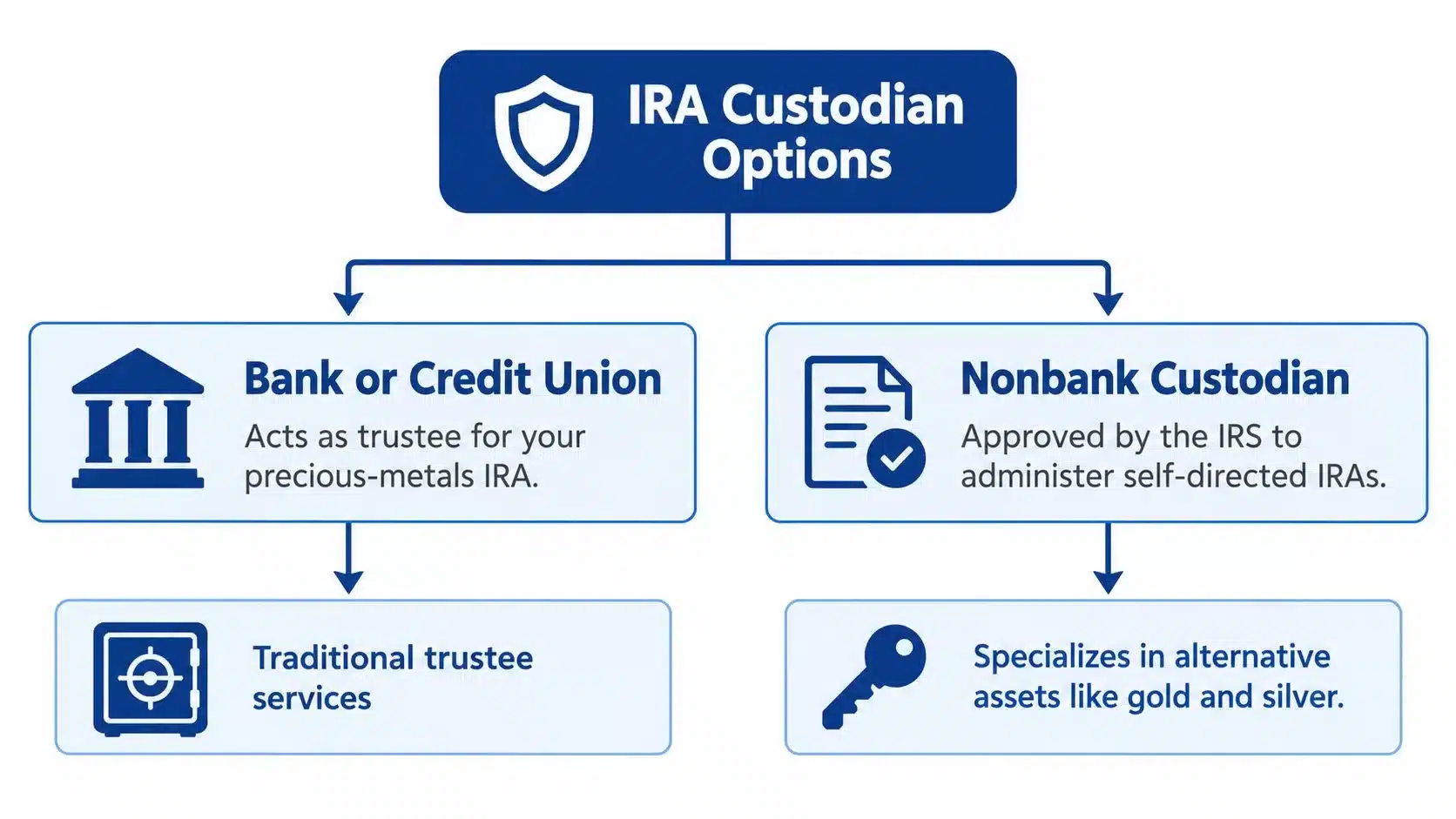
IRS eligibility falls into two practical paths. A bank, federally insured credit union, or savings and loan association can act as trustee or custodian. Alternatively, a nonbank entity can act after receiving IRS approval to administer IRAs in a manner consistent with statutory requirements.
Most Gold and Silver IRAs use the second path. Conventional banks and brokerage firms often limit IRA menus to securities and cash products. A nonbank custodian or trust company that administers self-directed IRAs is built to process alternative assets, coordinate with depositories, and record physical metal as an account holding.
The visual below separates those two eligible paths before the verification steps.
Approval to act as a custodian evaluates the institution's ability to administer accounts. It doesn't certify that every asset it accepts is prudent, fairly priced, or suitable. That's the gap investors must keep in view. IRS approved custodian describes an administrative status, not a government endorsement of a dealer or a coin.
How to Verify Status Before Funding
Investors should request the custodian's legal name, its category of eligibility, and documentation showing it's authorized to act as an IRA trustee or custodian. The custodial agreement should identify who maintains records, who reports to the IRS, and which depository will physically hold metal purchased for the account.
A disciplined documentation habit helps here. Business owners use a similar approach when they follow an SBA Express documentation checklist to confirm eligibility before submitting an application, and retirement savers should apply the same verify first discipline before wiring IRA funds anywhere.
The short video below offers additional context on separating custodian status from investment quality.

A custodian that can't explain its eligibility category, fee authority, or depository relationship in writing shouldn't receive a rollover. Clear answers don't guarantee a good investment, but vague answers are a reliable warning sign.
Custody Procedures for Physical Precious Metals
Consider the investor whose dealer offers to hold purchased coins in its own vault "until things settle." Convenient, and it can break the IRA. A dealer's inventory, a dealer's invoice, even a dealer's storage receipt all sit outside qualified custody. The compliance milestone is documented transfer into the trustee's custody arrangement, and anything short of that leaves the account exposed to distribution or disqualification treatment.
The statute is blunt about it. Under Internal Revenue Code §408(m)(3)+edition:prelim)&f=&fq=&num=0&hl=false&edition=prelim), qualifying bullion must meet the applicable fineness standard and sit in the physical possession of a trustee described in §408(a), and a 2014 IRS ruling reaffirmed the point. Fineness gets the marketing attention. Possession is where accounts fail.
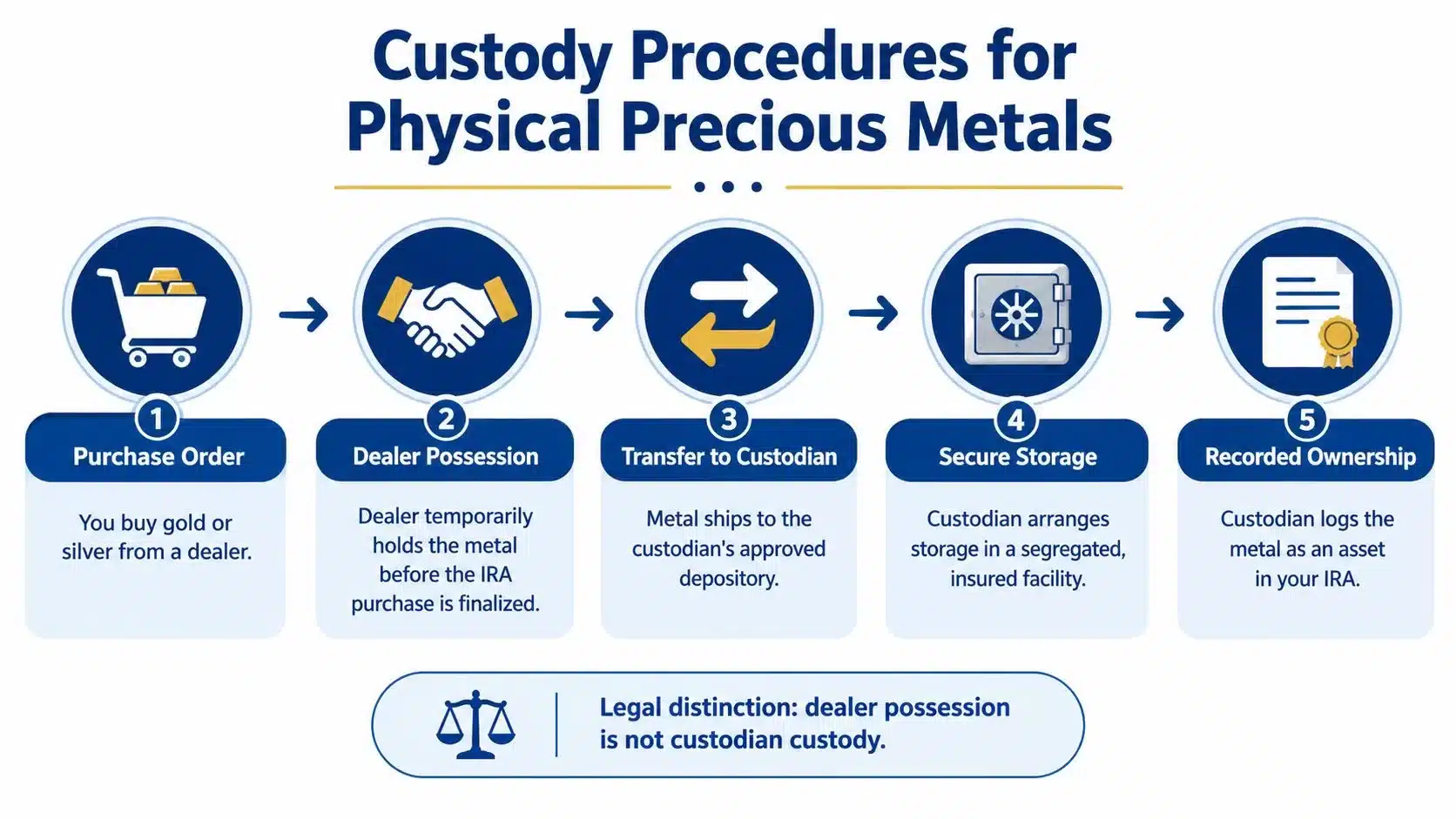
A compliant purchase runs a fixed sequence. The account owner submits written direction identifying the product, quantity, and dealer. The custodian releases IRA funds once the paperwork clears, and the dealer ships to the custodian's approved depository rather than any address the investor controls. The depository confirms receipt, the custodian books the holding to the IRA, and only then does the transaction close. Each handoff should leave a document: the purchase direction, the dealer invoice, the shipping or receipt confirmation, and the custodian statement showing the metal credited. I tell clients to file all four.
A dealer's vault receipt proves the dealer had metal. It doesn't prove the IRA trustee has custody.
Storage terms belong in the conversation before funds move, not after the dealer picks a carrier. The guide to precious metals storage arrangements for IRA accounts covers depository questions worth settling early, including how holdings are identified for the account.
Two shortcuts cause most custody failures I see. The first is personal storage: home safes and safe deposit boxes the owner controls don't satisfy the trustee-possession requirement, and neither does informal storage through a related party. The second is a dealer inside the family circle, because buying metal from a business owned by the investor or a close relative can trigger a prohibited transaction no matter where the coins end up. Clean paperwork doesn't rescue a tainted counterparty.
IRA-Eligible Metals Standards and Documentation
A dealer calls a graded proof coin "IRA approved" and the invoice says "retirement grade." Neither phrase means anything under the tax code. IRAs generally can't hold collectibles, and precious metals get in only through a narrow statutory exception. Eligibility lives in the statute, not in the marketing copy.
The IRS retirement plan investments FAQ on collectibles and Section 408(m) treats artwork, antiques, gems, certain coins, and alcoholic beverages as collectibles, with metals exempt only when they satisfy Section 408(m)(3). The custodian accepting your purchase direction has to sort eligible bullion and qualifying coins from disallowed collectibles before funds move.
| Test | Question to answer |
|---|---|
| Product eligibility | Is it a U.S. coin specifically excluded from the collectibles ban, or bullion meeting the required fineness standard? |
| Qualified custody | Will the trustee's custody arrangement physically hold it for the IRA? |
Pass one test and fail the other, and the purchase still fails. An eligible coin shipped to your home is a distribution. A perfectly stored numismatic rarity is a collectible.
On the product side, the statute carves out specific U.S. coins, including gold coins described in 31 U.S.C. §5112(a), silver coins described in §5112(e), and platinum coins described in §5112(k). Everything else, meaning gold, silver, platinum, or palladium bullion, must hit the applicable minimum fineness standard. Numismatic appeal is not an eligibility category, and graded rarities or collectible positioning deserve skepticism no matter how the dealer frames them.
Paperwork is where eligibility gets proven, and a sales description proves nothing. A defensible file ties product specifications, weight and fineness figures, and mint or refiner identification to the dealer invoice, then connects that invoice to the depository receipt showing which items landed in qualified storage for the IRA. Assay records support the fineness claim on bars, and statutory descriptions identify qualifying coins rather than dealer nicknames.
One question sorts serious custodians from order-takers: ask how the firm determines product eligibility before it funds a purchase. A vague answer means pause the transaction and get independent tax guidance.
Recordkeeping and IRS Reporting Functions
A metals purchase takes one afternoon. The paper trail behind it runs for decades. Every contribution, rollover, purchase, sale, distribution, and year-end value has to land in the custodian's records, and two forms carry that history to the IRS: Form 5498 reports contributions and rollovers, while Form 1099-R reports distributions.
Those forms create the official trail showing whether money entered the IRA properly, whether a distribution occurred, and what the account held at reporting time. Investors who want a plain-English walkthrough of contribution reporting can read Federal Benefits Sherpa's 2026 guide alongside the statements their own custodian issues.
Where the 60-Day Clock Catches Investors
A rollover generally must be completed within 60 days after the account owner receives the distribution, and an additional 10% tax may apply to an early distribution unless an exception is available, according to IRS guidance on accepting late rollover contributions. Timing failures are what turn a routine transfer into taxable income, and the sequence below is where deals usually break:
- The distributing custodian cuts the check. If it's payable to the owner personally rather than to the receiving custodian for the benefit of the IRA, the clock is already running.
- The owner redeposits the full amount. Anything short of the distributed total gets treated as a distribution on the difference.
- The receiving custodian credits the deposit. Delays in crediting are the owner's problem, not the IRS's, so confirm deposit procedures and timing before the check ever moves.
Direct trustee-to-trustee transfers sidestep this sequence entirely because funds never pass through the owner's hands.
Miss the window anyway, and relief exists but it's narrow. Under IRS Revenue Procedure 2020-46, IRA trustees, custodians, and issuers may accept a late rollover when the individual self-certifies eligibility for a waiver using the model letter or a substantially similar certification, provided the institution has no actual knowledge contradicting that certification.
A defensible file holds four things. Contribution records confirming amounts, tax-year designation, and deposit dates. Rollover records preserving distribution statements, deposit confirmations, and any self-certification letter. Transaction records covering purchase directions, invoices, depository receipts, and sale confirmations. Distribution records retaining Form 1099-R plus instructions for cash or in-kind distributions.
Valuation deserves a line in that file too. Physical metal produces no brokerage price feed inside the account, so ask how the custodian sources fair market value, how often statements refresh holdings, and how liquidation proceeds get documented. Statements should reconcile cash movements against metal holdings, and tax forms should match account history.
Discrepancies belong in a correction request, not in a tax-season surprise.
What Custodians Are Not Required to Verify
The most expensive misunderstanding in a Gold IRA is simple. Many buyers assume that if a custodian accepts the money and processes the purchase, someone independent has vetted the deal. That assumption is wrong.
According to SEC investor guidance on self-directed IRAs, self-directed IRA custodians generally hold and administer assets while conducting limited due diligence on the underlying investment. They may not evaluate the investment's quality, legitimacy, valuation, or suitability for the investor.

The Information Gap for Metals Buyers
A custodian may check whether paperwork is complete and whether an asset category can be held. That limited review doesn't necessarily confirm that a dealer's markup is reasonable, that a coin's resale market is liquid, that storage charges are competitive, or that the overall allocation fits the owner's retirement timeline.
Fees require separate scrutiny. Self-directed IRA costs can include account opening, annual, administrative, transaction, and asset specific charges, and they may be materially higher than conventional brokerage IRA fees. A complete written schedule should be obtained before funding, not reconstructed from the first statement.
Custodian acceptance is not a recommendation, a valuation opinion, or proof that a dealer acted fairly.
Investors retain responsibility for questions custodians aren't required to answer. Does the custodian independently verify metal eligibility or rely on dealer representations? Which depository holds the metal? How does liquidation work, who sets the buyback price, and how long does settlement take? Does the custodian receive compensation from dealers or other parties connected to the transaction?
Straight answers reduce risk. Evasive answers transfer it to the account owner. In a self-directed IRA, self-directed is not a marketing phrase. It's a warning label about where due diligence sits.
Prohibited Transaction Boundaries Investors Often Miss
A brother-in-law's coin dealership can look like a convenience and still be a compliance failure. Prohibited transaction analysis centers on who benefited, who controlled the counterparty, and whether the owner touched IRA property for personal reasons. A custodian can process a perfectly complete invoice while the relationship behind it violates the tax rules.
The IRS describes banned conduct in IRS Publication 590-B on prohibited transactions: borrowing from the IRA, selling property to it, using it as loan security, or buying property for personal use. Disqualified persons cover the fiduciary and close family, including a spouse, ancestors, lineal descendants, and spouses of lineal descendants.
Three fact patterns deserve a hard stop before any order is placed. A family-owned dealer raises self-dealing questions when a disqualified person owns or controls the seller, and the answer turns on ownership and control rather than the custodian's paperwork. Home storage is personal possession of IRA metal, regardless of intent to keep it safe. An owner selling personally held coins to the IRA, pledging IRA metal for a personal loan, or taking compensation from IRA-funded activity puts personal benefit ahead of the account.
Map relationships before the wire moves. The guide to self-directed IRA disqualified person and related party limits helps identify family and entity exposure early. If a prohibited transaction occurs, the account can lose IRA status as of the first day of that year, with assets treated as distributed at fair market value. That risk sits with the owner.
Pre-Transaction Compliance Checklist
No wire should leave until each item below has a named owner and a written answer. Timing questions matter too, and investors weighing whether is now a good time to move retirement funds into gold should separate market timing from compliance readiness. A good market decision can still fail on custody paperwork.
Use the documentation review checklist for custodian and storage paperwork to organize agreements, disclosures, transfer records, and confirmations in one file before signing.
- Custodian eligibility: Confirm the legal category and authorization to act as IRA trustee or custodian.
- Metal eligibility: Verify fineness or qualifying coin status independently of sales language.
- Depository identity: Name the actual facility and confirm the trustee custody arrangement and segregation policy.
- Complete fee schedule: Obtain setup, annual, transaction, storage, and liquidation charges in writing.
- Liquidation procedure: Document who buys metal back, how pricing is set, and how proceeds return to the IRA.
- Conflict review: Screen dealers, entities, and family relationships for disqualified person exposure.
- Rollover method: Prefer direct transfer where possible and calendar any indirect rollover deadline.
This is not financial advice. Consult a licensed financial advisor, CPA, or tax professional before making investment decisions.
Investors who want plain English guidance on custodian selection, eligible metals, rollover documentation, and storage questions can compare educational resources and provider reviews at Gold IRA Association before opening an account. Start with the compliance checklist, verify the custodian and depository in writing, and only then decide whether a Gold or Silver IRA fits the broader retirement plan.


