


Retirement savers often reach the same point at the same time. The stock market feels unsettled, inflation worries linger, and physical gold or silver starts to look appealing, but then the IRS rules turn a simple idea into a confusing maze. A precious metals IRA can work, but only if the account is set up and handled correctly from the start.
This guide explains the precious metal IRA rules that matter most in plain English. It covers which metals qualify, how custody works, what contribution limits apply, how distributions and RMDs are handled, and which mistakes can trigger taxes or penalties.
Your Guide to Navigating Precious Metal IRA Regulations
Many near-retirees aren’t confused about why gold or silver might belong in a retirement plan. They’re confused about the mechanics. Can the account hold coins or only bars? Can the metal stay at home? Can an old 401(k) be moved over? What happens later when distributions start?
Those are reasonable questions because a precious metals IRA doesn’t work like a standard brokerage IRA. Physical assets bring extra rules around purity, storage, and distributions.
A useful way to think about these rules is to break them into four checkpoints:
- What can the IRA own: Only certain bullion products and coins qualify.
- Where must it be held: The metals can’t sit in a home safe or personal lockbox.
- How does money get in: Funding can happen through annual contributions or a rollover from another retirement account.
- How does money come out: Distributions, taxes, and RMDs require more planning when the asset is a coin or bar instead of a mutual fund.
Practical rule: Most precious metal IRA problems come from one of two mistakes. Buying a product that isn’t IRA-eligible, or taking control of the metal personally before a proper distribution.
Readers who understand those checkpoints usually feel more confident right away. The IRS rules are strict, but they aren’t random. They exist to keep retirement accounts focused on compliant investment-grade holdings rather than collectibles or personal possession.
Which Precious Metals Are IRA-Approved
A common mistake happens before any metal is purchased. An investor sees a well-known coin, assumes recognizability means eligibility, and places it in the IRA process without checking the IRS standards first. In a precious metals IRA, familiar does not always mean permitted.
The rule is narrower than many retirees expect. The IRS separates investment-grade bullion from collectibles under IRC Section 408(m). In plain terms, the account is meant to hold specific bullion products and certain coins that meet federal standards, not just any gold or silver item with market value.
Why the IRS cares about purity
Purity is one of the first screening tests. It works like a minimum quality threshold for retirement accounts. Gold generally must meet .995 fineness, silver .999, and platinum and palladium .9995. One well-known exception often surprises people. American Gold Eagle coins are allowed even though they are 91.67% pure.
That exception is part of the statute. It does not open the door for other lower-purity coins.
If an IRA buys a metal product that falls into the prohibited collectible category, the tax consequences can be serious. The IRS can treat that purchase as a distribution rather than a proper IRA holding. For someone under age 59½, that can also mean an early withdrawal penalty.
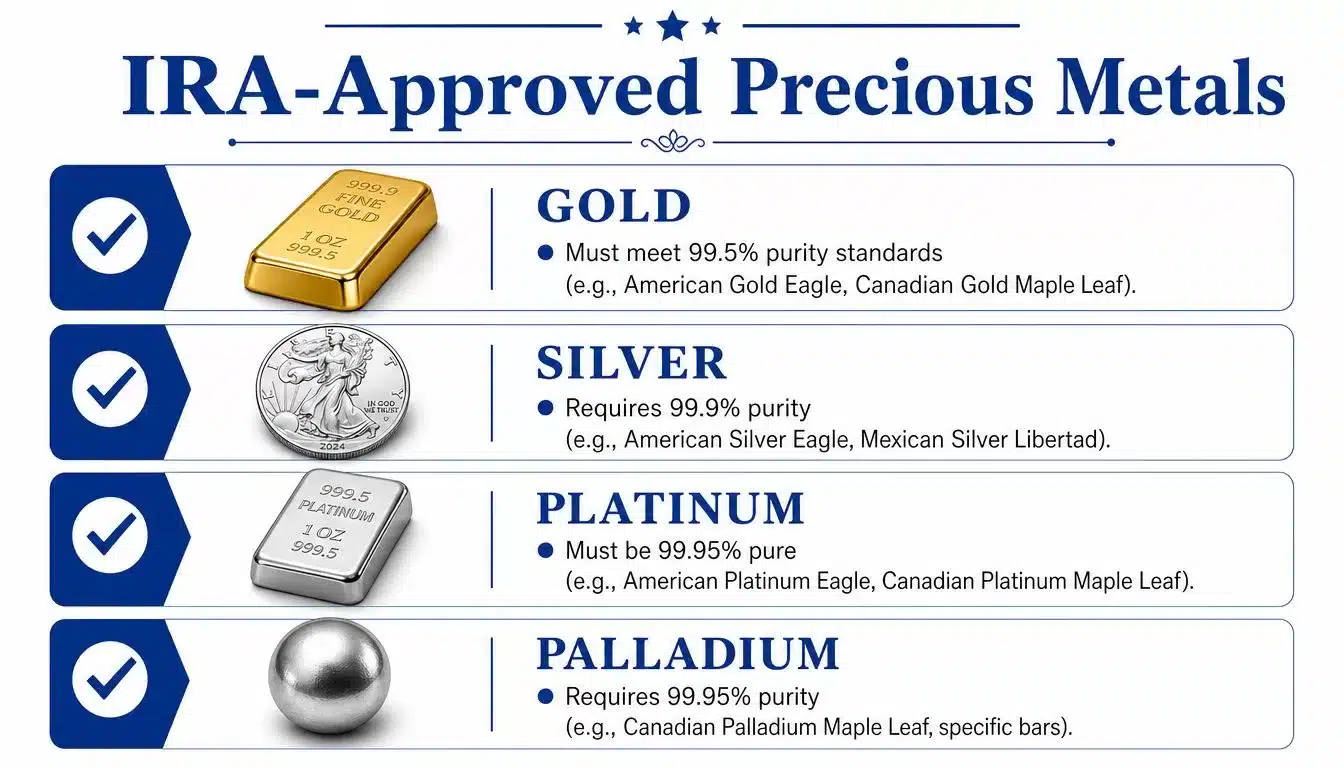
The approved metals at a glance
A practical checklist helps here. Before a purchase, confirm three things:
- The metal itself is allowed in an IRA.
- The product meets the required fineness standard, unless it falls under a specific legal exception.
- The custodian will accept that exact coin or bar.
Here is the basic fineness framework:
| Metal | Minimum standard |
|---|---|
| Gold | .995 fineness |
| Silver | .999 fineness |
| Platinum | .9995 fineness |
| Palladium | .9995 fineness |
In real account decisions, that often translates into products such as:
- Gold: American Gold Eagle coins, Canadian Gold Maple Leaf coins, and qualifying bars from approved refiners
- Silver: bullion coins and bars that meet the required silver standard
- Platinum: coins and bars that meet the .9995 standard
- Palladium: coins and bars that meet the .9995 standard
For a product-by-product reference, this guide to IRA-approved gold products can help you compare common coin and bar options before placing an order.
How investors usually go wrong
Problems usually start with coins sold for rarity, age, or collector demand. Those features may increase appeal for a personal collection, but they often create trouble inside an IRA because the tax code treats many collectibles differently from bullion.
A simple example makes the rule easier to apply. Suppose a retiree wants old European gold coins because they feel more historic than modern bullion. That may be a reasonable purchase in a taxable account. Inside an IRA, the better question is not whether the coin is attractive or widely recognized. The better question is whether the coin fits the IRS fineness and collectible rules, and whether the custodian will approve it.
That is why a compliance checklist matters more than a sales pitch. Before buying, ask for the exact product name, verify its fineness, confirm it is not being treated as a collectible, and make sure the custodian will hold it. That extra minute of screening can prevent a tax problem that is much harder to fix later.
Custody and Storage Rules You Cannot Ignore
If there is one rule that deserves extra attention, it's this one. IRA-owned precious metals cannot be stored personally. That includes a home safe, a personal vault, or direct possession by the account owner.
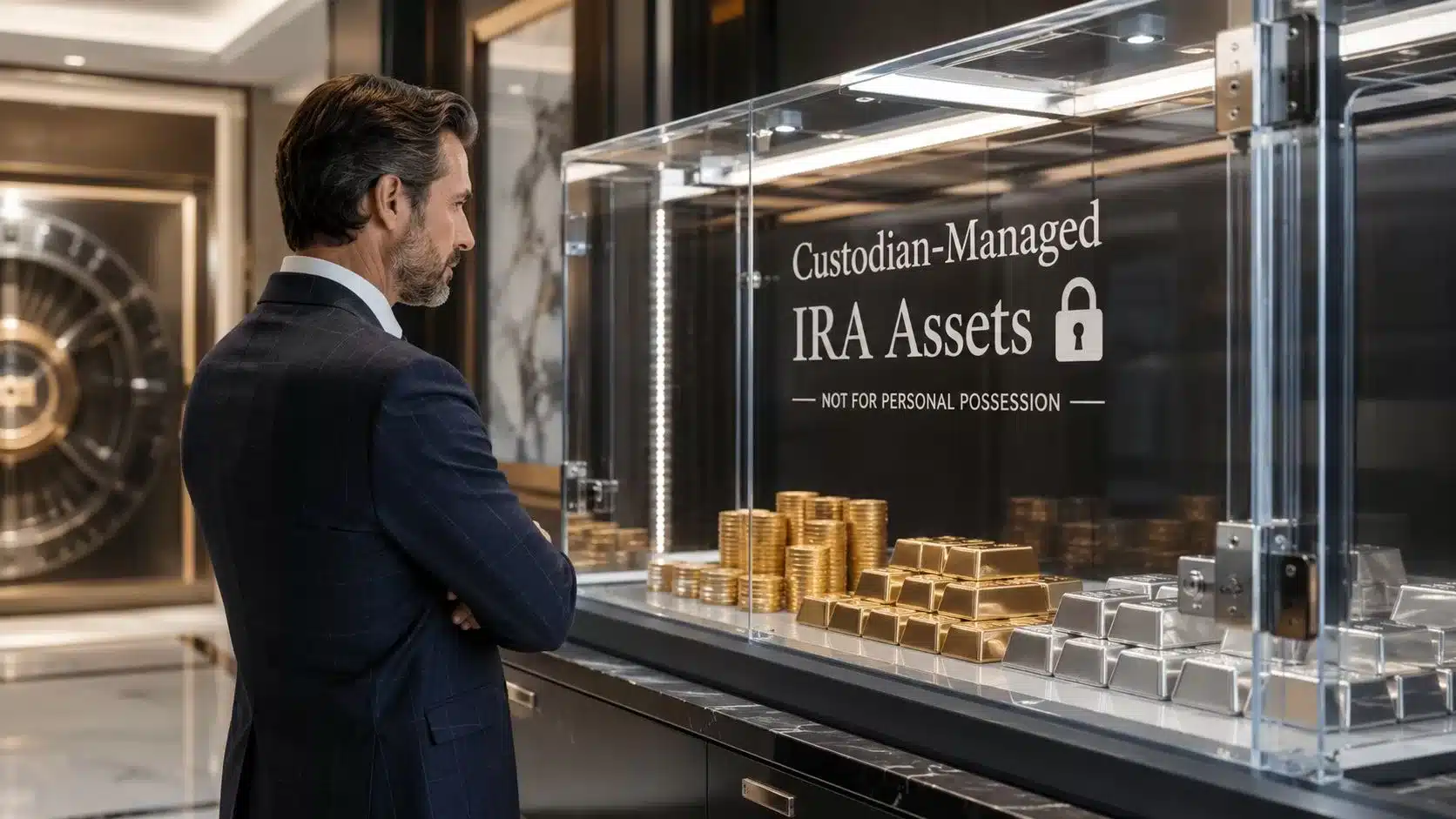
Who holds what in a precious metals IRA
A precious metals IRA relies on two separate roles.
- Custodian or trustee: This party administers the IRA, handles records, and carries out transactions for the account.
- Depository: This is the secure third-party facility where the metals are stored.
According to IRA Financial's explanation of approved precious metals storage, IRS rules require IRA-owned metals to be held by an IRS-approved, non-fiduciary third-party depository such as Brink's or Delaware Depository, under the custody of an approved trustee. That same explanation states that storing the metals at home or in a personal safe is a prohibited transaction that results in an immediate taxable distribution.
Readers who want a direct answer to the storage question can review this related guide on taking physical possession of gold in an IRA.

Why home storage creates trouble fast
The appeal of home storage is easy to understand. Many retirees want to see and control the metal they own. The problem is that an IRA isn't personal property in the ordinary sense. It is a tax-advantaged retirement account governed by strict custody rules.
That means personal possession changes the compliance picture immediately. Once the owner takes possession outside a proper distribution process, the IRS can treat the metal as distributed.
Here is the practical difference:
- Compliant setup: The IRA buys approved bullion through the custodian, and the metal is delivered to the approved depository.
- Noncompliant setup: The IRA buys approved bullion, but the owner stores it at home "for safekeeping."
Only the first arrangement preserves the IRA structure.
Home storage isn't a convenience feature. In an IRA context, it's a compliance failure.
This is why retirees should be skeptical of any marketing that suggests "easy home storage IRA" arrangements. With retirement accounts, the details matter more than the pitch.
Contribution and Rollover Rules for Your Gold IRA
A common retirement scenario goes like this: you already have savings in a 401(k) or traditional IRA, and you want part of that money in physical gold. The first question usually sounds simple. Are the funding rules different because the account holds metal?
They are not. A precious metals IRA uses the same contribution framework as other IRAs. The difference is not the annual cap. The difference is how the account is set up, funded, and administered so the purchase stays inside IRS rules.
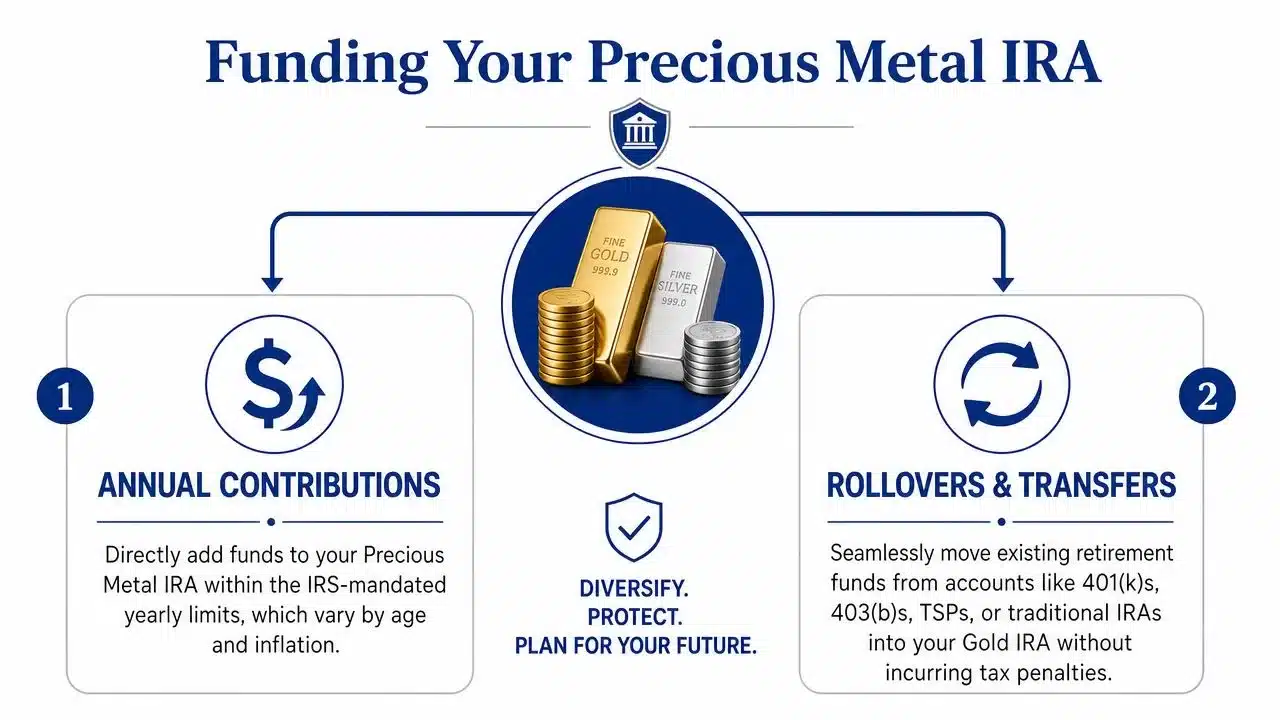
Annual contribution limits for 2026
For the 2026 tax year, annual IRA limits apply to precious metals IRAs just as they do to traditional and Roth IRAs. The IRS explains those caps in its guidance on 2026 IRA contribution limits.
The practical point is straightforward. Choosing gold, silver, platinum, or palladium does not create extra contribution room.
A quick example helps:
- Age 49: you can contribute up to the standard annual limit.
- Age 55: you may also qualify for the catch-up amount.
- Lower earned income: your contribution cannot exceed your taxable compensation for the year.
That last point trips people up. If you earn less than the annual limit, your contribution ceiling is your earned income, not the published maximum. A gold IRA works like any other IRA on that rule.
You can also review this overview of contribution rules for a plain-language explanation of how the limits apply.
How a rollover usually works
For many retirees, the larger funding decision is not the annual contribution. It is the rollover or transfer from an existing retirement account. That is often the path that moves meaningful dollars, because one year of contribution room is small compared with a long-built 401(k) balance.
The cleanest way to understand a rollover is to picture a relay race. The account, not you personally, should carry the baton from one retirement vehicle to the next.
The process usually works like this:
- Open a self-directed IRA with a custodian that can hold precious metals.
- Start a transfer or rollover request from the existing retirement account.
- Move the funds into the new IRA in cash so the account can make the purchase.
- Authorize the custodian to buy IRA-approved metals inside the account.
- Send the metals to the approved depository connected to the IRA.
Readers who want the step-by-step mechanics can review this guide on moving retirement funds into a Gold IRA.
A compliance checklist before money moves
This is the part many guides skip. The funding method matters, but the small handling details matter just as much.
Use this checklist before signing transfer paperwork or placing a metals order:
- Confirm the receiving account first. The IRA should already be open and structured to hold precious metals.
- Keep the money inside the retirement system. Direct custodian-to-custodian transfers are usually cleaner than taking possession of the funds yourself.
- Do not buy the metals personally. The IRA, through the custodian, should make the purchase.
- Check product eligibility before ordering. Not every coin or bar sold by dealers qualifies for IRA use.
- Verify the storage arrangement in advance. The depository should be part of the account setup before the metal is shipped.
- Match the transaction to your timeline. If you are close to retirement age, think ahead about future distribution and RMD logistics, especially if most of the account will be in physical bullion.
A real-world example makes the distinction clearer. Suppose Maria, age 58, wants to move part of an old 401(k) into gold. A compliant path is to open the self-directed IRA, direct the plan administrator to send funds to the new custodian, and have that custodian buy approved bullion for storage at the depository. A higher-risk path is to receive the money personally, wait, and then try to rebuild the transaction on her own. The destination may sound similar, but the compliance risk is not.
A well-run rollover keeps the account owner from acting as the buyer, holder, or temporary custodian of the assets. That separation helps preserve the IRA's tax treatment.
Understanding Distributions, Taxes, and RMDs
Getting money into a precious metals IRA is only half the story. Retirees also need to know how money comes out, because physical assets create practical issues that don't exist with a stock or bond fund.

Two ways to take money out
A traditional precious metals IRA generally follows the same basic tax treatment as a traditional IRA when distributions occur. In practice, retirees usually use one of two methods:
- Sell metals inside the IRA and withdraw cash: The custodian arranges the sale, and the retiree takes the distribution in cash.
- Take an in-kind distribution: The actual coins or bars are distributed out of the IRA to the owner.
That second option is where some readers pause. Yes, a retiree can receive the metal itself as a distribution. But once that happens, the distribution is taxable under the rules that apply to the individual's account type and circumstances.
Why RMDs are trickier with physical metals
This issue becomes more important once Required Minimum Distributions begin. As explained in this discussion of Gold IRA RMD handling, the RMD age is now 73, and it is scheduled to rise to 75 in 2033. The same explanation highlights a practical challenge unique to physical assets. An investor can't slice off part of a gold bar to satisfy an RMD and keep the rest neatly untouched.
Instead, the retiree generally has to do one of two things:
- Liquidate enough metal inside the IRA to generate the needed distribution amount, or
- Take an in-kind distribution of actual coins or bars that satisfy the required amount.
That operational detail is where many guides fall short. They mention the age rule but skip the mechanics. With physical bullion, compliance isn't just about knowing when RMDs start. It's about knowing how to execute one.
A short explainer can help frame that issue:
A practical example of an RMD decision
Consider a retiree whose IRA holds several gold coins and one larger bullion bar. The account owner reaches RMD age and needs to distribute value from the account.
Selling some coins may be easier than trying to deal with a single large bar. If the retiree prefers to keep the metals rather than liquidate them, an in-kind distribution may make more sense. But then the tax consequence arrives immediately, and the retiree also has to decide where and how to store the metal personally after distribution.
The RMD question isn't only "How much must come out?" It's also "Which asset should leave the account, and in what form?"
That is why distribution planning should start early. Physical metals are durable, but they aren't flexible in the same way as cash.
Prohibited Transactions and Costly Penalties
A common mistake starts innocently. A retiree buys approved bullion through the IRA, then wonders, "Why pay storage fees if I have a safe at home?" That single shortcut can change a tax-advantaged retirement account into a compliance problem.
Prohibited transaction rules exist to keep a clear wall between your IRA and your personal life. The IRA can own assets for your retirement. You can direct the account through the custodian. But you cannot treat those metals as property you can hold, store, borrow against, or use before a proper distribution.
Actions that can put the account at risk
The easiest way to understand these rules is to picture the IRA as a locked container with a chain of custody. Money goes in under IRA rules. Metals are purchased through the IRA. The custodian and approved depository hold them for the account. If that chain breaks, the IRS may treat the account as having stepped outside the IRA structure.
That is why product selection matters, but only as one part of the checklist. The IRS has special rules for IRA-eligible precious metals. Gold generally must meet the required fineness standard, and American Gold Eagle coins are a well-known exception that remain eligible even though their purity is lower than .995.
The larger lesson is practical. Dealer language such as "IRA friendly" is not enough by itself. The metal must be eligible, the purchase must run through the IRA, and the storage must stay with the approved custodian arrangement.
A short do-not-do list
Use this as a quick compliance check before any purchase or transfer:
- Do not store IRA metals at home. Personal possession is one of the clearest ways to trigger trouble.
- Do not buy coins mainly for rarity or collectible appeal. Many collectible products fall outside IRA rules even if they contain precious metal.
- Do not mix personal money or personal storage with IRA assets. The account should pay for, title, and hold its own property.
- Do not pledge IRA metals as collateral. An IRA is not a personal lending tool.
- Do not take direct control of the metal before a formal distribution. If the coins or bars are in your hands too early, the IRS may view that as a distribution or worse.
A real-world example helps. Suppose an IRA owner asks a dealer to ship newly purchased gold coins to the owner's house "temporarily" before forwarding them to a depository. Even if the delay is brief and no sale occurs, the problem is the break in custody. The IRA owner had possession of IRA assets.
The penalty can be severe. A prohibited transaction can cause the IRA to lose its tax-favored status as of the first day of the year in which the transaction occurred. Once that happens, the value involved may become taxable, and an early distribution penalty may also apply if the account owner is under the applicable age threshold.
That is why this section matters as more than a warning list. A useful compliance review asks three simple questions before every move: Is the metal IRA-eligible? Is the custodian handling the transaction? Will the metal stay in approved storage until a valid distribution occurs? If the answer to any one of those is no, stop and verify the transaction before proceeding.
Frequently Asked Questions About Precious Metal IRA Rules
Can one precious metals IRA hold both gold and silver
Yes. A single self-directed IRA can hold multiple approved precious metals, as long as each product meets the applicable IRS standards and is purchased and stored through the proper IRA structure. The account isn't limited to one metal type.
Can contributions be added every year
Yes, if the person remains eligible to contribute and stays within the annual IRA limits that apply for that tax year. For 2026, the contribution cap is $7,500 for those under age 50 and $8,600 for those age 50 or older, as outlined in this 2026 Gold IRA contribution summary.
What happens to a precious metals IRA after the owner dies
Like other IRAs, a precious metals IRA generally passes according to its beneficiary designation. The beneficiary typically doesn't receive "special" treatment just because the account holds metal. What changes is the practical handling. The beneficiary may need to decide whether to keep the assets within the inherited account structure, liquidate holdings, or take an in-kind distribution if permitted under the governing rules and custodial procedures.
Can someone take the actual coins or bars in retirement
Yes, through an in-kind distribution. Once distributed, the metal is no longer inside the IRA, and the tax consequences apply based on the account type and the individual's situation.
Is this financial or tax advice
No. This is educational content, not personal financial, tax, or legal advice. Investors should consult a licensed financial advisor, CPA, or tax professional before making investment decisions.
Readers who want a practical next step can explore Gold IRA Association to compare top Gold IRA companies, review rollover guides, and get clearer on which custodians and storage setups fit their retirement goals.
Prepared with the Outrank tool