



A typical precious metals IRA carries about $200 to $600 in recurring annual fees, on top of a one-time setup fee. The all-in cost depends heavily on account size, the storage choice, transaction activity, and how clearly the provider separates each charge.
A pre-retiree can roll retirement savings into a precious metals IRA expecting a straightforward way to diversify with physical gold or silver. Then the first statement arrives, and the account shows administration, storage, transaction, and other charges that weren't obvious when the metal was purchased. Understanding precious metals IRA fees before funding the account helps investors judge whether the structure fits their balance and retirement plan.
Why Precious Metals IRA Fees Catch Investors Off Guard
Consider a pre-retiree who transfers $80,000 into a precious metals IRA. The investor may focus on the gold or silver price and the dealer markup, then see a very different picture on the first statement. Administration, storage, transaction handling, and other services can each appear as separate deductions. Independent fee guides describe recurring annual costs of roughly $200 to $600, plus a one-time setup charge, though the actual schedule depends on the provider and account structure (IRA Research Hub's precious metals IRA fee guide).
The account is built from several layers. A dealer supplies the metal, a self-directed IRA custodian maintains the retirement account, and an approved depository stores the assets. Because these roles are separate, their charges may also be separate.
The tax wrapper does not erase those operating layers. Whether the account is a Traditional IRA or a Roth IRA, the custodian and depository still perform their required functions, so the account type generally does not remove administration or storage costs. IRS account rules affect how the retirement account is held and distributed, while the service providers determine how their fees are billed.
Practical rule: The metal's purchase price is only one part of ownership cost. Review the account wrapper, vault, transactions, and eventual exit separately.
A resort bill offers a useful comparison. The room rate is one charge, while parking, internet, meals, and other services appear elsewhere. Precious metals IRA fees can follow the same pattern. Account opening, custodial administration, storage, insurance, buying or selling, shipping, liquidation, and termination may all influence the final bill.
The eight fee layers to identify
A readable fee schedule should identify:
- Account opening: Initial paperwork and onboarding.
- Custodial administration: Recordkeeping, transactions, and retirement-account reporting.
- Storage: Vaulting the metals at an approved depository.
- Insurance: Coverage for stored assets, included or billed separately.
- Transactions: Charges for purchases and sales.
- Shipping: Handling and transport when metals enter or leave storage.
- Liquidation: Costs of selling holdings or converting them to cash.
- Termination: Closing, transferring, or moving the account.
The useful comparison is between billing methods, not just advertised annual fees. A flat charge can weigh more heavily on a smaller balance, while a percentage-based charge can grow with the account value. Ask for the all-in annual cost, identify one-time charges, and mark fees that occur only during transactions or distributions.
The Full Breakdown of Every Fee You May Pay
A fee schedule is easier to read when each charge is connected to the work it covers. The same account can carry costs for opening, administration, storage, transactions, shipping, and closing. Providers may also use either flat charges or percentage-based pricing, so a lower advertised annual fee does not always produce the lower total cost.
| Fee Type | What It Pays For | Typical Range |
|---|---|---|
| Account setup | Opening paperwork and custodial onboarding | $50 to $300, depending on provider |
| Custodial administration | Recordkeeping, account maintenance, and reporting | $75 to $300 annually (New York Post fee guide) |
| Depository storage | Vaulting and security for IRA-owned metals | $100 to $300 annually |
| Transaction charges | Processing purchases and sales | $25 to $75 per order |
| Asset-based storage | Storage calculated as a percentage of account value | Often 0.15% to 0.50%, with some structures around 0.5% to 1.0% |
Setup and custodial administration
A setup fee is charged when the account opens. It may cover application processing, identity verification, account registration, and the paperwork for an initial transfer or rollover. The provider may show it on the opening statement or deduct it from the starting cash balance.
The annual custodian or administration fee covers recordkeeping, account maintenance, instructions, and required retirement-account reporting. A flat charge works like a fixed service bill: it stays the same as the balance changes. A percentage-based charge moves with the account value, which can make it less expensive at a smaller balance but more expensive after the account grows.
The break-even point is the balance where the two methods cost the same. For example, a $300 flat fee equals a 0.5% asset-based fee at $60,000. Below that balance, the percentage charge is lower. Above it, the flat fee is lower, assuming no other terms change. This comparison helps explain why fee ranges alone can be misleading.
Storage, insurance, and movement of metals
Physical metals held inside an IRA must remain with an approved depository rather than at the investor's home. Storage may be commingled or segregated, and segregated arrangements generally cost more.
Insurance may be included in storage or listed separately. Ask which risks the policy covers, whether protection applies to the full account value, and whether a separate insurance charge appears on the statement.
Shipping and handling charges can arise when metals move into the depository, between facilities, or to the investor after an in-kind distribution. Transaction fees may apply whenever the custodian processes a purchase or sale. Dealer markups are separate from custodian charges, so request the purchase price and any premium over the market price in writing.
Exit costs deserve equal attention
Liquidation fees, buyback spreads, wire charges, and termination fees may remain invisible during the first year. They can still affect the final result. A provider that explains the opening cost but will not show the cost of selling or closing has not supplied a complete fee picture. Ask for one written schedule covering setup, annual administration, storage, transactions, distributions, liquidation, and termination.
How IRS Account Rules Shape Your Fee Structure
The legal wrapper affects taxes and distribution rules, but it generally doesn't transform the basic operating work required to hold physical metals. A Traditional IRA, Roth IRA, SEP IRA, or SIMPLE IRA still needs custodial administration and depository storage when it owns approved precious metals.
Readers reviewing eligibility, transfers, and storage requirements can consult the precious metal IRA rules guide. The important distinction is that tax status influences when taxes may apply, while provider pricing usually reflects administration, storage, and activity.
Contributions, rollovers, and distributions
Contribution limits apply to new contributions, not to every dollar that enters an IRA. For 2024, the contribution limit was $7,000, with a $1,000 catch-up contribution for people age 50 or older (IRS contribution limits). A rollover from a 401(k) or an existing IRA follows different mechanics and doesn't use that annual contribution limit, although the receiving account still follows its provider's fee schedule.
Required minimum distributions can affect transaction timing in a Traditional IRA. An investor may need to sell part of the holdings or arrange an in-kind distribution, and either route can create transaction, shipping, or liquidation costs. Roth IRAs generally have different distribution treatment, but the custodian and depository still perform the same operational work.
SEP and SIMPLE IRAs also carry the familiar custody and storage layers. Employer contribution paperwork or specialized administration may create additional charges, so the account owner should request a schedule designed for that account type rather than assuming the standard price applies.
A Worked Example of Total Annual Costs
A $10,000 account can make a flat annual charge feel surprisingly heavy. The same dollar fee takes a smaller share from a $50,000 or $250,000 account. The useful question is therefore not only “What is the fee?” but also “What percentage of this balance does it consume?”
The table applies the cited $450 to $800 or more combined custodian and storage estimate to three balances. It is an illustration, not a quote for a particular provider or a universal fee schedule (IRA Research Hub).
| Fee Layer | $10,000 Balance | $50,000 Balance | $250,000 Balance |
|---|---|---|---|
| Custodian and storage | $450 to $800+ | $450 to $800+ | $450 to $800+ |
| Approximate percentage drag | 4.5% to 8.0%+ | 0.9% to 1.6%+ | 0.18% to 0.32%+ |
| Dealer markup | Separate from the figures above | Separate from the figures above | Separate from the figures above |
| Transaction, wire, liquidation, and other charges | May add to the total | May add to the total | May add to the total |
The calculation is straightforward. A flat $450 annual cost uses much more of a $10,000 account than of a $250,000 account. The fee does not shrink in dollars as the balance grows, but its effect on the portfolio does.
Flat pricing versus percentage pricing
Percentage-based administration reverses the comparison at a higher balance. A 0.35% annual administration fee becomes more expensive than a $150 flat fee once the account exceeds approximately $42,857, before storage is included.
A flat fee tends to weigh more heavily on smaller accounts. A percentage fee can become the more expensive choice as the balance grows.
Calculate both structures against the expected account value. Then add storage, dealer markup, and activity-based charges. The break-even point is only the starting line. The better comparison is the complete annual cost under the investor's expected balance and transaction pattern.
Segregated Versus Commingled Storage Compared
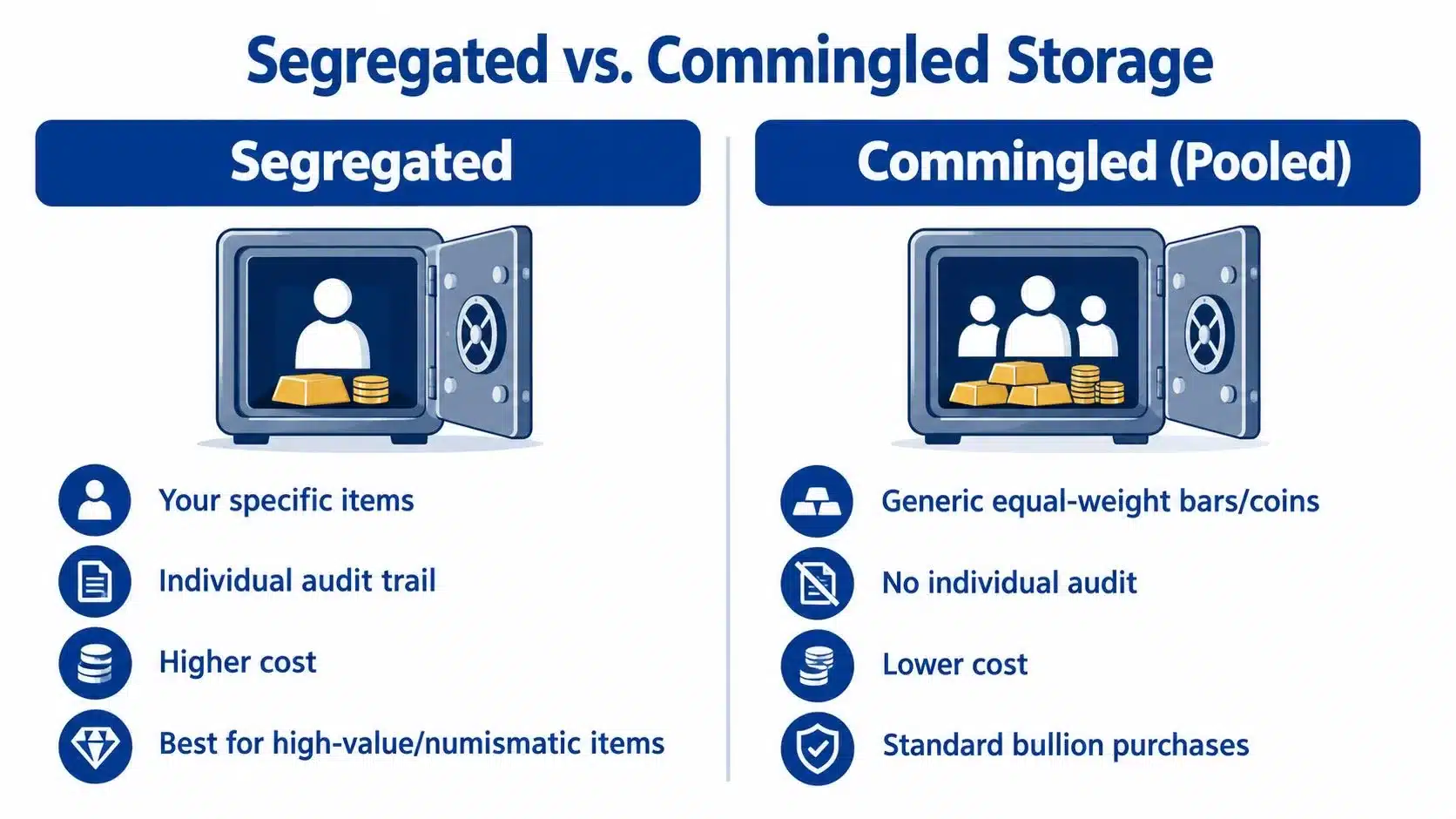
Storage choice changes how metals are handled in the vault, not whether an IRA-owned holding requires an approved depository. Commingled storage places equivalent metals with other clients' holdings, while segregated storage keeps a client's specific items separately identified. Separate identification generally costs more because it requires extra handling, inventory control, and audit work.
What the investor receives
With commingled storage, the custodian records ownership by metal type and quantity. At distribution, the investor generally receives equivalent eligible metals rather than the original bar or coin. That arrangement often fits standard bullion, where interchangeability matters more than the identity of a particular item.
Segregated storage creates a more specific audit trail. The depository records the investor's items separately, which can matter when particular bars, serial numbers, condition, or provenance affect the holding's purpose.
| Consideration | Commingled storage | Segregated storage |
|---|---|---|
| Cost | Generally lower | Generally higher |
| Tracking | Ownership recorded by type and quantity | Specific items tracked separately |
| Distribution | Equivalent eligible metals may be delivered | Identified items can be returned |
| Best fit | Common bullion | Holdings where identity matters |
Flat storage charges affect smaller balances more heavily, while percentage-based charges can become costlier as the balance grows. Compare both storage methods with the account's expected value, then include administration and transaction fees to identify the break-even point.
Both structures remain subject to the custodian and depository rules for IRA-owned metals. The practical question is whether item-level identification justifies the added charge. For an overview of vault arrangements, see this precious metals storage guide.
When Segregated Storage Is Worth the Extra Cost
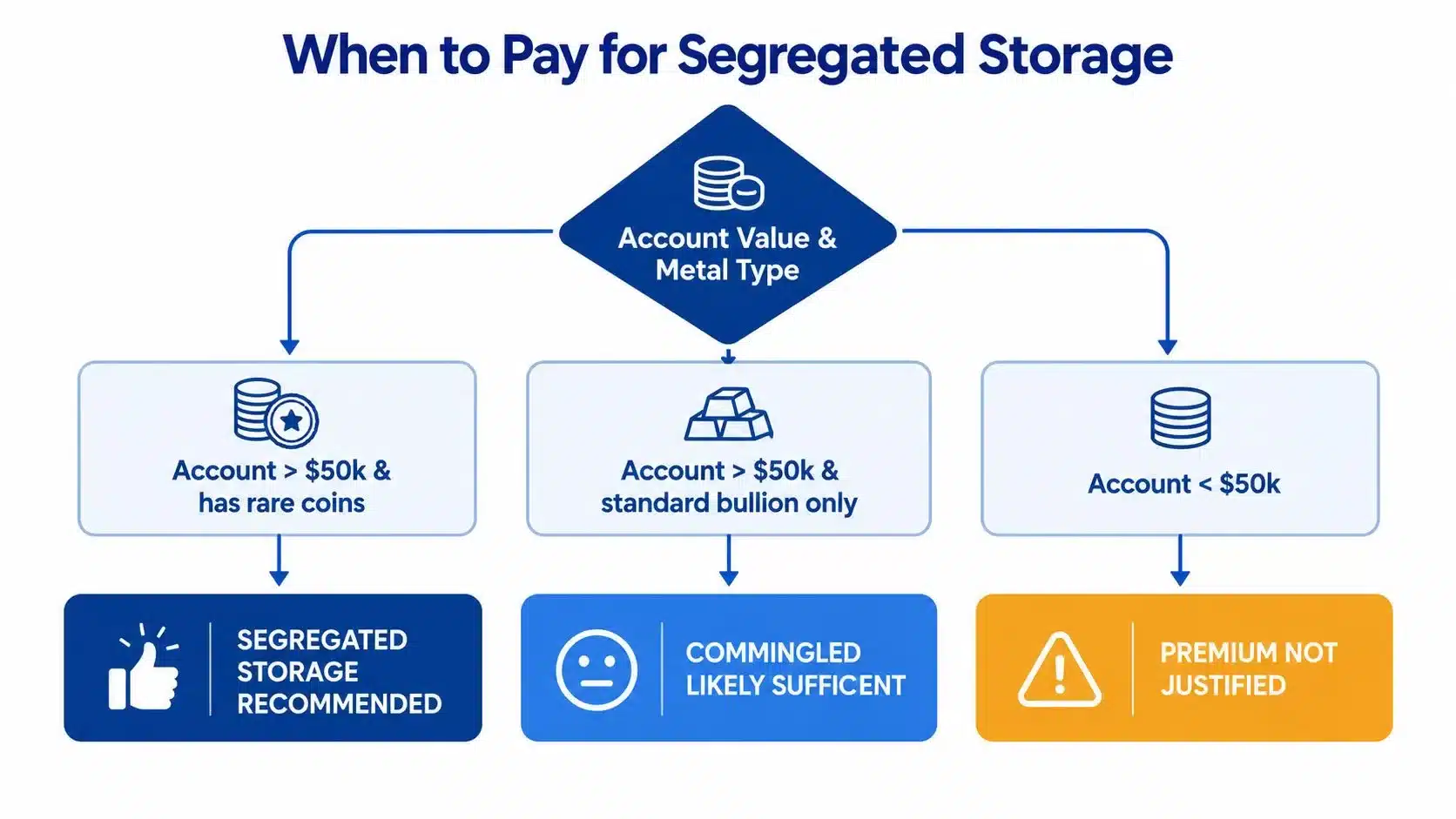
Segregated storage isn't automatically the superior choice. It solves a specific problem, namely the desire to track and receive particular items, and that benefit matters more for some holdings than others.
Situations that can justify segregation
An investor may reasonably consider segregated storage when:
- Specific identity matters: Rare or semi-numismatic holdings may be connected to provenance, serial numbers, or condition.
- The account is large: A fixed storage premium can represent a smaller share of a larger balance, although the investor should still calculate the exact percentage.
- Heirs may receive metals in kind: Separate records can make it easier to document which items belong to the account when distribution planning involves family members.
The reverse is also true. Standard bullion is generally chosen for its fungibility, so receiving an equivalent item rather than the original piece may not undermine the investment purpose.
When pooled storage may be more sensible
Commingled storage often deserves consideration for smaller accounts, common bullion, or a shorter expected holding period. Every recurring fee has more influence when the account balance is modest, and a storage premium can add cost without changing the investor's practical ability to sell or distribute equivalent metals.
Ask the provider how the segregated charge is calculated. Is it a flat account surcharge, a fee per asset class, or a charge per lot? Those methods can produce very different totals.
The decision shouldn't rely on a sales label such as “premium protection.” It should rest on the holdings, the expected distribution method, and the written annual difference between the two options.
A Checklist for Evaluating Precious Metals IRA Providers
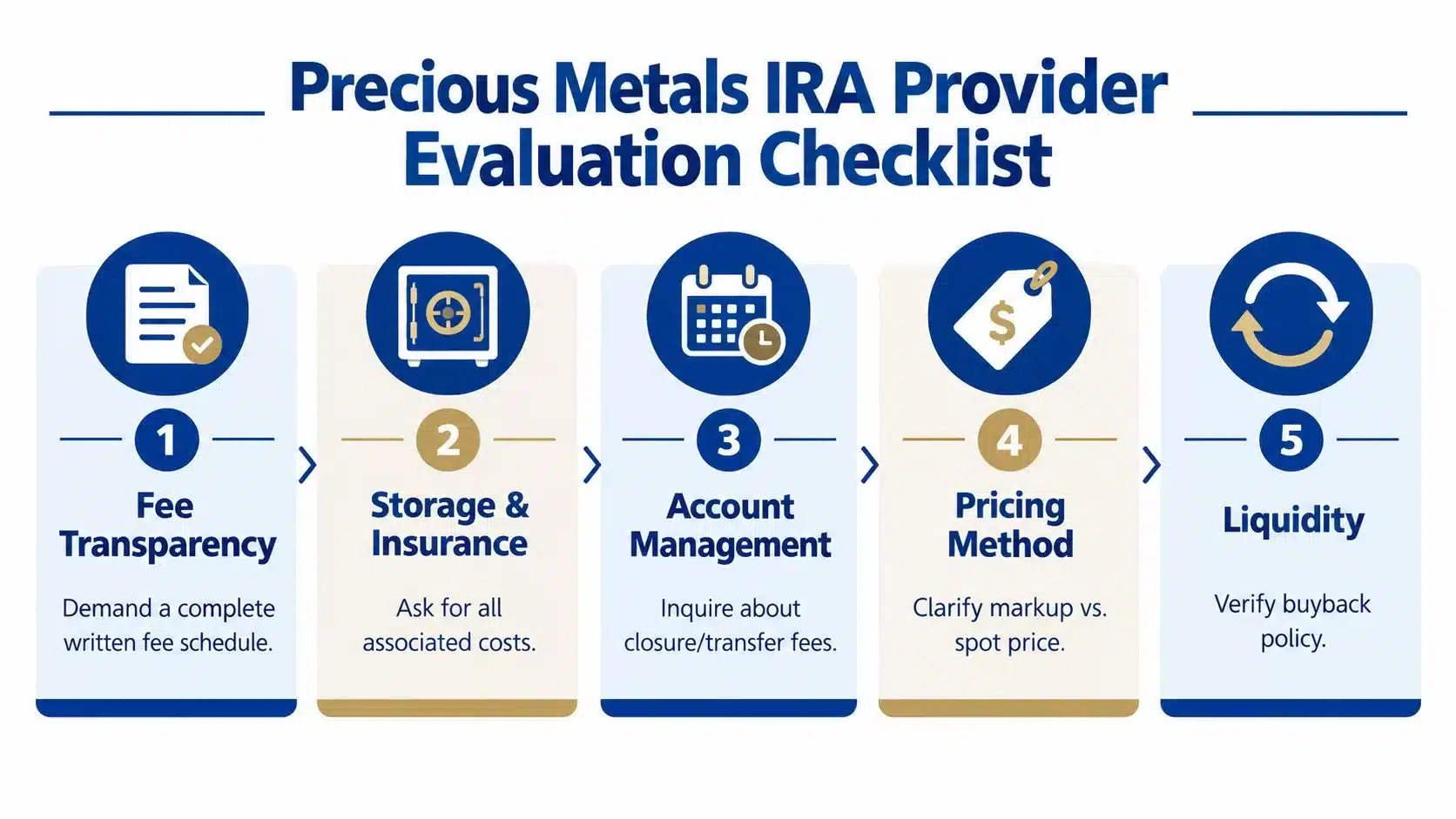
Treat provider selection as a documentation exercise, not a conversation based only on an attractive introductory fee. Before opening the account, request the complete fee schedule in writing, including charges that occur only when the investor buys, sells, transfers, or closes the account.
Use a side-by-side worksheet with the following questions:
- Setup and closure: What is the account-opening fee, and what will the investor pay to terminate, transfer, or close the account?
- Annual administration: Is the custodian fee flat, tiered, or based on asset value?
- Storage pricing: Is storage flat-rate or percentage-based? Does the price change with account value or storage type?
- Minimum balances: Does the provider waive any fee at a specified balance, and what happens if the balance later falls below that level?
- Transactions: Are purchase and sale charges billed per order, as a percentage, or through a dealer markup?
- Shipping: Who pays for incoming shipments, outgoing distributions, insurance during transit, and special handling?
- Liquidation: Is there a sell-back charge, a spread, a wire fee, or another cost when the investor needs cash?
A fee schedule should also identify the custodian and depository relationship. Investors can review the role of the IRA custodian for gold and ask which organization holds the account, which facility stores the metals, and who controls access.
Red flags in the fine print
Percentage-based storage deserves careful scrutiny, especially when the account may grow. Inactivity charges, unclear buyback commissions, and vague “market pricing” language can widen the spread without appearing as a familiar account fee.
Request a sample annual statement before funding. The statement should show administration, storage, insurance, transaction, and other charges separately. Investors should also compare actual distributions and reporting with the custodian's tax documents, including Form 1099-R where applicable, and ask a tax professional to explain any discrepancy.
Bringing It All Together on Precious Metals IRA Fees
Precious metals IRA fees become manageable once the account is viewed as three layers. The first is one-time setup, the second is recurring custody and storage, and the third consists of event-driven charges such as purchases, sales, shipping, liquidation, and closure.
The IRS determines the account framework and the conditions for holding retirement assets. Providers determine much of the operational pricing, and those prices can vary widely. Traditional and Roth status generally changes the tax treatment and distribution timing, not the basic work required to administer the account and store the metals.
The balance is the deciding variable
Flat fees can consume a larger percentage of smaller balances. Percentage-based fees can become more costly as assets increase, which is why the break-even calculation matters before an investor chooses a provider. A fee that seems competitive on a large account may be unsuitable for a smaller one, while a low flat charge may become attractive as the balance grows.
The most useful next step is practical: request two complete written fee schedules from competing providers, then calculate the expected annual cost against the intended starting balance. Include storage, administration, dealer markup, transaction activity, and the cost of a future distribution rather than comparing only the advertised account fee.
This is not financial advice. Consult a licensed financial advisor, CPA, or tax professional before making investment decisions.
Gold IRA Association provides educational guides, provider comparisons, rollover information, and fee explanations for people evaluating precious metals IRAs. Visit Gold IRA Association to compare the account structure, storage choices, and written fee schedules before moving retirement funds.